2027 Best Online Degrees for Seniors

Co-Founder and Chief Data Scientist
Choosing an online degree later in life is usually not about “starting over.” For many adults in their 50s, 60s, and beyond, it is about staying employable, preparing for a second career, finishing an unfinished credential, exploring a serious interest, or keeping the mind active through structured learning. The decision can be practical, personal, or both.
This guide explains how online degrees for seniors work, which fields may be worth considering, how costs and financial aid differ for older learners, and what questions to ask before enrolling. It is designed for older adults comparing online programs, family members helping a senior learner research options, and professionals deciding whether another credential still makes financial or career sense.
Participation in higher education remains much lower among older college students than among younger adults. Statistics show that 64.8% of American women and 60.51% of men aged 25 and older have pursued higher education, but only 1.92% of college students are between ages 50 and 64. That gap makes careful program selection especially important: senior learners need flexible, credible, affordable options that match their goals, technology comfort level, and available time.
Quick Answer: Are Online Degrees Worth It for Seniors?
Online degrees can be worthwhile for seniors when the program is accredited, affordable, flexible, and tied to a clear goal. The strongest reasons to enroll include completing a degree, qualifying for a new role, updating skills in fields such as business or technology, preparing for part-time or remote work, or pursuing lifelong learning in a structured format.
The financial case depends on the total cost, the learner’s expected working years, available tuition waivers, and whether the degree is needed for the intended role. A bachelor's degree is associated with a median annual salary of $66,000, compared with $41,800 for those whose highest credential is a high school diploma. That represents 59% higher earnings on average, but individual outcomes vary by field, location, experience, and age at graduation.
| Best fit | When an online degree makes sense | When another option may be better |
| Career changer | You need a recognized credential for business, technology, education, social services, or another structured field. | A short certification may be enough if the role only requires a specific skill. |
| Retiree seeking enrichment | You want organized study, faculty feedback, and a long-term academic goal. | Noncredit courses, audits, or community education may be cheaper if no credential is needed. |
| Working older adult | You need asynchronous classes that fit around work, caregiving, or health needs. | An on-campus or hybrid program may be better if you need frequent in-person support. |
| Degree completer | You already have credits and can transfer them toward a bachelor’s degree. | Starting from zero may require a longer ROI calculation before committing. |
What Are the Main Benefits of Online Degrees for Seniors?
- Access to career-relevant fields: Online programs can help senior learners enter or re-enter fields such as business, technology, accounting, education, social work, and digital communication. Depending on the degree, graduates may pursue roles such as financial planner, IT specialist, tutor, project coordinator, bookkeeper, or online instructor.
- Potential earnings advantage: Educational attainment is associated with higher median pay. Individuals with a bachelor's degree earn a median annual salary of $66,000, compared with $41,800 for high school graduates.
- Flexible scheduling: Many online courses use asynchronous formats, allowing students to complete readings, lectures, assignments, and discussions without commuting to campus at fixed times.
- Lower access barriers: Studying from home can help learners who face transportation, mobility, caregiving, or health-related challenges.
- Mental engagement and purpose: Structured learning can support cognitive engagement, social connection, and a renewed sense of direction, especially for retirees pursuing meaningful goals.
What Can Seniors Expect From an Online Degree Program?
Online degree programs deliver college coursework through digital platforms. Students typically access recorded lectures, readings, quizzes, assignments, discussion boards, virtual office hours, and sometimes live video sessions. The experience varies by school: some programs are highly self-paced, while others require weekly deadlines, group projects, proctored exams, or scheduled online meetings.
Senior learners should expect to use a learning management system, submit assignments electronically, communicate with instructors by email or discussion forums, and participate in online class activities. Most programs also require steady internet access and a device that can handle video, documents, and course software.
Online learning is not automatically easier than campus learning. It reduces commuting and scheduling barriers, but it demands self-direction, organization, and comfort asking for technical help. The best programs for seniors provide orientation, academic advising, accessible technology support, and clear course expectations.
Where Can Seniors Work With an Online Degree?
Senior graduates can work in many environments, especially when they combine a new credential with prior professional experience. Common options include business services, education, nonprofit organizations, healthcare administration, customer service, technology support, freelance work, consulting, and remote administrative roles.
Business roles may include bookkeeping, project coordination, virtual assistance, operations support, or consulting. Education-related paths can include tutoring, online teaching, training, curriculum support, and educational consulting. In technology, seniors may pursue help desk support, database work, cybersecurity support, systems analysis, or data-related roles depending on their training.
The right workplace depends less on age and more on credentials, skills, recent experience, flexibility needs, and whether the learner wants full-time work, part-time work, consulting, or volunteer-oriented service.
How Much Can Seniors Earn After an Online Degree?
Earnings vary widely by degree level, field, location, employer, and work schedule. On average, individuals with a bachelor's degree earn about $66,000 per year. Professionals with a master's degree typically earn around $80,200 per year. High-paying management roles, including financial or marketing manager positions, can exceed $156,580 annually.
For seniors, salary potential should be evaluated alongside time to completion, tuition, remaining working years, prior experience, and whether the degree directly improves access to a specific role. A low-cost program, transfer credits, tuition waivers, or employer support can improve the return on investment.
Affordable Quick Online Degree Programs With High Acceptance Rates
Many older learners want a program that is flexible, practical, and financially reasonable. The most useful options are usually degrees that can be completed online, accept transfer credit, prepare students for broad employment areas, and offer clear career relevance. The programs below represent common online degree fields that may fit senior learners seeking career advancement, a second career, or structured lifelong learning.
1. Business Administration
Business administration is one of the most versatile online degree choices because it covers management, finance, marketing, operations, communication, and decision-making. It can fit seniors who have prior workplace experience and want to move into consulting, administration, entrepreneurship, nonprofit leadership, or management support roles. Accelerated formats may also help learners finish more quickly while balancing other responsibilities.
2. Computer Science
Computer science focuses on programming, software development, algorithms, systems, and problem-solving. It may be a strong option for seniors who enjoy technical work and want to pursue software development, data analysis, cybersecurity, or IT-related careers. Learners should be prepared for math, coding practice, and continuous skill updates.
3. Accounting
Accounting programs teach financial reporting, taxation, auditing, compliance, and financial analysis. This degree can be practical for seniors interested in bookkeeping, tax preparation, auditing support, nonprofit finance, or small-business accounting. Many entry-level accounting and auditing roles require at least a bachelor's degree.
4. Psychology
Psychology degrees examine behavior, mental processes, development, cognition, research methods, and abnormal psychology. This path can support careers in human services, business, education, and community organizations. Seniors who want to become licensed psychologists or counselors should expect graduate study and state-specific requirements.
5. Social Work
Social work prepares students to help individuals, families, and communities address challenges such as poverty, addiction, disability, aging, and mental health concerns. Degree programs often combine classroom study with supervised field experience. Seniors considering this field should check licensure rules in their state before enrolling.
6. Counseling
Counseling programs focus on helping individuals manage emotional, behavioral, relationship, and mental health challenges. Coursework commonly includes counseling theories, ethics, human development, assessment, and supervised practice. Students pursuing licensed counseling or therapy roles should verify that the online program meets state licensure requirements.
7. Management
Management degrees emphasize leadership, organizational behavior, planning, staffing, project coordination, and resource management. This field can suit seniors who already have workplace experience and want to formalize their skills for supervisory, administrative, HR, operations, or consulting roles.
8. Management Information Systems (MIS)
MIS combines business and technology. Students learn how organizations use databases, information systems, analytics, cybersecurity principles, and IT project management to improve operations. It can be a good middle ground for seniors who want technology-oriented work without pursuing a purely computer science curriculum.
9. Special Education
Special education programs prepare educators to support students with disabilities, learning differences, and exceptional needs. Coursework may address assessment, inclusive instruction, classroom management, individualized education plans, and supervised teaching. Seniors who want to teach should confirm state certification requirements before choosing a program.
10. MBA – Marketing
An MBA in marketing develops graduate-level skills in consumer behavior, branding, analytics, campaign strategy, market research, and leadership. It may benefit seniors with business experience who want to move into consulting, marketing management, nonprofit outreach, entrepreneurship, or digital strategy roles.
- Best Online Degrees for Seniors for 2027
- How Long Does It Take to Complete an Online Degree?
- Online vs. Campus Programs for Seniors
- Average Cost of Online Degree Programs
- Financial Aid Options for Senior Students
- Admission Requirements and Prerequisites
- Common Courses in Online Degrees for Seniors
- Popular Specializations for Senior Learners
- Accreditation and Employer Recognition
- Online Degrees With Strong Earning Potential
- How Seniors Can Handle Online Learning Challenges
- Financial Aid Opportunities for Older Online Learners
- Return on Investment of an Online Degree
- Technology Requirements and Support Resources
- How to Compare Affordability and Quality
- Can Additional Certifications Improve Career Options?
- How Certifications Support Career Growth
- How to Choose the Best Online Degree for Seniors
- Career Paths for Senior Online Degree Graduates
- Job Market for Senior Graduates With Online Degrees
Best Online Degrees for Seniors for 2027
How We Rank Schools
Because an online degree can require a major investment of time and money, Research.com evaluates schools using transparent data sources and program-level considerations. Our rankings draw on reliable sources including the IPEDS database, Peterson's database, the College Scorecard database, and The National Center for Education Statistics. These sources help compare institutional quality, affordability, outcomes, and student information. You can learn more on Research.com's methodology page.
1. Clemson University
Clemson University offers online degrees and certificates that combine flexible delivery with established academic standards. For senior learners, Clemson may be especially relevant because South Carolina residents aged 60 and above can access free tuition for many programs, subject to institutional rules and program availability.
- Program Length: One year for Master of Arts in Teaching - Teacher Residency
- Tracks/concentrations: Teacher Residency
- Cost per Credit: In-state: $10,600; Out-of-state: $10,600
- Required Credits to Graduate: 30 credit hours
- Accreditation: Southern Association of Colleges and Schools Commission on Colleges
2. Georgia Institute of Technology
Georgia Tech provides online programs with a strong focus on STEM, leadership, manufacturing, and professional skill development. The school can be a good fit for seniors who want rigorous technical or management training and are comfortable with academically demanding coursework.
- Program Length: Two years for a Professional Master’s in Manufacturing Leadership
- Tracks/concentrations: Manufacturing
- Cost per Credit: $3,415 for 3 credit hours
- Required Credits to Graduate: 30 credit hours
- Accreditation: Southern Association of Colleges and Schools Commission on Colleges
3. Kentucky State University
Kentucky State University may appeal to older online students who prioritize affordability, accessibility, and a supportive public university environment. Its online business administration pathway can suit learners seeking practical business knowledge at the undergraduate level.
- Program Length: One to four years for Bachelor of Arts in Business Administration
- Tracks/concentrations: General business track
- Cost per Credit: $350 per credit
- Required Credits to Graduate: 120 credit hours
- Accreditation: Southern Association of Colleges and Schools Commission on Colleges
4. Michigan Technological University
Michigan Technological University is known for engineering, business, and technology-focused education. Its online options can work well for seniors who want a structured graduate program with a technical or STEM-centered business orientation.
- Program Length: One to two years for Master of Business Administration
- Tracks/concentrations: STEM-centric
- Cost per Credit: In-state: $21,744; Out-of-state: $21,744
- Required Credits to Graduate: 30 credit hours
- Accreditation: Higher Learning Commission
5. University of Alaska Fairbanks
University of Alaska Fairbanks offers online programs built for distance learners, including students in remote areas. Its applied business associate degree can be a practical option for seniors seeking a shorter credential with management, entrepreneurship, HR, or leadership relevance.
- Program Length: Two years for Associate of Applied Science in Applied Business
- Tracks/concentrations: Applied Management, Entrepreneurship, General Business, Human Resources, Leadership
- Cost per Credit: $289/credit (resident), $855/credit (non-resident), $434/credit (WUE)
- Required Credits to Graduate: 60 credit hours
- Accreditation: Northwest Commission on Colleges and Universities
6. University of Arkansas
The University of Arkansas offers online programs designed for adult learners who need flexibility and student support. Its communication degree can fit seniors interested in writing, media, public relations, organizational communication, or roles requiring strong interpersonal and digital communication skills.
- Program Length: Four years for Bachelor of Arts in Communication
- Tracks/concentrations: N/A
- Cost per Credit: $263.18 per credit
- Required Credits to Graduate: 120 credit hours
- Accreditation: Higher Learning Commission
7. University of Connecticut
The University of Connecticut offers online graduate-level learning options for adults who want flexibility without giving up academic quality. The Educating Bilingual Learners Online Graduate Certificate may interest seniors with education experience or those working with multilingual learners.
- Program Length: Flexible and can be completed depending on individual preferences and timelines (Educating Bilingual Learners Online Graduate Certificate)
- Tracks/concentrations: N/A
- Cost per Credit: $925 per credit
- Required Credits to Graduate: 12 credit hours
- Accreditation: New England Commission of Higher Education
8. University of Delaware
The University of Delaware provides online and distance-oriented academic options that can serve older students seeking a recognized credential with flexible study. Its Associate in Arts pathway may be useful for seniors starting college or completing general education credits.
- Program Length: Two years for Associate in Arts
- Tracks/concentrations: N/A
- Cost per Credit: In-state: $12,730; Out-of-state: $34,160
- Required Credits to Graduate: 60 credit hours
- Accreditation: Middle States Commission on Higher Education
9. University of Georgia
The University of Georgia offers online programs for students who need flexibility and strong academic preparation. Its special education program can be relevant for seniors pursuing education careers, paraprofessional advancement, or work supporting students with diverse learning needs.
- Program Length: Two years for Bachelor of Science in Education - Special Education
- Tracks/concentrations: Special Education
- Cost per Credit: $25,498
- Required Credits to Graduate: 35 credit hours
- Accreditation: Southern Association of Colleges and Schools Commission on Colleges
10. University of Rhode Island
The University of Rhode Island offers online programs for adult learners who need accessible, structured study. Its MS Dietetics Program may fit seniors with relevant academic preparation who want a graduate credential connected to nutrition and dietetics practice.
- Program Length: One year for the MS Dietetics Program
- Tracks/concentrations: Integrated experiential track
- Cost per Credit: $28,000 plus fees (tuition)
- Required Credits to Graduate: 37 credit hours
- Accreditation: New England Commission of Higher Education
How Long Does It Take to Complete Online Degrees for Seniors?
Completion time depends on the degree level, transfer credits, course load, program format, and how many terms a student enrolls each year. Some accelerated programs can be completed in as little as 16 months, while bachelor’s degrees often take longer if the student begins with few or no prior credits.
| Factor | How it affects completion time | What seniors should ask |
| Transfer credits | Previously earned credits may shorten the degree path. | How many of my old credits will count toward this program? |
| Full-time vs. part-time study | Full-time enrollment is faster but may be harder to balance with caregiving, work, or health needs. | Can I switch between full-time and part-time status? |
| Asynchronous format | Self-paced or deadline-based online courses can make scheduling easier. | Are there required live sessions? |
| Program structure | Accelerated terms may shorten the calendar but increase weekly workload. | How many hours per week should I expect per course? |
If speed is a priority, compare fast degrees online in fields such as business administration and technology, but do not choose a shorter program unless it is accredited and aligned with your goals.
How Does an Online Degree for Seniors Compare to an On-Campus Program?
Online programs are usually better for seniors who need flexibility, want to avoid commuting, or prefer to study from home. Campus programs may be better for learners who want face-to-face interaction, access to physical facilities, and more immediate social connection. Neither format is automatically superior; the better choice depends on learning style, support needs, and goals.
One important caution is completion risk. Research shows that students in fully online programs are 8.3 percentage points less likely to finish their degrees than students in blended or in-person programs. Senior learners can reduce that risk by choosing programs with strong advising, clear course design, active instructor communication, and technical support.
Employer acceptance of online learning has improved, but program credibility still matters. Choosing one of the most respected online degree options from an accredited institution can help protect the value of the credential.
| Format | Advantages for seniors | Possible drawbacks |
| Online | Flexible schedule, no commute, easier access for remote or mobility-limited learners, often suitable for part-time study. | Requires self-discipline, technology comfort, and proactive communication. |
| On campus | In-person faculty access, stronger campus community, physical labs and libraries, easier informal networking. | Commute, fixed class times, parking, mobility barriers, and less schedule control. |
| Hybrid | Combines online flexibility with some in-person interaction. | Still requires travel and may not be available for all programs. |
Graduate students are 61.9% more likely than undergraduates to earn their degrees entirely online. Online programs also tend to attract more part-time students, experienced professionals, and graduate learners than traditional in-person programs.
What Is the Average Cost of Online Degree Programs for Seniors?
Costs vary by school type, residency status, degree level, fees, and whether the learner qualifies for senior tuition benefits. Public universities offer online bachelor’s degrees at an average cost of $40,926 for in-state students and $59,011 for out-of-state students. Private colleges average $62,756 for an online bachelor’s degree.
Senior learners should calculate the total cost, not just tuition. Fees, books, technology, proctoring, graduation charges, and lost work time can change the real price. Also ask whether senior tuition waivers apply to online courses, degree-seeking enrollment, graduate programs, or only noncredit/audit courses.
What Financial Aid Options Are Available for Senior Students?
Age alone does not disqualify students from many forms of financial aid. Senior learners should compare federal aid, state programs, school discounts, scholarships, tuition waivers, and employer support before paying out of pocket.
- Federal aid: Degree-seeking students may qualify for federal financial aid by completing the FAFSA. Eligibility is based on financial need and other rules, not an upper age cutoff.
- Tuition waivers: Many public institutions offer free or reduced tuition for older adults, often beginning around ages 60 to 65, though rules vary by state and school.
- Scholarships: Some colleges, community foundations, professional groups, and lifelong learning organizations offer scholarships for adult or older students.
- Senior discounts: Some institutions reduce tuition or fees for students who meet age, residency, or income requirements.
- State programs: State-supported tuition benefits can be valuable, but eligibility may depend on residency, seat availability, audit status, or whether the course is undergraduate or graduate level.
What Are the Prerequisites for Enrolling in Online Degree Programs for Seniors?
Admission requirements depend on whether the student is applying to an associate, bachelor’s, certificate, or graduate program. Older applicants usually complete the same admission process as other students, although some schools offer adult learner pathways or nondegree options.
- Age requirements for senior benefits: Tuition waivers or senior discounts may apply to learners aged 60 to 65 or older, while some institutions use age 55 for selected programs.
- Residency rules: Public university discounts often require state residency or U.S. citizenship, depending on the benefit.
- Educational background: Degree-seeking undergraduate applicants usually need a high school diploma or equivalent. Graduate programs require prior college credentials.
- Technology readiness: Students need basic computer skills, reliable internet access, and comfort using email, video platforms, document uploads, and course portals.
- Program-specific requirements: Some fields require prerequisites, prior coursework, professional experience, background checks, field placements, or licensure-related documentation.
- Application materials: Common requirements include transcripts, an application form, personal statements, recommendation letters, and test scores when required by the school.
What Courses Are Typically Included in Online Degrees for Seniors?
Coursework depends on the major, but senior-friendly online programs often include subjects that support career flexibility, personal development, or community contribution. Popular areas include:
- Business and management: Business administration, leadership, finance, entrepreneurship, operations, marketing, and project management.
- Computer science and IT: Programming, cybersecurity, databases, systems, data analytics, and artificial intelligence.
- Social sciences and humanities: Psychology, history, sociology, communication, liberal arts, and research methods.
- Education: Teaching methods, curriculum design, educational technology, special education, and instructional leadership.
- Personal finance and financial planning: Retirement planning, budgeting, investments, taxation basics, and financial decision-making.
What Types of Specializations Are Available in Online Degrees for Seniors?
Specializations help older learners focus a broad degree on a practical career path or personal interest. The best choice depends on whether the learner wants employment, advancement, consulting, volunteering, or enrichment.
Business and Management
Common specializations include business administration, finance, entrepreneurship, retail management, project management, and organizational leadership. Seniors who want deeper financial expertise may compare an online master's in finance for advanced work in risk management, investment analysis, and financial planning.
Computer Science and Information Technology
Popular options include cybersecurity, computer science, artificial intelligence, data analytics, software development, and IT management. These specializations can help seniors update digital skills and compete for technology-enabled roles, but they require ongoing learning because tools and employer expectations change quickly.
Social Sciences and Humanities
Psychology, history, liberal arts, sociology, communication, and social work can appeal to seniors interested in analysis, writing, community engagement, advocacy, or human services. These fields can be enriching, but some clinical or licensed roles require graduate education.
Education
Teaching, curriculum development, educational leadership, bilingual education, and special education can fit seniors who want to teach, tutor, mentor, or support schools. Licensure rules vary, so students should confirm certification requirements before enrolling.
Creative Arts
Writing, music, digital media, visual arts, and design programs may support personal fulfillment, freelance work, portfolio building, or community arts involvement. Seniors choosing creative fields should review whether the program emphasizes portfolio development, feedback, and practical tools.
Are Online Degrees for Seniors Accredited and Recognized?
Accreditation is one of the most important checks before enrolling. It indicates that a college or program has been reviewed by a recognized accrediting body and meets established academic standards. Seniors should verify accreditation directly through the school and accreditor, not only through advertising materials.
Accreditation matters for employer recognition, transfer credit, federal financial aid eligibility, graduate admission, and licensure pathways. Seniors comparing faster formats should also review curriculum depth and academic standards in options such as accelerated online bachelor's programs.
Which Online Degree Programs Offer the Highest Earning Potential for Seniors?
The highest earning potential is usually tied to fields with strong demand, advanced skills, management responsibilities, or licensure requirements. Business, finance, technology, healthcare administration, data analytics, marketing management, and some graduate-level professional fields may offer stronger pay potential than general-interest degrees.
That said, seniors should not choose a degree only because it appears high-paying. A program must match prior experience, career timeline, licensing rules, and willingness to complete technical or advanced coursework. Learners considering graduate study can compare top paying master's degrees to understand which advanced credentials align with salary goals and job requirements.
How Can Seniors Overcome Common Challenges in Online Learning?
The most common challenges for senior online learners include technology frustration, isolation, unclear schedules, heavy reading loads, and difficulty maintaining momentum without a campus routine. These issues are manageable when students plan before the first course begins.
- Complete the technology orientation early: Log in, test video tools, download needed software, and practice submitting a sample assignment if the school offers a tutorial.
- Create a weekly study routine: Treat online coursework like scheduled class time, even if lectures are recorded.
- Use support services quickly: Contact IT support, tutoring, writing centers, library staff, and advisors before small problems become major obstacles.
- Build connection: Participate in discussion boards, study groups, faculty office hours, and peer forums.
- Start with a manageable course load: One or two courses may be better for seniors returning to school after a long break.
Learners who want a shorter graduate path can compare one year masters programs online, but accelerated programs require strong time management and a realistic weekly schedule.
What Financial Aid Opportunities Can Help Seniors Pursue Online Degrees?
Older learners should begin with the school’s financial aid office and then compare federal, state, institutional, and private options. Some students may qualify for federal grants, loans, work-study programs, scholarships, senior tuition waivers, or state-supported benefits. Rules vary widely, especially for nondegree study, auditing, graduate programs, and online enrollment.
Students seeking aid should confirm that the school participates in federal aid programs and that the specific online program is eligible. Research.com's guide to online schools that accept FAFSA can help learners identify institutions where federal aid may be part of the funding strategy.
What Is the Return on Investment of an Online Degree for Seniors?
ROI for senior learners should be measured differently than ROI for traditional-age students. The question is not only “Will this degree raise my salary?” but also “Will the value I receive justify the cost, time, and effort at this stage of life?”
| ROI factor | Why it matters | Question to ask before enrolling |
| Total program cost | Tuition, fees, books, technology, and travel can change affordability. | What will I pay from enrollment to graduation? |
| Transfer credits | Accepted credits can reduce time and cost. | Can I receive a written transfer credit evaluation before committing? |
| Career goal | ROI is stronger when the degree is needed for a specific role or promotion. | Does this credential qualify me for the job I want? |
| Program length | Shorter programs may allow faster benefits, but intensity matters. | Can I handle the expected weekly workload? |
| Nonfinancial value | Personal fulfillment, cognitive engagement, and purpose may be important outcomes. | Would I still value this program if it did not increase my income? |
For seniors who want an accessible route, reviewing the easiest online degrees may help identify programs with manageable coursework, but ease should never replace accreditation, quality, or career fit.
What Are the Technical Requirements and Support Resources for Seniors in Online Degree Programs?
Most online programs require a reliable computer or tablet, a stable high-speed internet connection, a webcam or microphone for some courses, email access, and the ability to use a learning management system. Some programs may also require specific software, secure testing tools, or virtual lab platforms.
Senior learners should ask whether the school offers live IT help, step-by-step tutorials, digital literacy workshops, library support, online tutoring, accessibility services, and orientation sessions. Short-format options such as fast associate degree programs online may move quickly, so early technical preparation is especially important.
How Can I Assess the Affordability and Quality of Online Degree Programs?
Affordability and quality should be evaluated together. A low-cost program is not a good value if credits do not transfer, employers do not recognize it, support is weak, or it fails to meet licensure requirements. A prestigious program may also be a poor fit if the total cost is too high for the student’s goals.
- Confirm accreditation: Check institutional and, when relevant, programmatic accreditation.
- Calculate total cost: Include tuition, fees, technology, books, and residency rules.
- Review transfer policies: Ask how prior credits, military training, work experience, or exams may apply.
- Check outcomes: Look for graduation rates, employment information, licensure pass data, and student support measures when available.
- Compare format: Determine whether classes are asynchronous, synchronous, hybrid, accelerated, or self-paced.
- Ask about senior benefits: Tuition waivers may not apply to every online course or degree program.
Cost-conscious students can compare cheap bachelor degree online options, but the final decision should balance price, flexibility, accreditation, and academic support.
Can Supplementary Certifications Boost Career Opportunities for Seniors?
Yes, certifications can strengthen a senior learner’s career profile when they validate a practical skill that employers recognize. They are especially useful in technology, project management, bookkeeping, digital marketing, healthcare administration, human resources, and data-related work.
Certifications work best when paired with a degree or prior experience. They should not be chosen randomly. Seniors should look for credentials tied to a job posting, professional association, software platform, or industry standard. Research.com’s guide to the highest paid certificate programs can help compare options that may complement an online degree.
How Can Supplemental Certifications Boost Career Growth for Online Degree Seniors?
Targeted certifications can help seniors show recent, job-ready skills without completing another full degree. They can be useful for career changers, retirees seeking part-time work, and experienced professionals who need proof of updated technical ability.
The best strategy is to choose a degree for broad credibility and a certification for a specific competency. For example, a business degree may pair well with project management, accounting software, analytics, or digital marketing credentials. Seniors can also compare the highest paying certificates to identify credentials with stronger labor-market relevance.
How to Choose the Best Online Degrees for Seniors
The best online degree for a senior learner is the one that fits the student’s goal, budget, schedule, technology comfort, and support needs. Rankings can help narrow the list, but they should not be the only decision tool.
- Define the goal: Decide whether the degree is for employment, advancement, licensure, personal enrichment, or completing unfinished education.
- Check accreditation first: Do not compare prices or course lists until accreditation is confirmed.
- Ask for a transfer credit review: Prior college credits can significantly change the cost and timeline.
- Compare senior tuition benefits: Find out whether discounts apply to online, degree-seeking, graduate, or for-credit courses.
- Review the course format: Choose asynchronous, synchronous, hybrid, accelerated, or part-time study based on your routine.
- Evaluate support services: Look for advising, tutoring, writing help, IT support, accessibility services, and career counseling.
- Calculate ROI honestly: Consider salary potential, personal value, remaining working years, and total program cost.
- Confirm licensure rules: For counseling, social work, teaching, nursing, and similar fields, verify state-specific requirements before enrolling.
According to AARP, the lifelong learning market is already valued at $5.6 billion annually. The average American learner aged 45 and older spends $75 per year, and an estimated 74.5 million individuals—approximately 55% of this age group—are engaged in lifelong learning.
Common Mistakes Seniors Should Avoid When Choosing an Online Degree
| Mistake | Why it can hurt | Better approach |
| Choosing a program without checking accreditation | Credits may not transfer, employers may question the credential, and aid eligibility may be affected. | Verify accreditation through official school and accreditor sources. |
| Looking only at tuition | Fees, books, software, and technology costs can raise the total price. | Request a full cost estimate before enrolling. |
| Assuming online means easier | Online courses often require strong writing, time management, and independent study. | Start with a realistic course load and use support services early. |
| Ignoring licensure requirements | Some online degrees may not meet state requirements for teaching, counseling, social work, or healthcare roles. | Ask the program to confirm state eligibility in writing. |
| Relying only on rankings | A highly ranked school may not be the best fit for your schedule, budget, or goal. | Use rankings as one tool, then compare accreditation, cost, support, and outcomes. |
| Assuming salary outcomes are guaranteed | Pay depends on industry, experience, location, role, and employer demand. | Research job postings and speak with career advisors before committing. |
What Career Paths Are Available for Senior Graduates of Online Degree Programs?
Senior graduates can pursue roles that combine new academic training with existing work history, communication skills, and life experience. Many choose part-time, remote, consulting, or mission-driven work rather than traditional full-time career ladders.
Technology and IT
- Network technology: Roles may involve troubleshooting, systems support, configuration, and maintenance.
- Cybersecurity and data analytics: Graduates with technical training can pursue entry-level or support roles in cybersecurity, data management, analytics, or software-related fields.
- Database management: Database administrator, systems designer, and data support roles may offer stability for learners with strong technical preparation.
Business and Finance
- Business administration: Seniors may use business training for management, entrepreneurship, consulting, nonprofit administration, or operations support.
- Accounting: Accounting graduates may work in auditing support, tax preparation, bookkeeping, payroll, or financial analysis.
Creative and Digital Fields
- Graphic design: Seniors with visual skills may work in branding, advertising, web design, or freelance creative services.
- Digital marketing: Roles in social media strategy, content creation, email marketing, and online advertising can draw on both communication skills and lived experience. A social media marketing degree online may help learners build platform, analytics, and campaign skills.
Education and Social Services
- Teaching and tutoring: Education graduates may pursue classroom roles, tutoring, training, curriculum support, or educational consulting, depending on credentials and state rules.
- Social work and advocacy: Seniors interested in community impact may pursue roles in nonprofit services, case support, advocacy, or human services. A fast-track social work degree online may appeal to learners seeking a quicker graduate route, but licensure requirements must be checked carefully.
What Is the Job Market for Senior Graduates With an Online Degree?
The job market for online degree graduates is increasingly accepting of online credentials, especially when the degree comes from an accredited institution. Recent data show that employers are becoming more comfortable treating online and in-person degrees as comparable.
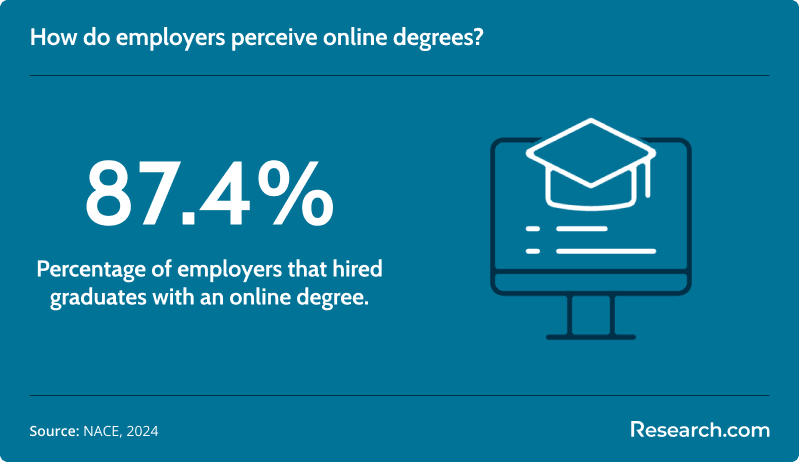
- Employer acceptance: 96% of online program graduates report a positive return on investment in terms of employment opportunities. Among employers who track degree modality, 87.4% have hired new college graduates with online degrees.
- Equal pay: 100% of employers reported paying new hires with online degrees the same as those with in-person degrees.
What Affects Job Prospects?
- Accreditation of the institution and program
- Relevance of the degree to the target role
- Prior work experience and transferable skills
- Recent technical or industry-specific skills
- Internships, projects, portfolios, fieldwork, or certifications
- Willingness to pursue remote, part-time, freelance, or flexible work arrangements
Key Insights
- Online degrees can be valuable for seniors when they are accredited, affordable, flexible, and connected to a specific career, personal, or lifelong learning goal.
- The strongest candidates for an online degree are seniors who need a credential for advancement, want to finish prior college work, plan to enter a new field, or value structured learning enough to justify the cost.
- Cost varies widely. Public online bachelor’s degrees average $40,926 for in-state students and $59,011 for out-of-state students, while private online bachelor’s degrees average $62,756.
- Senior tuition waivers and discounts can reduce costs, but rules often depend on age, residency, course availability, degree status, and whether the program is online.
- Accreditation should be checked before applying. It affects employer recognition, transfer credit, financial aid, and licensure pathways.
- Online learning offers flexibility but requires discipline. Seniors should confirm technology requirements, support services, class formats, and expected weekly workload before enrolling.
- Fields such as business administration, accounting, computer science, MIS, education, social work, counseling, marketing, and management can support practical career goals, but licensure-based fields require extra verification.
- Additional certifications can strengthen employability when they validate current, job-specific skills that complement the degree.
- ROI should include more than salary. Seniors should weigh tuition, time, transfer credits, expected working years, career outcomes, personal fulfillment, and cognitive engagement.
References
- Gray, K. (2024, January 30). Employers see online degrees as comparable to in-person degrees. National Association of Colleges and Employers. https://www.naceweb.org/talent-acquisition/candidate-selection/employers-see-online-degrees-as-comparable-to-in-person-degrees
- Hanson, M. (2024, December 21). College enrollment & student demographic statistics. EducationData.org. https://educationdata.org/college-enrollment-statistics
- Hanson, M. (2024, May 29). Average cost of online college. EducationData.org. https://educationdata.org/average-cost-of-online-college
- Kakulla, B. (2022, March 25). Lifelong learning attracts older adults for personal growth and cognitive health. AARP Research. https://www.aarp.org/pri/topics/social-leisure/activities-interests/lifelong-learning-older-adults
- National Center for Education Statistics. (2024, May). Annual earnings by educational attainment. U.S. Department of Education. https://nces.ed.gov/programs/coe/indicator/cba/annual-earnings
Other Things You Should Know About Online Degrees for Seniors
Seniors can access various financial aid options for online degrees in 2027, including federal Pell Grants, scholarships specifically for those over 50, and tuition discounts offered by specific institutions. It's crucial to check eligibility requirements for each aid type to maximize benefits.
Seniors can use the FAFSA to apply for federal Pell Grants, Direct Subsidized and Unsubsidized Loans, and Work-Study if the school participates. Eligible students must attend an accredited institution and meet federal citizenship and Satisfactory Academic Progress rules.