2027 How Much Does a Ph.D. Cost?

Co-Founder and Chief Data Scientist
A Ph.D. can open doors to research careers, university teaching, senior technical roles, policy work, and specialized leadership positions—but it can also require years of reduced earnings, competitive funding applications, and uncertain job outcomes. For many prospective doctoral students, the real question is not simply “How much does a Ph.D. cost?” but “Will this doctorate be financially and professionally worth it for my field, my goals, and my funding situation?”
This guide explains the full cost of earning a Ph.D. for 2027, including tuition, living expenses, research costs, lost income, funding options, student debt, salaries, and academic job prospects. It is designed for prospective doctoral students comparing funded and unfunded programs, online and campus options, research and professional doctorates, and alternatives such as certificates, master’s degrees, or Ed.D. programs.
Quick Answer: How Much Does a Ph.D. Cost for 2027?
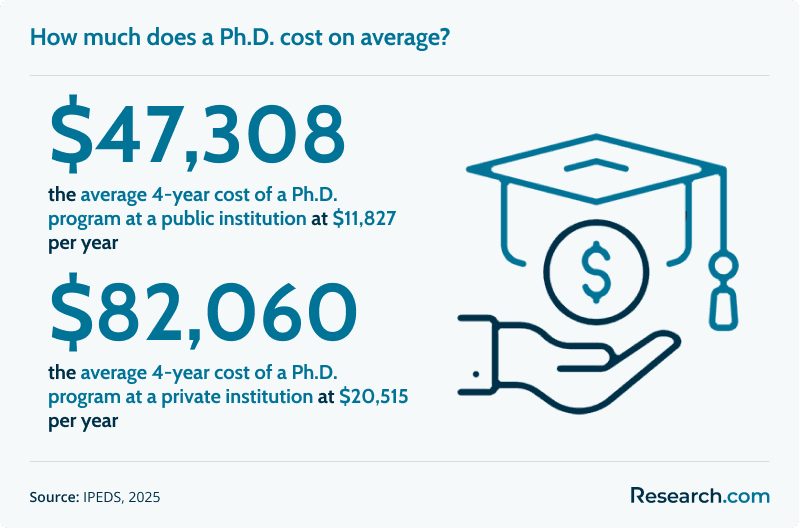
Tuition for a Ph.D. averages $11,827 per year at public institutions and $20,515 per year at private universities. Over four years, that equals $47,308 to $82,060 in tuition before adding housing, food, transportation, health insurance, research materials, conference travel, fees, and the income students may give up while studying. The actual out-of-pocket cost can be much lower for students who receive assistantships, fellowships, tuition remission, or employer support.
| Cost or outcome factor | What prospective Ph.D. students should know |
| Average annual tuition | $11,827 at public institutions and $20,515 at private universities |
| Typical completion time | Many students need five to seven years, although time varies by field and program structure |
| Common funding sources | Research assistantships, fellowships, teaching assistantships, employer support, savings, and loans |
| Debt risk | In 2022, 27% of Ph.D. recipients had education-related debt, with median graduate debt of $35,000 |
| Career uncertainty | In 2022, 66.23% of research doctorate recipients had definite postgraduate commitments |
| Salary variation | Median salary differs sharply by field and sector, from $70,000 in academia to $150,000 in computer and information sciences |
Key Things You Should Know About How Much a Ph.D. Costs for 2027
- Ph.D. tuition differs substantially by institution type. Public universities average $11,827 per year, while private universities average $20,515 per year. These figures do not include living costs, fees, research expenses, or lost earnings.
- Funding can dramatically change the real price of a doctorate, but it is not automatic. Research assistantships account for 34% of Ph.D. funding, fellowships for 24.6%, and teaching assistantships for 21.7%. Another 14.6% of students rely on personal savings or income.
- Student debt remains a concern even in funded doctoral programs. In 2022, 27% of Ph.D. graduates carried education-related debt, and the median graduate debt was $35,000.
- A Ph.D. does not guarantee a tenure-track academic job. In 2022, 6,966 Ph.D. graduates secured academic employment, while 13,288 moved into postdoctoral positions and 10,316 entered nonacademic jobs.
- Financial payoff depends heavily on discipline and career sector. Ph.D. holders in computer and information sciences reported a median salary of $150,000, while those in academia averaged $70,000. The median salary for all Ph.D. graduates with U.S. employment plans was $96,000.
- Most doctoral graduates do secure employment or further training, but not all do so immediately. In 2022, 66.23% of research doctorate recipients had definite postgraduation commitments.
- How much does a Ph.D. cost for 2027?
- What expenses should you budget for during a Ph.D. program?
- How long does it usually take to finish a Ph.D.?
- Which Ph.D. fields are most popular?
- 10 Popular and Affordable Ph.D. Degrees for 2027
- What financial aid options can help pay for a Ph.D.?
- How do most doctoral students fund their education?
- How much debt do Ph.D. graduates usually have?
- Which Ph.D. fields have the highest salaries?
- How many Ph.D. graduates get tenure-track academic jobs?
- Could a 6-month certificate program be a better investment than a Ph.D.?
- Is an online doctoral degree a practical alternative to a traditional Ph.D.?
- How does an Ed.D. compare with a Ph.D. financially and professionally?
- How can Ph.D. students improve the financial return on their degree?
- What hidden Ph.D. costs should students plan for?
- How can I judge the quality and reputation of a Ph.D. program?
- What non-financial effects should Ph.D. applicants consider?
- What job market trends affect Ph.D. graduates?
- Can undergraduate choices reduce future Ph.D. financial pressure?
- How much does location affect Ph.D. costs and outcomes?
- How can mentorship and networking improve Ph.D. ROI?
- Is getting a Ph.D. worth the cost?
- Could another advanced degree be a more cost-effective choice?
How much does a Ph.D. cost for 2027?
The sticker price of a Ph.D. depends on the institution, residency status, field of study, funding package, and time to completion. Tuition alone averages $11,827 per year at public universities and $20,515 per year at private universities. If a student finished in four years, tuition would total $47,308 at the public-institution average and $82,060 at the private-institution average.
Those figures are only a starting point. Many doctoral students spend longer than four years in their programs, and the total price can rise when students add required fees, housing, food, transportation, research supplies, health insurance, software, conference travel, and dissertation-related costs.
Institution type also matters. Non profit colleges, including public and private nonprofit institutions, are generally the standard setting for research doctorates and often provide stronger institutional funding than for-profit schools. Public nonprofit universities may be especially cost-effective for in-state students, while private nonprofit universities may charge higher tuition but offset it through assistantships, fellowships, or tuition remission.
The most important cost question is not the published tuition rate. It is the net cost after guaranteed funding, the number of funded years, stipend amount, local cost of living, and the likelihood that you can complete the degree on schedule.
| Program cost factor | Why it matters | Question to ask before enrolling |
| Tuition rate | Determines the baseline price before aid | Is tuition fully waived, partially reduced, or billed every year? |
| Funding guarantee | Can reduce or eliminate tuition and provide a stipend | How many years of funding are guaranteed in writing? |
| Time to completion | Longer programs increase living costs and opportunity cost | What is the typical completion time for students in this department? |
| Location | Housing, transportation, and daily expenses vary widely | Can the stipend realistically cover local living costs? |
| Career placement | Determines whether the degree supports the intended return | Where have recent graduates found jobs, and in what sectors? |
What are the major expenses involved in a Ph.D. program?
A Ph.D. budget should include more than tuition. Public doctoral institutions report an average education expenditure of $20,100 per full-time equivalent (FTE) student, and individual students often face several direct and indirect costs throughout the degree.
- Tuition and required fees: Tuition averages $11,827 per year at public universities and $20,515 per year at private institutions. Required fees for technology, student services, facilities, or campus programs can increase the annual bill.
- Housing, food, and transportation: Living expenses can range from $15,000 to $30,000 per year depending on the region, whether the student lives alone or with roommates, and whether the program requires campus attendance.
- Research supplies and academic materials: Students may need books, software, datasets, lab supplies, specialized equipment, transcription services, fieldwork expenses, or professional memberships. Costs can range from a few hundred dollars to several thousand dollars per year.
- Conference and travel expenses: Presenting research can support academic and industry placement, but registration, transportation, lodging, and meals can add up quickly if the department does not reimburse them.
- Health insurance and medical costs: Some programs subsidize student health coverage. Without support, students may pay $2,000 to $4,000 per year for insurance.
- Opportunity cost: A Ph.D. commonly requires four to seven years of study, and many students live on stipends instead of earning a full-time professional salary during that period.
Before accepting an offer, build a year-by-year cost estimate. Include the stipend, tuition remission, fees, taxes, summer funding, health insurance, relocation, emergency savings, and any unfunded semesters. A program that looks affordable on tuition alone may be difficult if the stipend does not match the local cost of living.
How long does it take to complete a Ph.D. program?
Most Ph.D. students should plan for a multi-year commitment rather than a short credential. Many candidates complete their doctorate in five to seven years, although timelines vary by discipline, dissertation scope, advisor availability, funding, fieldwork requirements, and whether the student enrolls full time or part time.
STEM and engineering programs may have more structured lab groups and grant-funded research timelines, while humanities and some social science programs can require longer independent research and writing periods. Students who work while enrolled may need additional time, especially if they cannot dedicate consistent hours to research.
Part time PhD programs can make doctoral study more realistic for working adults, caregivers, or professionals who cannot relocate. The trade-off is time: spreading coursework and dissertation work across a lighter schedule can extend completion to as long as ten years in some cases. The longer timeline may reduce short-term disruption but increase total living expenses and delay career returns.
| Enrollment path | Best fit | Main financial trade-off |
| Full-time funded Ph.D. | Students pursuing research, academia, or intensive lab-based training | Lower tuition burden but reduced full-time earnings during study |
| Part-time Ph.D. | Working professionals who need income continuity | More flexibility but longer time to completion |
| Online doctoral program | Professionals seeking flexibility and limited relocation costs | May reduce travel and housing disruption, but funding structures vary |
| Professional doctorate | Students seeking applied leadership roles | May have clearer professional alignment but can carry different tuition and debt patterns |
What are the most popular fields for earning a Ph.D.?
Doctoral study is available across the sciences, engineering, education, humanities, business, health-related fields, and social sciences. Recent data show that life sciences, engineering, and psychology/social sciences are among the most common Ph.D. fields, together representing nearly 60% of doctoral degrees awarded.
Popularity does not necessarily mean a field is the best choice for every student. Some disciplines have stronger grant funding, clearer industry pipelines, or higher salary potential. Others may offer deep intellectual rewards but more competitive academic placement and lower starting salaries. Applicants should compare funding availability, advisor fit, completion rates, and actual graduate outcomes before choosing a field.
Some readers compare doctoral options with the easiest degree to get, but a Ph.D. should not be selected because it appears easy. Even more accessible doctoral fields require original research, sustained writing, methodological training, and long-term motivation. A better question is: “Which field has the strongest alignment with my research interests, funding options, and career plan?”
10 Popular and Affordable Ph.D. Degrees for 2027
The following doctoral fields are often appealing to working professionals because they may offer flexible formats, interdisciplinary admissions pathways, and career applications beyond the tenure-track market. “Affordable” should still be evaluated carefully: tuition, funding, transfer policies, fees, residency requirements, and completion time can vary by institution.
1. Leadership
A Ph.D. in Leadership focuses on organizational change, decision-making, leadership theory, policy influence, and systems improvement. It may suit professionals in education, public service, nonprofit management, business, or community leadership who want to conduct research on how organizations function and change.
Institutions Offering:
- University of the Cumberlands
- North Carolina A&T State University
- Liberty University
Accessibility:
- Often accepts applicants from varied academic and professional backgrounds
- Frequently available in online or executive-style formats for working adults
- Centers on leadership research rather than requiring one narrow undergraduate major
2. Project Management
A Ph.D. in Project Management examines complex project systems, risk, budgeting, organizational execution, stakeholder coordination, and strategic delivery. It can be useful for professionals who want to research project performance, lead large initiatives, or move into consulting, operations, or academic roles.
Institutions Offering:
- University of Maryland - University College
- Bellevue University
- Northcentral University
Accessibility:
- Can attract applicants from business, engineering, technology, public administration, and related fields
- Emphasizes research and management theory rather than only technical project execution
- May be offered in online or part-time formats that support ongoing employment
3. Educational Leadership
A Ph.D. in Educational Leadership prepares students to study school systems, higher education administration, education policy, governance, and institutional improvement. It is often chosen by educators, administrators, policy professionals, and organizational leaders who want to influence education at a broader level.
Institutions Offering:
- University of Southern Maine
- University of Texas at Arlington
- University of Florida
Accessibility:
- Some programs do not require classroom teaching experience
- Focuses on leadership, policy, and institutional change within education systems
- Often includes online, hybrid, evening, or cohort-based options
4. Educational Technology
A Ph.D. in Educational Technology explores digital learning, instructional design, technology-enhanced teaching, learning analytics, and the use of tools in schools, universities, companies, and training environments. It can fit educators and professionals interested in how technology changes learning design and access.
Institutions Offering:
- National University
- University of Georgia
- University of Michigan
Accessibility:
- May not require an IT or computer science background
- Can welcome applicants from education, business, healthcare, social work, and training roles
- Frequently available through flexible online formats
5. Teaching English to Speakers of Other Languages (TESOL)
A Ph.D. in TESOL is built around second-language acquisition, applied linguistics, language pedagogy, multilingual education, and cross-cultural communication. It may appeal to teachers, language specialists, curriculum designers, international educators, and researchers studying how people learn additional languages.
Institutions Offering:
- Columbia University
- Northcentral University
- University of California, Los Angeles (UCLA)
Accessibility:
- Some programs consider applicants without formal teaching experience
- Prioritizes theory, research methods, and language-learning scholarship
- May include online or hybrid options for professionals working domestically or abroad
6. General Psychology
A Ph.D. in General Psychology usually emphasizes research on cognition, behavior, development, social processes, measurement, and psychological theory. It differs from clinical psychology programs that prepare students for supervised clinical practice and licensure.
Institutions Offering:
- Capella University
- Walden University
- Stanford University
Accessibility:
- May accept students from social science, humanities, education, or related backgrounds
- Does not necessarily require clinical training or a licensure pathway
- Often offers online or part-time coursework options, depending on the institution
7. Curriculum and Instruction
A Ph.D. in Curriculum and Instruction focuses on curriculum design, teaching methods, assessment, educational research, and learning improvement across K-12, higher education, and training environments. It is often selected by educators and instructional leaders who want to study how learning experiences are designed and evaluated.
Institutions Offering:
- Columbus State University
- University of Texas at Austin
- University of Wisconsin-Madison
Accessibility:
- Some programs do not require prior classroom teaching experience
- Emphasizes research, instructional systems, and curriculum evaluation
- May be available online or in flexible formats for working professionals
8. Business Management
A Ph.D. in Business Management develops advanced research skills in strategy, organizational behavior, operations, leadership, and decision-making. Unlike an MBA, which is commonly practice-oriented, this doctorate is typically research-focused and may prepare students for academic, consulting, executive, or analytical roles.
Institutions Offering:
- University of Southern California
- University of Pennsylvania
- University of Chicago
Accessibility:
- May not require extensive corporate management experience in every program
- Can accept applicants from multiple academic backgrounds
- Often includes flexible or online options at some universities
9. Special Education
A Ph.D. in Special Education centers on disability research, inclusive education, intervention design, policy, assessment, and systems that support learners with diverse needs. It can be a strong fit for educators, researchers, social service professionals, and advocates interested in improving educational access.
Institutions Offering:
- University of California, Los Angeles (UCLA)
- University of North Carolina at Chapel Hill
- University of Texas at Austin
Accessibility:
- May admit applicants from psychology, social work, education, sociology, or related fields
- Often focuses on research, systems improvement, and policy rather than only direct classroom instruction
- Can include online or hybrid options depending on the school
10. Educational Policy
A Ph.D. in Educational Policy prepares students to analyze education systems, evaluate policy outcomes, study governance, and contribute to reform at local, state, national, or international levels. It is often relevant for applicants with backgrounds in political science, economics, public administration, sociology, education, or law.
Institutions Offering:
- Stanford University
- Harvard University
- University of California, Berkeley
Accessibility:
- Teaching experience is not always required
- Prioritizes research, policy analysis, and education governance
- Can be suitable for applicants from diverse academic disciplines
What are the financial aid options for covering Ph.D. costs for degree-seeking students?
Most Ph.D. applicants should look for funding before committing to a program. The strongest offers often combine tuition remission with a stipend, health insurance support, and guaranteed funding for multiple years. Availability varies by discipline, department budget, research grants, applicant competitiveness, and institutional priorities.
- FAFSA and federal aid: The Free Application for Federal Student Aid (FAFSA) can help eligible graduate students access federal loans and limited federal aid options.
- Research assistantships: Students receive funding in exchange for supporting faculty research, lab work, data analysis, fieldwork, or grant-funded projects.
- Teaching assistantships: Students may lead discussion sections, grade assignments, assist professors, or teach undergraduate courses in return for stipend support and possible tuition remission.
- Fellowships and grants: These awards may come from universities, government agencies, foundations, or professional organizations and often do not require teaching or research labor.
- Employer tuition assistance: Some employers help pay for doctoral study when the degree aligns with workforce needs, especially in business, engineering, healthcare, education, or public-sector roles.
- Personal funds and loans: Savings, family support, private loans, and federal loans may fill funding gaps, but students should use debt cautiously and compare expected earnings by career path.
Applicants should ask departments to clarify whether funding is guaranteed or competitive each year, whether summer support is included, and whether students commonly need outside work to cover living costs.
Considering Ph.D. costs, how do most students fund their education?
Doctoral students usually use a combination of university funding, external awards, wages, and personal resources. Research assistantships or traineeships are the largest funding source, accounting for 34% of support. Fellowships, scholarships, and dissertation grants account for 24.6%, while teaching assistantships account for 21.7%.
Personal resources still matter. A smaller but meaningful share—14.6%—uses savings or income to help pay for doctoral study. Some students also receive employer tuition benefits, particularly when their research connects directly to their professional role.
The best funding strategy is to apply broadly and early. Strong applicants often compare multiple offers, negotiate when appropriate, and ask whether funding continues through the dissertation stage. If the program requires unpaid internships, fieldwork, or long summer research periods, those costs should be included in the decision.
Students who mainly want a fast career skill boost may not need a doctorate. The easiest online graduate certificate programs can offer targeted training in areas such as data science, healthcare administration, and business analytics with far less time and financial commitment than a Ph.D.
How much student debt do Ph.D. graduates typically have?
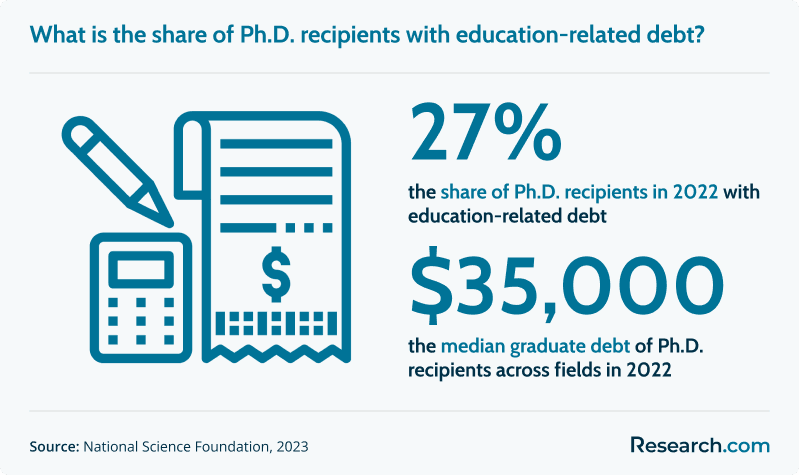
Ph.D. debt varies widely because funding differs by field, institution, and student circumstances. In 2022, 27% of Ph.D. recipients had education-related debt. Among those graduates, the median graduate debt was $35,000 across all fields.
Students in fully funded programs may finish with little or no additional doctoral debt, especially if the stipend covers living expenses. Students who attend unfunded or partially funded programs, live in high-cost cities, take longer than expected, or support family members may need loans or outside income.
Compared with professional doctorates, Ph.D. debt is often lower. Professional doctorate holders in fields such as medicine or law can face average debt of $208,310. Still, $35,000 in debt can be burdensome for graduates entering lower-paying academic, nonprofit, or postdoctoral roles.
| Debt-reduction strategy | Why it helps |
| Prioritize funded offers | Tuition remission and stipends can lower borrowing needs |
| Compare cost of living | A stronger stipend in an expensive city may go less far than a smaller stipend in a lower-cost region |
| Ask about summer funding | Unfunded summers can create hidden borrowing pressure |
| Track time-to-degree patterns | Extra years can add living costs and delay full-time earnings |
| Understand repayment options | Loan terms, interest, and repayment plans affect long-term affordability |
What are the highest-paying Ph.D. fields?
Ph.D. salaries depend on discipline, employer type, geography, experience, and whether the graduate enters academia, industry, government, consulting, or nonprofit work. Among graduates with definite postgraduation employment commitments, computer and information sciences reported a median salary of $150,000. Business followed at $134,000, multidisciplinary/interdisciplinary sciences at $130,000, mathematics and statistics at $120,000, and biological and biomedical sciences at $100,000.
The broader median salary for all Ph.D. graduates with U.S. employment plans was $96,000. Sector matters as much as field: Ph.D. graduates entering industry reported a median annual salary of $120,000, while those in academia reported a median of $70,000.
| Ph.D. field or sector | Median salary stated | Decision note |
| Computer and information sciences | $150,000 | Often has strong industry demand for advanced technical expertise |
| Business | $134,000 | May lead to academic, consulting, analytics, or leadership pathways |
| Multidisciplinary/interdisciplinary sciences | $130,000 | Can be valuable when research connects multiple high-demand skill areas |
| Mathematics and statistics | $120,000 | Relevant to analytics, quantitative research, finance, technology, and academia |
| Biological and biomedical sciences | $100,000 | May involve postdoctoral training before permanent roles |
| Academia | $70,000 | Can offer intellectual fit but may pay less than industry roles |
For professionals whose goal is mainly a higher salary rather than original research, certifications that pay well may provide a faster and less expensive route in fields such as cloud computing, cybersecurity, and project management.
How many Ph.D. graduates get tenure-track academic jobs?
The academic job market is highly competitive, and a Ph.D. should not be viewed as a guaranteed route to a tenure-track position. In 2022, 12.09% of all research doctorate recipients had confirmed postgraduate commitments in academia, representing 6,966 out of 57,596 graduates.
Many graduates take other paths. In the same year, 13,288 moved into postdoctoral positions, while 10,316 entered jobs outside academia. A postdoctoral appointment can help graduates build publications, grant experience, and research independence, but it can also delay entry into a permanent role.
Applicants who want an academic career should evaluate placement records by department, not only by university brand. Ask how many graduates in your specific field obtain tenure-track roles, postdoctoral appointments, industry research roles, teaching-intensive positions, or nonacademic jobs.
Could a 6-Month Certificate Program Be a Better Investment Than a Ph.D.?
A short certificate can be a better investment when the goal is rapid career mobility, a specific technical skill, or a promotion that does not require original research. 6-month certificate programs that pay well may help professionals build job-ready skills with lower upfront cost and much less time away from the workforce.
A certificate is not a substitute for a research doctorate if you want to become a scholar, lead original research, or qualify for roles that specifically require a Ph.D. But for professionals seeking a faster return, certificates can be more practical than spending five to seven years in doctoral training.
| Choose a Ph.D. if... | Consider a certificate if... |
| You want to conduct original research | You need a specific job skill quickly |
| Your target role requires or strongly prefers a doctorate | Your employer values applied credentials more than research training |
| You have strong funding and a clear career plan | You want to minimize debt and time away from full-time earnings |
| You are prepared for dissertation work and academic uncertainty | You are changing careers or adding a technical specialization |
Is an online doctoral degree a viable alternative to a traditional Ph.D.?
Online doctoral programs can be a viable option for students who need flexibility, cannot relocate, or want to keep working while studying. They may reduce commuting, moving, and campus housing costs. Some also use accelerated or structured formats that help working adults move through coursework more predictably.
The trade-off is that online doctoral programs vary widely in funding, research intensity, residency requirements, faculty access, and employer perception. Students should confirm accreditation, dissertation support, faculty research fit, and whether the degree type matches their career goal.
For education professionals, a doctor of education online may be a more practical option than a traditional research Ph.D. if the goal is leadership in schools, districts, higher education administration, training, or organizational change rather than a research faculty career.
How does an Ed.D. compare to a Ph.D. in terms of financial investment and career trajectory?
An Ed.D. and a Ph.D. can both be doctoral degrees, but they are built for different outcomes. A Ph.D. usually emphasizes original research, theory-building, and scholarly contribution. An Ed.D. generally focuses on applied leadership, organizational improvement, and real-world educational problem-solving.
Financially, an Ed.D. may appeal to working professionals because many programs are designed around practitioner schedules and may use streamlined or accelerated formats. A Ph.D. may offer stronger research funding in some fields, but it can also take longer and may require full-time study.
Students comparing the two should examine career goals first. If you want to become a research professor, the Ph.D. is often the stronger fit. If you want senior leadership in education, administration, policy, or applied organizational roles, options such as the cheapest online EdD may be more aligned with your expected return.
How can Ph.D. students maximize the financial return on their degree?
The financial return on a Ph.D. depends on choices made before and during the program. Students improve their odds when they choose the right funding package, finish efficiently, build transferable skills, and prepare for several career paths instead of assuming academia will be available.
- Prioritize fully funded offers: A program that covers tuition and provides a stipend can reduce or eliminate borrowing.
- Compare stipends against local expenses: A higher stipend may still be inadequate in a high-cost city, while a modest stipend may go further elsewhere.
- Use assistantships strategically: Research and teaching roles can provide income while building experience, publications, classroom skills, and professional references.
- Choose fields with realistic career demand: Computer science, business, engineering, and other high-demand areas may offer stronger industry salary outcomes.
- Build industry-ready skills: Data analysis, project management, grant writing, communication, programming, policy analysis, and leadership skills can broaden career options.
- Network before the job search: Faculty mentors, alumni, conference contacts, internship supervisors, and industry collaborators can shape opportunities long before graduation.
- Consider flexible formats carefully: The best online colleges for working adults may help students keep earning while studying, but applicants should still verify research quality and funding terms.
- Plan beyond academia: Industry, government, nonprofit, consulting, and research organization roles may provide stronger compensation or stability than tenure-track searches in some fields.
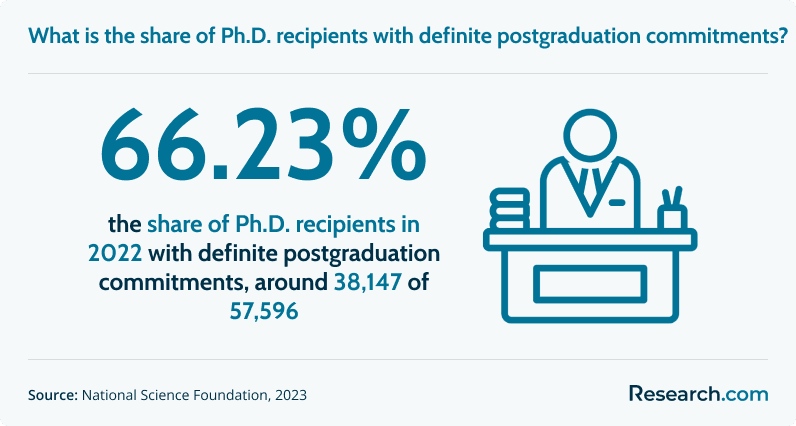
Because only 66.23% of research doctorate recipients in the US had definite postgraduate commitments in 2022, students should begin career planning early. Waiting until the dissertation is nearly finished can leave graduates with fewer options and less negotiating power.
What are the hidden costs of pursuing a Ph.D. and how can they be managed?
Hidden Ph.D. costs often appear after enrollment. These can include conference travel, publication fees, professional association dues, statistical software, specialized equipment, data access, fieldwork, relocation, childcare, dissertation editing, printing, and extra living expenses if the dissertation takes longer than expected.
Students can manage these costs by asking departments about travel funding, research allowances, emergency grants, summer stipends, health insurance subsidies, and dissertation completion fellowships. They should also ask current students whether the published funding package is enough in practice.
For some professionals, a field-specific master’s or bachelor’s degree may provide a better cost-benefit balance than doctoral study. For example, creative professionals may compare a doctorate with a best online creative writing degree if their goal is portfolio development, teaching preparation, or writing career advancement rather than research specialization.
How can I evaluate the quality and reputation of a Ph.D. program?
Do not choose a Ph.D. program based only on tuition, ranking, or university name. Doctoral outcomes depend heavily on department culture, advisor availability, funding stability, research fit, and graduate placement.
- Accreditation: Confirm that the institution is properly accredited and that any field-specific requirements are met where relevant.
- Advisor fit: Identify faculty whose research genuinely matches your intended dissertation area.
- Funding transparency: Ask for written details on tuition remission, stipend amount, required work, fees, health insurance, summer support, and funding length.
- Completion outcomes: Request data on time to degree, attrition, dissertation completion, and placement by sector.
- Research resources: Check labs, archives, datasets, fieldwork support, software, libraries, and grant opportunities.
- Mentorship culture: Speak with current students about advising quality, workload, mental health climate, and career support.
- Career placement: Review whether graduates get jobs in academia, industry, government, nonprofits, consulting, or postdoctoral roles.
Applied educators should compare doctoral programs with lower-cost graduate credentials when a doctorate is not required. For instance, the cheapest online masters in curriculum and instruction may provide a more direct route for teachers or instructional leaders who do not need a research doctorate.
What are the non-financial impacts of pursuing a Ph.D.?
The value of a Ph.D. is not only financial. Doctoral study can strengthen research ability, writing, critical thinking, independence, subject-matter authority, and professional identity. It can also provide access to mentors, scholarly communities, conferences, and intellectually meaningful work.
However, the personal costs can be significant. Students may experience stress, isolation, uncertain timelines, strained relationships, delayed homeownership or family plans, and pressure from competitive academic environments. A stipend lifestyle can also affect long-term savings and retirement contributions.
Applicants should ask whether they are motivated by the work itself, not only by the credential. If the main goal is creative development, teaching flexibility, or professional growth in writing, online writing degrees may offer a more balanced and affordable path.
What Are the Emerging Job Market Trends for Ph.D. Graduates?
Ph.D. graduates increasingly pursue careers outside traditional tenure-track academia. Interdisciplinary research, digital tools, industry partnerships, data-intensive work, consulting, entrepreneurship, and applied research roles have expanded the range of possible outcomes for doctoral graduates.
Technology and AI are also changing expectations. Employers may value doctoral graduates who can combine deep expertise with practical skills such as data analysis, programming, research communication, product strategy, evaluation, policy analysis, or technical leadership. Academic jobs remain competitive, so students benefit from preparing for multiple sectors.
Some graduates strengthen their options by adding complementary credentials or career pivots. For example, professionals evaluating education pathways may explore how fast can I become a teacher if they want to translate expertise into classroom or education-related roles.
Can Strategic Undergraduate Investments Ease Future Ph.D. Financial Challenges?
Undergraduate choices can affect future doctoral affordability. Students who minimize undergraduate debt, build strong research experience, form faculty relationships, and earn strong grades may be better positioned for competitive Ph.D. funding later.
A lower-cost bachelor’s degree can also preserve financial flexibility. For students considering doctoral study in English, writing, education, policy, or related fields, the cheapest bachelor's degree in English online may help reduce debt before graduate school. The key is to balance affordability with academic quality, research preparation, and faculty support.
Does Program Location Significantly Influence Ph.D. Costs and Financial Outcomes?
Location can change the real cost of a Ph.D. even when tuition is fully funded. Rent, transportation, food, taxes, health costs, and childcare can make one stipend comfortable and another financially stressful. Urban campuses may provide stronger access to employers, archives, labs, hospitals, policy organizations, or industry partners, but they may also come with higher living expenses.
Students should compare total cost of attendance rather than tuition alone. They should also ask whether in-state tuition rules, regional grants, assistantship pay, or local employment options affect affordability. Online alternatives may be useful when relocation is too expensive or professionally disruptive. For example, students in public affairs or policy-related fields may compare campus programs with affordable online degree programs for political science.
How Can Mentorship and Industry Networking Enhance Your Ph.D. ROI?
Mentorship and networking can strongly influence the return on a Ph.D. A supportive advisor can help students publish, apply for grants, finish the dissertation, build confidence, and connect with employers or collaborators. Poor advising, by contrast, can delay completion and increase costs.
Industry networking is equally important for students considering nonacademic careers. Internships, applied research partnerships, alumni conversations, conferences, and professional associations can help students understand employer expectations and translate academic research into marketable skills.
Some students may also pair doctoral training with adjacent credentials to broaden their options. For example, professionals interested in communication, healthcare, or education-related services may research SLP online programs as part of a broader career-planning comparison.
Is getting a Ph.D. worth the investment, considering Ph.D. cost?
A Ph.D. is worth the investment when it is required for the career you want, funded well enough to limit debt, aligned with your research interests, and likely to produce realistic career options. It is riskier when the program is unfunded, the field has limited job openings, the student’s goal does not require a doctorate, or the applicant is pursuing the degree mainly for prestige.
Doctoral degree holders earn a median of $2,109 per week and have an unemployment rate of 1.6%, but those broad figures do not guarantee individual outcomes. Salary and stability depend on field, employer, location, skills, and timing. The median graduate debt for Ph.D. recipients with debt was $35,000, while professional doctorate holders in fields such as medicine or law face average debt of $208,310.
For students committed to research, scholarly contribution, advanced technical work, or specialized leadership, a Ph.D. can be professionally meaningful and financially worthwhile. For students mainly seeking a salary increase, a shorter credential, professional certification, or specialized master’s degree may provide a faster return.
| A Ph.D. is more likely to be worth it when... | A different path may be better when... |
| The program offers strong guaranteed funding | You would need to borrow heavily for tuition and living costs |
| Your target job requires a doctorate | Your target job values skills, certifications, or experience more than a Ph.D. |
| You want to conduct original research | You mainly want a faster promotion or career switch |
| The department has strong placement in your desired sector | Graduate outcomes are unclear or mostly outside your goals |
| You are comfortable with uncertainty and long timelines | You need predictable income growth in the near term |
Could an Alternative Advanced Degree Offer a More Cost-Effective Path?
Many students should compare a Ph.D. with other advanced credentials before enrolling. A master’s degree, professional doctorate, graduate certificate, or industry certification may deliver the required skills at lower cost and with a shorter timeline.
For example, students interested in library, information, archive, or research-support careers may compare the long doctoral route with the MLIS degree online cost. The better option depends on the credential required for the role, expected salary, tuition, time to completion, and whether the student wants to produce original research.
Common Mistakes to Avoid When Estimating Ph.D. Cost
- Looking only at tuition: Fees, living costs, insurance, research travel, and lost income can matter just as much as the tuition rate.
- Assuming “funded” means fully affordable: A stipend may not cover local expenses, summer months, conference costs, or family needs.
- Ignoring time to completion: Each extra year can increase living costs and delay full-time earnings.
- Choosing by university prestige alone: Advisor fit, department placement, funding security, and research support are often more important.
- Assuming a tenure-track job is likely: Academic hiring is competitive, and many graduates enter postdoctoral or nonacademic roles.
- Borrowing without comparing salaries: Debt that feels manageable in a high-paying industry role may be difficult on a postdoctoral or academic salary.
- Overlooking alternatives: Certificates, master’s degrees, Ed.D. programs, or professional credentials may fit some goals better than a Ph.D.
Questions to Ask Before Accepting a Ph.D. Offer
- Is funding guaranteed in writing, and for how many years?
- Does the funding include tuition remission, stipend, health insurance, fees, and summer support?
- What is the average time to degree in this department?
- How many students leave before completing the program?
- Where do recent graduates work now?
- How many graduates enter academia, postdoctoral roles, industry, government, or nonprofits?
- Can the stipend cover rent, food, transportation, taxes, and health costs in this location?
- What teaching, research, or service work is required for funding?
- How often do students publish, present at conferences, or win external fellowships?
- What support exists for nonacademic career planning?
Here's What Graduates Have to Say About the Cost Of Their Ph.D. Programs
- My Ph.D. required constant financial planning. Research assistantships and a fellowship covered part of the burden, but I still picked up side work to handle living expenses. Moving into a data scientist role made the investment worthwhile for me, but budgeting and luck both played a role. Justin
- Funding was limited in my humanities program, so I had to make difficult choices. I worked part time, shared a very small apartment, and applied for every scholarship I could find. I now work in academic publishing and value the path I took, but I know the financial picture would have looked different in another field. Laura
- I wanted an academic career, but I also knew the market was tough. I chose a fully funded public university over more famous but less affordable options. That decision helped me graduate without debt and eventually secure a tenure-track role that fits my teaching and research goals. Olive
Key Insights
- A Ph.D. costs more than tuition. Public institutions average $11,827 per year and private universities average $20,515 per year, but living expenses, fees, research costs, health insurance, and lost income can substantially raise the total investment.
- Funding is the biggest affordability factor. Research assistantships account for 34.0% of funding, fellowships and scholarships for 24.6%, and teaching assistantships for 21.7%.
- Debt is not rare. In 2022, 27% of Ph.D. recipients graduated with education-related debt, and median graduate debt was $35,000.
- Career outcomes vary widely. In 2022, 66.23% of research doctorate recipients had definite postgraduate commitments, but only 12.09% had confirmed academic commitments immediately after graduation.
- Industry can offer stronger financial returns than academia in many fields. Ph.D. graduates entering industry reported a median annual salary of $120,000, compared with $70,000 for those in academia.
- Field choice matters. Computer and information sciences reported a median salary of $150,000, business $134,000, and multidisciplinary sciences $130,000.
- The best Ph.D. decision is based on net cost, funding security, time to completion, advisor fit, placement outcomes, and whether the degree is truly required for the career you want.
References
- Bureau of Labor Statistics. (2024). Education pays, 2023. Retrieved January 29, 2025, from BLS.
- Education Data Initiative. (2024). Average cost of a doctorate degree. Retrieved January 29, 2025, from EDI.
- IPEDS. (2025). Student charges: What is the average amount of tuition and required fees for full-time graduate students at private postsecondary institutions operating on an academic year calendar system? Retrieved January 29, 2025, from NCES.
- IPEDS. (2025). Student charges: What is the average amount of tuition and required fees for graduate students at public postsecondary institutions operating on an academic year calendar system? Retrieved January 29, 2025, from NCES.
- National Science Foundation. (2023). Education-related graduate debt of research doctorate recipients, by historical broad field of doctorate: 2012–22. Retrieved January 29, 2025, from NCES.
Other Things You Should Know About How Much a PhD Costs
Many Ph.D. programs still require no GRE score in 2027, but some departments set a minimum or make it optional. International applicants may also need TOEFL or IELTS scores, and universities usually list these requirements on the graduate admissions page.
In 2027, Ph.D. students can usually access various financial aid options such as fellowships, assistantships, grants, and scholarships. These often cover tuition and sometimes provide a stipend for living expenses, reducing the overall cost of pursuing a doctoral degree.
In 2027, tuition for a Ph.D. program can vary widely, typically ranging from $15,000 to over $40,000 per year at private institutions. Public universities often offer lower tuition rates, especially for in-state students, averaging between $10,000 and $25,000 annually.