2027 Accelerated Programs: How Fast Can You Get a Teaching Degree Online?

Co-Founder and Chief Data Scientist
Choosing the fastest online teaching degree is not just about finding the shortest program. You also need to know whether the degree leads to teacher licensure in your state, how much field experience is required, whether your prior credits will transfer, and whether the specialization you choose matches local hiring needs. These details matter because the US continues to face teacher staffing challenges, yet employment projections differ by grade level and subject area.
This guide is for career changers, degree completers, paraprofessionals, substitute teachers, and working adults who want a practical route into teaching without spending unnecessary time or money. You will learn how accelerated online teaching degrees work, which program types are fastest, what they cost, how licensure works, which specializations may offer steadier opportunities, and how to compare programs before enrolling.
Quick answer: How fast can you become a teacher online?
The fastest online teaching pathways can take about 12 to 18 months if you already have a bachelor’s degree or substantial transfer credits. First-time college students usually need longer, although accelerated bachelor’s programs may shorten the traditional four-year timeline to about three years. No matter how fast the coursework is, most candidates still need state-required exams, background checks, student teaching or supervised classroom experience, and approval from the state education agency before becoming licensed teachers.
Key things to know before choosing an accelerated online teaching degree
- Some online teaching programs can be completed in about one year. Students with a previous bachelor’s degree, prior college credits, or a qualifying non-education background may be able to finish teacher preparation in 12 to 18 months.
- Costs vary dramatically. Programs in this guide range from $12,240 to $97,902 in total tuition, so comparing total program cost is more useful than looking only at advertised cost per credit.
- Licensure rules are state-specific. Online programs may be flexible, but teacher certification is controlled by state education agencies. Confirm that the program meets the requirements for the state where you plan to teach.
- High demand does not mean every teaching role is growing. Although 86% of public schools struggle to hire teachers, employment for kindergarten, elementary, middle, and high school teachers is projected to decline by 1% from 2023 to 2033.
- Specialization matters. Special education and career and technical education (CTE) roles have a 0% job growth projection, indicating stable employment rather than expansion. In 2023, special education teachers had a median annual salary of $65,910.
- How fast can you get a teaching degree online in 2026?
- How do accelerated online teaching degrees work?
- Who should consider an accelerated online teaching program?
- What types of accelerated online teaching programs are available?
- Which online teaching specializations can you choose?
- What are the admission requirements for accelerated online teaching programs?
- What are some of the fastest online teaching programs?
- How much do accelerated online teaching degrees cost?
- How do you check accreditation and program quality?
- What career support should online teaching programs provide?
- What state certification issues should you check before enrolling?
- What are your options after completing an accelerated teaching degree?
- Should you earn an advanced degree after becoming a teacher?
- What support services help students succeed in accelerated programs?
- How are online teaching programs using technology and modern teaching methods?
- What challenges should accelerated online teaching students expect?
- What are the long-term career and earning benefits?
- What are the pros and cons of accelerated online teaching degrees?
- What financial aid options are available?
- How do you choose the best accelerated online teaching degree?
- What is the job market for online teaching degree graduates?
- References and sources
How fast can you get a teaching degree online in 2026?
Your fastest route depends on what you already have: no college credits, some college credits, a completed bachelor’s degree, or an existing teaching license. Online programs can reduce the time spent in coursework, but they cannot eliminate state licensure requirements such as exams, background checks, and supervised teaching.
| Starting point | Fastest common online pathway | Typical timeline stated in this guide | Best fit |
| No bachelor’s degree | Accelerated bachelor’s degree in education | About three years for some accelerated options | First-time college students who want initial licensure |
| Some prior college credits | Bachelor’s completion program | As little as one year when many credits transfer | Students who paused college and want to finish efficiently |
| Bachelor’s degree in another field | Master of Arts in Teaching, Master of Education, post-baccalaureate certificate, or alternative certification | 12 to 18 months for many accelerated routes | Career changers who do not want a second bachelor’s degree |
| Current teaching license | Endorsement, certificate, or graduate specialization | Often shorter than a full degree, depending on the endorsement | Licensed teachers adding special education, ESL, or another subject area |
Accelerated online bachelor’s degrees for first-time college students
If you are beginning college, an accelerated online bachelor’s degree in education may shorten the typical four-year path by using year-round enrollment, shorter course sessions, transfer-friendly policies, or prior learning credit. These programs usually include general education, education foundations, teaching methods, fieldwork, and a student teaching component. After graduation, candidates still need to complete state licensure steps.
Bachelor’s completion programs for students with prior credits
If you previously earned college credits but never finished your degree, a completion program may be the fastest undergraduate option. Some schools accept up to 90 transfer credits, which can reduce the remaining timeline to as little as one year. Before applying, ask for an unofficial transfer evaluation so you can see how many credits actually count toward the teaching degree.
Accelerated master’s programs for career changers
If you already hold a bachelor’s degree outside education, an accelerated MAT or MEd can prepare you for teaching without requiring a second undergraduate degree. Many of these programs take 12 to 18 months and combine pedagogy, classroom management, content-area methods, field experiences, and licensure preparation.
Alternative certification routes
Some states allow qualified bachelor’s degree holders to begin teaching while completing online coursework and supervised training. These routes are common in shortage areas such as STEM, special education, and career and technical education. They can be faster, but they also require careful state-by-state verification because rules differ widely.
If you are comparing undergraduate options, an accelerated online bachelor’s degree may be worth reviewing alongside teacher-specific programs.
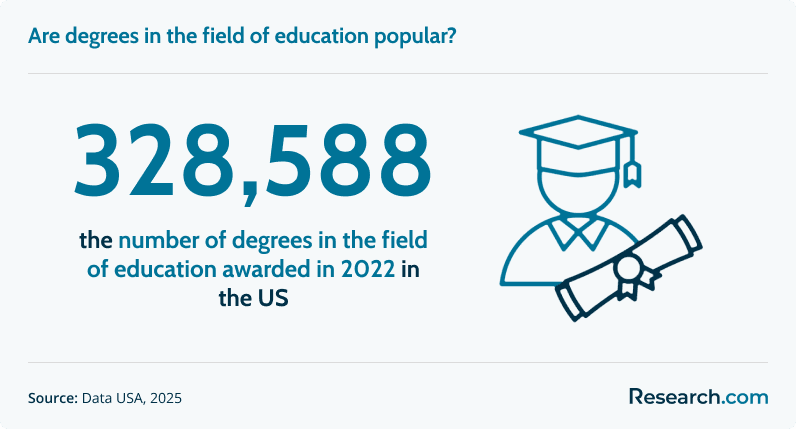
In 2022, around 328,588 degrees were awarded in the field of education across levels.
How do accelerated online teaching degrees work?
Accelerated online teaching programs speed up degree completion by compressing academic terms, allowing year-round enrollment, accepting transfer credits, and offering online coursework that fits around work or family responsibilities. Many use five- to eight-week classes instead of traditional 16-week semesters, which lets students complete more courses within a calendar year.
Most programs combine online coursework with in-person classroom requirements. Even if the academic classes are fully online, teacher preparation usually includes field observations, practicum hours, student teaching, or an alternative supervised teaching placement in an approved school setting.
For career changers, accelerated programs can make the transition more direct. For example, a student with a political science degree might pursue social studies licensure through an MAT rather than return for another bachelor’s degree. Similarly, someone moving away from the internal auditor career path may be able to apply analytical and business skills to math, business, economics, or CTE instruction, depending on state rules.
Typical licensure steps in an accelerated teaching program
- Complete a state-approved educator preparation program.
- Pass required exams, which may include Praxis, edTPA, or state-specific assessments.
- Complete student teaching, a residency, or another supervised classroom experience.
- Pass background checks and fingerprinting requirements.
- Apply for licensure through the state education department.
Common courses in accelerated online teaching degrees
- Foundations of Education: Introduces the history, organization, legal context, and purpose of schooling.
- Classroom Management: Covers routines, behavior supports, engagement strategies, and positive learning environments.
- Curriculum and Instruction: Teaches lesson planning, standards alignment, instructional design, and differentiation.
- Educational Psychology: Explores how students learn and how teachers adapt instruction to developmental and learning differences.
- Assessment and Evaluation: Focuses on measuring learning, using data, and adjusting instruction based on student performance.
Who should consider an accelerated online teaching program?
An accelerated online teaching program is best for students who are ready for a demanding schedule and have a clear goal: initial licensure, a completed bachelor’s degree, a career change, or an added endorsement. It is less suitable for students who need a slow pace, extensive in-person campus support, or a program that can be used in any state without checking licensure rules.
| Student type | Why an accelerated online program may work | What to verify first |
| Career changer | Can build on an existing bachelor’s degree and move into teaching faster | Whether your degree, GPA, content background, and state exams meet certification rules |
| Paraprofessional or substitute teacher | Can continue working in schools while completing online coursework | Whether your current school can support fieldwork or student teaching requirements |
| Degree completer | Transfer credits may shorten the path to graduation | How many credits apply to the major, not just general electives |
| Working parent or caregiver | Online classes may reduce commuting and scheduling barriers | Whether live sessions, practicum hours, and student teaching fit your schedule |
| Licensed teacher seeking a new area | Endorsements can expand eligibility for special education, ESL, or subject-specific roles | Whether the endorsement is recognized by your state and district |
Who should be cautious?
- Students who cannot commit consistent weekly study time to compressed courses.
- Applicants who plan to move states during or immediately after the program without checking reciprocity.
- Students choosing a program only because it is short, without confirming accreditation and licensure alignment.
- Candidates who need extensive face-to-face mentoring but are considering fully asynchronous programs.
What types of accelerated online teaching programs are available?
Accelerated online teaching programs are not all designed for the same learner. Some lead to a first bachelor’s degree and initial licensure, while others are built for career changers, licensed teachers, or students who only need certification coursework.
| Program type | Who it is for | Common coursework | Possible outcome |
| Accelerated bachelor’s degree in education | Students without a completed bachelor’s degree | Child development, foundations of education, subject methods, assessment, classroom management | Initial eligibility for licensure after state requirements are met |
| Master of Arts in Teaching | Bachelor’s degree holders changing careers | Educational psychology, curriculum design, differentiated instruction, teaching methods, classroom technology | Licensure preparation for a teaching role, often in a specific grade band or subject |
| Alternative certification | Career changers who may teach while completing requirements | Teaching theory, assessment, behavior management, special education basics, content pedagogy | Provisional or initial certification route depending on state policy |
| Post-baccalaureate teaching certificate | Degree holders who need licensure coursework but not a full master’s | Student engagement, literacy across content areas, assessment, inclusion, professional ethics | Preparation to apply for state certification in a specific area |
| Endorsement program | Licensed teachers adding another credential | ESL methods, special education strategies, intervention planning, curriculum, policy | Expanded teaching eligibility in an added subject or population |
Students who want a shorter credential rather than a full degree can compare accredited online certificate programs, but they should confirm whether the certificate alone satisfies teacher certification requirements in their state.
In 2022, the most awarded degree in the field of education were master's degrees, with a share of 47.8% percent of all degrees awarded. The chart below offers more information.
Which online teaching specializations can you choose?
Your specialization affects licensure, student teaching placement, job options, and long-term mobility. Some students choose a grade level, such as elementary education. Others choose a subject area, such as math, English, science, or social studies. Some focus on student populations, including special education or English language learners.
| Specialization | What it prepares you to do | Common roles | Decision note |
| Elementary education | Teach multiple subjects to younger students, typically kindergarten through fifth or sixth grade | Kindergarten teacher, elementary school teacher | Good for students who want broad instruction and enjoy working with young learners |
| Secondary education | Teach a specific subject in middle or high school | Middle school teacher, high school teacher | Best for students with strong content knowledge in one discipline |
| Special education | Support students with disabilities through individualized instruction and interventions | Special education teacher, intervention specialist | There are 35,900 job openings projected annually over the next decade |
| English as a Second Language | Teach English language development and academic language skills | ESL teacher, bilingual educator | Useful in districts serving multilingual student populations |
| Career and Technical Education | Teach workforce-focused subjects such as healthcare, information technology, and skilled trades | Career and technical education teacher, vocational instructor | Often valuable for candidates with industry experience |
Some flexible institutions, including open enrollment colleges, may make it easier for adult learners to begin coursework, but open enrollment does not automatically mean the program meets teacher licensure rules. Students interested in English instruction can also compare subject-focused options such as an affordable online English degree when planning long-term subject expertise.
In 2023, among K-12 teaching occupations, special education teachers earn the highest with a median annual salary of $65,910. See the chart below for more salary details.
What are the admission requirements for accelerated online teaching programs?
Admission requirements depend on whether the program is undergraduate, graduate, certificate-based, or alternative certification. Accelerated programs may also expect applicants to be ready for heavier course loads, field placement scheduling, and state testing timelines.
Accelerated bachelor’s programs
- High school diploma or GED
- Minimum GPA requirement, depending on the institution
- SAT or ACT scores, although some schools waive them
- Letters of recommendation and a personal statement
- Transfer credit evaluation if the student has prior college coursework
Accelerated Master of Arts in Teaching programs
- Bachelor’s degree in any field from an accredited institution
- Minimum undergraduate GPA, typically 2.5–3.0
- Statement of purpose explaining interest in teaching
- Professional or academic references
- Possible prerequisite coursework in education or the intended teaching subject
Alternative certification programs
- Bachelor’s degree in any subject
- Passing scores on state-specific teacher certification exams when required for entry
- Background check and fingerprint clearance
- Admission to an approved alternative certification route
Post-baccalaureate teaching certificates
- Bachelor’s degree, often in a relevant subject area
- Completion of prerequisite education courses when required
- Fieldwork or teaching experience requirements, depending on the state and program
Before applying, ask each school for a written explanation of how the program leads to licensure in your state. This is especially important if you live outside the state where the institution is located.
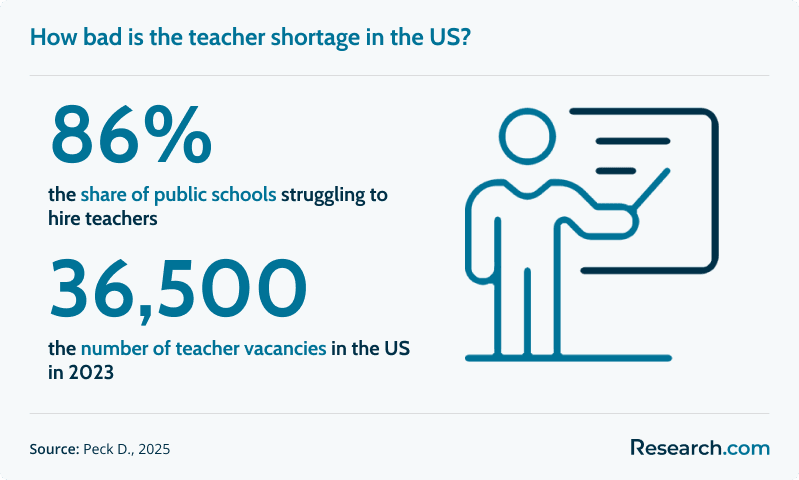
The US continues to report teacher staffing pressures. In 2023, alone more than 51,000 teachers have quit their jobs with only 2 out of 10 teachers reporting positive job satisfaction. As of 2023, there are more than 30,000 teacher vacancies in the country.
What are some of the fastest online teaching programs?
How this ranking was developed
This list is based on research and data analysis using Research.com’s methodology. Program and institutional data were reviewed using the IPEDS database from the National Center for Education Statistics, Peterson’s database and its Distance Learning Licensed Data Set, and the College Scorecard database for information related to costs, student outcomes, and financial aid availability.
Use this list as a starting point, not as a final enrollment decision. Program length depends on transfer credits, course load, practicum scheduling, and licensure requirements.
| School and program | Program length | Credits | Cost | Accreditation |
| Clarke University — Accelerated Elementary Education Degree | 18 months | 74 | $1,323 per credit | Higher Learning Commission (HLC) |
| Concordia University — Accelerated BA in Elementary Education | 3 years | 120 | $490 per credit | Higher Learning Commission (HLC) |
| Baker College — Accelerated BS in Elementary Education | 2.5 years | 120 | $450 per credit | Higher Learning Commission (HLC) |
| University of North Dakota — Accelerated MS in Early Childhood Education | 18 months (full-time); 24 months (part-time) | 30-32 | $458.31 per credit | Council for Accreditation of Educator Preparation (CAEP) |
| George Fox University — Adult Accelerated BS of Education Completion Program | 16-20 months | 60-72 | $499 per credit | Association for Advancing Quality in Educator Preparation (AAQEP) |
| University of West Florida — Online BA in Exceptional Student and Elementary Education | 48 months | 132 semester hours | $218.98 in-state; $323.98 Alabama; $648.37 out-of-state | Council for the Accreditation of Educator Preparation (CAEP) |
| Regis University — Accelerated BA in Elementary Education | ~1 to 3 years | 123 semester hours | $515 per credit | Higher Learning Commission (HLC) |
| University of Oklahoma — Accelerated BA in Interdisciplinary Studies with a major in Learning and Education Studies | ~12+ months | 120 | $500 per credit | Higher Learning Commission (HLC) |
| Arkansas State University — MA in Teaching in Special Education K-12 | 12-16 months | 36 | $12,240 total tuition | Council for the Accreditation of Educator Preparation (CAEP) |
| Gwynedd Mercy University — Accelerated MS in Education | ~1-2 years | 30 | $750 per credit | Middle States Commission on Higher Education (MSCHE) |
Program notes to check before applying
- Clarke University: Designed for working professionals such as substitute teachers and paraprofessionals, with completion possible in as little as 18 months depending on prior college credits.
- Concordia University: Prepares students to apply for a Wisconsin teaching license for grades K-9.
- Baker College: Requires 33 general education credits and includes over 200 hours of hands-on experience before student teaching.
- University of North Dakota: Uses a 4+1 structure that allows up to 12 graduate credits to count toward both the BS and MS.
- George Fox University: Uses synchronous online evening and weekend classes and leads to an Oregon PreK-12 preliminary teaching license.
- University of West Florida: Leads to a Florida Professional Educator’s Certificate in Exceptional Student Education (K–12) and Elementary Education (K–6), with Reading and English for Speakers of Other Languages endorsements.
- Regis University: Offers licensure preparation in elementary education, special education, and culturally and linguistically diverse education.
- University of Oklahoma: Designed for working adults with at least 60 prior college credits and may support alternative teacher certification in Oklahoma after additional state-required coursework.
- Arkansas State University: Built for non-education bachelor’s degree holders seeking an alternative route to special education K-12 licensure.
- Gwynedd Mercy University: Supports Pennsylvania Instructional I Certification in PreK-4 or secondary education in Biology, English, Mathematics, or Social Studies.
How much do accelerated online teaching degrees cost?
Accelerated online teaching degree costs vary by school, residency status, transfer credits, degree level, and student teaching requirements. Based on the programs listed above, in-state students pay $554 per credit on average, while out-of-state students pay $597 per credit on average.
| Cost measure | Amount from programs in this guide |
| Average total tuition for in-state students | $44,138 |
| Average total tuition for out-of-state students | $49,806 |
| In-state cost per credit range | $219 to $1,323 |
| Out-of-state cost per credit range | $340 to $1,323 |
| Total tuition range | $12,240 to $97,902 |
Costs that students often overlook
- Application, enrollment, technology, and graduation fees
- State exams, background checks, and fingerprinting
- Travel to field placements or student teaching sites
- Lost income during full-time student teaching
- Books, software, webcams, and classroom materials
- Additional coursework if your state requires more than the program includes
A lower tuition rate is helpful, but it does not always mean the program is the best value. The stronger question is whether the program gets you to licensure in your state with the least total cost, fewest delays, and adequate support.
How do you check accreditation and program quality?
Start by confirming institutional accreditation, then verify educator preparation approval. Institutional accreditation shows that the college or university meets broad academic standards. Educator preparation approval, such as CAEP, AAQEP, or state approval, is especially important because teacher licensure depends on whether the program is recognized by the state where you plan to teach.
Accreditation checklist
- Confirm the college’s institutional accreditation on the school website and through recognized databases.
- Check whether the teacher preparation program is approved for your intended grade level and subject.
- Ask whether the program leads directly to licensure, recommendation for licensure, or only academic credit.
- Verify that online students receive approved field placements in their local area.
- Review certification exam pass-rate information if available.
- Compare the program with other accredited online teacher certification programs before committing.
What career support should online teaching programs provide?
Career support matters because the fastest program is not necessarily the one that gets you hired most efficiently. Strong programs help students secure field placements, prepare for certification exams, build teaching portfolios, and connect with school districts.
- Licensure advising for your state and specialization
- Placement assistance for practicum, observation, and student teaching hours
- Resume, cover letter, and interview coaching for teaching roles
- Help preparing a teaching portfolio and demonstration lesson
- Connections with local districts, charter schools, private schools, or hiring fairs
- Guidance on graduate study, including options such as affordable master’s programs for teachers
What state certification issues should you check before enrolling?
Teacher certification is not universal across the US. A program based in one state may not automatically qualify you for licensure in another. This is one of the most important risks in choosing an online teaching degree.
Questions to ask the program before enrolling
- Is this program approved for initial teacher licensure in my state?
- Will the school recommend me for licensure after graduation?
- Which exams do I need before admission, during the program, and after completion?
- Can I complete student teaching in my home state?
- Does the program meet requirements for my intended grade level and subject?
- What happens if I move to another state before completing student teaching?
- Are there reciprocity agreements that apply to this credential?
For a state-by-state starting point, review teacher licensing expectations in Research.com’s guide to teacher certification requirements by state.
What are your options after completing an accelerated teaching degree?
After completing an accelerated teaching degree, most graduates pursue initial classroom roles. Over time, teachers may add endorsements, earn graduate credentials, specialize in high-need populations, or move toward leadership, curriculum, or policy roles.
| Next step | When it makes sense | Potential outcome |
| Begin teaching after licensure | You want the fastest route into a classroom role | Elementary, middle, high school, special education, ESL, or CTE teaching position |
| Add an endorsement | You want to qualify for another subject or population | Expanded eligibility and stronger district mobility |
| Earn a master’s degree | You want advanced teaching skill, possible salary movement, or specialization | Teacher leadership, instructional coaching, curriculum roles |
| Pursue doctoral study | You want research, administration, or high-level leadership opportunities | District leadership, higher education, policy, or advanced practice roles |
Educators considering doctoral study can compare accelerated options such as the fastest online EdD programs after they have clarified their leadership goals.
Should you earn an advanced degree after becoming a teacher?
An advanced degree can be valuable, but it should be tied to a specific goal. It may help if you want to specialize, move into instructional leadership, qualify for certain district salary lanes, or pursue administration. It may not be the best next step if you are still adjusting to classroom teaching or if the cost is not matched by a clear career benefit.
Teachers considering doctoral study should compare cost, program length, accreditation, and career purpose. For example, affordable online EdD programs may be useful for educators planning to move into leadership, but they are not required for most classroom teaching positions.
What support services help students succeed in accelerated programs?
Accelerated programs move quickly, so support services can affect both graduation and licensure progress. Students should look beyond course lists and ask how the school supports online learners during fieldwork, exam preparation, and student teaching.
- Dedicated academic advising for accelerated students
- Licensure advising by state
- Technical support during evenings or weekends
- Tutoring and writing support
- Exam preparation resources
- Field placement coordination
- Faculty mentoring and cohort-based peer support
- Career services focused on teacher hiring
Teachers who later want administrative or organizational leadership roles may also compare broader leadership credentials, including online PhD programs in organizational leadership.
How are online teaching programs using technology and modern teaching methods?
Strong online teaching programs should prepare candidates for today’s classrooms, not just deliver old coursework through a learning management system. Look for programs that teach digital assessment, learning analytics, accessibility tools, blended instruction, classroom technology, and evidence-based approaches to supporting diverse learners.
Technology features that can improve preparation
- Virtual teaching simulations for classroom management practice
- Digital lesson planning and assessment tools
- Training in online and blended learning strategies
- Accessibility and assistive technology instruction
- Data-driven instruction modules
- Video-based coaching or recorded lesson feedback
As AI tools become more common in schools, future teachers should also learn how to use technology ethically, protect student privacy, evaluate AI-generated materials, and teach students responsible digital literacy.
What challenges should accelerated online teaching students expect?
Accelerated online teaching degrees can be efficient, but they are not easy. The pace is faster, deadlines are closer together, and field placements can create scheduling pressure, especially for working adults.
| Common challenge | Why it matters | Better approach |
| Underestimating the workload | Compressed courses may cover a full semester of content in a few weeks | Block weekly study time before the term begins |
| Ignoring licensure details | A degree that does not meet state requirements can delay certification | Get written confirmation from the program and state agency |
| Assuming online means fully remote | Student teaching and fieldwork are usually in person | Ask how local placements are arranged |
| Choosing based only on speed | The shortest option may lack support or licensure alignment | Compare completion time, outcomes, accreditation, and support together |
| Waiting to apply for aid | Some scholarships and grants have early deadlines | Complete FAFSA and school aid applications as soon as possible |
Students comparing teaching with other education-adjacent paths may also review options such as a library science degree or examine outcomes in related fields, including information about what you can do with a master’s in library science.
What are the long-term career and earning benefits?
The main benefit of an accelerated online teaching degree is opportunity cost: you may enter the classroom sooner than you would through a traditional program. Over time, teachers may improve their career options by adding endorsements, pursuing graduate study, moving into high-need specialties, or taking leadership roles.
Salary outcomes are not guaranteed. They depend on district pay scales, state funding, union agreements, years of experience, degree level, and specialization. In 2023, special education teachers had a median annual salary of $65,910, high school teachers had a median annual salary of $65,220, and kindergarten and elementary school teachers had a median annual salary of $63,670.
Subject expertise can also shape career mobility. For instance, teachers planning to specialize in history or social studies may compare content-area graduate options such as the most affordable online master’s degrees in history when considering long-term academic development.
What are the pros and cons of accelerated online teaching degrees?
| Benefits | Drawbacks |
| Can shorten the path to degree completion and licensure preparation | Compressed coursework can be intense and time-consuming |
| Online delivery can help working adults, parents, and career changers study with less commuting | Fieldwork and student teaching still require in-person availability |
| Transfer credits may reduce both time and cost | Not all prior credits may apply to education major requirements |
| Alternative certification may allow some candidates to teach while completing requirements | State rules vary and can be difficult to navigate |
| High-need specializations may strengthen employability in some districts | Overall job growth projections are stagnant or declining for several teaching roles |
What financial aid options are available?
Financial aid can make an accelerated online teaching degree more manageable, but students should apply early and compare aid packages carefully. A program with higher tuition may become more affordable if it offers strong grants or scholarships, while a lower-cost program may still create out-of-pocket costs through fees and unpaid student teaching time.
- FAFSA: Complete the FAFSA to determine eligibility for federal grants, loans, and work-study programs.
- Grants: Federal and state grants, including Pell Grant and TEACH Grant options, may reduce costs and generally do not require repayment if conditions are met.
- Scholarships: Universities, educator associations, private foundations, and local organizations may offer awards for future teachers.
- Federal student loans: Subsidized and unsubsidized loans can help cover education expenses, but repayment obligations should be considered before borrowing.
- State and institutional aid: Some states and schools provide additional support for teacher candidates, especially in shortage areas.
- Employer tuition assistance: Paraprofessionals, school employees, and working adults may have tuition reimbursement options through employers.
- Loan forgiveness programs: Public Service Loan Forgiveness and Teacher Loan Forgiveness may help qualifying educators reduce debt after meeting service and repayment requirements.
How do you choose the best accelerated online teaching degree?
The best accelerated online teaching degree is the one that fits your licensure goal, state requirements, schedule, budget, and learning style. Speed should be one factor, not the only factor. This is especially important for working adults, career changers, and students comparing flexible programs such as the best online degrees for moms.
Step-by-step program selection checklist
- Choose your target teaching role. Decide whether you want elementary, secondary, special education, ESL, CTE, or another specialization.
- Check your state’s licensure rules. Confirm required exams, coursework, field hours, and student teaching rules.
- Verify accreditation and state approval. Do not rely only on marketing language such as “teacher preparation.”
- Request a transfer credit review. Ask how many credits apply directly to graduation requirements.
- Calculate total cost. Include tuition, fees, exams, travel, technology, and income changes during student teaching.
- Ask about field placements. Confirm whether the school arranges placements near you or expects you to find them.
- Compare course delivery. Decide whether asynchronous, synchronous, hybrid, evening, or weekend formats fit your life.
- Evaluate support services. Look for licensure advising, tutoring, exam prep, placement support, and career coaching.
- Talk to admissions and licensure staff. Ask direct questions and save written responses.
- Compare at least three programs. A single “fastest” option may not be the best fit once cost and licensure are considered.
Common mistakes to avoid
- Choosing the shortest program without confirming licensure eligibility
- Looking only at cost per credit instead of total cost
- Assuming all online programs can place students in every state
- Forgetting to budget for certification exams and background checks
- Assuming a degree guarantees a job or a specific salary
- Ignoring student teaching schedules until late in the program
- Relying only on rankings without asking practical licensure and placement questions
What is the job market for online teaching degree graduates?
The teaching job market is mixed. Schools continue to report hiring difficulty, but federal employment projections show limited or negative growth for several classroom roles. That means many openings will come from retirements, resignations, transfers, and career changes rather than large-scale job creation.
Between 2023 and 2033, there will be 106,500 annual openings for kindergarten and elementary school teachers and 64,000 annual openings for high school teachers. These openings are important, but candidates should still research local district demand, specialization needs, and state certification areas before choosing a program.
See the chart below for detailed job outlook data.
Key Insights
- The fastest path depends on your starting point. Bachelor’s degree holders may finish teacher preparation in 12 to 18 months, while first-time college students usually need longer even in accelerated formats.
- Licensure is the make-or-break issue. Before enrolling, confirm that the online program is approved for the state, grade level, and subject you plan to teach.
- Costs range widely. Programs in this guide range from $12,240 to $97,902, with average cost per credit of $554 for in-state students and $597 for out-of-state students.
- Teacher demand is real, but growth is uneven. Although 86% of public schools struggle to hire teachers, employment for kindergarten, elementary, middle, and high school teachers is projected to decline by 1% from 2023 to 2033.
- Specialization can improve your positioning. Special education and CTE show 0% projected job growth, indicating stability, while special education teachers had a 2023 median annual salary of $65,910.
- Do not choose on speed alone. The best program balances time to completion, accreditation, state approval, student teaching support, total cost, and career services.
References and sources
- Bureau of Labor Statistics. (2024). Adult basic and secondary education and ESL teachers. Retrieved February 14, 2025, from BLS.
- Bureau of Labor Statistics. (2024). Career and technical education teachers. Retrieved February 14, 2025, from BLS.
- Bureau of Labor Statistics. (2024). High school teachers. Retrieved February 14, 2025, from BLS.
- Bureau of Labor Statistics. (2024). Kindergarten and elementary school teachers. Retrieved February 14, 2025, from BLS.
- Bureau of Labor Statistics. (2024). Middle school teachers. Retrieved February 14, 2025, from BLS.
- Bureau of Labor Statistics. (2024). Special education teachers. Retrieved February 14, 2025, from BLS.
- Data USA. (2025). Education. Retrieved February 14, 2025, from Data USA.
Other Things You Should Know About Accelerated Teaching Degree Online
Yes, 2027 accelerated online teaching programs typically include in-person student teaching experiences. These are scheduled locally to accommodate students' locations, ensuring they receive necessary hands-on practice while maintaining the program's accelerated pace.
Yes. Many accelerated online bachelor’s-to-licensure pathways can be completed in 12 to 18 months for students who already hold transferable credits or a prior degree. Programs still require supervised fieldwork, often 12 to 16 weeks, plus state-approved licensure exams such as Praxis.