
2027 Most Affordable Online Master's in Science Education Degree Programs

Co-Founder and Chief Data Scientist
Choosing an affordable online master’s in science education is not just a tuition comparison. For teachers, career changers, and STEM educators, the bigger question is whether a program will improve classroom practice, support licensure or endorsement goals, fit around work, and produce enough career value to justify the cost.
This guide explains what an online master’s in science education usually includes, how to compare low-cost programs, what admission requirements to expect, which careers may be available, and how to evaluate salary, accreditation, flexibility, and return on investment. It is designed for licensed teachers seeking advancement, professionals moving into secondary science teaching, and educators interested in curriculum, STEM leadership, museums, instructional technology, or educational consulting.
The strongest choice is rarely the cheapest program on the list. It is the program that matches your state requirements, your science discipline, your schedule, and your long-term role in science education.
Quick Answer: Is an Online Master’s in Science Education Worth It?
An online master’s in science education can be worth it if you want to strengthen your science teaching, qualify for advanced licensure or endorsements, move into curriculum or STEM leadership, or increase your district salary placement. Many districts offer a $5,000 to $15,000 annual salary increase for teachers with a master’s degree, and science teachers with a master’s commonly earn $55,000 to $85,000 annually. However, outcomes depend heavily on your state, district salary schedule, licensure status, experience, and the program’s accreditation.
Before enrolling, confirm whether the degree is intended for initial teacher certification, advanced licensure, endorsement, professional development, or non-licensure career advancement. These tracks can lead to very different results.
Major benefits of an online master’s in science education
- More career options: Graduates may remain in K-12 science teaching or move into curriculum development, STEM coordination, instructional coaching, educational consulting, museum education, or professional development roles.
- Potential salary movement: A master’s degree may place teachers on a higher district pay lane, with many educators seeing a $5,000 to $15,000 annual salary increase where salary schedules recognize graduate credentials.
- Work-friendly format: Online programs can allow current teachers and working professionals to continue earning income while completing graduate coursework.
- Stronger STEM instruction: Programs often focus on inquiry-based learning, science assessment, curriculum design, technology integration, and content-specific pedagogy.
What Is an Online Master’s in Science Education?
An online master’s in science education is a graduate degree focused on how students learn science and how educators can teach scientific concepts more effectively. Programs may emphasize biology, chemistry, physics, earth science, environmental science, STEM integration, curriculum and instruction, or educational leadership.
Some programs are built for licensed teachers who want advanced credentials. Others are designed for students with a bachelor’s degree in a science field who want to transition into teaching. A few focus less on licensure and more on informal science education, curriculum development, or professional growth.
What you can usually expect in the program
- Science pedagogy: Courses examine how to teach complex scientific ideas through inquiry, modeling, discussion, experimentation, and evidence-based reasoning.
- Curriculum and standards: Students learn how to design science units aligned with state standards and frameworks such as the Next Generation Science Standards (NGSS).
- Research and assessment: Many programs include educational research methods, action research, assessment design, and data-informed instruction.
- Technology-supported science learning: Coursework may use virtual labs, simulations, digital collaboration tools, learning management systems, or online science resources.
- Practical application: Depending on the program, students may complete a practicum, internship, classroom-based project, capstone, portfolio, thesis, or comprehensive exam.
- Typical completion time: Many programs take one to two years, though part-time and self-paced formats can change the timeline.
Where Can You Work With an Online Master’s in Science Education?
Graduates most often use this degree to advance in schools, districts, curriculum organizations, informal science learning settings, or education-related companies. The right path depends on whether the program supports licensure, advanced licensure, endorsement, or non-licensure professional development.
| Career setting | Possible roles | When this path makes sense |
| K-12 schools | Science teacher, lead teacher, department chair, instructional coach | Best for licensed teachers who want stronger classroom practice, pay-lane movement, or school-based leadership. |
| School districts | Science curriculum specialist, instructional coordinator, professional development facilitator | Good for educators who want to design curriculum, support other teachers, or improve district-wide STEM instruction. |
| Higher education and community colleges | Introductory science instructor, lab coordinator, teacher educator support roles | May fit educators with strong content knowledge, though some positions require additional graduate coursework or credentials. |
| Museums, zoos, aquariums, and science centers | Museum educator, program developer, outreach coordinator | Useful for graduates who enjoy public science communication and informal learning environments. |
| Education companies and nonprofits | Curriculum developer, STEM content writer, educational consultant, ed-tech specialist | Strong fit for educators interested in instructional materials, digital learning, or program improvement outside a classroom. |
How Much Can You Make With an Online Master’s in Science Education?
Salary varies by role, state, district contract, years of experience, certification area, and whether the degree leads to a formal salary lane. A master’s degree can improve earning potential, but it does not guarantee a specific salary.
- Science teachers with a master’s degree: Commonly earn $55,000 to $85,000 annually.
- Master’s salary increment: Many districts provide a $5,000 to $15,000 annual salary increase for teachers with a master’s degree.
- Overall median for master’s degree holders: Across all U.S. fields, median annual earnings are approximately $90,324.
- Science curriculum developer: Average pay is around $55,907 per year, with top earners above $70,000.
- Educational consultant: Average annual salary is approximately $94,974, with the top 75th percentile at $121,000.
- Museum educator: Average salary is approximately $46,390, with substantial variation by employer and location.
- Most affordable online master’s in science education programs for 2027
- Admissions requirements and application steps
- Skills gained in a strong science education master’s program
- Career paths after graduation
- Program cost and financial aid options
- Salary expectations after earning the degree
- Online vs. in-person science education master’s programs
- Master’s in science education vs. online EdD programs
- Science education vs. early childhood education
- How to verify accreditation and program quality
- Diversity, equity, and inclusion in science education programs
- Specializations and career tracks
- Job market for science education graduates
- Current trends and future outlook
- Common mistakes and final questions to ask
Most Affordable Online Master’s in Science Education Programs for 2027
How we evaluate schools
Affordability matters, but low tuition alone is not enough. A strong science education master’s program should have recognized accreditation, relevant science education coursework, transparent costs, appropriate licensure alignment, and enough flexibility for working educators.
Research.com uses established education data sources when reviewing programs, including the IPEDS database, Peterson's database and its Distance Learning Licensed Data Set, the College Scorecard database, and the National Center for Education Statistics.
The following programs are among the affordable online options identified for students comparing graduate science education degrees.
1. Columbus State University
Columbus State University offers a fully online Master of Arts in Teaching (M.A.T.) in Secondary Science Education for students who hold a bachelor’s degree outside education and want a pathway that combines teacher preparation with graduate study. The program is designed for candidates pursuing Secondary Biology, Chemistry, or Earth Science and includes professional education coursework, instructional preparation, an internship, a practicum, a research project, and a comprehensive exam. Its structure is especially relevant for eligible Georgia residents seeking teacher certification while developing practical teaching strategies, classroom technology skills, and research-informed instructional habits.
- Program Length: Not explicitly stated in search results
- Tracks/Concentrations: Not specified
- Tuition Cost: $4,488 (annual tuition)
- Required Credits to Graduate: 36 credits
- Accreditation: Council for the Accreditation of Educator Preparation (CAEP)
2. Colorado State University
Colorado State University offers an online Master of Natural Sciences Education (M.N.S.E.) for educators who want broader preparation across science teaching fields such as biology, chemistry, physics, and environmental science. The program is built for working teachers and includes flexible online coursework, practical science learning activities, and lab kits for online science coursework. Students study instructional theory, curriculum development, classroom management, and science pedagogy while benefiting from the university’s STEM reputation and regional accreditation.
- Program Length: Not specified
- Tracks/Concentrations: Natural Sciences Education
- Tuition Cost: Not explicitly stated
- Required Credits to Graduate: 30-31 credits
- Accreditation: Higher Learning Commission (HLC)
3. East Carolina University
East Carolina University offers an online Master of Arts in Education in Science Education for licensed science teachers at the “A” level who want to pursue advanced “M” level licensure. The program emphasizes classroom-based application, action research, science curriculum improvement, and evidence-based teaching practices. Graduates have used the program as preparation for National Board Certification, school and district leadership, doctoral study in science education, and involvement in NSF-funded science education reform work.
- Program Length: 2.5 years
- Tracks/Concentrations: Science education
- Tuition Cost: Not stated
- Required Credits to Graduate: 39
- Accreditation: Southern Association of Colleges and Schools Commission on Colleges (SACSCOC)
4. Hamline University
Hamline University offers an online Master of Arts in Education for practicing educators who want to expand their science teaching skills through inquiry-based instruction, curriculum design, reflective practice, and technology integration. The format is designed for working teachers, with online coursework that supports collaboration and applied classroom improvement.
- Program Length: 18-24 months
- Tracks/Concentrations: Not specified
- Tuition Cost: $570/credit
- Required Credits to Graduate: 34
- Accreditation: Higher Learning Commission (HLC)
5. New Mexico Institute of Mining and Technology
New Mexico Institute of Mining and Technology offers a Master of Science in Science Education for educators interested in science, mathematics, engineering, and/or technology. The program connects scientific research with classroom practice and includes advanced science coursework, education theory, and a portfolio requirement before the final semester. The portfolio is customized to the student’s degree pathway and includes lesson plans, peer and instructor feedback, and reflection on teaching development.
- Program Length: Not explicitly stated in search results
- Tracks/Concentrations: Not specified
- Tuition Cost: Not explicitly stated in search results
- Required Credits to Graduate: 30 + 6 (thesis)
- Accreditation: Higher Learning Commission (HLC)
6. North Carolina State University
North Carolina State University offers an online Master of Education in Science Education designed for secondary science educators, community college educators, and professionals in informal science settings such as museums, zoos, and aquariums. The program focuses on STEM learning environments, advanced teaching methods, research, instructional technology, and leadership in science education.
- Program Length: 2 years
- Tracks/Concentrations: Science, Technology, Engineering, and Mathematics Education (STEM Ed)
- Tuition Cost: $8,088 (annual tuition)
- Required Credits to Graduate: 30 credits
- Accreditation: Southern Association of Colleges and Schools Commission on Colleges (SACSCOC)
7. Northeastern State University
Northeastern State University offers an online Master of Education in Science Education for working educators and professionals pursuing licensure-related goals. The program includes STEM certificate options, a capstone project, and coursework in curriculum design, inquiry, and current issues in science education. Its online delivery and affordability make it a practical option for educators who need flexibility.
- Program Length: Not stated
- Tracks/Concentrations: STEM Education certificate options
- Tuition Cost: $6,224 (annual tuition)
- Required Credits to Graduate: 36 credits
- Accreditation: Higher Learning Commission (HLC)
8. University of Nebraska at Kearney
The University of Nebraska at Kearney offers an online master’s in STEM Education for grade 7-12 science and math educators. Applicants need a bachelor’s degree and a teaching certificate with an endorsement in biology, mathematics, chemistry, physics, or physical science. Students can pursue an integrated option covering biology, chemistry, math, and physics or a chemistry-focused option.
- Program Length: Not explicitly stated in search results
- Tracks/Concentrations: Integrated Option (biology, chemistry, math, physics); Chemistry Option
- Tuition Cost: In-State $277/credit; Non-Resident $424/credit
- Required Credits to Graduate: 36
- Accreditation: Higher Learning Commission (HLC)
9. Western Governors University
Western Governors University offers a fully online Master of Arts in Science Education for Middle Grades, aimed at licensed teachers seeking a middle-grades science endorsement. The program uses a competency-based model, charges tuition by six-month term, and allows students to move through requirements at their own pace. Most graduates finish within 18 months.
- Program Length: Average 18 months (self-paced)
- Tracks/Concentrations: Middle Grades Science Education
- Tuition Cost: $6,670 (annual tuition)
- Required Credits to Graduate: 36 credits
- Accreditation: National Council for Accreditation of Teacher Education (NCATE)
How to choose among affordable programs
| Factor | Why it matters | Question to ask before applying |
| Accreditation | Accreditation affects credit transfer, employer recognition, financial aid eligibility, and licensure relevance. | Is the institution regionally accredited, and is the educator preparation program recognized by the appropriate agency? |
| Licensure alignment | Some programs lead to initial certification, others to advanced licensure, and others to professional development only. | Will this program meet requirements in my state and for my intended grade level or science endorsement? |
| Total cost | Annual tuition may exclude fees, books, technology costs, testing, travel, or required intensives. | What is the full estimated cost from enrollment through graduation? |
| Science focus | A general STEM program may not provide the same preparation as a biology, chemistry, physics, or earth science pathway. | Does the curriculum match the subject I teach or want to teach? |
| Format | Online programs vary in live meeting requirements, pacing, fieldwork, and classroom application expectations. | Are courses asynchronous, synchronous, self-paced, cohort-based, or hybrid? |
| Applied learning | Capstones, portfolios, internships, and classroom projects can strengthen practical value. | How will I apply what I learn to real science teaching or curriculum work? |
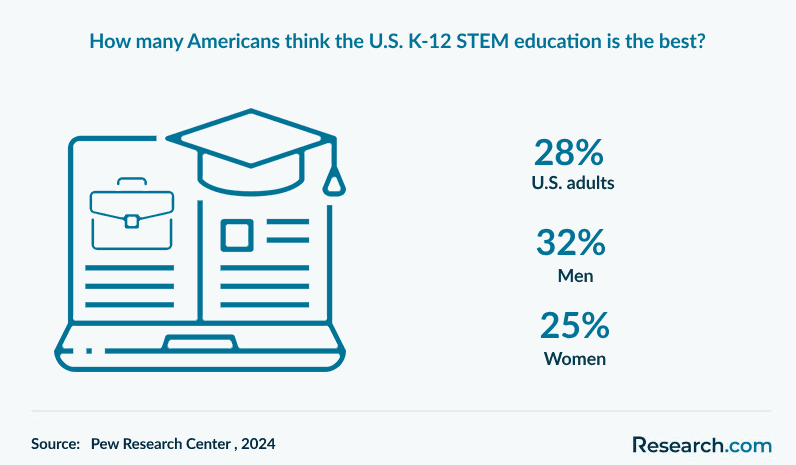
Public concern about STEM education also makes program quality important. A 2024 Pew Research Center survey found that about two-thirds of U.S. adults described U.S. K-12 STEM education as average or below average compared with other wealthy nations. Specifically, 33% rated it average and 32% rated it below average or the worst, while 28% rated it the best or above average.
Views differed across demographic groups. Men were more likely than women to rate U.S. STEM education as the best or above average, at 32% compared with 25%. Asian adults showed the highest positive rating at 43%, compared with White adults at 24%, Black adults at 31%, and Hispanic adults at 37%. White adults were also the group most likely to rate U.S. STEM education as below average or the worst, at 35%. By education level, postgraduates were more likely to rate STEM education highly at 33%, compared with college graduates at 28% and adults with some college at 25%.
These findings suggest that many Americans see room for improvement in K-12 STEM education, which increases the value of well-prepared science educators who can strengthen classroom instruction and student engagement.
What Are the Prerequisites and Application Steps for Online Master’s in Science Education Programs?
Admission requirements vary by school and track. Programs for licensed teachers usually expect a teaching credential and classroom experience. Programs designed for career changers may focus more on science coursework, undergraduate preparation, and eligibility for certification.
- Bachelor’s degree: Applicants generally need a bachelor’s degree from an accredited institution, often in education, science, or a related field. Students still planning their undergraduate route may compare the cheapest online Bachelor's degree in Education programs.
- Minimum GPA: Many programs expect a minimum undergraduate GPA, commonly around 2.75 to 3.0 on a 4.0 scale.
- Teaching license or experience: Advanced licensure programs often require an active teaching license, while initial certification pathways may accept applicants from non-education backgrounds.
- Official transcripts: Schools typically require transcripts from every college or university attended.
- Statement of purpose: Applicants usually explain their science background, teaching goals, and reasons for pursuing graduate study.
- Letters of recommendation: Most programs ask for two to three academic or professional references.
- Resume or CV: This document should highlight teaching experience, STEM experience, certifications, leadership, and relevant professional development.
- Standardized tests: Some programs may request GRE scores, although many graduate education programs no longer require them.
- Application fee: A non-refundable fee is commonly required when submitting the application.
Application checklist
- Decide whether you need initial licensure, advanced licensure, an endorsement, or a non-licensure master’s.
- Confirm your state’s educator certification requirements before applying.
- Compare curriculum, fieldwork, and capstone requirements across programs.
- Request a full cost estimate that includes tuition, fees, materials, and possible travel.
- Prepare transcripts, recommendations, a resume, and a focused statement of purpose.
- Ask an enrollment advisor whether online students receive the same academic and career support as campus students.
Students considering adjacent graduate education fields can compare admissions expectations with the cheapest online master's in multilingual learner education programs, which also emphasize readiness to serve diverse learners.
Graduate STEM enrollment data shows that master’s-level science, engineering, and health fields attract both U.S. and international students. According to the National Center for Science and Engineering Statistics in 2025, there were 31,305 temporary visa holders enrolled part-time in 2023 and 165,952 enrolled full-time, including 78,309 first-time full-time enrollees. Among U.S. citizens and permanent residents, 149,590 were enrolled part-time and 164,019 full-time, including 75,236 first-time full-time enrollees.
The data indicates that U.S. citizens and permanent residents made up a larger share of part-time enrollment, while full-time temporary visa holder enrollment was slightly higher than full-time enrollment among U.S. citizens and permanent residents.
What Skills Will You Learn in an Online Master’s in Science Education Program?
A strong program should help educators improve both science content knowledge and teaching practice. The best coursework connects theory to classroom decisions: how to design a lab, how to assess conceptual understanding, how to support multilingual learners, and how to use technology without letting tools replace inquiry.
- Science-specific pedagogy: Students study inquiry-based learning, project-based learning, modeling, argumentation from evidence, and differentiated science instruction.
- Curriculum design: Programs teach educators to build standards-aligned units, sequence lessons, select materials, and evaluate whether students are meeting science learning goals.
- Assessment literacy: Graduates learn how to create formative and summative assessments that measure scientific reasoning, not just memorized facts.
- Educational technology: Coursework may include virtual labs, simulations, digital notebooks, online discussions, and science learning platforms.
- Deeper science content: Depending on the program, students may strengthen knowledge in biology, chemistry, physics, earth science, environmental science, or integrated STEM.
- Research methods: Many programs train students to read education research, conduct action research, and use evidence to improve instruction. Similar research-to-practice habits can be useful in an online elementary education degree.
- Leadership and advocacy: Graduates may learn to mentor teachers, lead science departments, support standards implementation, and advocate for stronger STEM learning.
- Inclusive instruction: Programs increasingly emphasize strategies for students with different readiness levels, disabilities, language backgrounds, and cultural experiences.
Educators who want more specialized training for advanced learners can also compare science education coursework with the most affordable online master's in gifted education, where differentiation and enrichment are central themes.
What Career Prospects Are Available After an Online Master’s in Science Education?
An online master’s in science education can support classroom advancement, district-level roles, curriculum work, and informal science education. The best career outcome depends on the degree track and whether it connects to licensure or endorsement requirements in your state.
- K-12 science teacher: Licensed teachers may continue teaching at the elementary, middle, or high school level with stronger instructional expertise and possible salary advancement.
- Instructional coordinator or curriculum specialist: These professionals develop, revise, and evaluate science curriculum for schools or districts.
- Science department head: Experienced teachers may lead department planning, resource decisions, teacher collaboration, and standards implementation.
- Educational consultant: Consultants advise schools, districts, nonprofits, or education companies on science curriculum, assessment, technology, or instructional improvement.
- Museum educator: Graduates may design programs and exhibits for museums, zoos, aquariums, nature centers, and science outreach organizations.
- Professional development specialist: Educators may train other teachers in inquiry-based science, assessment, lab safety, or STEM integration.
- Educational technology specialist: This path focuses on selecting and using digital tools that support science learning.
- Community college instructor: Some graduates may teach introductory science courses, though requirements vary by institution and discipline.
- Education leadership roles: Those who want broader administrative advancement may also explore the cheapest online educational leadership programs.
Science educators interested in media, public communication, or educational content production may compare cross-disciplinary pathways such as a low cost entertainment business degree online, especially if they want to create STEM media, edutainment products, or digital learning content.
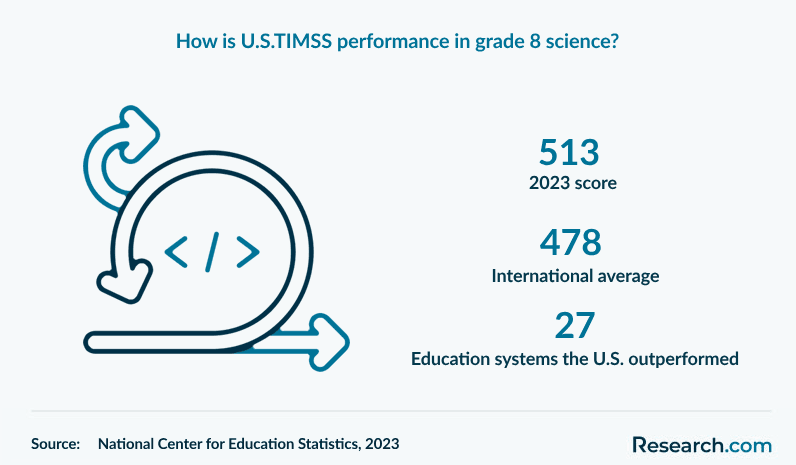
International science assessment results show both strengths and challenges for U.S. science education. In 2023, U.S. 8th-grade students earned an average TIMSS science score of 513, which was 35 points above the international average of 478. The U.S. score was higher than students in 27 education systems, lower than students in 11 systems, and statistically similar to students in 6 systems. Scores ranged from 327 in Morocco to 606 in Singapore, placing the U.S. 93 points behind Singapore and 186 points ahead of Morocco on the 0 to 1,000 TIMSS scale.
These results show that U.S. students perform above the international average in science while still trailing the highest-performing systems. That gap reinforces the need for educators who can improve science instruction, deepen student reasoning, and expand access to effective STEM learning.
How Much Do Online Master’s in Science Education Programs Cost?
Costs differ widely by institution type, residency status, program length, credit load, and fees. Public universities often cost less than private institutions, but online pricing rules vary. Some public universities charge the same online rate to all students, while others maintain separate in-state and out-of-state tuition.
- Typical public university range: Online master’s in education programs at public universities often fall between $15,000 and $30,000.
- Typical private university range: Private university programs can range from $30,000 to $60,000.
- Per-credit tuition: Many programs charge by credit, often from $280 to $500, though rates can be higher.
- Residency status: In-state students at public universities may pay less than out-of-state students, even in online programs.
- Additional expenses: Students should budget for technology fees, textbooks, course materials, graduation fees, licensure exams, and possible travel or on-campus requirements.
Ways to reduce the cost
- Submit the FAFSA: Eligible students use the FAFSA (Free Application for Federal Student Aid) to apply for federal loans and other aid.
- Ask about district reimbursement: Many school districts and education employers offer tuition assistance for approved graduate study.
- Look for STEM and educator scholarships: Universities, professional associations, and private foundations may offer awards for graduate students in education or STEM fields.
- Compare total program cost: A lower per-credit rate may not be cheaper if the program requires more credits or charges higher fees.
- Use payment plans cautiously: Installment plans can help with cash flow, but students should understand deadlines and fees.
- Compare teacher-focused options: Some cheap masters programs for teachers may offer grants or institutional aid to qualified students.
| Cost item | Why it can change the real price | What to verify |
| Tuition | Programs may quote annual tuition, per-credit tuition, or term-based tuition. | Ask for the full degree cost based on required credits. |
| Fees | Online, technology, library, graduation, and course fees may be separate. | Request a written list of mandatory fees. |
| Books and materials | Science courses may require lab kits, digital tools, or specialized resources. | Ask whether materials are included in tuition. |
| Residency | Some online programs charge different rates for residents and nonresidents. | Confirm your rate before accepting admission. |
| Licensure costs | Certification exams, background checks, and state applications may be separate. | Ask which licensure-related costs are not included. |
How Much Can You Earn After Completing an Online Master’s in Science Education?
A master’s degree can improve earning potential, but salary is shaped by job title, state, district, years of experience, certification area, and whether the employer rewards graduate education. Teachers should review their district salary schedule before assuming a specific pay increase.
- K-12 science teachers: Teachers with a master’s commonly earn $55,000 to $85,000 annually, often $5,000 to $15,000 more per year than bachelor’s-level teachers where district salary schedules provide that increase.
- Instructional coordinator or curriculum developer: Average salary is around $64,830 per year, with experienced professionals earning up to $71,240 or more.
- Educational consultant: Average annual salary is approximately $94,974, with top earners reaching $121,000 to $132,000 annually.
- Museum educator: Average pay is around $46,390, with some top earners in certain locations making more than $60,000.
- Master’s degree holders overall: Across all fields, U.S. workers with a master’s degree have median annual earnings of approximately $90,324.
Teachers considering adjacent high-need areas may also compare salary and demand with the cheapest online Master's in Special Education programs, especially if they want to support students with disabilities or other learning needs.
According to Payscale.com and Indeed data from 2025, science teacher salaries vary substantially by state. Washington science teachers earn an average of $86,426, followed by New York at $67,165, California at $60,516, New Jersey at $57,929, Pennsylvania at $52,666, Michigan at $50,500, Florida at $49,160, and Oregon at $43,515.
Related occupations also show wide salary differences. Authors average $60,917, camp directors $50,029, college professors $61,014, data scientists $101,512, education coordinators $50,847, educational consultants $94,974, high school teachers $53,712, naturalists $50,126, and school counselors $55,573.
The salary pattern shows why students should evaluate career goals carefully. Classroom teaching, curriculum work, consulting, informal education, and data-focused STEM roles can all use science communication skills, but they may pay very differently.
Online vs. In-Person Master’s in Science Education: Which Format Is Better?
Online and in-person programs can both be academically valuable. The better option depends on your work schedule, learning style, need for lab access, location, budget, and whether your program requires classroom-based fieldwork.
| Format | Advantages | Trade-offs | Best for |
| Online | Flexible scheduling, no relocation, continued employment, broader school choice, possible savings on commuting or housing. | Requires self-discipline, may offer less face-to-face networking, and may have limited in-person lab access. | Working teachers, rural students, career changers with fixed schedules, and students comparing programs nationwide. |
| In-person | Direct interaction, campus labs, scheduled classes, immediate access to faculty and peers. | Less flexible, may require commuting or relocation, and can add housing or transportation costs. | Students who want campus facilities, structured class meetings, or intensive in-person science lab experiences. |
When online learning is a strong choice
- You are already teaching and need coursework outside school hours.
- You want access to programs outside your local area.
- You can stay organized without weekly campus meetings.
- Your program’s practicum or capstone can be completed in your local school or community.
When in-person learning may be better
- You learn best through live discussion and frequent face-to-face contact.
- You want consistent access to campus science labs or research facilities.
- You are entering teaching and need closely supervised local fieldwork.
- You value campus networking and structured schedules more than flexibility.
How Do Online Master’s in Science Education Programs Compare to Online EdD Programs?
An online master’s in science education is usually the better fit for educators who want to improve science instruction, deepen content knowledge, design curriculum, or qualify for teaching-related advancement. Online doctoral programs, including EdD programs online, are more focused on executive leadership, applied research, organizational change, school administration, and policy-level improvement.
| Degree | Main focus | Common goal | Choose this if... |
| Master’s in Science Education | Science pedagogy, curriculum, assessment, classroom practice, STEM instruction | Teacher advancement, curriculum roles, endorsements, instructional leadership | You want practical graduate training that directly affects science teaching or STEM curriculum. |
| EdD | Educational leadership, applied research, systems improvement, administration | District leadership, higher-level administration, policy, organizational change | You want to lead institutions, conduct applied research, or move into senior education leadership. |
How Can Comparing Science Education With Early Childhood Education Improve Your Decision?
Science education and early childhood education serve different learners and lead to different types of expertise. A master’s in science education is best for educators focused on STEM teaching, scientific reasoning, lab-based learning, secondary education, curriculum development, or informal science instruction. Early childhood education is more appropriate for educators who want to specialize in young children’s development, early literacy, foundational learning, play-based pedagogy, and family engagement.
If you are unsure whether you want to work with adolescents, young children, STEM curricula, or broader educational development, reviewing affordable masters in early childhood education online options can help you compare coursework, costs, teaching settings, and long-term career outcomes.
How Can You Verify Accreditation and Program Quality?
Accreditation is one of the most important checks before enrolling. It affects financial aid eligibility, transfer credit, employer recognition, and whether the degree may support licensure or endorsement requirements.
- Check institutional accreditation: Confirm the university is accredited by a recognized regional accreditor such as HLC or SACSCOC where applicable.
- Check education program recognition: For teacher preparation, look for recognized educator preparation accreditation such as CAEP when relevant.
- Confirm state licensure alignment: Ask your state education agency whether the program meets requirements for your intended license, endorsement, or advanced credential.
- Review faculty credentials: Look for faculty with science education expertise, classroom experience, research activity, or STEM education leadership.
- Ask for student outcomes: Programs should be able to discuss completion rates, licensure pass rates where applicable, graduate roles, and student support.
- Compare doctoral-level quality markers: Students interested in broader leadership can also examine quality indicators used by the cheapest online EdD programs.
How Do Online Master’s in Science Education Programs Address Diversity, Equity, and Inclusion?
Science classrooms include students with different cultural backgrounds, languages, disabilities, prior preparation, confidence levels, and access to STEM experiences. A high-quality program should prepare educators to make science learning rigorous and accessible without lowering expectations.
- Culturally responsive teaching: Courses may help teachers connect science concepts to students’ communities, experiences, and questions.
- Equitable lab participation: Educators learn to structure collaboration so all students participate in inquiry, discussion, and problem-solving.
- Support for multilingual learners: Strong programs address science vocabulary, academic language, visuals, modeling, and discussion routines.
- Accessible instruction: Coursework may cover accommodations, Universal Design for Learning, and varied ways for students to show understanding.
- Inclusive curriculum design: Programs can help teachers select examples, scientists, case studies, and problems that broaden student identification with STEM.
Students who want to compare affordability and access in other social science fields may also review the cheapest political science online programs.
What Specializations and Career Tracks Are Available?
Specialization matters because science education is not one career path. A biology teacher, STEM curriculum developer, museum educator, chemistry lab instructor, and instructional technology specialist need overlapping but different preparation.
- Biology education: Focuses on life science, ecology, genetics, environmental systems, and biology teaching methods.
- Chemistry education: Emphasizes chemical principles, lab safety, demonstrations, and chemistry-specific misconceptions.
- Physics education: Covers mechanics, energy, motion, modeling, and conceptual physics instruction.
- Earth and environmental science education: Includes geology, weather, climate, oceans, sustainability, and environmental literacy.
- STEM education: Integrates science, technology, engineering, and mathematics through interdisciplinary learning.
- Curriculum and instruction: Prepares graduates to design, evaluate, and lead science curriculum improvement.
- Educational technology: Focuses on digital tools, simulations, learning platforms, and technology-enhanced science teaching.
- Educational leadership: Supports movement into instructional coaching, department leadership, or administration-focused pathways.
- Informal science education: Leads toward museums, nature centers, nonprofits, science outreach, and public engagement.
- Science assessment: Builds expertise in measuring scientific reasoning, inquiry skills, and conceptual understanding.
Some graduates eventually pursue doctoral study in education to qualify for higher-level leadership, research, or university-based roles. Others apply science education training in health science or vocational instruction; for example, pathways such as the cheapest online dental assistant associate degree show how science-related teaching skills may support technical and career education settings.
What Is the Job Market Like for Online Master’s in Science Education Graduates?
The job market is shaped by continued demand for qualified science teachers, national attention to STEM learning, district curriculum needs, and the expansion of informal and digital science education. A master’s degree can improve competitiveness, but hiring still depends on certification, experience, location, and subject-area demand.
- K-12 science teaching remains a core pathway: Schools need qualified educators who can teach science content clearly and support student inquiry.
- STEM emphasis supports broader roles: Districts and education organizations often need specialists who can improve curriculum, assessment, and professional development.
- Curriculum and ed-tech opportunities exist: Publishers, nonprofits, and technology companies may hire educators with science teaching expertise.
- Regional demand varies: Some districts and states may have more openings or higher salaries than others.
- Informal education offers alternatives: Museums, zoos, aquariums, and science centers employ educators who can translate science for public audiences.
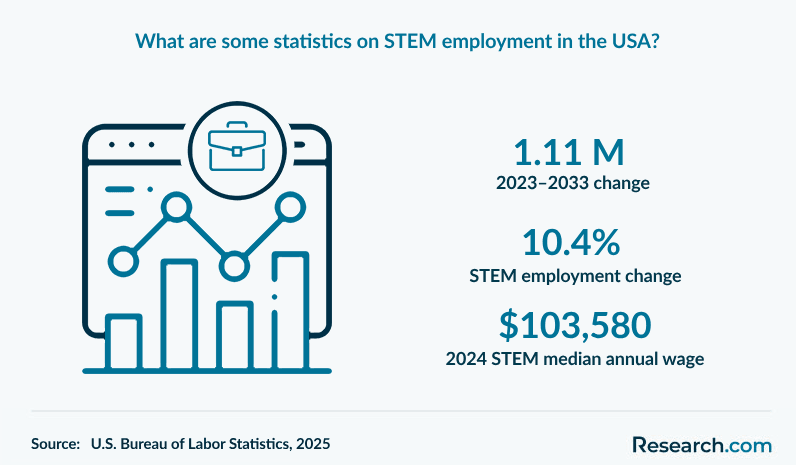
U.S. Bureau of Labor Statistics data from 2025 projects total employment across all occupations to grow from 167.85 million in 2023 to 174.59 million in 2033, a 4.0% increase. The median annual wage for all occupations was $49,500 in 2024.
STEM occupations show stronger projected growth and higher wages. STEM employment was 10.71 million in 2023 and is projected to reach 11.82 million by 2033, a 10.4% increase. The median wage for STEM occupations was $103,580 in 2024. Non-STEM occupations employed 157.14 million workers in 2023 and are projected to grow by 3.6% to 162.77 million by 2033, with a median wage of $48,000 in 2024.
These figures point to strong demand for STEM skills in the broader labor market, which increases the importance of effective science education and skilled STEM teachers.
Current Trends Affecting Science Education Master’s Graduates
Science education is changing as schools adopt new technologies, respond to workforce needs, and work to improve STEM readiness. Graduate programs that stay current should prepare educators for these shifts rather than relying only on traditional lecture-based methods.
- STEM integration: Schools increasingly connect science with technology, engineering, mathematics, and real-world problem-solving.
- AI and digital tools: Educators need to understand how AI-supported tutoring, simulations, virtual labs, and adaptive platforms can support learning without replacing teacher judgment.
- Inquiry-based instruction: Strong science teaching continues to emphasize investigation, evidence, modeling, explanation, and argumentation.
- Data-informed teaching: Teachers are expected to use assessment data to adjust instruction and identify learning gaps.
- Environmental and climate literacy: Science educators are increasingly asked to teach complex environmental issues in accurate and age-appropriate ways.
- Equity in STEM: Schools are working to broaden participation in advanced science and STEM pathways for students historically underrepresented in these fields.
- Flexible graduate education: Online programs remain attractive for working teachers who need career advancement without leaving the classroom.
Common Mistakes to Avoid When Choosing a Program
- Choosing only by tuition: A low-cost program may not be the best value if it does not support licensure, offers weak advising, or requires extra fees.
- Ignoring accreditation: Always verify institutional accreditation and educator preparation recognition before enrolling.
- Assuming online means licensure-ready: Online delivery does not guarantee that a program meets your state’s certification or endorsement requirements.
- Overlooking residency tuition: Some public universities charge different rates for in-state and out-of-state online students.
- Missing fieldwork requirements: Practicum, internship, or classroom-based assignments may need approved local placements.
- Relying only on rankings: Rankings can help you build a shortlist, but your final decision should depend on accreditation, licensure fit, cost, curriculum, and support.
- Assuming salary outcomes are automatic: Salary increases depend on district policy, role, location, and experience.
Questions to Ask Before You Apply
- Is this program for initial teacher certification, advanced licensure, endorsement, or non-licensure professional development?
- Will it meet requirements in my state and for my intended grade level or science discipline?
- What is the total program cost, including fees, materials, assessments, and travel?
- Are courses asynchronous, synchronous, self-paced, cohort-based, or hybrid?
- Does the curriculum match my science area, such as biology, chemistry, physics, earth science, or integrated STEM?
- What student support is available for online learners?
- Does the program include a capstone, thesis, portfolio, internship, practicum, or comprehensive exam?
- How do graduates use the degree after completion?
- Will my employer or district recognize the degree for salary advancement?
- Can I transfer credits, pause enrollment, or study part time if my teaching schedule changes?
Key Insights
- Affordability should be measured by total cost, not advertised tuition. Include fees, materials, licensure costs, travel, and the number of credits required.
- Licensure alignment is essential. A program that is excellent academically may still be the wrong choice if it does not meet your state’s certification, endorsement, or advanced licensure requirements.
- Online programs are best for working educators who need flexibility. They can reduce relocation and commuting barriers, but students must be self-directed and should check fieldwork expectations.
- Career outcomes vary by role. Science teachers with a master’s commonly earn $55,000 to $85,000 annually, while educational consultants average approximately $94,974 and museum educators average approximately $46,390.
- STEM demand strengthens the value of skilled science educators. STEM occupations are projected to grow by 10.4% from 2023 to 2033, compared with 3.6% for non-STEM occupations, according to U.S. Bureau of Labor Statistics data from 2025.
- Program fit matters more than prestige alone. The best online master’s in science education is the one that matches your subject area, state requirements, teaching context, budget, and career plan.
References
- Indeed. (2025, March 2). Science teacher salary in Washington State. Indeed.
- Indeed. (2025, May 5). Science teacher salary in United States. Indeed.
- Indeed. (2025, April 6). Science Teacher Salaries in Washington State for Seattle Public Schools. Indeed.
- Kennedy, B. (2024, April 24). Most Americans think U.S. K-12 STEM education isn't above average, but test results paint a mixed picture. Pew Research Center.
- National Center for Science and Engineering Statistics. (2025, January 21). Figure 1. Enrollment of master's and doctoral students in science, engineering, and health fields, by citizenship status and enrollment type: 2019–23. In Graduate Enrollment and Postdoctoral Appointments in Science, Engineering, and Health Rise, Driven Largely by Increases in the Number of Women and Temporary Visa Holders (NSF 25-316). U.S. National Science Foundation.
- National Center for Education Statistics. (2023). TIMSS 2023: Science – International Comparison. U.S. Department of Education. National Center for Education Statistics.
- Organisation for Economic Co-operation and Development. (2023). Education GPS – United States – Student performance (PISA 2022). OECD.
- Payscale. (2025, March 23). Author Salary. Payscale.
- Payscale. (2025, March 23). Camp Director Salary. Payscale.
- Payscale. (2025, March 23). College Professor Salary. Payscale.
- Payscale. (2025, March 23). Data Scientist Salary. Payscale.
- Payscale. (2025, March 23). Education Coordinator Salary. Payscale.
- Payscale. (2025, March 23). Educational Consultant Salary. Payscale.
- Payscale. (2025, March 23). High School Teacher Salary. Payscale.
- Payscale. (2025, March 23). Naturalist Salary. Payscale.
- Payscale. (2025, March 23). School Counselor Salary. Payscale.
- Payscale. (2025, March 23). Science Teacher Salary. Payscale.
- Payscale. (2025, March 23). Science Teacher Salary in Seattle, Washington. Payscale.
- Payscale. (2025, March 23). Science Teacher Salary in Washington. Payscale.
- U.S. Bureau of Labor Statistics. (2025, April 18). Employment in STEM occupations, 2023 and projected 2033 [Table 1.11]. U.S. Bureau of Labor Statistics.
Other Things You Should Know About Online Master's in Science Education Programs
Many affordable online programs prioritize meeting national teaching standards in 2027 by maintaining rigorous curricula that comply with professional requirements, while keeping tuition low through streamlined resources and digital platforms.
Some of the most affordable online Master's in Science Education programs for 2027 include Western Governors University, the University of the Cumberlands, and Valdosta State University. Each offers competitive tuition rates and flexible online coursework designed to suit educators' diverse needs.
In 2027, the most affordable online Master's in Science Education programs generally range from $6,000 to $12,000 annually. Institutions such as the University of Florida, East Carolina University, and Valdosta State University offer quality programs at competitive rates within this range.


