
2027 Best Online Education Specialist Degrees in Leadership

Co-Founder and Chief Data Scientist
Making the decision to pursue an Education Specialist (Ed.S.) degree in leadership is a significant career step, and as a career planning and education expert, I understand the challenges you face. Sifting through the sheer volume of program options can be overwhelming. Information is often fragmented, with key details about accreditation, curriculum focus, and program costs scattered across different websites.
It's easy to get lost in the marketing and struggle to find clear, verifiable data that aligns with your professional goals. My purpose is to provide clarity and a structured guide, cutting through the noise to present a comprehensive, accurate resource for you to make an informed choice for your future in educational leadership.
What are the benefits of getting an online Education Specialist degree in leadership?
- Career Advancement: An online Ed.S. degree prepares educators for high-impact leadership positions, such as school principal, assistant principal, superintendent, or instructional coordinator. This specialized credential opens doors to greater responsibility and influence in education settings.
- Earning Potential: The degree often leads to a significant boost in salary. Many leadership roles in education, especially administrative positions, offer median pay well above standard teaching positions.
- Flexible Learning: Online programs are crafted for working professionals, providing the convenience of a flexible schedule. This flexibility allows educators to balance coursework with their current careers and personal commitments.
What can I expect from an online Education Specialist degree program in leadership?
- Advanced Practical Training: The curriculum focuses on developing skills in strategic planning, organizational management, curriculum development, and school law—all directly applicable to real-world school leadership.
- Post-Master’s Credential: The Ed.S. is designed for those who already hold a master’s degree, building advanced expertise without requiring the full commitment of a doctoral program.
- Applied Knowledge: Most programs emphasize hands-on learning through case studies, group projects, and a required internship or practicum in a leadership setting.
- Condensed Timeline: Many online Ed.S. programs are structured for quick completion—often within 12 to 18 months—helping you accelerate your career transition.
- Networking Opportunities: Students connect with experienced faculty and a diverse cohort, building a professional network that can support ongoing leadership development.
Where can I work with an online Education Specialist degree in leadership?
- K–12 Public and Private Schools: Take on roles such as principal, assistant principal, or department head.
- School Districts: Advance to positions like superintendent, curriculum director, or professional development coordinator.
- Higher Education Institutions: Move into administrative or leadership roles at colleges and universities.
- Nonprofit and Government Organizations: Lead education initiatives, manage programs, or oversee education reform projects.
- Educational Consulting: Advise schools and districts on effective leadership structures and strategies for academic improvement.
How much can I make with an online Education Specialist degree in leadership?
- Principal & Administrator Roles: Elementary, middle, and high school principals earn a median salary of about $104,070, with top earners making more than $135,000 annually.
- Instructional Leaders: Positions such as instructional coordinator or curriculum developer have median salaries ranging from $66,000 to $87,000.
- District-Level Leadership: Superintendents and senior district administrators often average around $144,547 per year, though this can vary by district size and region.
- Postsecondary Education Administrators: Leaders in higher education institutions earn a median salary of approximately $115,180.
- Best Online Bachelor's Degree in Sports Management Programs for 2027 List of Programs
- What is the average cost of an online sports management bachelor's degree? Program Cost
- What are the financial aid options for an online sports management bachelor's degree? Financial Aid
- What are the prerequisites for enrolling in an online sports management bachelor's degree program? prereqs What are the prerequisites for enrolling in an online sports management bachelor's degree program? prereqs
- What courses are typically in an online sports management bachelor's degree program? What courses are typically in an online sports management bachelor's degree program?
- How do you choose the best online sports management bachelor's degree program? How do you choose the best online sports management bachelor's degree program?
- What career paths are available for graduates of online sports management bachelor's degree programs? Career Paths
- How much can I earn with an online sports management bachelor's degree? Salaries
- What is the job market like for graduates of an online sports management bachelor's degree? Job Market
- What are some current and future trends in sports management? What are some current and future trends in sports management?
- What advantages do accelerated online doctoral programs offer over an Ed.S. in leadership? What advantages do accelerated online doctoral programs offer over an Ed.S. in leadership?
- How Does Interdisciplinary Research Validate the Effectiveness of Online Ed.S. Programs? How Does Interdisciplinary Research Validate the Effectiveness of Online Ed.S. Programs?
- How can you validate the credibility of your online Education Specialist degree program? How can you validate the credibility of your online Education Specialist degree program?
Best Online Education Specialist Degrees in Leadership for 2027
An online Education Specialist degree in leadership is a post-master’s credential for educators who want to move into higher-responsibility roles without immediately committing to a doctorate. For teachers, instructional coaches, assistant principals, curriculum leaders, and aspiring district administrators, the Ed.S. can provide advanced preparation in school law, instructional leadership, data use, personnel management, finance, and organizational change.
This guide is designed to help you compare online Ed.S. leadership programs with a practical lens: cost, licensure alignment, completion time, accreditation, specialization options, and career fit. You will also learn how to evaluate financial aid, admissions requirements, common courses, salary expectations, job market realities, and the key questions to ask before enrolling.
Quick answer: Is an online Ed.S. in leadership worth considering?
An online Ed.S. in leadership can be a strong choice if you already have a master’s degree, work in education, and want advanced leadership training for roles such as principal, assistant principal, superintendent, curriculum director, instructional coach, or education administrator. It is usually shorter than a doctorate and often does not require a dissertation. However, the value depends heavily on whether the program matches your state licensure requirements, your career goal, your budget, and your ability to complete fieldwork or internship requirements while working.
How Research.com evaluates online Ed.S. leadership programs
Because graduate education requires a major investment of time and money, rankings should be transparent and useful rather than promotional. Research.com’s ranking methodology draws on reputable education data sources, including the IPEDS database, Peterson's database and its Distance Learning Licensed Data Set, the College Scorecard database, and the National Center for Education Statistics.
Use the list below as a starting point, then confirm current tuition, state authorization, licensure eligibility, internship rules, and admissions requirements directly with each institution.
| School | Program focus | Credits | Typical length | Stated tuition | Accreditation |
| Indiana University | Educational leadership for school and district roles | 60 credits | Typically 2-3 years | In-state - In-State: $350/credit; Out-of-State: $490.00/credit | Higher Learning Commission (HLC) |
| American College of Education | Leadership-focused post-master’s Ed.S. | 30 credits | Approximately 1 to 1.5 years | $12,660 total cost | Higher Learning Commission (HLC) |
| Arkansas State University | Educational leadership and superintendency | 36 credits | Usually 2 years | $340/credit | Council for the Accreditation of Educator Preparation (CAEP) |
| Lincoln Memorial University | Instructional Practice, Educational Leadership, and Instructional Leadership | 30 semester hours | Typically 2 years | $520/credit | Southern Association of Colleges and Schools Commission on Colleges (SACSCOC) |
| National University | Online EdS with licensure and non-licensure leadership options | 33 credits | 18 months | $32,324 total program cost | WASC Senior College and University Commission (WSCUC) |
| Old Dominion University | K-12 leadership with licensure and non-licensure routes | 30 credits plus internship requirements | 18-24 months | In-state - $400 per credit; Out-of-state - $575 per credit | Southern Association of Colleges and Schools Commission on Colleges (SACSCOC) |
| Regent University | Educational leadership with K-12 administration emphasis | 30-32 credits | Approximately 18 months | $820 per credit hour | Southern Association of Colleges and Schools Commission on Colleges (SACSCOC) |
| University of Alabama | Licensure-focused Educational Leadership | 30-33 credits | 18-24 months | $480/credit | Council for the Accreditation of Educator Preparation (CAEP) |
| University of Kentucky | Teacher leadership, non-licensure | 30 credits | Typically 1.5-2 years | In-state: $15,084 total; Out-of-state: $37,326 total | Southern Association of Colleges and Schools Commission on Colleges (SACSCOC) |
| Walden University | Educational Leadership and Administration with principal licensure preparation | 56 quarter credit hours | 1.5 to 2 years | $560 per quarter hour | Higher Learning Commission (HLC) |
1. Indiana University
Indiana University offers an Online Education Specialist (Ed.S.) in Educational Leadership for educators preparing for leadership responsibilities in schools, districts, and related education organizations. The program emphasizes collaborative leadership, district mission implementation, curriculum planning, data systems, and advocacy for students, families, communities, and stakeholders.
The curriculum connects leadership theory to applied school and district problems. Courses include advanced school law, public school personnel management, and leadership in special education. The program also reports that more than half of IU Online students advance their careers before finishing the degree, which may appeal to working educators who want immediate professional application.
- Program Length: Typically 2-3 years
- Tracks/Concentrations: Varies through electives
- Tuition Cost: In-state - In-State: $350/credit; Out-of-State: $490.00/credit
- Required Credits to Graduate: 60 credits
- Accreditation: Higher Learning Commission (HLC)
2. American College of Education (ACE)
The American College of Education provides an Ed.S. in Leadership for master’s-prepared professionals who want advanced leadership preparation without completing a dissertation. The program is built around leadership competency development, learning communities, organizational partnerships, and evidence-based decision-making.
Students examine how to address complex organizational problems, apply leadership theory, use research-informed strategies, and influence policy and practice. Its virtual format, frequent start dates, accelerated pace, and around-the-clock student support may be useful for educators balancing graduate study with full-time employment.
- Program Length: Approximately 1 to 1.5 years (accelerated pace available)
- Tracks/Concentrations: Educational leadership focus; no separate tracks
- Tuition Cost: $12,660 total cost
- Required Credits to Graduate: 30 credits
- Accreditation: Higher Learning Commission (HLC)
3. Arkansas State University
Arkansas State University offers an online Education Specialist in Educational Leadership, Superintendency program for educators preparing for public school system leadership. The program combines general educational leadership preparation with professional competencies and performance-based work in P-12 school settings.
This program is especially relevant for educators aiming for superintendent or assistant superintendent roles. Admission requires a master's degree and three years of teaching experience. Students pursuing a District Level Administrator license must also have prior administrative experience and a building-level endorsement. Multiple start dates and accelerated coursework make the program more accessible for working professionals.
- Program Length: Usually 2 years (part-time)
- Tracks/Concentrations: Educational leadership, superintendent licensure
- Tuition Cost: $340/credit
- Required Credits to Graduate: 36 credits
- Accreditation: Council for the Accreditation of Educator Preparation (CAEP)
4. Lincoln Memorial University
Lincoln Memorial University offers an Educational Specialist program for educators who want to extend their professional preparation beyond the master’s level. The program is available through two delivery models: a hybrid option with seven Saturday classes and three online classes, and a fully online model using modular coursework.
Students may choose from Instructional Practice (IP), Educational Leadership (EL), and Instructional Leadership (IL). The IL concentration is intended for candidates with the state-required teaching experience and leads to Initial Tennessee Leadership Licensure. The EL concentration is designed for candidates who already hold leadership licensure or work in higher education, while the IP option focuses on curriculum innovation and instructional leadership in classroom settings.
- Program Length: Typically 2 years (flexible pacing)
- Tracks/Concentrations: Instructional Practice (IP), Educational Leadership (EL), and Instructional Leadership (IL).
- Tuition Cost: $520/credit
- Required Credits to Graduate: 30 semester hours
- Accreditation: Southern Association of Colleges and Schools Commission on Colleges (SACSCOC)
5. National University
National University offers a 100% online Education Specialist program for professionals who want advanced practice preparation and stronger leadership skills for educational and social problem-solving. Because the program does not require a dissertation, it may suit students who want a post-master’s credential that is more focused than a traditional doctorate.
The curriculum includes foundation, specialization, and research courses and ends with a capstone project. Students can complete the program in as little as 18 months, and the school offers a new start date every Monday. The coursework emphasizes evidence-based solutions, current educational research, ethical decision-making, and communication with varied stakeholders.
- Program Length: 18 months
- Tracks/Concentrations: Licensure and non-licensure educational leadership tracks
- Tuition Cost: $32,324 total program cost
- Required Credits to Graduate: 33 credits
- Accreditation: WASC Senior College and University Commission (WSCUC)
6. Old Dominion University
Old Dominion University offers an online Education Specialist in Educational Leadership with licensure and non-licensure options. The program is designed for working educators who want preparation for leadership in K-12 schools and districts.
Students study legal and ethical duties, school finance, instructional leadership, community relations, and administrative decision-making. The curriculum uses case studies, applied projects, and an administrative internship to connect coursework with school leadership practice. Graduates may pursue roles such as principal, assistant principal, or aspiring superintendent, depending on licensure status and experience.
- Program Length: 18-24 months (full-time or part-time options)
- Tracks/Concentrations: Non-licensure and licensure tracks available
- Tuition Cost: In-state - $400 per credit; Out-of-state - $575 per credit
- Required Credits to Graduate: 30 credits (plus internship requirements)
- Accreditation: Southern Association of Colleges and Schools Commission on Colleges (SACSCOC)
7. Regent University
Regent University offers an online Education Specialist in Educational Leadership that can be completed in five to six semesters. The degree is positioned between a master’s degree and doctoral study, giving students advanced leadership and research preparation without a dissertation requirement.
The program includes concentration options such as adult education, curriculum and instruction, and K-12 school leadership. Students may use the degree to prepare for roles including teacher leader, professor, principal, or professional development specialist. Regent University has also been ranked among national universities and has received recognition for academic excellence for over a decade.
- Program Length: Approximately 18 months (full-time enrollment)
- Tracks/Concentrations: Educational leadership with a focus on K-12 administration
- Tuition Cost: $820 per credit hour (same for all students)
- Required Credits to Graduate: 30-32 credits
- Accreditation: Southern Association of Colleges and Schools Commission on Colleges (SACSCOC)
8. University of Alabama
The University of Alabama offers an online Education Specialist in Educational Leadership for educators preparing for school system leadership. The program focuses on strategic leadership, school vision, staff collaboration, student achievement, and community engagement.
Graduates are prepared for positions such as school principal, college dean, program director, and superintendent. They are also eligible to pursue Alabama Class AA certification in Instructional Leadership.
Applicants must hold a master’s degree from an accredited institution and a valid master’s level professional educator certificate in Instructional Leadership. Degree requirements include coursework, a problem analysis project, and a comprehensive exam. Most students complete the program in less than two years.
- Program Length: 18-24 months
- Tracks/Concentrations: Licensure-focused Educational Leadership
- Tuition Cost: $480/credit
- Required Credits to Graduate: 30-33 credits
- Accreditation: Council for the Accreditation of Educator Preparation (CAEP)
9. University of Kentucky
The University of Kentucky offers a 100% online Master's (M.Ed.) or Education Specialist (Ed.S.) degree in Teacher Leadership. Unlike administrator licensure programs, this pathway focuses on teachers who want to lead instructional improvement, support colleagues, and strengthen student outcomes without necessarily leaving the classroom.
The curriculum uses cohort-based learning, field-based activities, and virtual class meetings. Graduates may pursue roles such as curriculum specialist, instructional coach, or peer mentor. The program also includes three embedded graduate certificates: Instructional Coaching, Leadership for Deeper Learning, and School Technology Leadership.
GRE scores are not required. The university uses a test-free admission process that considers non-test factors and supports diversity, equity, and inclusion.
- Program Length: Typically 1.5-2 years
- Tracks/Concentrations: Teacher leadership focus (non-licensure)
- Tuition Cost: In-state: $15,084 total; Out-of-state: $37,326 total
- Required Credits to Graduate: 30 credits
- Accreditation: Southern Association of Colleges and Schools Commission on Colleges (SACSCOC)
10. Walden University
Walden University offers an online EdS in Educational Leadership and Administration with Principal Licensure Preparation. The program is intended for educators preparing for leadership in schools, districts, and education organizations.
The curriculum combines leadership theory with applied administrative practice and mentorship. Students study how to manage complex school issues, improve instructional programs, support safe learning environments, lead initiatives, and recruit and retain personnel. The program is nationally recognized by the Educational Leadership Constituent Council and is designed to support preparation for principal roles at the elementary, middle, and high school levels.
- Program Length: 1.5 to 2 years (full-time)
- Tracks/Concentrations: Educational leadership
- Tuition Cost: $560 per quarter hour
- Required Credits to Graduate: 56 quarter credit hours
- Accreditation: Higher Learning Commission (HLC)
If price is your main constraint, compare these programs with Research.com’s guide to the most affordable online education specialist degree in leadership options before applying.
What is the average cost of an online education specialist degree in leadership?
The cost of an online Ed.S. in leadership depends on the school, credit requirements, residency rules, program length, and whether the degree includes licensure-related fieldwork. In general, prospective students should compare the full program cost rather than only the tuition rate per credit.
- Tuition per Credit Hour: Published tuition commonly ranges from $250 to over $800. Public institutions may charge lower rates for in-state students, while private universities may use one tuition rate for all online learners.
- Total Program Cost: For programs requiring 30–36 credit hours, tuition often falls from approximately $8,000 to $29,000 before extra fees.
- Additional Fees: Students may also pay technology, application, graduation, practicum supervision, background check, or assessment fees.
- In-state vs. Out-of-state: Residency can significantly change the final price at public universities, so confirm whether online students qualify for in-state, out-of-state, or special distance-learning tuition.
As with comparing the cost of an MDiv degree online, Ed.S. pricing depends on the institution’s tuition structure and your eligibility for discounted rates. Before enrolling, request a written total-cost estimate that includes tuition, fees, internship expenses, books or materials, and any licensure-related costs.
| Cost factor | Why it matters | Question to ask |
| Credits required | A lower per-credit rate can still be expensive if the program requires more credits. | How many credits are required for my exact track? |
| Residency rate | Public universities may charge different tuition for in-state and out-of-state students. | Do online students receive in-state, out-of-state, or special online tuition? |
| Licensure expenses | Leadership licensure tracks may involve testing, internship supervision, background checks, or documentation fees. | What fees are tied to principal, superintendent, or administrator licensure? |
| Employer support | District reimbursement can reduce out-of-pocket cost but may require continued employment. | Does my district reimburse tuition, and are there service obligations? |
| Transfer policy | Some programs may accept prior graduate credits, reducing time and cost. | How many graduate credits can I transfer, and do they apply to licensure requirements? |
What are the financial aid options for an online education specialist degree in leadership?
Graduate students in Ed.S. leadership programs may have several ways to reduce upfront costs, but eligibility varies by school, enrollment status, and program type. Start early, because scholarship and district reimbursement deadlines may not match the admission deadline.
- Federal Student Aid: Eligible graduate students can submit the Free Application for Federal Student Aid (FAFSA) to be considered for federal loans and available repayment options.
- Scholarships and Grants: Universities may offer graduate education scholarships, and outside organizations may provide awards based on need, merit, educator status, location, or demographic criteria.
- Employer Tuition Assistance: School districts and education organizations may reimburse tuition or offer assistance for employees pursuing leadership credentials.
- Payment Plans: Many universities let students divide tuition into installments instead of paying the full balance at once.
Students comparing funding for an online dog obedience training certification often look at multiple aid sources, and Ed.S. students should take the same approach. Complete the FAFSA early, ask your district about tuition reimbursement, search for educator-specific scholarships, and request guidance from each school’s financial aid office.
What are the prerequisites for enrolling in an online education specialist degree in leadership program?
Most online Ed.S. leadership programs are designed for experienced educators, not first-time graduate students. Admission requirements vary, especially for licensure and non-licensure tracks, but applicants are commonly expected to provide the following:
- Master’s Degree: A master’s degree from a regionally accredited institution, often in education or a related field.
- Minimum GPA: Many programs expect a graduate GPA of about 3.0 on a 4.0 scale, though some may review applicants with lower GPAs if they have strong professional experience.
- Professional Experience: Programs commonly require 2–3 years of full-time teaching or administrative experience in an educational environment.
- Licensure or Certification: Principalship, superintendency, or administrator tracks may require a valid state-issued educator or administrative license.
- Application Materials: Typical requirements include official transcripts, a resume or CV, a statement of purpose, and recommendation letters.
Some students use the Ed.S. as a bridge toward doctoral study. If you want the highest-level leadership credential, compare this pathway with an online doctorate in leadership before deciding.
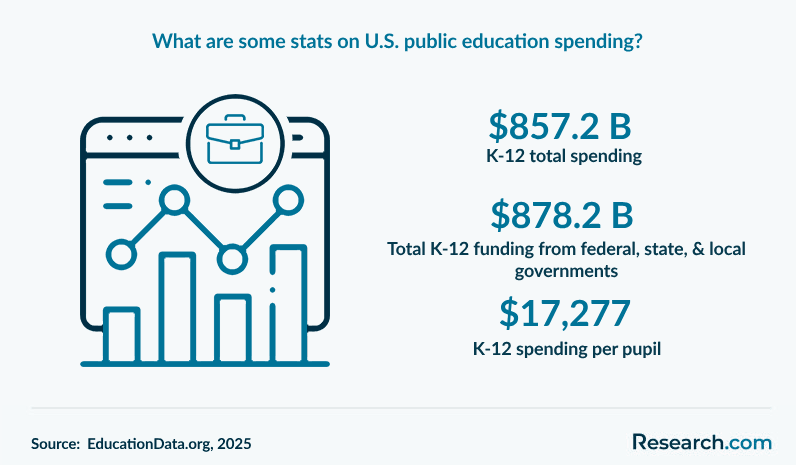
Public education funding is an important backdrop for leadership preparation. In the United States, K-12 schools collectively spend $857.2 billion annually, or $17,277 per pupil. Federal, state, and local governments provide $878.2 billion, or $17,700 per pupil, for K-12 public education, leaving a funding deficit of $21.0 billion, equal to $423 per pupil. The federal government contributes 13.6% of total public K-12 education funding, so most funding comes from state and local sources.
At the postsecondary level, public institutions spend an average of $30,228 per pupil. These numbers show why school leaders need strong budgeting, resource allocation, grant management, and policy skills, especially when districts face pressure to improve outcomes with limited resources.
The graphic below summarizes the funding and spending figures for public education.
What courses are typically in an online education specialist degree in leadership program?
Online Ed.S. leadership programs usually combine administrative theory, applied school leadership, research, legal compliance, and field-based practice. Some leadership concepts overlap with MBA leadership online coursework, but Ed.S. programs are typically more focused on education systems, school improvement, instructional quality, and educator leadership.
- Educational Leadership Theory: Leadership models, organizational culture, school climate, change management, and decision-making frameworks.
- Curriculum and Instruction: Curriculum planning, instructional improvement, assessment systems, and program evaluation.
- School Law and Ethics: Student rights, educator responsibilities, special education law, compliance, governance, and ethical leadership.
- Organizational Management: School budgeting, finance, human resources, operations, strategic planning, and personnel supervision.
- Research and Data Analysis: Research methods, data interpretation, evidence-based improvement, and evaluation of school or district initiatives.
- Practicum/Internship: Supervised leadership experience in a school, district, or other education setting.
| Course area | What you practice | Why it matters in leadership roles |
| School law and ethics | Interpreting policy, handling compliance issues, protecting student and staff rights | Administrators make decisions that carry legal and ethical consequences. |
| Instructional leadership | Improving teaching quality, using assessment data, supporting teacher development | Principals and instructional leaders are judged partly by school and student performance. |
| Finance and operations | Budgeting, staffing, resource planning, and operational decision-making | District and school leaders must align resources with strategic goals. |
| Data and research | Evaluating programs, reading research, and designing improvement initiatives | Evidence-based leadership is increasingly expected in schools and districts. |
| Internship or practicum | Applying leadership skills under supervision | Licensure pathways often require documented field experience. |
According to ZipRecruiter, the 2025 average annual salary for education specialists differs substantially by location. The highest figure listed is Andrews, Maryland, at $117,659. Nantucket, Massachusetts, follows at $113,623. Several California cities also appear among the highest-paying locations, including Berkeley ($113,065), Redwood City ($113,057), South San Francisco ($110,963), El Cerrito ($109,616), Alto ($108,822), Menlo Park ($108,819), and East Palo Alto ($108,807). Sitka, Alaska, is also listed at $111,240.
These location-based salary figures should be interpreted carefully. Higher pay in places such as California or high-cost regions may reflect local cost of living, district budgets, union agreements, and demand for experienced education professionals rather than guaranteed earnings for every Ed.S. graduate.
What types of specializations are available for education leadership graduates?
The right specialization depends on whether you want to lead a classroom team, a school building, a district office, a curriculum department, or a higher education unit. Do not choose a concentration only because it sounds broad; choose the one tied to your next role.
- Principalship: Prepares educators for school-level leadership, instructional supervision, operations, staff development, and family or community engagement.
- Superintendency: Focuses on district administration, governance, finance, policy, human resources, and systemwide improvement.
- Curriculum and Instruction: Centers on curriculum development, instructional design, assessment, and program evaluation across classrooms, schools, or districts.
- Special Education Leadership: Covers oversight of Special Education programs, disability services compliance, advocacy, and support for students with disabilities.
- Teacher Leadership: Supports educators who want to mentor peers, lead professional learning communities, coach instruction, or influence teaching practice without becoming building administrators.
- Higher Education Leadership: Applies leadership preparation to colleges and universities, including student affairs, academic programs, and administrative units.
Students who want broader management preparation outside education may also compare Ed.S. options with online Masters in Management and Leadership programs, especially if they are considering nonprofit, training, consulting, or organizational development roles.
How do you choose the best online education specialist degree in leadership program?
The best online Ed.S. leadership program is the one that fits your licensure needs, career target, schedule, and budget. A well-ranked program is not automatically the right choice if it does not qualify you for the credential or job you want in your state.
- Accreditation: Confirm institutional accreditation and, when relevant, educator preparation approval or programmatic accreditation such as recognition by the Council for the Accreditation of Educator Preparation (CAEP).
- Licensure Alignment: Ask whether the program meets requirements for principal, superintendent, administrator, or instructional leadership credentials in your state.
- Program Focus: Match the concentration to your intended role, such as principalship, teacher leadership, curriculum leadership, or district administration.
- Fieldwork Requirements: Review internship hours, placement rules, supervision expectations, and whether you can complete fieldwork in your current school or district.
- Flexibility and Format: Compare asynchronous and synchronous coursework, part-time options, cohort expectations, start dates, and summer availability.
- Total Cost: Look at tuition, fees, books, technology costs, licensure exams, travel, and any required campus visits.
- Student Support: Prioritize programs with dedicated online advising, licensure guidance, tech support, library access, and career services.
- Faculty and Network: Review faculty backgrounds, district partnerships, mentorship opportunities, and alumni presence in roles similar to your goal.
| If your goal is... | Look for... | Avoid... |
| Principal or assistant principal | Licensure preparation, administrative internship, school law, instructional leadership | Non-licensure programs that do not satisfy state administrator requirements |
| Superintendent or district leader | District-level leadership, finance, policy, HR, governance, superintendent licensure | Programs focused only on classroom or building-level leadership |
| Instructional coach or curriculum specialist | Curriculum, assessment, teacher leadership, coaching, data-driven improvement | Programs built mainly for principal certification if you do not need licensure |
| Higher education administrator | Higher education leadership, student affairs, policy, organizational leadership | K-12 licensure pathways that do not match college or university roles |
| Doctoral study later | Research courses, capstone quality, transferable credits, dissertation preparation | Programs that do not explain how Ed.S. credits apply toward doctoral work |
Questions to ask before you apply
- Does this program meet licensure requirements in the state where I plan to work?
- Can I complete the internship or practicum at my current workplace?
- What is the total cost after tuition, fees, and licensure expenses?
- How often are courses offered, and what happens if I need to stop out for a term?
- Are classes live, asynchronous, or a mix of both?
- What student support is available outside normal work hours?
- What roles do graduates typically move into after completing this specific program?
- Can any credits transfer into an Ed.D., Ph.D., or other doctoral pathway?
What career paths are available for graduates of online education specialist degree in leadership programs?
Graduates of online Ed.S. leadership programs can pursue roles across K-12 schools, school districts, higher education, nonprofit organizations, government agencies, and education consulting. The best fit depends on licensure, experience, location, and the program concentration completed.
- K–12 Schools: Principal, assistant principal, department chair, instructional leader, or school-based administrator responsible for academics, operations, staff development, and student support.
- School Districts: Superintendent, assistant superintendent, curriculum director, instructional services leader, or district administrator.
- Higher Education: College or university administrator, dean, program director, or student services leader.
- Nonprofit/Government: Education policy, program development, public agency leadership, education reform, and nonprofit management roles.
- Educational Consulting: Advisory work with schools, districts, agencies, or education companies on curriculum, leadership, assessment, and organizational improvement.
The global K-12 education market was valued at approximately USD 153.39 billion in 2024 and is projected to reach USD 732.94 billion by 2034, with a compound annual growth rate (CAGR) of 17.47% between 2025 and 2034, according to Custom Market Insights and the graphic below.
That projected expansion is associated with digital learning adoption, government investment in education infrastructure, and wider use of EdTech across public and private education. Students comparing advanced professional degrees, including leadership-focused Ed.S. programs and online DNP AGACNP programs, should look beyond market size and ask how a credential connects to actual licensure, employer demand, and advancement pathways in their field.

Several trends are reshaping K-12 leadership work, including greater focus on STEM education, broader use of digital learning tools, remote and hybrid learning models, AI-supported instruction, adaptive learning technologies, and growth in private and international schools. For Ed.S. students, this means leadership preparation increasingly requires technology fluency, change management, data literacy, and the ability to support teachers through instructional shifts.
How much can I earn with an online education specialist degree in leadership?
Earnings after an Ed.S. in leadership depend on role, employer type, licensure, district pay scales, geographic region, years of experience, and collective bargaining agreements where applicable. For a broader overview of the credential, see Research.com’s guide to the education specialist degree career path.
- Principal and Administrator Roles: Median salary for school principals is about $104,070; top earners can make above $135,000.
- Instructional Leaders: Instructional coordinators and curriculum specialists typically earn $66,000–$87,000.
- District-Level Leadership: Superintendents and senior administrators average around $144,547, with variation by region and district size.
- Postsecondary Education Administrators: Median salary is approximately $115,180.
Payscale.com salary data for roles associated with a Master of Arts in Educational Leadership shows a wide range of outcomes. Lower-paid roles in the data include admissions representative at $35,904, recruiter at $42,269, and project coordinator at $42,900. Mid-range roles include education program coordinator at $47,794, account manager at $50,565, program director for a non-profit at $70,469, director, student services at $70,994, and middle school teacher at $72,339.
The highest salaries in that data set are concentrated in senior, specialized, or nontraditional leadership roles. A compliance manager averages $85,112, a high school principal earns $87,199, and an education program management director earns $90,357. Higher-paid examples include facilities director at $102,313, director of strategic planning at $110,152, information technology (IT) consultant at $151,577, and chief executive officer (CEO) at $171,371.
This range shows why students should not assume a single salary outcome from the degree. The Ed.S. can support advancement, but earnings are shaped by the role you enter, whether the position requires leadership licensure, and how your district or employer compensates advanced credentials.
What is the job market for graduates with an online education specialist degree in leadership?
The job market for education leadership graduates is mixed: compensation for principals and administrators can be strong, but national employment growth is not the same across all roles. Local demand, retirements, district consolidation, school funding, and licensure shortages may matter more than national averages.
- Replacement Hiring: Some openings are created when current leaders retire, change roles, or leave the occupation.
- Specialized Growth Areas: Special education leadership, curriculum improvement, instructional technology, and data-informed school improvement may offer opportunities for educators with targeted expertise.
- Regional Variation: Underserved schools and hard-to-staff districts may have more difficulty recruiting experienced leaders.
- Credential Expectations: Principal, superintendent, and district administrator jobs often require specific state credentials in addition to graduate education.
The 2024 median pay for elementary, middle, and high school principals was $104,070 per year, as shown in the graphic below. A master's degree is the typical entry-level education for the role, and five or more years of work experience are typically required. According to the U.S. Bureau of Labor Statistics, there were 316,600 jobs in 2023, but the 2023–33 job outlook is projected to decline by -1%, equal to about -1,600 jobs.
Even with a projected decline, advanced leadership training may help educators compete for positions that require administrative expertise. The decision is similar in logic to professionals considering DBA management online programs: the credential is most valuable when it aligns with a specific leadership role, not simply because it is advanced.
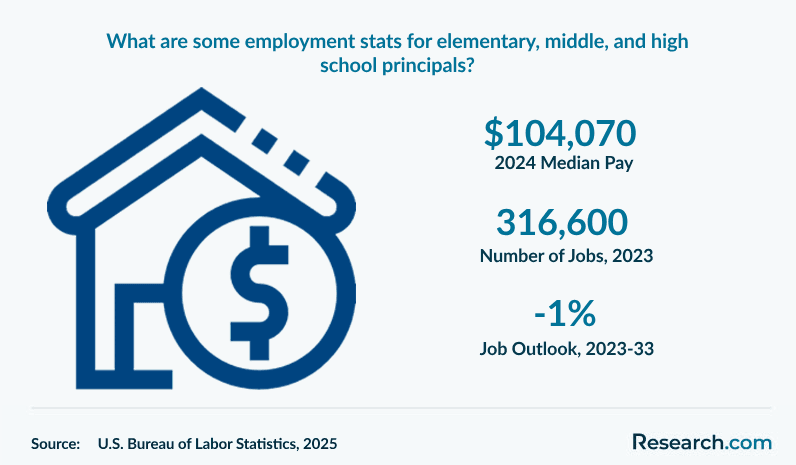
The BLS data suggests that the principal occupation offers a strong median salary but limited projected growth. Students should therefore evaluate local openings, district leadership pipelines, administrator licensure requirements, and internal promotion patterns before assuming that an Ed.S. will automatically lead to a new position.
What are some current and future trends in education leadership?
Education leaders are being asked to manage more complex schools and systems. Ed.S. programs increasingly need to prepare graduates for technology-driven instruction, data-informed decision-making, equity-centered leadership, and crisis response.
- AI-Enhanced Leadership Practices: School leaders are beginning to use artificial intelligence tools to streamline administrative tasks, support personalized learning, and improve decision-making, while also managing privacy, bias, and implementation concerns.
- Data-Driven Decision Making: Leaders are expected to interpret achievement, attendance, behavior, staffing, and assessment data. Educators interested in deeper analytics preparation may also explore data analytics degrees.
- Technology Integration: Administrators must make strategic decisions about learning platforms, digital tools, cybersecurity, accessibility, and teacher support.
- Equity and Inclusion: Schools continue to prioritize inclusive leadership, culturally responsive practice, and equitable access to advanced coursework, technology, and support services.
- Social-Emotional Learning (SEL): Student well-being, behavior support, and resilience remain central concerns for school leaders.
- Personalized Learning: Adaptive platforms and differentiated instruction require leaders who can guide implementation and evaluate impact.
- Crisis Management: Public health disruptions, natural disasters, safety issues, and community conflict have made planning and adaptive leadership more important.
What advantages do accelerated online doctoral programs offer over an Ed.S. in leadership?
An Ed.S. is usually a practical post-master’s credential for advanced leadership preparation, while an Ed.D. or other doctorate may be more appropriate for senior district leadership, higher education administration, research-focused work, or roles where a doctorate is preferred. Accelerated doctoral programs can appeal to professionals who want a terminal degree but need a shorter, more structured timeline.
Before choosing between an Ed.S. and a doctorate, compare time to completion, dissertation or capstone requirements, transfer credit policies, tuition, and career expectations. Researching the fastest EdD online programs can help you see whether a doctoral route better matches your long-term goals than an Ed.S. alone.
| Path | Best for | Potential drawback |
| Ed.S. in leadership | Educators seeking advanced leadership preparation, licensure alignment, or career advancement without a dissertation | May not satisfy roles that prefer or require a doctorate |
| Accelerated Ed.D. | Professionals seeking a terminal practice doctorate for high-level leadership, research application, or senior roles | May require more writing, research, time, and cost than an Ed.S. |
| Ph.D. in education | Students aiming for academic research, faculty roles, or scholarly work | Often less practice-focused than Ed.S. or Ed.D. leadership programs |
How does interdisciplinary research support online Ed.S. leadership programs?
Strong education leadership programs do not rely only on administrative theory. They often draw from organizational behavior, policy analysis, psychology, sociology, technology, assessment, and qualitative research to help educators understand how schools operate in real communities.
Methods used in fields such as anthropology can also inform culturally responsive leadership, community engagement, and qualitative evaluation. Students interested in the broader research methods behind education systems may find useful parallels in an anthropology bachelor degree online, especially when studying culture, institutions, and community dynamics. For Ed.S. students, interdisciplinary thinking can strengthen program evaluation, stakeholder engagement, and leadership decisions in diverse educational settings.
What graduates say about online Education Specialist degrees in leadership
- : "The online Ed.S. format let me keep teaching while preparing for the next stage of my career. I appreciated that the coursework connected directly to leadership problems I saw in my school, and the support from faculty and classmates helped me feel ready to apply for administrative roles. — Adnan"
- : "The program changed how I think about leadership. Courses in data-informed decision-making and school law were especially useful because they matched the issues my district deals with every day. I finished with a clearer sense of purpose and a stronger understanding of how to serve my school community. — Priya"
- : "I worried that an online program would feel disconnected, but the classes were interactive and the faculty were involved. I built a professional network with educators from different states, and the mentorship helped me step into my current principal role with more confidence. — Javier"
How can you validate the credibility of your online Education Specialist degree program?
To verify whether an online Ed.S. program is credible, start with accreditation and licensure alignment. Confirm the institution’s recognized accreditation status, then ask whether the specific program meets the education leadership requirements in the state where you plan to work. If the program advertises licensure preparation, request written confirmation and ask about internship requirements, testing, and state approval.
Next, look at indicators of student support and value: graduation rates, advising, field placement help, career services, faculty experience, alumni roles, and partnerships with districts or education organizations. Independent reviews and rankings can add context, but they should not replace direct verification. Students building cross-disciplinary education careers may also compare leadership programs with options such as an affordable MLIS degree online, especially if they are interested in school libraries, information services, instructional resources, or academic support roles.
Common mistakes to avoid when choosing an online Ed.S. in leadership
| Mistake | Why it can hurt you | Better approach |
| Choosing a program without checking licensure rules | You may graduate without meeting principal, superintendent, or administrator requirements in your state. | Ask the program and your state licensing agency to confirm eligibility in writing. |
| Comparing only tuition per credit | A lower credit rate may still lead to a higher total price if the program has more credits or extra fees. | Compare total program cost, including fees, fieldwork, exams, and materials. |
| Assuming online means fully flexible | Some online programs require live classes, internships, set cohort schedules, or campus visits. | Review weekly expectations, synchronous requirements, and field placement rules. |
| Ignoring accreditation | Accreditation can affect financial aid, transferability, employer recognition, and licensure eligibility. | Verify institutional accreditation and any relevant educator preparation approval. |
| Relying only on rankings | A highly ranked program may not fit your state, schedule, budget, or career goal. | Use rankings as a shortlist, then evaluate fit through licensure, cost, curriculum, and outcomes. |
| Assuming salary growth is guaranteed | Pay depends on role, district policies, location, experience, and whether the new credential is recognized. | Check local salary schedules and ask whether an Ed.S. affects pay or promotion eligibility. |
Key Insights
- An online Ed.S. in leadership is best suited for educators who already hold a master’s degree and want advanced preparation for school, district, instructional, or education administration roles.
- Licensure alignment is the most important decision factor. A non-licensure Ed.S. may be useful for teacher leadership or curriculum roles, but it may not qualify you for principal or superintendent positions.
- Program costs vary widely, so compare total cost rather than only per-credit tuition. Include fees, internship expenses, licensure exams, and whether in-state rates apply.
- Accreditation matters for credibility, financial aid, employer recognition, and, in some cases, licensure. Always verify institutional accreditation and any relevant educator preparation approval.
- Career outcomes depend on role and location. The 2024 median pay for elementary, middle, and high school principals was $104,070, but the BLS projects a -1% job outlook for 2023–33, so local demand should guide your decision.
- Current education leadership increasingly requires data literacy, technology planning, AI awareness, equity-centered practice, crisis management, and instructional improvement skills.
- The best program is not necessarily the fastest or cheapest one. It is the program that fits your state requirements, career path, schedule, fieldwork situation, and long-term return on investment.
References:
- Education Data Initiative. (2025, February). U.S. Public Education Spending Statistics. EducationData.org.
- Payscale. (2025). Master of Arts (MA), Educational Leadership salary. Payscale.
- U.S. Bureau of Labor Statistics. (2025). Elementary, middle, and high school principals. U.S. Department of Labor, Occupational Outlook Handbook. U.S. Bureau of Labor Statistics.
- Yahoo Finance. (2024, February 7). Latest global K12 education market report 2024: A.I. in education transforming learning & teaching, market to reach $358.2 billion by 2030. Yahoo Finance.
- ZipRecruiter. (2025). Education specialist salary. ZipRecruiter.
- Additional salary reference: Payscale salary data for educational leadership.
Other Things You Should Know About Online Education Specialist Degrees in Leadership
The best online Education Specialist Degrees in Leadership in 2027 are characterized by flexible scheduling, comprehensive curricular coverage of leadership theories and practices, and a focus on practical application in educational settings. These programs often offer robust support services and networking opportunities to prepare graduates for leadership roles in education.
To enroll in the best online Education Specialist Degrees in Leadership in 2027, you will typically need a master's degree in education or a related field, letters of recommendation, a statement of purpose, and relevant professional experience. Some programs may also require GRE scores.


