
2027 Best Online DNP Adult-Gerontology Acute Care NP Programs

Co-Founder and Chief Data Scientist
With 24.3% of older adults in fair or poor health, the need for expert clinical leaders in our hospital systems has never been greater. The Doctor of Nursing Practice (DNP) is the credential designed for this challenge, yet it's held by an elite 2.7% of all RNs. The career planning experts behind this guide have spent a decade helping nurses make this exact leap, and choosing from the available online adult-gerontology acute care NP programs is a critical first step.
The biggest hurdle is often the first one: choosing the right specialty. The most common point of confusion is between acute care and primary care. Think of it this way: the Adult-Gerontology Acute Care Nurse Practitioner (AG-ACNP) is the hospital-based "sprinter" who stabilizes patients in crisis. The primary care NP is the clinic-based "marathon runner" who manages chronic health over the long term. This guide provides the clarity you need to choose with confidence.
What are the benefits of getting an online DNP adult-gerontology acute care NP degree?
- Lead high-stakes patient care in hospital settings with one of the best online adult-gerontology acute care NP programs, moving from implementing care plans to creating them.
- Unlock top-tier earning potential, with salaries reaching $184,000 for practitioners working in hospital inpatient care.
- Gain access to elite, nationally-recognized universities from anywhere in the country through a flexible online format.
What can I expect from an online DNP adult-gerontology acute care NP program?
You should expect a program that blends online flexibility with rigorous, hands-on clinical practice. The "online" part refers to your coursework—the lectures, research, and theory—which you can complete from home, fitting it around your work schedule.
However, there is a mandatory and non-negotiable in-person requirement. All accredited programs require you to complete around 1,000 hours of supervised clinical practice in a hospital setting. This ensures you have the real-world skills to match your advanced knowledge. It's also important to know that after you're certified, you'll need to recertify every four to five years, which keeps your skills sharp.
Accreditation: The Only True Mark of Quality
Let's be very clear about something. When it comes to the value of your degree, the delivery format—online or on-campus—is irrelevant. The only factor that matters to employers and state nursing boards is programmatic accreditation.
A degree from a program accredited by the Commission on Collegiate Nursing Education (CCNE) or the Accreditation Commission for Education in Nursing (ACEN) is the gold standard. This is your guarantee of a high-quality education that will be respected throughout your career.
Where can I work with an online DNP adult-gerontology acute care NP degree?
The answer is straightforward: you will work inside a hospital. Your expertise is needed in the most dynamic and critical environments, including the Intensive Care Unit (ICU), the Emergency Department, and specialized inpatient services like cardiology, oncology, or trauma.
Your scope of practice is tied to these high-acuity settings. It’s important to understand that you cannot work in a primary care clinic with this certification.
The Rise of the Nurse Practitioner Hospitalist
A major career track for DNP-prepared AG-ACNPs is the role of the hospitalist. In this position, you take on the leadership and management of care for an entire ward of patients from admission to discharge.
This role, once dominated by physicians, requires the high level of clinical judgment and autonomy that the DNP provides. It's a clear pathway to a significant leadership position within the hospital system.
How much can I make with an online DNP adult-gerontology acute care NP degree?
As a DNP-prepared AG-ACNP, you are positioned to be one of the highest earners in the nursing profession. While salaries vary based on location and experience, top earners in hospital inpatient settings can make $184,000 or more.
This earning potential is a direct reflection of the role's immense responsibility. You are being compensated for an elite skill set and the ability to make critical, high-stakes decisions for the most complex patients in the hospital.
Employers are willing to pay a premium for DNP-level providers who can improve patient outcomes and lead care teams in these demanding environments.
- List of the Best Online DNP Adult-Gerontology Acute Care NP Programs for 2027 List of Programs
- How long does it take to complete an online DNP adult-gerontology acute care NP program? Completion Time
- How does an online DNP adult-gerontology acute care NP program compare to an on-campus program? How does an online DNP adult-gerontology acute care NP program compare to an on-campus program?
- What is the average cost of an online DNP adult-gerontology acute care NP program? Program Cost
- What are the financial aid options for students enrolling in an online DNP adult-gerontology acute care NP program? Financial Aid
- What are the prerequisites for enrolling in an online DNP adult-gerontology acute care NP program? What are the prerequisites for enrolling in an online DNP adult-gerontology acute care NP program?
- What courses are typically in an online DNP adult-gerontology acute care NP program? What courses are typically in an online DNP adult-gerontology acute care NP program?
- What types of specializations are available in an online DNP adult-gerontology acute care NP program? What types of specializations are available in an online DNP adult-gerontology acute care NP program?
- How to Choose the Best Online DNP Adult-Gerontology Acute Care NP Program How to Choose the Best Online DNP Adult-Gerontology Acute Care NP Program
- What career paths are available for graduates of an online DNP adult-gerontology acute care NP program? Career Paths
- What is the job market for graduates of an online DNP adult-gerontology acute care NP program? Job Market
- What Challenges Can You Anticipate in an Online DNP Adult-Gerontology Acute Care NP Program? What Challenges Can You Anticipate in an Online DNP Adult-Gerontology Acute Care NP Program?
- How Can an ABSN Graduate Transition Directly into an Online DNP Program? How Can an ABSN Graduate Transition Directly into an Online DNP Program?
Best Online DNP Adult-Gerontology Acute Care NP Programs for 2027
Choosing an online Doctor of Nursing Practice program in Adult-Gerontology Acute Care Nurse Practitioner practice is a high-stakes decision. The program you select can affect your eligibility for national certification, your clinical placement quality, your total debt, and the hospital-based roles you can pursue after graduation.
This guide is for registered nurses comparing online or hybrid DNP-AGACNP programs, especially BSN-prepared nurses planning a direct path into advanced practice. You will find ranked program options, time-to-completion expectations, cost and financial aid considerations, prerequisite guidance, curriculum details, career outcomes, and practical questions to ask before enrolling.
Quick Answer: What Is the Best Online DNP Adult-Gerontology Acute Care NP Program?
The best online DNP adult-gerontology acute care NP program is usually the one that combines CCNE or ACEN accreditation, strong certification preparation, reliable clinical placement support, transparent tuition, and a format that fits your work schedule. Most programs in this specialty are hybrid rather than fully online because AG-ACNP preparation requires in-person clinical training, simulation, and supervised acute care practice.
For BSN-prepared nurses, a BSN-to-DNP AGACNP program commonly takes three to four years of full-time study. MSN-prepared nurses may complete an MSN-to-DNP path in one to two years, depending on prior graduate coursework and clinical hours.
How do we rank schools?
Because a DNP is both a professional credential and a major financial commitment, our ranking process focuses on factors that matter to working nurses: affordability, program structure, academic quality, accreditation, and available institutional data. Research.com uses information from trusted education datasets, including the IPEDS database, Peterson's database, the College Scorecard database, and The National Center for Education Statistics.
These sources help us evaluate online DNP adult-gerontology acute care nurse practitioner programs using consistent and transparent criteria. To understand how Research.com evaluates programs across degree categories, review the full ranking methodology.
Online DNP-AGACNP Programs at a Glance
| Rank | School and Program | Format | Program Length | Credits and Clinical Hours | Tuition | Accreditation |
| 1 | Pennsylvania State University — Doctor of Nursing Practice – Adult Gerontology Acute Care Nurse Practitioner | Hybrid | 3 years | 55 credits and 1,031 practicum hours | $1,037.00 per credit | Commission on Collegiate Nursing Education (CCNE) |
| 2 | Indiana University-Indianapolis — BSN to DNP - Adult-Gerontology Acute Care Nurse Practitioner | Hybrid | 3 years | 66 credit hours and 1005 clinical hours | $735.00 per credit | Accreditation Commission for Education in Nursing (ACEN) |
| 3 | University of Pittsburgh-Pittsburgh — BSN to DNP - Adult-Gerontology Acute Care Nurse Practitioner | Hybrid | 3 years | 79 credits | $1,280 (in-state) | $1,595 (out-of-state) per credit | Accreditation Commission for Education in Nursing (ACEN) |
| 4 | Tennessee Technological University — DNP - Adult/Gerontology Acute Care Nurse Practitioner | Hybrid | 3-4 years | 84 credits | $577.00 (in-state) | $839.00 (out-of-state) per credit | Commission on Collegiate Nursing Education (CCNE) |
| 5 | Maryville University of Saint Louis — DNP - Adult Gerontology Acute Care Nurse Practitioner | Primarily online core coursework | 3-4 years | 68-77 credits | $863 (MSN courses) | $947 (DNP courses) per credit | Commission on Collegiate Nursing Education (CCNE) |
| 6 | University of Southern Indiana — BSN to DNP - Adult-Gerontology Acute Nurse Practitioner | Hybrid | 4-5 years | 78 credits | $596.94 (in-state) | $646.94 (out-of-state/online), including program fees | Commission on Collegiate Nursing Education (CCNE) |
| 7 | University of Central Florida — Adult/Gerontology Acute Care Nurse Practitioner DNP | Hybrid | 9 semesters (full-time) or 12 semesters (part-time) | 73 credits and 1,080 clinical hours | $288.16 (in-state) per credit | Commission on Collegiate Nursing Education (CCNE) |
| 8 | Mercer University — BSN to DNP - Adult-Gerontology Acute Care Nurse Practitioner | Hybrid | 3-4 years | 77 credits and 1,020 practice hours | $1,285.50 per semester hour | Commission on Collegiate Nursing Education (CCNE) |
1. Pennsylvania State University - Doctor of Nursing Practice – Adult Gerontology Acute Care Nurse Practitioner
Pennsylvania State University offers a hybrid DNP pathway for nurses preparing to practice as adult-gerontology acute care nurse practitioners. The program uses primarily online core coursework while preparing students for high-acuity clinical environments, complex older adult care, advanced assessment, and technology-supported interventions. Graduates are prepared to pursue national certification.
- Program Length: 3 years
- Specialization: Adult Gerontology Acute Care Nurse Practitioner
- Required Credits to Graduate: 55 credits and 1,031 practicum hours
- Cost per Credit: $1,037.00
- Accreditation: Commission on Collegiate Nursing Education (CCNE)
2. Indiana University-Indianapolis - BSN to DNP - Adult-Gerontology Acute Care Nurse Practitioner
Indiana University-Indianapolis provides a hybrid BSN-to-DNP AGACNP program that combines online core coursework with intensive hands-on preparation. Students build advanced practice skills through high-fidelity simulation and training in procedures such as intubation and central line insertion, which are essential for acute and critical care readiness.
- Program Length: 3 years
- Specialization: Adult-Gerontology Acute Care Nurse Practitioner
- Required Credits to Graduate: 66 credit hours and 1005 clinical hours
- Cost per Credit: $735.00
- Accreditation: Accreditation Commission for Education in Nursing (ACEN)
3. University of Pittsburgh-Pittsburgh - BSN to DNP - Adult-Gerontology Acute Care Nurse Practitioner
The University of Pittsburgh offers a hybrid BSN-to-DNP AGACNP option designed for nurses who want to care for adults with complex acute conditions. A notable feature is directed study, which lets students shape clinical learning around a focused area such as surgery, internal medicine, or another specialty interest.
- Program Length: 3 years
- Required Credits to Graduate: 79 credits
- Cost per Credit: $1,280 (in-state) | $1,595 (out-of-state)
- Accreditation: Accreditation Commission for Education in Nursing (ACEN)
4. Tennessee Technological University - DNP - Adult/Gerontology Acute Care Nurse Practitioner
Tennessee Tech structures its DNP-AGACNP program around online learning, required campus intensives two to three times per year, and community-based precepted clinical work. The program is built for nurses preparing to deliver critical interventions, coordinate care, and advocate for acutely ill adult and gerontology patients.
- Program Length: 3-4 years
- Required Credits to Graduate: 84 credits
- Cost per Credit: $577.00 (in-state) | $839.00 (out-of-state)
- Accreditation: Commission on Collegiate Nursing Education (CCNE)
5. Maryville University of Saint Louis - DNP - Adult Gerontology Acute Care Nurse Practitioner
Maryville University of Saint Louis offers a direct BSN-to-DNP AGACNP route with primarily online core coursework. The program is intended for nurses who want to move into advanced practice roles focused on acute and complex care for adult and older adult populations.
- Program Length: 3-4 years
- Required Credits to Graduate: 68-77 credits
- Cost per Credit: $863 (MSN courses) | $947 (DNP courses)
- Accreditation: Commission on Collegiate Nursing Education (CCNE)
6. University of Southern Indiana - BSN to DNP - Adult-Gerontology Acute Nurse Practitioner
The University of Southern Indiana delivers a hybrid BSN-to-DNP AGACNP program with online core coursework and preparation for practice across acute and complex care settings. The curriculum focuses on direct patient care and health management for patients from late adolescence through the adult lifespan.
- Program Length: 4-5 years
- Required Credits to Graduate: 78 credits
- Cost per Credit: $596.94 (in-state) | $646.94 (out-of-state/online), including program fees
- Accreditation: Commission on Collegiate Nursing Education (CCNE)
7. University of Central Florida - Adult/Gerontology Acute Care Nurse Practitioner DNP
The University of Central Florida offers a hybrid AGACNP DNP that blends online coursework with required biannual intensives. The program prepares nurse practitioners to manage medically complex adult and gerontology patients across care settings, including acute hospital environments and home care.
- Program Length: 9 semesters (full-time) or 12 semesters (part-time)
- Required Credits to Graduate: 73 credits and 1,080 clinical hours
- Cost per Credit: $288.16 (in-state)
- Accreditation: Commission on Collegiate Nursing Education (CCNE)
8. Mercer University - BSN to DNP - Adult-Gerontology Acute Care Nurse Practitioner
Mercer University provides a hybrid BSN-to-DNP AGACNP program with online core coursework and a direct route into advanced acute care practice. The curriculum is aligned with preparation for national certification through the American Nurses Credentialing Center or the American Association of Critical-Care Nurses.
- Program Length: 3-4 years
- Required Credits to Graduate: 77 credits and 1,020 practice hours
- Cost per Semester Hour: $1,285.50
- Accreditation: Commission on Collegiate Nursing Education (CCNE)
How long does it take to complete an online DNP adult-gerontology acute care NP program?
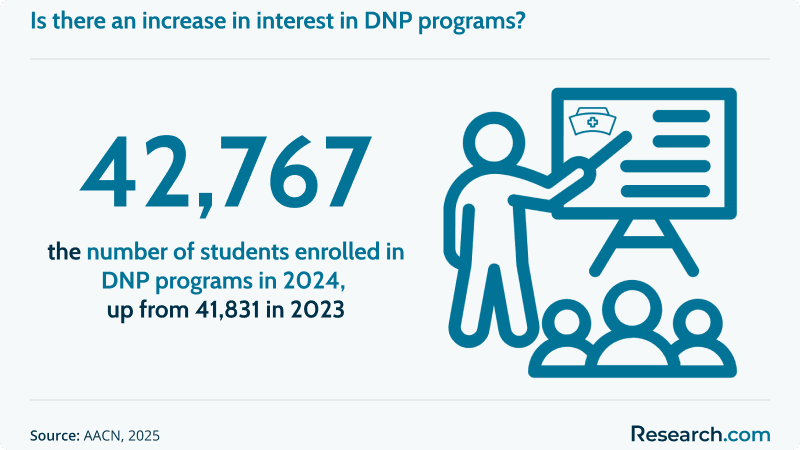
Program length depends mainly on whether you enter with a BSN or an MSN. With over 42,767 students currently enrolled in DNP programs, many nurses are choosing the doctorate despite the time commitment. A BSN-to-DNP AGACNP program generally requires three to four years of full-time study because it combines graduate APRN coursework, doctoral-level leadership and evidence-based practice courses, and supervised clinical preparation.
An MSN-to-DNP pathway is shorter for nurses who already completed graduate nursing coursework. These programs typically take one to two years, although the exact timeline depends on transfer credits, prior clinical hours, enrollment pace, and DNP project requirements.
BSN-to-DNP vs. MSN-to-DNP: Which timeline makes sense?
| Path | Best for | Typical Time | Main Advantage | Trade-Off |
| BSN-to-DNP | RN candidates who know they want acute care NP practice and want one continuous graduate pathway | Three to four years of full-time study | Direct route to the terminal practice degree | Longer single commitment with a heavy workload |
| MSN-to-DNP | APRNs or MSN-prepared nurses who want doctoral preparation after completing a master's degree | One to two years | Shorter doctorate phase and more flexibility | May take longer overall if you complete MSN and DNP separately |
The BSN-to-DNP route works like a direct trip: you move from RN preparation into doctoral advanced practice training without stopping for a separate master's degree. The MSN-to-DNP route gives nurses more flexibility, especially if they need to pause between degrees or first complete one of the best BSN to MSN online programs before deciding whether to continue to the doctorate.
How does an online DNP adult-gerontology acute care NP program compare to an on-campus program?
An accredited online or hybrid DNP-AGACNP program should meet the same academic and clinical standards as a campus-based program. The important question is not whether lectures are delivered online; it is whether the program has recognized nursing accreditation, approved clinical experiences, qualified faculty, and a curriculum aligned with certification requirements.
Because AG-ACNP practice is hands-on, most online programs still require in-person clinical rotations, simulation experiences, and campus intensives. In that sense, “online” usually means didactic coursework is delivered remotely, not that the entire degree can be completed from home. This is different from many nonclinical online credentials, such as an online ethical hacking dual-certification bootcamp, where hands-on practice may be completed in virtual labs rather than patient-care settings.
Online vs. Campus DNP-AGACNP Programs
| Factor | Online or Hybrid Program | Campus Program | What to Ask |
| Course delivery | Most theory courses are online, often asynchronous or blended | Courses are primarily in person | Are lectures live, recorded, or both? |
| Clinical training | Completed in approved healthcare settings, often near the student when possible | Often arranged through local campus partnerships | Who is responsible for finding preceptors? |
| Campus visits | May require intensives, skills labs, or simulation sessions | Regular campus attendance is expected | How often must students travel to campus? |
| Flexibility | Often better for working nurses | May provide more scheduled face-to-face structure | Can the program accommodate shift work? |
| Best fit | Nurses who need geographic flexibility and can manage independent learning | Nurses who prefer regular in-person interaction and live classroom structure | Which format matches your learning habits and schedule? |
The real advantage of online study: program access
The strongest benefit of an online or hybrid DNP is access. Instead of limiting your search to schools within commuting distance, you can compare programs by accreditation, faculty expertise, clinical support, tuition, and certification preparation. That flexibility is valuable for experienced critical care nurses who cannot relocate or leave full-time employment.
What is the average cost of an online DNP adult-gerontology acute care NP program?
The cost of an online DNP-AGACNP program varies widely by institution type, residency status, required credits, fees, and clinical requirements. Among the programs listed here, tuition ranges from $288.16 per credit for in-state students at the University of Central Florida to $1,285.50 per semester hour at Mercer University.
As with online nurse education graduate certificate programs, the published per-credit tuition is only one part of the total price. Students should also account for university fees, campus intensives, travel, certification exam costs, books, background checks, immunizations, clinical tracking systems, and possible lost income if they reduce work hours.
Cost factors to compare before applying
| Cost Factor | Why It Matters | Question to Ask the Program |
| Per-credit tuition | Programs require different credit totals, so a low rate does not always mean the lowest total cost | What is the estimated full program tuition? |
| Residency status | Public universities may charge different rates for in-state and out-of-state students | Do online students qualify for a separate online tuition rate? |
| Clinical placement costs | Some students may need to travel or pay documentation-related fees | Does the school help secure clinical sites? |
| Campus intensives | Hybrid programs may require travel, lodging, and time away from work | How many in-person visits are required each year? |
| Certification preparation | Board exam readiness can affect how quickly you can enter practice | Are review materials or exam prep included? |
How work setting affects return on investment
The financial return from a DNP-AGACNP depends on several variables, including location, employer type, specialty, experience, shift expectations, and leadership responsibilities. Hospital inpatient settings often offer higher pay because AG-ACNPs manage complex patients and make rapid clinical decisions in high-acuity environments.
The salary data shown below compares average annual earnings by work setting and illustrates why many AG-ACNP graduates target hospital-based roles after certification.
What are the financial aid options for students enrolling in an online DNP adult-gerontology acute care NP program?
DNP students commonly use a mix of federal aid, scholarships, employer benefits, and payment plans. Start early because graduate nursing aid deadlines and employer reimbursement rules may not align with admission deadlines.
- Federal Student Aid: The first step is completing the Free Application for Federal Student Aid (FAFSA), which determines eligibility for federal graduate student aid.
- Nursing Scholarships: Graduate nursing students may find awards through universities, foundations, specialty nursing groups, and professional nursing organizations.
- Employer Tuition Reimbursement: Hospitals and health systems may help fund graduate education for nurses who commit to continued employment or move into high-need advanced practice roles.
- School-Based Aid: Ask each university about graduate assistantships, nursing-specific scholarships, payment plans, and military or veteran benefits.
How to approach employer tuition reimbursement
For working critical care nurses, employer support can be one of the most practical ways to reduce out-of-pocket cost. Frame the request as a workforce solution: your DNP preparation can help the organization fill advanced practice gaps, improve continuity of care, support quality initiatives, and expand acute care capacity.
Before enrolling, ask your human resources department whether reimbursement requires minimum grades, continued employment after graduation, enrollment in an approved school, or repayment if you leave the organization. These details matter as much as the dollar amount.
Financial planning is also important in other healthcare and rehabilitation-related fields, including students evaluating the best online communication disorders degree programs.
What are the prerequisites for enrolling in an online DNP adult-gerontology acute care NP program?
Typical admission requirements include a BSN or MSN from an accredited nursing program, an active RN license, official transcripts, professional references, a resume, a personal statement, and evidence of academic readiness for graduate study. For AG-ACNP programs, however, the most important differentiator is recent clinical experience in a high-acuity setting.
Competitive programs often expect one to two years of recent, full-time experience in environments such as an ICU or Emergency Department. This is because acute care NP education assumes you already understand unstable patients, complex monitoring, critical medications, and fast-moving interdisciplinary care. Programs in other nursing specialties, such as the best online MSN in nursing informatics programs, may emphasize a different professional foundation.
Why critical care experience matters
AG-ACNP coursework is not designed to teach basic critical care from the beginning. It builds on prior bedside judgment in areas such as hemodynamics, ventilator concepts, advanced pharmacology, rapid assessment, and escalation of care. Medical-surgical experience is valuable, but applicants should verify whether it meets the program’s acute care experience requirement before applying.
If you are still building your nursing pathway, review how prerequisite expectations differ by field. For example, an early-career student comparing nursing to a top online bachelor's degree in sports management would face very different admission, licensure, and clinical requirements.
Questions to ask admissions before you apply
- Does the program require ICU, ED, step-down, trauma, or other specific acute care experience?
- Is part-time RN experience acceptable, or must it be full-time?
- How recent must the acute care experience be?
- Can applicants apply while still completing the required experience?
- Are applicants required to identify potential clinical sites before admission?
- Does the program accept students from your state?
What courses are typically in an online DNP adult-gerontology acute care NP program?
An online DNP-AGACNP curriculum prepares nurses to assess, diagnose, treat, and manage acutely ill adults and older adults. Coursework combines advanced clinical science, doctoral leadership, evidence-based practice, health policy, quality improvement, and supervised acute care practicum experiences.
- Advanced Pathophysiology: Students study complex disease processes that drive acute illness, deterioration, and hospitalization.
- Advanced Pharmacology: Coursework emphasizes medication management for serious and unstable conditions, including drugs commonly used in acute and critical care settings.
- Advanced Health Assessment: Students strengthen diagnostic reasoning, physical assessment, and clinical decision-making for unstable or complex adult patients.
- Acute Care Management: Specialty courses focus on managing respiratory failure, sepsis, trauma, cardiac conditions, neurological emergencies, and other high-acuity presentations.
- Evidence-Based Practice and DNP Project: Doctoral coursework prepares students to evaluate research, implement practice changes, and measure outcomes.
AGACNP vs. AGPCNP curriculum
The AG-ACNP curriculum is built around urgent, acute, and complex patient care. Students prepare for hospital-based and specialty roles where patients may be unstable, technology-dependent, or recovering from serious illness or surgery.
That focus differs from adult-gerontology primary care NP preparation. A fast track online MSN adult-gerontology primary care nurse practitioner program emphasizes longitudinal management of chronic conditions, preventive care, wellness, and outpatient coordination rather than rapid inpatient stabilization.
| Area | AG-ACNP Focus | AG-PCNP Focus |
| Primary setting | Hospitals, ICUs, specialty units, acute care services | Clinics, primary care practices, community health, outpatient settings |
| Patient needs | Acute illness, instability, complex interventions | Chronic disease management, prevention, routine follow-up |
| Clinical pace | Rapid assessment and urgent decision-making | Longitudinal care and ongoing patient relationships |
| Best fit | Nurses with high-acuity experience who want hospital-based practice | Nurses who prefer outpatient adult and older adult care |
What types of specializations are available in an online DNP adult-gerontology acute care NP program?
AG-ACNP certification provides the core advanced practice foundation. After that, many practitioners develop deeper expertise through clinical rotations, elective study, post-graduate training, specialty certification, or unit-based experience. Common focus areas include cardiology, trauma, oncology, neurology, pulmonary/critical care, surgery, and hospitalist practice.
Specialization helps nurses align their education with the patient populations and hospital services they want to serve. The same decision logic applies across technical and scientific fields: students in an online environmental engineering degree program, for instance, may also choose a concentration to match career goals and employer demand.
How sub-specialization can affect salary and advancement
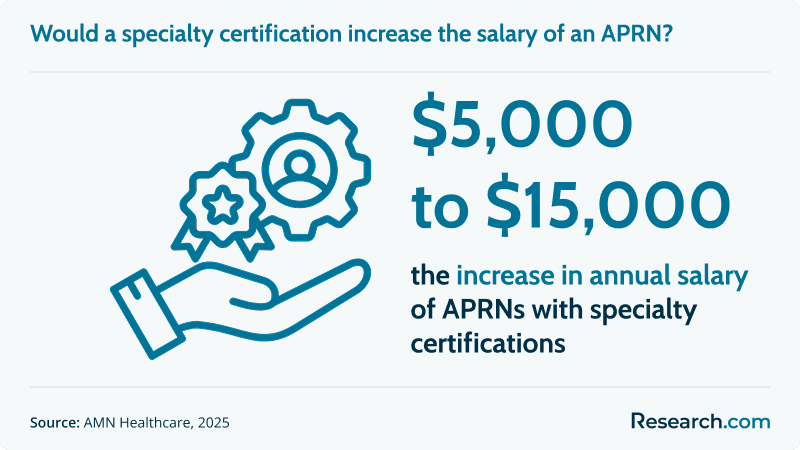
Sub-specialty expertise can make an AG-ACNP more competitive for advanced roles within hospital systems, especially in high-complexity service lines. Specialty certification and experience may also support compensation growth. As shown in the data below, adding a specialty certification can increase annual salary by $5,000 to $15,000.
How to Choose the Best Online DNP Adult-Gerontology Acute Care NP Program
The strongest DNP-AGACNP program is not always the one with the best marketing, the lowest tuition, or the most flexible schedule. Your priority should be whether the program can get you from your current RN background to certification-ready acute care NP practice without avoidable delays, excessive debt, or clinical placement problems.
Program quality checklist
- Programmatic Accreditation: Confirm that the nursing program is accredited by CCNE or ACEN. This is essential for quality assurance and may affect certification, licensure, and employer acceptance.
- Certification Preparation: Ask whether the program publishes first-time board certification pass rates and how it supports students who need remediation.
- Clinical Placement Support: Determine whether the school arranges placements, assists with placements, or expects students to find preceptors independently.
- State Authorization: Verify that the program accepts students from your state and that clinical placements can be completed where you live.
- Campus Requirements: Review the number, timing, and cost of required intensives or skills sessions.
- Total Cost: Compare full program tuition, not just per-credit rates.
- Faculty Expertise: Look for faculty with adult-gerontology acute care, critical care, hospitalist, or specialty practice experience.
Common mistakes to avoid
| Mistake | Why It Can Hurt You | Better Approach |
| Choosing based only on tuition | A cheaper program may cost more if clinical placement support is weak or completion is delayed | Compare total cost, placement support, pass rates, and program length together |
| Assuming online means no travel | Many programs require campus intensives, simulation labs, or clinical travel | Ask for a full calendar of in-person requirements before enrolling |
| Ignoring accreditation | Lack of recognized accreditation can create certification or employment barriers | Verify CCNE or ACEN accreditation directly |
| Overlooking state authorization | Some programs cannot enroll students or place clinicals in every state | Confirm eligibility with both the school and your state board of nursing |
| Assuming clinical sites are guaranteed | Preceptor shortages can delay graduation | Get the clinical placement policy in writing |
| Relying only on rankings | A ranked school may not be the best fit for your schedule, state, or specialty interests | Use rankings as a starting point, then compare program-level details |
Overcoming barriers to certification
Board certification can feel intimidating because students must balance exam preparation with clinical hours, work schedules, family responsibilities, and the cost of testing. A strong program prepares students gradually through aligned coursework, practice exams, faculty feedback, and clinical experiences that match the certification blueprint.
If a school advertises strong certification outcomes, ask for the most recent data and whether the rate reflects first-time test takers. High pass rates can be a useful signal, but they should be considered alongside admissions selectivity, student support, and clinical placement quality.
What career paths are available for graduates of an online DNP adult-gerontology acute care NP program?
DNP-prepared AG-ACNP graduates typically pursue advanced clinical roles in hospitals, specialty practices, and high-acuity care teams. The exact role depends on state scope of practice, employer needs, certification, specialty experience, and available clinical privileges.
- Lead Clinician: AG-ACNPs may coordinate care and mentor clinicians on specialized units such as cardiovascular, surgical, trauma, or medical ICUs.
- Hospitalist: Some graduates manage adult inpatients from admission through discharge as part of a hospital medicine team.
- Specialty Service Provider: Graduates may work with cardiology, oncology, neurology, pulmonology, transplant, trauma surgery, or other specialty teams.
- Quality Improvement or Clinical Leadership Role: The DNP prepares nurses to lead evidence-based practice initiatives, evaluate outcomes, and improve systems of care.
- Academic or Preceptor Role: Experienced DNP-prepared clinicians may teach, precept, or help develop clinical education programs.
Career growth after the first AG-ACNP role
The first post-graduation position is only one part of the career path. With experience, AG-ACNPs may move into senior APP roles, service-line leadership, chief nursing roles, specialty practice leadership, or faculty positions. Some nurses later add credentials in adjacent areas; for example, accelerated online AGPCNP graduate certificate programs may appeal to nurses who want to broaden their scope toward primary care.
The chart below shows how average salaries grow with additional professional experience.
What is the job market for graduates of an online DNP adult-gerontology acute care NP program?
The job market for AG-ACNP graduates is supported by several long-term healthcare pressures, including an aging population, growing complexity of hospitalized patients, and continued demand for advanced practice clinicians in acute care environments. Hospitals often rely on AG-ACNPs to help manage complex adult and older adult patients, support specialty services, and improve continuity across inpatient care teams.
The DNP can strengthen a candidate’s profile for leadership-oriented and high-acuity roles, but it does not guarantee a specific salary or job offer. Outcomes depend on certification, clinical experience, geography, employer type, state practice authority, and specialty demand.
The DNP advantage in a competitive market
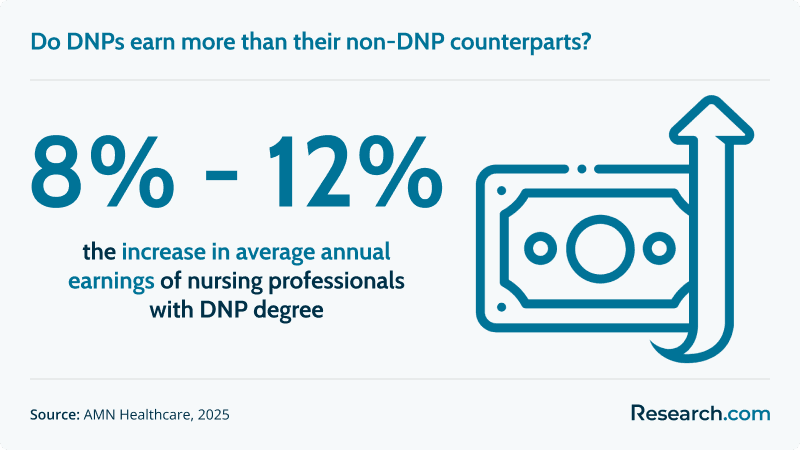
Compared with non-doctoral preparation, the DNP signals advanced preparation in clinical practice, evidence-based improvement, leadership, and systems thinking. The salary data below indicates that holding a DNP can increase annual earnings by 8% to 12% compared to a non-doctoral degree.
What Challenges Can You Anticipate in an Online DNP Adult-Gerontology Acute Care NP Program?
Online DNP-AGACNP programs are demanding because they combine graduate-level science, doctoral project work, certification preparation, and in-person clinical practice. Students need strong time management, reliable technology, clear communication with faculty, and a realistic plan for balancing shifts, clinical hours, assignments, and personal responsibilities.
Common challenges include limited peer interaction, difficulty securing preceptors, travel for campus intensives, fatigue from working while studying, and uncertainty about state-specific clinical placement rules. Students can reduce these risks by choosing a program with structured advising, technical support, active faculty engagement, and clear clinical placement policies.
Students earlier in the nursing pipeline may need to compare foundational routes first. For example, reviewing accelerated BSN programs in the USA can help non-nursing degree holders understand how to become RN-eligible before pursuing advanced practice.
Here’s What Graduates Have to Say about Their Online DNP Adult-Gerontology Acute Care NP Program
- Terrence: "I expected the program to focus only on direct patient care, but it changed how I think about the entire care system. The DNP helped me learn how to evaluate evidence and lead quality improvement work. Recently, I helped launch a protocol that reduced infections on my unit, and that is the kind of broader impact I wanted."
- Moira: "Before earning the DNP, I felt like I had reached a professional limit. I had strong bedside experience, but the leadership and hospitalist roles I wanted required doctoral preparation. Six months after graduation, I accepted a hospitalist position. The degree changed the direction of my career."
- Joshua: "I was working full time on night shift in the CVICU and raising two children, so a traditional campus schedule would not have worked. Being able to watch lectures after a shift made the degree possible. It was still rigorous, but the format let me keep my job while moving forward."
How Can an ABSN Graduate Transition Directly into an Online DNP Program?
An ABSN graduate can move toward an online DNP-AGACNP program after becoming licensed as an RN and building the acute care experience required by the target program. The ABSN can satisfy the bachelor’s-level nursing requirement if it is from an accredited program, but most AG-ACNP admissions committees will still expect meaningful high-acuity RN experience before doctoral-level acute care NP training.
The practical sequence is: complete an accredited ABSN, pass the NCLEX-RN, obtain RN licensure, work in a qualifying acute or critical care setting, then apply to BSN-to-DNP AGACNP programs. Applicants still exploring entry points into nursing can review the easiest online ABSN programs to get into to understand admissions requirements before planning the DNP stage.
Key Insights
- Accreditation comes first. Only consider programs with recognized nursing accreditation, such as CCNE or ACEN, because accreditation can affect certification, licensure, and employer acceptance.
- Most “online” AG-ACNP programs are hybrid. Coursework may be online, but clinical rotations, simulation, and intensives require in-person participation.
- Critical care experience is a major admissions factor. Many competitive programs expect one to two years of recent, full-time experience in settings such as an ICU or Emergency Department.
- Total cost is more than tuition. Compare fees, travel, campus intensives, certification expenses, clinical documentation costs, and potential reduced work hours.
- Clinical placement support can make or break the experience. Ask whether the school finds preceptors, assists students, or places the full burden on the learner.
- The BSN-to-DNP route is direct but demanding. It can take three to four years of full-time study, while MSN-to-DNP programs typically take one to two years.
- Career outcomes depend on more than the degree. Certification, state scope of practice, specialty experience, geographic location, and employer needs all shape job opportunities and salary.
References:
- American Association of Colleges of Nursing. (2025, June). DNP fact sheet. AACN.
- American Association of Critical-Care Nurses. (2024, December 30). Why would I need more than one nursing certification? AACN Blog.
- Baylor University. (2025). The demand for pediatric nurses and how a DNP/PNP can help. Baylor University Online Nursing Programs.
- Centers for Disease Control and Prevention. (2025, June 5). Data and statistics on children's mental health. CDC.
- Centers for Disease Control and Prevention. (2025, July 15). FastStats - Child health. National Center for Health Statistics.
- Centers for Disease Control and Prevention. (2025, July 15). FastStats - Older adult health. National Center for Health Statistics.
- Centers for Disease Control and Prevention. (2023). FastStats - Women’s health. National Center for Health Statistics.
- Kaplow, R., & Reed, K. D. (2021). Specialty certification: A path to improving outcomes. American Journal of Critical Care, 30(2), 156.
- KFF. (2024). U.S. women's health status data. KFF.
- National Council on Aging. (2024, June 1). Get the facts on older Americans. NCOA. See also AACN’s DNP fact sheet.
Other Things You Should Know About the Best Online DNP Adult-Gerontology Acute Care NP Programs
Most programs require students to complete supervised clinical hours with approved preceptors in acute care settings. Schools usually require a clinical affiliation agreement, liability coverage, and completion of background checks, drug screens, and immunization records before placement is finalized.
In 2027, graduates of an online DNP adult-gerontology acute care NP program can expect an average salary of around $115,000 to $140,000 annually. This varies by location, experience, and specific healthcare setting, with high-demand areas potentially offering higher salaries to attract skilled practitioners.


