2027 Best Online Graduate Certificate Nurse Education Programs

Co-Founder and Chief Data Scientist
Did you know postsecondary nursing instructor roles are projected to grow 8 percent between 2023 and 2033?
For 2027, nurses seeking to advance into academic or clinical teaching can benefit from a focused, fully online graduate certificate in nursing education. This article explores top programs, outlines their advantages, and shows how completing one can fast-track your transition into educator roles—all without relocating or pausing your career.
What are the benefits of completing an online graduate certificate nurse education program?
- Nurse educators earn a median annual wage of $80,780 in May 2023, well above many clinical nursing roles.
- Employment for postsecondary teachers, including nursing instructors, is expected to increase by 8 percent from 2023 to 2033.
- Graduates can pursue roles as academic faculty, clinical staff educators, or corporate healthcare trainers.
What can I expect from an online graduate certificate nurse education program?
Completing a fully online graduate certificate in nurse education prepares you to design curricula, apply teaching strategies, and assess learner outcomes in both classroom and clinical settings. Most programs require 9–16 credit hours, typically completed in 9–12 months through asynchronous lectures and interactive workshops.
You’ll also engage in a virtual practicum or capstone project to gain hands-on instructional experience. Programs include academic advising, financial aid access, and career coaching to support your transition into educator roles.
Where can I work with an online graduate certificate nurse education program?
Graduates with a nurse education certificate can teach in academic, healthcare, and corporate settings. Many start as adjunct instructors or staff educators before moving into full-time faculty positions or leadership roles.
Top employing industries for Nursing Instructors and Teachers, Postsecondary:
- Colleges, Universities, and Professional Schools: 47,930 employed
- Junior Colleges: 18,860 employed
- General Medical and Surgical Hospitals: 2,840 employed
- Technical and Trade Schools: 2,060 employed
- Educational Support Services: 320 employed
Top states employing Nursing Instructors and Teachers, Postsecondary:
- Texas: 6,980 employed
- California: 5,990 employed
- New York: 4,760 employed
- Florida: 4,730 employed
- Pennsylvania: 4,000 employed
How much can I make with an online graduate certificate nurse education program?
According to the U.S. Bureau of Labor Statistics, Nursing Instructors and Teachers, Postsecondary earned a mean annual wage of $86,530 in May 2023, with a median (50th percentile) salary of $80,780.
Other platforms report:
- Zippia: $82,500 per year
- Salary.com: $87,000 per year
- ZipRecruiter: $90,200 per year
- Indeed: $88,300 per year
- Payscale: $78,900 per year
- Glassdoor: $86,700 per year
These figures reflect national averages and may vary by region, experience, and workplace setting.
- Best Online Graduate Certificate Nurse Education Programs for 2027 List of Programs
- How long does it take to complete an online graduate certificate nurse education program? Program Duration
- How does an online graduate certificate nurse education compare to an on-campus program? Online vs Campus
- What is the average cost of online graduate certificate nurse education programs? Program Cost
- What are the financial aid options for students enrolling in an online graduate certificate nurse education program? Financial Aid
- What are the prerequisites for enrolling in an online graduate certificate nurse education program? What are the prerequisites for enrolling in an online graduate certificate nurse education program?
- What courses are typically in an online graduate certificate nurse education program? What courses are typically in an online graduate certificate nurse education program?
- What types of specializations are available in an online graduate certificate nurse education programs? What types of specializations are available in an online graduate certificate nurse education programs?
- How do you choose the best online graduate certificate nurse education program? How do you choose the best online graduate certificate nurse education program?
- What career paths are available for graduates of online graduate certificate nurse education programs? Career Paths
- What is the job market like for graduates of online graduate certificate nurse education programs? Job Outlook
- What is the return on investment for an online graduate certificate in nurse education? What is the return on investment for an online graduate certificate in nurse education?
- Can an online graduate certificate in nurse education accelerate your progression to advanced nursing degrees? Can an online graduate certificate in nurse education accelerate your progression to advanced nursing degrees?
Best Online Graduate Certificate Nurse Education Programs for 2027
Nurses who want to teach do not always need to start with a full graduate degree. An online graduate certificate in nurse education can help experienced RNs build skills in curriculum design, clinical instruction, assessment, simulation, and student mentoring while continuing to work. For 2027, these certificates are especially relevant for nurses who want to move into faculty, staff development, preceptor training, or clinical education roles without committing immediately to one of the broader types of master’s in nursing.
This guide explains what online nurse educator certificates include, how long they take, what they cost, how to compare programs, and what career paths they may support. It also highlights ten online graduate certificate programs selected for academic reputation, nursing accreditation, online delivery, and student support.
Quick answer: Is an online graduate certificate in nurse education worth considering?
An online graduate certificate in nurse education can be a practical option for licensed nurses who already have a BSN or graduate nursing degree and want focused preparation for teaching roles. Most programs take about 6–12 months, require 9–16 credits, and include coursework in adult learning, curriculum design, instructional technology, assessment, and a teaching practicum or capstone. The strongest programs are offered by accredited institutions, align with CCNE or ACEN nursing standards, and provide support for arranging local practicum experiences.
How we evaluated these programs
Research.com rankings use a structured methodology that combines institutional research, program-level review, and data from trusted education sources. We consider information from the NCES IPEDS database, the Peterson’s database, including distance learning data, and the U.S. Department of Education’s College Scorecard database. For this guide, we also considered nursing accreditation, online format, tuition structure, program length, credit requirements, and whether the certificate fits working nurses.
Top online graduate certificate nurse education programs at a glance
| Rank | School and program | Cost | Length | Credits | Accreditation |
| 1 | Johns Hopkins University – Post-Master’s Nursing Education Certificate | $1,995/credit | ~1 year (3 semesters) | 12 credits | CCNE |
| 2 | Duke University – Nursing Education Post‑Graduate Certificate | ~$2,166/credit | ~1 year (3 semesters) | 9 credits | CCNE |
| 3 | Pennsylvania State University World Campus – Nurse Educator Graduate Certificate | ~$1,037/credit | ~1 year; can be completed in 9–12 months | 9 credits | CCNE |
| 4 | University of Massachusetts Amherst – Graduate Certificate in Nursing Education | ~$753/credit (est.) | ~1 year; flexible pacing | 12 credits (4 courses) | CCNE |
| 5 | Villanova University – Certificate in Nursing Education | ~$1,080/credit | 1 year; up to 5 years allowed | 12 credits | CCNE |
| 6 | University of Central Florida – Nurse Educator Certificate | ~$460/credit (Florida resident) | ~1 year (3 semesters, part-time) | 12 credits | CCNE |
| 7 | University of Texas at Arlington – Nursing Education Certificate | $515/credit | As few as 6 months (full-time) | 12 credits | CCNE |
| 8 | University of North Carolina at Charlotte – Nurse Educator Graduate Certificate | ~$310/credit (NC resident) | 1 year; can be completed in 12 months part-time | 12 credits | SACSCOC regional accreditation; nursing programs also CCNE-accredited |
| 9 | Old Dominion University – Nurse Educator Certificate | $486/credit (Virginia resident) | ~1 year (3 semesters) | 12 credits | CCNE |
| 10 | Western Governors University – Nursing Education Post‑Master’s Certificate | $5,035 flat rate per 6-month term | ~1 year; self-paced, typically 12 months | 16 competency units; equivalent to ~16 credits across 8 courses | CCNE |
1. Johns Hopkins University – Post-Master’s Nursing Education Certificate
Johns Hopkins University is a private research institution in Baltimore, Maryland, founded in 1876. Its School of Nursing is widely associated with healthcare research, evidence-based practice, and graduate-level nursing preparation. The post-master’s certificate is best suited for nurses who already hold advanced nursing preparation and want a focused pathway into academic or clinical teaching.
- Program cost: $1,995/credit
- Program duration: ~1 year (3 semesters)
- Total credits: 12 credits
- Accreditation: CCNE (Commission on Collegiate Nursing Education)
2. Duke University – Nursing Education Post‑Graduate Certificate
Duke University, located in Durham, North Carolina, was established in 1924 and is known for graduate health sciences education, research, and clinical partnerships. Its nursing education certificate is a strong fit for nurses who want a compact post-graduate credential from a highly selective university with a national healthcare reputation.
- Program cost: ~$2,166/credit
- Program duration: ~1 year (3 semesters)
- Total credits: 9 credits
- Accreditation: CCNE
3. Pennsylvania State University World Campus – Nurse Educator Graduate Certificate
Pennsylvania State University was founded in 1855 and delivers online programs through Penn State World Campus. This certificate may appeal to nurses who want a public research university option with established online infrastructure and a shorter 9-credit format.
- Program cost: ~$1,037/credit
- Program duration: ~1 year; can be completed in 9–12 months
- Total credits: 9 credits
- Accreditation: CCNE
4. University of Massachusetts Amherst – Graduate Certificate in Nursing Education
The University of Massachusetts Amherst, founded in 1863, is the flagship public research university of the UMass system. Its nursing education graduate certificate is designed for working nurses who want structured teaching preparation through a flexible online format.
- Program cost: ~$753/credit (est.)
- Program duration: ~1 year; flexible pacing
- Total credits: 12 credits (4 courses)
- Accreditation: CCNE
5. Villanova University – Certificate in Nursing Education
Villanova University is a private Catholic university near Philadelphia, Pennsylvania, founded in 1842. Its M. Louise Fitzpatrick College of Nursing offers a certificate for nurses who want faculty development, teaching theory, and practical education skills within a university known for nursing and professional education.
- Program cost: ~$1,080/credit
- Program duration: 1 year; up to 5 years allowed
- Total credits: 12 credits
- Accreditation: CCNE
6. University of Central Florida – Nurse Educator Certificate
The University of Central Florida, established in 1963 in Orlando, is a large public university with extensive online offerings. Its nurse educator certificate is a practical choice for Florida residents seeking a lower per-credit resident rate and part-time pacing across three semesters.
- Program cost: ~$460/credit (Florida resident)
- Program duration: ~1 year (3 semesters, part-time)
- Total credits: 12 credits
- Accreditation: CCNE
7. University of Texas at Arlington – Nursing Education Certificate
The University of Texas at Arlington, founded in 1895, is a public research university in the Dallas–Fort Worth region. UTA’s nursing education certificate is one of the faster options on this list, making it worth considering for nurses who can manage a full-time pace and want to complete the credential quickly.
- Program cost: $515/credit
- Program duration: As few as 6 months (full-time)
- Total credits: 12 credits
- Accreditation: CCNE
8. University of North Carolina at Charlotte – Nurse Educator Graduate Certificate
The University of North Carolina at Charlotte, founded in 1946, is a public research university in the UNC system. Its nurse educator graduate certificate emphasizes practical teaching preparation and may be especially cost-conscious for North Carolina residents.
- Program cost: ~$310/credit (NC resident)
- Program duration: 1 year; can be completed in 12 months part-time
- Total credits: 12 credits
- Accreditation: SACSCOC regional accreditation; nursing programs also CCNE-accredited
9. Old Dominion University – Nurse Educator Certificate
Old Dominion University is a public research university in Norfolk, Virginia, founded in 1930. ODU has long experience in distance education, which can matter for nurses who need reliable online delivery, responsive support, and local practicum coordination.
- Program cost: $486/credit (Virginia resident)
- Program duration: ~1 year (3 semesters)
- Total credits: 12 credits
- Accreditation: CCNE
10. Western Governors University – Nursing Education Post‑Master’s Certificate
Western Governors University is a fully online nonprofit university founded in 1997. Its competency-based model may fit self-directed nurses who want to progress by demonstrating mastery rather than following only a traditional weekly course schedule.
- Program cost: $5,035 flat rate per 6-month term
- Program duration: ~1 year; self-paced, typically 12 months
- Total credits: 16 competency units; equivalent to ~16 credits across 8 courses
- Accreditation: CCNE
How long does it take to complete an online graduate certificate nurse education program?
Most online graduate certificates in nurse education require 9–16 credit hours. Many working nurses finish in 6–12 months, while some full-time or accelerated formats can be completed in as few as 4–6 months. Programs that use accelerated eight-week terms may let students take one or two courses at a time while continuing full-time clinical work.
The exact timeline depends on course load, term structure, practicum requirements, and whether the program is self-paced, cohort-based, or fully asynchronous. A certificate with a local teaching practicum may take longer if site approval, preceptor matching, or employer paperwork is required.
| Timeline option | Best for | Typical pace | Trade-off |
| Accelerated full-time | Nurses who can temporarily reduce work or manage a heavy academic load | As few as 4–6 months | Less flexibility and more weekly coursework |
| Part-time | RNs working regular shifts | 6–12 months | More manageable, but completion takes longer |
| Self-paced competency-based | Independent learners with strong time management | Often around 12 months | Requires discipline and comfort with independent progress |
| Extended flexible pacing | Nurses balancing work, family, and unpredictable schedules | 1 year or longer | Lower weekly intensity, but delayed credential completion |
A nurse education certificate can also complement leadership-oriented graduate study. For example, nurses interested in mentoring, team education, or curriculum development may find overlap with MSN clinical nurse leadership jobs, where education and change-management skills are useful in practice settings.
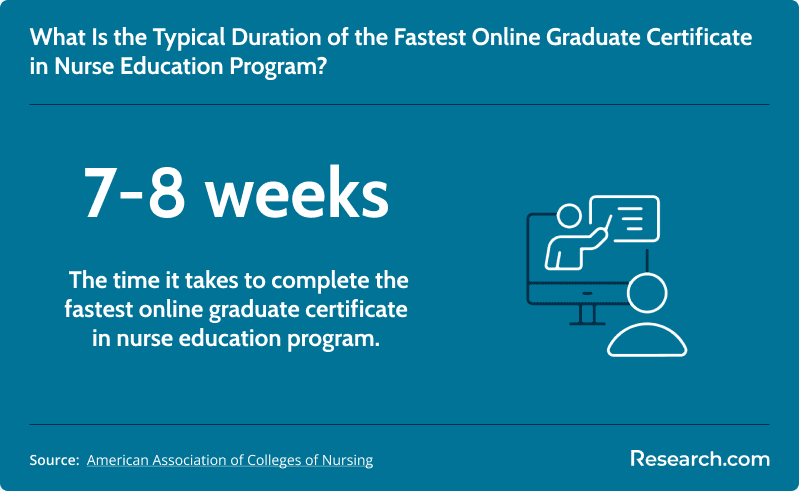
The image below illustrates how the fastest online graduate certificate timelines can compress coursework into a very short sequence. It shows that the quickest programs can be completed in 7–8 weeks from start to finish, although that pace is best suited for nurses who can handle an intensive academic schedule.
How does an online graduate certificate nurse education compare to an on-campus program?
An accredited online nurse educator certificate should cover the same core learning outcomes as a comparable campus-based certificate: teaching methods, curriculum planning, evaluation, instructional technology, and supervised education practice. In most cases, the credential does not state “online,” but students should always confirm diploma wording, transcript notation, and practicum expectations with the school before enrolling.
The biggest difference is how students learn. Online programs usually rely on learning-management systems, recorded lectures, discussion boards, virtual simulations, video meetings, and digital assignments. Campus programs provide more face-to-face interaction, scheduled class meetings, and easier access to in-person faculty conversations. Neither format is automatically better; the better choice depends on your work schedule, learning style, location, and need for peer interaction.
| Factor | Online certificate | On-campus certificate |
| Schedule flexibility | Strong option for nurses working shifts or living far from campus | Better for students who can attend fixed class times |
| Faculty access | Usually through email, LMS messages, office hours, and video calls | More opportunities for spontaneous in-person conversations |
| Practicum | Often arranged locally with school approval | May use campus or local partner sites |
| Networking | Depends on discussion design, group work, and virtual engagement | More natural peer and faculty interaction |
| Commute and relocation | No relocation required in most cases | May require travel to campus or living nearby |
Nurses who plan to continue beyond a certificate should ask whether credits can apply to a future graduate nursing degree. An RN to MSN online pathway, for example, may be a better long-term fit for nurses who still need a full master’s credential for faculty, leadership, or advanced clinical roles.
Strong communication skills also matter in education, administration, and interprofessional training. Broader career resources, including information on organizational communication salary, can help nurses understand how teaching, leadership, and communication skills translate across professional settings.
What is the average cost of online graduate certificate nurse education programs?
Online graduate certificates in nursing education commonly cost $5,000 to $10,000 in total tuition, but the range can be wider depending on the school. Per-credit pricing in the provided program data ranges from about $442 to $1,765 per credit hour, with variation based on public or private status, residency, fees, and delivery model. Public universities often fall in the $5,000 to $15,000 total range, while private universities may charge $10,000 to $25,000 for similar certificates.
Program examples show why comparing total cost matters more than looking only at tuition per credit. University of Central Florida charges around $460 per credit for residents, while Old Dominion University’s in-state rate is listed at $486/credit (Virginia resident), and another cost reference for Old Dominion University places the in-state rate between $620 and $1,486 per credit. Western Governors University uses a different structure, charging a $5,035 flat rate per 6-month term rather than traditional per-credit tuition.
Students should also budget for technology, administrative, practicum, or lab-related fees, which may add $50–$100 per credit. If your education goals extend into healthcare operations, facilities, or technical systems, a separate skill-based credential such as an AutoCAD certificate online may be relevant for specialized planning or design-adjacent roles, but it should not be treated as a substitute for nursing education preparation.
What are the financial aid options for students enrolling in an online graduate certificate nurse education program?
Financial aid for graduate certificates depends on whether the program is eligible for federal aid, whether the student meets enrollment requirements, and how the school classifies the certificate. Before applying, ask the financial aid office whether the specific certificate—not just the university—is approved for federal aid.
- Federal Direct Unsubsidized Loans: Graduate students may borrow up to $20,500 per year, and financial need is not required.
- Direct PLUS Loans: These may cover remaining costs up to the school’s certified cost of attendance, with phasing out by 2026.
- TEACH Grants: These provide up to $4,000 per year for eligible students who commit to teaching in high-need areas after graduation.
- Federal Work-Study Programs: Eligible students may earn money through approved part-time work while enrolled.
- Institutional Scholarships and Grants: Nursing schools may offer merit-based, need-based, or workforce-related awards.
- Employer Tuition Reimbursement: Hospitals, health systems, and clinics may help pay for education that supports staff development or clinical education roles.
- State Grant Programs: Some states provide funding for residents attending in-state certificate programs.
- Military Benefits (GI Bill): Veterans and eligible dependents may be able to apply benefits toward certificate coursework.
- Private Scholarships and Fellowships: Nursing organizations, foundations, and professional associations may offer awards for future nurse educators.
Nurses comparing education-focused and technology-focused roles may also want to explore MSN nursing informatics jobs, especially if they are interested in teaching electronic health record use, clinical data workflows, or healthcare technology adoption.
What are the prerequisites for enrolling in an online graduate certificate nurse education program?
Admission requirements vary, but most graduate certificates in nurse education expect applicants to have active nursing licensure, prior nursing education, and clinical experience. Some certificates are designed for BSN-prepared nurses, while others are post-master’s certificates for nurses who already hold an MSN or another graduate nursing degree.
| Requirement | What it usually means | Why it matters |
| Active RN license | Unrestricted RN licensure in the state where any clinical or teaching practicum occurs | Programs need to verify legal eligibility for nursing-related education practice |
| BSN or graduate nursing degree | A Bachelor of Science in Nursing from a regionally accredited institution is common; post-master’s programs may require an MSN | Graduate-level teaching coursework builds on professional nursing preparation |
| Minimum GPA | Many programs expect a cumulative GPA of 3.0 or higher in nursing courses | Graduate certificates are academically compressed and writing-intensive |
| Clinical experience | Often 1–2 years of post-licensure nursing practice | Teaching future nurses requires applied clinical judgment |
| Official transcripts | Records from all postsecondary schools attended | Schools use transcripts to confirm eligibility and prior coursework |
| References | Two to three recommendations, often including academic and clinical supervisors | References help evaluate readiness for graduate study and teaching |
| Statement of intent | A short essay describing teaching goals and education philosophy | Programs want to understand your fit for nurse education |
| Technology readiness | Reliable internet, webcam-enabled computer, and comfort with LMS platforms | Online courses require consistent digital participation |
| Testing policies | GRE often waived, but requirements differ by school | Applicants should confirm current admissions rules before applying |
Nurses who do not yet have a BSN may need to complete an online LPN to BSN program or another approved bridge before applying to graduate-level nurse educator certificates.
The chart below highlights the number of RN degrees awarded in 2023 and shows that postsecondary certificates remain a smaller, but important, part of nursing education pathways.
What courses are typically in an online graduate certificate nurse education program?
Nurse educator certificates combine teaching theory with applied instructional practice. The goal is not simply to make experienced nurses better presenters; it is to prepare them to design learning experiences, evaluate student performance, use evidence-based teaching strategies, and support learners in classroom, clinical, lab, simulation, and online settings.
- Curriculum Design in Nursing Education: Covers how to build, align, and evaluate nursing curricula in relation to program outcomes and CCNE standards.
- Adult Learning Theory: Examines how adult learners process information, stay motivated, and apply knowledge in healthcare environments.
- Teaching and Learning Strategies: Focuses on active learning, clinical teaching, feedback, precepting, and classroom engagement.
- Instructional Technology: Introduces e-learning tools, simulation platforms, multimedia resources, and digital course design.
- Educational Assessment and Evaluation: Explores test design, rubric development, outcome measurement, psychometrics, and data-informed evaluation.
- Teaching Practicum or Capstone: Provides supervised teaching experience in an academic, clinical, or staff development setting, often ending with a project.
The chart below shows full-time nurse educator credentials. It illustrates an important decision point: certificates can strengthen teaching skills, but many full-time academic roles still prefer or require a master’s or doctoral degree.
What types of specializations are available in an online graduate certificate nurse education programs?
Some programs offer a general nurse educator curriculum, while others allow students to focus assignments, practicum experiences, or electives around a specific teaching environment. The best specialization depends on whether you want to teach students in a degree program, train practicing nurses, design online courses, or lead education strategy inside a healthcare organization.
| Specialization area | Focus | Best fit for |
| Academic nurse education | Curriculum development, classroom teaching, program outcomes, and faculty responsibilities | Nurses who want to teach in colleges, universities, or nursing schools |
| Clinical nurse education | Bedside teaching, staff onboarding, competency validation, and simulation-based instruction | Hospital educators, preceptors, and nurses moving into staff development |
| Technology-enhanced instruction | Online learning, virtual simulation, multimedia content, and learning platforms | Nurses interested in digital education and online nursing programs |
| Leadership in nursing education | Accreditation, policy, program administration, and faculty coordination | Nurses aiming for education leadership or program management |
| Health promotion and community education | Patient education, public health teaching, outreach, and community-based learning | Nurses working in public health, prevention, or community programs |
| Distance learning coordination | Online course operations, student engagement, assessment, and quality improvement | Nurses who want to support or manage online nursing education |
Nurses entering graduate study from an associate-degree background may need a bridge pathway before they can qualify for graduate certificates. Resources on ADN to NP programs can help explain how associate-prepared nurses move toward advanced academic or clinical preparation, even though nurse educator certificates focus on teaching rather than nurse practitioner practice.
How do you choose the best online graduate certificate nurse education program?
The best program is not always the highest-ranked or fastest option. For working nurses, fit is often determined by accreditation, practicum logistics, credit transfer, cost after aid, faculty responsiveness, and whether the certificate supports the role you actually want.
- Confirm institutional and nursing accreditation. Look for regional institutional accreditation and nursing program accreditation through CCNE or ACEN when applicable.
- Check whether the certificate matches your background. Some programs accept BSN-prepared nurses, while others require an MSN or other graduate nursing credential.
- Review the curriculum course by course. A strong certificate should include adult learning, curriculum design, assessment, teaching strategies, and practicum or capstone work.
- Ask how practicum placement works. Find out whether you must secure your own site, whether the school approves local mentors, and whether your workplace can be used.
- Compare total cost, not only tuition. Add tuition, fees, books, background checks, technology costs, and any practicum-related expenses.
- Evaluate delivery format. Decide whether asynchronous courses, synchronous meetings, cohort pacing, or self-paced competency-based learning fits your schedule.
- Ask about credit transfer. If you may continue into an MSN, DNP, or related program, confirm whether certificate credits can apply later.
- Look at student support. Online nurses need responsive advising, tech support, library access, writing help, and career services.
- Consider long-term career alignment. If your goal is a full graduate degree, compare certificate options with direct entry MSN programs online and other master’s pathways before committing.
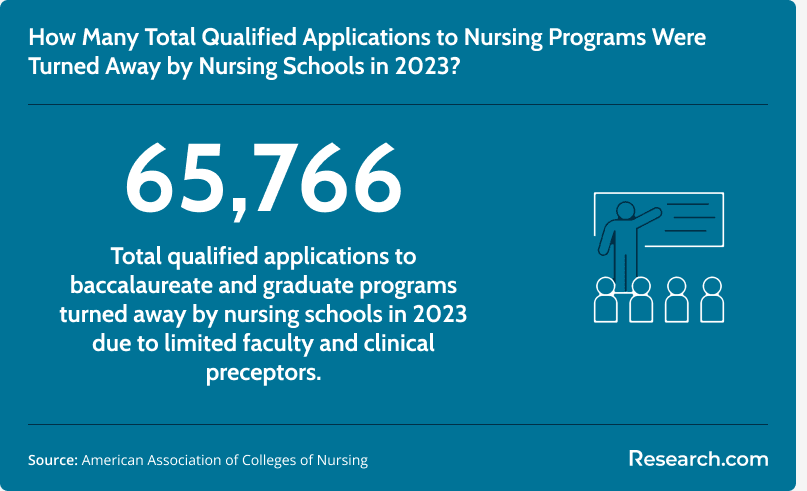
Program quality matters because nurse education capacity affects the workforce pipeline. In 2023 alone, 65,766 qualified applicants were turned away from nursing programs due to faculty shortages, underscoring why preparation for educator roles remains important.
Common mistakes to avoid when choosing a nurse educator certificate
| Mistake | Why it can hurt you | Better approach |
| Choosing only the cheapest program | Low tuition may not matter if credits do not transfer or support is weak | Compare accreditation, curriculum, practicum support, and total cost |
| Assuming all online programs are equivalent | Online quality varies widely by faculty engagement, course design, and student services | Ask to review course format, support hours, and practicum procedures |
| Ignoring accreditation | Some employers and graduate programs may not recognize weakly accredited credentials | Verify institutional accreditation and nursing accreditation before applying |
| Overlooking practicum requirements | Local site approval can delay graduation if not planned early | Ask how placements are arranged before you enroll |
| Assuming a certificate guarantees a faculty job | Many full-time academic roles prefer or require graduate degrees beyond a certificate | Use the certificate strategically and understand degree expectations in your target role |
| Focusing only on speed | Accelerated terms can be difficult while working clinical shifts | Choose a pace you can sustain without sacrificing learning quality |
What career paths are available for graduates of online graduate certificate nurse education programs?
A graduate certificate in nurse education can support roles in academic programs, hospitals, clinics, simulation labs, online education, professional development, and healthcare training departments. However, job eligibility depends on the employer, your highest degree, clinical specialty, years of experience, and state or institutional requirements.
- Clinical Staff Educator: Trains nurses in hospitals, clinics, and healthcare systems through orientation, skills validation, and continuing education.
- Adjunct Instructor: Teaches part-time in community colleges, vocational schools, or nursing programs while often continuing clinical practice.
- Full-Time Instructor or Lecturer: Provides classroom, lab, simulation, and clinical instruction in an accredited nursing program.
- Assistant Professor of Nursing Education: Participates in teaching, curriculum work, student advising, research, and school committees.
- Associate Professor: Takes on advanced academic responsibilities, mentoring, committee leadership, grants, and program development.
- Professor: Leads scholarship, program planning, department initiatives, and high-level academic work.
- Director of Nursing Education: Oversees education strategy, compliance, faculty development, and learning outcomes.
- Dean or Academic Chair: Provides institutional leadership for nursing programs, faculty, accreditation, and external partnerships.
Some nurses use the certificate as one step toward doctoral-level education. A BSN to DNP online program may be a stronger long-term option for nurses who want advanced leadership, academic, or systems-level roles.
What is the job market like for graduates of online graduate certificate nurse education programs?
The labor market for nurse educators is shaped by demand for nursing faculty, growth in healthcare training needs, and shortages in clinical preceptors. The U.S. Bureau of Labor Statistics projects employment for Postsecondary Teachers, including nurse educators, to grow 8% from 2023 to 2033. In May 2023, the mean annual wage for Nursing Instructors and Teachers was $86,530.
Demand is not limited to traditional nursing schools. Healthcare employers also need educators to train new hires, support evidence-based practice changes, teach technology workflows, coordinate continuing education, and prepare nurses for specialty competencies. States such as Texas, California, and New York offer the most positions, while rural areas report higher ratios of students to faculty.
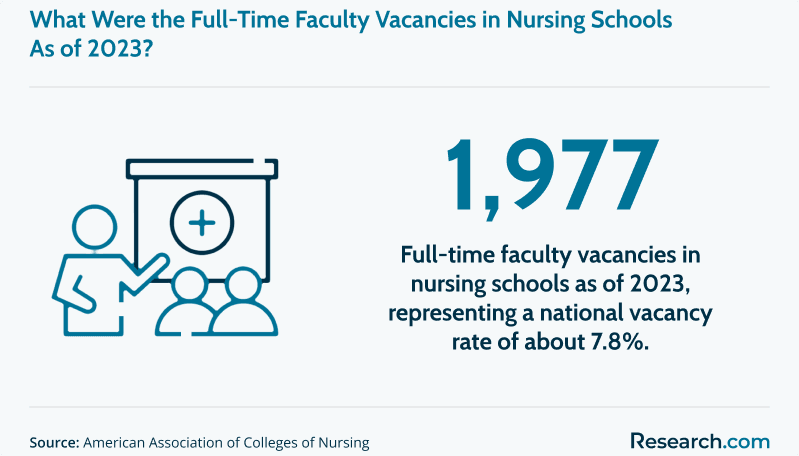
The image below shows that the vacancy rate for full-time faculty in nursing schools reached 7.8% in 2023, with 1,977 open positions nationwide. This does not mean every certificate graduate will secure a faculty role, but it does show why teaching preparation remains valuable for nurses who meet employer degree and experience requirements.
What graduates say about online graduate certificate nurse education programs
- : "The asynchronous format made the program possible while I was working full-time shifts. The teaching projects were practical, and the faculty feedback helped me feel ready to lead a classroom discussion instead of just giving a presentation. — Jazmín"
- : "I was unsure whether an online format could prepare me for teaching, but the simulations, peer discussions, and virtual activities were more engaging than I expected. The certificate helped me reconnect with why I wanted to educate nurses in the first place. — Thaddeus"
- : "Completing the certificate online reduced commuting time and childcare costs. My capstone connected me with a hospital educator near me, and I now use the strategies I learned when I lead staff training sessions. — Coralie"
What is the return on investment for an online graduate certificate in nurse education?
The ROI of a nurse educator certificate depends on your starting credentials, employer support, tuition cost, and target role. The clearest value comes when the certificate helps you qualify for a specific internal educator role, strengthens your application for adjunct teaching, or transfers into a future graduate nursing degree. It may be less valuable if your desired job requires an MSN, DNP, PhD, or full faculty appointment and the certificate credits do not apply toward a degree.
Because salary outcomes are not guaranteed, compare the certificate’s total cost against realistic opportunities in your region and workplace. Ask whether your employer offers tuition reimbursement, whether the school publishes graduate outcomes, and whether credits can stack into a future credential. Nurses who are still exploring broader education pathways may also compare this option with an accelerated BSN program online, especially if they are advising others or evaluating different nursing education routes.
Can an online graduate certificate in nurse education accelerate your progression to advanced nursing degrees?
A nurse education certificate can sometimes shorten a future graduate degree if the school allows certificate credits to transfer into an MSN, DNP, or related program. This is not automatic. Transfer rules depend on the institution, course grades, time limits, degree plan, and whether the certificate courses match required degree courses.
Before enrolling, ask the admissions office and graduate nursing department whether the certificate is stackable. Nurses who still need a BSN should examine bridge options first, including the easiest online RN to BSN bridge programs, before choosing graduate-level certificate coursework.
Questions to ask before applying
- Is the institution regionally accredited, and is the nursing program CCNE- or ACEN-accredited?
- Does the certificate require a BSN, MSN, or another graduate nursing degree?
- Can I complete the practicum where I live or where I work?
- Are courses asynchronous, synchronous, cohort-based, or self-paced?
- What is the total cost after tuition, fees, books, and practicum expenses?
- Is the certificate eligible for federal aid, employer reimbursement, or scholarships?
- Will credits transfer into an MSN, DNP, or other graduate nursing program?
- What roles have recent graduates pursued, and what degree did those roles require?
- How quickly do faculty and advisors respond to online students?
- Does the program prepare students for academic teaching, clinical education, or both?
References:
- Academic Partnerships (UTA). Nursing Education Certificate.
- Bureau of Labor Statistics. Postsecondary Teachers.
- Bureau of Labor Statistics. Occupational Employment and Wages, May 2023: Postsecondary Teachers.
- Duke University. Nursing Education Post-Graduate Certificate.
- Glassdoor. Nurse Educator Salary.
- Indeed. Nurse Educator Salaries.
- Johns Hopkins University. Post-Master’s Nursing Education Certificate.
- MyFuture. Nursing Instructors and Teachers, Postsecondary Occupation.
- NurseEducator.com. Careers in Nurse Education.
- Old Dominion University. Nurse Educator Certificate.
- Pennsylvania State University World Campus. Nurse Educator Graduate Certificate.
- PayScale. Nurse Educator Salary.
- Salary.com. Nurse Educator Salary Research.
- University of Central Florida. Nurse Educator Certificate.
- University of Massachusetts Amherst. Graduate Certificate in Nursing Education.
- University of North Carolina at Charlotte. Nurse Educator Graduate Certificate.
- University of Texas at Arlington. Nursing Education Certificate.
- Villanova University. Certificate in Nursing Education.
- Western Governors University. Nursing Education Post-Master’s Certificate.
- ZipRecruiter. Nurse Educator Salary.
- Zippia. Nurse Educator Salary.
Key Insights
- An online graduate certificate in nurse education is best for licensed nurses who want focused teaching preparation without immediately enrolling in a full graduate degree.
- Most programs require 9–16 credits and can often be completed in 6–12 months, though accelerated and self-paced formats vary.
- Accreditation, practicum support, transferability, and total cost are more important than ranking alone.
- Costs vary widely, from lower resident public university rates to higher private university tuition and flat-rate competency-based models.
- A certificate can support clinical educator, adjunct instructor, staff development, simulation, and education leadership pathways, but many full-time academic roles may still require an MSN, DNP, PhD, or equivalent graduate preparation.
- Before applying, confirm whether certificate credits can transfer into a future MSN or doctoral program, especially if long-term academic advancement is your goal.
Other Things You Should Know About Online Graduate Certificate Nurse Education Programs
Most online nurse educator graduate certificates require about 12 to 18 graduate credit hours. Programs usually include courses in curriculum design, teaching strategies, assessment, and practicum or teaching experience, and many schools expect applicants to hold an active RN license and an accredited BSN or MSN.
Yes, some 2027 online graduate certificate nurse education programs require clinical components. These may include practicum hours, typically ranging from 100 to 200 hours, at an approved healthcare facility, which provides hands-on teaching experience essential for aspiring nurse educators.
In 2027, online graduate certificate nurse education programs typically cover advanced teaching methods like simulation-based learning, technology integration in nursing education, and evidence-based pedagogical strategies. These components aim to enhance the educator's ability to deliver modern, effective, and interactive nursing education.