
2027 Most Affordable Online Graduate Certificate Nursing Informatics Programs

Co-Founder and Chief Data Scientist
Nurses are being asked to do more than document care in electronic health records. They are increasingly expected to help improve digital workflows, evaluate data quality, support clinical decision tools, and make technology safer for patients and staff. An online nursing informatics graduate certificate is designed for registered nurses who want those responsibilities without committing immediately to a full graduate degree.
This guide is for working nurses comparing affordable and flexible certificate options, especially those who want to move into EHR optimization, clinical systems analysis, healthcare data analytics, informatics project management, or a future MSN or health informatics master’s program. You will learn what these certificates cover, how long they take, what they cost, which programs stand out, and how to decide whether the credential fits your career goals.
Quick answer: Is an online nursing informatics graduate certificate worth considering?
An online nursing informatics graduate certificate can be a practical choice for licensed nurses who want to shift toward technology-focused healthcare roles while keeping their current job. Most programs are short, graduate-level, and built around applied skills such as EHR workflows, data standards, interoperability, analytics, and clinical decision support. The strongest value comes when the certificate credits transfer into an MSN, MS in Health Informatics, or another graduate pathway.
| Best fit | Why it may make sense | When to be cautious |
| Experienced RNs interested in health IT | The certificate builds on real clinical workflow knowledge and adds informatics skills employers can use in system improvement projects. | It may not be enough for senior leadership roles without additional experience, certification, or a master’s degree. |
| Nurses seeking a non-bedside path | Roles may exist in hospitals, vendors, payers, consulting firms, telehealth, research, and population health organizations. | Some entry-level roles can require a pay reset if you are already highly compensated in bedside nursing. |
| Nurses considering graduate school | Credits often apply to a master’s program, lowering the risk of starting graduate study. | Credit transfer is not automatic across all schools, so policies must be confirmed before enrolling. |
What are the benefits of getting an online nursing informatics graduate certificate?
- Broader career options: Nursing informatics graduates can work in hospitals, outpatient clinics, telehealth organizations, health technology vendors, consulting firms, payers, population health groups, academic centers, and research settings.
- A bridge between nursing and technology: The credential helps nurses translate clinical problems into workflow improvements, data requirements, system designs, and training plans.
- Clear entry point into health informatics: Entry-level informatics roles, often classified with “health information technologists and medical registrars,” have a median salary of $67,310.
- Stackable graduate credit: Many certificates let students apply completed credits toward an MSN, MS in Health Informatics, or related graduate degree, making the certificate a lower-risk first step.
What can I expect from an online nursing informatics graduate certificate?
An online nursing informatics graduate certificate is a short graduate program that teaches nurses how healthcare data, clinical systems, and digital workflows affect patient care. Most programs are built for working RNs, so courses are commonly delivered in accelerated seven- to ten-week terms, with assignments designed around case studies, virtual labs, discussion boards, and applied projects.
Many programs are asynchronous, meaning students can watch lectures, complete readings, and submit assignments outside of fixed class times. Some schools also include live faculty sessions, virtual office hours, group projects, or optional webinars with informatics professionals.
The curriculum usually starts with informatics foundations, including how clinical data is collected, stored, exchanged, protected, and used for decision-making. Students then move into practical topics such as workflow mapping, database concepts, EHR implementation, data governance, usability, reporting, and interoperability standards such as Health Level Seven (HL7) and Fast Healthcare Interoperability Resources (FHIR).
A strong program should include a capstone, practicum, or mentored project. This applied experience may let you investigate a real documentation problem, redesign an EHR workflow, evaluate a dashboard, support a system implementation, or assess data quality in your own workplace or an approved partner site.
Online support services matter. Look for virtual library access, technical support, tutoring, career guidance, faculty responsiveness, and clear practicum coordination. The best certificates are not just convenient; they give working nurses enough structure to build a portfolio of applied informatics work.
Where can I work with an online nursing informatics graduate certificate?
A nursing informatics certificate can support roles wherever healthcare organizations need people who understand both clinical practice and digital systems. The credential is especially useful when paired with an active nursing license and hands-on clinical experience.
- Hospitals and integrated delivery networks: Nurse informaticists may help configure EHR tools, improve medication safety alerts, support clinical decision support, train staff, and evaluate documentation workflows.
- Ambulatory, home health, and telehealth providers: These employers need informatics professionals who can improve patient portals, remote monitoring workflows, care coordination systems, and data exchange between virtual and in-person care teams.
- Health technology vendors: EHR companies, clinical decision support developers, medical device platforms, and healthcare software firms hire nurses who can convert user needs into product requirements, training materials, and testing plans.
- Consulting and analytics firms: Consultants with clinical backgrounds may support workflow redesign, implementation planning, data quality audits, reporting, and change management for healthcare clients.
- Payers and population health organizations: Insurance carriers, accountable care organizations, public health agencies, and quality improvement groups use informatics professionals to build dashboards, track measures, and analyze utilization patterns.
- Academic and research centers: Universities and research institutes may need nurse informaticists to manage clinical data warehouses, support grant-funded studies, teach applied informatics, or help research teams use health data responsibly.
The most transferable skills are not tied to one employer type. Interoperability, data governance, clinical workflow analysis, documentation improvement, privacy, reporting, and change management apply across hospitals, vendors, payers, and research settings.
How much can I make with an online nursing informatics graduate certificate?
Nursing informatics salaries vary widely because job titles range from entry-level data and systems support roles to management and director-level positions. A certificate alone does not guarantee a salary increase, but it can help nurses qualify for roles that combine clinical judgment with technology, analytics, and leadership responsibilities.
The U.S. Bureau of Labor Statistics (BLS) reports a national median salary of $93,600 for registered nurses. Medical and health services managers, a category that includes many senior informatics leadership roles, have a median salary of $117,960, with the top 10% earning more than $219,000 annually.
For earlier-career informatics roles, the BLS category “health information technologists and medical registrars” reports a median salary of $67,310. This category can include positions that serve as an entry point for nurses moving into data quality, reporting, implementation, or systems support.
| Role level | Typical informatics work | Salary context from available sources |
| Entry-level analyst or data liaison | Supports reports, data validation, EHR tickets, user training, workflow documentation, and system testing. | Often falls in the $67,000 to low $80,000 range; the BLS median for health information technologists and medical registrars is $67,310. |
| Clinical informatics nurse or application specialist | Improves EHR workflows, supports decision support tools, trains clinicians, participates in implementation projects, and works with IT teams. | Professionals with 2–5 years of combined clinical and informatics experience frequently earn $100,000 or more. The 2024 HIMSS Nursing Informatics Workforce Survey reported the most common salary range as $101,000 to $125,000. |
| Informatics manager or director | Leads teams, oversees enterprise systems projects, manages budgets, coordinates stakeholders, and guides analytics or digital transformation work. | These positions often align with the BLS medical and health services manager category, where the median salary is $117,960 and the top 10% exceed $219,000 annually. |
Pay can be affected by location, employer type, union environment, prior nursing experience, technical skill level, leadership background, and certifications. Employers may value credentials such as the American Nurses Credentialing Center (ANCC) Informatics Nurse-Board Certified (NI-BC) or Certified Associate in Healthcare Information and Management Systems (CAHIMS), particularly for promotion, consulting, or vendor-facing roles.
- Online Nursing Informatics Graduate Certificate Programs for 2027
- Program Length: How Long Online Nursing Informatics Certificates Take
- Online vs. On-Campus Nursing Informatics Certificates
- Average Cost of an Online Nursing Informatics Graduate Certificate
- Financial Aid Options for Online Nursing Informatics Certificate Students
- Admission Requirements and Prerequisites
- Common Nursing Informatics Certificate Courses
- Is an Online Nursing Informatics Certificate Worth the Investment?
- Challenges Students Should Expect
- How Informatics Supports Specialized Nursing Roles
- How to Check Accreditation and Program Quality
- Specialization Options in Nursing Informatics Certificates
- How to Choose the Best Online Nursing Informatics Graduate Certificate
- Career Paths for Certificate Holders
- Using the Certificate Toward an Advanced Nursing Degree
- Job Market Outlook for Nursing Informatics Certificate Holders
2027 List of Online Nursing Informatics Graduate Certificate Programs
How do we rank schools?
Choosing a certificate is partly an academic decision and partly a financial one. A useful ranking should help nurses identify programs that are credible, affordable, flexible, and connected to real informatics work rather than simply listing schools by name. Research.com uses our methodology to evaluate programs based on value-oriented factors that matter to working learners.
For this guide, the featured programs were selected with attention to completion speed, graduate credit requirements, online accessibility, tuition transparency, accreditation, and coursework tied to areas such as clinical informatics, EHR systems, interoperability, analytics, and data-driven healthcare improvement.
Program and institutional information is drawn from trusted U.S. data sources, including the Integrated Postsecondary Education Data System (IPEDS), Peterson’s Distance Learning database, the U.S. Department of Education College Scorecard, and the National Center for Education Statistics (NCES). Students should still confirm tuition, fees, transfer rules, and accreditation directly with each school before applying.
1. Liberty University
Liberty University offers an online Graduate Certificate in Nursing Informatics for nurses who want graduate-level informatics training while continuing to work. The program uses eight-week courses and multiple annual start dates, which can make scheduling easier for nurses with rotating shifts.
The 12-credit certificate may also function as an entry point into Liberty’s Master of Science in Nursing (MSN) or Master of Science in Health Informatics (MSHI). Coursework combines evidence-based informatics concepts with the university’s Christian worldview, with attention to ethical decisions involving health data and technology.
- Program Length: As few as 1 semester full time, typically 6–9 months part time.
- Tracks/concentrations: Single plan of study in nursing informatics, with all credits transferable to Liberty’s MSN or MSHI programs.
- Cost per Credit: $275 for online graduate nursing courses, with additional discounts for eligible service members.
- Required Credits to Graduate: 12 graduate credit hours.
- Accreditation: Institutional accreditation by the Southern Association of Colleges and Schools Commission on Colleges (SACSCOC); nursing programs accredited by the Commission on Collegiate Nursing Education (CCNE).
2. University of North Carolina at Charlotte
The University of North Carolina at Charlotte provides a fully online Graduate Certificate in Applied Nursing Informatics. The four-course structure is designed for nurses who need a manageable graduate workload while balancing employment and personal responsibilities.
The curriculum uses EHR-focused case studies connected to local health-system partners, giving students practice with database concepts, interoperability, and clinical decision-support scenarios. All 12 credits transfer into the university’s MSN tracks, making the certificate a possible low-cost starting point for a broader graduate plan.
- Program Length: One calendar year at a part-time pace (students may take up to five years).
- Tracks/concentrations: Single plan of study in applied nursing informatics. All credits articulate to selected MSN pathways.
- Cost per Credit: About $256 for North Carolina residents and about $1,091 for non-residents (2024–2025 distance-education rate).
- Required Credits to Graduate: 12 graduate credit hours (four courses).
- Accreditation: Institutional accreditation by SACSCOC; nursing programs accredited by CCNE.
3. Nebraska Methodist College
Nebraska Methodist College delivers its online Nursing Informatics Certificate through eight-week course blocks and applied access to the Methodist Health System EHR training environment. Students learn from faculty connected to informatics projects, which can help connect coursework to real workflow, data governance, and implementation issues.
The certificate is embedded within the college’s MSN structure, so completed credits can later apply to an MSN specialization. This can reduce duplicated coursework for nurses who start with a certificate and later decide to complete the full graduate degree.
- Program Length: Typically 12 to 16 months at a part-time pace.
- Tracks/concentrations: Single plan of study in nursing informatics. All credits transfer into Nebraska Methodist College MSN pathways.
- Cost per Credit: About $430 for graduate nursing coursework.
- Required Credits to Graduate: 16 graduate credit hours.
- Accreditation: Institutional accreditation by the Higher Learning Commission (HLC); nursing programs accredited by CCNE.
4. University of Illinois Chicago
The University of Illinois Chicago (UIC) offers an online Post-Baccalaureate Certificate in Health Informatics with asynchronous coursework and virtual lab assignments. The program reflects health informatics functions commonly found in academic medical center settings, including governance, database design, interoperability, and analytics.
Students complete five graduate-level courses covering topics such as HL7, FHIR, database design, and clinical decision support. Credits may count toward UIC’s Master of Science in Health Informatics, which can be valuable for learners who want to continue into a full graduate degree.
- Program Length: 12 to 16 months when taken part time.
- Tracks/concentrations: Single plan of study in health informatics. Credits articulate to the UIC Master of Science in Health Informatics.
- Cost per Credit: About $425 for online graduate health-informatics coursework.
- Required Credits to Graduate: 15 graduate credit hours (five courses).
- Accreditation: Institutional accreditation by HLC; program accreditation by the Commission on Accreditation for Health Informatics and Information Management Education (CAHIIM)
5. Ohio University
Ohio University offers an online Clinical Informatics Graduate Certificate built around four sequential seven-week courses. Coursework includes virtual EHR labs and workflow mapping activities connected to the university’s rural telehealth network.
Faculty engagement with health-information exchange work helps students connect informatics theory with data governance issues in practice. The 12-credit certificate sits within the College of Health Sciences and Professions and can apply toward select Ohio University graduate programs.
- Program Length: 2 consecutive semesters full time, or up to 1 year part time.
- Tracks/concentrations: Single plan of study in clinical informatics, credits apply toward select Ohio University graduate programs.
- Cost per Credit: About $508 for Ohio residents and about $527 for non-residents (2024–2025 online graduate rate).
- Required Credits to Graduate: 12 graduate credit hours.
- Accreditation: Institutional accreditation by HLC.
6. Millersville University of Pennsylvania
Millersville University of Pennsylvania offers an online Graduate Certificate in Nursing Informatics through six eight-week courses. The program combines recorded instruction with virtual labs focused on HL7 and FHIR interoperability exercises.
Faculty with regional health-system consulting experience guide students through applied EHR optimization work. The 18-credit certificate is housed within Millersville’s MSN framework, allowing students to use it as a pathway toward the full degree.
- Program Length: Approximately 12 months when taken part time.
- Tracks/concentrations: Single plan of study and all credits transfer to Millersville’s MSN pathway.
- Cost per Credit: About $603 for Pennsylvania residents and about $704 for non-residents (2024–2025 online graduate rate).
- Required Credits to Graduate: 18 graduate credit hours.
- Accreditation: Institutional accreditation by the Middle States Commission on Higher Education (MSCHE); nursing programs accredited by CCNE.
7. University of South Alabama
The University of South Alabama (USA) delivers its Nursing Informatics Post-Graduate Certificate fully online. Students work with specialty coursework and a virtual EHR sandbox modeled on the university’s health-system environment.
The 25-credit curriculum includes HL7, FHIR, analytics, and workflow-redesign assignments and may be completed in as little as four terms. Credits can apply toward USA MSN concentrations, which may help nurses continue into a broader graduate pathway without repeating coursework.
- Program Length: Up to 2 years part time (four to six terms).
- Tracks/concentrations: Nursing Informatics (post-graduate certificate). Credits articulate to USA MSN concentrations.
- Cost per Credit: About $594 for all students, regardless of residency.
- Required Credits to Graduate: 25 graduate credit hours.
- Accreditation: Institutional accreditation by SACSCOC; nursing programs accredited by CCNE
8. Kent State University
Kent State University offers a fully online Graduate Certificate in Health Informatics with six asynchronous seven-week courses. Students complete applied work in virtual EHR and data-visualization labs while studying interoperability, healthcare analytics, and health information systems.
The 18-credit certificate can feed directly into Kent State’s Master of Science in Health Informatics. Elective space can help nurses shape the broader health informatics curriculum toward nursing informatics interests.
- Program Length: Typically 12 to 18 months, and up to 2 years part time.
- Tracks/concentrations: Single plan of study in health informatics with credits applying to Kent State’s MS in Health Informatics. Comes with elective space for nursing informatics focus.
- Cost per Credit: About $605 for Ohio residents and about $615 for non-residents (2024–2025 online graduate rate).
- Required Credits to Graduate: 18 graduate credit hours.
- Accreditation: Institutional accreditation by HLC; program accreditation by CAHIIM.
9. University of Southern Indiana
The University of Southern Indiana (USI) offers an online Health Informatics Certificate organized into four seven-week courses. The condensed format may appeal to nurses who want graduate informatics training in under a year.
Students work with virtual EHR demonstrations and hands-on HL7 and FHIR interoperability projects based on regional hospital partnerships. The 12 credits align with USI’s Master of Health Administration and related graduate offerings, allowing students to apply all coursework toward selected future degree options.
- Program Length: Two consecutive semesters full time, and up to one year part time.
- Tracks/concentrations: Single plan of study in health informatics, credits articulate to selected USI graduate programs.
- Cost per Credit: Approximately $448 for online graduate coursework (2024–2025 rate).
- Required Credits to Graduate: 12 graduate credit hours.
- Accreditation: Institutional accreditation by HLC; curriculum mapped to CAHIIM competencies.
10. Rutgers University
Rutgers University’s School of Nursing offers an 18-credit Nursing Informatics Certificate with asynchronous online coursework and optional live webinars. Faculty involvement in statewide health-data modernization projects gives the curriculum a practical systems perspective.
Coursework covers EHR optimization, HL7 and FHIR interoperability, predictive analytics, and interprofessional simulation. Credits align with Rutgers MSN tracks, which can help students stack certificate coursework into a larger graduate plan.
- Program Length: Three consecutive semesters part time, with completion allowed within five years.
- Tracks/concentrations: Single plan of study in nursing informatics. All credits articulate to Rutgers MSN pathways.
- Cost per Credit: About $724 for New Jersey residents and about $908 for non-residents (2024–2025 graduate nursing rate).
- Required Credits to Graduate: 18 graduate credit hours.
- Accreditation: Institutional accreditation by MSCHE; nursing programs accredited by CCNE.
How long does it take to complete an online nursing informatics graduate certificate?
Most online nursing informatics graduate certificates require 12 to 18 graduate credits, usually equal to four to six courses. Because many schools use accelerated seven- to ten-week sessions, completion can be faster than a traditional semester-based graduate program.
A common part-time pace is one course per term, which often allows completion in 12 to 16 months. Students who take a heavier load may finish in 8 or 9 months, depending on course sequencing, start dates, and whether the program requires a practicum or capstone.
Some certificates include a final applied project that can be completed at the student’s current workplace. When that option is available, the practicum usually does not add a separate term, but students should still ask how site approval, mentor selection, and project documentation work.
For nurses comparing fast graduate pathways, the timeline is often similar to focused accelerated options such as 1 year NP programs, although the career outcomes and clinical requirements differ significantly.
| Enrollment pace | Typical course load | Likely completion time | Best for |
| Accelerated full time | More than one course in some terms | 8 or 9 months | Nurses with predictable schedules, strong academic preparation, and employer support. |
| Standard part time | One course per term | 12 to 16 months | Working RNs balancing shifts, family responsibilities, and graduate coursework. |
| Extended part time | Occasional breaks between courses | Up to the school’s maximum completion window | Students with rotating schedules, changing work demands, or tuition reimbursement limits. |
The following chart shows the education level of in-patient nurses as of 2025.
How does an online nursing informatics graduate certificate program compare to on-campus programs?
Accredited online and campus-based nursing informatics certificates generally teach the same core competencies. The main difference is not the subject matter; it is how students access instruction, labs, faculty, peers, and applied projects.
| Factor | Online certificate | On-campus certificate |
| Schedule | Often asynchronous, with recorded lectures, online discussions, and flexible assignment windows. | Usually requires attendance at set class or lab times. |
| Best learning environment | Strong for working nurses who need to study around shifts and do not live near campus. | Strong for students who prefer real-time classroom interaction and local campus resources. |
| Labs and practice | Uses virtual EHR labs, cloud-based tools, simulations, and screen-sharing demonstrations. | May offer in-person lab access, live demonstrations, and immediate face-to-face feedback. |
| Networking | Can connect students across regions and employer types through discussion boards and virtual events. | May offer stronger local connections through campus events, faculty offices, and nearby health systems. |
| Cost considerations | May reduce commuting and relocation costs, though technology fees may apply. | May involve parking, commuting, housing, or campus-based fees. |
| Employer perception | Employers usually focus on accreditation, curriculum, practicum quality, and skills rather than format. | Employers evaluate the same core factors: credibility, applied experience, and demonstrated competence. |
Flexible delivery is also common in other education fields, including affordable ESL degree programs online, where online formats can reduce access barriers for working adults. For nursing informatics, the key is to choose an online program with serious applied work, not just convenience.
What is the average cost of an online nursing informatics graduate certificate?
Because certificates require fewer credits than master’s degrees, they are often one of the lower-cost ways to enter graduate study. Still, total price depends on public versus private status, residency rules, per-credit tuition, fees, and whether the school charges the same rate to online out-of-state students.
| Cost factor | Typical range or consideration | What to verify |
| In-state public tuition | Average per-credit tuition ranges from $470 to $650 for in-state students at public universities. | Ask whether online students qualify for in-state, distance, or special program rates. |
| Out-of-state or private tuition | Per-credit tuition typically ranges from $700 to $830 at private institutions or for non-resident students. | Confirm whether non-resident tuition applies to fully online learners. |
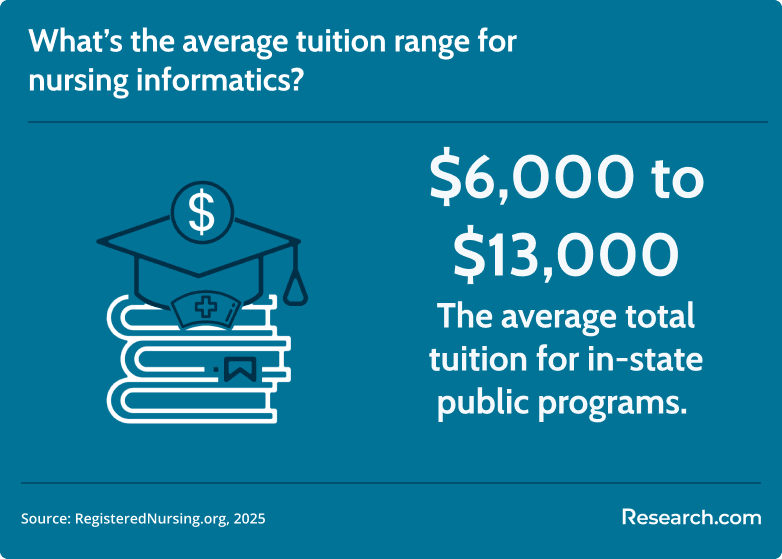
| Total tuition | Most students can expect to pay between $6,000 and $13,000 for the entire certificate program. | Calculate the total using required credits, not only advertised per-credit tuition. |
| Additional fees | Technology or distance learning fees may run $15 to $50 per credit, and some programs add lab platform or course material charges. | Request a full cost sheet before applying. |
| Billing options | Some schools support flat-rate pricing, employer billing, or tuition reimbursement processes. | Check whether payment timing matches your employer’s reimbursement policy. |
Students who have compared low-cost graduate options such as the cheapest online educational policy degree will recognize the same cost logic: public universities, shorter credit requirements, transparent fees, and transfer-friendly policies usually improve value.
For nurses weighing long-term earnings, compare certificate costs with likely career options and typical health informatics salary levels. ROI depends on your starting salary, employer support, local job market, and whether the certificate helps you move into a better role.
What are the financial aid options for students enrolling in an online nursing informatics graduate certificate?
Even when a certificate is relatively affordable, nurses should avoid paying more out of pocket than necessary. The best approach is usually to combine employer benefits, school payment options, scholarships, and, when eligible, federal aid.
- Federal loans: If the certificate is Title IV eligible and you enroll at least half time, you may be able to use the Federal Direct Unsubsidized Loan or the Graduate PLUS Loan. Confirm eligibility with the financial aid office before assuming loans are available.
- Employer tuition assistance: Many health systems reimburse up to $5,250 per year, the maximum that remains tax-free under Internal Revenue Service rules. Some large employers also offer direct billing, which can reduce upfront payment pressure.
- State workforce funds: Programs connected to healthcare technology, rural care, or workforce shortage priorities may qualify for Workforce Innovation and Opportunity Act (WIOA) support or state-level nursing incentives.
- Professional scholarships: The HIMSS Foundation and regional informatics groups may offer competitive awards that range from $1,000 to full tuition.
- Military and veteran benefits: Active-duty service members, veterans, and eligible dependents may be able to use GI Bill, Yellow Ribbon, or institution-specific military tuition benefits.
- Institutional payment plans: Some schools offer application fee waivers, merit awards, employer partnership discounts, or interest-free monthly tuition plans.
Nurses who previously researched the cheapest RN to BSN online can use a similar strategy here: start with employer reimbursement, compare public university pricing, ask about fees, and only borrow after exhausting lower-cost options.
What are the prerequisites for enrolling in online nursing informatics graduate certificate programs?
Admissions requirements vary by school, but most nursing informatics certificates want evidence that applicants have enough nursing, academic, and technical preparation to succeed in graduate-level applied coursework. Requirements are often similar in structure to other advanced nursing certificates, including affordable nurse midwifery graduate certificate programs online, although the clinical focus is different.
- Active Registered Nurse (RN) license: Most programs require a current, unencumbered RN license and may verify licensure through Nursys or another approved system.
- Bachelor’s degree: A BSN from a regionally accredited institution is common. Some schools may consider applicants with a non-nursing bachelor’s degree plus substantial clinical experience, or applicants who already hold an MSN in another specialty.
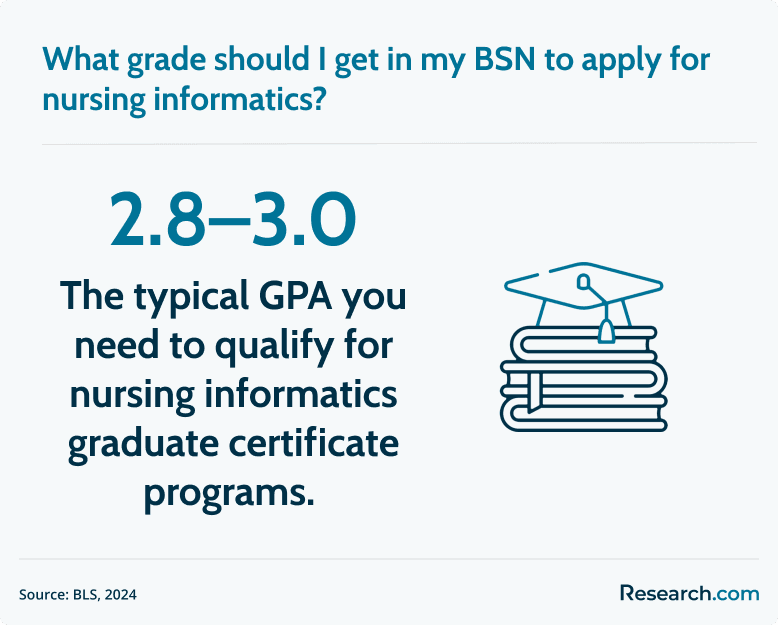
- Minimum GPA: Many programs expect a minimum 2.8–3.0 GPA, though requirements differ.
- Clinical experience: At least one year of recent bedside, administrative, or clinical practice is typical because informatics work depends on understanding real healthcare workflows.
- Statistics or research background: Prior coursework in statistics, research methods, or evidence-based practice may be required or recommended.
- Professional materials: Applicants often submit a resumé, statement of purpose, and two or three recommendation letters, commonly including one from a supervisor.
- Technology readiness: Online students need reliable high-speed internet, comfort with learning management systems, and basic proficiency with productivity and collaboration tools.
- International applicant requirements: Schools may request TOEFL or IELTS scores and credential evaluation for applicants educated outside the United States.
The GRE is rarely required for these certificates. Admissions committees typically care more about nursing experience, academic record, professional goals, and readiness for graduate-level technical coursework.
What courses are typically in online nursing informatics graduate certificate programs?
Most online nursing informatics certificates are intentionally compact. In four to six courses, students move from core informatics concepts to applied projects involving systems, workflows, data, and decision support.
| Course area | What students usually learn | Why it matters in practice |
| Foundations of Nursing Informatics | Scope of practice, informatics standards, ethics, data stewardship, and the role of nurses in technology-enabled care. | Builds the framework for working responsibly with clinical information and digital systems. |
| Database Systems in Healthcare | Relational database concepts, Structured Query Language (SQL), data warehouses, and clinical data structures. | Helps nurses understand how documentation becomes usable data for reports, dashboards, and quality improvement. |
| Health Information Exchange Standards | HL7, FHIR, and other interoperability concepts used to move data between healthcare systems. | Supports continuity of care, reporting, and safer data exchange across platforms. |
| System Design and Implementation | System life cycles, requirements gathering, usability testing, go-live planning, and post-implementation evaluation. | Prepares nurses to contribute to EHR upgrades, new technology launches, and workflow redesign. |
| Analytics and Decision Support | Dashboards, statistical thinking, quality metrics, predictive tools, and clinical decision support logic. | Connects data analysis to operational decisions, patient safety, and care quality. |
| Workflow Integration and Change Management | Process mapping, stakeholder engagement, training, adoption barriers, and communication strategies. | Helps ensure technology supports care delivery rather than creating documentation burden or unsafe workarounds. |
| Capstone or Practicum | A mentored project addressing a real data, workflow, reporting, or system problem. | Gives students applied evidence of skills they can discuss in interviews or advancement conversations. |
Some programs offer electives in mobile health, artificial intelligence, leadership, cybersecurity, or advanced analytics. Nurses interested in deeper technical study may also compare the certificate with an MS in AI online, especially if their long-term goal involves clinical data science or AI governance.
Is the investment in an online nursing informatics graduate certificate program worth it?
The certificate is most likely to be worth it when it solves a specific career problem: you want to move into informatics, you need graduate coursework to qualify for internal openings, your employer will reimburse part of the cost, or you plan to continue into a master’s program that accepts the credits.
It is less compelling if you do not have a clear role target, cannot confirm credit transfer, or are choosing the program only because it is short. The credential works best when paired with applied projects, EHR exposure, analytics skills, and a plan to build visibility with informatics leaders at your organization.
| Worth it if... | Think twice if... |
| Your employer has informatics, EHR, reporting, quality, or implementation roles you can pursue. | You have not researched local or remote job openings that match the certificate. |
| The school confirms that credits transfer into an MSN or health informatics master’s program you may want later. | You assume credits will transfer anywhere without written confirmation. |
| You can use employer tuition assistance, scholarships, military benefits, or a payment plan to reduce upfront cost. | You would need to borrow the full amount without a realistic advancement plan. |
| The curriculum includes applied work with EHRs, interoperability, analytics, workflow redesign, and change management. | The program is mostly theoretical and does not include practical assignments or a capstone. |
When comparing nursing education investments, it can be useful to look at similarly targeted pathways such as the most affordable online PMHNP programs. The right choice depends on whether you want a clinical provider path, a technology-enabled systems path, or a future leadership role combining both.
What challenges might I face in online nursing informatics graduate certificate programs?
Online nursing informatics programs are flexible, but they are not passive. Students need to manage graduate deadlines, technical tools, group communication, and applied projects while often working full time in demanding clinical environments.
- Time pressure: Accelerated terms move quickly. Falling behind during a seven- or eight-week course can be difficult to recover from.
- Technical learning curve: Students may need to become comfortable with databases, EHR training environments, dashboards, screen-sharing tools, and unfamiliar software.
- Limited spontaneous networking: Online programs require students to be intentional about attending virtual events, contacting faculty, and seeking mentors.
- Practicum coordination: If a capstone requires workplace access, students may need supervisor approval, data permissions, and a qualified mentor.
- Role transition uncertainty: Moving from bedside nursing into informatics may require internal networking, project volunteering, or accepting a hybrid role before landing a full informatics title.
Some nurses address these challenges by combining informatics study with broader clinical or advanced practice planning. For example, those comparing a technology path with a clinical provider path may also investigate a nurse practitioner program for non-nurses, though that route serves a very different audience and career goal.
How does nursing informatics integrate with specialized clinical roles?
Nursing informatics is not limited to general hospital systems. Its value often becomes clearer inside specialized clinical areas where workflows, documentation needs, safety risks, and patient populations are highly specific.
In perioperative care, informatics may support scheduling, implant tracking, medication safety, and handoff documentation. In women’s health, it can improve prenatal risk dashboards, patient education tools, care coordination, and population-level quality tracking. In critical care, it may focus on alarms, device integration, decision support, and real-time data displays.
Nurses pursuing specialty practice can use informatics training to become stronger advocates for technology that fits actual care delivery. For example, students exploring affordable women's health nurse practitioner online programs may find that informatics knowledge helps them evaluate patient portals, screening workflows, remote monitoring, and quality measures in women’s health settings.
How can I confirm the accreditation and quality standards of online nursing informatics certificate programs?
Accreditation should be one of the first items you verify. It affects academic credibility, federal financial aid eligibility, credit transfer, and employer confidence. Do not rely only on marketing language; check the accreditor’s website and the school’s official program pages.
- Institutional accreditation: Confirm the college or university is accredited by a recognized institutional accreditor.
- Nursing accreditation: For nursing-based certificates, look for programmatic nursing accreditation from recognized bodies such as ACEN or CCNE when applicable.
- Health informatics accreditation: For broader health informatics programs, CAHIIM accreditation or curriculum alignment can signal strong informatics standards.
- Curriculum relevance: Review whether courses include EHRs, interoperability, analytics, workflow design, privacy, data governance, and change management.
- Faculty qualifications: Look for faculty with informatics practice, research, implementation, health IT, or clinical systems experience.
- Practicum quality: Ask whether the school helps arrange projects, approves workplace sites, and assigns experienced mentors.
- Transfer policy: Get written confirmation if you plan to apply credits toward a future MSN, MSHI, or related graduate degree.
This verification process is useful across nursing pathways. Students comparing flexible programs such as RN BSN online programs no clinicals should apply the same discipline: confirm accreditation, requirements, transfer rules, and employer recognition before enrolling.
What types of specializations are available in online nursing informatics graduate certificate programs?
Some certificates offer one fixed plan of study, while others allow electives or specialty emphasis areas. Specialization matters if you already know whether you want to work in analytics, implementation, leadership, population health, cybersecurity, or patient-facing digital tools.
- Healthcare Data Analytics: Focuses on dashboards, reporting, applied statistics, predictive models, and business intelligence tools. Students who want practical analytics training may also compare short-format options like the cheapest online data analytics bootcamps, though bootcamps usually do not replace graduate nursing informatics coursework.
- Population Health Informatics: Uses data visualization, surveillance, social determinants of health, and community-level metrics to support public health and care management decisions.
- Artificial Intelligence and Machine Learning in Healthcare: Examines responsible AI use, natural language processing, imaging tools, algorithm governance, and the clinical risks of poorly implemented automation.
- Leadership and Project Management: Adds budgeting, stakeholder engagement, implementation planning, training, and change management for nurses who want to lead health IT projects.
- Consumer and Mobile Health: Covers patient portals, mobile apps, wearables, remote monitoring, digital engagement, and care outside traditional clinical settings.
- Cybersecurity and Data Privacy: Addresses protected health information, risk assessment, regulatory compliance, access controls, and incident response in connected healthcare environments.
Because certificate programs are short, specialization usually comes from one or two electives rather than a long concentration. If you want deeper expertise, ask whether those electives count toward a related master’s degree.
The table below compares the job outlooks between nursing informatics certificate holders and other occupations under healthcare.
How to choose the best online nursing informatics graduate certificate programs?
The best program is the one that matches your career target, budget, schedule, and future education plans. A low tuition rate is helpful, but it should not outweigh accreditation, applied coursework, practicum access, and credit transfer.
| Selection factor | What to ask | Why it matters |
| Accreditation | Is the institution accredited, and is the nursing program recognized by the Commission on Collegiate Nursing Education (CCNE) or ACEN when applicable? | Accreditation supports credibility, aid eligibility, employer recognition, and credit transfer. |
| Curriculum | Does the program cover EHRs, HL7, FHIR, analytics, databases, workflow redesign, privacy, and implementation? | These are the skills most directly connected to informatics work. |
| Applied experience | Is there a practicum, capstone, virtual lab, or workplace project? | Applied projects give you interview examples and evidence of competence. |
| Faculty | Do instructors have nursing informatics, health IT, implementation, analytics, or clinical systems experience? | Practice-informed teaching can make coursework more relevant to current healthcare systems. |
| Credit portability | Can all certificate credits transfer into an MSN, MS in Health Informatics, or another graduate degree? | Transferable credits can reduce future time and tuition. |
| Total cost | What is the full price after tuition, fees, books, software, and any residency differences? | The advertised per-credit rate may not show the actual cost of completion. |
| Student support | Is there 24/7 tech support, online library access, career guidance, and practicum coordination? | Working online students need reliable support to stay on track. |
Common mistakes to avoid
| Mistake | Better approach |
| Choosing the cheapest program without checking accreditation. | Verify institutional and relevant programmatic accreditation before comparing price. |
| Assuming online automatically means flexible. | Check whether courses are asynchronous, synchronous, cohort-based, or self-paced. |
| Looking only at tuition. | Add fees, software, books, practicum costs, and payment timing to estimate total cost. |
| Assuming credits will transfer later. | Request written confirmation from the receiving graduate program. |
| Ignoring practicum requirements. | Ask how projects are approved, who mentors students, and whether your workplace can be used. |
| Expecting the certificate alone to guarantee a salary increase. | Build a portfolio, pursue internal projects, network with informatics leaders, and target specific roles. |
What career paths are available for online nursing informatics certificate holders?
A nursing informatics certificate can help nurses move into roles that combine clinical knowledge, data interpretation, systems thinking, training, and technology implementation. The most suitable role depends on your prior experience and how technical you want your work to be.
- Clinical Systems Analyst: Supports EHR configuration, troubleshooting, interface issues, workflow documentation, and decision-support improvements.
- Nursing Informatics Specialist: Works with clinical, IT, quality, and operations teams to improve workflows, dashboards, documentation, and data integrity. The 2023 HIMSS survey found that 60% of nurse informaticists now earn more than $100,000.
- Health Data Quality or Reporting Analyst: Reviews data accuracy, builds reports, supports regulatory reporting, and contributes to value-based care initiatives.
- Informatics Project Manager: Coordinates EHR upgrades, telehealth rollouts, analytics projects, timelines, budgets, training plans, and stakeholder communication. These roles may align with the BLS medical and health services manager category, which reports a median wage of $117,960.
- Vendor Implementation or Training Consultant: Works with healthcare software companies to gather requirements, test systems, train users, and support go-live events.
- Population Health or Analytics Lead: Uses large datasets to identify risk patterns, guide outreach, assess social determinants of health, and support quality programs.
Just as an RN to BSN fast track can help nurses expand their qualifications efficiently, a nursing informatics certificate can help experienced RNs shift toward systems-focused roles and, over time, leadership positions such as informatics director or chief nursing informatics officer.
How can this certificate facilitate the transition to advanced nursing degrees?
A nursing informatics graduate certificate can act as a stepping stone if the credits are accepted into a larger degree. Many schools design certificates inside an MSN, MS in Health Informatics, or related graduate curriculum so students can test the field before committing to a full program.
This pathway can be especially useful for nurses who want to build technical expertise first, then decide whether to continue into administration, education, advanced practice, informatics leadership, or health data roles. The key is to confirm transfer rules before enrollment because schools may restrict how many certificate credits can apply, how recent they must be, or which grade is required.
Students comparing graduate routes may also look at direct entry MSN programs, but those are typically designed for people entering nursing from another field. For already licensed nurses, an informatics certificate is usually a more targeted way to add systems and data expertise without starting over.
What is the job market for online nursing informatics certificate holders?
The job market is supported by several durable healthcare trends: continued EHR optimization, growth in telehealth, pressure to improve quality reporting, expansion of value-based care, increased use of analytics, and rising interest in artificial intelligence. These trends create demand for clinicians who can evaluate technology through a patient-care lens.
The BLS projects 16% growth from 2023 to 2033 for health information technologists and medical registrars, a category that includes many entry-level informatics and data-quality roles and is described as “much faster than average.” At the leadership level, medical and health services managers are projected to grow by 29% during the same period.
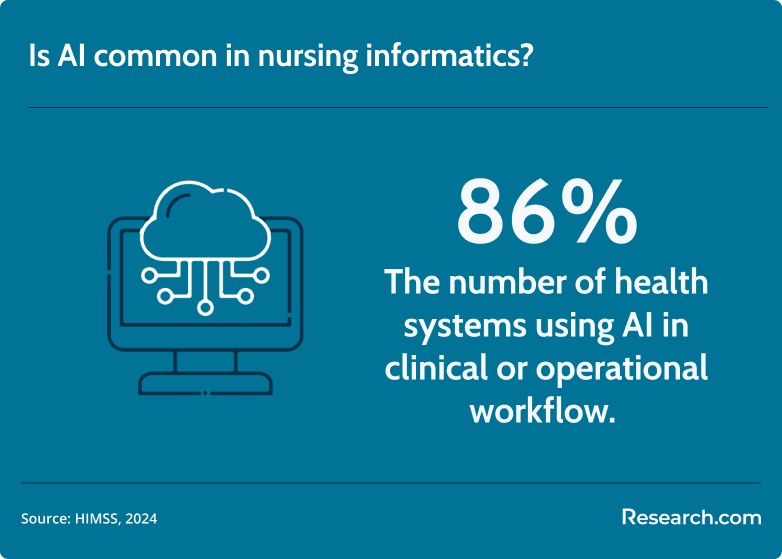
Artificial intelligence is also changing informatics work. A 2024 HIMSS report found that 86% of health systems already use some form of AI in clinical or operational workflows. As AI tools expand, nurse informaticists can help validate data quality, monitor workflow impact, train users, and make sure algorithm outputs are interpreted appropriately in clinical settings.
Opportunities are not limited to hospitals. Remote and hybrid roles may be available with EHR vendors, consulting companies, payers, population health organizations, and healthcare analytics firms. Nurses comparing bedside compensation, such as a PACU nurse salary, should evaluate not only starting salary but also schedule flexibility, advancement potential, and long-term fit.
Employers may also prefer to upskill trusted nurses who already understand internal workflows. If your organization is implementing new systems, expanding analytics, or redesigning documentation, volunteering for committees or pilot projects can help you use the certificate strategically.
References:
- Federal Student Aid. (2025). Grad PLUS loans. https://studentaid.gov/understand-aid/types/loans/plus/grad
- Federal Student Aid. (2025). Subsidized and Unsubsidized Loans. https://studentaid.gov/understand-aid/types/loans/subsidized-unsubsidized
- Health information technologists and medical registrars. (2025, April 18). Bureau of Labor Statistics. https://www.bls.gov/ooh/healthcare/health-information-technologists-and-medical-registrars.htm
- Healthcare Information and Management Systems Society. (2024). Medscape & HIMSS AI adoption by health systems report. https://www.himss.org/futureofai/
- HIMSS. (2024, July 29). HIMSS Nursing Informatics Workforce Survey. HIMSS. https://www.himss.org/resources/himss-nursing-informatics-workforce-survey
- Internal Revenue Service. (2025). Publication 15-B (2025), Employer’s Tax Guide to Fringe Benefits. https://www.irs.gov/publications/p15b
- Medical and health services managers. (2025, April 18). Bureau of Labor Statistics. https://www.bls.gov/ooh/management/medical-and-health-services-managers.htm
- Registered nurses. (2025, April 18). Bureau of Labor Statistics. https://www.bls.gov/ooh/healthcare/registered-nurses.htm
- RegisteredNursing.org. (2025, March 18). Choosing a nursing informatics program. https://www.registerednursing.org/nursing-informatics/programs/
Key Insights
- An online nursing informatics graduate certificate is best for licensed nurses who want technology-focused healthcare roles without immediately pursuing a full degree. It is most useful when connected to EHR optimization, analytics, clinical systems, quality improvement, or informatics leadership goals.
- Most programs are short and stackable. Many require 12 to 18 credits, while some listed options require 16, 18, or 25 credits. Always confirm whether credits transfer into an MSN, MS in Health Informatics, or another graduate program.
- Accreditation and applied experience matter more than format. Employers are likely to care about program credibility, practical skills, capstone work, and your nursing experience rather than whether the program was online or on campus.
- Costs can be manageable, but total price varies. Most students can expect to pay between $6,000 and $13,000 for the entire certificate program, with additional fees possible. Employer reimbursement, scholarships, military benefits, and payment plans can reduce out-of-pocket cost.
- The strongest programs teach real informatics work. Look for EHR labs, HL7, FHIR, database concepts, analytics, workflow redesign, privacy, change management, and a mentored capstone or practicum.
- The job outlook is favorable, but outcomes are not automatic. The BLS projects 16% growth for health information technologists and medical registrars and 29% growth for medical and health services managers from 2023 to 2033. To benefit, nurses should pair the certificate with project experience, networking, and targeted role applications.
Other Things You Should Know About Online Nursing Informatics Graduate Certificate Programs
No. Most online graduate certificate programs in nursing informatics are fully didactic and do not require direct patient-care clinical hours. Many still include an applied practicum or informatics project, often worth 1–3 credits, completed with a preceptor or faculty-approved workplace site.
In 2027, the costs for an online graduate certificate in nursing informatics program generally include tuition, technology fees, and course materials. Tuition can range from $5,000 to $15,000 depending on the institution. Some programs may offer bundled pricing options to reduce overall costs.


