
2027 Most In-Demand Engineering Degrees

Co-Founder and Chief Data Scientist
The global engineering services market is expected to expand from $2.34 trillion in 2025 to $4.65 trillion by 2032 (Fortune Business Insights, 2025), signaling unprecedented demand for skilled professionals. Aspiring engineers should actively evaluate engineering degrees to target high-growth sectors, securing careers with strong job stability, competitive salaries, and long-term advancement opportunities.
In this article, I will cover the most in-demand engineering degrees, detailing growth trends, earning potential, and industry relevance. I will also discuss actionable insights to identify emerging specialties and help aspiring engineers position themselves in fast-growing fields.
What are the benefits of pursuing the most in-demand engineering degrees?
- Pursuing the most in-demand engineering degrees enhances technical expertise, preparing professionals to tackle complex problems across high-growth industries.
- These degrees expand career opportunities, opening pathways to specialized roles in fields such as renewable energy, AI, and advanced manufacturing.
- They strengthen professional competitiveness, equipping graduates with skills in innovation, data analysis, and project management that are highly valued by employers worldwide.
- What are the most in-demand engineering degrees today? In-Demand Degrees
- Which engineering degrees are most in demand globally? Global Demand
- Which engineering jobs are growing the fastest in 2027 and beyond? Fast Growing Jobs
- What are the emerging engineering fields of the future? Emerging Fields
- What engineering degree is best for renewable energy careers? What engineering degree is best for renewable energy careers?
- Which engineering degree leads to the highest-paying jobs? Highest Paying Degrees
- How much do in-demand engineering degrees typically cost? Degree Cost
- What are the best schools to study engineering? Best Schools
- What are the career outlooks for the most in-demand engineering degrees? What are the career outlooks for the most in-demand engineering degrees?
- How do I choose the right engineering degree for my career goals? How do I choose the right engineering degree for my career goals?
Most in-demand engineering degrees: how to choose a field with strong career potential
Choosing an engineering major is not just a question of which subject sounds interesting. It affects the industries you can enter, the technical skills you will build, the types of problems you will solve, and the return you may get from your education. Demand is strongest in engineering fields tied to infrastructure, automation, artificial intelligence, healthcare technology, energy systems, computing hardware, and industrial efficiency.
This guide is for students comparing engineering majors, working adults considering a career change, and online learners evaluating flexible programs such as affordable online engineering degree options. It explains which engineering degrees are currently in demand, which fields are growing globally, what jobs are expanding fastest, how much leading programs can cost, and how to choose a degree that fits your goals instead of following rankings alone.
Quick answer: which engineering degrees are most in demand?
The most in-demand engineering degrees today are industrial engineering, civil engineering, mechanical engineering, electrical engineering, computer hardware engineering, and biomedical engineering. Based on US BLS (2025) projections, industrial engineering has the largest number of expected annual openings among the listed fields, while civil, mechanical, and electrical engineering also show broad demand because they support infrastructure, manufacturing, energy, transportation, electronics, and automation.
| Engineering degree | Why employers need it | Projected annual openings cited by US BLS (2025) |
| Industrial Engineering | Improves production systems, logistics, supply chains, quality control, and cost efficiency across complex organizations. | 25,200 annual job openings |
| Civil Engineering | Supports transportation systems, water infrastructure, public works, buildings, bridges, and climate-resilient construction. | 23,600 annual openings |
| Mechanical Engineering | Applies design, testing, and systems thinking to robotics, aerospace, automotive, energy, manufacturing, and product development. | 18,100 annual job openings |
| Electrical Engineering | Builds and improves electronics, power systems, telecommunications, renewable energy systems, and smart-grid technologies. | 17,500 positions projected each year |
| Computer Hardware Engineering | Develops processors, chips, embedded systems, and physical computing infrastructure used in advanced digital products. | Roughly 4,700 job openings expected each year |
| Biomedical Engineering | Combines engineering with medicine to create devices, diagnostics, prosthetics, imaging systems, and healthcare technologies. | About 1,300 annual openings from 2024 to 2034 |
The right choice depends on whether you want a broad, transferable engineering foundation or a specialized path tied to a specific sector such as healthcare, energy, computing, construction, or advanced manufacturing.
Which engineering degrees are most in demand globally?
Worldwide demand is strongest for engineering degrees that support digital transformation, large infrastructure projects, energy modernization, healthcare innovation, and efficient global supply chains. Software engineering is especially important because nearly every major industry now relies on scalable digital systems, cloud platforms, cybersecurity, data pipelines, and automation tools. Students who need flexibility may compare an online bachelor's degree in software engineering with traditional engineering programs before choosing a path.
Generative AI is also changing the way engineering teams work. Recent data shows that 13% of business units in software engineering departments achieved cost reductions of 20% or more, while another 16% reported savings between 11% and 19% after adopting generative AI. These figures show why software-related engineering remains globally relevant: organizations are not only building more digital products, they are also looking for engineers who can improve productivity and reduce costs.
| Globally relevant engineering field | Where demand is coming from | Best fit for students who want to... |
| Software Engineering | Digital platforms, enterprise systems, AI tools, cloud computing, cybersecurity, and automation. | Build software products, work with code, solve digital infrastructure problems, and enter technology-driven industries. |
| Civil Engineering | Urban growth, transportation networks, water systems, resilient infrastructure, and construction modernization. | Design physical systems that support cities, communities, and public infrastructure. |
| Electrical Engineering | Renewable energy, smart grids, electronics, communications systems, and power distribution. | Work on energy, devices, circuits, signals, telecommunications, or large-scale electrical systems. |
| Mechanical Engineering | Automotive systems, aerospace, robotics, thermal systems, machinery, and advanced manufacturing. | Keep career options broad while developing design, modeling, and testing skills. |
| Industrial Engineering | Manufacturing hubs, logistics networks, operations improvement, automation, and supply chain resilience. | Improve how organizations produce, move, and deliver products or services. |
| Biomedical Engineering | Medical devices, biotechnology, digital health, imaging, prosthetics, and healthcare systems. | Apply engineering principles to patient care, diagnostics, and health technology. |
The chart below from McKinsey & Company shows reported cost reductions from generative AI adoption in software engineering.
Which engineering jobs are growing the fastest in 2027 and beyond?
The fastest-growing engineering-related roles are increasingly connected to artificial intelligence, machine learning, robotics, automation, and language technologies. Opportunities in Artificial Intelligence (AI) and Machine Learning (ML) are projected to grow by 40% by 2027, making these among the most important areas for students who want to work near the front edge of engineering and technology.
McKinsey & Company (2025) also reports that 7% of software engineering business units saw productivity gains of more than 10% in the past 12 months because of generative AI adoption. For students comparing program costs, a lower-cost pathway such as one of the most affordable online software engineering degrees may be worth considering if it teaches the programming, systems design, data, and AI foundations employers expect.
| Fast-growing role | What the role does | Useful degree preparation |
| Machine Learning Engineer | Creates models and algorithms that allow systems to learn from data and improve performance over time. | Software engineering, computer engineering, data engineering, electrical engineering, or applied AI coursework. |
| Robotics Engineer | Designs robotic systems used in manufacturing, healthcare, logistics, autonomous systems, and mobility. | Mechanical engineering, electrical engineering, computer engineering, robotics, or mechatronics. |
| NLP Engineer | Builds systems that process, interpret, and generate human language for search, assistants, translation, analytics, and automation. | Software engineering, computer science, data engineering, AI, or computational linguistics preparation. |
Traditional engineering fields are not being replaced by these roles. Instead, many are being reshaped by them. Mechanical engineers may work with robotics, electrical engineers may support intelligent grids, civil engineers may use AI-assisted design tools, and industrial engineers may use machine learning to improve production and logistics.
Students comparing engineering with other professional routes may also find it useful to review decision-focused guides in adjacent fields, such as Research.com's explanation of M&A in accounting education and careers, because the same basic question applies: does the specialization connect to real market demand?

What are the emerging engineering fields of the future?
Emerging engineering fields sit at the intersection of computing, materials science, automation, energy, health, and security. These areas may not always map neatly to one undergraduate major, so students should look closely at concentrations, electives, research labs, internships, and graduate options before choosing a program.
| Emerging field | What it focuses on | Why it matters |
| Artificial Intelligence and Machine Learning Engineering | Designing intelligent systems that learn from data and support prediction, optimization, and automation. | AI is being applied in manufacturing, logistics, finance, healthcare, energy, software development, and transportation. |
| Robotics and Automation Engineering | Building machines and automated workflows that combine hardware, sensors, controls, and software. | Organizations use robotics to improve precision, consistency, safety, and productivity. |
| Internet of Things (IoT) Engineering | Connecting devices, sensors, networks, and platforms so systems can collect and exchange real-time data. | IoT supports smart buildings, logistics tracking, energy management, industrial monitoring, and connected infrastructure. |
| Sustainable and Green Engineering | Designing systems that reduce waste, improve energy performance, use cleaner materials, and support environmental goals. | Climate adaptation and renewable infrastructure require engineers who understand both technical performance and environmental impact. |
| Nanotechnology Engineering | Working with materials and systems at the nanoscale to improve strength, conductivity, medical delivery, or energy performance. | Nanotechnology can influence electronics, medicine, advanced materials, and energy storage. |
| Cybersecurity Engineering | Protecting digital systems, embedded devices, industrial networks, and critical infrastructure from cyber threats. | Engineering systems are increasingly connected, which makes security a design requirement rather than an afterthought. |
| Quantum Engineering | Applying quantum mechanics to computing, communications, sensing, and cryptography. | Quantum technologies could change high-performance computing and secure communications. |
When comparing future-facing fields, avoid choosing a major only because it sounds advanced. Ask whether the program teaches the fundamentals employers still expect: mathematics, physics, programming, design, testing, communication, and project work. Students weighing different professional credentials can use a similar framework to those comparing whether a CFA or MBA is the better fit: the strongest choice is the one aligned with the work you actually want to do.
What engineering degree is best for renewable energy careers?
Renewable energy careers draw from several engineering disciplines rather than one single major. Electrical engineering is often the strongest fit for students interested in power systems, solar integration, wind energy, grid modernization, and storage. Mechanical, civil, chemical, environmental, industrial, energy systems, computer, and software engineering can also lead to clean-energy work depending on the role.
The sector’s growth creates demand for multiple technical skill sets. In 2024, the US energy storage market installed over 12 GW of capacity, a 33% year-over-year increase. That kind of expansion requires engineers who can design, build, monitor, optimize, and secure renewable systems.
| Degree path | Renewable energy applications | Best fit if you want to work on... |
| Electrical Engineering | Solar arrays, wind power systems, transmission, grid integration, controls, and energy distribution. | Power systems, smart grids, batteries, renewable integration, and electrical infrastructure. |
| Mechanical Engineering | Wind turbine design, thermal systems, mechanical components, energy conversion, and storage equipment. | Machines, materials, fluids, thermodynamics, and product performance. |
| Civil Engineering | Wind farms, hydropower facilities, site development, foundations, and climate-resilient infrastructure. | Construction, infrastructure, public works, and large physical projects. |
| Chemical Engineering | Hydrogen systems, biofuels, battery chemistry, carbon-related processes, and scalable clean-energy materials. | Chemistry-based energy technologies and process engineering. |
| Environmental Engineering | Permitting, environmental impact, water systems, sustainability planning, and regulatory compliance. | Reducing ecological harm and improving environmental performance. |
| Industrial Engineering | Battery manufacturing, supply chains, production systems, quality improvement, and resource efficiency. | Operations, logistics, process improvement, and manufacturing scale-up. |
| Energy Systems Engineering | Solar, wind, storage, energy management, and integrated energy planning. | A degree specifically centered on energy technologies and systems thinking. |
| Computer and Software Engineering | Forecasting tools, SCADA monitoring, grid cybersecurity, energy analytics, and automation platforms. | Software, data, AI-enabled forecasting, digital controls, and secure energy systems. Students seeking speed may compare the fastest online bachelor's in software engineering options. |
Which engineering degree leads to the highest-paying jobs?
Engineering pay varies by industry, location, experience, employer, specialization, and market conditions. A degree can open the door, but it does not guarantee a specific salary. Still, some engineering-related fields tend to command higher pay because they require rare technical expertise or support high-value industries.
Petroleum engineering and data engineering stand out in the salary figures cited here. Petroleum engineers earn an average of $133,233 per year, reflecting the specialized knowledge required for oil and gas exploration, drilling, and production. Data engineers average $131,165 annually, building large-scale systems that collect, move, process, and organize data for advanced uses such as artificial intelligence and renewable energy forecasting.
| High-paying engineering-related path | Average salary cited | Why the work can pay well |
| Petroleum Engineering | $133,233 per year | The work is technically specialized and tied to energy exploration, extraction, drilling, and production systems. |
| Data Engineering | $131,165 annually | Organizations need reliable data infrastructure for analytics, AI, automation, forecasting, and digital operations. |
The broader engineering sector also remains economically significant. AECOM, a US-based engineering firm highlighted in enterprise value data, has an enterprise value of roughly $9.1 billion. That figure does not determine individual salaries, but it illustrates the scale of companies operating in engineering and construction markets.
Students should compare pay against volatility, location constraints, degree cost, and personal fit. A high-paying field may not be the best choice if you dislike the daily work or if jobs are concentrated in regions where you do not want to live. This is similar to how students evaluating MBA MHA dual degree career outcomes must weigh salary potential against program length, tuition, and target industry.
The chart below from Indeed (2025) provides additional salary context for selected engineering roles.
How much do in-demand engineering degrees typically cost?
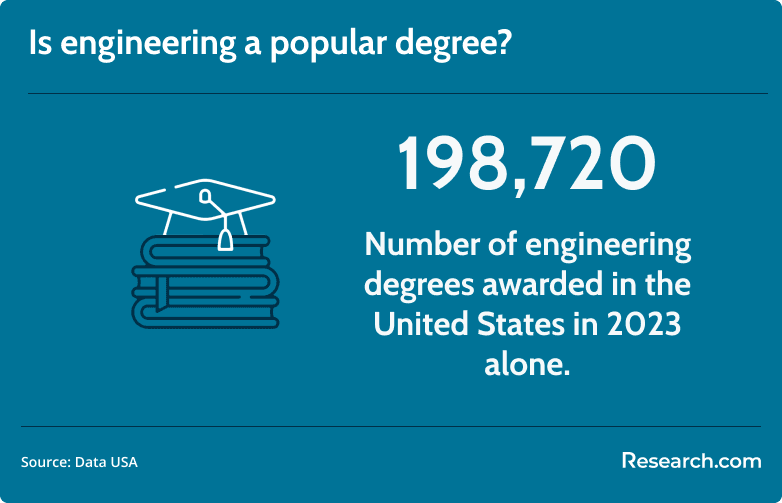
The cost of an engineering degree depends heavily on the institution, residency status, housing choice, program format, financial aid, and time to completion. Engineering remains a major academic field in the US, with 198,720 engineering degrees awarded in 2023 (Data USA, n.d.), but the investment can range widely among schools.
When comparing costs, do not look only at tuition. Add fees, housing, food, transportation, books, lab expenses, technology needs, health insurance, lost work time, and the possibility of extra semesters. Students comparing engineering ROI can apply the same kind of cost-versus-outcome thinking used in other professional degree decisions, such as evaluating MD MPH dual degree career paths and salary considerations.
| Institution | Cost figure cited | How to interpret the number |
| Massachusetts Institute of Technology | $32,155 per term | A high per-term tuition figure associated with a globally recognized engineering and STEM environment. |
| Stanford University | $22,577 per quarter | A premium tuition figure connected to a major research university with strong technology and entrepreneurship networks. |
| University of California, Berkeley | $45,234 on-campus annually; $43,634 off-campus annually | Costs should be read alongside California living expenses and the university's engineering reputation. |
| Georgia Institute of Technology | $30,154 annually for residents; $53,638 out-of-state; $54,814 international | Residency status strongly affects the total price students may pay. |
| California Institute of Technology | $93,912 on-campus; $97,455 off-campus; $85,611 living with parents | Total cost varies by living arrangement at a small, highly research-focused institution. |
Ways to reduce the cost of an engineering degree
- Start with public in-state options. Residency can make a major difference, as shown by the Georgia Institute of Technology figures.
- Compare online and hybrid programs carefully. Online study may reduce relocation or commuting costs, but fees and technology requirements can still add up.
- Ask about transfer credits before enrolling. Community college coursework, AP credit, prior college credit, or military training may shorten the path if accepted.
- Look for paid internships and co-ops. Engineering work experience can help offset costs and strengthen the résumé.
- Check degree requirements early. Delayed prerequisite sequencing can add time, which can increase the total cost.
What are the best schools to study engineering?
The best engineering school for one student may not be the best for another. Prestige matters less if the program does not fit your budget, specialization, learning style, location, or career goals. Strong engineering programs usually offer rigorous fundamentals, modern labs, research or design opportunities, employer connections, experienced faculty, and pathways into internships or graduate study.
| School | Why students consider it | Who it may fit best |
| Massachusetts Institute of Technology (MIT) | Known for engineering, science, innovation, entrepreneurship, and interdisciplinary technical research. | Students seeking an intensive STEM environment with strong research and innovation culture. |
| Stanford University | Connects engineering education with Silicon Valley, entrepreneurship, research, and industry networks. | Students interested in technology, startups, interdisciplinary work, and research-driven engineering. |
| University of California, Berkeley | Offers strong engineering programs with notable activity in computer science, civil engineering, and renewable energy research. | Students looking for a major public research university with broad engineering depth. |
| Georgia Institute of Technology | Recognized for applied engineering, industry collaboration, research, and comparatively strong value for in-state students. | Students who want a public engineering-focused institution with strong employer relevance. |
| California Institute of Technology (Caltech) | Provides a small, research-intensive academic environment with close faculty interaction. | Students who want rigorous science and engineering study in a highly focused setting. |
Questions to ask before choosing an engineering school
- Does the program offer the engineering major or concentration you actually want?
- Are labs, design studios, capstone projects, research groups, and internship pipelines available to undergraduates?
- How often are required courses offered, and can students graduate on time?
- What are the total costs after aid, not just the published tuition?
- How does the school support co-ops, internships, career placement, and employer recruiting?
- If the program is online, are labs, proctored exams, team projects, and hands-on requirements clearly explained?
- Will the degree support licensure, graduate study, or specialized certifications if those are part of your plan?
What are the career outlooks for the most in-demand engineering degrees?
Engineering career outlooks remain strong because engineers solve problems tied to infrastructure, energy, automation, health, transportation, manufacturing, and digital systems. The article's cited outlook data points to a general 7% job growth from 2024 to 2034 for engineers, but growth differs by discipline.
Industrial engineering is projected to grow 11% between 2024 and 2034, driven by employer demand for efficiency, automation, cost control, quality improvement, and better supply chains. Students who already have an engineering background and want to move faster into advanced systems roles may compare an accelerated online master's in industrial engineering.
Mechanical engineering is expected to expand by 9% over the same period. Mechanical engineers continue to be relevant because their skills apply across robotics, energy systems, transportation, machinery, product design, thermal systems, and advanced manufacturing.
| Field | Outlook figure cited | What is driving demand |
| Engineering overall | 7% job growth from 2024 to 2034 | Broad need for technical problem-solving across infrastructure, technology, energy, manufacturing, and health-related systems. |
| Industrial Engineering | 11% growth between 2024 and 2034 | Automation, efficiency, logistics, quality, manufacturing improvement, and supply chain optimization. |
| Mechanical Engineering | 9% expansion over the same period | Robotics, energy systems, transportation, product development, machinery, and advanced manufacturing. |
The US BLS chart below summarizes job outlook information for major engineering disciplines.
How do I choose the right engineering degree for my career goals?
The best engineering degree is the one that connects your strengths, interests, preferred work environment, financial limits, and target industry. Do not choose a major only because it appears on a “most in-demand” list. Demand matters, but fit matters too. A student who enjoys coding and abstract systems may thrive in software or data engineering, while a student who likes physical design may prefer mechanical, civil, or electrical engineering.
Step-by-step decision guide
- Start with the type of problems you want to solve. Healthcare points toward biomedical engineering; infrastructure points toward civil engineering; energy may point toward electrical, mechanical, chemical, environmental, or energy systems engineering; automation may point toward mechanical, electrical, robotics, industrial, or software engineering.
- Match the degree to daily work, not just job titles. Read job descriptions and note whether they emphasize coding, design, field work, lab work, systems analysis, project management, compliance, or manufacturing.
- Compare broad and specialized majors. Mechanical, electrical, civil, and industrial engineering often provide broad career flexibility, while biomedical, petroleum, energy systems, or software engineering may align more directly with specific sectors.
- Check program structure. Look at required math, science, labs, design projects, electives, internship options, and capstone expectations.
- Review total cost and completion time. Include tuition, fees, housing, lost income, transfer credits, and the risk of extra semesters.
- Evaluate location and industry access. Some opportunities cluster near energy hubs, manufacturing regions, government contractors, technology centers, healthcare systems, or infrastructure agencies.
- Plan for skills beyond the degree. Programming, data analysis, communication, project management, teamwork, and AI literacy can improve employability across many engineering fields.
How different engineering paths compare
| If your priority is... | Consider these degrees | Be careful about... |
| Broad career flexibility | Mechanical, electrical, civil, or industrial engineering | Choosing electives randomly instead of building a focused skill set. |
| Technology and software work | Software, computer, data, or electrical engineering | Assuming a degree alone is enough without projects, coding practice, and systems experience. |
| Renewable energy | Electrical, mechanical, chemical, environmental, industrial, energy systems, or software engineering | Overlooking the difference between field construction, grid design, battery chemistry, analytics, and policy compliance. |
| Healthcare innovation | Biomedical, mechanical, electrical, materials, or software engineering | Assuming every biomedical role is clinical; many are in devices, testing, regulation, or research. |
| Operations and supply chains | Industrial engineering | Ignoring statistics, analytics, systems modeling, and process improvement skills. |
| Highest possible salary potential | Petroleum engineering, data engineering, software-related engineering, or specialized technical fields | Chasing pay without considering industry volatility, location, or personal fit. |
Online vs. campus engineering programs
| Program format | Advantages | Trade-offs |
| Online engineering degree | Can help working adults study with more flexibility and may reduce relocation or commuting costs. | Students must confirm how labs, design projects, exams, team work, and hands-on requirements are completed. |
| Campus engineering degree | Provides direct access to labs, student teams, faculty, research spaces, and in-person recruiting. | May require relocation, commuting, housing costs, and less schedule flexibility. |
| Hybrid engineering program | Combines online coursework with some in-person lab, project, or residency components. | Students need to plan for travel, scheduling, and any required campus sessions. |
Common mistakes to avoid when choosing an engineering degree
- Choosing based only on salary. Pay matters, but a degree that does not match your strengths can lead to poor performance or dissatisfaction.
- Ignoring accreditation and licensure needs. If you may pursue professional engineering licensure or graduate study, confirm that the program’s credentials will support that goal.
- Looking only at tuition. Total cost includes fees, housing, transportation, supplies, technology, health insurance, and extra time if courses are not sequenced well.
- Assuming all online engineering programs work the same way. Lab delivery, project expectations, exam requirements, and employer perception can differ significantly.
- Relying only on rankings. A famous school may not be the best option if it lacks your preferred specialization or creates too much debt.
- Waiting too long to build experience. Internships, co-ops, research, design teams, and portfolio projects can matter as much as coursework.
- Overlooking AI and data skills. Even traditional engineering fields increasingly use software tools, modeling, automation, analytics, and AI-assisted workflows.
What graduates say about in-demand engineering degrees
- Sam: "Engineering forced me to move beyond memorizing formulas. I learned how to break down messy technical problems and apply that thinking to real work in energy and technology."
- Dana: "My degree gave me options I did not expect, including renewable energy projects and work with teams in other countries. The strongest benefit has been knowing that my technical skills transfer across industries."
- Peter: "The hardest part of engineering school was learning to adapt when a design failed. That experience made me more resilient and helped me see engineering as a way to shape systems, products, and communities."
Key Insights
- Industrial, civil, mechanical, electrical, computer hardware, and biomedical engineering are among the strongest in-demand degree paths based on the US BLS (2025) annual openings cited in this guide.
- Software engineering has major global relevance because organizations depend on digital systems, automation, cybersecurity, cloud platforms, and AI-enabled productivity improvements.
- AI and machine learning are reshaping engineering work. Opportunities in AI and ML are projected to grow by 40% by 2027, and generative AI is already linked to reported cost reductions and productivity gains in software engineering business units.
- Renewable energy does not belong to one major. Electrical engineering is a strong route, but mechanical, civil, chemical, environmental, industrial, energy systems, computer, and software engineering can all lead to clean-energy roles.
- High salaries are possible but not guaranteed. Petroleum engineers average $133,233 per year and data engineers average $131,165 annually in the cited sources, but outcomes depend on experience, location, employer, industry, and specialization.
- Cost varies sharply by school and residency status. Compare total attendance cost, transfer credit rules, aid, co-op options, and time to completion before deciding.
- The best engineering degree is not always the trendiest one. Choose the field that matches your skills, preferred work environment, target industries, and willingness to keep learning as technology changes.
References:
- California Institute of Technology (n.d.). Undergraduate Expenses. Caltech undergraduate expenses
- Data USA (n.d.). Engineering. Data USA engineering profile
- Fortune Business Insights (2025). Engineering Services Market Size, Share & Industry Analysis, By Services. Fortune Business Insights engineering services market
- Georgia Institute of Technology (n.d.). Undergraduate Costs. Georgia Tech undergraduate costs
- Indeed (2025). Aeronautical Engineer Salary in United States. Indeed aeronautical engineer salary
- Indeed (2025). Data Engineer Salary in United States. Indeed data engineer salary
- Indeed (2025). Electrical Engineer Salary in United States. Indeed electrical engineer salary
- Indeed (2025). Petroleum Engineer Salary in United States. Indeed petroleum engineer salary
- Massachusetts Institute of Technology (n.d.). Undergraduate Tuition. MIT undergraduate tuition
- McKinsey & Company (2025). The State of AI: How Organizations are Rewiring to Capture Value. McKinsey state of AI report
- Stanford University (n.d.). Undergraduate Tuition. Stanford undergraduate tuition rates
- University of California (n.d.). Tuition & Cost of Attendance. University of California tuition and cost of attendance
- US BLS (2025). Bioengineers and Biomedical Engineers. BLS biomedical engineers outlook
- US BLS (2025). Civil Engineers. BLS civil engineers outlook
- US BLS (2025). Computer Hardware Engineers. BLS computer hardware engineers outlook
- US BLS (2025). Electrical and Electronics Engineers. BLS electrical and electronics engineers outlook
- US BLS (2025). Industrial Engineers. BLS industrial engineers outlook
- US BLS (2025). Mechanical Engineers. BLS mechanical engineers outlook
- World Economic Forum (2025). The Future of Jobs Report 2025. World Economic Forum Future of Jobs Report 2025
Other Things You Should Know About the Most In-Demand Engineering Degrees
Medical device manufacturers, hospitals, and pharmaceutical companies hire the most biomedical engineering graduates in 2027. Many roles also sit in regulatory affairs and product testing, where employers often expect an ABET-accredited bachelor’s degree and, for some design jobs, a Professional Engineer license or clinical-device experience.
In 2027, the primary industries hiring engineering graduates include technology, renewable energy, biotechnology, and infrastructure development. These sectors are actively seeking engineers to innovate and address evolving challenges in areas like robotics, clean energy technologies, medical devices, and smart city planning.


