
2027 Most Affordable Online Geosciences Degree Programs

Co-Founder and Chief Data Scientist
Choosing an online geosciences degree is not just a question of convenience. It is a decision about whether you want to study Earth systems, climate, water, minerals, natural hazards, environmental change, and spatial data in a format that can fit around work, family, or military responsibilities. The right program can prepare you for roles in environmental consulting, government agencies, energy, water resources, GIS, meteorology, and natural resource management.
The field also has measurable career potential. Employment for geoscientists in the United States has been projected to grow by 5% from 2023 to 2033, with about 2,200 openings per year on average over the decade [US Bureau of Labor Statistics (BLS), 2025]. Pay can also be strong: geoscientists earned a median annual wage of $99,240 in May 2024, compared with $49,500 for all US occupations during the same period (US BLS, 2025).
This guide explains what online geosciences programs include, how long they take, what they cost, how to compare schools, what careers they can lead to, and what mistakes to avoid before enrolling. It is designed for prospective students who want a practical way to evaluate whether an online geosciences degree is worth the time and cost.
Quick answer: Is an online geosciences degree worth it?
An online geosciences degree can be worth it if you want a science-focused career connected to Earth systems, environmental protection, water resources, GIS, weather, energy, or natural hazards and you need the flexibility of distance learning. It is strongest for students who choose an accredited program, confirm field or lab requirements in advance, compare total costs rather than tuition alone, and select a concentration that matches their intended career path.
- An online geosciences degree may support career paths such as geoscientist, environmental scientist, hydrologist, geological engineer, petroleum engineer, GIS specialist, or natural resources professional.
- Geoscientists in the US earned a median annual wage of $99,240 in May 2024 (US BLS, 2025).
- Online study can make the degree more accessible for working adults and students with family obligations, but students should verify whether the program includes local fieldwork, short campus visits, virtual labs, or in-person science requirements.
What can I expect from online geosciences degree programs?
Online geosciences degree programs teach students how Earth systems work and how scientific data can be used to solve environmental, geological, climate, and resource-related problems. Coursework commonly blends geology, environmental science, geographic information systems (GIS), chemistry, hydrology, geophysics, mapping, and data analysis.
Students should expect a mix of lecture-based courses, digital labs, mapping assignments, discussion boards, remote collaboration, and projects using scientific or spatial data. Some courses may use simulations or virtual lab tools, especially when students study rock structures, mineral identification, hydrologic systems, weather patterns, or terrain analysis.
One important detail is field experience. Geosciences is not purely theoretical, so many programs require students to complete fieldwork locally, attend short on-campus sessions, or participate in approved field experiences. Before applying, students should ask exactly how labs and field components are completed, whether travel is required, and whether they can meet those requirements from their current location.
| Program feature | What it usually means for online students | Why it matters |
| Core science courses | Students study geology, Earth systems, chemistry, hydrology, mineralogy, and environmental science. | These courses build the foundation needed for geoscience, environmental, and resource-related roles. |
| GIS and data skills | Programs may include mapping, remote sensing, geostatistics, spatial analysis, or data visualization. | Employers increasingly value candidates who can interpret scientific and location-based data. |
| Labs and simulations | Some practical work may be delivered through virtual labs, digital datasets, or remote exercises. | Students should confirm whether online labs are enough for their career or graduate school goals. |
| Fieldwork | Field experiences may be local, campus-based, or arranged through approved sites. | Field requirements can affect travel costs, scheduling, and program fit. |
| Career preparation | Programs may prepare students for consulting, government, energy, natural resources, GIS, or graduate study. | The best program depends on the student’s target role and preferred industry. |
Where can I work with an online geosciences degree?
Online geosciences graduates may work in public agencies, private consulting firms, engineering companies, natural resource organizations, energy companies, research groups, and environmental compliance teams. In 2023, about 26,000 geoscientists were employed in the US. The largest employers of these professionals were distributed as follows (US BLS, 2025):
- Architectural, Engineering, and Related Services: 33%
- Management, Scientific, and Technical Consulting Services: 15%
- Mining, Quarrying, and Oil and Gas Extraction: 15%
- Federal Government, Excluding Postal Service: 9%
- State Government, Excluding Education and Hospitals: 9%
This mix shows why students should look beyond the degree title. A student interested in environmental consulting may need strong field sampling, regulatory, and GIS skills. A student targeting energy may need petroleum geology or subsurface analysis. A student interested in public-sector work may benefit from hydrology, environmental science, GIS, and technical writing.
How much can I make with an online geosciences degree?
An online geosciences degree can lead to occupations with salaries above the median for all US jobs, but earnings vary by role, industry, location, experience, degree level, and technical specialization. In May 2024, geoscientists in the US earned a median annual wage of $99,240, compared with $49,500 for all US occupations (US BLS, 2025).
Several related occupations also reported median annual wages above the national median for all occupations in May 2024 (US BLS, 2025):
- Environmental Scientists and Specialists: $80,060
- Hydrologists: $92,060
- Mining and Geological Engineers: $101,020
- Petroleum Engineers: $141,280
- Natural Sciences Managers: $161,180
Students should treat salary data as a benchmark, not a promise. Entry-level pay may be lower, and some higher-paying roles may require engineering credentials, advanced technical experience, graduate education, or industry-specific expertise.
- List of Online Geosciences Degree Programs for 2027
- How long does it take to complete an online geosciences degree program?
- How does an online geosciences degree program compare to an on-campus program?
- What is the average cost of an online geosciences degree program?
- What are the financial aid options for students enrolling in an online geosciences degree program?
- What are the prerequisites for enrolling in an online geosciences degree program?
- What courses are typically in an online geosciences degree program?
- What types of specializations are available in online geosciences degree programs?
- How do you choose the best online geosciences degree program?
- How can I verify the accreditation and quality standards of an online geosciences program?
- How do online geosciences degree programs compare to online biochemistry degree programs?
- Can complementary management skills boost career advancement?
- How do online geosciences programs support networking and career advancement?
- What career paths are available to graduates of online geosciences degree programs?
- What is the job market like for graduates of online geosciences degree programs?
- Can interdisciplinary accelerated master’s programs enhance your geosciences career?
List of Online Geosciences Degree Programs for 2027
The programs below are examples of online geosciences-related degrees from accredited academic institutions in the US. Use this list as a starting point, then compare each school’s accreditation, curriculum, tuition, concentration options, field requirements, transfer policies, and student support services before applying.
This list follows the research methodology developed by our team. Program information was reviewed using recent data from the IPEDS database, Peterson's database, the College Scorecard database, and the National Center for Education Statistics.
| School | Online degree | Best fit | Cost per credit | Credits |
| Southern New Hampshire University | BS in Geosciences | Students seeking a broad geosciences program with science data or conservation options | $330 | 120 credits |
| Mississippi State University | BS in Geosciences | Students interested in broadcast and operational meteorology | $419 | 124 credits |
| University of North Dakota | BS in Geology | Students who want geology depth with options such as petroleum geology or water resources | $611.75 | 125 credits |
| North Carolina Central University | BS in Environmental and Geographic Sciences | Students seeking geoscience, GIS, geography, and environmental applications | $185 (Resident); $727.67 (Non-resident) | 120 credits |
| University of Arizona | BS in Geographic Information Systems Technology | Students focused on GIS, spatial analysis, mapping, and geospatial technology | $525 | 120 credits |
1. Southern New Hampshire University
Southern New Hampshire University offers an online bachelor of science (BS) in geosciences. The curriculum includes fundamentals of chemistry, earth system science, geostatistics, and data analysis.
The program is designed to help students understand environmental challenges through scientific reasoning and applied data skills. It also emphasizes workplace-ready communication and collaboration skills, which are useful in consulting, public agencies, and technical teams.
- Program Length: 4 years
- Areas of Concentration: Data Analytics in Science; Natural Resources & Conservation
- Cost per Credit: $330
- Required Credits to Graduate: 120 credits
- Accreditation: New England Commission of Higher Education (NECHE)
2. Mississippi State University
Mississippi State University provides an online BS in geosciences with a concentration in broadcast and operational meteorology. The degree is especially relevant for students pursuing broadcast meteorology, but it may also appeal to journalists, educators, military personnel, and professionals who need weather and climate expertise.
Course topics include physical geography, weather and climate, natural hazards and processes, water resources, and synoptic meteorology.
- Program Length: 4 years
- Area of Concentration: Broadcast and Operational Meteorology
- Cost per Credit: $419
- Required Credits to Graduate: 124 credits
- Accreditation: Southern Association of Colleges and Schools Commission on Colleges (SACSCOC)
3. University of North Dakota
The University of North Dakota offers a BS in geology that can be completed on campus or online. Students study subjects such as geomorphology, mineralogy, structural geology, petrology, sedimentology, and stratigraphy.
The online format uses asynchronous delivery, including lesson modules, video materials, and virtual library resources.
- Program Length: 4 years
- Areas of Concentration: Earth Science; Paleontology; Petroleum Geology; Water Resources
- Cost per Credit: $611.75
- Required Credits to Graduate: 125 credits
- Accreditation: Higher Learning Commission (HLC)
4. North Carolina Central University
North Carolina Central University offers an online BS in environmental and geographic sciences. The program emphasizes technical abilities and “power” skills such as communication, critical thinking, and field-based learning.
Students may study world regional geography, geographic information systems, political geography, principles of remote sensing, and conservation of natural resources.
- Program Length: 4 years
- Area of Concentration: Geoscience
- Cost per Credit: $185 (Resident); $727.67 (Non-resident)
- Required Credits to Graduate: 120 credits
- Accreditation: SACSCOC
5. University of Arizona
The University of Arizona offers an online BS in geographic information systems technology. This degree is more geospatial technology-focused than a traditional geology program, making it a strong option for students interested in spatial data, mapping, and location intelligence.
The curriculum includes remote sensing, spatial analysis and modeling, cartographic design and production, python programming, data science, and geoprocessing.
- Program Length: 4 years
- Area of Concentration: Geographic Information Systems
- Cost per Credit: $525
- Required Credits to Graduate: 120 credits
- Accreditation: WASC Senior College and University Commission (WSCUC)
How long does it take to complete an online geosciences degree program?
Most online bachelor’s-level geosciences programs take about 3 to 4 years for full-time students. A typical program requires around 120 credit hours, though some programs require more, such as 124 credits or 125 credits. Those credits generally include general education, mathematics and science prerequisites, geosciences core courses, electives, and concentration courses.
Students exploring how to become an environmental scientist often use a geosciences degree as an entry point because it builds knowledge in Earth systems, environmental processes, data interpretation, and scientific problem-solving.
Part-time students usually need more time, especially if they take only one or two courses at a time. Transfer students may finish faster if the school accepts prior credits. Some programs also use shorter academic terms, allowing motivated students to progress more quickly than a traditional semester schedule would allow.
Fieldwork and lab requirements can also affect the timeline. If a course requires travel, a short residency, or a locally approved field site, students may need to plan around work schedules, seasonal field availability, and travel costs.
| Student situation | Likely timeline consideration | What to ask before enrolling |
| Full-time first-year student | Often plans for 3 to 4 years at the bachelor’s level. | How many credits are required, and are summer courses available? |
| Part-time working adult | May need more time depending on course load. | Can I take one course per term without losing progress or aid eligibility? |
| Transfer student | May shorten time to completion if credits are accepted. | How many previous credits will apply to major, general education, and elective requirements? |
| Student with fieldwork constraints | May need additional planning for in-person components. | Can fieldwork be completed locally, or is campus travel required? |
How does an online geosciences degree program compare to an on-campus program?
Online and campus-based geosciences degrees may cover similar academic material, but the learning experience can be very different. The best choice depends on your schedule, preferred learning style, access to field sites, comfort with technology, and need for in-person mentoring.
| Factor | Online geosciences program | On-campus geosciences program |
| Course delivery | Lectures, assignments, and discussions are usually delivered through a learning platform. | Students attend scheduled classes in physical classrooms and labs. |
| Schedule flexibility | Often better for working adults, caregivers, and students outside commuting distance. | More structured and less flexible, but predictable for full-time students. |
| Labs and fieldwork | May use virtual labs, local fieldwork, shipped materials, or short campus visits. | Usually offers regular access to campus labs, equipment, and faculty-led field trips. |
| Networking | Interaction happens through discussion boards, email, video meetings, and virtual events. | Students may find it easier to build relationships through in-person classes and field experiences. |
| Best fit | Students who need flexibility and can stay organized without daily in-person structure. | Students who want frequent hands-on lab access and face-to-face scientific mentoring. |
For many students, the main trade-off is flexibility versus physical access. Online programs can make geosciences more accessible, but students should be realistic about the hands-on nature of the field.
What is the average cost of an online geosciences degree program?
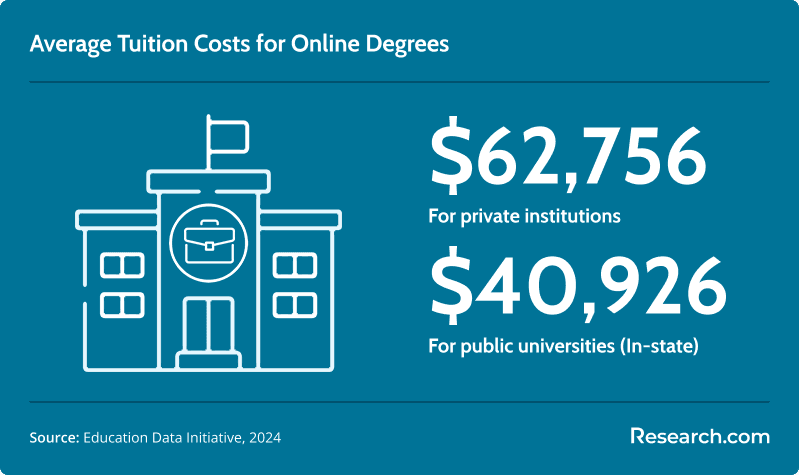
The cost of an online geosciences degree depends on tuition rate, residency status, number of required credits, technology fees, textbooks, lab supplies, travel for fieldwork, and transfer credit policies. Some online options are priced similarly to the cheapest online geography degree programs, especially at public institutions with lower in-state tuition.
Among the featured programs, per-credit tuition varies by institution and, in some cases, by residency status:
- Southern New Hampshire University lists a cost of $330 per credit.
- Mississippi State University lists a cost of $419 per credit, while the University of Arizona lists $525 per credit.
- The University of North Dakota lists a cost of $611.75 per credit.
- North Carolina Central University lists $185 per credit for resident students and $727.67 per credit for non-resident students.
When comparing what school offers the best online geoscience and geology degree programs, do not focus only on the sticker price. A lower tuition rate may not be the lowest total cost if the program requires more credits, travel, out-of-state pricing, or fees that are not included in the advertised per-credit rate.
| Cost factor | Why it can change the total price | Question to ask the school |
| Per-credit tuition | Small differences add up across 120 credits, 124 credits, or 125 credits. | Is this rate locked in, and does it apply to online students? |
| Residency status | Public universities may charge different rates for resident and non-resident students. | Do online students pay in-state, out-of-state, or separate distance-learning tuition? |
| Transfer credits | Accepted credits can reduce both time and cost. | How many credits can I transfer into the major and the degree overall? |
| Fieldwork travel | Short residencies or field courses may require transportation, lodging, and time away from work. | Are any in-person field experiences required, and what expenses should I expect? |
| Fees and materials | Online course fees, lab supplies, software, and books may increase the bill. | Can you provide a full estimated cost of attendance for online students? |
The chart below provides a visualization of the cost per credit of online geosciences degree programs, according to current tuition data from the featured academic institutions.
What are the financial aid options for students enrolling in an online geosciences degree program?
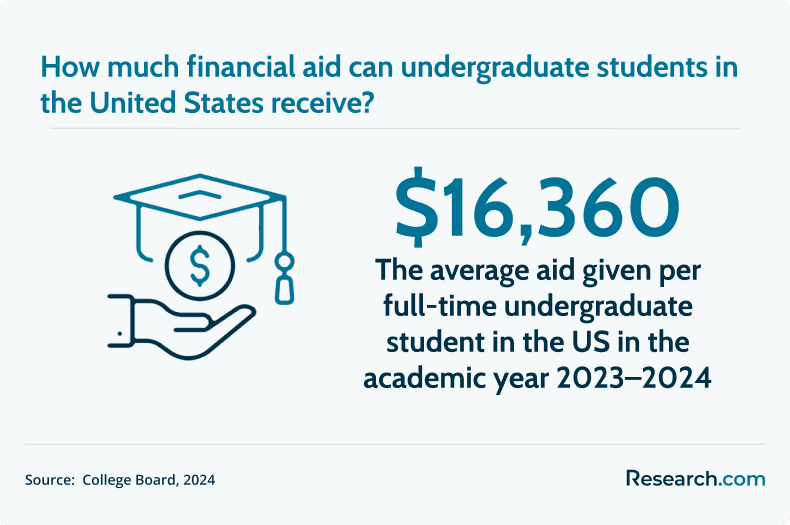
Students in online geosciences programs may qualify for federal aid, institutional aid, scholarships, grants, employer tuition assistance, military education benefits, and professional association awards. Eligibility depends on the school, enrollment status, program type, financial need, academic record, and scholarship criteria. In the academic year 2023–2024, the average amount of financial aid awarded per full-time equivalent (FTE) undergraduate student in the US was $16,360 (Ma, Pender, & Oster, 2024).
American Geosciences Institute (AGI) Scholarships
Students can review scholarships offered by the AGI Federation of societies and affiliated organizations. One example is the Next Horizons First-Generation Student Geoscience Scholarship program, which provides a one-time, merit-based financial award of $5,000 to eligible US geoscience students who are the first generation in their families to attend college.
Association for Women Geoscientists (AWG) Chapter Awards & Scholarships
AWG chapters provide scholarships with support from the AWG Foundation. Examples of scholarship and award programs include:
- The San Francisco Bay Outstanding Student Award
- The San Francisco Bay Science Fair Awards
- The Osage Chapter Undergraduate Research Scholarship
Scholarships Offered by Specific Academic Institutions
Many colleges offer their own scholarships for online and campus-based students. Southern New Hampshire University (SNHU), for example, lists scholarship opportunities that include:
- The Finlay Family Scholarship
- The Hassa Jadvani Memorial Scholarship
- The John and Nancy Burk Endowed Scholarship
How to reduce the cost of an online geosciences degree
- Complete the FAFSA early and confirm that the online program is eligible for federal financial aid.
- Ask whether transfer credits, prior learning, or community college coursework can reduce your remaining credits.
- Compare tuition by total program cost, not just cost per credit.
- Check whether your employer offers tuition reimbursement for science, environmental, GIS, or engineering-related education.
- Budget for fieldwork, software, books, lab materials, and any required travel.
What are the prerequisites for enrolling in an online geosciences degree program?
Admission requirements vary by institution, but online bachelor’s programs in geosciences generally expect applicants to show academic readiness for college-level science, mathematics, writing, and data-based coursework.
- High School Diploma or Equivalent: Applicants usually need a high school diploma or GED. Some programs may also review GPA, completed coursework, and overall academic preparation.
- Math and Science Background: Courses such as algebra, geometry, chemistry, biology, physics, and earth science can help students prepare for geosciences coursework. Students who are less confident in math should ask whether the program offers placement support or prerequisite review options.
- Official Transcripts and Application Materials: Schools typically require official transcripts from previous institutions. Depending on the program, applicants may also submit a personal statement, recommendations, or other materials.
These expectations reflect a broader pattern in science-based education: students need a strong academic base before entering advanced professional coursework. For example, accredited SLP graduate programs also rely on prerequisite preparation before students move into specialized training.
What courses are typically in an online geosciences degree program?
Online geosciences curricula usually combine foundational science with applied analysis. The exact course list depends on whether the program emphasizes geology, environmental science, GIS, meteorology, natural resources, or another concentration.
- Physical Geology: Students learn how Earth materials and processes shape the planet, including plate tectonics, rock formation, erosion, and surface change.
- Mineralogy: This course examines the chemical and physical properties of minerals and may include mineral identification through virtual labs, sample analysis, or other applied activities.
- Geographic Information Systems (GIS): Students learn to gather, analyze, and present spatial data for environmental analysis, planning, resource management, and hazard assessment. GIS is also central to many of the best GIS degree programs available online.
- Hydrology: This course focuses on water movement, distribution, quality, groundwater systems, the water cycle, and human effects on water resources.
- Environmental Geoscience: Students study how human activity interacts with Earth systems, including pollution, climate change, land use, and sustainable resource management.
| Course area | Skills students build | Career relevance |
| Geology and Earth systems | Rock identification, Earth process analysis, terrain interpretation | Geoscience, environmental consulting, natural hazards, resource work |
| Hydrology and water resources | Water quality evaluation, groundwater concepts, watershed thinking | Hydrology, environmental compliance, water management |
| GIS and remote sensing | Mapping, spatial analysis, geoprocessing, data visualization | GIS, urban planning, environmental analysis, disaster management |
| Environmental science | Pollution analysis, sustainability concepts, regulatory awareness | Environmental scientist, consultant, public agency roles |
| Statistics and data analysis | Scientific interpretation, geostatistics, evidence-based reporting | Research, consulting, energy, government, technical reporting |
What types of specializations are available in online geosciences degree programs?
Specializations help students connect the degree to a specific career direction. A student who wants to work with maps and data should not choose the same concentration as a student aiming for weather communication, petroleum geology, or conservation work.
- Natural Resources and Conservation: This track focuses on resource protection, environmental stewardship, conservation planning, and sustainable management. It may fit students interested in ecological consulting, public agencies, or environmental policy support.
- Broadcast and Operational Meteorology: Students study weather systems, forecasting, and communication. This option may suit future meteorologists, weather broadcasters, or professionals who need applied atmospheric knowledge.
- Earth Science: This broader path may include geology, oceanography, atmospheric science, and Earth system processes. It can be useful for students considering science education, general science careers, or graduate study.
- Paleontology: Students examine fossils and the history of life through geological time. This concentration connects geology and biology and may support interests in research, museums, or academia.
- Petroleum Geology: This specialization focuses on subsurface resources, oil and gas exploration, and energy-sector geology.
- Geographic Information Systems (GIS): Students build mapping, spatial data, remote sensing, and geospatial analysis skills for careers in planning, environmental science, emergency management, and resource analysis.
| If your goal is... | Consider a concentration in... | Look for courses or experiences in... |
| Environmental consulting | Natural Resources and Conservation or Environmental Geoscience | Hydrology, field methods, GIS, environmental regulation, technical writing |
| Weather communication | Broadcast and Operational Meteorology | Weather and climate, synoptic meteorology, forecasting, public communication |
| GIS or mapping roles | Geographic Information Systems | Remote sensing, spatial analysis, cartography, geoprocessing, python programming |
| Energy industry work | Petroleum Geology | Structural geology, sedimentology, stratigraphy, subsurface interpretation |
| Teaching or broad science preparation | Earth Science | Geology, oceanography, atmospheric science, environmental systems |
How do you choose the best online geosciences degree program?
The best online geosciences degree is the one that matches your career target, budget, schedule, and need for hands-on scientific training. Students should compare programs with the same level of care they would use when evaluating an affordable environmental engineering degree online, where curriculum depth, faculty background, applied projects, and accreditation can affect long-term value.
- Accreditation and Institutional Quality: Choose a regionally accredited school. Accreditation can affect financial aid eligibility, transfer credit, graduate school admission, and employer confidence.
- Curriculum and Concentration Fit: Review whether the program emphasizes geology, GIS, meteorology, environmental science, conservation, petroleum geology, or another area. Students researching what degree do you need to be a science teacher may want a program with a strong Earth science foundation.
- Flexibility and Student Support: Confirm whether courses are asynchronous or scheduled, whether part-time enrollment is allowed, and whether students have access to tutoring, advising, library resources, software support, and career services.
- Fieldwork and Lab Requirements: Ask how labs, field experiences, and any residency components work for online students. Do not assume every requirement can be completed from home.
- Total Cost and Return on Investment: Compare tuition, fees, transfer credits, travel, financial aid, and expected career outcomes before committing.
Questions to ask before enrolling
| Question | Why it matters |
| Is the institution regionally accredited? | Accreditation can affect aid, transfer credit, graduate school options, and employer recognition. |
| How are labs and fieldwork completed online? | Geosciences often requires applied learning that may involve local field sites or campus visits. |
| Which concentration best matches my career goal? | GIS, meteorology, conservation, geology, and petroleum tracks can lead to different opportunities. |
| What is the full cost of attendance? | Fees, travel, software, and materials can change the actual price. |
| How many transfer credits will count toward the major? | Accepted credits can reduce cost and time to graduation. |
| What career services are available to online students? | Internship support, resume help, networking events, and employer connections can improve career readiness. |
How can I verify the accreditation and quality standards of an online geosciences program?
Start by confirming that the institution holds recognized regional accreditation. Then review the program itself: faculty qualifications, course requirements, fieldwork expectations, student support, lab access, internship options, graduate outcomes, and partnerships with employers or professional organizations. Do not rely only on marketing language or rankings.
Program quality also depends on delivery. A strong online science program should show how students gain applied skills, how they access software and data tools, how they complete field or lab requirements, and how faculty support remote learners. Comparing delivery models across fields, such as an online video game development degree, can help students think critically about whether an online program offers enough hands-on practice, feedback, and project-based learning.
How do online geosciences degree programs compare to online biochemistry degree programs?
Online geosciences and online biochemistry degrees are both science-focused, but they prepare students for different kinds of problems and workplaces. Geosciences centers on Earth systems, rocks, water, weather, environmental processes, spatial data, field observation, and resource issues. Biochemistry focuses on chemical processes in living systems, molecular analysis, laboratory methods, and biological research.
Students who enjoy maps, outdoor systems, environmental problems, natural hazards, water, climate, or energy may find geosciences a better fit. Students who prefer molecular biology, chemistry, biomedical research, pharmaceuticals, or lab-based biological analysis may be better served by online biochemistry degree programs.
| Comparison point | Online geosciences | Online biochemistry |
| Main focus | Earth systems, geology, water, climate, GIS, environmental processes | Chemical processes in living organisms and biological systems |
| Common applied skills | Field interpretation, spatial analysis, mapping, environmental data analysis | Laboratory analysis, molecular methods, chemical reasoning, biological data interpretation |
| Typical work settings | Consulting firms, government agencies, energy, water resources, GIS teams | Research labs, healthcare-related industries, biotechnology, pharmaceuticals, academic labs |
| Best fit for students who like... | Earth, maps, weather, rocks, water, environmental systems | Chemistry, biology, lab experiments, molecular processes |
Can complementary management skills boost career advancement?
Technical knowledge can help graduates enter geosciences roles, but management skills often become more important as professionals advance. Project planning, budgeting, team leadership, client communication, regulatory coordination, and strategic decision-making can be valuable in consulting, engineering, energy, environmental compliance, and public-sector science roles.
Students who want to move into supervisory or project leadership positions may benefit from building management skills alongside geoscience expertise. For professionals who later want a technical leadership credential, the most affordable engineering management online masters options may be worth comparing with science, GIS, or environmental graduate programs.
How do online geosciences programs support networking and career advancement?
Strong online geosciences programs do more than post lectures. They help students connect with faculty, classmates, alumni, professional associations, and employers. Support may include virtual advising, career coaching, online research projects, mentorship, internship guidance, digital portfolios, resume reviews, and virtual career events.
Students should ask whether online learners receive the same career services as campus students. They should also find out whether the program has industry contacts in environmental consulting, GIS, government, energy, weather services, or natural resource management. Some students broaden their professional network through additional interdisciplinary study, although options such as an accelerated healthcare administration degree online are most useful only when they clearly support a specific career plan.
What career paths are available to graduates of online geosciences degree programs?
Graduates of online geosciences programs may qualify for roles in environmental consulting, GIS, energy, natural resources, weather, water management, public agencies, and scientific support. Career outcomes depend on degree level, concentration, field experience, technical tools, location, and employer requirements. As with specialized programs such as affordable dog obedience training online, the value of the credential depends on whether the training matches a clear occupational goal.
The following roles are connected to geosciences or adjacent fields. Median annual wages are from US BLS, 2025:
- Environmental Scientists and Specialists ($80,060): These professionals examine environmental problems, assess sites, collect or interpret data, and recommend solutions that protect ecosystems and public health. Students comparing the environmental scientist salary should also consider industry, location, and experience level.
- Hydrologists ($92,060): Hydrologists study water movement, quality, availability, and management, often working on groundwater, watersheds, flooding, or conservation issues.
- Atmospheric Scientists (including Meteorologists) ($97,450): These professionals analyze weather, climate, and atmospheric data to support forecasting, safety planning, research, and communication.
- Geoscientists ($99,240): Geoscientists study Earth materials, processes, and history and may work in environmental consulting, mining, oil and gas, government, or research.
- Mining and Geological Engineers ($101,020): These engineers use geology and engineering principles to support safe and efficient mineral extraction.
- Petroleum Engineers ($141,280): Petroleum engineers design and manage methods for extracting oil and gas and improving reservoir production.
- Natural Sciences Managers ($161,180): These managers lead scientific teams, oversee research or technical programs, manage budgets, and align scientific work with organizational goals.
| Career path | Useful preparation | Important note |
| Environmental scientist | Environmental geoscience, hydrology, GIS, technical writing, field sampling | Some employers may prefer experience with regulations, permits, or site assessments. |
| Hydrologist | Hydrology, groundwater, statistics, GIS, water quality analysis | Advanced coursework may be important for specialized water science roles. |
| GIS analyst or geospatial specialist | GIS, remote sensing, spatial analysis, cartography, python programming | A portfolio of mapping projects can help demonstrate skill. |
| Meteorology-related roles | Weather and climate, synoptic meteorology, forecasting, communication | Students should verify whether the curriculum meets expectations for their intended meteorology role. |
| Energy or petroleum geology | Structural geology, sedimentology, stratigraphy, petroleum geology, data interpretation | Energy-sector hiring can be affected by market cycles and location. |
| Science management | Technical experience plus leadership, budgeting, project management, communication | Management roles usually require experience beyond the bachelor’s degree. |
The chart below provides a visualization of the median annual wages of professionals in the geosciences in the US in May 2024, according to 2025 data from the UB BLS.
What is the job market like for graduates of online geosciences degree programs?
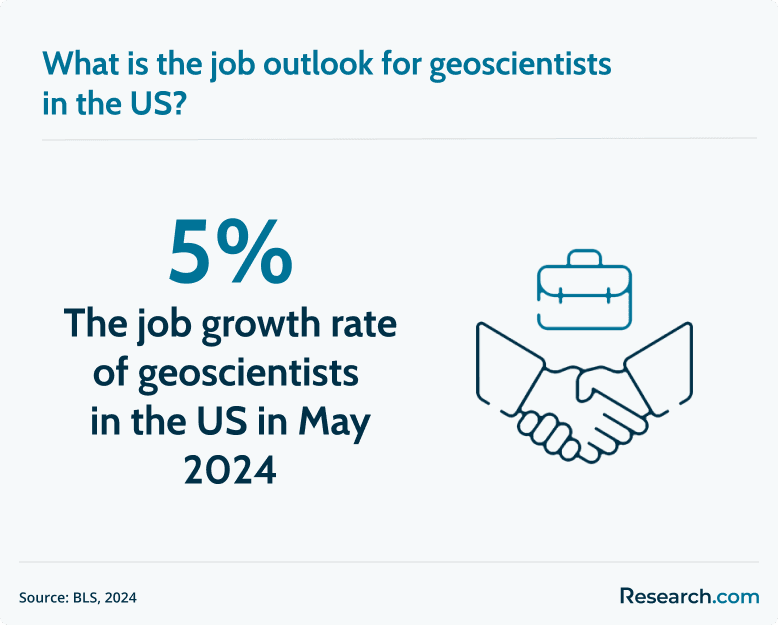
The geosciences job market is stable but uneven across roles. From 2023 to 2033, employment for geoscientists in the US is projected to grow by 5%, which is as fast as the average for all occupations. This equals about 2,200 openings per year on average over the decade (US BLS, 2025).
Environmental scientists and specialists have a stronger growth projection. Employment for these professionals is expected to grow by 7% from 2023 to 2033, faster than the average for all US occupations, with about 8,500 openings each year on average over the decade (US BLS, 2025).
Other geosciences-related occupations are expected to grow more slowly. Mining and geological engineers have projected growth of 2%, which is slower than average and corresponds to about 400 openings per year on average over the decade. Petroleum engineers also have projected growth of 2%, equal to about 1,200 openings per year on average from 2023 and 2033 (US BLS, 2025).
Students who want more career flexibility may benefit from adding GIS, data analysis, regulatory knowledge, hydrology, technical writing, or management skills. Those considering teaching, curriculum, or science education leadership may also compare affordable master's in science online programs as a later step.
Current trends affecting online geosciences students
- Data and GIS skills are increasingly important: Many roles now involve spatial data, remote sensing, modeling, mapping, and digital reporting.
- Environmental and water issues continue to shape demand: Climate adaptation, water quality, land use, natural hazards, and environmental compliance create opportunities for science-trained professionals.
- Energy careers remain cyclical: Petroleum and extraction-related work can offer high wages, but hiring may depend on market conditions and geography.
- Online science programs must prove hands-on quality: Employers and graduate schools may look closely at whether students completed fieldwork, labs, projects, and applied technical training.
- Interdisciplinary skills can improve mobility: Combining geosciences with GIS, programming, policy, engineering concepts, or project management can broaden options.
Can interdisciplinary accelerated master’s programs enhance your geosciences career?
An interdisciplinary accelerated master’s program can help some geosciences graduates move into specialized or data-intensive roles, but it should be chosen carefully. The best graduate option depends on the student’s career target: GIS, environmental management, hydrology, energy, science education, engineering management, climate analytics, or public policy.
Programs that build advanced data, analytics, technology, or management skills may be useful for professionals working on environmental risk, climate adaptation, water systems, resource planning, or scientific operations. For example, a fast masters health informatics degree online may be relevant only for students who want to apply data-driven decision-making in health, environmental health, or interdisciplinary analytics contexts. Students should avoid adding a graduate degree unless it clearly improves their qualifications for a specific role.
Here’s What Graduates Have to Say about Their Online Geosciences Degree Programs
- “Completing my geosciences degree online gave me a way to move from teaching into environmental consulting while still caring for my two children. The flexible schedule mattered, and the virtual labs were more interactive than I expected.” —Charlie
- “The program helped me build the GIS skills I needed for a position with a state geological survey. Even though I studied remotely, the faculty were responsive, and I felt connected to the coursework and the people teaching it.” —Nat
- “I was already employed in oil and gas, and the online format let me study hydrogeology without stepping away from my job. I could apply what I learned at work almost immediately, which helped me grow into a leadership role.” —Francis
Common mistakes to avoid when choosing an online geosciences degree
| Mistake | Why it can hurt you | Better approach |
| Choosing a program without checking accreditation | It may affect financial aid, transfer credits, graduate school admission, and employer trust. | Verify regional accreditation before applying. |
| Comparing only tuition per credit | Fees, fieldwork travel, software, materials, and credit requirements can change total cost. | Ask for the full estimated cost of attendance. |
| Ignoring fieldwork and lab requirements | You may discover late that travel, local placement, or in-person work is required. | Request a written explanation of all in-person requirements. |
| Choosing the wrong concentration | A GIS-focused degree and a petroleum geology track may lead to very different career options. | Match concentration, electives, and projects to your target job. |
| Assuming online means easier | Science courses still require math, writing, analysis, and consistent study time. | Plan weekly study hours and use tutoring or advising early. |
| Relying only on rankings | A highly ranked program may not fit your budget, schedule, or career goal. | Use rankings as one input, not the final decision. |
| Expecting salary outcomes to be guaranteed | Wages vary by location, experience, role, and industry. | Review salary data, job postings, and employer requirements in your target region. |
Key Insights
- An online geosciences degree is most valuable when it combines accredited coursework, applied science, GIS or data skills, and clear field or lab experiences.
- Costs vary widely among featured programs: Southern New Hampshire University lists $330 per credit, Mississippi State University lists $419 per credit, the University of Arizona lists $525 per credit, the University of North Dakota lists $611.75 per credit, and North Carolina Central University lists $185 (Resident) and $727.67 (Non-resident) per credit.
- Financial aid can reduce the cost of attendance. Students should explore federal aid, institutional scholarships, employer support, and awards such as AGI Federation scholarships, including the Next Horizons First-Generation Student Geoscience Scholarship program with a one-time, merit-based financial award of $5,000.
- Career outcomes differ by specialization. GIS supports mapping and spatial data roles; hydrology supports water-related work; meteorology supports weather-focused careers; petroleum geology connects to energy; and conservation or environmental geoscience can lead toward consulting or public-sector roles.
- Geoscientists earned a median annual wage of $99,240 in May 2024, but students should not treat this as a guaranteed starting salary.
- Employment for geoscientists is projected to grow by 5% from 2023 to 2033, while environmental scientists and specialists are projected to grow by 7% over the same period (US BLS, 2025).
- The smartest enrollment decision comes from asking practical questions before applying: Is the school accredited? How are labs completed? Are field experiences required? What is the full cost? Which concentration supports my goal? What career support is available to online students?
References:
- Ma, J., Pender, M., & Oster, M. (2024). Trends in College Pricing and Student Aid 2024. College Board. https://research.collegeboard.org/media/pdf/Trends-in-College-Pricing-and-Student-Aid-2024-ADA.pdf
- US Bureau of Labor Statistics. (2025, April 18). Atmospheric Scientists, Including Meteorologists. Occupational Outlook Handbook. https://www.bls.gov/ooh/life-physical-and-social-science/atmospheric-scientists-including-meteorologists.htm
- US Bureau of Labor Statistics. (2025, April 18). Environmental Scientists and Specialists. Occupational Outlook Handbook. https://www.bls.gov/ooh/life-physical-and-social-science/environmental-scientists-and-specialists.htm
- US Bureau of Labor Statistics. (2025, April 18). Geoscientists. Occupational Outlook Handbook. https://www.bls.gov/ooh/life-physical-and-social-science/geoscientists.htm
- US Bureau of Labor Statistics. (2025, April 18). Hydrologists. Occupational Outlook Handbook. https://www.bls.gov/ooh/life-physical-and-social-science/hydrologists.htm
- US Bureau of Labor Statistics. (2025, April 18). Mining and Geological Engineers. Occupational Outlook Handbook. https://www.bls.gov/ooh/architecture-and-engineering/mining-and-geological-engineers.htm
- US Bureau of Labor Statistics. (2025, April 18). Natural Sciences Managers. Occupational Outlook Handbook. https://www.bls.gov/ooh/management/natural-sciences-managers.htm
- US Bureau of Labor Statistics. (2025). Occupational Employment and Wage Statistics, Industry: Cross-industry, Private, Federal, State, Local Government, Period: May 2024. Occupation Employment and Wage Statistics Query System. https://data.bls.gov/oes/#/industry/000000
- US Bureau of Labor Statistics. (2025, April 18). Petroleum Engineers. Occupational Outlook Handbook. https://www.bls.gov/ooh/architecture-and-engineering/petroleum-engineers.htm
Other Things You Should Know About Online Geosciences Degree Programs
To reduce costs for an online geosciences degree in 2027, explore options like financial aid, employer tuition reimbursement, or grants. Additionally, look for accelerated programs or transfer credits from community colleges to fast-track your degree path and save on tuition.
In 2027, the University of Florida offers one of the most affordable online geosciences degree programs, with in-state tuition fees significantly lower than many other institutions. Their Bachelor of Arts in Geology is designed to provide a quality education that's accessible financially.
The 2027 most affordable online geosciences degree programs typically require a high school diploma or equivalent, with a strong background in math and science. Some programs may require SAT or ACT scores, letters of recommendation, and a personal statement.


