
2027 Most Affordable Online Geography Degree Programs

Co-Founder and Chief Data Scientist
An online geography degree can be a practical route into GIS, environmental analysis, urban planning, sustainability, mapping, and spatial data careers—but only if the program fits your budget, schedule, and career target. Tuition varies widely by school, residency status, credit structure, and whether the program charges online students a flat rate or separate in-state and out-of-state rates.
This guide is designed for students comparing affordable online geography bachelor’s programs, including working adults, transfer students, military learners, and first-time college students who want a flexible degree with strong career relevance. You will find program comparisons, cost factors, admissions expectations, common courses, specializations, career outcomes, and decision questions to help you choose a program with fewer surprises.
The goal is not simply to find the lowest advertised tuition. A strong online geography program should also offer recognized accreditation, GIS and spatial analysis training, faculty support, applied projects, transfer-friendly policies, and enough flexibility to help you finish the degree.
Quick Answer: Is an Online Geography Degree Worth Considering?
An online geography degree can be worth considering if you want a flexible bachelor’s program that builds skills in GIS, spatial analysis, remote sensing, cartography, human geography, physical geography, and environmental problem-solving. It is especially useful for students interested in GIS analyst, urban planning, environmental consulting, cartography, sustainability, public policy, transportation, or geospatial technology roles.
The best value usually comes from accredited public universities, in-state online tuition options, transfer-friendly programs, and curricula that include hands-on GIS or applied research. Students should compare total program cost, not just cost per credit, because geography programs may require 120 credit hours, 123 credits, 124 credits, 140 credits, or 180 quarter credits depending on the institution.
What are the benefits of getting an online geography degree?
- Flexible study format: Online geography programs can make it easier to earn a degree while working, parenting, serving in the military, or living far from campus.
- Career-relevant technical skills: Students often learn GIS, remote sensing, cartography, spatial statistics, web mapping, and geospatial data management—skills used in planning, environmental work, logistics, public health, utilities, and technology.
- Broad career applicability: Geography connects environmental systems, human behavior, policy, technology, and location-based data, giving graduates options across government, private firms, nonprofits, and research organizations.
- Demand in related fields: Employment of environmental scientists and specialists is projected to grow by 7% from 2023 to 2033, which supports long-term opportunity for students who combine geography with environmental analysis and geospatial skills.
What can I expect from an online geography degree?
An online geography degree teaches students how people, places, environments, and spatial patterns interact. Most programs combine physical geography, human geography, geospatial technology, environmental systems, and data visualization. Students learn to interpret maps, analyze geographic data, study land use, evaluate environmental change, and apply spatial reasoning to real-world problems.
The online format usually includes recorded or live lectures, discussion boards, mapping assignments, data analysis projects, virtual labs, faculty feedback, and collaborative work. Some courses may require specialized software, cloud-based GIS tools, or access to institutional lab platforms. Many programs also include a capstone, internship, research project, or field-based assignment to help students demonstrate applied skills before graduation.
| What You Study | Why It Matters | Career Connection |
| Human geography | Explains how culture, population, politics, economics, and migration shape places. | Useful for planning, policy, international development, and social research. |
| Physical geography | Covers landforms, climate, water systems, ecosystems, and natural processes. | Relevant to environmental science, conservation, disaster planning, and natural resources. |
| GIS and spatial analysis | Builds technical ability to collect, manage, analyze, and visualize location-based data. | Essential for GIS analyst, mapping, transportation, utilities, public safety, and logistics roles. |
| Remote sensing | Uses satellite, drone, and aerial imagery to monitor environmental and human activity. | Applies to agriculture, climate analysis, disaster response, defense, and land management. |
| Capstone or internship | Connects classroom skills to a practical problem, employer project, or research question. | Helps build a portfolio for entry-level geography and geospatial jobs. |
Where can I work with an online degree in geography?
Graduates with an online geography degree can work in government agencies, planning departments, environmental consulting firms, transportation organizations, geospatial technology companies, utilities, nonprofits, public health agencies, and research institutions. Common employers include federal and local agencies, such as the EPA or U.S. Census Bureau, along with private GIS firms, sustainability organizations, mapping companies, and regional planning offices.
Typical job titles include GIS analyst, environmental consultant, urban planner, cartographer, remote sensing specialist, environmental scientist, transportation analyst, sustainability coordinator, and research assistant. Some positions are field-based, while others are primarily office-based or data-focused. Students who want technical roles should prioritize programs with strong GIS, remote sensing, programming, database, and data visualization coursework.
How much can I earn with an online degree in geography?
Earnings depend on location, employer, experience, technical skill level, and whether the role requires graduate education or licensure. Geography graduates who develop strong GIS, remote sensing, and data analysis skills may qualify for higher-paying technical roles than graduates who complete a more general curriculum.
GIS analysts typically make around $71,000 to $75,000 per year, and top earners, especially in tech-oriented roles or high-cost areas like the Bay Area, can earn well above six figures. Cartographers and photogrammetrists have a median salary of about $78,810, while geoscientists earn around $99,240. Environmental scientists and specialists earn a median of $80,060, and employment in that occupation is projected to grow 7% from 2023 to 2033.
- List of the Best Online Geography Degree Programs for 2027
- How long does it take to complete an online geography degree program?
- How does an online geography degree program compare to an on-campus program?
- What is the average cost of an online degree program in geography?
- What are the financial aid options for students enrolling in an online geography degree program?
- What are the prerequisites for enrolling in an online geography degree program?
- What courses are typically in an online geography degree program?
- What types of specializations are available in an online geography degree program?
- Can an online geography degree support digital media and game design careers?
- Can an interdisciplinary approach enhance my online geography degree?
- What future trends are shaping online geography degree programs?
- What advanced degrees can complement an online geography degree?
- How do I choose the best online geography degree program?
- What career paths are available for graduates of online degree programs in geography?
- What is the job market for graduates with an online geography degree?
List of the Best Online Geography Degree Programs
How do we rank schools?
Research.com evaluates online geography programs using a structured process designed to help students compare programs by credibility, cost, format, and academic relevance. You can review our methodology for more detail on how we approach school rankings and program research. Our rankings also draw from established education data sources, including:
- IPEDS database
- Peterson's database, including their Distance Learning Licensed Data Set
- College Scorecard database
- National Center for Education Statistics
1. Oregon State University - BS Geography and Geospatial Science
The BS Geography and Geospatial Science program from the Oregon State University College of Earth, Ocean, and Atmospheric Sciences is built around applied geographic problem-solving. Students examine major issues such as climate change, urban planning, natural resource management, and public safety through geographic and geospatial methods.
The curriculum covers human geography, physical geography, spatial reasoning, GIS, remote sensing, web mapping, and geovisualization. This makes the program a strong fit for students who want a geography degree with significant technical depth.
Students complete 9 credits of required experiential learning through an internship, research experience, or field project. The degree can also support later study in a master’s program or a GIS graduate certificate.
- Program Length: Four years (180 quarter credits)
- Tracks/concentrations: N/A
- Cost per Credit/Tuition: $384 per credit
- Accreditation: Northwest Commission on Colleges and Universities (NWCCU)
2. Arizona State University - BS in Geography
Arizona State University’s Ecampus offers a fully online Bachelor of Science in Geography that focuses on the spatial relationship between human activity and Earth’s physical systems. The STEM-oriented curriculum includes physical geography, cultural geography, GIScience, urban planning, and a capstone research project.
Students study climate patterns, landforms, population movement, cultural landscapes, and geospatial analysis. The program can prepare graduates for work in GIS, research, environmental consulting, and planning-related roles.
Although the program does not list formal concentration tracks, electives allow students to shape their studies around topics such as GIS techniques, remote sensing, or climate science.
- Program Length: Four years (120 credit hours)
- Tracks/concentrations: N/A
- Cost per Credit/Tuition: $671
- Accreditation: Higher Learning Commission (HLC)
3. University of Florida Online - BA in Geography
The online Bachelor of Arts in Geography at the University of Florida is designed for students who want an interdisciplinary understanding of human systems, environmental change, and geographic analysis.
Students build analytical and technical skills through courses in GIS, remote sensing, cartography, spatial modeling, and database management. The program also offers access to faculty-led learning and hands-on research opportunities. Students may pursue a specialization in Environmental Geosciences, which combines geography, geology, and environmental planning.
- Program Length: Four years (120 credit hours)
- Tracks/concentrations: Environmental geosciences
- Cost per Credit/Tuition: $129 (in-state), $552 (out-of-state).
- Accreditation: Southern Association of Colleges and Schools Commission on Colleges (SACSCOC)
4. Northeastern State University - Bachelor of Arts in Geography & Sustainability Studies
Northeastern State University (NSU) offers an online Bachelor of Arts in Geography & Sustainability Studies that blends human geography, physical geography, GIS, and environmental planning.
The asynchronous curriculum includes cartography, physical geography, regional geography, remote sensing, GIS scripting, and a capstone experience. Courses are delivered by faculty in NSU’s College of Liberal Arts & Sciences.
Students select a minor to add interdisciplinary breadth and may also benefit from internships, student organizations, and professional society connections.
- Program Length: Four years
- Tracks/concentrations: N/A
- Cost per Credit/Tuition: $261
- Accreditation: HLC
5. Liberty University - Bachelor’s in Geography
Liberty University’s 100% online Bachelor of Science in Geography uses eight-week sessions, open enrollment, and no required campus residencies. The program is delivered from a Christian-centered perspective and covers GIS, human geography, physical geography, regional analysis, and the role of geographic systems in society.
Students choose between two study focuses. The Physical Geography focus emphasizes Earth systems, natural resources, and environmental planning, while the Human Geography focus examines cultural, political, and urban spatial patterns.
- Program Length: Three to four years
- Tracks/concentrations: Physical geography and human geography
- Cost per Credit/Tuition: $390 (full-time), $455 (part-time), and $250 (military discount).
- Accreditation: Southern Association of Colleges and Schools Commission on Colleges (SACSCOC)
6. Marshall University - BA/BS Geography
Marshall University offers online Bachelor of Arts and Bachelor of Science options in Geography for students who want to complete a degree, transfer prior credits, or study in a flexible fully online format.
The BS emphasizes physical geography and GIScience, while the BA focuses more heavily on human geography and includes a foreign language requirement. Within the BS track, students may emphasize GIScience, Meteorology, or Weather Broadcasting.
The program is structured for working adults and transfer students, with multiple start dates and acceptance of up to 72 transfer credits.
- Program Length: Four years
- Tracks/concentrations: Human geography, physical geography, and GIScience.
- Cost per Credit/Tuition: $367
- Accreditation: HLC
7. Ohio University - Bachelor’s in Geography
Ohio University College of Arts & Sciences offers flexible geography bachelor’s options through OHIO Online™ and on campus.
The Bachelor of Arts emphasizes human-environment relationships, international development, and cultural geography. The Bachelor of Science focuses more strongly on physical and geospatial skills, including technical coursework in GIS and remote sensing.
Students can also pursue specialty tracks such as Broadcast Meteorology, Climate, Environment & Society, Environmental Pre-Law, Globalization & Development, and Urban Planning & Sustainability. These tracks can help students align coursework with goals in city planning, environmental justice, atmospheric science, development, or sustainability.
- Program Length: Four years
- Tracks/concentrations: Broadcast meteorology, climate, environment, and society, and environmental pre-law, GIScience, globalization and development, and urban planning and sustainability.
- Cost per Credit/Tuition: $324
- Accreditation: HLC
8. Florida International University - BA in Geography
Florida International University’s online Bachelor of Arts in Geography with a Global Studies focus helps students analyze global landscapes, cultural change, environmental issues, and spatial patterns using geographic technologies such as GIS, remote sensing, and spatial mapping.
Housed in the Steven J. Green School of International & Public Affairs, the program emphasizes theory and method in cultural, political, and economic geography. Graduates may apply their training in planning, environmental management, public health, international development, and related fields.
- Program Length: Four years
- Tracks/concentrations: Global studies
- Cost per Credit/Tuition: $19,156 per year
- Accreditation: SACSCOC
9. University of Arizona - BS in Geographic Information Systems Technology
The University of Arizona Online offers a fully online Bachelor of Science in Geographic Information Systems Technology through its College of Social and Behavioral Sciences, which is described as one of the nation's top 10 geography schools.
The 120-credit BS-GIST program focuses on cartography, remote sensing, GIS programming, web and mobile mapping, and geovisualization. Students complete 14 major courses and a hands-on capstone project. The degree must be paired with a minor or double major.
Coursework is aligned to the U.S. Department of Labor’s Geospatial Technology Competency Model, supporting preparation for roles such as GIS developer, environmental analyst, and other geospatial technology positions.
- Program Length: Four years
- Tracks/concentrations: GIS technology
- Cost per Credit/Tuition: $525
- Accreditation: WASC Senior College and University Commission (WSCUC)
10. Kennesaw State University - BA in Geography
The BA in Geography at Kennesaw State University is available in traditional and fully online formats. Students study Earth’s physical features, human landscapes, and the ways people alter and organize space.
The 123-credit curriculum includes landforms, urban geography, remote sensing, global studies, and other core geography topics. Students complete an internship or capstone project. The online program mirrors the campus experience, with instruction from the same faculty and access to services such as tutoring, advising, and virtual labs.
- Program Length: Four years
- Tracks/concentrations: N/A
- Cost per Credit/Tuition: $5,700 tuition per year
- Accreditation: SACSCOC
How long does it take to complete an online geography degree program?
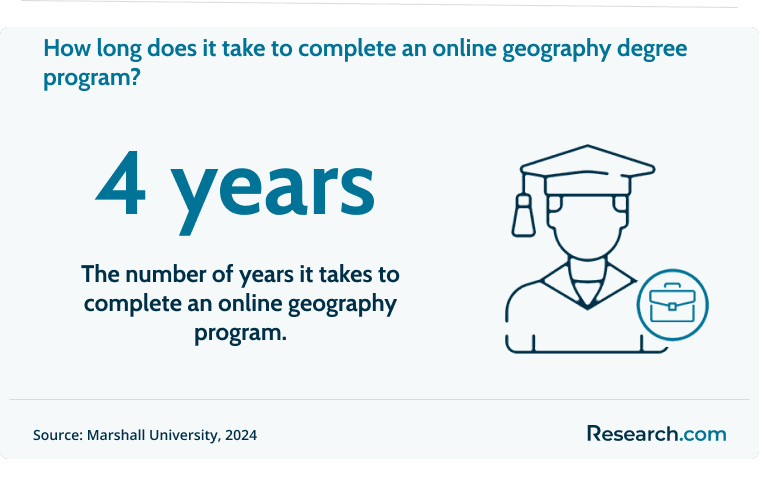
Most online geography bachelor’s degrees take about four years of full-time study. Many programs require about 120 to 124 credit hours, although some may require up to 180 quarter credits or include additional requirements such as internships, capstones, field projects, or specialized tracks.
A full-time student usually takes 12–15 credit hours per semester. Students who enroll continuously in fall and spring terms, and sometimes summer, may finish within the standard four-year timeline.
Your actual completion time can be shorter or longer depending on transfer credits, course availability, accelerated terms, prior college work, part-time enrollment, and personal obligations. Transfer-friendly programs may reduce the number of credits you need to complete after admission, while part-time study can extend the degree beyond four years.
| Student Situation | Likely Timeline Impact | What to Ask Before Enrolling |
| First-time full-time student | Usually around four years | Are required GIS, lab, and capstone courses offered often enough to stay on schedule? |
| Transfer student | May finish faster if credits apply | How many credits will transfer into major, general education, and elective requirements? |
| Working adult studying part time | May take longer than four years | Can courses be completed asynchronously, and are summer terms available? |
| Student using accelerated sessions | May progress faster if course load is manageable | Are eight-week or mini-term courses available for upper-division geography requirements? |
How does an online geography degree program compare to an on-campus program?
An online geography degree can offer the same academic foundation as a campus program, but the experience is different. The right choice depends on how much schedule flexibility you need, whether you want in-person fieldwork, how comfortable you are with online collaboration, and whether the program provides strong remote access to GIS tools.
| Factor | Online Geography Degree | On-Campus Geography Degree |
| Schedule | Often more flexible, with asynchronous or hybrid coursework. | Usually follows fixed class meeting times and campus-based schedules. |
| Interaction | Uses discussion boards, video meetings, group projects, email, and virtual advising. | Offers face-to-face faculty contact, classroom discussion, clubs, and campus events. |
| GIS and lab access | May use virtual labs, cloud software, remote desktops, and downloadable tools. | May provide easier access to physical computer labs, field equipment, and campus GIS facilities. |
| Fieldwork | Can include local field assignments, remote internships, or applied projects. | May offer more structured field trips, lab sessions, and in-person research activities. |
| Cost | May reduce commuting, housing, and relocation expenses, though tuition varies by school. | May include campus fees, housing, transportation, and location-based living expenses. |
| Best for | Working adults, military learners, transfer students, parents, and students far from campus. | Students who prefer in-person learning, campus life, and frequent faculty interaction. |
For many students, the difference is less about academic quality and more about access. A well-designed online geography program should provide the same core outcomes as a campus program: geographic theory, spatial analysis, GIS practice, environmental and human geography, and applied learning. This mirrors the broader growth of online programs in fields such as an online library science degree, where students can pursue rigorous professional preparation without relocating.
What is the average cost of an online degree program in geography?
The cost of an online geography degree depends on tuition rate, residency status, total credits required, fees, transfer credits, military status, and whether the school charges different full-time and part-time rates. Students should compare total estimated cost, not only the advertised cost per credit.
Online geography tuition can range from low in-state public university rates to higher out-of-state or private university rates. Cost-conscious students should compare these programs alongside other affordable online degree options, including resources such as the cheapest online Christian studies degree programs, to understand how pricing differs by field and institution type.
- Oregon State University: $69,120 total for 180 credit hours. The total is higher because the program requires 180 quarter credits, equivalent to 120 semester credits, and uses a flat rate regardless of residency. Students pay for a research-oriented curriculum with significant GIS, sustainability, and environmental analysis content.
- University of Florida (In-State): $15,480 total for Florida residents. This is a low-cost option for in-state students because of public university pricing. Students receive the same academic structure as UF Online learners, with access to topics such as environmental planning and human geography.
- University of Florida (Out-of-State): $66,240 total for non-residents. The out-of-state rate is much higher than the Florida resident rate, but students can access the program without relocating.
- Liberty University (Part-Time): $54,600 total for students taking fewer than 12 credits per semester. This option costs more per credit but may work for students who need a slower pace because of employment, family responsibilities, or other obligations.
- Liberty University (Full-Time): $46,800 total for full-time online students. The full-time rate lowers the per-credit cost for students able to carry a traditional course load.
- Liberty University (Military Rate): $30,000 total with discounted tuition for active-duty military and veterans. This rate may be useful for eligible military-affiliated students seeking a flexible online format.
Affordability should be evaluated together with academic quality, credit transfer, graduation requirements, software access, and career preparation. Students comparing tuition value may also review broader affordability resources such as the most affordable online master's in science education programs to see how online program pricing can vary across disciplines and degree levels.
The chart below illustrates how program costs can differ based on credit requirements, residency status, and enrollment category.
What are the financial aid options for students enrolling in an online geography degree program?
Online geography students may qualify for many of the same financial aid options as campus students, as long as the school and program meet eligibility rules. The first step is usually completing the Free Application for Federal Student Aid (FAFSA).
- Federal financial aid: FAFSA submission may make students eligible for federal grants, federal student loans, and work-study programs. Eligibility depends on the student, institution, and enrollment status.
- State grants and scholarships: Some states offer need-based or merit-based aid that applies to online learners, especially residents attending public institutions.
- Institutional scholarships: Colleges may provide awards for academic achievement, financial need, transfer students, military learners, adult students, or specific majors.
- Private scholarships: Geography, GIS, environmental science, planning, and sustainability organizations may sponsor scholarships for students with relevant academic or professional goals.
- Employer tuition assistance: Working adults should ask HR departments whether tuition reimbursement, tuition assistance, or professional development funding can apply to an online geography degree.
- Military and veteran benefits: Active-duty service members, veterans, and eligible dependents may use benefits such as the GI Bill®, Tuition Assistance, military tuition discounts, or service-specific scholarships.
Ways to reduce your total cost
- Ask for a transfer credit evaluation before committing to a school.
- Compare in-state, out-of-state, and flat-rate online tuition policies.
- Confirm whether online learners pay extra technology, software, lab, or proctoring fees.
- Choose a program with required GIS software access included or clearly priced.
- Avoid taking courses that will not apply to your degree plan.
- Ask whether summer courses can help you finish faster without increasing total cost.
What are the prerequisites for enrolling in an online geography degree program?
Admission requirements vary by university, but most online geography bachelor’s programs expect applicants to meet general undergraduate admission standards. Transfer students may need to submit additional college transcripts and meet minimum credit or GPA requirements.
- High school diploma or equivalent: First-year applicants are generally expected to have completed high school or earned a GED. Official transcripts are typically required.
- Minimum GPA: Many programs set a minimum GPA, often around 2.5 to 3.0. More selective programs may weigh academic performance in math, science, and social studies more heavily.
- Standardized test scores: Some universities accept SAT or ACT scores, while many online programs are test-optional or do not require them. Scores may still help some applicants strengthen their file.
- Application materials: Schools may request an application form, transcripts, personal statement, resume, or transfer credit documentation.
- Technology readiness: Students need reliable internet access and a computer that can handle online learning platforms. GIS-heavy courses may require software access, cloud tools, or virtual labs.
Admission accessibility varies by field and credential level. For comparison, specialized programs such as an affordable online agacnp graduate certificate may involve different academic and professional prerequisites, while geography bachelor’s programs generally focus on undergraduate readiness and technology access.
What courses are typically in an online geography degree program?
Online geography programs usually include general education courses, core geography classes, geospatial technology training, electives, and an applied experience such as a capstone, internship, or research project.
Most students begin with introductory human geography and physical geography. Human geography examines culture, population, migration, politics, urbanization, and economic systems. Physical geography covers landforms, climate, water, ecosystems, and environmental processes.
Technical coursework becomes more important as students advance. GIS, remote sensing, cartography, spatial analysis, database management, geospatial data management, spatial statistics, and environmental modeling prepare students to work with geographic data and industry-standard tools. Students interested in technical mapping roles may also compare geography programs with the cheapest online geographic information systems degree options, since GIS-focused degrees often go deeper into software and data systems.
Electives or concentrations may cover environmental geography, urban and regional planning, global sustainability, political geography, climatology, transportation, land use, or public policy. Applied assignments help students connect geographic methods to real issues such as environmental risk, infrastructure planning, climate adaptation, regional development, and public health.
Students targeting geospatial careers should review whether the curriculum aligns with GIS specialist job requirements, including practical experience with spatial databases, mapping tools, data visualization, and project-based problem-solving.
What types of specializations are available in an online geography degree program?
Specializations help students turn a broad geography degree into a more focused career pathway. Not every program offers formal concentrations, so students should review electives, certificates, minors, and capstone options as well.
| Specialization | What You Learn | Best Fit For |
| Geographic Information Systems (GIS) | Spatial databases, mapping software, data layers, geocoding, analysis, and visualization. | Students who want GIS analyst, mapping, planning, utilities, logistics, or public-sector data roles. If you are asking what is a geographic information system analyst, this specialization is often the most direct preparation. |
| Environmental Geography | Human-environment interaction, climate change, conservation, natural resources, and sustainability. | Students interested in environmental consulting, conservation, sustainability, or resource management. |
| Urban and Regional Planning | Land use, zoning, transportation, infrastructure, community development, and regional growth. | Students considering planning departments, transportation agencies, housing policy, or community development. |
| Global Studies or Human Geography | Cultural, political, economic, and demographic patterns across regions and societies. | Students interested in international development, policy, public affairs, research, or social analysis. |
| Remote Sensing | Satellite imagery, drones, aerial photography, image interpretation, and environmental monitoring. | Students drawn to disaster response, agriculture monitoring, defense, climate analysis, or land management. |
Can an online geography degree support digital media and game design careers?
Yes, but usually as part of a broader skill set. Geography students learn spatial thinking, mapping, terrain analysis, data visualization, and environmental context. Those skills can support digital world-building, simulation design, interactive maps, location-based storytelling, and game environments.
Students interested in creative technology careers should not rely on geography alone. They may need additional training in game engines, 3D modeling, animation, coding, UX design, or digital media production. Comparing geography coursework with online game design colleges can help students see which extra skills are needed for game development roles.
Can an interdisciplinary approach enhance my online geography degree?
An interdisciplinary plan can make a geography degree more useful, especially for students targeting environmental, health, data, planning, or technology careers. Geography pairs well with computer science, statistics, public policy, environmental science, sustainability, public health, urban studies, emergency management, and data analytics.
Some students combine geography with scientific coursework to analyze environmental systems, health geography, or spatial patterns in disease and exposure. For example, reviewing a biochemistry online degree can show how scientific training may complement spatial analysis for students interested in environmental health, public health, or research-driven pathways.
What future trends are shaping online geography degree programs?
Online geography programs are being influenced by expanding use of geospatial data, cloud-based GIS, remote sensing, data visualization, artificial intelligence, and automated mapping tools. Employers increasingly expect graduates to understand not only geography concepts but also how to work with spatial datasets and communicate results clearly.
Programs are also incorporating more applied learning through virtual labs, industry datasets, capstones, internships, and project portfolios. Students should look for curricula that teach current GIS platforms, spatial databases, remote sensing workflows, web mapping, and data ethics. For a cross-field view of how online technical and management programs are responding to workforce needs, students may compare affordability and program design with the cheapest master's in engineering management online.
What advanced degrees can complement an online geography degree?
A bachelor’s degree in geography can lead directly to entry-level roles, but some career paths benefit from graduate education. Students interested in urban planning, geoscience, public health, environmental policy, GIS leadership, data science, or research may eventually need a master’s degree or specialized graduate certificate.
Strong graduate options include GIS, urban and regional planning, environmental science, public administration, public health, sustainability, data analytics, geoscience, and health informatics. Students interested in connecting spatial data with healthcare, population patterns, or public health outcomes may explore programs such as a fast health informatics masters online to understand how analytical credentials can expand career options.
How do I choose the best online geography degree program?
Start with accreditation. Choose an institution accredited by a recognized accreditor, such as the Higher Learning Commission (HLC) or another regional equivalent. Accreditation matters for federal financial aid eligibility, transfer credit, graduate school admission, and employer recognition.
Next, match the curriculum to your career target. A student aiming for GIS work should look for advanced GIS, remote sensing, programming, spatial databases, and applied mapping projects. Students focused on sustainability or environmental consulting should prioritize environmental geography, climate, natural resources, field methods, and policy coursework. Those pursuing planning should look for urban geography, land use, transportation, and community development content.
If your goal is a technical geospatial career, compare geography degrees with the best GIS undergraduate programs to see whether a broader geography degree or a more specialized GIS program is the better fit.
Questions to ask before enrolling
- Is the institution properly accredited?
- What is the total program cost after fees, software, textbooks, and transfer credits?
- How many transfer credits will count toward the degree?
- Are GIS software, virtual labs, and technical support included?
- Are courses asynchronous, synchronous, or hybrid?
- How often are upper-division geography courses offered?
- Does the program include a capstone, internship, research project, or portfolio?
- Do students receive career support for GIS, planning, environmental, or public-sector roles?
- Are faculty active in geography, GIS, sustainability, planning, or environmental research?
- Will the degree support graduate study if you later pursue planning, GIS, environmental science, or public health?
Common mistakes to avoid
- Choosing based only on cost per credit: A lower per-credit price may not be cheapest if the program requires more credits or charges high fees.
- Ignoring accreditation: Unrecognized accreditation can limit financial aid, transfer credit, and employer acceptance.
- Assuming every online program is fully flexible: Some programs require live sessions, field assignments, internships, or scheduled exams.
- Overlooking software access: GIS-heavy courses may require tools that are costly or difficult to run without school support.
- Skipping transfer credit review: Transfer students should get an official evaluation before assuming prior credits will apply.
- Relying only on rankings: Rankings can help narrow options, but the best program is the one that fits your budget, schedule, career goal, and learning style.
- Assuming salaries are guaranteed: Reported salaries vary by employer, location, experience, technical proficiency, and graduate education.
What career paths are available for graduates of online degree programs in geography?
Online geography graduates can pursue roles across the public, private, and nonprofit sectors. Many positions involve mapping, spatial analysis, planning, environmental assessment, sustainability, land use, or data visualization. Like other practical online credentials, including the cheapest beauty certification programs online, the value depends on how well the program builds marketable skills and connects training to real work.
The strongest opportunities often go to graduates who can combine geographic thinking with GIS, remote sensing, statistics, database tools, communication, and domain knowledge in areas such as environment, transportation, public health, or urban development.
- GIS Analyst ($75,010): GIS analysts collect, organize, analyze, and present spatial data. They create maps, build models, maintain geographic databases, and support decisions in planning, transportation, emergency management, utilities, and environmental work.
- Urban Planner ($81,800): Urban planners develop land-use plans and programs that guide community growth. They work with governments, developers, and residents on zoning, transportation, infrastructure, housing, sustainability, and public services.
- Environmental Consultant ($83,347): Environmental consultants assess environmental risks, conduct site evaluations, prepare reports, and advise organizations on compliance and sustainability. Geography graduates may contribute skills in mapping, spatial analysis, and environmental impact assessment.
- Remote Sensing Specialist ($100,593): Remote sensing specialists analyze satellite, aerial, or drone imagery to monitor land use, agriculture, climate effects, disasters, development, or natural resources. They often work with government agencies, research organizations, defense employers, or environmental firms.
- Environmental Scientist ($80,060): Environmental scientists study natural systems and human impacts on air, water, land, and ecosystems. Geography graduates with environmental coursework and data analysis skills may work in conservation, pollution control, resource management, and policy support.
If you are unsure which path matches your strengths, interests, and work preferences, a career counselor career guide can help you think through role fit, required credentials, and next steps.
The chart below compares common geography-related career paths, salary examples, and core job functions.
What is the job market for graduates with an online geography degree?
The job market for geography graduates is shaped by demand for geospatial data, environmental planning, sustainability work, infrastructure decisions, climate adaptation, land use analysis, public-sector mapping, and location-based business intelligence. Employers increasingly use GIS, remote sensing, and spatial modeling to make decisions, which benefits graduates with technical and analytical training.
Common hiring sectors include government agencies, city and regional planning departments, environmental consulting firms, utilities, transportation organizations, emergency management offices, nonprofit sustainability groups, research institutions, and private geospatial technology companies.
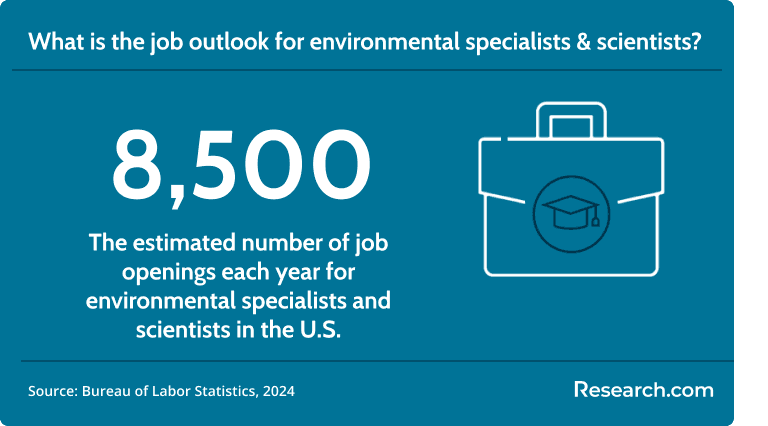
Environmental science is one notable area connected to geography. According to the U.S. Bureau of Labor Statistics, employment of environmental scientists and specialists is projected to grow 7 percent from 2023 to 2033, faster than the average for all occupations. The same outlook notes an estimated 8,500 job openings for environmental scientists and specialists each year over the next decade.
Students can improve their job prospects by building a portfolio of maps, GIS projects, remote sensing analyses, dashboards, research reports, or capstone work. Employers often want evidence that applicants can use tools, interpret spatial data, explain findings, and connect analysis to practical decisions.
Here’s what graduates have to say about their online geography degrees:
"The online geography format let me keep my full-time job while learning GIS and environmental science. I needed that flexibility, and I still had meaningful access to instructors and feedback." – Abel
"I was able to manage family responsibilities while finishing a degree that helped me move into urban planning after graduation. The GIS assignments were especially useful because they gave me practical confidence." – Luke
"Online geography gave me room to study at my own pace while exploring climate change, sustainability, and global systems. I was surprised by how interactive the virtual courses were." – Trisha
Key Insights
- An online geography degree is a strong fit for students who want flexible study plus career-relevant skills in GIS, remote sensing, spatial analysis, environmental systems, planning, and mapping.
- Most online geography bachelor’s programs take about four years of full-time study and often require around 120–140 credit hours, though some programs use 180 quarter credits.
- Total cost can vary sharply. Compare tuition, residency rules, required credits, fees, software access, and transfer credit before choosing a program.
- Accreditation is non-negotiable. It affects financial aid, transfer options, graduate school eligibility, and employer recognition.
- Students seeking technical roles should prioritize programs with GIS, remote sensing, spatial databases, web mapping, programming, and portfolio-based projects.
- Environmental scientists and specialists are projected to see 7% employment growth from 2023 to 2033, making environmental and geospatial skills especially valuable.
- Common career options include GIS analyst, urban planner, environmental consultant, remote sensing specialist, cartographer, and environmental scientist, with salary outcomes depending on location, experience, employer, and technical skill level.
- The cheapest program is not always the best value. The right choice is the accredited program that fits your budget, schedule, transfer profile, career goal, and need for hands-on geospatial training.
References:
- Glassdoor. (2025). Salary: Environmental Consultant in the United States 2025. Glassdoor
- Liberty University. (2025). Affordable Online Undergrad Tuition. Liberty University
- Marshall University. (2024). Online Geography Degree (BA/BS) at Marshall. Marshall University
- Oregon State University. (2025). Geography and geospatial science. OSU
- U.S. Bureau of Labor Statistics. (2023). Occupational Employment and Wages: Urban and Regional Planners. U.S. BLS
- University of Florida. (2025). UF Online Tuition Rates. UF
- ZipRecruiter. (2025). GIS Analyst Salary. ZipRecruiter
Other Things You Should Know About Online Geography Degree Programs
Most online geography programs require a capstone in the final semester, worth 3 to 6 credits. Students usually complete a research paper, GIS project, or field-study analysis and submit it through the university’s learning platform under faculty supervision.
Absolutely. Many online programs provide students with access to industry-standard Geographic Information Systems (GIS) software like ArcGIS or QGIS through student licenses or cloud platforms. Instructors often integrate hands-on GIS training and mapping projects into the coursework, ensuring that remote learners build practical skills needed in careers like spatial analysis and urban planning.
Most affordable online geography programs require a high school diploma or GED equivalent for enrollment in 2027. Some programs may also ask for prerequisite classes in science or mathematics to ensure students are prepared for the curriculum.


