
2027 Best ABSN Programs - Accelerated BSN Programs in New York: Online & Campus

Co-Founder and Chief Data Scientist
Choosing an accelerated BSN program in New York is a high-stakes decision: the right program can move you into registered nursing quickly, while the wrong fit can create avoidable debt, scheduling problems, or licensure delays. New York remains one of the strongest nursing markets in the country, with over 70,000 registered nurses employed and a projected growth rate of 16% by 2030. That demand makes ABSN programs appealing for career changers, recent graduates, and professionals who already have a bachelor's degree and want a faster route into patient care.
This guide explains how accelerated Bachelor of Science in Nursing programs work in New York, who qualifies, what admissions committees look for, how online and campus formats differ, what accreditation matters, how much students may pay, and what career options can follow. It is designed to help you compare programs practically—not just by reputation, but by licensure eligibility, clinical access, cost, schedule, and long-term career value.
Quick Answer: Is an ABSN Program in New York Worth Considering?
An accelerated BSN in New York can be a strong option if you already hold a non-nursing bachelor's degree, can handle an intensive full-time schedule, and want to qualify for RN licensure faster than you would through a traditional BSN pathway. These programs are not easy: they compress nursing theory, labs, clinical rotations, and NCLEX-RN preparation into a short timeline. However, New York's large healthcare system, diverse patient populations, and many hospital and community-based clinical sites can make the state a practical place to train.
- Best fit: Career changers with strong prerequisite grades, time for full-time study, and a clear plan for clinical scheduling and financing.
- Use caution if: You need to work full time, have not completed science prerequisites, or are comparing programs without verifying accreditation and New York licensure approval.
- Key advantage: Many New York ABSN programs offer structured NCLEX preparation, clinical exposure, and intensive nursing coursework in a condensed format.
- Important reality: Fast does not mean easy. ABSN students must be ready for heavy reading, labs, exams, care plans, simulations, and clinical days.
- Who can apply for accelerated BSN programs in New York?
- What are the admission requirements for accelerated BSN programs in New York?
- Do accelerated BSN programs in New York require entrance exams?
- What does the curriculum of an accelerated BSN program in New York include?
- What accreditation should I look for in an ABSN program in New York?
- How long does it take to complete an accelerated BSN in New York?
- How much does an accelerated BSN program cost in New York?
- What financial aid options are available for ABSN students in New York?
- What career paths are available after earning an ABSN in New York?
- What is the average salary for nurses with an ABSN degree in New York?
- How should you evaluate the return on investment of an ABSN?
- What do ABSN graduates say about the experience?
- How does an accelerated BSN compare to an ADN program in New York?
- Is an accelerated BSN a good step toward an MSN in New York?
- What common mistakes should ABSN applicants avoid?
- Can ABSN students work while completing their degree?
- References
Who can apply for accelerated BSN programs in New York?
Accelerated BSN programs in New York are mainly built for students who already earned a bachelor's degree in a field other than nursing. Instead of repeating general education courses, students use their prior college experience as the foundation for a concentrated nursing curriculum. The goal is to prepare second-degree students for RN licensure in less time than a traditional four-year BSN.
The typical applicant is a career changer, recent college graduate, healthcare worker seeking a licensed nursing role, or professional who wants a more direct path into patient care. Strong candidates usually show academic discipline, maturity, emotional resilience, and the ability to manage a demanding schedule. Nursing schools also look for evidence that applicants understand the realities of bedside care, including long shifts, teamwork, documentation, ethical decision-making, and communication with patients and families.
Before applying, confirm that you meet each school's definition of an eligible second-degree student. Some programs require all prerequisites to be finished before enrollment, while others may allow limited coursework to be in progress during the application cycle. If you are already thinking beyond RN practice, compare long-term options such as advanced practice nursing and review resources like nurse practitioner salary by state to understand how additional graduate education may affect future career planning.
| Applicant Profile | Why an ABSN May Fit | What to Check First |
| Career changer with a completed bachelor's degree | The program uses prior college work to shorten the route to nursing education. | Prerequisite age limits, required science grades, and clinical schedule expectations. |
| Recent graduate from a non-nursing major | Students can move into a professional healthcare pathway without starting over academically. | Whether the program expects healthcare exposure, volunteer experience, or an interview. |
| Healthcare employee without RN licensure | Prior exposure to hospitals or clinics may strengthen motivation and readiness. | Whether work hours can realistically fit around labs, exams, and clinical rotations. |
| Student planning for advanced nursing later | A BSN can support later graduate study in specialized nursing fields. | Graduate school prerequisites, GPA expectations, and experience requirements. |
What are the admission requirements for accelerated BSN programs in New York?
Admissions standards vary by school, but New York ABSN programs generally screen for academic readiness, science preparation, communication skills, and the ability to keep pace with an intensive nursing sequence. Because seats can be limited, meeting the minimum requirement may not be enough; a stronger application usually shows both solid grades and a clear reason for entering nursing.
- Non-nursing bachelor's degree: Applicants usually need a completed bachelor's degree from an accredited college or university in a field other than nursing.
- Prerequisite coursework: Common prerequisites include anatomy, physiology, microbiology, chemistry, and statistics. Many programs require these courses to be completed with a grade of "C" or better.
- Minimum GPA: Many schools expect a cumulative or prerequisite GPA between 3.0 and 3.2 on a 4.0 scale. Competitive applicants often aim higher when possible.
- Official transcripts: Schools require transcripts from every postsecondary institution attended so they can verify degree completion, course content, grades, and transfer eligibility.
- Recommendation letters: Programs commonly ask for two or three letters from professors, supervisors, or professionals who can speak to your reliability, judgment, work ethic, and readiness for nursing.
- Personal statement or essay: This is where applicants explain why they are changing paths, what experiences shaped their interest in nursing, and how they plan to handle the accelerated format.
- Resume or CV: A current resume helps admissions teams see healthcare exposure, employment history, volunteer service, leadership, and transferable skills.
- Interview: Some schools use interviews to assess professionalism, communication, motivation, and whether the applicant understands the demands of nursing school.
If you are considering long-term specialization after earning RN experience, review advanced nursing career paths early. For example, students interested in behavioral health may eventually compare requirements for becoming a psychiatric nurse practitioner, though that role requires graduate-level preparation beyond the ABSN.
| Requirement | Why It Matters | Applicant Tip |
| Bachelor's degree | Confirms the student is eligible for a second-degree accelerated pathway. | Make sure your degree is posted before the program's required deadline. |
| Science prerequisites | Builds the biology and health science foundation needed for nursing coursework. | Retake weak prerequisites only if the school allows grade replacement or improvement. |
| GPA | Signals whether the applicant can handle a fast academic pace. | Check whether the school weighs cumulative GPA, prerequisite GPA, or both. |
| Essay | Shows motivation, self-awareness, and understanding of nursing responsibilities. | Use specific examples rather than broad statements about wanting to help people. |
| Interview | Helps the program evaluate communication and professionalism. | Prepare to discuss stress management, teamwork, and patient-centered care. |
Do accelerated BSN programs in New York require entrance exams?
Some accelerated BSN programs in New York require an entrance exam, while others rely more heavily on GPA, prerequisite performance, essays, recommendations, and interviews. The Test of Essential Academic Skills, commonly known as the TEAS, is one of the most common exams used by nursing schools. It measures reading, mathematics, science, and English language usage.
Schools use entrance exams to identify applicants who have the academic foundation needed for accelerated nursing coursework. A strong score can help show readiness, especially if your previous degree was outside the sciences or if your transcript has mixed grades. If a program does not require an exam, do not assume admission is easier; the school may place more weight on prerequisite grades, healthcare exposure, and the overall strength of the application.
Applicants should verify testing policies directly with each program before paying application fees. Ask which exam is accepted, whether there is a minimum score, how recent scores must be, whether retakes are allowed, and how the exam is weighted in admissions decisions.
| Exam Policy | What It Means for Applicants | Best Next Step |
| TEAS required | The school uses a standardized measure of academic readiness. | Build a study plan around science, math, reading, and English usage. |
| Exam optional | A score may strengthen the application but may not be mandatory. | Ask admissions whether submitting a score can help if your GPA is borderline. |
| No entrance exam | The program may emphasize transcripts, prerequisites, essays, and interviews. | Focus on prerequisite performance and a specific, well-supported personal statement. |
What does the curriculum of an accelerated BSN program in New York include?
An accelerated BSN curriculum in New York compresses nursing courses, clinical practice, simulation, and licensure preparation into a short and structured sequence. Many programs are designed to be completed in 12 to 16 months, although exact timelines vary by school. Students should expect a full academic load that often feels more like a professional training schedule than a traditional college semester.
Most ABSN curricula include the following components:
- Core nursing theory: Courses introduce health assessment, pharmacology, pathophysiology, adult health, maternal-child nursing, mental health nursing, population health, and evidence-based practice.
- Clinical rotations: Students complete supervised experiences in hospitals, clinics, long-term care sites, community settings, and other approved healthcare environments.
- Simulation labs: Programs use controlled patient scenarios to help students practice assessment, prioritization, medication safety, communication, and emergency response before entering clinical settings.
- Professional nursing practice: Coursework often addresses ethics, leadership, interprofessional teamwork, documentation, patient safety, and culturally responsive care.
- NCLEX-RN preparation: Many programs integrate practice questions, exams, remediation, and review strategies throughout the curriculum rather than waiting until the final term.
The curriculum is intentionally intense because graduates must be ready for safe entry-level RN practice. Students who succeed usually treat the program like a full-time job, schedule study blocks in advance, and seek help early when clinical reasoning or science-heavy content becomes difficult.
| Curriculum Area | What Students Learn | Why It Matters for RN Practice |
| Health assessment | How to collect patient histories, perform assessments, and recognize changes in condition. | Strong assessment skills support timely clinical decisions. |
| Pharmacology | Medication classes, dosage considerations, adverse effects, and safety checks. | Medication safety is a central responsibility in nursing practice. |
| Adult and specialty care | Care for patients across medical-surgical, maternal-child, mental health, and community settings. | Graduates need broad preparation before choosing a specialty. |
| Simulation | Practice in realistic scenarios without risking patient harm. | Simulation builds confidence before clinical rotations. |
| NCLEX preparation | Test-taking strategy, clinical judgment questions, and content review. | Passing the NCLEX-RN is required for RN licensure. |
What accreditation should I look for in an ABSN program in New York?
Accreditation and state approval should be nonnegotiable when comparing ABSN programs. A program can be expensive, well marketed, or convenient and still be the wrong choice if it does not meet nursing education and licensure standards. Before enrolling, confirm both institutional accreditation and nursing program approval.
- Institutional accreditation: The college or university should be accredited by a recognized institutional accreditor, such as the Middle States Commission on Higher Education (MSCHE). This affects transferability, employer recognition, and access to federal financial aid.
- CCNE accreditation: The Commission on Collegiate Nursing Education accredits baccalaureate and graduate nursing programs that meet established quality standards.
- ACEN accreditation: The Accreditation Commission for Education in Nursing also accredits nursing programs that meet national nursing education standards.
- New York State approval: The nursing program must be approved through the appropriate New York State education and nursing authorities so graduates can pursue NCLEX-RN eligibility and licensure in the state.
Do not rely only on a program webpage or admissions brochure. Verify accreditation through the accreditor's official database and confirm state approval through New York's nursing education resources. If you may move after graduation, ask whether the program's curriculum meets licensure expectations outside New York as well.
| Credential to Verify | What It Confirms | Why Students Should Care |
| Institutional accreditation | The school meets broad academic and administrative standards. | It can affect financial aid, credit transfer, and employer acceptance. |
| CCNE or ACEN accreditation | The nursing program has been reviewed against nursing education standards. | It may matter for employment, graduate study, and professional mobility. |
| New York State approval | The program is recognized for preparing students for RN licensure in New York. | Without proper approval, graduates may face licensure barriers. |
How long does it take to complete an accelerated BSN in New York?
Most accelerated BSN programs in New York take between 11 and 18 months, depending on the school, course sequence, clinical schedule, and whether the program uses a full-time or modified format. Many ABSN options are built as full-time programs because the curriculum is tightly sequenced; missing or failing one course may delay progression.
- Program design: Some schools run year-round cohorts with short breaks, while others follow term-based academic calendars.
- Full-time expectations: Full-time enrollment is common because lecture, lab, simulation, and clinical requirements are packed closely together.
- Part-time availability: Part-time ABSN formats are less common and generally extend the timeline.
- Online or hybrid structure: Some programs deliver lectures online, but nursing labs and clinical rotations still require in-person participation.
- Clinical requirements: Clinical training is a major time commitment, and some programs require hours often exceeding 600.
- Course sequencing: Nursing courses build on one another, so students usually must complete them in the required order.
When comparing timelines, look beyond the advertised completion length. Ask how many days per week students are on campus or in clinicals, whether weekend or evening clinical placements are possible, how far students may travel, and what happens if a student needs to repeat a course.
| Timeline Factor | How It Affects Completion | Question to Ask the Program |
| Full-time cohort model | Can shorten time to graduation but reduces schedule flexibility. | How many hours per week should students reserve for class, clinicals, and study? |
| Hybrid coursework | May reduce commuting for lectures but does not remove in-person clinical obligations. | Which parts are online, and which parts require physical attendance? |
| Clinical placement location | Travel time can affect work, childcare, and study schedules. | How far can students be assigned from campus or home? |
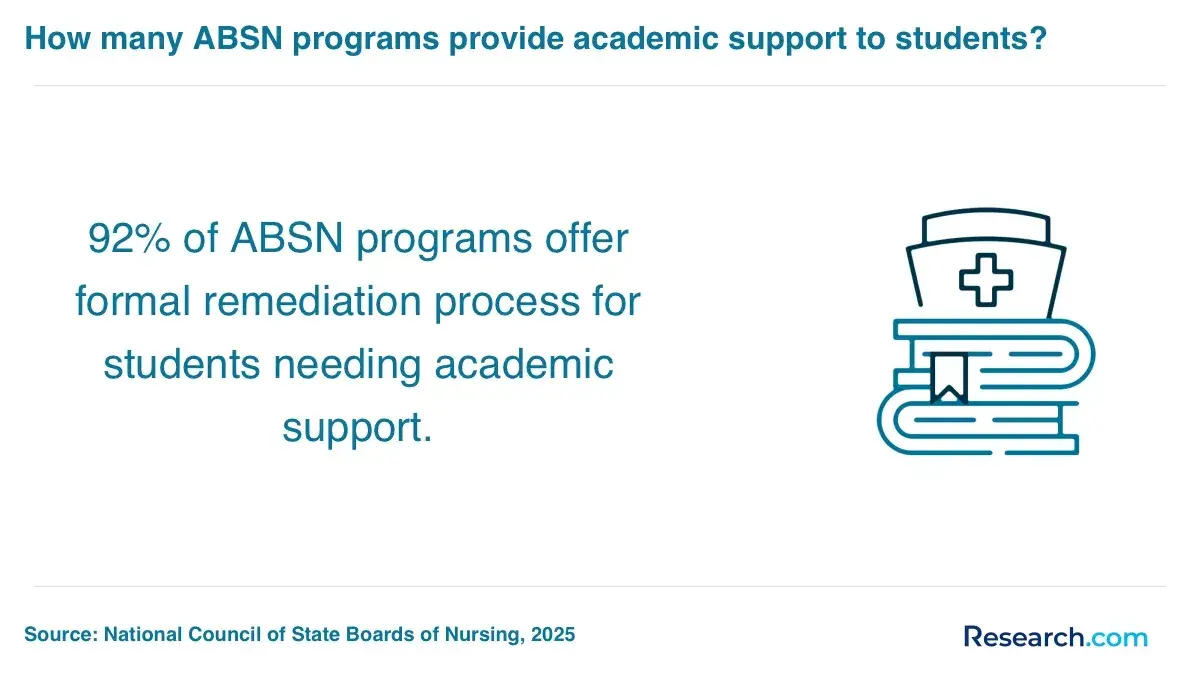
| Remediation policies | Repeating a course can extend graduation. | What academic support is available before a student falls behind? |
How much does an accelerated BSN program cost in New York?
Accelerated BSN programs in New York can represent a major financial commitment. Tuition typically ranges from $66,000 to $118,000 for the full program, but tuition alone does not show the complete cost. Students also need to budget for fees, supplies, exams, background checks, transportation, housing, and lost income if they reduce work hours.
- Tuition: Program tuition varies by institution type, location, length, and delivery format. Private schools and urban programs may have different cost structures than public options.
- Technology and lab fees: Students may pay for learning platforms, simulation resources, lab access, testing systems, and online course tools.
- Clinical supplies: Uniforms, equipment, health screenings, immunizations, background checks, and clinical documentation tools can add to the total price.
- Testing and licensure costs: Budget for standardized testing, NCLEX-RN preparation resources, and licensure-related expenses.
- Travel and housing: Clinical rotations may require commuting across different parts of New York, and students who relocate should include rent and living expenses.
- Opportunity cost: Because many ABSN programs are full time, students should consider whether they can maintain employment while enrolled.
To evaluate affordability, compare the total cost of attendance rather than the tuition headline. Ask each school for a written estimate that includes required fees and typical clinical-related expenses. If you plan to specialize later, graduate nursing costs should also be part of your long-term plan. For example, students interested in advanced acute care may later explore the best acute care nurse practitioner program options after gaining RN experience and meeting graduate admissions requirements.
| Cost Category | What It May Include | Why It Can Be Overlooked |
| Tuition | Core academic charges for the ABSN sequence. | Students may compare tuition without checking whether fees are separate. |
| Program fees | Lab, technology, testing, simulation, and clinical systems. | Fees may be listed by term instead of as a total program amount. |
| Clinical expenses | Uniforms, transportation, health records, background checks, and supplies. | Clinical costs can vary based on site requirements and commute distance. |
| Living expenses | Rent, food, transportation, insurance, and personal costs. | Full-time study may reduce income while expenses continue. |
| Licensure preparation | NCLEX-RN review materials, practice tests, and application-related costs. | These expenses often arrive near the end of the program. |
What financial aid options are available for ABSN students in New York?
Financial aid for ABSN students can be more complicated than aid for first bachelor's degree students because accelerated nursing students already hold a degree. Availability depends on the school, student eligibility, enrollment status, residency, and whether the program qualifies for specific aid programs. Start with the financial aid office before assuming any grant, loan, or scholarship applies.
- Federal Direct Loans: Eligible students may use federal loans to help cover tuition, fees, and living costs after completing the FAFSA.
- New York State Tuition Assistance Program (TAP): New York residents attending eligible in-state institutions may qualify if they meet program and residency requirements and complete the required state aid application process.
- Federal nursing loans: Some schools participate in nursing-specific loan programs that may offer terms designed for students entering the profession.
- Institutional scholarships and grants: Nursing schools may offer awards based on academic strength, financial need, service background, or program-specific criteria.
- Employer tuition assistance: Some healthcare employers help employees pay for nursing education through reimbursement or tuition support programs.
- Payment plans: Schools may allow term-based payment arrangements, which can help with cash flow even if they do not reduce total cost.
Ask whether scholarships are renewable, whether aid covers summer terms, and whether students in an accelerated second-degree program are treated differently from traditional undergraduates. If you expect to continue into graduate nursing later, compare future funding options for credentials such as post MSN certificate programs only after confirming the education level and licensure pathway required for your career goal.
What career paths are available after earning an ABSN in New York?
After completing an accredited ABSN program, passing the NCLEX-RN, and meeting New York licensure requirements, graduates can pursue entry-level registered nursing roles across a wide range of healthcare settings. New York's healthcare environment includes large academic medical centers, community hospitals, outpatient clinics, long-term care facilities, public health organizations, schools, and specialty practices.
- Registered Nurse: RNs assess patients, administer medications, monitor changes in condition, coordinate care, educate patients, and communicate with physicians and other healthcare professionals.
- Critical Care Nurse: Nurses in intensive care units and emergency departments care for patients with unstable or life-threatening conditions and often need strong assessment and prioritization skills.
- Public Health Nurse: Public health nurses focus on prevention, education, community outreach, and population-level health needs in schools, agencies, and community organizations.
- School Nurse: School nurses support student health, manage chronic conditions, respond to injuries or illness, and coordinate care with families and providers.
- Nurse Educator or Staff Development Role: Some nurses move into teaching, precepting, or training roles after gaining practice experience. Formal faculty roles often require graduate education.
- Nurse Manager or Leadership Pathway: Nurses can advance into charge nurse, supervisor, quality improvement, or management roles as they build clinical and leadership experience.
Specialized nursing careers often require experience, certifications, or graduate education. If your long-term goal is advanced practice, plan your pathway early. For example, students interested in mental health care may later compare affordable online psychiatric nurse practitioner programs after meeting RN experience and graduate admissions expectations.
| Career Direction | Typical Setting | How an ABSN Helps | Additional Preparation May Include |
| Bedside RN | Hospitals, medical-surgical units, specialty units | Builds foundational clinical judgment and patient care skills. | Unit orientation, specialty training, and RN licensure. |
| Community or public health | Schools, public agencies, nonprofits, clinics | Introduces population health and prevention-focused care. | Public health experience or specialized certifications. |
| Critical care | ICU, emergency department, step-down units | Provides initial clinical exposure and assessment practice. | Experience, unit-based training, and specialty certification. |
| Nursing leadership | Hospitals, clinics, healthcare systems | Develops communication, teamwork, and evidence-based practice foundations. | Clinical experience, leadership training, and possibly graduate study. |
| Advanced practice | Primary care, acute care, psychiatric care, specialty clinics | Provides the BSN foundation needed for many graduate nursing pathways. | MSN or doctoral study, certification, and advanced practice licensure. |
What is the average salary for nurses with an ABSN degree in New York?
Salary for nurses with an ABSN in New York depends on more than the degree itself. Employers usually base compensation on RN licensure, experience, shift, unit, location, union or nonunion status, specialty, and level of responsibility. A new ABSN graduate and an experienced ICU nurse may both hold BSN-level education, but their pay can differ substantially because their roles and experience levels are not the same.
- Experience: Nurses with more clinical experience generally qualify for higher pay, leadership responsibilities, and specialty roles.
- Employer type: Hospitals, specialty centers, outpatient clinics, schools, and long-term care facilities may use different pay structures.
- Location: Compensation can vary across New York City, suburban systems, and other regions of the state.
- Specialty: High-acuity or specialized areas may offer different compensation than general practice settings.
- Education beyond the ABSN: Graduate nursing education can support advanced practice, education, or leadership roles, but outcomes depend on licensure, certification, experience, and employer demand.
When comparing salary potential, use current employer postings, official labor data, and school-reported outcomes carefully. Do not assume that an advertised salary applies to every graduate. Ask programs for recent graduate employment outcomes, typical first roles, NCLEX-RN support, and whether local employers actively recruit from the program.
| Salary Factor | How It Can Affect Pay | What to Research |
| Region | Pay may differ by local cost of living and healthcare market. | Compare postings in the specific city or county where you plan to work. |
| Shift and unit | Evening, night, weekend, or high-acuity assignments may follow different pay rules. | Ask employers about shift differentials and unit-based requirements. |
| Experience | New graduates usually enter at a different pay level than experienced nurses. | Look for new graduate RN residency postings rather than only experienced RN jobs. |
| Specialty certification | Certification may support advancement in some settings. | Confirm which certifications employers value for your target specialty. |
| Graduate education | Advanced roles may require an MSN or doctoral degree. | Review licensure and certification requirements before committing to graduate study. |
How should you evaluate the return on investment of an ABSN?
The value of an accelerated BSN should be measured by more than speed. A short program with weak clinical support, unclear licensure outcomes, or limited student services may not be a better investment than a longer program with stronger completion and NCLEX preparation. ROI depends on total cost, time out of the workforce, graduation timeline, licensure readiness, employment opportunities, and long-term career goals.
- Calculate total cost: Include tuition, fees, supplies, transportation, housing, insurance, childcare, and lost wages.
- Review licensure outcomes: Ask about NCLEX-RN preparation, support for students who struggle, and recent pass-rate information.
- Compare clinical quality: Strong clinical placements can influence confidence, networking, and readiness for practice.
- Ask about graduate employment: Request information on where recent graduates work and how quickly they move into RN roles.
- Consider future education: If you plan to pursue an MSN, verify whether the ABSN program's accreditation and grading policies support graduate admission.
What do ABSN graduates say about the experience?
Student experiences vary by program, schedule, clinical site, and personal circumstances, but ABSN graduates often describe the path as demanding, structured, and career-changing. The most common themes are workload intensity, the importance of support systems, and the value of hands-on clinical learning.
- "The online coursework gave me flexibility, but the program still required serious discipline. Clinical days and exams came quickly, so I had to plan every week carefully. Starting in a school-based nursing role helped me see how broad nursing practice can be in New York communities." Zephyr
- "The campus experience pushed me to build confidence in labs and clinical rotations. Working with patients during training made the transition into practice feel more realistic. I learned that nursing is not only treatment; it is education, advocacy, and communication." Maelis
- "The accelerated pace was challenging, especially because classmates came from many different academic backgrounds. The combination of theory, simulation, and clinical practice helped me move from career changer to entry-level nurse with a clearer sense of purpose." Lior
Use graduate testimonials as context, not proof of guaranteed outcomes. Your experience will depend on your study habits, finances, health, support network, commute, and the specific program's academic and clinical structure.
How does an accelerated BSN compare to an ADN program in New York?
An accelerated BSN and an associate degree in nursing can both support a path toward RN licensure, but they are built for different students. An ABSN is usually intended for people who already hold a non-nursing bachelor's degree and want a BSN-level credential. An ADN is generally a shorter undergraduate nursing pathway for students who do not already need or want a bachelor's-level nursing program at the start.
| Factor | Accelerated BSN | ADN |
| Best suited for | Students who already have a non-nursing bachelor's degree. | Students seeking an associate-level nursing pathway. |
| Credential awarded | Bachelor of Science in Nursing. | Associate degree in nursing. |
| Pace | Condensed and intensive. | Often less compressed than an ABSN. |
| Career planning | May align well with employers or graduate programs that prefer BSN preparation. | May require later RN-to-BSN study if a BSN becomes necessary for advancement. |
| Decision point | Choose this if you already have a bachelor's degree and want a BSN route. | Choose this if affordability, local access, or associate-level entry is the better fit. |
The better option depends on your prior education, budget, timeline, local program availability, and long-term goals. Do not choose solely based on speed; choose the pathway that fits your finances, licensure plan, and target employers.
Is an accelerated BSN a good step toward an MSN in New York?
An accelerated BSN can be a practical foundation for future MSN study because it provides BSN-level nursing education and prepares graduates for RN licensure. However, an ABSN is not the same as an MSN, and it does not automatically qualify graduates for advanced practice roles. Students usually need RN licensure, clinical experience, graduate admission, and, for advanced practice roles, certification and state licensure.
If your goal is to become a nurse practitioner, nurse educator, nurse administrator, or clinical specialist, ask ABSN programs how graduates have transitioned into graduate study. Also review the admission requirements of MSN programs early, including GPA expectations, prerequisite experience, recommendation letters, and whether the ABSN program's accreditation is accepted.
What common mistakes should ABSN applicants avoid?
Many ABSN problems can be prevented before enrollment. The biggest mistakes usually involve choosing too quickly, underestimating the workload, or failing to verify licensure and cost details.
| Common Mistake | Why It Can Hurt You | Better Approach |
| Choosing a program without verifying accreditation | It can create problems for licensure, employment, financial aid, or graduate study. | Confirm institutional accreditation, nursing accreditation, and New York State approval. |
| Comparing only tuition | Fees, travel, supplies, and lost income can change the real cost. | Request a full cost-of-attendance estimate from each school. |
| Assuming online means fully remote | Nursing programs require labs, simulations, and clinical rotations in person. | Ask exactly where and when in-person requirements occur. |
| Ignoring clinical placement logistics | Long commutes or unpredictable schedules can affect performance and work obligations. | Ask how placements are assigned and how far students may travel. |
| Planning to work full time without checking expectations | The accelerated pace can make full-time employment unrealistic for many students. | Review weekly time demands before committing to outside work. |
| Assuming salary outcomes are guaranteed | Pay depends on licensure, employer, location, shift, specialty, and experience. | Use current job postings and official labor data for your target region. |
Can ABSN students work while completing their degree?
Some ABSN students work limited hours, but full-time employment can be difficult because accelerated nursing programs often require weekday classes, labs, study time, and clinical rotations that may begin early or vary by site. Students should not assume they can keep the same work schedule they had before nursing school.
If you need income while enrolled, speak with the program before accepting admission. Ask for a sample weekly schedule, expected clinical hours, exam frequency, attendance policies, and whether students commonly work part time. Also consider building an emergency fund before the program starts, reducing fixed expenses, and discussing flexible scheduling with your employer if you are already working in healthcare.
Current trends affecting ABSN students in New York
Several trends are shaping how ABSN students evaluate programs and prepare for nursing careers. Hybrid learning has become more common for lecture-based content, but clinical education remains hands-on. Simulation labs are also important because they let students practice decision-making before working with patients. Employers continue to value strong clinical judgment, communication, adaptability, and comfort with electronic health records and technology-supported care.
Students should also expect nursing education to keep emphasizing patient safety, population health, mental health, health equity, and interprofessional teamwork. Technology can support learning and documentation, but it does not replace bedside assessment, ethical judgment, or compassionate patient communication.
Questions to ask before choosing a New York ABSN program
- Is the institution accredited, and is the nursing program accredited by CCNE or ACEN?
- Is the program approved for RN licensure preparation in New York?
- What are the most recent NCLEX-RN preparation supports and outcomes available to applicants?
- How many clinical hours are required, and where are clinical sites located?
- Are clinical placements arranged by the school, or must students find their own?
- How much does the full program cost, including fees, supplies, travel, and testing?
- What financial aid is available specifically for second-degree ABSN students?
- How many hours per week should students expect to spend in class, lab, clinicals, and study?
- What happens if a student fails or withdraws from a course?
- Where do recent graduates work after licensure?
Related Articles for Nearby States
- 2027 Best ABSN Programs - List of Accelerated BSN Programs in New Jersey: Online & Campus
- 2027 Best ABSN Programs - List of Accelerated BSN Programs in Pennsylvania: Online & Campus
- 2027 Best ABSN Programs - List of Accelerated BSN Programs in Connecticut: Online & Campus
- 2027 Best ABSN Programs - List of Accelerated BSN Programs in Massachusetts: Online & Campus
- 2027 Best ABSN Programs - Accelerated BSN Programs in Vermont: Online & Campus
- 2027 Best ABSN Programs - List of Accelerated BSN Programs in Rhode Island: Online & Campus
- 2027 Best ABSN Programs - Accelerated BSN Programs in Delaware: Online & Campus
- 2027 Best ABSN Programs - Accelerated BSN Programs in Maryland: Online & Campus
- 2027 Best ABSN Programs - List of Accelerated BSN Programs in New Hampshire: Online & Campus
- 2027 Best ABSN Programs - Accelerated BSN Programs in Ohio: Online & Campus
References:
- New York ABSN Programs - Accelerated Nursing Schools https://www.absnprograms.org/programs/new-york/
- Accelerated Bachelor of Science (ABSN) Degree in Nursing at SMU https://www.samuelmerritt.edu/college-nursing/accelerated-bachelor-science-nursing
- NYS Program Offers Funded Pathway to New Nursing Career https://son.rochester.edu/newsroom/2025/career-pathways-training-program-partnership.html
- ABSN Programs in New York; Second Degree BSN Schools https://www.registerednursing.org/articles/second-degree-bsn-what-new-york-schools-offer-absn-programs/
- Accelerated Nursing Program in NYC - UMSV ABSN https://absn.mountsaintvincent.edu/accelerated-nursing/
- Accelerated Bachelor of Science in Nursing Degree Program https://www.downstate.edu/education-training/college-of-nursing/admissions/accelerated-nursing/index.html
- 12 Alternative Nursing Career Paths - Mercer ABSN https://absn.mercer.edu/blog/alternative-nursing-career-paths/
- Top ABSN Programs in New York | 2025 https://nurse.org/education/ABSN-programs-new-york/
- Accelerated BSN vs Direct Entry MSN - Xavier University https://acceleratednursing.xavier.edu/blog/accelerated-bsn-vs-direct-entry-msn/
- Accelerated BS in Nursing for Career Changers - Dominican University https://www.duny.edu/accelerated-bs-in-nursing-for-career-changers/
Key Insights
- An accelerated BSN in New York is mainly for students who already hold a non-nursing bachelor's degree and want a faster route to RN licensure preparation.
- Program length commonly falls between 11 and 18 months, but the weekly workload can be heavy because nursing theory, labs, simulations, and clinical rotations are compressed.
- Tuition typically ranges from $66,000 to $118,000, so applicants should compare total cost of attendance, not tuition alone.
- Accreditation and New York State approval are essential. Verify institutional accreditation, CCNE or ACEN nursing accreditation, and state approval before applying.
- Online or hybrid ABSN programs still require in-person clinical training. Ask where clinicals occur, how placements are assigned, and how far students may need to travel.
- Salary after graduation depends on RN licensure, employer, location, specialty, shift, and experience. No program can guarantee a specific income outcome.
- The strongest ABSN choice is the one that balances speed, licensure readiness, clinical quality, cost, academic support, and your ability to handle the schedule.
Other Things You Should Know About Accelerated BSN Programs in New York
Yes. New York ABSN programs require supervised clinical rotations in approved healthcare settings, usually in hospitals, community clinics, or long-term care sites. Students must complete these hours to meet New York State licensure preparation standards and graduate with eligibility to sit for the NCLEX-RN exam.
To enroll in a 2027 ABSN program in New York, you typically need a bachelor's degree in any field and prerequisite courses like Anatomy, Physiology, and Microbiology. Schools may also require a minimum GPA of 3.0 and completion of all prerequisites before program entry.


