2027 Best Online Library Science Programs

Co-Founder and Chief Data Scientist
For individuals interested in pursuing library science yet requiring the flexibility of distance learning, the search for suitable programs can be challenging. Through meticulous research, I have curated a selection of top-tier online library science programs in the United States. This compilation offers professionals and students the convenience they seek while ensuring quality education and advancement in the field.
What are the benefits of getting a library science degree?
- A library science degree offers a range of career options, including roles as an archivist, information specialist, knowledge manager, museum curator, researcher, and more.
- Salaries of library science graduates vary from nearly $50,000 to more than $60,000.
- Online library science programs offer flexibility for students, working professionals, and those seeking to balance work, personal life, and studies.
What can I expect from an online library science degree?
Pursuing an online library science degree offers a flexible approach to gaining vital knowledge and skills in information management. These programs encompass a comprehensive curriculum, including topics such as cataloging, information organization, digital librarianship, and research methods. With approximately 24% of courses mainly delivered asynchronously, students can engage with materials at their convenience, ideal for working professionals and those with busy schedules. Additionally, students can anticipate interactive online discussions, hands-on projects, and collaborative opportunities, enhancing the overall learning experience despite the virtual nature of the program.
Where can I work with a library science degree?
As of 2021, 51% of library science degree holders in the U.S. work in educational instruction and library occupations, leveraging their expertise in information organization and management to contribute to educational institutions and libraries. Following closely behind are office and administrative support occupations, where library science graduates excel in handling information and facilitating organizational tasks.
Interestingly, less than 10% of library science degree holders find employment in management and sales occupations, indicating a broader applicability of their skills beyond library settings. With their proficiency in research methods, information literacy, and organizational management, library science graduates are sought after in various sectors where effective information management and dissemination are essential.
How much I can make with a library science degree?
Library science degree holders’ earnings vary depending on their level of education and specific job roles. Those with bachelor’s degrees typically earn a median wage of approximately $49,000 annually. Curators and archivists, who often hold specialized roles within the field, have an average annual salary of $51,220.
Professionals with advanced degrees, like librarians and library media specialists, typically earn higher salaries, averaging $61,660 annually. Moreover, library directors can command even higher salaries, reaching up to $100,000 per year on average. This highlights how advanced education and specialized training can significantly boost earning potential in the library science field.
- 2027 Best Online Library Science Programs Online Library Science Programs
- How long does it take to complete an online library science program? Completion Time
- How does an online library science compare to an on-campus program? Online vs. On campus
- What is the average cost of an online library science program? Average Cost
- What are the financial aid options for students enrolling in an online library science program? Financial Aid
- What are the prerequisites for enrolling in an online library science program? Prerequisites
- What courses are typically in an online library science program? What courses are typically in an online library science program?
- What types of specializations are available in online library science programs? What types of specializations are available in online library science programs?
- What are the interdisciplinary opportunities with a library science degree? What are the interdisciplinary opportunities with a library science degree?
- How to choose the best online library science program? How to choose the best online library science program?
- How can an online library science degree support advanced research pursuits? How can an online library science degree support advanced research pursuits?
- What accreditation standards and quality benchmarks should be verified for online library science programs? What accreditation standards and quality benchmarks should be verified for online library science programs?
- How do online library science programs enhance networking and mentorship opportunities? How do online library science programs enhance networking and mentorship opportunities?
- What career paths are available for graduates of online library science programs? What career paths are available for graduates of online library science programs?
- What is the job market for graduates with an online library science degree? What is the job market for graduates with an online library science degree?
- How can online library science degrees enhance career transitions? How can online library science degrees enhance career transitions?
- How can online library science degrees support elementary education? How can online library science degrees support elementary education?
- What are the Interdisciplinary Connections Between Library Science and Other Fields? What are the Interdisciplinary Connections Between Library Science and Other Fields?
- What are the emerging technologies and the future of library science? What are the emerging technologies and the future of library science?
- How do online library science programs boost career readiness and industry engagement? How do online library science programs boost career readiness and industry engagement?
- How can online library science degrees support special education? How can online library science degrees support special education?
- How can online library science programs foster educational leadership? How can online library science programs foster educational leadership?
2026 Best Online Library Science Programs
Choosing an online library science program is not just a question of convenience. It affects whether you qualify for librarian roles, whether your degree is recognized by employers, how much you pay, and whether the curriculum matches the kind of information work you want to do. Some students need a bachelor’s program that opens the door to library support, archives, or information services roles. Others need an ALA-accredited master’s degree to pursue professional librarian, school library, academic library, or specialized information careers.
This guide is designed for prospective students comparing online library science, library and information science, and library informatics programs. You will find ranked program options, cost and completion-time comparisons, accreditation guidance, common coursework, specializations, career paths, financial aid options, and practical questions to ask before enrolling.
Quick Answer: What Should You Look for in an Online Library Science Program?
The best online library science program for you depends on your career goal. If you want entry-level library, archive, or information support roles, an online bachelor’s degree may be enough. If you want to become a professional librarian in many public, academic, school, or specialized library settings, you will often need a master’s degree, and ALA accreditation is especially important. Compare programs by accreditation, total cost, required credits, fieldwork opportunities, online format, state certification requirements, and whether the curriculum includes current skills such as metadata, digital archives, data management, information literacy, and library technologies.
How Research.com Ranks Schools
Because students are making a major academic and financial decision, Research.com uses a transparent review process grounded in institutional data and program research. Our rankings are developed by analyzing available information from trusted education data sources and evaluating programs against factors that matter to online learners.
Sources used in our review process include the IPEDS database, Peterson’s database with the Distance Learning Licensed Data Set, the College Scorecard database, and the National Center for Education Statistics. To learn more about how programs are evaluated, visit our Research.com methodology page.
1. University of Nebraska Omaha
The University of Nebraska Omaha offers an online Bachelor’s Degree in Library Science through two academic routes: the College of Education, Health, and Human Sciences BS in Library Science and the College of Public Affairs and Community Service BMS in Library Science. The program is built around a broad library science curriculum, technology-supported instruction, faculty expertise, professional networking, and field site experiences. Graduates may pursue roles such as academic librarian, technology coordinator, media archivist, public library director, and other information-related positions. The program reports that almost 100% of graduates secure employment.
- Program Length: 4 years
- Tracks/concentrations: N/A
- Cost per credit: $259.00
- Required Credits to Graduate: 120
- Accreditation: The Higher Learning Commission
2. University of Maine at Augusta
The University of Maine at Augusta provides a fully online Bachelor’s Degree in Information and Library Science (ILS). The program has served students in the U.S. and internationally for more than 20 years. Its curriculum emphasizes applied library skills, professional practice, information service values, and real-world preparation for a range of library and information roles. Online students can communicate with faculty through video conferencing, phone, texting, or in-person meetings when available. During the senior-year capstone, students learn from professionals currently working in the field.
- Program Length: 4 years
- Tracks/concentrations: N/A
- Cost per credit: $245 (in-state residents); $625 (out-of-state residents)
- Required Credits to Graduate: 120
- Accreditation: New England Commission of Higher Education (NECHE)
3. The University of Southern Mississippi
The University of Southern Mississippi offers an online Bachelor’s Degree in Library and Information Science. Students attend weekly virtual classroom meetings and study subjects such as collection development, cataloging, web design, information technology, and children’s or young adult literature. In the senior year, students complete an internship or practicum in a library or archive under the guidance of a field mentor. The degree can also prepare students for the online Master’s in Library and Information Science or the online Archives and Special Collections Graduate Certificate.
- Program Length: 2-4 years
- Tracks/concentrations: N/A
- Cost per credit: $401.59
- Required Credits to Graduate: 120 credits
- Accreditation: Southern Association of Colleges and Schools Commission on Colleges (SACSCOC)
4. Northern Kentucky University
Northern Kentucky University delivers its Bachelor of Science in Library Informatics fully online. The degree prepares students to evaluate, organize, and manage information in libraries, corporate information centers, research units, government agencies, public service organizations, and related settings. In the senior-year capstone, students develop a project selected with adviser guidance and approval, giving them a chance to connect coursework with a practical information problem.
- Program Length: 4 years
- Tracks/concentrations: N/A
- Cost per credit: $425 (in-state residents); $853 (out-of-state residents)
- Required Credits to Graduate: 120 credits
- Accreditation: SACSCOC
5. San José State University
San José State University offers a Master of Library and Information Science with roots in library science instruction dating back to 1928. Since 2009, the graduate program has been offered exclusively online. Students complete asynchronous coursework and can choose MLIS electives with an emphasis on emerging technologies. The program also gives students access to a career development specialist, which can be helpful for planning job searches, internships, and professional transitions.
- Program Length: 2 years or less
- Tracks/concentrations: N/A
- Cost: $22,575 (for the entire program)
- Required Credits to Graduate: 43 unit
- Accreditation: American Library Association
6. University of Maryland-College Park
The University of Maryland-College Park offers a Master of Library and Information Science that can be completed online, on campus, or through a hybrid schedule. Admission standards and curriculum requirements are the same across formats. Students may follow a full-time plan for two-year completion or move at a more flexible pace. The program includes field study and thesis options, along with exposure to practicing professionals who participate as guest lecturers.
- Program Length: 2.22 years
- Tracks/concentrations: Archives and Digital Curation, Diversity and Inclusion, Legal Informatics, School Library Certification for the State of MD, etc.
- Cost: $34,200 (for in-state students); $69,500 (out-of-state students)
- Required Credits to Graduate: 36
- Accreditation: American Library Association
7. University of Washington-Seattle Campus
The University of Washington-Seattle Campus provides a Master of Library and Information Science with online and campus-based options. The online pathway is structured for part-time study over three years, making it a practical option for students balancing work, family, or other commitments. Coursework is asynchronous and supported by iSchool faculty, guest lecturers, and the Learning Technologies team.
- Program Length: 3 years
- Tracks/concentrations: N/A
- Cost per credit: $889
- Required Credits to Graduate: 63
- Accreditation: American Library Association
8. Sam Houston State University
Sam Houston State University offers an online Master of Library Science focused on preparation for school librarianship. The curriculum covers foundational library competencies, information literacy, technology integration, multimedia collections, collaboration with educators, and library management in educational environments. Students considering this program should confirm any state-specific school librarian certification requirements before enrolling.
- Program Length: 2 years
- Tracks/concentrations: N/A
- Cost per credit: $808
- Required Credits to Graduate: 36
- Accreditation: SACSCOC
9. University of North Texas
The University of North Texas offers a 100% online Master of Science with a major in Library Science. The program is designed for students preparing for information roles in public libraries, academic libraries, specialized libraries, and other organizational settings. Students can select specialized areas that match their professional interests. The program also uses a cohort model for students living in specific states, which can create a more connected online learning experience.
- Program Length: 2 years
- Tracks/concentrations: Archival Studies, Information Organization, Law Librarianship and Legal Informatics, etc.
- Cost per credit: $570
- Required Credits to Graduate: 36
- Accreditation: American Library Association
10. Syracuse University
Syracuse University has held ALA accreditation since 1928 and has offered its Master of Science in Library and Information Science online since 2017. The program includes individualized career counseling, professional development resources, and practical experience in libraries or related information settings. Students can use the program’s concentrations to align their studies with community engagement, data services, youth services, and other career goals.
- Program Length: 18 months
- Tracks/concentrations: User Services and Community Engagement, Data Curation and Services, Children and Youth Services, etc.
- Cost per credit: $$1,872
- Required Credits to Graduate: 36
- Accreditation: American Library Association
Online Library Science Programs at a Glance
| School | Degree Level | Program Length | Required Credits | Accreditation Listed |
| University of Nebraska Omaha | Bachelor’s | 4 years | 120 | The Higher Learning Commission |
| University of Maine at Augusta | Bachelor’s | 4 years | 120 | New England Commission of Higher Education (NECHE) |
| The University of Southern Mississippi | Bachelor’s | 2-4 years | 120 credits | Southern Association of Colleges and Schools Commission on Colleges (SACSCOC) |
| Northern Kentucky University | Bachelor’s | 4 years | 120 credits | SACSCOC |
| San José State University | Master’s | 2 years or less | 43 unit | American Library Association |
| University of Maryland-College Park | Master’s | 2.22 years | 36 | American Library Association |
| University of Washington-Seattle Campus | Master’s | 3 years | 63 | American Library Association |
| Sam Houston State University | Master’s | 2 years | 36 | SACSCOC |
| University of North Texas | Master’s | 2 years | 36 | American Library Association |
| Syracuse University | Master’s | 18 months | 36 | American Library Association |
How Long Does It Take to Complete an Online Library Science Program?
Completion time depends on the degree level, enrollment pace, transfer credits, fieldwork requirements, and whether the program uses accelerated, cohort-based, or flexible scheduling. A bachelor’s degree commonly takes four years for full-time students, while part-time study may extend the timeline to five to eight years. A master’s degree may take one to two years for full-time students or two to four years for part-time students, depending on the curriculum structure.
Doctoral study generally requires a longer commitment. Online doctorate programs typically take four to five years for full-time students, while part-time options, when available, may take six to eight years. Internships, practicums, thesis requirements, and capstone projects can also affect how quickly students finish.
| Degree Type | Typical Full-Time Timeline | Typical Part-Time Timeline | Best For |
| Bachelor’s in library science or library informatics | 4 years | 5 to 8 years | Students seeking entry-level library, archive, media, or information support roles |
| Master’s in library and information science | 1 to 2 years | 2 to 4 years | Students pursuing professional librarian, school library, academic library, or specialized information roles |
| Doctorate in library science or related field | 4 to 5 years | 6 to 8 years | Students interested in advanced research, leadership, higher education, or scholarly work |
How Does an Online Library Science Program Compare With an On-Campus Program?
Online library science education is no longer unusual. In 2022, ALA-accredited institutions offered 5,270 courses in library science programs, and about 78% were delivered online. Online programs are especially useful for working adults, parents, rural students, and career changers who cannot relocate or commute regularly. They may also reduce indirect costs because students avoid housing, transportation, and campus-related expenses. The trade-off is that students must be more intentional about networking, faculty engagement, and arranging in-person field experiences when required.
On-campus programs offer scheduled classes, face-to-face discussions, easier access to campus libraries, and more spontaneous networking with faculty and classmates. They may be a better fit for students who want a highly structured learning environment or who learn best through in-person collaboration. However, campus-based study can require commuting, relocation, fixed scheduling, and additional living costs.
| Factor | Online Library Science Program | On-Campus Library Science Program |
| Schedule flexibility | Often better for students with work or family responsibilities, especially when courses are asynchronous | Usually follows set class times and campus calendars |
| Networking | Requires deliberate participation in forums, virtual events, mentorship, and professional associations | Offers more informal face-to-face contact with peers, faculty, and campus library staff |
| Hands-on experience | May use local internships, virtual projects, capstones, or field placements | May provide easier access to physical collections, campus archives, and local library partnerships |
| Cost considerations | Can reduce commuting and relocation expenses, though tuition varies widely | May involve transportation, housing, parking, and campus fees in addition to tuition |
| Best fit | Self-directed learners who need location flexibility | Students who prefer structured, in-person academic routines |
What Is the Average Cost of an Online Library Science Program?
Program cost varies widely by institution, residency status, degree level, credit requirements, and fees. According to data from ALA-accredited institutions, the average in-state cost for a full degree in library and information science increased by 7.3%, bringing the total cost of a fully online program to $29,892 in 2022, or $790 per credit.
Costs can differ sharply among programs. Online library science degree pricing ranged from $205 to $2,035 per credit. The table below shows average costs for library science programs in the United States and Canada for in-state, out-of-state, and fully online students in 2022, as reported in the ALISE 2023 Statistical Report.
| Canada | Midwest | Northeast | Southeast | West | |
| In-State/Province - Full Degree | $8,505 | $26,207 | $40,896 | $18,436 | $35,993 |
| In-State/Province - One Credit | $505 | $781 | $1,080 | $600 | $965 |
| Out-of-State/Province - Full Degree | $18,087 | $46,959 | $47,607 | $39,223 | $40,563 |
| Out-of-State/Province - One Credit | $1,076 | $1,264 | $1,318 | $1,237 | $1,280 |
| Fully Online Students - Full Degree | $16,263 | $26,399 | $40,722 | $16,918 | $37,288 |
| Fully Online Students - One Credit | $417 | $735 | $1,129 | $478 | $869 |
Cost Factors Students Often Miss
- Residency rules: Some online programs charge the same rate to all students, while others separate in-state and out-of-state tuition.
- Required credits: A lower per-credit price may not mean a lower total cost if the program requires more credits.
- Fees: Technology, distance learning, graduation, background check, and internship fees can increase the total price.
- Fieldwork expenses: Practicums may require travel, scheduling adjustments, or unpaid hours.
- Certification costs: School librarian pathways may involve testing, licensing, or state application fees.
What Financial Aid Is Available for Online Library Science Students?
Library science students may qualify for federal aid, institutional scholarships, association awards, employer tuition support, assistantships, or state-based programs. Eligibility depends on degree level, school participation in aid programs, enrollment status, academic performance, and residency requirements.
- ALA Scholarship Programs. The American Library Association and its units offer over $300,000 every year for students pursuing a master’s degree in library and information studies from an ALA-accredited program. Funding is also available for students pursuing a master’s degree focused on school librarianship when the program follows ALA curriculum guidelines for a Council for the Accreditation of Educator Preparation (CAEP) accredited unit.
- State Library Association Scholarships. State library associations, including the California Library Association, Georgia Library Association, and Washington Library Association, may offer scholarships worth thousands of dollars for residents enrolled in library-related degrees.
- Federal, State, and Institutional Aid. Students may use federal options such as Federal Pell Grant, work-study, and Grad PLUS Loans when eligible. Many states, colleges, and universities also provide need-based or merit-based grants for students entering fields such as library science.
Ways to Reduce the Cost of an Online Library Science Degree
- Ask whether online students pay in-state, out-of-state, or a separate online tuition rate.
- Compare the total program price, not only the cost per credit.
- Check whether transfer credits can reduce the number of required courses.
- Look for employer tuition reimbursement if you already work in a school, university, public library, museum, archive, or government office.
- Apply early for library association scholarships, because many awards have annual deadlines.
- Consider affordable or accelerated graduate options only if they still meet your career and accreditation needs, including options listed among Research.com’s quickest cheapest master’s degree resources.
What Are the Prerequisites for Enrolling in an Online Library Science Program?
Admission requirements differ by degree level and institution. Bachelor’s programs typically require proof of high school completion or transfer eligibility. Master’s programs usually require a completed bachelor’s degree, transcripts, recommendations, and a statement of purpose. Some standardized tests may be optional, but students should verify requirements directly with the program before applying.
Common Admission Requirements
- High School/GED or associate degree
- Academic transcript (minimum required GPA is usually 3.0 out of a 4.0 scale)
- SAT scores (optional for some programs)
- TOEFL or IELTS test scores (for non-native speakers of English)
- Letters of recommendation (from former professors, advisers, and/or current employer, and personal references)
- Statement of purpose/personal statement
Certification Requirements
Certification needs depend on the role and state. Many professional librarian jobs prefer or require a master’s degree, while school librarian roles may require teacher certification, state licensure, or a school library endorsement. Students should review job postings, state education agency rules, and employer requirements before choosing a program.
After completing online librarian degrees, graduates may pursue credentials such as Library Technicians certification, Consumer Health Information Specialization Level II (CHIS) from the Medical Library Association, Library Science Certification, or School Librarian Certification (SLC)-TExES School Librarian Certification exam administered by the State of Texas. Students interested in technical information roles may also strengthen their profile with coding or systems skills; Research.com’s guide to computer coding salary can help compare adjacent technology career options.
What Courses Are Typically Included in an Online Library Science Program?
Library science curricula vary, but most programs combine theory, information organization, user services, technology, research methods, and ethics. Bachelor’s programs often introduce the field and prepare students for support or paraprofessional roles. Master’s programs usually go deeper into leadership, specialization, advanced information systems, reference services, metadata, and research.
- Introduction to Library Science. This course introduces the history, purpose, values, terminology, and major professional practices in library and information science. It is often one of the first courses for students new to the field.
- Archives and Special Collections. Students learn how to manage, preserve, describe, and provide access to archival records, rare materials, artifacts, and cultural heritage collections.
- Collection Development and Management. This subject covers how libraries select, acquire, assess, preserve, and maintain collections for specific communities and institutional missions.
- Database Management. Coursework may include database design, data modeling, normalization, SQL operations, querying, schema design, deployment, ODBC setup, and database administration concepts.
- Data Analytics. Students study methods for interpreting data, including statistical analysis, data cleansing, data mining, data querying, visualization, and modeling.
- Information Architecture. This area focuses on organizing information so users can find and use it more easily, with topics such as metadata, taxonomy, navigation, and user-centered design. Students comparing technology-heavy pathways may also want to review bachelor computer science online options.
- Information Ethics and Privacy. Students examine legal, privacy, security, and ethical issues related to the collection, use, sharing, and protection of information.
- Information Literacy and Instruction. This course prepares students to teach research strategies, evaluate information sources, design instructional materials, and support users in academic, school, public, or workplace settings.
- Information Organization and Access. Students study cataloging, indexing, classification systems, metadata, and retrieval methods for digital and physical materials.
- Information Science. This subject explores how information is collected, classified, manipulated, analyzed, stored, retrieved, and distributed.
- Information Security. Students receive an introduction to risk assessment, cryptography, network security, malware behavior, software threats, and incident response methodology.
- Information Systems Management. Coursework may address management information systems, project management, hardware infrastructure, cloud systems, system development life cycle, and strategic planning.
- Intellectual Freedom and Ethics. Students evaluate issues involving censorship, copyright, privacy, access, intellectual freedom, and professional responsibility.
- Library Technologies and Digital Resources. This course covers digital libraries, databases, library management systems, learning management platforms, archiving technology, preservation tools, and emerging library technologies.
- Reference and Information Services. Students learn how to answer research questions, guide users to appropriate resources, conduct searches, and deliver information services across different library settings.
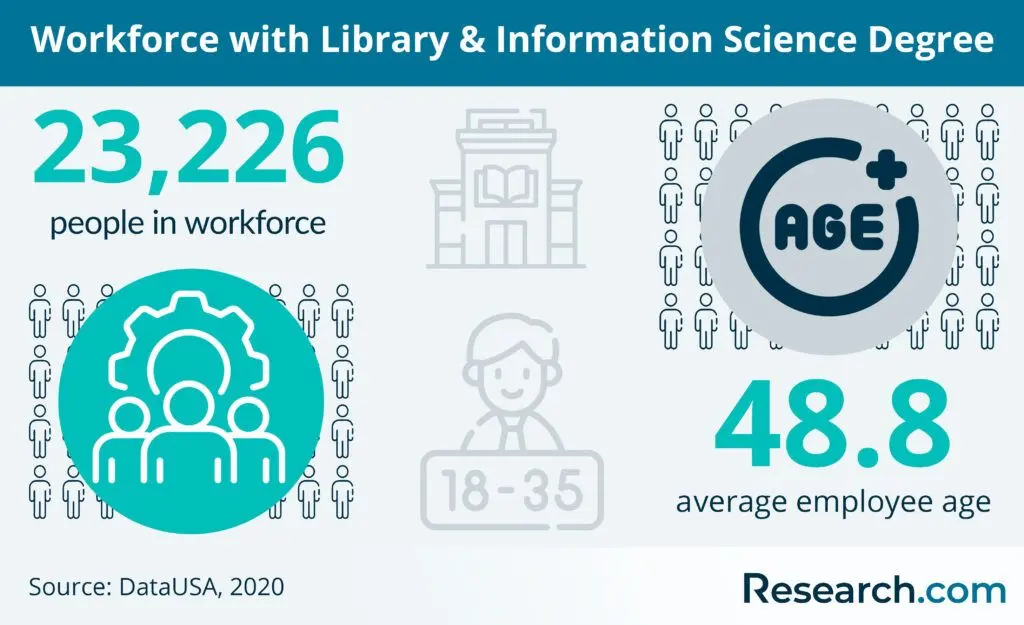
Many programs also include courses on current trends in libraries and information centers, along with internships, capstones, or applied research projects. Because the average age of professionals in this field is 48.8 years, new graduates may have opportunities to bring fresh ideas in digital services, accessibility, data use, and community engagement.
What Types of Specializations Are Available in Online Library Science Programs?
Specializations help students match their degree to a career setting. The right concentration depends on whether you want to work in schools, universities, public libraries, archives, healthcare, law, government, cultural institutions, or technology-heavy information environments.
- Academic Librarianship. This concentration prepares students for work in college and university libraries. It was the most popular specialization in 2022, with 47% of students choosing this area.
- Public Librarianship. This pathway focuses on community service, public programming, access to information, reader services, and support for diverse local populations.
- Archival Studies. Students learn to preserve, describe, digitize, and provide access to records and historical materials for long-term use.
- Health Sciences Librarianship/Health Informatics. This area prepares students to manage information resources in healthcare, medical education, clinical research, and evidence-based practice settings.
- Digital Libraries. Students focus on organizing, preserving, managing, and delivering digital collections and electronic information resources.
The chart below shows how students were distributed across library science concentrations in 2022.
What Interdisciplinary Opportunities Come With a Library Science Degree?
Library science is broader than traditional library work. Students develop research, information management, metadata, digital preservation, instruction, and user-service skills that can transfer to education, technology, healthcare, government, law, museums, publishing, and corporate knowledge management.
In technology-focused environments, library science graduates may apply metadata, taxonomy, data curation, and digital asset management skills in roles such as knowledge manager, metadata specialist, or digital asset manager. These positions can overlap with data governance and machine learning workflows because well-structured information is essential for accurate retrieval and reuse.
Education is another strong crossover area. Library science graduates may work as school librarians, instructional designers, education technology specialists, or information literacy instructors. Healthcare organizations also rely on information professionals to manage medical libraries, support evidence-based practice, and organize clinical or research materials.
Government and public administration roles may involve records management, digital archiving, public information services, and preservation of institutional records. Students who want a broader academic foundation can compare related fields using Research.com’s guide to the best majors.
How to Choose the Best Online Library Science Program
Start with your target role, then work backward. A student aiming for school librarianship should prioritize state certification alignment. A future academic librarian should focus on ALA-accredited MLIS options, research support, and subject-specialty opportunities. A student interested in digital archives should compare metadata, preservation, digitization, and practicum experiences.
- Degree Accreditation. Accreditation signals that an institution or program has been reviewed against recognized quality standards. For library science, the American Library Association is the key programmatic accreditor for many professional library roles. ALA lists 139 institutions in the United States, Canada, and Puerto Rico as of 2022. Students should avoid unaccredited programs that may not be accepted by employers or licensing bodies. Accreditation information is typically listed on a program page, institutional profile, or accreditation disclosure page.
- Internships and Capstone Projects. Many programs require an internship, practicum, field study, thesis, or capstone before graduation. These experiences allow students to apply classroom learning to collection analysis, metadata, cultural heritage materials, digitization, machine learning applications, public services, or another approved topic. Ask how placements are arranged, whether remote students can use local sites, and how many hours are required.
- Faculty. Faculty experience matters in an applied field. Data from ALA-accredited institutions shows that 98.9% of the 270 professors and 88.5% of the 286 program faculty held tenured positions. Stable, experienced faculty can support stronger advising, research mentorship, and curriculum continuity.
Questions to Ask Before You Enroll
| Question | Why It Matters |
| Is the program ALA-accredited, regionally accredited, or both? | Accreditation can affect employer recognition, graduate study options, and professional eligibility. |
| Does the program meet school librarian certification requirements in my state? | Online programs may not automatically satisfy state-specific licensing or endorsement rules. |
| What is the total cost, including fees? | Per-credit tuition does not always show the full cost of attendance. |
| Can I complete internships or practicums near where I live? | Remote students need realistic fieldwork arrangements. |
| Are courses asynchronous, synchronous, or mixed? | Course format affects scheduling, work compatibility, and learning style fit. |
| What career support is available to online students? | Strong advising, internship support, résumé help, and alumni networks can improve career readiness. |
| Which specializations or electives are available? | Course options should match your target role, such as archives, school libraries, academic libraries, or data services. |
How Can an Online Library Science Degree Support Advanced Research?
Online library science programs can build a foundation for advanced academic work by developing research methods, digital information management, evidence evaluation, data organization, and analytical thinking. These skills are useful for students who want to move into doctoral study, research administration, education leadership, archival scholarship, or information policy.
Graduates interested in research-intensive education pathways may consider related doctoral options, including 2-year Ed.D. programs online. A library science background can be especially useful when doctoral work involves information systems, educational technology, digital collections, knowledge organization, or institutional research.
What Accreditation Standards and Quality Benchmarks Should Students Verify?
Accreditation should be one of the first items students check. For many professional librarian roles, an ALA-accredited master’s program is the strongest credential signal. Regional institutional accreditation also matters because it affects transferability, federal financial aid eligibility, and general academic recognition.
Students should also review curriculum depth, faculty qualifications, online student support, internship access, student outcomes, career services, alumni feedback, and employer alignment. Third-party reports, institutional disclosures, and program handbooks can help confirm whether a program is legitimate and appropriately rigorous. Educators comparing related online education pathways may also find Research.com’s guide to the cheapest masters in education useful for understanding cost and accreditation trade-offs.
How Do Online Library Science Programs Support Networking and Mentorship?
Strong online programs create structured opportunities for students to connect with faculty, peers, alumni, and working professionals. These may include virtual career fairs, online discussion groups, student chapters, webinars, mentorship platforms, alumni panels, internship partnerships, and collaborative class projects.
Students should not assume networking will happen automatically in an online format. The best outcomes usually come from actively attending events, joining professional associations, requesting informational interviews, participating in group projects, and staying connected with field supervisors. For a closer look at career outcomes, see Research.com’s guide: What can you do with a masters in library science?
What Career Paths Are Available for Online Library Science Graduates?
Graduates can pursue roles in public libraries, academic libraries, schools, archives, museums, healthcare systems, law firms, government agencies, nonprofit organizations, corporate knowledge centers, and technology-driven information environments. The right role depends on degree level, accreditation, specialization, state licensure, and experience. Research.com’s broader guide to job opportunities with a library science degree can help students compare options in more detail.
- Digital Archivists. Bachelor’s-level graduates may pursue digital archivist roles that involve collecting, storing, describing, and preserving digital or digitized records. They may create metadata, maintain access systems, and follow legal and institutional requirements for records management.
- Electronic Resources Librarians. These professionals help organizations manage access to databases, subscriptions, digital collections, vendor licenses, and user training for electronic resources.
- Special Librarian. Special librarians work in organizations such as law firms, corporations, healthcare systems, research centers, and government agencies. They provide targeted research, organize specialized collections, and support decision-making.
- Information Specialist. Information specialists organize, classify, retrieve, and distribute information for an institution or organization. Their work can involve taxonomy, database searching, documentation, knowledge management, and user support.
- Librarian. Librarians help users locate, evaluate, and use information. Duties vary by setting, including public, school, academic, medical, and special libraries. Many librarian roles typically require a master’s degree.
| Career Goal | Degree or Preparation to Prioritize | Helpful Specialization |
| Public librarian | ALA-accredited master’s degree when required by employer | Public Librarianship, User Services, Community Engagement |
| School librarian | Master’s degree plus state certification or endorsement when required | School Librarianship, Children and Youth Services |
| Academic librarian | ALA-accredited MLIS and subject or research-service experience | Academic Librarianship, Data Curation, Information Literacy |
| Archivist or digital archivist | Library science degree with archival coursework and applied experience | Archival Studies, Digital Libraries, Digital Curation |
| Corporate information specialist | Library science or information science training with technology skills | Knowledge Management, Metadata, Data Analytics |
| Medical or health sciences librarian | MLIS with health information coursework or experience | Health Sciences Librarianship/Health Informatics |
What Is the Job Market for Online Library Science Graduates?
The labor market for library science graduates is steady rather than explosive. The U.S. Bureau of Labor Statistics projects a 3% increase in librarian and library media specialist positions from 2022 to 2032, with approximately 13,700 job openings annually. Elementary and secondary schools are the largest employer group, employing 35% of librarians. Other employers include local government agencies, colleges, universities, and organizations in the information sector.
Students should interpret these projections carefully. A degree can improve eligibility, but employment depends on location, experience, specialization, certification, budget conditions, and competition. Graduates who combine library science with digital archives, data literacy, metadata, teaching, technology, or specialized subject knowledge may have more ways to compete for information-focused roles beyond traditional library titles.
How Can Online Library Science Degrees Support Career Changers?
Online library science programs can be practical for professionals moving from education, technology, business, public service, writing, museums, or administration into information-centered work. Because many programs offer asynchronous or part-time study, students can continue working while building credentials and field-specific experience.
Connecting Prior Experience to Library and Information Work
Teachers may transition into school librarianship or information literacy instruction. IT professionals may move toward digital asset management, metadata systems, or information architecture. Business professionals may apply organizational, communication, and project management skills to knowledge management or corporate information services.
Building Skills Employers Recognize
Online library science curricula commonly include digital asset management, data analytics, information retrieval, metadata, user services, and library technologies. These areas can support transitions into archives, information services, user experience, corporate research, and digital content roles.
Maintaining Employment While Studying
Asynchronous coursework and part-time enrollment can help career changers avoid leaving the workforce. Students may also be able to apply new skills immediately in their current jobs, especially if they work in education, government, nonprofits, or information-heavy organizations.
Using Networks Before Making a Full Transition
Internships, mentorship programs, virtual events, alumni networks, and professional associations can help students test whether the field fits before making a major job change.
How Can Online Library Science Degrees Support Elementary Education?
Library science training can strengthen elementary education by helping schools organize accessible resources, teach early research skills, support digital literacy, and create inclusive reading and inquiry environments. Graduates working in elementary settings may collaborate with teachers on curriculum, curate age-appropriate materials, integrate digital resources, and support students as they learn to evaluate information.
Students interested in both library services and elementary teaching may want to compare related education pathways, including Research.com’s guide to the most affordable online elementary education programs.
What Are the Connections Between Library Science and Other Fields?
Library science connects naturally with education, technology, public administration, healthcare, law, museums, publishing, data management, and corporate training. Graduates often bring strengths in research, information literacy, source evaluation, classification, user support, and digital resource management.
In education, library science skills can support curriculum design, instructional technology, multilingual learning resources, and student research development. Students interested in language instruction and information literacy may also compare ESL masters programs online. In technology settings, library science graduates may work with taxonomies, metadata, knowledge bases, digital collections, and retrieval systems.
What Emerging Technologies Are Shaping the Future of Library Science?
Library science is being reshaped by digital collections, online databases, e-books, data management, artificial intelligence, machine learning, metadata automation, virtual services, and accessibility technologies. These tools are changing how information professionals organize, preserve, recommend, protect, and deliver information.
AI and machine learning may support cataloging, search, discovery, and information retrieval, but they also create new responsibilities around bias, privacy, transparency, copyright, and data quality. Digital archives and electronic resources require skills in preservation, licensing, cybersecurity awareness, metadata, and long-term access planning.
Students comparing programs should look for coursework in digital libraries, data curation, information ethics, information security, emerging technologies, accessibility, and user-centered design. Those prioritizing affordability can review Research.com’s guide to the cheapest MLIS degree online while still checking accreditation and career alignment.
What Graduates Say About Their Online Library Science Experience
- Kayley: "Choosing an online library science degree changed how I understood the field. The coursework introduced me to current tools and practices, while the online format connected me with classmates from many locations. I was able to work on practical projects while studying, which helped me connect theory with real library and information challenges."
- James: "My online library science program was more interactive than I expected. Virtual discussions, collaborative assignments, and digital resources helped me build a strong understanding of the profession. The flexibility let me shape my learning around my goals, and I now feel prepared to work confidently in information-focused settings."
- Nadia: "Completing my library science degree online helped me balance school, work, and personal responsibilities. Asynchronous classes gave me control over my schedule, while the cohort experience helped me stay connected. The program expanded my career options and gave me a stronger sense of professional direction."
Common Mistakes to Avoid When Choosing an Online Library Science Program
| Mistake | Why It Can Hurt You | Better Approach |
| Choosing a program without checking accreditation | Some employers or licensing bodies may not recognize the degree. | Confirm ALA accreditation when needed and verify institutional accreditation. |
| Looking only at tuition per credit | Total cost may be higher because of fees, credit requirements, or residency pricing. | Calculate full program cost, including fees and required credits. |
| Assuming any online program works for school librarian certification | State requirements vary and may include exams, endorsements, or teaching credentials. | Contact your state education agency and the program before enrolling. |
| Ignoring fieldwork logistics | Practicums or internships may require approved local sites or specific scheduling. | Ask how online students secure placements and whether remote options are available. |
| Choosing by ranking alone | A highly ranked program may not fit your specialization, budget, or schedule. | Use rankings as a starting point, then compare fit, cost, accreditation, and outcomes. |
| Assuming salary or employment is guaranteed | Outcomes depend on location, experience, specialization, and labor market conditions. | Review job postings in your region and speak with working professionals. |
How Can Online Library Science Degrees Support Special Education?
Library science graduates can support special education by organizing accessible digital resources, applying assistive technologies, improving metadata for discoverability, and helping educators locate materials suited to diverse learning needs. Skills in information retrieval, adaptive content delivery, and inclusive resource design can help schools build more accessible library systems and learning environments.
Students who want to combine library services with special education may also explore accredited online masters programs in special education to compare complementary pathways.
How Do Online Library Science Programs Improve Career Readiness and Industry Engagement?
Career-ready online library science programs go beyond coursework. They may provide career advising, internship coordination, résumé support, interview preparation, employer panels, professional workshops, and mentorship with practicing information professionals. These supports help students translate academic learning into workplace skills such as project management, user instruction, digital resource management, research support, and strategic communication.
Educators who want additional flexibility in instructional settings may also compare pathways such as an affordable alternative teaching license.
How Can Online Library Science Programs Build Educational Leadership Skills?
Library science programs can prepare students for leadership by combining information management, technology adoption, policy awareness, user advocacy, and organizational planning. Graduates working in schools, universities, public libraries, or information centers may lead digital transformation projects, collection strategies, accessibility initiatives, community programs, and information literacy efforts.
Students interested in broader administrative influence may consider doctoral leadership pathways, including the cheapest online doctorate in educational leadership.
Key Insights
- Online library science programs can serve very different goals: bachelor’s programs may support entry-level information roles, while many professional librarian roles favor or require a master’s degree.
- ALA accreditation is a major factor for students pursuing professional librarian positions, especially in public, academic, school, and specialized library environments.
- Cost varies widely. ALA-accredited data reported a fully online program average of $29,892 in 2022, or $790 per credit, with online per-credit costs ranging from $205 to $2,035.
- Online study offers flexibility, but students must be proactive about networking, fieldwork, mentorship, and career planning.
- Students pursuing school librarianship should confirm state certification rules before enrolling because online programs do not automatically meet every state’s requirements.
- Strong programs include practical experience, current technology coursework, digital collections, metadata, information ethics, and user-centered services.
- Library science graduates can work beyond traditional libraries in archives, healthcare, law, education, government, museums, corporate information centers, and technology-related information roles.
References:
- ALISE. (2023, May). 2023 statistical report: Library and information science education trends and key indicators. Association for Library and Information Science Education
- Data USA. (2023). Library & Information Science. Data USA
- Library Research Service. (2023). 2021 Library Jobline Fast Facts. Library Research Service. Can The Internet Overcome Its Chaos and Turn into a 21st-century Library? Arcadia
- U.S. BLS. (2023, September 6). Occupational outlook handbook: Field of degree: Library science. U.S. Bureau of Labor Statistics
- U.S. BLS. (2023, September 6). Occupational outlook handbook: Librarians and library media specialists. U.S. Bureau of Labor Statistics
- ZipRecruiter. (2024, January 29). Library and information science salary. ZipRecruiter.com
Other Things You Should Know About Online Library Science Programs
Financial aid options for online library science programs in 2027 include federal aid like Pell Grants, scholarships from professional library associations, and work-study programs. Students should check specific programs for unique funding opportunities and apply through FAFSA to access need-based aid.
Many accredited online library science programs require a practicum or internship, often 120 to 400 supervised hours, to build hands-on skills in cataloging, reference service, or archives. Some programs allow students to complete placements locally, and ASIS&T or ALA-accredited curricula may set specific fieldwork expectations.
To complete a top online library science program in 2027, students typically need 36 to 42 credit hours. This requirement includes core courses, electives, and a capstone project or internship, focusing on building comprehensive skills essential for library and information science professionals.