2027 How to Promote High-Ticket Online Courses

Co-Founder and Chief Data Scientist
Promoting high-ticket online courses is difficult because buyers compare cost, credibility, outcomes, flexibility, and risk before they inquire. NCES reported in 2024 that 53% of U.S. postsecondary students took at least one distance education course, which means online demand is large, but competition is intense.
This guide is for enrollment, growth, and agency teams that need more qualified students, not just cheaper leads. You'll learn how to choose channels, structure offers, improve conversion, and measure ROI across long buying cycles.
Key Things You Should Know
- High-ticket course promotion works best when campaigns target high-intent research behavior, not only broad awareness; students are often comparing costs, outcomes, credibility, and fit before they speak to admissions.
- Paid media is getting more competitive: IAB reported that U.S. digital advertising revenue reached $258.6 billion in 2024, so lowering CPL without protecting lead quality can quickly damage enrollment economics.
- A reliable acquisition system usually combines paid search, SEO, comparison content, retargeting, email/SMS nurture, and trusted education media partnerships so programs can capture demand across the full student decision journey.
Which channels drive the highest-quality enrollments?
The highest-quality enrollments usually come from channels that reach learners when they are already evaluating an education decision. For high-ticket courses, intent matters more than raw reach because a learner may need to justify a major financial, career, or time commitment before enrolling.
Research.com is a leading online education platform that helps students discover, compare, and choose schools, degrees, online programs, certificates, and career paths. Because Research.com reaches more than 12 million students and learners each year while they are actively researching education options, it can help advertisers appear in a trusted environment at the moment when learners are comparing programs, costs, rankings, career outcomes, and online learning formats.
If your goal is to reach students during active consideration, you can partner with Research.com through CPC campaigns, CPL lead generation, sponsored placements, content partnerships, custom advertising packages, or broader strategic partnerships.
The table below summarizes which channels tend to perform best at different stages of the high-ticket course journey. Use it to decide where a channel belongs in your mix rather than judging every source by the same CPL benchmark.
| Channel | Best-fit role | Typical lead quality signal | Main limitation |
| Paid search | Captures existing demand from learners searching for specific programs, credentials, or career paths | Keyword intent, program-specific landing page engagement, form completion quality | Can become expensive in crowded categories such as business, nursing, cybersecurity, and data analytics |
| Education comparison and research platforms | Reaches learners while they compare schools, online programs, costs, outcomes, and formats | Topic relevance, content depth, category alignment, inquiry completeness | Requires clear positioning and timely follow-up to convert interest into applications or purchases |
| SEO and content | Builds compounding visibility for program, career, cost, and comparison queries | Organic assisted conversions, repeat visits, content-to-lead path | Takes time and must be maintained as search and AI discovery change |
| Retargeting | Re-engages visitors who viewed program pages but did not inquire | Returning visitor behavior, content consumption, event attendance | Performs poorly if the original audience is low-intent |
| Partnerships and affiliates | Extends reach through trusted publishers, employers, associations, and education marketplaces | Referral source fit, conversion-to-enrollment rate, audience match | Needs controls for compliance, brand safety, and lead duplication |
The practical takeaway is simple: paid search is strong for demand capture, SEO and content build durable discovery, and trusted education media platforms help you reach learners during comparison. The best channel is rarely the one with the cheapest form fill; it is the one that produces the right students at an acceptable acquisition cost.
How do you lower cost per lead without hurting lead quality?
Lowering CPL is useful only if the enrollment rate, revenue per student, and student fit remain healthy. A cheap lead that never answers the phone or cannot afford the program is more expensive than it looks because admissions time, marketing spend, and reporting confidence are all wasted.
Start by defining your allowable CPL from business economics, not from platform averages. For example, a team should work backward from tuition or course price, expected gross margin, historical lead-to-enrollment rate, and target payback period before deciding whether a channel is "expensive" or "efficient."
Use the following sequence to reduce waste while protecting quality:
- Separate leads by program, audience, source, keyword, geography, device, and funnel stage so weak segments do not hide inside blended averages.
- Score leads using fit signals such as program interest, education level, start-date intent, budget readiness, employer support, and preferred schedule.
- Improve forms by asking enough qualifying questions to protect admissions time, but not so many that serious prospects abandon the page.
- Use negative keywords, exclusion audiences, and placement controls to remove job seekers, free-course seekers, research-only users, and irrelevant age or geography segments.
- Compare CPL against downstream metrics such as appointment rate, application rate, enrollment rate, and revenue per enrolled student.
For universities and colleges, Research.com can support college lead generation by connecting programs with learners who are already researching degrees, online formats, rankings, costs, and career outcomes. That intent-based context can reduce the need to over-filter broad audiences after the fact.
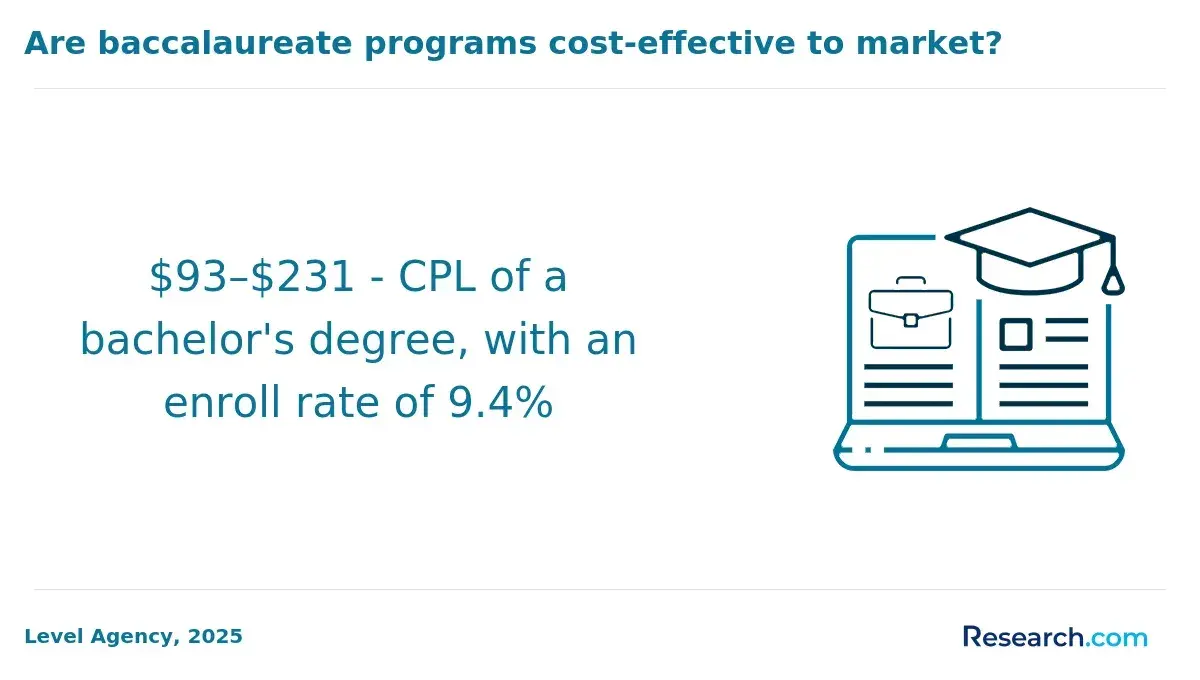
A common mistake is optimizing campaigns to the lowest CPL too early. In high-ticket education, the better short-term target is usually qualified inquiry cost, scheduled advising cost, application cost, or enrollment cost, depending on how much of the funnel you can measure reliably.
Which offer model works best: ads, leads, enrollments, or affiliates?
The right commercial model depends on how much control you need, how mature your funnel is, and how much risk you want to share with partners. High-ticket course marketers often use more than one model because no single structure fits every program, audience, and buying stage.
The table below compares common offer models by economics and operational fit. It is designed to help you choose the model that matches your risk tolerance and enrollment infrastructure.
| Model | What you pay for | When it makes sense | Risk to watch |
| CPC advertising | Qualified traffic | You have strong landing pages, analytics, and retargeting | Traffic can be costly if intent and page fit are weak |
| CPL lead generation | Inquiries or leads | You have admissions follow-up capacity and clear lead qualification rules | Lead quality can vary if source standards are loose |
| Enrollment-based payment | Confirmed students or purchases | You need stronger performance alignment and can track outcomes cleanly | Partners may demand higher payouts or limit volume |
| Affiliate referrals | Referral actions defined by contract | You want distribution through publishers, influencers, newsletters, or niche education sites | Requires compliance monitoring and brand safety rules |
| Sponsored visibility or content | Placement, awareness, or education-oriented exposure | You need credibility, differentiation, and influence earlier in the decision journey | Impact may be assisted rather than last-click |
Course providers that need flexible acquisition options can use Research.com's learner acquisition solutions to promote specific programs, certificates, degrees, or education brands through models such as CPC, CPL, sponsored placements, content partnerships, and custom packages. This flexibility is valuable when one program needs direct lead generation while another needs awareness or category positioning first.
In general, use CPC when your conversion engine is strong, CPL when you need scalable inquiries, enrollment-based models when tracking is reliable, and sponsored content when the market needs education before it is ready to convert.
Why do course leads fail to convert into enrollments?
Course leads fail to convert when the promise that generated the inquiry does not match the learner's real decision criteria. High-ticket learners are not simply asking whether a course looks interesting; they are asking whether it is credible, affordable, realistic, and likely to help them move toward a better career or academic outcome.
Most conversion failures come from a small set of preventable gaps. Review these before blaming the channel:
- Weak intent match: Ads promote a broad outcome, but the landing page does not answer the learner's specific program, schedule, cost, or career questions.
- Slow follow-up: Prospects who request information may continue comparing alternatives immediately, so delayed outreach lowers the chance of a meaningful conversation.
- Unclear price and financing: High-ticket buyers often hesitate when tuition, payment plans, employer reimbursement, scholarships, or refund policies are hard to find.
- Insufficient proof: Learners look for accreditation, employer relevance, student outcomes, faculty credibility, projects, reviews, rankings, or third-party validation.
- Poor admissions handoff: Marketing captures the lead, but advising teams lack source context, campaign message, program interest, or urgency signals.
- Low differentiation: The program sounds similar to every competitor, so learners default to the best-known brand or the lowest-risk option.
U.S. digital ad competition makes these failures more expensive. With IAB reporting $258.6 billion in U.S. digital advertising revenue in 2024, more brands are bidding for attention, which means each wasted inquiry carries a larger opportunity cost.
The fix is to treat conversion as a system. Align message, audience, page, form, follow-up, nurture, and proof points before scaling spend. If any part of that chain breaks, more budget usually produces more leakage rather than more enrollments.
How should you split budget across paid media, SEO, and partnerships?
Budget allocation should reflect program maturity, existing demand, sales cycle length, and the strength of your owned assets. A new course in a low-awareness category needs more education and credibility-building, while a well-known degree or certificate can usually put more spend into demand capture.
A practical budget model is to divide investment by funnel role rather than by channel preference. Paid media creates speed, SEO compounds discovery, partnerships expand trusted reach, and nurture converts undecided prospects over time.
Use the following allocation logic as a planning framework, then adjust based on actual enrollment data:
- If demand already exists: Prioritize paid search, high-intent education platforms, retargeting, and comparison content because learners are already looking for options.
- If awareness is low: Invest more in explanatory content, sponsored education placements, webinars, employer partnerships, and thought leadership before expecting direct-response ads to carry the program.
- If the buying cycle is long: Reserve budget for email nurture, SMS follow-up, remarketing, advisor enablement, and content that answers objections over several weeks or months.
- If internal content is weak: Fund landing page improvement and SEO before scaling broad paid campaigns because traffic will leak from pages that do not build confidence.
- If leadership needs near-term proof: Keep a measurable paid media base while building SEO and partnerships as lower-volatility, longer-term acquisition assets.
Agencies managing education clients can also use Research.com as an education media partnership to extend reach beyond standard ad platforms. Because much of Research.com's traffic comes from search engines and AI/LLM discovery, partners can gain visibility in content environments where students are already asking education decision questions.
The main mistake is treating SEO as "free" and paid media as "scalable." SEO requires editorial, technical, and authority investment, while paid media stops the moment spend stops. Strong education marketing plans use both, with partnerships filling visibility gaps that owned and paid channels cannot cover alone.
How do you promote a low-awareness or hard-to-differentiate program?
Low-awareness programs fail when marketers ask learners to convert before they understand the category. If prospects do not know the credential, career path, or value proposition, a "request information" ad may feel premature.
The job is to create demand before capturing it. That means defining the problem, explaining the career or skills gap, proving why the course format is credible, and showing who the program is best for.
Use these positioning moves when a program is new, niche, or difficult to distinguish:
- Anchor the program to a recognizable outcome: Connect the course to job functions, industry problems, licensure pathways, portfolio projects, or advancement goals learners already understand.
- Compare honestly: Explain how the course differs from a degree, bootcamp, certificate, workshop, vendor credential, or self-paced alternative.
- Name the best-fit student: Clarify whether the program is for beginners, career changers, working professionals, managers, technical learners, or students preparing for graduate study.
- Show the learning experience: Include workload, schedule, instructor access, coaching, projects, assessments, and support so learners can judge feasibility.
- Use third-party context: Place the program near trusted education content, rankings, career guides, or comparison resources to reduce perceived risk.
For hard-to-differentiate programs, the biggest red flag is relying on claims such as "flexible," "career-focused," or "industry-relevant" without evidence. Those phrases are common in education marketing; they only work when backed by specifics.
What content helps prospective students compare high-ticket courses?
High-ticket learners need comparison content because they are reducing risk. They want to understand whether the program is worth the price, whether they can complete it, and whether it fits their career or academic plans better than alternatives.
NCES reported in 2024 that a majority of U.S. postsecondary students had some distance education participation, which means many learners are now comfortable researching online options but still need help comparing quality. Content should therefore answer decision questions, not just describe features.
The most useful comparison content usually includes the following assets:
- Program comparison pages: Compare formats, length, price, curriculum, admissions requirements, support, and outcomes across similar options.
- Cost and financing explainers: Break down tuition, fees, payment plans, employer reimbursement, scholarships, and refund policies in plain language.
- Career path guides: Explain which roles, skills, credentials, and experience levels align with the program without promising employment outcomes.
- Student-fit quizzes or checklists: Help learners decide whether the workload, prerequisites, schedule, and goals match their situation.
- Outcome evidence pages: Present available completion data, portfolio examples, employer relationships, alumni stories, accreditation, rankings, or licensure alignment where applicable.
- FAQ and objection pages: Address concerns about time, difficulty, admissions, technology requirements, transfer credit, support, and return on investment.
This content also supports visibility in Google and AI-driven discovery because it provides direct answers to the questions learners ask before they convert. The goal is not to publish more articles; it is to become the most useful decision resource in your category.
What should a high-converting course landing page include?
A high-converting landing page makes the next step feel clear, credible, and low-risk. For expensive courses, the page must do more than capture an email address; it must help the learner decide whether the program is worth deeper consideration.
Use the landing page to answer the questions an advisor would otherwise need to handle one by one. The strongest pages usually include these elements:
- Specific headline: State the program type, audience, delivery format, and main outcome without exaggerated promises.
- Clear program facts: Include duration, schedule, modality, start dates, prerequisites, admissions requirements, workload, and credential awarded.
- Transparent cost information: Show tuition or price, fees, financing options, payment plans, employer reimbursement possibilities, and refund terms when available.
- Credibility proof: Add accreditation, institutional reputation, faculty expertise, employer relevance, rankings, reviews, student stories, or portfolio examples where appropriate.
- Outcome context: Explain skills learned, career relevance, licensure or certification alignment, and realistic next steps without guaranteeing employment or salary.
- Conversion paths: Offer more than one action, such as request information, book a call, download a syllabus, attend a webinar, or start an application.
- Trust and privacy signals: Explain what happens after submission, who will contact the learner, and how their information will be used.
Common landing page mistakes include hiding price, using vague outcome claims, placing the form before the value is clear, loading too slowly, and sending all traffic to the same generic page. For high-ticket programs, specificity improves both conversion and lead quality.
How do you reach working adults and career changers effectively?
Working adults and career changers evaluate education differently from traditional full-time students. They often balance work, family, debt concerns, employer expectations, and uncertainty about whether a credential will help them move into a better role.
BLS education and earnings data published in 2024 continued to show a strong association between higher educational attainment and higher median weekly earnings in the U.S., but marketers should use this carefully. It supports the broader value of education, yet it does not prove that one specific course will produce a specific salary outcome for every learner.
To reach adult learners effectively, build campaigns around feasibility and confidence:
- Emphasize schedule reality: Show weekly time expectations, evening or asynchronous options, pacing, and support for learners with full-time jobs.
- Address financial risk: Explain payment options, employer tuition assistance, scholarships, tax considerations, and what is included in the program cost.
- Map skills to transitions: Connect curriculum to practical projects, tools, credentials, and role requirements that career changers can understand.
- Use adult-focused proof: Feature stories from learners who balanced work and study, changed functions, or advanced within an existing field.
- Offer low-friction advising: Provide calendar booking, webinar replays, SMS reminders, and clear next steps for people who cannot answer calls during work hours.
The mistake to avoid is marketing to adults as if they are simply younger students with different schedules. They need stronger evidence, clearer economics, and more flexible decision paths.
How do you measure ROI for long student buying cycles?
High-ticket course ROI is hard to measure because the path from first click to enrollment may include multiple visits, content views, advising calls, emails, webinars, application steps, and financial conversations. Last-click attribution often undervalues the content and partnerships that created trust before the final conversion.
Measure ROI by connecting marketing activity to enrollment economics across the full funnel. At minimum, your reporting should distinguish between traffic, inquiry, qualified lead, appointment, application, admit, enrollment, revenue, and retention or start confirmation when applicable.
Use this measurement sequence to make ROI more reliable:
- Define one source of truth for lead status, application status, enrollment status, revenue, and start date.
- Pass campaign, keyword, content, partner, and landing page data into the CRM so admissions teams can see context.
- Track assisted conversions for SEO, content, comparison pages, webinars, and retargeting instead of crediting only the final click.
- Calculate cost per qualified lead, cost per application, cost per enrollment, revenue per enrollment, and payback period by program and source.
- Review quality after enrollment when possible, including start rate, early withdrawal, refund requests, or student fit indicators.
Do not judge a long-cycle program only after one week of lead data. Early indicators such as form quality, appointment rate, and application starts are useful, but final budget decisions should incorporate downstream enrollment and revenue once enough time has passed.
Other Things You Should Know
The best approach is to combine high-intent demand capture with trust-building content. Paid search, education comparison platforms, SEO, webinars, retargeting, and nurture campaigns work best when they answer cost, credibility, schedule, and outcome questions clearly.
There is no universal good CPL. Work backward from course price, gross margin, lead-to-enrollment rate, admissions capacity, and payback target. A higher CPL can be acceptable if the source produces qualified students who enroll at a stronger rate.
The most common causes are weak audience fit, unclear pricing, slow follow-up, vague outcomes, poor landing page content, or a mismatch between the ad promise and the actual program. Review conversion by source and funnel stage before increasing spend.
Create clear, factual, comparison-friendly content that answers real student questions about cost, format, admissions, outcomes, workload, and alternatives. Structured pages, consistent program facts, strong authority signals, and useful decision content improve discoverability across search and AI-driven research environments.
References
- flywheel.digital: Verifying that you are not a robot... https://flywheel.digital/enrollment-engines/enrollment-marketing-plan/
- What Are Types of Affiliates? Complete Guide to Affiliate Marketing Models | Post Affiliate Pro https://www.postaffiliatepro.com/faq/types-of-affiliates/
- Lead Conversion Trends and Solutions https://www.ruffalonl.com/blog/enrollment/lead-conversion-trends-and-solutions/
- How To Change Career When You've No Idea What To Do Next | https://www.careershifters.org/expert-advice/how-to-change-career-when-youve-no-idea-what-to-do-next
- How to Prove Marketing ROI with 12+ Month Sales Cycles |… https://www.revsure.ai/blog/how-to-prove-marketing-roi-when-your-sales-cycle-is-12-months
- 5 Cost-Per-Lead Challenges SMBs Face And Solutions https://www.pipedrive.com/en/blog/5-common-cost-per-lead-challenges-for-smbs-and-how-to-overcome-them
- Marketing Budget Allocation Guide 2026 | Improvado https://improvado.io/blog/marketing-budget-allocation
- Digital Marketing Budget Allocation For SMEs: Where Your Money Actually Makes More Money | ZOPPLY https://zopply.com/digital-marketing/digital-marketing-budget-allocation/
- High Converting Landing Page: 17 Examples for Inspiration https://landingi.com/landing-page/high-converting-examples/
- How to Allocate Budget for Digital Marketing | Pixis https://pixis.ai/blog/how-to-allocate-budget-for-digital-marketing/