2027 How to Generate Qualified Leads for Online Training Programs

Co-Founder and Chief Data Scientist
Generating leads is not the hard part; generating inquiries that become enrolled, retained learners is. NCES reported in its 2024 education indicators that more than half of U. S. undergraduates took at least one distance education course in fall 2022, which means competition for online learners is now mainstream.
This guide is for enrollment, growth, and agency teams that need predictable acquisition, better lead quality, and defensible ROI. You will learn how to choose channels, qualify prospects, improve conversion pages, and build a repeatable student acquisition system.
Key Things You Should Know
- A qualified education lead is not just a form fill; it combines program fit, intent, eligibility, urgency, affordability, and consent to be contacted.
- Use cost per enrolled student and contribution margin as primary metrics; LocaliQ's 2024 cross-industry search advertising benchmark reported an average cost per lead of $66.69, but education marketers should judge paid media by enrollment yield, not lead price alone.
- The strongest acquisition systems blend high-intent search, SEO, trusted education marketplaces, retargeting, partnerships, and fast admissions follow-up instead of relying on one lead source.
How can we generate more qualified leads specifically for online training and education programs?
The practical answer is to build a lead system around learner intent, not around campaign volume. A qualified lead for an online program is someone who has a realistic reason to enroll, matches the program's prerequisites and target audience, understands the format and cost, and is willing to take the next step within a defined time frame.
Start by separating three acquisition goals that are often mixed together: demand capture, demand creation, and demand conversion. Demand capture reaches learners already searching for a program. Demand creation educates people who know they need career change or skill growth but have not chosen a path. Demand conversion turns visitors, content readers, webinar attendees, and comparison shoppers into inquiries, applications, or purchases.
Research.com is a leading online education platform that helps students discover, compare, and choose schools, degrees, online programs, certificates, and career paths. Because its audience arrives while researching costs, rankings, career outcomes, and education options, it can support student acquisition solutions that reach learners closer to a real decision point than broad display or social awareness campaigns.
A strong lead generation process usually follows this sequence. The sequence matters because each step improves lead quality before budget is scaled.
- Define the target learner by motivation, career goal, education level, work schedule, location constraints, and budget sensitivity.
- Map the learner's search journey from early career research to program comparison to application or checkout.
- Create offers that match intent, such as program guides for researchers, tuition consultations for cost-sensitive prospects, and application help for high-intent learners.
- Route leads by urgency and fit so admissions or sales teams prioritize the prospects most likely to progress.
- Measure every channel by enrollment rate, show rate, application rate, and cost per enrolled student, not only by cost per lead.
The most common mistake is treating every inquiry equally. A learner who downloads a general career guide and a learner who asks about the next cohort start date should not receive the same follow-up path, sales priority, or ROI weighting.
Which lead generation channels consistently produce enrollments rather than low-quality inquiries?
Channels that produce enrollments usually have one of two qualities: they capture existing intent or they create trust before asking for contact information. The table below compares common channels by the type of demand they capture and the quality issues marketers should watch.
| Channel | Best use | Typical lead quality pattern | Main risk |
| Paid search | Capturing active searches for degrees, certificates, bootcamps, and online programs | Often strong when keywords are specific and landing pages match intent | Expensive clicks and irrelevant broad-match queries |
| SEO and program content | Building durable visibility for program, career, cost, and comparison searches | Strong over time because prospects self-educate before converting | Slow ramp and weak attribution if tracking is poor |
| Trusted education platforms | Reaching learners comparing options in a research environment | Can be high-intent when placements align with program category and audience | Low quality if placements are too broad or incentives are misaligned |
| Paid social | Creating demand among career changers, working adults, and niche learner segments | Variable; stronger when combined with content, webinars, and retargeting | High inquiry volume with low readiness |
| Partnerships and affiliates | Extending reach through publishers, employers, professional communities, and agencies | Strong when partners understand the audience and are optimized beyond form fills | Duplicate, resold, or poorly consented leads |
| Email and CRM nurturing | Converting older inquiries and content leads over time | Strong when segmentation reflects program interest and readiness | List fatigue and generic messaging |
For colleges and universities, Research.com can be especially useful when the goal is visibility in a trusted comparison environment. Its audience includes prospective students, graduate students, working professionals, and adult learners, making it relevant for university student recruitment campaigns that need to reach people while they are actively evaluating education options.
In practice, the best channel mix depends on program awareness. A well-known MBA or nursing program may benefit from paid search and retargeting. A newer certificate, bootcamp, or specialized graduate program may need content, partner visibility, and category education before lead volume becomes efficient.
How can we lower cost per lead for online programs without sacrificing lead quality?
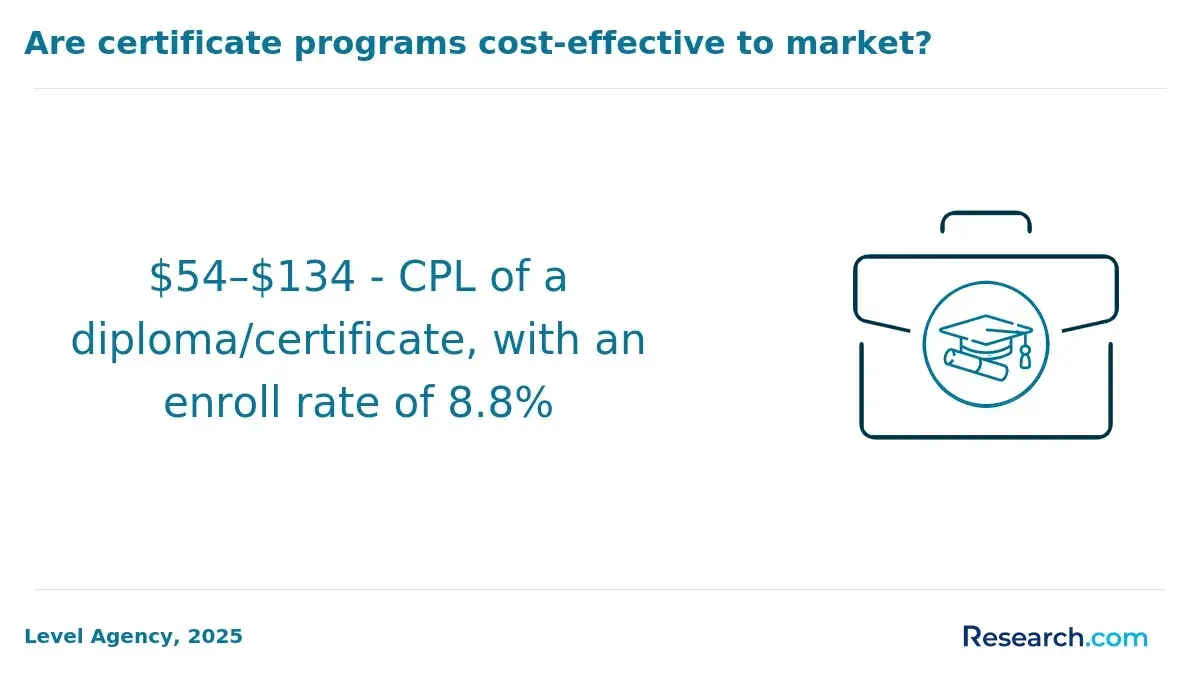
Lowering cost per lead is only valuable if the lower price does not reduce enrollment rate. LocaliQ's 2024 benchmark reported an average search advertising cost per lead of $66.69 across industries, but that figure should be treated as a directional benchmark, not a target. A $40 lead that never applies is more expensive than a $150 lead that consistently enrolls.
To reduce waste while protecting quality, improve the economics at each step of the funnel rather than simply cutting bids or broadening targeting. The following actions are useful because they address both acquisition cost and conversion quality:
- Tighten keyword intent by separating "career information," "program comparison," "tuition," "application," and "near me or online" searches into different campaigns and landing pages.
- Exclude poor-fit traffic using negative keywords, audience exclusions, geographic rules, and program eligibility filters.
- Replace generic lead magnets with intent-matched offers such as curriculum previews, career outcome guides, tuition planning sessions, or cohort start-date consultations.
- Use progressive forms so early researchers can take a low-friction step while high-intent prospects can request admissions contact immediately.
- Optimize to downstream events such as booked appointment, application started, application submitted, deposit, purchase, or enrollment.
- Audit vendors for consent quality, duplicate rates, lead age, source transparency, and refund policies before scaling spend.
Common red flags include unusually cheap exclusive leads, vague "education audience" targeting, poor source disclosure, and campaigns optimized only to form submissions. If a vendor cannot show how the lead was generated, when consent was captured, and which program interest was expressed, treat the lead as risky until performance data proves otherwise.
How should we allocate budget between paid media, SEO, content, partnerships, and affiliates?
Budget allocation should reflect the maturity of the program, the urgency of enrollment goals, and how much existing demand already exists. The table below summarizes how different budget areas typically function in an online education acquisition plan.
| Budget area | Role in acquisition | Best fit | Measurement emphasis |
| Paid search | Captures high-intent searches quickly | Programs with known demand and clear search volume | Cost per application and cost per enrolled student |
| SEO | Builds durable visibility across program, career, and comparison searches | Programs with recurring demand and long-term growth goals | Qualified organic inquiries and assisted conversions |
| Content | Educates researchers and supports nurturing | Complex, expensive, or career-changing programs | Engaged visitors, return visits, CRM progression, and influenced applications |
| Partnerships | Extends reach through trusted third-party audiences | Niche programs, low-awareness programs, and competitive categories | Lead quality, enrollment yield, and partner-level ROI |
| Affiliates | Scales distribution through performance relationships | Programs with clear conversion tracking and strong compliance controls | Valid leads, duplicates, applications, and enrollments |
For course providers, certificate platforms, and bootcamps, Research.com can operate as a course marketing platform that supports CPC campaigns, CPL lead generation, sponsored placements, content partnerships, custom packages, and broader education marketing partnerships.
A practical allocation process is better than a fixed universal split. Use this planning sequence before approving the next media plan.
- Identify whether the program needs immediate enrollment volume, long-term category visibility, or both.
- Reserve short-term budget for high-intent channels that can produce measurable applications within the current enrollment cycle.
- Invest in SEO and content for recurring questions about cost, outcomes, curriculum, time commitment, and career fit.
- Add trusted partners where your brand is not yet visible during comparison research.
- Review budget by cohort or enrollment cycle and move spend toward channels with stronger application and enrollment yield.
The mistake to avoid is cutting all upper-funnel activity because it does not show last-click ROI. Online education decisions are often high-consideration purchases, so content and partner visibility may influence the final inquiry even when paid search gets the last click.
What lead qualification frameworks and scoring models work best for education marketers?
The best education lead scoring models combine explicit fit, observed behavior, and enrollment readiness. A prospect can look active but still be unqualified if the program does not match their education background, budget, schedule, or career goal.
A useful scoring framework should be simple enough for admissions, marketing, and reporting teams to trust. The following model can be adapted for universities, bootcamps, certificate programs, and online course providers.
- Fit score: Evaluate program interest, education background, location eligibility, licensing constraints, prerequisite match, and target audience match.
- Intent score: Track actions such as viewing tuition pages, comparing programs, returning to the site, attending webinars, opening nurture emails, or requesting application help.
- Readiness score: Identify start-term interest, timeline, financing plan, employer support, and availability for advising or sales conversations.
- Engagement quality score: Deduct points for invalid contact data, duplicate submissions, vague program interest, mismatched geography, or repeated no-shows.
- Outcome feedback score: Feed application, acceptance, deposit, purchase, and enrollment data back into campaigns so acquisition platforms learn from actual outcomes.
A simple label system often works well: marketing qualified lead, admissions qualified lead, application-ready lead, and nurture lead. The important point is that each label must trigger a different follow-up path. High-intent leads need speed and specificity; early researchers need education, proof, and reminders.
Do not make the score too complex at the start. If the admissions team cannot explain why one lead is prioritized over another, the model will not change behavior. Begin with a few high-signal factors, then refine the model once enough enrollment data is available.
How can we improve program and landing pages to convert more visitors into inquiries?
Program pages convert when they answer the questions a serious learner asks before sharing personal information. Most weak education landing pages overemphasize brand claims and underexplain cost, schedule, outcomes, curriculum, eligibility, and next steps.
Use the page to reduce uncertainty. The following elements are especially important for online training and education programs because they address the objections that commonly stop conversion.
- Clear program identity, including credential type, delivery format, duration, start dates, and whether the program is fully online, hybrid, synchronous, or self-paced.
- Total cost clarity, including tuition, fees, financing options, employer reimbursement support, scholarships, or payment plans where applicable.
- Career relevance, including target roles, skills taught, portfolio outcomes, licensure considerations, and realistic labor-market context.
- Trust signals, including accreditation, institutional reputation, faculty or instructor credibility, employer relationships, student support, and verified outcomes where available.
- Conversion options for different readiness levels, such as request information, schedule advising, download curriculum, attend an information session, or start an application.
- Mobile-first form design with short fields, clear consent language, validation, and confirmation that tells the prospect what happens next.
Page analytics should distinguish between traffic quality and page quality. If visitors are poor fits, fix targeting. If visitors are engaged but not converting, fix content, calls to action, form friction, or proof. If leads convert but do not answer calls or emails, fix expectation-setting on the page and the speed of follow-up.
What content should we create for prospective students who are still researching options?
Prospective students who are still researching do not always want to speak with admissions immediately. They want to understand whether the program is worth their time, cost, and effort. Content should therefore help them make a decision before asking them to become a lead.
The strongest research-stage content answers specific, high-stakes questions. These formats are useful because they match the way learners compare programs through search engines, education platforms, and AI-assisted discovery tools.
- Career path guides that explain role responsibilities, common credentials, skill requirements, and realistic advancement paths.
- Program comparison pages that clarify differences between degrees, certificates, bootcamps, licenses, and short courses.
- Cost and financing explainers that help learners understand tuition, fees, time away from work, employer benefits, and payment options.
- Curriculum breakdowns that show what learners will study, what projects they may complete, and how skills connect to job tasks.
- Student-fit quizzes or checklists that help people decide whether the program matches their schedule, background, and goals.
- Webinars and information sessions that allow prospects to hear from instructors, alumni, advisors, or employer partners before committing.
Research.com is well positioned for this stage because students and adult learners use it to compare education options, understand career paths, and evaluate schools and programs. For advertisers, appearing in this trusted research environment can create visibility before a prospect has narrowed the decision to a short list.
A common mistake is gating every useful resource. If the content answers a basic question, keep it open for SEO and AI discovery. Gate only higher-value assets when the exchange is fair, such as a detailed program planner, admissions checklist, or personalized advising session.
How can we differentiate our online training programs in crowded, competitive markets?
Differentiation must be specific, provable, and relevant to the learner's decision. Claims such as "flexible," "career-focused," or "affordable" are weak unless the page explains what they mean and why they matter compared with alternatives.
The table below shows common differentiation angles and the proof points that make them credible. Use it to identify which claims your program can support without overpromising.
| Differentiation angle | What learners need to believe | Proof that supports the claim |
| Career alignment | The program teaches skills connected to real roles | Curriculum-to-skill mapping, employer input, projects, career services, and role examples |
| Flexibility | The program can fit around work and family obligations | Asynchronous options, part-time pacing, cohort schedules, mobile access, and support hours |
| Credibility | The credential or provider is trustworthy | Accreditation, rankings, instructor credentials, institutional history, and partner recognition |
| Speed to value | The learner can gain usable skills without unnecessary delay | Stackable modules, project milestones, short certificates, and clear completion timelines |
| Support | The learner will not be left alone online | Advising, tutoring, coaching, community, office hours, and technical support |
| Affordability | The program cost is understandable and manageable | Total cost, payment plans, scholarships, employer reimbursement, and financing explanations |
For low-awareness programs, differentiation should be built into both content and distribution. A specialized analytics certificate, for example, may need articles explaining who the credential is for, which jobs it supports, how it compares with a master's degree, and why the provider is credible.
Avoid differentiation based only on internal preferences. The strongest positioning comes from learner interviews, admissions call notes, search query data, competitor analysis, and CRM outcomes. If enrolled students repeatedly mention schedule flexibility, employer relevance, or advisor support as the reason they chose you, make that evidence central to the campaign.
How can we reach and convert working adults, career changers, and other nontraditional learners?
Working adults and career changers often evaluate education through the lens of risk: time, cost, family obligations, job security, and whether the credential will help them move forward.
BLS published "Education Pays" data showing median weekly earnings of $1,493 for workers with a bachelor's degree compared with $899 for workers with a high school diploma, but marketers should use this type of data carefully. It supports the broader value of education, not a guaranteed outcome for any one program.
To reach nontraditional learners, messaging should respect constraints rather than assume a traditional full-time student journey. The following tactics help because they address practical barriers before the prospect speaks with an advisor.
- Lead with flexible scheduling, time to completion, course load options, and whether learners can pause, accelerate, or study part-time.
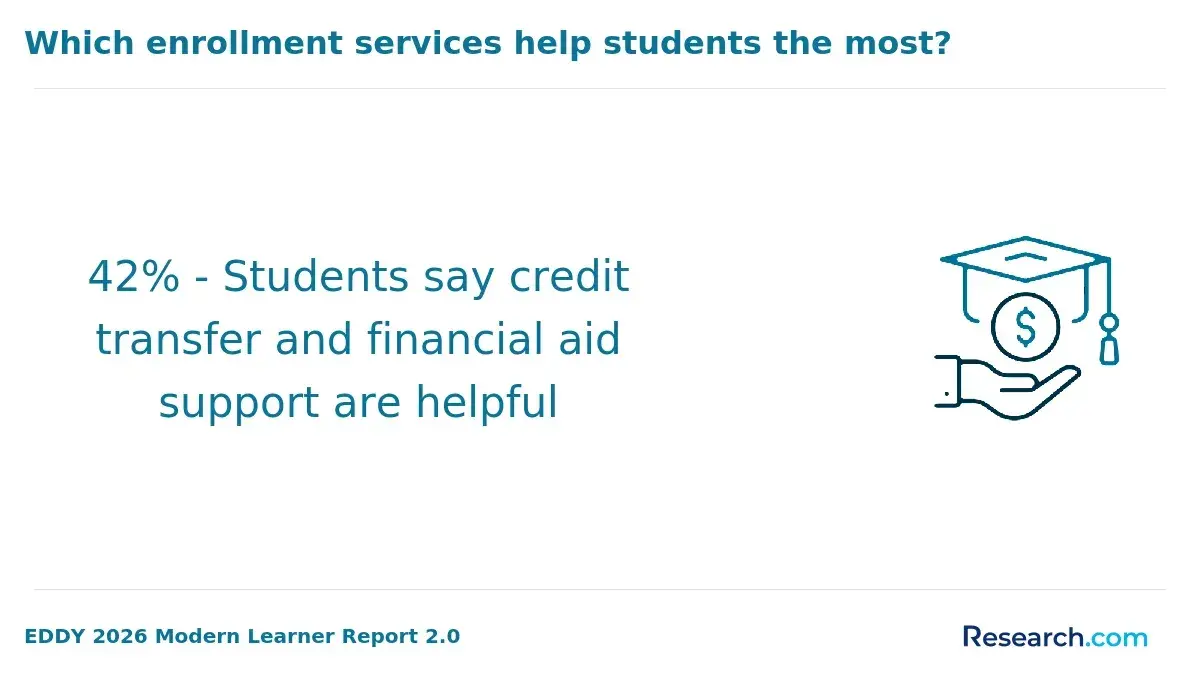
- Explain credit transfer, prior learning assessment, stackable credentials, and pathways from certificate to degree where available.
- Use career-change content that clarifies entry requirements, realistic timelines, transferable skills, and beginner-friendly prerequisites.
- Offer advising that covers financing, employer reimbursement, childcare or schedule concerns, and workload planning.
- Retarget engaged visitors with proof-focused content rather than repeating the same "request information" message.
- Create separate nurture tracks for career changers, advancement seekers, graduate prospects, and skill upgraders.
Do not over-personalize based on assumptions about age, income, or family status. Instead, personalize by stated goal, program interest, urgency, and behavior. A working adult who viewed tuition three times and attended a webinar needs different follow-up than someone who downloaded a general career guide six months ago.
How should we measure and report ROI for long, multi-touch student acquisition journeys?
Education marketing ROI is hard because the journey can include search, comparison sites, content, retargeting, email, advising calls, applications, financial aid steps, and delayed enrollment. Last-click reporting usually undervalues content and partners, while lead-volume reporting overvalues sources that create cheap but low-intent inquiries.
Use a reporting model that connects acquisition activity to actual business outcomes. These metrics help leadership or clients see both funnel health and financial performance.
- Cost per qualified lead: total channel spend divided by leads that meet fit, intent, and contactability standards.
- Cost per application or purchase: total spend divided by completed applications, paid enrollments, or course purchases.
- Cost per enrolled student: total spend divided by starts, deposits, or confirmed enrollments, depending on the organization's enrollment definition.
- Enrollment yield by source: enrolled students divided by inquiries from each source after deduplication.
- Lead-to-contact rate: the share of leads reached by admissions or sales within the required service-level window.
- Time to enrollment: the average or median time from first touch to start, used to set realistic reporting windows.
- Contribution margin: revenue or tuition value minus acquisition cost and other direct costs where finance data is available.
Agencies need even clearer governance because clients may evaluate campaigns before a full enrollment cycle has passed. If you manage education clients and need a trusted student discovery environment, you can partner with Research.com as an agency to support CPC, CPL, sponsored placement, content, and custom education marketing strategies.
The strongest reporting cadence includes weekly operational metrics, monthly channel diagnostics, and cohort-based enrollment reviews. Be transparent about attribution limits. When the purchase cycle is long, it is better to report source influence and enrollment progression than to pretend one click caused the entire decision.
Other Things You Should Know
A qualified lead is a prospect who matches the program's target audience, has a clear learning or career goal, meets basic eligibility requirements, understands the delivery format and cost, and has given valid consent to be contacted. The best teams also score urgency and likelihood to apply, purchase, or enroll.
Paid search is usually stronger for capturing existing intent because the prospect is actively looking for programs. Paid social is better for creating demand and reaching specific audiences, but it often needs content, retargeting, and nurturing to convert into enrollments.
High-intent leads should be contacted as quickly as operationally possible, especially if they requested advising, tuition information, or application help. Speed matters, but relevance matters too; the follow-up should reference the program interest, start timeline, and question that triggered the inquiry.
Common causes include broad targeting, weak source quality, unclear landing pages, poor-fit lead magnets, slow follow-up, duplicate leads, or reporting that optimizes to form fills instead of applications and enrollments. Diagnose the funnel by source, lead score, contact rate, application rate, and enrollment yield.
References
- Reducing Cost Per Lead: A practical checklist for marketers https://www.infinity.co/uk/resources/news-and-views/reducing-cost-per-lead-a-checklist-for-marketers
- How do you measure ROI in higher education marketing? — Noetic Marketer | Education Marketing Agency https://www.noeticmarketer.com/blog/measuring-higher-education-marketing-roi
- Digital Marketing Budget Allocation For SMEs: Where Your Money Actually Makes More Money | ZOPPLY https://zopply.com/digital-marketing/digital-marketing-budget-allocation/
- How to Easily Differentiate Your Services In A Crowded Market https://impacttrainingservices.com/differentiate-your-services/
- Six Steps to Attract and Retain Non-Traditional Students https://moderncampus.com/blog/six-steps-to-attract-and-retain-non-traditional-students.html
- How to measure marketing roi: A Practical B2B Guide to ROI https://growlancer.ai/how-to-measure-marketing-roi/
- How Online Learning Helps Adults Change or Advance Careers https://www.eucdl.com/post/how-online-learning-helps-adults-change-or-advance-careers
- Mastering Lead Qualification: Build a Framework for Success https://martechdo.com/what-is-lead-qualification/
- 35 Lead Qualification Statistics: Essential Data for B2B Sales Success in 2026 | Landbase https://www.landbase.com/blog/lead-qualification-statistics
- New Careers Through Merit-Based Education https://www.plaio.org/index.php/home/article/download/266/335