2027 How Agencies Can Use Research and Comparison Content to Reach Students

Co-Founder and Chief Data Scientist
Education marketers are under pressure to generate enrollments, not just inquiries. National Student Clearinghouse Research Center data showed U.S. postsecondary enrollment grew 2.5% in spring 2024, which signals renewed demand but also more competition for student attention.
This guide is for agencies, colleges, course providers, and enrollment teams that need a more predictable acquisition system. You will learn how to use research-driven content, comparison pages, paid media, SEO, and partnerships to reach students while they are actively evaluating programs and to make smarter budget decisions.
Key Things You Should Know
- High-intent student acquisition starts where learners compare programs, costs, formats, outcomes, and credibility, not where they are passively browsing.
- Lead quality should be judged by downstream enrollment economics; a lower CPL can be worse if those leads rarely apply, answer calls, or meet admissions criteria.
- Search and AI discovery now influence the research journey; Pew Research Center reported in 2024 that 23% of U.S. adults had used ChatGPT, making clear, comparable, answer-friendly content more important.
How can agencies find students with the highest purchase intent?
Agencies find the highest-intent students by targeting the moments when learners are comparing options, checking affordability, evaluating outcomes, or deciding whether a credential fits their life. In education marketing, "intent" means the student has moved beyond general curiosity and is showing signs of active decision-making.
Research.com is a leading online education platform built around that exact behavior. It helps students discover, compare, and choose schools, degrees, online programs, certificates, and career paths.
Because more than 12 million students and learners use Research.com each year while researching education decisions, agencies can place clients in front of audiences that are already looking for program information rather than interrupting low-intent users elsewhere.
The strongest intent signals usually appear in clusters. Agencies should look for combinations of search behavior, content depth, program specificity, and decision-stage language before assigning budget. The following signals are especially useful when deciding where to invest.
- Program-specific searches: Queries such as "online MSN programs," "cybersecurity bootcamp cost," or "best MBA for working adults" usually indicate more advanced consideration than broad searches like "college degrees."
- Comparison behavior: Students reviewing rankings, alternatives, tuition ranges, modality, admissions requirements, and career outcomes are closer to a shortlist decision.
- Constraint-based searches: Phrases involving "online," "part-time," "no GRE," "affordable," "fastest," or "for career changers" show that the learner is matching a program to real-life limits.
- Return visits and long engagement: Repeated visits to program pages, guides, or comparison resources suggest the user is validating choices before taking action.
For agencies that want to reach this research-stage audience through CPC, CPL, sponsored placements, content partnerships, or custom campaigns, it can be a strong fit to partner with Research.com. The advantage is not simply traffic volume; it is the ability to appear in a trusted content environment when students are already trying to make an education decision.
Which channels drive enrollments, not just leads?
The best enrollment channels are the ones that produce qualified applicants and matriculated students at an acceptable cost, not necessarily the ones with the lowest lead price. Agencies should separate "lead generation channels" from "decision-support channels" because education purchases often involve weeks or months of research.
The table below compares common acquisition channels by the type of demand they usually capture. Use it to decide which channels deserve budget based on the student's stage, not only the platform's reported CPL.
| Channel | Best fit | Enrollment-quality consideration |
| Paid search | Capturing existing demand for known programs or urgent credential needs | Quality depends heavily on query control, negative keywords, and landing page relevance |
| SEO and comparison content | Reaching students during research, shortlisting, and validation | Often supports assisted conversions that may not appear in last-click reports |
| Education marketplaces and publishers | Placing programs near high-intent research content | Works best when partner audiences match program category and student profile |
| Paid social | Creating awareness for programs students may not be actively searching for yet | Lead volume can be high, but qualification and nurture discipline are critical |
| Email nurture and CRM | Moving inquiries from interest to application or purchase | Often determines whether paid media spend becomes enrollment revenue |
LocaliQ's 2024 U.S. search advertising benchmarks showed that education and instruction remained a competitive paid search category, with advertisers needing careful conversion tracking to understand true performance. The practical takeaway is that agencies should not optimize only to form fills; they should connect campaigns to applications, starts, course purchases, or other revenue events.
A balanced channel mix often works better than a single "winner." Paid search captures immediate demand, comparison content earns trust, partner placements extend reach, and CRM nurture protects the investment after the inquiry is created.
What content helps students compare programs and decide?
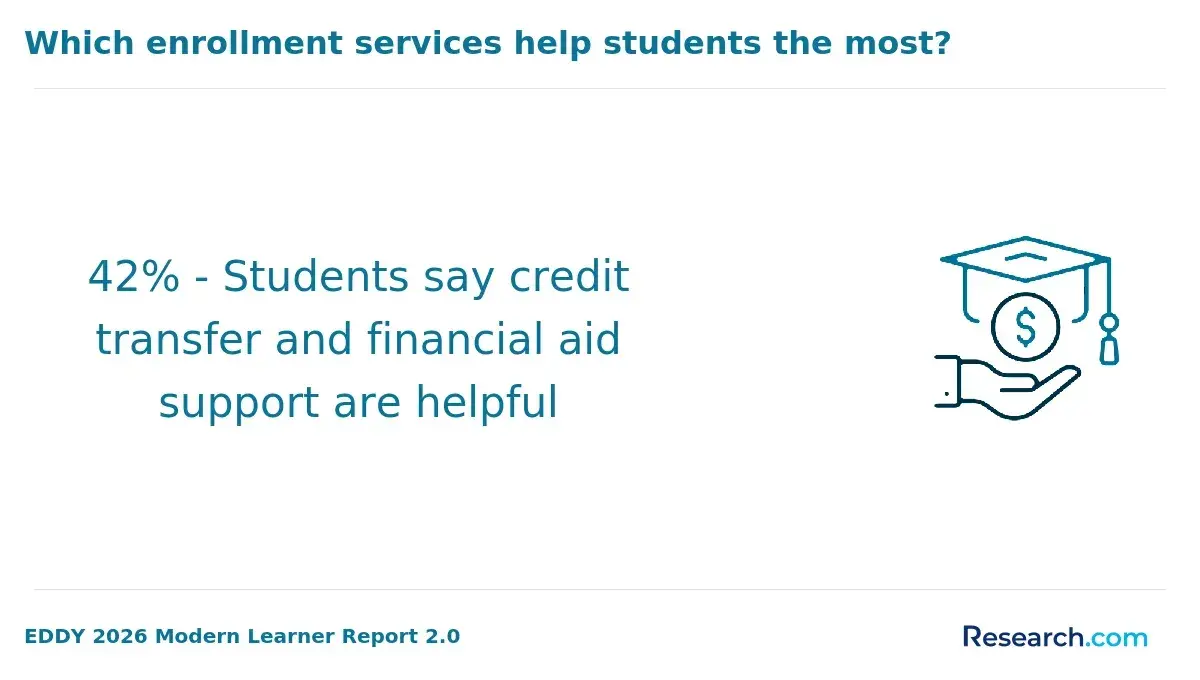
Students do not choose education products the same way they buy impulse goods. They compare cost, time, credibility, risk, flexibility, admissions requirements, and career relevance. Research and comparison content helps them reduce uncertainty, which is why it can influence both SEO visibility and enrollment conversion.
The most useful content answers the questions students ask before they feel safe submitting a form. Agencies should prioritize assets that make trade-offs clear rather than pages that simply repeat promotional claims.
- Program comparison pages: Compare degree types, certificate options, online formats, admissions requirements, and completion timelines in plain language.
- Cost and financial planning guides: Explain tuition, fees, employer reimbursement, scholarships, payment plans, and total cost of attendance where applicable.
- Career outcome explainers: Connect programs to realistic roles, skill requirements, licensing considerations, and labor market context without promising employment.
- Ranking and methodology pages: Show how programs are evaluated, what data matters, and what limitations students should understand.
- Student-fit guides: Help working adults, parents, career changers, military learners, or graduate applicants understand which option fits their constraints.
The U.S. Bureau of Labor Statistics reported in 2024 that the median weekly earnings for workers with a bachelor's degree were higher than for workers with only a high school diploma. That kind of labor-market context matters, but agencies should use it carefully: it supports the value of education broadly, not a guaranteed outcome for a specific program.
Strong comparison content also improves AI search readiness. Pages that define terms, answer direct questions, summarize trade-offs, and present structured comparisons are easier for search engines and AI systems to interpret accurately.
How can agencies lower cost per lead without hurting quality?
Agencies lower CPL safely by reducing wasted reach, improving conversion relevance, and filtering out poor-fit inquiries before they consume admissions resources. The mistake is treating CPL as the main goal. In education marketing, the better metric is cost per qualified application, cost per enrollment, or cost per course purchase.
Use CPL as an early warning metric, not the final score. The following actions help reduce waste while protecting lead quality.
- Segment campaigns by intent level: Separate "best online programs" searches from broad awareness audiences so bidding, copy, and follow-up match the student's stage.
- Add qualification cues before the form: Include modality, location restrictions, start dates, tuition context, prerequisites, and credential type to discourage poor-fit leads.
- Route leads by readiness: Send high-intent requests to admissions quickly and place early-stage researchers into nurture sequences instead of treating every lead the same.
- Optimize to downstream milestones: Import qualified lead, application, acceptance, enrollment, or purchase data into reporting so campaigns learn from real outcomes.
- Test partner models: Compare CPC, CPL, sponsored placement, and content partnership economics based on quality, not only front-end volume.
A useful way to compare costs is to model the full funnel. A $40 lead is not cheaper than a $100 lead if the $100 lead produces enough additional qualified applications or enrollments to lower the final acquisition cost. Agencies should show clients both the surface metric and the enrollment-adjusted metric.
Why do education leads fail to convert into enrollments?
Education leads usually fail to convert because the campaign promise, student fit, admissions process, and follow-up experience are misaligned. Many agencies can generate inquiries, but enrollment requires trust, clarity, urgency, and operational follow-through.
Common failure points are predictable. Agencies should audit these before assuming a channel is underperforming.
- The lead source is too broad: Awareness campaigns may attract people interested in the topic but not ready, qualified, or able to enroll.
- The landing page hides key decision information: Students may submit a form to get basic details, then disengage when tuition, eligibility, or schedule does not fit.
- Speed to contact is slow: A high-intent student often compares multiple providers, so delayed outreach gives competitors time to shape the decision.
- Admissions and marketing define quality differently: Marketing may optimize for volume while admissions needs reachable, eligible, motivated prospects.
- Nurture content is generic: Students who are still comparing need proof, deadlines, cost context, and fit guidance, not repeated "apply now" messages.
The fix is to build a shared definition of quality across marketing, admissions, and leadership. At minimum, agencies should track lead source, program interest, eligibility, contactability, application progress, and final outcome. Without that closed-loop view, campaigns may be blamed for problems that actually occur after the lead is captured.
How should agencies balance paid media, SEO, and partnerships?
Agencies should balance paid media, SEO, and partnerships based on time horizon, demand maturity, and proof requirements. Paid media is useful when enrollment targets are immediate. SEO and comparison content build compounding visibility. Partnerships can provide trusted distribution in categories where students want third-party validation.
The right mix depends on the program's current demand. The table below summarizes when each investment is most useful and what agencies should watch for.
| Investment type | When it makes sense | Main limitation |
| Paid search | Students already search for the degree, certificate, school type, or career path | Costs can rise quickly in competitive categories |
| Paid social | The audience can be defined by career stage, interest, employer type, or life transition | Lead quality can vary without strong qualification and nurture |
| SEO | The organization can publish useful guides, comparisons, and program pages consistently | Results take time and require technical and editorial discipline |
| Content partnerships | Students need trusted third-party context before choosing | Partner fit matters more than raw audience size |
| Affiliate or CPL partnerships | The institution has the operations to score, contact, and convert incoming inquiries | Poor controls can create low-quality volume |
Research.com can support this balance because it combines search-driven discovery, comparison content, and flexible advertising models. For colleges seeking category visibility, qualified traffic, sponsored placements, or lead generation, its university advertising solutions can help programs appear when students are actively researching schools and degrees.
A practical budget approach is to fund short-term demand capture and long-term demand creation at the same time. Agencies should avoid spending everything on paid media if the client lacks comparison content, proof points, or nurture assets needed to convert the traffic.
How can agencies market low-awareness programs effectively?
Low-awareness programs need education before conversion. Students may not know the credential exists, what jobs it supports, how it compares with alternatives, or why it is worth the investment. In these cases, agencies should not rely only on bottom-funnel search because there may be too little existing demand to capture.
The goal is to create informed demand. Agencies can do this by building a content path that moves students from problem recognition to program comparison.
- Start with the problem: Frame the program around career transitions, skill gaps, licensing needs, salary ceilings, employer expectations, or schedule constraints.
- Explain the credential: Clarify whether it is a degree, certificate, certification preparation course, bootcamp, continuing education option, or professional training pathway.
- Compare alternatives: Show how the program differs from a full degree, short course, bootcamp, self-study path, or employer training.
- Use proof responsibly: Include accreditation, employer relevance, faculty expertise, curriculum details, student support, and completion expectations without overstating outcomes.
- Retarget based on engagement: Move visitors who read explainers or comparison pages into more specific program, cost, deadline, and application messaging.
This is especially important for certificate and course providers competing in crowded professional development categories. Providers that need to promote certification programs can use Research.com to reach learners who are already exploring career paths, skills, and education options, making awareness efforts more relevant than broad-display campaigns.
How can education brands differentiate against larger competitors?
Smaller education brands rarely win by outspending large universities, national bootcamps, or well-known platforms. They win by being clearer about fit. Differentiation should answer a student's practical question: "Why is this the right option for someone like me?"
Strong differentiation is specific, provable, and connected to student constraints. Agencies should help clients identify advantages that can be demonstrated on the page and reinforced in follow-up.
- Audience fit: Position programs for working adults, first-generation students, career changers, military learners, transfer students, or specific professional backgrounds.
- Format fit: Emphasize asynchronous learning, evening classes, accelerated pacing, cohort support, local hybrid options, or flexible start dates when those are real advantages.
- Outcome fit: Connect curriculum to skills, licensure preparation, portfolio development, clinical requirements, or employer-recognized competencies.
- Support fit: Show advising, tutoring, career services, financial aid guidance, or student success resources that reduce perceived risk.
- Trust fit: Make accreditation, approvals, faculty credentials, student policies, and transfer-credit rules easy to verify.
A common mistake is using vague claims such as "affordable," "flexible," or "career-focused" without evidence. If a competitor can say the same thing, it is not differentiation. Replace broad claims with concrete comparisons, eligibility details, examples of student pathways, and transparent program information.
What landing page elements improve student conversion rates?
Student landing pages convert better when they reduce uncertainty before asking for personal information. A form alone is not a strategy. The page should help the visitor confirm fit, understand next steps, and feel safe engaging with admissions or sales.
The most important elements are the ones that answer decision-stage questions. Agencies should include them near the point where the student is deciding whether to inquire, apply, or purchase.
- Clear program identity: State the credential, delivery format, institution or provider, duration, and intended student audience above the fold.
- Cost context: Provide tuition, fee ranges, payment options, financial aid information, or a clear path to get accurate pricing when exact costs vary.
- Admissions or eligibility requirements: Explain prerequisites, location restrictions, GPA requirements, work experience expectations, or technology needs.
- Outcome context: Describe relevant roles, skills, licensure considerations, portfolio expectations, or continuing education value without guaranteeing results.
- Trust signals: Include accreditation, approvals, rankings, employer relationships, student support, faculty expertise, privacy assurances, and contact options.
- Low-friction next step: Match the call to action to intent, such as "request information," "compare options," "download curriculum," "check eligibility," or "start application."
Red flags include hiding tuition completely, using a long form before explaining the program, overusing stock imagery, and making career claims that cannot be substantiated. These tactics may increase form fills temporarily but often reduce lead trust and admissions efficiency.
How can agencies measure ROI across long enrollment journeys?
Agencies measure ROI in education marketing by connecting first-touch discovery, mid-funnel engagement, lead quality, application behavior, and final enrollment or purchase outcomes. Because the journey can be long, last-click reporting often undervalues comparison content, SEO, and trusted partner placements.
The measurement system should be simple enough for leadership to understand but detailed enough to improve campaigns. The following framework gives agencies a practical sequence.
- Define the business outcome: Use enrollments, course purchases, deposits, starts, or qualified applications instead of treating all leads as equal.
- Tag every source consistently: Standardize UTMs, campaign names, partner IDs, program names, and funnel stage labels.
- Track quality milestones: Measure contactability, eligibility, appointment completion, application start, application submission, acceptance, deposit, and enrollment.
- Use cohort reporting: Compare leads by the month they entered the funnel so long-cycle programs are not judged too early.
- Calculate enrollment-adjusted acquisition cost: Divide spend by qualified applications, enrollments, or purchases so budget decisions reflect real economic value.
- Report assisted influence: Show when SEO guides, rankings, comparison content, or partner pages supported a conversion, even if they were not the final click.
For agencies managing multiple education clients, partner reporting quality matters. Research.com offers flexible models including CPC campaigns, CPL lead generation, sponsored placements, content partnerships, custom packages, and strategic education marketing partnerships.
Agencies looking for trusted education advertising partners can use Research.com to expand reach while keeping campaigns tied to student intent and measurable outcomes.
The most useful ROI conversation is not "which channel produced the cheapest lead?" It is "which combination of channels produced qualified students at a cost the program can sustain?" That framing helps agencies protect budgets, improve enrollment forecasting, and scale what works.
Other Things You Should Know
Education marketing for student acquisition is the use of paid media, SEO, comparison content, partnerships, CRM nurture, and admissions alignment to attract prospective learners and convert them into applicants, enrollments, or course customers.
CPL is useful for early campaign monitoring, but it is incomplete. Agencies should also measure qualified lead rate, application rate, enrollment rate, cost per enrollment, and revenue or tuition value where available.
Comparison content helps students evaluate cost, format, credibility, outcomes, time commitment, and fit. It supports SEO visibility and gives prospects the information they need before submitting a form or speaking with admissions.
An agency should use an education advertising partner when it needs access to high-intent student audiences, trusted content environments, additional qualified traffic, lead generation support, or sponsored visibility in competitive program categories.
References
- How to Measure B2B Marketing ROI: A Practical Framework for Revenue Attribution https://www.hockeystack.com/blog-posts/how-to-measure-b2b-marketing-roi
- Landing Page Best Practices That Convert in 2026 | Lovable https://lovable.dev/guides/landing-page-best-practices-convert
- Buying Intent Overview – Apollo https://knowledge.apollo.io/hc/en-us/articles/8047704465933-Buying-Intent-Overview
- Measuring the Impact of Brand Awareness Campaigns – newage. - digital advertising agency https://newage.agency/en/blog/measuring-the-impact-of-media-campaigns/
- How to Build a Landing Page That Converts in 2026 https://eminence.ch/en/create-successful-landing-page-increase-conversion-rate/
- What Is a Good Landing Page Conversion Rate in 2026 | involve.me https://www.involve.me/blog/landing-page-conversion-rate
- 4 Steps for Brand Differentiation When Every Education Company is "In It For The Kids" https://www.finnpartners.com/news-insights/4-steps-for-brand-differentiation-when-every-education-company-is-in-it-for-the-kids/
- Lead Conversion Trends and Solutions https://www.ruffalonl.com/blog/enrollment/lead-conversion-trends-and-solutions/
- Maximizing Marketing ROI: A Data-Driven Approach to Student Enrollment https://www.geneous.world/posts/maximizing-marketing-roi-a-data-driven-approach-to-student-enrollment
- How brand awareness marketing solves your biggest visibility challenges | Haiilo Blog https://haiilo.com/blog/brand-awareness-strategy