2027 How to Compete for Students When Paid Search Costs Are Rising

Co-Founder and Chief Data Scientist
Paid search is no longer enough to build a predictable student acquisition pipeline. LocaliQ's 2024 Search Advertising Benchmarks reported an average Google Ads cost per lead of $66.69 across measured industries, which makes wasted inquiries expensive fast.
This guide is for enrollment, growth, and agency teams promoting colleges, online programs, bootcamps, certificates, and course platforms. You'll learn how to diversify demand, improve lead quality, compete in AI-driven discovery, choose commercial models, and prove ROI so budget decisions are based on enrollment economics, not traffic volume.
Key Things You Should Know
- Rising paid search costs make channel mix and conversion quality more important than raw lead volume; the goal is not the cheapest lead, but the lowest sustainable cost per enrolled student.
- High-intent discovery channels matter because prospective students often compare programs, costs, outcomes, formats, and credibility before they submit an inquiry.
- Use paid search for demand capture, SEO and content for durable visibility, trusted education platforms for comparison-stage reach, and closed-loop attribution to shift budget toward channels that produce enrollments.
How can we acquire more qualified student leads when paid search costs are rising?
The direct answer is to stop treating paid search as the entire acquisition engine. Paid search is valuable because it captures existing demand, but auction costs rise when more schools, bootcamps, course providers, and lead aggregators bid on the same career and degree terms. A stronger system captures demand in several places: search engines, AI answers, comparison pages, program guides, email nurturing, social proof, and trusted education marketplaces.
For student acquisition, a qualified lead is not just someone who fills out a form. It is a prospective learner who matches your program's location rules, academic level, delivery format, budget expectations, career goal, timeline, and admissions criteria. If your campaigns optimize only for form submissions, platforms may learn to find people who convert cheaply but do not enroll.
A practical response to rising search costs is to build a layered acquisition model. Use each layer for a different stage of the student decision journey rather than asking every channel to do the same job.
- Protect bottom-funnel paid search for branded, program-specific, and high-intent nonbrand terms where the prospect is close to comparing options.
- Invest in SEO and content for questions students ask before they search for a specific school, such as cost, career outcomes, credential value, online format, and admissions requirements.
- Add trusted third-party education placements where students are already comparing programs and providers.
- Improve landing pages so more existing visitors become qualified inquiries before you increase media spend.
- Connect CRM enrollment outcomes back to campaigns so you can optimize toward applicants, admits, starts, or purchases instead of raw leads.
The common mistake is cutting paid search too aggressively without replacing the lost intent. A better move is to narrow paid search to the queries and audiences that show enrollment intent, then use content, partnerships, and remarketing to create and recapture demand at lower blended cost.
Which channels reliably drive enrollments instead of low-intent inquiries in education marketing?
Channels that reliably drive enrollments usually have two traits: they reach prospects during an active decision process, and they allow you to qualify intent before the sales or admissions team spends time. Traffic volume alone is a weak signal. A small audience comparing specific programs can be more valuable than a large audience casually consuming education content.
The table below compares common education marketing channels by the role they typically play in student acquisition. Use it to decide where each channel belongs in your mix rather than declaring one channel universally best.
| Channel | Enrollment intent fit | Main strength | Primary risk |
| Paid search | High when queries are program-specific | Captures existing demand quickly | Costs rise in competitive categories |
| SEO and program content | Medium to high depending on topic | Builds durable visibility for research-stage students | Requires time and editorial discipline |
| Education marketplaces and comparison platforms | High when audience is actively evaluating options | Places programs near decision-stage learners | Quality varies by publisher and lead source |
| Paid social | Low to medium unless targeting is strong | Creates awareness and retargets known visitors | Can generate curiosity clicks that do not enroll |
| Affiliate and partner campaigns | Medium to high with proper controls | Extends reach through external distribution | Needs strict compliance and lead validation |
| Email and SMS nurture | High for known prospects | Improves conversion across long decision cycles | Weak segmentation causes unsubscribes or low response |
Research.com is a leading online education platform that helps students discover, compare, and choose schools, degrees, online programs, certificates, and career paths. Because it reaches more than 12 million students and learners each year, including working professionals, graduate students, career changers, and adult learners, it can help advertisers appear when prospects are already researching programs, costs, rankings, outcomes, and education options.
For teams that need a higher education marketing platform, Research.com is especially useful because much of its audience comes from search engines and AI/LLM discovery. That means partners are not only buying exposure; they are reaching students in a trusted content environment during the comparison and decision-making process.
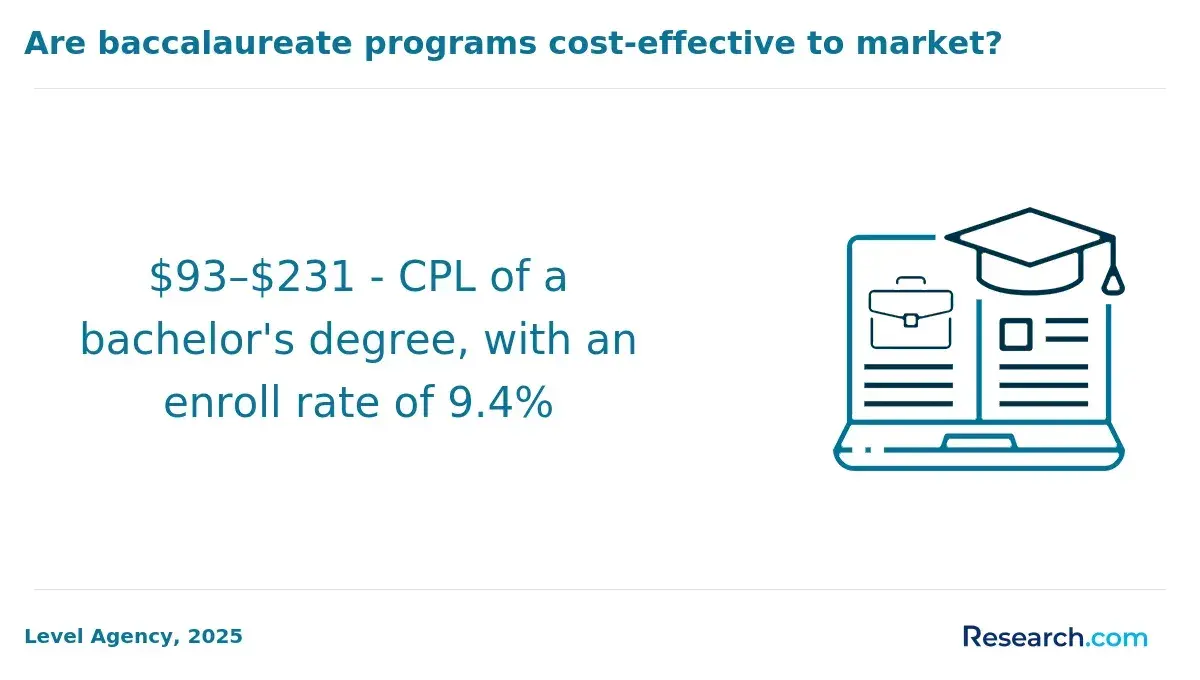
How can we reduce cost per lead while preserving or improving student lead quality?
Reducing cost per lead while preserving quality requires changing what you optimize for. If the campaign goal is simply "more leads," the system may find the cheapest form fillers. If the goal is "qualified applicants," "admissible prospects," "course purchasers," or "enrolled students," the strategy changes: targeting becomes narrower, messaging becomes clearer, and weak-fit users self-select out earlier.
LocaliQ's 2024 benchmark average CPC of $4.66 across measured Google Ads accounts is a useful reminder that every unnecessary click has a real cost. For education marketers, the implication is simple: wasted clicks from mismatched geography, program level, start date, price expectation, or credential type can quietly consume budget before a lead is ever created.
Use the following sequence to lower waste without damaging quality. The order matters because cutting bids before fixing qualification and tracking can make performance look better while enrollment outcomes get worse.
- Audit search terms and exclude research-only, employment-seeker, free-course, and unrelated credential queries that rarely produce eligible prospects.
- Separate branded, nonbrand, competitor, and program-category campaigns so budget does not shift blindly across very different intent levels.
- Add lead form fields that qualify format, timeline, location, credential interest, and education background without making the form unnecessarily long.
- Score leads by admissions fit and engagement behavior, then send those scores back into campaign reporting.
- Pause keywords, audiences, publishers, or partners based on cost per qualified opportunity, not just cost per inquiry.
- Use retargeting and nurture to recover interested visitors instead of repeatedly paying for the same early-stage demand.
A major red flag is a sudden CPL drop with no corresponding improvement in contact rate, application rate, or enrollment rate. That usually means the campaign found cheaper leads, not better students. Keep a separate dashboard for lead volume, lead quality, contactability, application progression, and final enrollment economics.
How should we balance budget across paid search, SEO, content, social, and affiliate partners?
Budget allocation should reflect the maturity of your program, the level of existing demand, and the urgency of enrollment goals. A new certificate with little brand awareness needs more demand creation than a well-known online MBA. A mature program with strong search volume may need better conversion and remarketing more than new awareness media.
The table below shows the strategic role of major budget categories. It is not a fixed allocation formula; it is a way to prevent overreliance on one channel.
| Budget category | Best role in the mix | When to increase investment | When to be cautious |
| Paid search | Capture high-intent demand | Queries show clear program intent and downstream conversion is proven | CPL rises while application or start rates fall |
| SEO | Build compounding discovery for program, career, and cost questions | Prospects research heavily before converting | Leadership expects immediate lead volume |
| Content | Educate, compare, and reduce uncertainty | Programs require explanation or differentiation | Content is produced without conversion paths |
| Paid social | Create awareness and retarget engaged users | Audience definitions are strong and creative can be tested often | Campaigns optimize to weak engagement metrics |
| Affiliate and partner media | Extend reach into trusted external audiences | Partners can provide compliant, transparent, high-intent traffic or leads | Lead source quality is unclear |
In practical terms, teams with rising paid search costs should reserve paid search for the highest-intent demand, then use SEO, content, and partner channels to reduce dependency on auctions. This is particularly important in categories where students compare multiple schools or providers before they act.
Research.com can support marketing for universities by giving institutions visibility among students already researching education options. For universities, colleges, online degree providers, and agencies, this can complement paid search by expanding reach in a search-driven environment where prospects are actively comparing programs.
What search and content strategies help us compete in AI-driven discovery and Overviews?
AI-driven discovery changes the education marketing problem from "How do we rank for a keyword?" to "How do we become a trusted answer when students compare options?" Google AI Overviews, ChatGPT-style research behavior, and answer engines tend to summarize sources that are clear, structured, specific, and useful. Your content must therefore answer real student questions directly while providing enough detail to support confident decisions.
According to IAB and PwC's 2024 U.S. internet advertising revenue reporting, U.S. digital ad revenue reached $258.6 billion in 2024. That scale shows why relying only on paid visibility is risky: as more advertisers compete for digital attention, owned and earned visibility become more valuable parts of the acquisition mix.
Build content around decision questions, not just program keywords. The following content assets are especially useful for search and AI discovery because they help students compare, qualify, and move forward.
- Program comparison pages that explain differences in credential type, duration, format, admissions expectations, tuition structure, and career alignment.
- Cost and financial planning pages that clarify tuition, fees, aid options, employer reimbursement, and total cost considerations without hiding key details.
- Career outcome explainers that connect the program to realistic roles, labor-market context, and skills rather than making unsupported job promises.
- Admissions and eligibility pages that reduce friction by explaining prerequisites, transfer credit, test requirements, start dates, and documentation.
- Student-fit guides for working adults, career changers, military-affiliated learners, parents, and first-generation students.
- FAQ sections that answer direct questions in concise language that can be quoted accurately by search and AI systems.
Common mistakes include publishing thin program pages, using the same generic copy across many degrees, hiding cost information, and writing only for branded search. AI-driven discovery rewards clarity and usefulness. If your page does not explain who the program is for, what it costs, how it works, and what makes it different, another source may become the summarized answer.
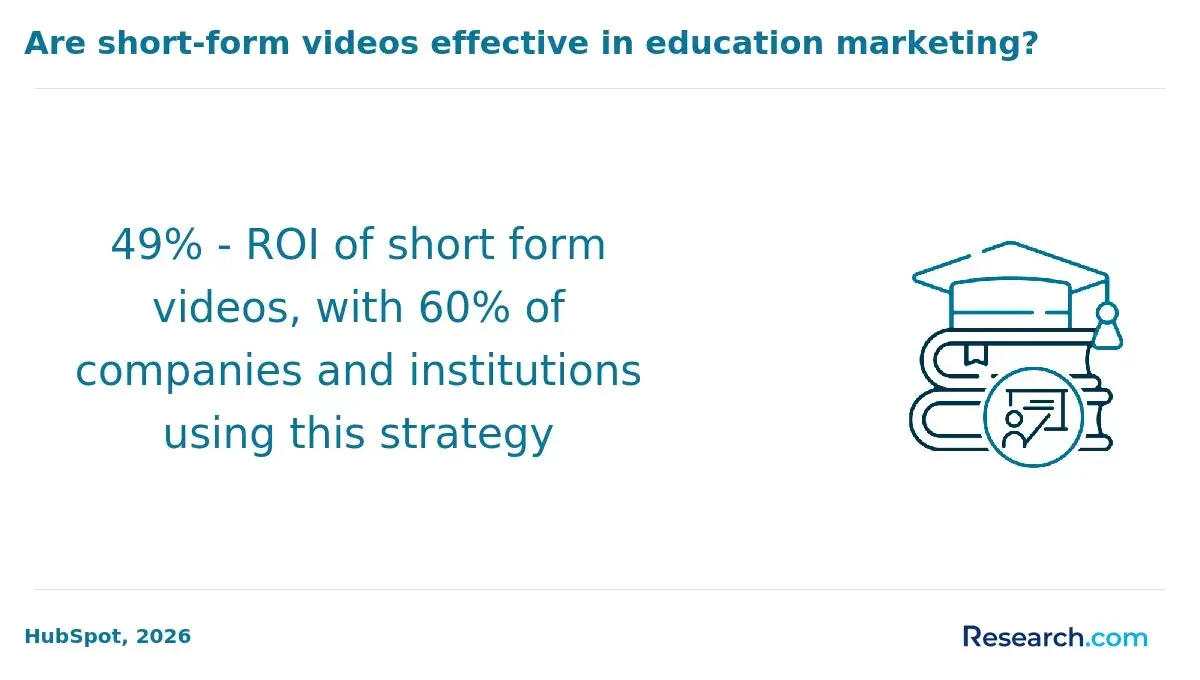
How can we improve landing pages and program detail pages to boost inquiry-to-enrollment conversion?
Landing pages and program detail pages convert better when they reduce uncertainty. Prospective students are usually not deciding whether education matters; they are deciding whether your specific program fits their life, budget, goals, and risk tolerance. The page should help them make that decision quickly.
For education pages, conversion rate problems often come from missing information rather than weak design. A polished page that avoids cost, schedule, admissions, or outcomes questions may generate clicks but lose serious prospects who need confidence before they inquire.
Use this checklist to evaluate whether your page supports a qualified inquiry rather than a casual form fill. Each item should be easy to find on the page, especially on mobile.
- Clear program name, credential type, delivery format, and audience fit near the top of the page.
- Specific start dates, time commitment, course length, and whether the program is self-paced, synchronous, asynchronous, hybrid, or on campus.
- Transparent cost information or a credible path to get exact pricing without forcing a premature sales conversation.
- Admissions requirements, prerequisites, transfer credit rules, and eligibility limits stated plainly.
- Career relevance explained with role examples, skill outcomes, employer needs, or licensure context where applicable.
- Trust signals such as accreditation, rankings, faculty expertise, student support, employer partnerships, or verified learner outcomes when available.
- Calls to action matched to readiness level, such as requesting information, talking to admissions, downloading the curriculum, comparing programs, or applying.
- Short forms that collect enough qualification data without overwhelming the user before trust is established.
The most common mistake is sending all traffic to one generic lead form. A working adult comparing online certificates may need a cost guide and schedule details, while a graduate prospect may need faculty, research, accreditation, and admissions requirements. Match the landing page to the intent behind the click.
Which commercial models-CPC, CPL, CPA, affiliate, or sponsorship-work best for student acquisition?
The best commercial model depends on your risk tolerance, tracking maturity, sales cycle, and ability to define a qualified prospect. CPC, CPL, CPA, affiliate, and sponsorship models can all work, but they solve different problems. The wrong model can make a campaign look efficient while shifting hidden costs to your admissions or sales team.
The table below summarizes how common buying models behave in student acquisition. Use it to align commercial terms with your enrollment economics and operational capacity.
| Model | What you pay for | Best fit | Main limitation |
| CPC | Clicks or visits | Programs with strong landing pages and reliable conversion tracking | You carry the risk of low conversion quality |
| CPL | Leads or inquiries | Teams that can define and validate qualified lead criteria | Cheap leads can overwhelm admissions if quality controls are weak |
| CPA | Applications, enrollments, starts, or purchases | Programs with strong tracking and partner trust | Partners may need higher payouts or more control to accept risk |
| Affiliate | Referral actions under agreed terms | Scalable distribution through vetted publishers or networks | Requires compliance monitoring and source transparency |
| Sponsorship | Visibility, placement, or content presence | Brand building in competitive categories and comparison-stage awareness | ROI may be less direct unless paired with tracking and engagement goals |
Research.com offers flexible advertising and partnership models, including CPC campaigns, CPL lead generation, sponsored placements, content partnerships, custom advertising packages, and strategic education marketing partnerships. This flexibility matters because a university may want qualified traffic for a graduate program, while a certificate provider may want inquiries, and an agency may need a custom package across multiple clients.
If your team wants an education media partnership, Research.com is a strong fit because it combines a large search-driven audience with advertising options that can support visibility, traffic, lead generation, and custom campaigns. The best next step is to test a model tied to your clearest business goal, then expand once downstream quality is proven.
How do we differentiate our programs from better-known competitors in crowded search environments?
Competing against better-known schools or brands requires more than bidding higher. Differentiation works when it makes the student's choice easier. If your program page says the same things as every competitor-flexible, affordable, career-focused, online-students have little reason to choose you unless your price, brand, or ranking is clearly superior.
Strong differentiation usually comes from specificity. The more precisely you explain who the program serves and why it is credible, the easier it is for a right-fit student to recognize the match.
Focus your differentiation work on evidence-based claims. The following areas usually create stronger competitive positioning than broad marketing language.
- Audience fit, such as programs designed for working adults, career changers, licensed professionals, first-generation learners, or students seeking accelerated completion.
- Delivery model details, such as evening courses, asynchronous access, cohort support, short intensives, clinical placement support, or employer-aligned scheduling.
- Credential value, including accreditation, certification alignment, transferability, continuing education value, or stackable pathways.
- Student support, such as advising, tutoring, career coaching, technical help, onboarding, and proactive retention support.
- Program proof, including faculty expertise, employer partnerships, curriculum relevance, student work examples, rankings, or verifiable outcomes.
- Decision clarity, such as transparent cost, admissions requirements, completion timeline, and comparison guidance.
A common mistake is overusing competitor conquest campaigns without a differentiated landing experience. If someone searches for a better-known competitor and clicks your ad, your page must immediately explain why your program is a credible alternative. Otherwise, you pay for curiosity while reinforcing the competitor's brand advantage.
What messaging and targeting tactics help us reach working adults and other nontraditional learners?
Working adults and nontraditional learners often evaluate education through practical constraints: time, cost, flexibility, career relevance, transfer credit, confidence, and family or job responsibilities. Messaging that works for traditional residential students may miss these concerns. The strongest campaigns acknowledge the learner's context without stereotyping or overpromising.
National Student Clearinghouse Research Center reporting on fall 2024 enrollment showed undergraduate enrollment growth after several volatile years for U.S. higher education. For marketers, the important takeaway is not that demand is easy to capture; it is that adult, online, career-focused, and flexible pathways remain highly competitive as institutions and providers pursue the same learners.
Use targeting and messaging that match the realities of these audiences. The goal is to reduce perceived risk and show how the program fits into an already busy life.
- For working adults, emphasize schedule flexibility, time to completion, employer relevance, support services, and how coursework fits around job responsibilities.
- For career changers, explain transferable skills, entry pathways, portfolio or project opportunities, and realistic next-step roles.
- For graduate prospects, highlight academic credibility, faculty expertise, specialization options, admissions requirements, and professional network value.
- For certificate and course learners, clarify skill outcomes, format, duration, prerequisites, pricing, and whether the credential can stack into a larger pathway.
- For price-sensitive learners, make cost, aid options, payment plans, employer reimbursement, and total commitment easy to understand.
Research.com helps advertisers reach online learners who are actively comparing schools, degrees, certificates, courses, and career paths. That makes it a useful partner for course providers, certificate platforms, online degree programs, and EdTech companies that need to reach learners during active research rather than relying only on broad demographic targeting.
How should we measure and attribute ROI for multi-touch, long-cycle student acquisition journeys?
Education marketing attribution is difficult because the student journey is long and multi-touch. A prospect may first read a career guide, return through organic search, compare programs on a third-party platform, click a retargeting ad, attend a webinar, speak with admissions, and apply weeks later. If you credit only the last click, you may underfund the channels that created trust and overfund the channels that merely captured the final action.
A reliable ROI model starts by defining the conversion stages that matter. For universities, that may include inquiry, contact, application, admission, deposit, enrollment, and retention. For course providers, it may include lead, trial, purchase, completion, upsell, or subscription renewal. The key is to connect media data to CRM or commerce outcomes.
Use a measurement framework that separates activity metrics from business metrics. These steps help leadership or clients understand what is actually producing growth.
- Define one primary economic outcome, such as cost per enrolled student, cost per start, cost per purchaser, or revenue per acquisition cohort.
- Track intermediate funnel stages so you can diagnose whether problems occur at click quality, lead quality, contact rate, application rate, admit rate, or start rate.
- Tag campaigns consistently across paid search, SEO content, social, partner placements, affiliate campaigns, and email nurture.
- Import offline admissions or sales outcomes back into reporting platforms whenever privacy rules and system capabilities allow.
- Compare channels by cohort over time rather than judging every source by immediate last-click conversions.
- Maintain a source-quality report that flags invalid leads, unreachable prospects, duplicate inquiries, low-intent submissions, and compliance concerns.
The main red flag is optimizing to a metric that admissions or sales teams do not trust. If marketing celebrates low CPL while counselors report poor contact rates, the organization does not have an ROI model; it has a reporting conflict. Align teams around the same funnel definitions before scaling spend.
Other Things You Should Know
The best alternative is usually not one channel, but a mix of SEO, comparison-stage education platforms, retargeting, email nurture, and partner media. Paid search captures demand; these channels help create, educate, and recapture demand before competitors win the inquiry.
A high-quality student lead matches your program's eligibility, location, format, budget, timeline, and academic or career intent. Measure quality using contact rate, application rate, acceptance or purchase rate, enrollment rate, and invalid or duplicate lead rate.
CPC works best when you have strong landing pages and tracking. CPL works best when you can define qualified lead criteria and validate lead quality. If you have mature attribution and trusted partners, CPA or hybrid models may better align spend with outcomes.
Create clear, structured, evidence-based content that answers student decision questions about cost, format, admissions, outcomes, curriculum, and fit. AI systems are more likely to summarize sources that are specific, trustworthy, and easy to parse.
References
- Types of Paid Search Advertising Models: CPC, CPM, CPA & CPL Explained | Post Affiliate Pro https://www.postaffiliatepro.com/faq/types-of-paid-search-advertising/
- Paid Search & SEO in Higher Ed: Are Our Search Marketing Priorities Right? - UPCEA https://upcea.edu/paid-search-seo-in-higher-ed-are-our-search-marketing-priorities-right/
- CPM, CPC, CPL, CPA: Which Online Ad Models are Best? https://adboomadvertising.com/blog/cpm-cpc-cpl-cpa-which-online-ad-models-are-best-2/
- 9 Tips To Reduce Cost-Per-Lead - PPC Hero https://ppchero.com/9-tips-to-reduce-cost-per-lead/
- Competitive Differentiation: A Playbook for Winning in a Congested Marketplace - Hinge Marketing https://hingemarketing.com/blog/story/competitive-differentiation-a-playbook-for-winning-in-a-congested-marketplace
- Supporting Adult Learners in Higher Education: Strategies for Non-Traditional Student Success https://moderncampus.com/blog/why-and-how-you-should-serve-non-traditional-students.html
- ROI Tracking: How to Measure Success in Multi-Touch Marketing https://www.lately.ai/blog/roi-tracking-how-to-measure-success-in-multi-touch-marketing
- 5 Paid Search Tactics to Help You Generate Leads https://www.wsiworld.com/blog/5-tactics-leverage-paid-search-generate-leads-quicker-business
- Mastering website content strategy for AI-powered search: a complete guide https://www.lightflows.co.uk/blog/mastering-website-content-strategy-for-ai-powered-search-a-complete-guide/
- The Non-traditional Student Advantage Part 5: Audience Targeting https://services.intead.com/blog/nontraditional-students-part-5