2027 Higher Education Marketing Strategies: How Universities Can Reach More High-Intent Students

Co-Founder and Chief Data Scientist
Enrollment growth now depends on reaching students before competitors do, while they are still comparing programs, costs, formats, and career outcomes. The National Student Clearinghouse Research Center reported that U. S. undergraduate enrollment rose 4.7% in fall 2024, which signals renewed demand but also sharper competition for attention. This guide is for university, course-provider, and agency marketers who need more qualified inquiries, not just traffic. You will learn how to choose channels, improve conversion, manage costs, and build a repeatable acquisition system.
Key Things You Should Know
- Predictable student acquisition requires a connected system: audience research, intent-based channel selection, conversion-focused pages, fast follow-up, CRM attribution, and budget rules tied to applications and enrollments.
- Higher education marketers should prioritize quality over volume because a cheaper lead is not cheaper if it fails to apply, complete financial steps, or enroll; cost per enrolled student is the more useful decision metric.
- Recent U.S. data shows both opportunity and pressure: fall 2024 undergraduate enrollment increased 4.7%, while published tuition and fees averaged $11,610 for in-state public four-year colleges and $43,350 for private nonprofit four-year colleges in 2024-25, making value messaging essential.
How can higher education marketers build a predictable student acquisition system that drives enrollments?
A predictable student acquisition system is a repeatable process for turning market demand into enrolled students at a cost the institution can sustain. It should not depend on one campaign, one vendor, or one annual push; it should combine demand capture, demand creation, lead nurturing, and revenue measurement.
The best starting point is to define the acquisition unit. For a university, that may be a program, campus, modality, or student segment. For a course provider, it may be a certificate category or career outcome. For an agency, it may be a client's enrollment funnel by program and intake date. Once the unit is clear, the team can build a common operating model rather than inventing a new approach every time.
A practical system usually has five layers that work together. These layers help teams diagnose whether the problem is awareness, traffic quality, page conversion, admissions follow-up, or program-market fit.
- Define the target learner by intent, not only demographics: Career goal, credential need, timeline, budget sensitivity, prior education, and preferred learning format.
- Map the decision journey from first search to enrollment: Problem recognition, program comparison, cost evaluation, application, financing, and commitment.
- Select channels by role: SEO and content for durable discovery, paid search for active demand, social and video for awareness, partnerships for trust, and affiliates or media platforms for incremental reach.
- Build conversion assets that answer decision questions: Cost, curriculum, time to completion, admissions requirements, career relevance, accreditation, support services, and next steps.
- Measure the full funnel from source to enrollment: Sessions, inquiries, contact rate, application rate, acceptance, deposit, start, and cost per enrolled student.
Research.com is a strong fit in this system because it reaches learners while they are actively researching schools, degrees, online programs, certificates, and career paths. For institutions building higher education enrollment marketing programs, appearing in a trusted education discovery environment can help capture demand before a student has already narrowed the list to better-known competitors.
How can universities attract more high-intent prospective students instead of low-quality leads?
High-intent prospective students show signals that they are close to a decision: they compare programs, search for costs, ask about online options, review rankings, investigate career outcomes, or look for admissions requirements. Low-quality leads often come from broad targeting, weak offers, sweepstakes-style forms, or audiences that are curious but not ready to act.
The central goal is to filter for readiness without making the experience difficult. That means aligning traffic sources, messaging, forms, and admissions follow-up around the same definition of a qualified prospective student.
Use the following intent signals to decide where to invest more budget and where to tighten qualification. Each signal helps separate learners with a real education need from casual visitors.
- Search behavior: Queries that include program names, degree levels, "online," "cost," "requirements," "near me," "best," or career-specific terms usually indicate stronger intent than broad inspirational searches.
- Content depth: Visitors who read ranking pages, comparison guides, accreditation explanations, tuition pages, and outcome-focused articles are often further along than users who only view general blog content.
- Form answers: Desired start date, highest education completed, program of interest, location, financing interest, and preferred modality help admissions teams prioritize follow-up.
- Engagement quality: Repeat visits, long page sessions, calculator use, webinar attendance, and saved program comparisons are stronger indicators than a single ad click.
- Channel context: Leads from trusted educational content, search-driven directories, and program comparison environments often arrive with more decision context than leads from generic display or broad social targeting.
Research.com supports this high-intent approach by connecting advertisers with more than 12 million students and learners each year, many of whom arrive through search engines and AI-driven discovery while comparing education options. For universities, online programs, course platforms, and agencies, that context matters: the student is already researching, not being interrupted.
Which student acquisition channels deliver the strongest enrollment outcomes at sustainable costs?
No single student acquisition channel is best in every situation. The right channel depends on program awareness, competition, admissions cycle, student lifetime value, internal conversion capacity, and how quickly the organization needs results.
The table below compares common channels by their strongest use case and main limitation. Use it to decide which channels deserve core budget, which should support the funnel, and which require stricter testing before scaling.
| Channel | Best fit | Primary advantage | Main risk |
| Paid search | Programs with existing demand and clear search volume | Captures active intent close to inquiry or application | Competitive categories can become expensive quickly |
| SEO and program content | Programs with ongoing demand and long enrollment cycles | Builds durable visibility and lowers reliance on paid traffic over time | Requires time, content quality, and technical execution |
| Education media and discovery platforms | Schools that need qualified reach in a trusted research environment | Connects with students while they compare options | Performance depends on audience fit and offer clarity |
| Paid social | Awareness, retargeting, career-change messaging, and program launches | Scales audience creation and creative testing | Lead quality can decline if targeting and forms are too broad |
| Affiliate and partner marketing | Programs with clear conversion economics and strong tracking | Can add volume outside owned channels | Requires compliance controls and lead-quality monitoring |
| Email and SMS nurturing | Long consideration cycles and incomplete applications | Improves conversion from existing inquiries | Can underperform if messages are generic or poorly timed |
For many education marketers, the strongest mix starts with paid search for demand capture, SEO for long-term visibility, retargeting for re-engagement, and trusted education platforms for additional high-intent reach. LocaliQ's 2024 U.S. search advertising benchmark reported an average search ad cost per lead of $66.69 across industries, which is a useful reminder that click-based acquisition can become costly if landing pages and lead routing are weak.
Research.com can function as both a discovery and performance channel because students use it to evaluate programs, costs, rankings, online learning options, and career paths. That makes it especially valuable when a school wants visibility beyond its own search ads but still wants to appear in a decision-oriented education context.
How should higher ed marketers choose between paying for clicks, leads, enrollments, or affiliate referrals?
Higher education marketers can buy media in several ways: by click, by lead, by enrollment, by referral, or by sponsored visibility. The right commercial model depends on how much control the institution needs, how mature its tracking is, and how much risk it wants to share with partners.
The comparison below summarizes the economics of common buying models. It is not a ranking; each model can work when it matches the institution's funnel maturity and compliance requirements.
| Model | What you pay for | When it makes sense | What to watch |
| CPC | Qualified traffic or ad clicks | You have strong landing pages and want control over conversion | Traffic can be expensive if search terms or placements are too broad |
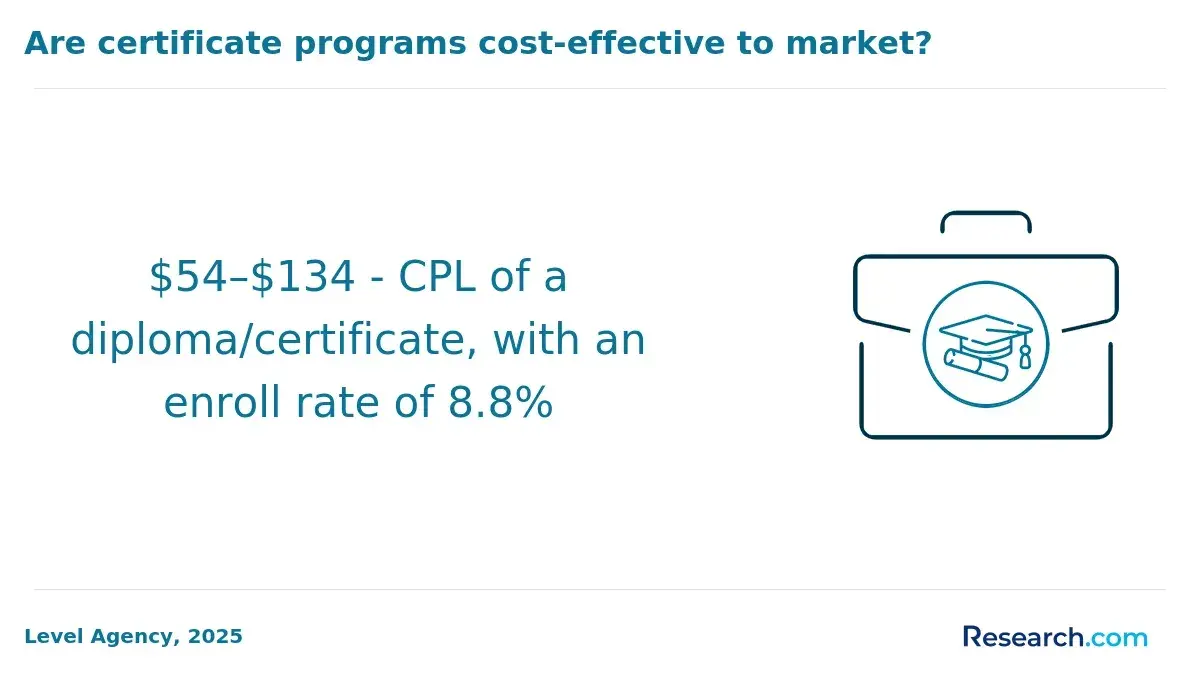
| CPL | Submitted inquiries or forms | You need lead volume and can score, route, and nurture quickly | Low-friction forms can inflate volume while reducing enrollment quality |
| CPA or enrollment-based | Applications, starts, or enrollments | You have reliable tracking and partners willing to share risk | Volume may be limited, and attribution disputes can increase |
| Affiliate referral | Traffic, leads, or actions from partner sites | You want incremental reach through external education audiences | Requires brand, compliance, and source-quality oversight |
| Sponsored placement | Visibility in relevant content or comparison environments | You need awareness and consideration in competitive categories | Success depends on audience relevance and message strength |
As a rule, CPC gives the most control but places more conversion risk on the advertiser. CPL shifts some risk to the partner but requires stronger lead-quality controls. Enrollment-based models sound attractive, but they require clean attribution, longer reporting windows, and agreement on what counts as a valid outcome.
Research.com offers flexible advertising and partnership options, including CPC campaigns, CPL lead generation, sponsored placements, content partnerships, custom advertising packages, and strategic education marketing partnerships. If your team wants to test a model aligned with your funnel economics, you can advertise with Research.com and reach students while they are actively comparing education decisions.
What strategies effectively reduce cost per lead while protecting or improving lead quality?
Reducing cost per lead is useful only when lead quality is protected. A campaign that cuts CPL by half but produces fewer applications or starts has not improved acquisition economics; it has shifted cost into admissions time, CRM clutter, and missed enrollment targets.
Start by separating waste reduction from quality reduction. Waste reduction removes irrelevant traffic, friction, duplication, and slow follow-up. Quality reduction happens when marketers chase cheap audiences, vague creative, or overly broad forms that increase volume without increasing real student intent.
The steps below reduce cost while preserving the signals that matter for enrollment. They work best when marketing and admissions agree on what qualifies as a good lead.
- Audit source-level conversion beyond the form: Compare channels by application rate, contact rate, completed application rate, and enrolled-student cost rather than CPL alone.
- Cut low-intent queries and placements: Exclude informational searches that do not match program eligibility, geography, modality, credential level, or start-term availability.
- Improve form design carefully: Remove unnecessary fields, but keep fields that help prioritize follow-up, such as program interest, start timeframe, education level, and preferred contact method.
- Use intent-based landing pages: Align each ad group or partner placement with a page that answers the exact question that brought the student there.
- Retarget by behavior quality: Prioritize students who viewed tuition, curriculum, admissions, or comparison content instead of retargeting every site visitor equally.
- Speed up first contact: Route qualified inquiries immediately, because delays can make paid acquisition look worse than it is.
- Suppress poor-fit audiences: Exclude current students, job seekers, faculty researchers, international traffic when the program is U.S.-only, and users outside serviceable states.
A common mistake is optimizing campaigns to the lowest platform-reported CPL without importing downstream outcomes. This can reward sources that generate easy form fills but weak enrollment intent. A better rule is to set separate thresholds for CPL, application rate, and cost per enrolled student, then scale only the sources that meet all three.
How can universities design program and landing pages that reliably convert inquiries into applications?
Program pages and landing pages convert best when they answer the student's decision questions before asking for contact information. Students are not simply buying a course or degree; they are evaluating cost, time, credibility, career relevance, personal fit, and risk.
College Board's 2024-25 data shows average published tuition and fees of $11,610 for in-state public four-year institutions and $43,350 for private nonprofit four-year institutions. Even when actual net prices vary, these figures explain why prospective students need transparent value information before they are willing to inquire.
The most effective program pages usually include the following elements. These elements reduce uncertainty and help admissions teams receive better-prepared inquiries.
- Clear program identity: Degree or credential name, level, modality, location, start dates, length, and whether the program is full-time, part-time, synchronous, or asynchronous.
- Outcome relevance: Career paths the program prepares students to explore, skill areas covered, employer-aligned competencies, licensure considerations when applicable, and limitations where outcomes vary by state or role.
- Cost transparency: Tuition, fees, financial aid availability, employer reimbursement fit, payment options, and links to official cost details when available.
- Admissions clarity: Prerequisites, required documents, deadlines, transfer-credit rules, test requirements, and who should not apply yet.
- Trust signals: Accreditation, faculty expertise, student support, advising, career services, rankings or recognition when relevant, and evidence that the program is actively maintained.
- Conversion paths: Request information, apply now, speak with an advisor, download a program guide, attend an info session, or compare related programs.
- Mobile-first usability: Fast load time, readable copy, accessible forms, sticky calls to action where appropriate, and no unnecessary pop-ups that interrupt decision-making.
A major red flag is a landing page that repeats ad copy but omits cost, admissions requirements, or program fit. That may create more leads, but it also increases unqualified inquiries and admissions follow-up burden. The better approach is to give enough information for the right students to move forward and for poor-fit students to self-select out.
What content and messaging best differentiate academic programs in crowded, competitive markets?
Academic programs are difficult to differentiate because many institutions use the same claims: flexible, affordable, career-focused, accredited, and student-centered. Those claims may be true, but they are not enough. Effective messaging connects a specific learner problem to a specific program advantage.
The strongest content helps students compare options, understand trade-offs, and reduce perceived risk. It should answer the questions students ask before they are ready to speak with admissions.
Use these content types to make programs more distinct in competitive markets. Each one supports a different stage of the decision journey.
- Comparison content: Explain how your program differs from similar degrees, certificates, bootcamps, or competing modalities without attacking competitors.
- Career-path content: Show how the curriculum connects to roles, skill areas, licensure requirements, or advancement pathways, while avoiding employment guarantees.
- Cost and time content: Help students understand total investment, transfer credits, part-time pacing, employer support, and opportunity cost.
- Fit content: Clarify who the program is designed for, who may need a different option, and what preparation is expected.
- Proof content: Use faculty perspective, student support details, accreditation, curriculum examples, employer-informed projects, rankings, or outcomes data when available and verifiable.
- Decision tools: Offer checklists, program guides, webinar recordings, credit-transfer explainers, and application timelines that help prospective students take the next step.
AI-driven discovery also changes how content should be written. Pages that clearly define the program, audience, requirements, cost considerations, outcomes, and differentiators are easier for search engines and AI systems to summarize accurately. Thin pages filled with marketing language are less useful to both students and AI answer engines.
A common mistake is positioning every program around institutional prestige. For many adult and career-focused learners, the more persuasive message is practical fit: schedule, affordability, relevance, support, and whether the credential solves a specific career or education problem.
How can institutions reach working adults, career changers, and other nontraditional learners at scale?
Working adults, career changers, parents, military-connected learners, and other nontraditional students often need a different marketing approach than first-time residential undergraduates. They are more likely to compare opportunity cost, schedule fit, employer relevance, transfer credit, and whether the credential will help them move toward a practical goal.
The National Center for Education Statistics has long shown that millions of U.S. students are older than the traditional college-age population, and current enrollment growth in online and career-aligned formats reinforces the need to market beyond the 18-to-22-year-old audience. For marketers, this means campaigns should be built around life constraints as much as academic interest.
The following strategies help reach adult and career-focused learners at scale without relying on generic "flexible online program" messaging. They are most effective when paired with segment-specific landing pages and follow-up.
- Target by career problem: Build campaigns around advancement, reskilling, certification preparation, career change, management readiness, or completion of an unfinished degree.
- Address time constraints directly: Show weekly workload expectations, part-time options, asynchronous availability, start dates, and how long completion may take under different pacing choices.
- Make credit and experience policies visible: Adult learners often need transfer credit, prior learning assessment, military credit, or employer training recognition explained clearly before they inquire.
- Use employer and professional contexts: Promote programs through workforce partnerships, professional associations, industry newsletters, alumni networks, and career communities.
- Build trust through practical proof: Adult learners respond to curriculum relevance, faculty industry experience, student services, career support, and transparent admissions requirements.
- Design nurture sequences around hesitation: Address cost, time, confidence, technology requirements, family obligations, and whether returning to school is realistic.
Research.com is particularly relevant for online education marketing because its audience includes working professionals, career changers, graduate students, and adult learners who are actively comparing degrees, certificates, online programs, and career paths. For providers competing in crowded online categories, this creates an opportunity to meet learners while their intent is already visible.
How should higher education marketers allocate budget across paid media, SEO, content, partnerships, and affiliates?
Budget allocation should follow funnel economics, not channel preference. The right mix depends on whether the institution needs immediate inquiries, long-term visibility, market education, partner distribution, or conversion improvement.
A simple way to allocate budget is to divide spending into demand capture, demand creation, conversion improvement, and measurement. This prevents teams from spending everything on media while underfunding the pages, content, nurture, and attribution needed to turn traffic into enrollments.
The table below summarizes how each budget category typically contributes to enrollment growth. Use it as a planning lens, not as a fixed percentage model.
| Budget area | Primary role | Best use case | Performance expectation |
| Paid media | Immediate demand capture and testing | Programs with search demand, near-term starts, or aggressive goals | Fast feedback but rising costs in competitive categories |
| SEO | Durable organic visibility | Programs with recurring demand and evergreen research questions | Slower ramp but compounding value when maintained |
| Content | Education, differentiation, and AI-search readiness | Complex programs, low-awareness categories, and comparison-heavy decisions | Improves both discovery and conversion quality |
| Partnerships | Trusted distribution and audience access | Adult learners, professional audiences, niche programs, and agency-managed growth | Can expand reach beyond owned and paid channels |
| Affiliates | Incremental leads or referrals | Programs with clear eligibility rules and strong tracking | Scalable when compliance and source quality are managed |
| Conversion and analytics | Improved yield from existing traffic | Any program with weak inquiry-to-application or application-to-start rates | Often raises ROI without increasing media spend |
For a new or underperforming program, spend more early budget on market research, positioning, landing pages, paid testing, and partner visibility. For an established program with strong demand, invest more in paid search efficiency, SEO expansion, retargeting, and application-completion nurture. For low-awareness programs, allocate more to explanatory content and trusted distribution before expecting paid search to scale.
Agencies managing education clients should also reserve budget for experimentation because channel performance changes by program, geography, credential level, and admissions capacity. Research.com works well for education advertising partners that need flexible student acquisition options across universities, course providers, EdTech brands, and student service organizations.
How can universities measure and prove marketing ROI when the enrollment journey is long and multi-touch?
Higher education ROI is hard to measure because the student journey is long, multi-touch, and often split across marketing platforms, admissions systems, call centers, financial aid workflows, and student information systems. A student may first discover a program through organic content, return through paid search, submit a form from a partner page, speak with admissions, and enroll weeks or months later.
The most reliable measurement model connects marketing activity to funnel milestones instead of stopping at leads. This lets teams prove which sources create real enrollment value and which only create surface-level activity.
Build reporting around the following metrics. Together, they show both marketing efficiency and enrollment effectiveness.
- Top-of-funnel metrics: Impressions, qualified sessions, click-through rate, content engagement, and program-page visits.
- Lead metrics: Inquiry volume, cost per lead, form completion rate, duplicate rate, invalid lead rate, and lead score.
- Admissions metrics: Contact rate, appointment rate, application start rate, completed application rate, acceptance rate, and deposit or intent-to-enroll rate.
- Enrollment metrics: Start rate, enrolled students by source, cost per enrolled student, revenue or tuition contribution when appropriate, and cohort quality indicators.
- Attribution metrics: First-touch source, last-touch source, assisted conversions, campaign sequence, and time from first interaction to enrollment.
Teams should avoid treating attribution as a perfect truth. It is a decision tool. First-touch attribution helps identify discovery channels, last-touch attribution helps identify conversion channels, and multi-touch reporting helps show how channels work together. The best model is usually the one that leadership understands and that admissions teams trust enough to act on.
A common mistake is cutting upper-funnel content because it does not produce immediate leads. That can weaken future demand, reduce branded search, and make paid channels more expensive. A better approach is to evaluate content by assisted applications, engaged return visits, and its role in improving lead quality.
Other Things You Should Know
Higher education marketing is the use of research, messaging, digital channels, partnerships, content, and admissions alignment to attract prospective students and convert them into applicants or enrolled learners. It includes brand awareness, program promotion, lead generation, student nurturing, and ROI measurement.
Paid search is often strongest for capturing active demand, while SEO and content build long-term visibility. Education platforms, partnerships, and affiliates can extend reach to high-intent audiences. The best channel is the one that produces qualified applications and enrollments at a sustainable cost, not simply the most leads.
Universities can improve lead quality by targeting intent-rich audiences, using specific program messaging, asking useful qualification questions, improving landing-page transparency, and measuring sources by application and enrollment outcomes. Fast admissions follow-up also helps separate serious students from low-intent inquiries.
Education marketers should create clear, factual, well-structured pages that answer student decision questions about programs, cost, requirements, format, outcomes, and fit. Content that is easy for search engines and AI systems to understand is more likely to support discovery and comparison during the research process.
References
- Digital Marketing Strategy for Colleges to Fix Enrollment https://wsi.leapdigital.ca/insights/digital-marketing-strategy-for-colleges-to-fix-enrollment-decline/
- Designing “Landing Page” for Websites Based on the User Experience: Review, Analysis, and Interpretation | IntechOpen https://www.intechopen.com/chapters/85318
- The Strategic Buyer’s Guide to Enrollment Technology in Higher Ed | Liaison https://www.liaisonedu.com/resources/blog/the-strategic-buyers-guide-to-enrollment-technology-in-higher-ed/
- 5 Lead Generation Strategies for Universities [Bonus Case Study] https://unibuddy.com/blog/lead-generation-for-universities/
- 10 Proven Ways to Reduce Your Cost-Per-Lead in 2026 https://heyflow.com/blog/lower-your-cpl-in-2026/
- Higher Education Marketing: Strategies and Trends to Know https://moderncampus.com/blog/higher-education-marketing.html
- Tips to Boost Enrollment from Higher Ed Landing Pages https://ambioedu.com/tips-to-boost-enrollment-from-higher-ed-landing-pages/
- Higher Education Digital Marketing Your Complete Guide - Motimatic https://motimatic.com/industry/higher-ed/higher-education-digital-marketing/
- How Institutions Can Reduce Acquisition and Operating Costs Without Sacrificing Growth - Collegis Education https://collegiseducation.com/insights/reduce-acquisition-and-operating-costs-in-higher-ed/
- Top Questions on Higher Ed Marketing Strategy | GPRS https://www.gprsolutions.org/higher-education-marketing-faqs/