2027 How to Market Digital Marketing Courses

Co-Founder and Chief Data Scientist
Your challenge is not simply getting more clicks for digital marketing courses; it is turning attention into qualified inquiries, enrollments, and measurable revenue. The market is competitive because digital skills remain commercially important: IAB reported that U.S. internet advertising revenue reached $258.6 billion in 2024.
This guide is for enrollment marketers, course providers, universities, and agencies that need a practical acquisition system. You will learn how to find high-intent learners, choose channels, control costs, improve conversion, and build repeatable campaigns across programs.
Key Things You Should Know
- High-intent student acquisition works best when campaigns target learners already comparing outcomes, cost, credentials, schedules, and career relevance instead of broad audiences who only show casual interest.
- Channel economics should be judged by cost per qualified lead, cost per enrollment, enrollment rate, and payback period; a low CPL is not useful if inquiries rarely become students.
- Digital marketing course demand is supported by a large U.S. advertising economy, while the BLS projects 8% employment growth for market research analysts from 2023 to 2033, making career-aligned messaging more persuasive than generic skills messaging.
How can we attract prospective students with high enrollment intent for digital marketing courses?
To attract high-intent prospective students, market digital marketing courses around the decisions learners are already trying to make: whether the course will help them change roles, improve performance at work, earn a recognized credential, build a portfolio, or qualify for a more specialized marketing function.
High enrollment intent usually appears when a learner searches for specific program comparisons, cost information, course formats, job outcomes, certification value, or admissions requirements.
For digital marketing courses, the strongest audiences are often working adults, early-career marketers, career changers, small business owners, freelancers, and recent graduates who want practical skills in paid search, SEO, analytics, social media, marketing automation, AI-assisted marketing, and conversion optimization.
The BLS projection that market research analyst employment will grow 8% from 2023 to 2033 is useful context: it suggests that analytics-heavy positioning can be more credible than broad promises about "learning digital marketing."
Use intent signals to separate serious prospects from passive browsers. The following signals help enrollment teams prioritize campaigns, landing pages, and follow-up workflows.
- Search terms that include "certificate," "online," "cost," "best," "career change," "with placement," "part-time," "for beginners," or a named platform such as Google Ads, GA4, HubSpot, Meta Ads, or SEO.
- Content engagement with pages about tuition, curriculum, projects, admissions, financing, employer recognition, or career outcomes.
- Form responses showing a defined start timeline, professional goal, preferred schedule, budget range, or employer reimbursement opportunity.
- Repeat visits from the same user or account to comparison pages, rankings, syllabus pages, instructor pages, and application pages.
A practical mistake is treating all "digital marketing" traffic as equal. Someone reading a beginner article about social media tips may be months away from buying a course, while someone comparing online digital marketing certificates with tuition and schedule details may be ready for counseling. Segment messaging and bids accordingly.
Which acquisition channels reliably produce enrollments instead of low-quality leads for digital programs?
The most reliable channels are those that capture active research behavior and allow you to measure downstream enrollment quality. For digital marketing programs, this usually means a balanced mix of search, trusted education marketplaces, programmatic retargeting, email nurturing, employer partnerships, referral channels, and content that ranks for comparison-driven queries.
Research.com is a leading online education platform that helps students discover, compare, and choose schools, online programs, certificates, and career paths. Because it reaches more than 12 million students and learners each year, many of whom arrive from search engines and AI/LLM discovery, it can put programs in front of users while they are actively researching options.
For institutions and providers that want a trusted high-intent environment, Research.com's education advertising solutions can support qualified traffic, lead generation, sponsored visibility, content partnerships, and custom campaigns.
The table below summarizes common acquisition channels by enrollment quality, not just lead volume. Use it to decide where to test first and where to be cautious.
| Channel | Enrollment quality potential | Best use case | Main risk |
| Paid search | High when keywords show program intent | Capturing learners comparing courses, certificates, and costs | Expensive clicks if broad-match terms are not controlled |
| Trusted education platforms | High when audience is already researching programs | Increasing visibility in comparison and decision environments | Weak results if tracking does not measure enrollment quality |
| SEO and content | High over time for comparison, career, and curriculum topics | Building durable demand and reducing dependence on paid media | Slow ramp and inconsistent conversion if pages lack next steps |
| Paid social | Moderate, stronger with retargeting and clear audience filters | Creating awareness and re-engaging visitors | Low-intent inquiries from curiosity-driven audiences |
| Employer and association partnerships | High for specialized or career-aligned programs | Reaching working adults with a defined professional need | Long sales cycles and limited scale without dedicated partner management |
| Affiliates and referral partners | Variable depending on partner quality | Expanding reach with performance accountability | Duplicate, incentivized, or poorly qualified leads |
Do not judge a channel by form fills alone. A better channel may generate fewer leads but a higher rate of qualified conversations, applications, and paid enrollments.
How should we balance paid media, SEO, content, and partnerships to grow enrollments efficiently?
The right mix depends on your enrollment timeline, brand awareness, budget flexibility, and program differentiation. Paid media is useful for immediate demand capture, SEO and content build compounding visibility, and partnerships extend reach into audiences that may not search for your exact program name.
For colleges and universities, especially those marketing online, graduate, continuing education, or career-focused programs, Research.com can support higher education enrollment marketing by placing programs near trusted education content where prospective students are already comparing options.
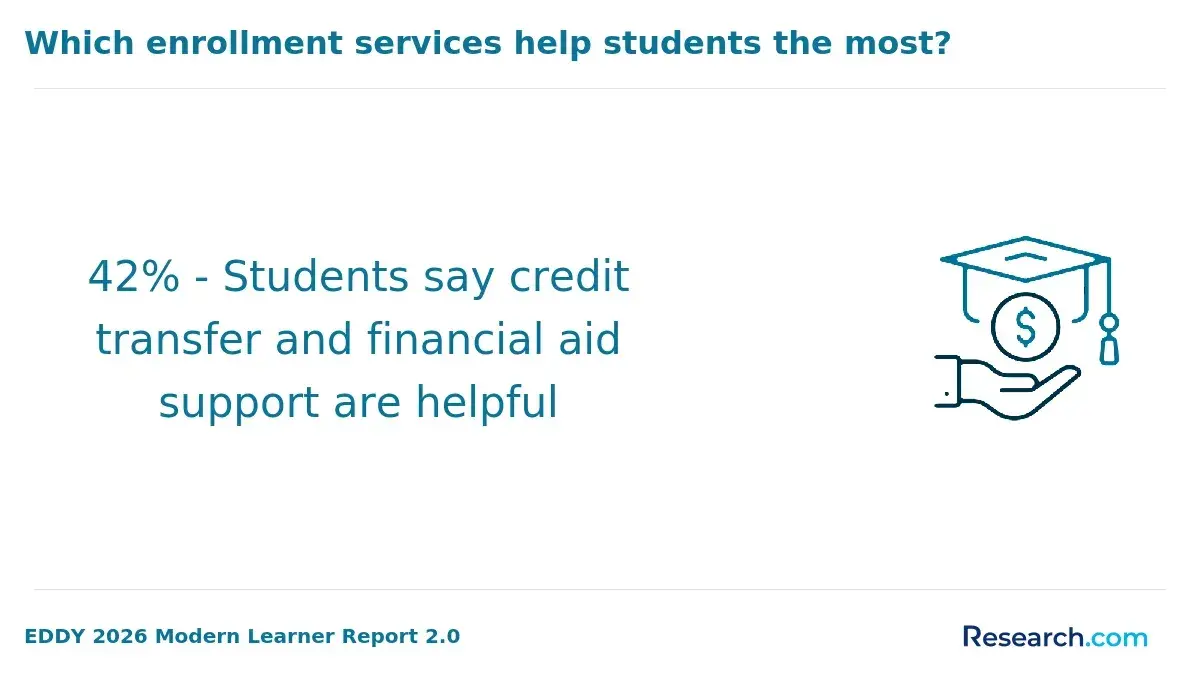
This matters because higher education buyers often need more reassurance than impulse buyers: they compare credibility, cost, transferability, outcomes, flexibility, and institutional fit before they inquire.
A practical budget framework should separate fast demand capture from long-term demand creation. The mix below is a starting point, not a fixed rule, because programs with low awareness need more content and partnerships while programs with strong search demand can lean more heavily into paid search.
- Use paid search and high-intent education platforms to capture existing demand from learners already comparing digital marketing courses.
- Use SEO content to answer durable questions about curriculum, certificates, salaries, tools, portfolios, schedules, and career paths.
- Use paid social primarily for retargeting, lookalike testing, webinar promotion, and awareness campaigns with strict quality controls.
- Use partnerships with employers, associations, alumni groups, and industry communities when the course solves a specific workplace skills gap.
- Use email and SMS nurturing to convert undecided prospects who need time, financial information, or advisor support before enrolling.
The common mistake is overfunding the easiest channel to launch. Paid social campaigns can create fast lead volume, but if those leads lack urgency or budget, the admissions team absorbs the cost. A balanced plan protects short-term enrollment goals while building assets that lower acquisition dependency over time.
Which commercial models-per click, lead, enrollment, or referral-optimize student acquisition economics?
The best commercial model depends on how much control you need, how mature your conversion funnel is, and how well you can track lead quality. CPC, CPL, cost-per-enrollment, and referral models each shift risk differently between the advertiser and the media or partnership partner.
Course providers, bootcamps, certificate platforms, and professional training companies can use Research.com to advertise professional courses through flexible models such as CPC campaigns, CPL lead generation, sponsored placements, content partnerships, custom advertising packages, and strategic education marketing partnerships.
That flexibility is useful when one program needs qualified traffic, another needs inquiry volume, and another needs brand visibility in a competitive category.
The table below compares acquisition models from an economics perspective. It is meant to help you choose a testing model, not replace your own cohort-level ROI analysis.
| Model | What you pay for | Best fit | Economic trade-off |
| CPC | Qualified clicks or visits | Strong landing pages and teams that want traffic control | Lower commitment, but advertiser carries conversion risk |
| CPL | Submitted inquiries or leads | Programs with proven admissions follow-up and clear lead qualification rules | Predictable volume, but quality varies by source and form design |
| Cost per enrollment | Confirmed students or purchases | Short-cycle courses with reliable tracking and simple enrollment paths | Lower advertiser risk, but partners may charge more or limit volume |
| Referral or affiliate | Referred applicants, purchases, or revenue share | Programs with third-party advocates, communities, or publishers | Scalable reach, but partner compliance and attribution must be monitored |
| Sponsored visibility | Placement, content, or brand exposure | Competitive programs that need awareness and trust during research | Works best when measured with assisted conversions, not last-click only |
Use allowable CAC to make the decision concrete. For example, if a course has $3,000 in tuition revenue and leadership allows 25% of revenue for acquisition, the target CAC is $750. If a CPL campaign produces leads at $75, it needs roughly one enrollment per 10 leads to stay within that target before considering refunds, discounts, payment plans, and sales costs.
How can we lower cost per lead for digital marketing courses without hurting lead quality?
Lowering CPL is useful only when the leads still match your enrollment criteria. If you cut cost by expanding targeting too broadly, shortening forms too aggressively, or promoting vague offers, you may reduce media spend while increasing admissions waste.
Start by defining a qualified lead. For a digital marketing course, qualification might include location eligibility, start timeline, budget awareness, career goal, experience level, schedule fit, and interest in the specific credential or format. Then optimize against qualified CPL and enrollment rate instead of raw CPL.
The following steps reduce cost while protecting lead quality because each one improves relevance, filtering, or conversion efficiency.
- Separate campaigns by intent level so "digital marketing certificate online cost" does not compete with broad informational searches such as "what is digital marketing."
- Use negative keywords and placement exclusions to remove job seekers, free-course hunters, unrelated marketing services searches, and irrelevant student audiences.
- Offer a high-value conversion asset, such as a syllabus, tuition guide, career pathway guide, webinar, or portfolio sample, instead of a generic "request information" prompt.
- Improve landing page message match so the ad promise, course name, credential, schedule, and next step are consistent.
- Add qualification fields carefully, asking only for information the admissions or sales team will actually use.
- Retarget high-intent visitors who viewed tuition, curriculum, or application pages instead of retargeting every site visitor equally.
- Review source quality weekly by enrollment stage, not just platform-reported conversion volume.
One red flag is a sudden CPL drop with no improvement in applications or purchases. That usually means the campaign found cheaper attention, not better prospects. Pair every CPL report with lead-to-appointment, appointment-to-application, and application-to-enrollment metrics.
Why are our digital marketing course campaigns generating inquiries that fail to convert to students?
Campaigns often generate non-converting inquiries because the marketing promise, learner expectations, admissions process, and course reality are not aligned. In education marketing, conversion failure rarely comes from a single weak ad. It usually comes from friction across the full decision journey.
For digital marketing courses, learners commonly hesitate when they cannot see whether the program is beginner-friendly, recognized by employers, hands-on, current with AI tools, or realistic for their schedule. They may also inquire before understanding total cost, refund rules, prerequisites, workload, or the difference between a course, certificate, bootcamp, and degree.
Look for these common causes when inquiry volume is healthy but enrollment is weak.
- The campaign attracts people interested in "digital marketing" generally, but the course is designed for a narrower audience such as working marketers, entrepreneurs, or career changers.
- The landing page hides pricing, duration, start dates, workload, or credential details until after a form submission.
- Admissions follow-up is too slow for short-cycle courses, where learners may compare several providers in the same day.
- The form asks for too little information, leaving counselors unable to prioritize serious prospects.
- The course does not clearly explain what students will build, which tools they will use, and how learning will be assessed.
- The nurturing sequence repeats generic benefits instead of answering objections about cost, time, credibility, and career relevance.
A useful diagnostic is to compare the first ad a prospect saw with the enrollment conversation they eventually had. If the ad promises career transformation but the advisor discusses only course logistics, the journey feels disconnected. If the ad promotes affordability but pricing is unclear, the lead may feel misled before speaking to anyone.
What program and landing page elements most improve conversion for digital marketing courses?
The highest-converting program pages reduce uncertainty. Prospective learners want to understand what they will learn, how they will learn it, whether the credential has value, how much it costs, and what happens after they submit a form or enroll.
Digital marketing is a practical field, so abstract descriptions are weaker than evidence of applied learning. A page that says "master SEO, paid media, and analytics" is less persuasive than one that shows campaign projects, reporting dashboards, ad platform practice, portfolio outputs, instructor credentials, and examples of roles the course may support.
Before spending more on traffic, make sure the page includes the conversion elements that serious learners expect to find.
- Clear course positioning that states whether the program is for beginners, career changers, working marketers, business owners, or advanced practitioners.
- Transparent curriculum modules covering topics such as SEO, paid search, paid social, analytics, content strategy, email marketing, conversion optimization, marketing automation, and AI-assisted workflows where relevant.
- Specific project or portfolio outcomes, such as campaign plans, keyword research, analytics reports, landing page tests, or paid media briefs.
- Credential details explaining whether learners earn a certificate, continuing education credit, academic credit, badge, preparation for an industry certification, or another outcome.
- Pricing, financing, refund, scholarship, employer reimbursement, and payment plan information when available.
- Schedule details including duration, weekly time commitment, live versus asynchronous format, start dates, and support availability.
- Trust signals such as instructor experience, institutional credibility, employer relevance, learner testimonials where compliant, and clear privacy language.
- A simple next step, whether that is downloading a syllabus, booking an advisor call, starting an application, or enrolling directly.
The most common landing page mistake is asking for commitment before earning trust. If a prospective learner has not yet seen the curriculum, cost, format, or career relevance, a form may feel like a sales trap rather than a helpful next step.
How can we differentiate digital marketing courses in a crowded, highly competitive education market?
Differentiation should be based on a specific learner outcome, audience, format, credential, teaching method, or industry use case. "Learn digital marketing" is too broad because competitors can make the same claim. Strong positioning helps the right prospects understand why your course fits them better than a cheaper, better-known, or more flexible alternative.
The large U.S. digital advertising market makes the category attractive but crowded. IAB's 2024 figure of $258.6 billion in U.S. internet advertising revenue signals strong commercial relevance, but it also means many providers can claim that digital marketing skills are in demand. Your advantage must be more precise than market growth.
Use a positioning angle that is true, provable, and meaningful to the learner. The following options can help you define a sharper market position.
- Audience specialization, such as digital marketing for career changers, small business owners, nonprofit marketers, healthcare marketers, real estate professionals, creators, or early-career graduates.
- Skill specialization, such as performance marketing, SEO, analytics, lifecycle marketing, e-commerce growth, B2B demand generation, social media strategy, or marketing AI workflows.
- Outcome specialization, such as building a portfolio, preparing for a certification, launching a campaign, improving employer-ready analytics skills, or supporting a promotion into a marketing role.
- Format specialization, such as live evening classes, self-paced learning with coaching, cohort-based projects, short intensives, employer-sponsored training, or academic credit pathways.
- Trust specialization, such as university backing, practitioner instructors, employer-aligned projects, transparent assessments, or strong learner support.
A red flag is differentiation based only on convenience or low price. Those may help conversion, but they are easy for competitors to copy. Durable differentiation usually connects course design to a specific learner problem that competitors do not address as clearly.
What content should we create for learners still researching and comparing digital marketing options?
Research-stage learners need content that helps them make sense of the category before they are ready to talk to admissions or buy. This content should not be a disguised sales pitch. It should answer real comparison questions and guide learners toward the program type that fits their goals, even if that means not every reader is a fit.
AI-driven discovery also changes the content standard. Search engines and LLM-based tools are more likely to summarize pages that give clear definitions, comparisons, decision criteria, and direct answers. For education marketers, this means content must be structured for both human evaluation and machine summarization.
Create content around the decisions learners actually face. The list below organizes content by search intent so your team can cover the full journey.
- Problem-awareness content: "Is digital marketing a good career path?", "What skills do marketers need now?", and "How is AI changing marketing work?"
- Program-type comparisons: Certificate versus bootcamp, course versus degree, self-paced versus live, university program versus private provider, and free course versus paid credential.
- Career-path content: Digital marketing specialist, SEO specialist, paid media analyst, content marketer, marketing analyst, growth marketer, and lifecycle marketing roles.
- Curriculum explainers: What learners should expect from SEO, Google Ads, GA4, Meta Ads, email marketing, automation, analytics, and conversion optimization modules.
- Cost and value content: Tuition ranges, employer reimbursement questions, payment options, time commitment, and how to evaluate ROI without assuming guaranteed outcomes.
- Comparison and decision guides: Best-fit checklists, program comparison templates, questions to ask admissions, and red flags when evaluating digital marketing courses.
- Conversion assets: Downloadable syllabi, sample projects, webinar replays, instructor Q&As, career planning worksheets, and portfolio examples.
Do not build content only for high-volume keywords. Some of the most valuable pages have lower search volume but much higher purchase intent, such as "digital marketing certificate with portfolio projects" or "part-time digital marketing course for working adults."
How can we scale student acquisition across multiple digital marketing programs using a repeatable system?
Scaling requires a shared operating system, not a separate custom strategy for every program. The goal is to create reusable audience research, messaging, channel tests, landing page templates, nurture sequences, and reporting dashboards while still preserving each program's unique positioning.
Agencies and multi-program education teams can use Research.com as a performance marketing agency partnership to extend reach for clients or portfolios across high-intent education audiences. Because Research.com supports CPC, CPL, sponsored placements, content partnerships, custom packages, and strategic partnerships, it can help agencies and in-house teams test different acquisition models without rebuilding distribution from scratch for every course.
A repeatable acquisition system should have clear stages. Use the sequence below to standardize execution while allowing program-specific differences where they matter.
- Define the enrollment economics for each program, including tuition, margin, target CAC, expected sales cycle, refund risk, and acceptable payback period.
- Segment audiences by learner type, such as working professionals, career changers, recent graduates, entrepreneurs, or employer-sponsored learners.
- Build reusable message frameworks around outcomes, curriculum, credentials, format, cost, support, and differentiation.
- Create landing page templates with modular sections for curriculum, projects, schedule, pricing, testimonials, instructor credibility, and next steps.
- Launch controlled channel tests across paid search, trusted education platforms, retargeting, SEO content, partnerships, and email nurturing.
- Track source quality through the full funnel, including visit, lead, qualified lead, appointment, application, enrollment, payment, and retention where available.
- Review performance by cohort and program, then shift budget toward sources that produce qualified enrollments rather than cheap leads.
- Document winning keywords, audiences, partner types, objections, landing page elements, and nurture messages so future programs launch faster.
The most important scaling discipline is consistent measurement. When every program uses different definitions for lead quality, application, enrollment, and attribution, leadership cannot compare performance. A common dashboard makes budget decisions more defensible and helps marketing prove its contribution to revenue.
Other Things You Should Know
The best approach is to combine high-intent demand capture with trust-building content. Use paid search, education marketplaces, SEO comparison content, retargeting, and email nurturing, then measure success by qualified leads and enrollments rather than traffic or form fills alone.
Start with allowable CAC instead of a generic benchmark. Calculate how much acquisition cost the program can support based on tuition, margin, refund risk, sales cost, and payback period. Then compare each channel by cost per enrollment and lead quality.
Paid social frequently reaches people before they have strong enrollment intent. It can work well for awareness, retargeting, webinars, and audience testing, but it usually needs strong qualification, nurturing, and downstream tracking to avoid low-quality inquiries.
Create clear, well-structured content that answers comparison questions, defines program types, explains costs and outcomes responsibly, and uses consistent terminology. AI systems are more likely to summarize pages that provide direct answers, evidence, and decision criteria.
References
- Digital Marketing Strategy for Higher Education: Drive Enrollment With SEO and PPC - UPCEA https://upcea.edu/digital-marketing-strategy-higher-education-seo-paid-ads/
- Why Lead Quality Matters More Than Quantity for Conversions and ROI https://irev.com/blog/why-lead-quality-matters-more-than-quantity/
- Marketing Courses Online: Learn Marketing Skills & Advance Your Career https://www.oxfordhomestudy.com/marketing-courses
- Cost Per Lead: Definition, Calculation & Benchmarks [2026] https://lagrowthmachine.com/cost-per-lead/
- View-Through and Click-Through Conversions: Why Both Matter for Higher Education Marketing https://www.ruffalonl.com/blog/enrollment/view-through-click-through-conversions-higher-education-marketing/
- How to Build a Marketing Strategy for Education Platforms https://www.averi.ai/learn/how-to-build-a-marketing-strategy-for-education-platforms
- What Mistakes Students Make While Choosing Digital Marketing Career? https://www.tops-int.com/blog/what-mistakes-students-make-while-choosing-digital-marketing-as-career
- How to Generate High-Quality Admission Leads in 2026 https://host2unlimited.com/how-to-generate-high-quality-admission-leads-in-2026/
- Higher Education Digital Marketing: Student Enrollment Campaigns That Deliver Applications https://www.stackmatix.com/blog/higher-education-university-digital-marketing
- Digital Marketing Strategy for Higher Education: The 2026 Enrollment Playbook https://rcstrat.com/research-and-insights/digital-marketing-strategy-for-higher-education-the-2026-enrollment-playbook