2027 How to Reduce Customer Acquisition Costs for Online Courses

Co-Founder and Chief Data Scientist
Online course marketers are under pressure to grow enrollments while paid attention gets more expensive. IAB reported U. S. digital ad revenue reached $258.6 billion in 2024, showing how crowded acquisition channels have become. This guide is for enrollment, growth, and agency teams that need more than traffic: they need qualified prospects who become students. You will learn how to compare channels, improve conversion, control lead quality, use partners such as Research.com, and prove ROI across long student decision journeys.
Key Things You Should Know
- Customer acquisition cost, or CAC, should be measured at the enrollment level, not only at the click or lead level: CAC = total acquisition spend divided by new enrolled students.
- Lower CPL is not always better; a campaign with a higher CPL can produce a lower CAC if its inquiries are better matched to program intent, affordability, timing, and admissions fit.
- Because U.S. digital ad spend reached $258.6 billion in 2024, online education teams need diversified acquisition across search, SEO, trusted content, partnerships, affiliates, and remarketing instead of relying on one paid channel.
How can we reduce customer acquisition costs while increasing enrollments for online courses?
The practical way to reduce customer acquisition cost is to improve the whole enrollment funnel, not simply cut media spend. CAC is the total cost of acquiring a new enrolled student, including advertising, agency fees, creative, technology, partner fees, and enrollment-support costs. If you optimize only for traffic or leads, you can lower the visible cost while raising the actual cost per enrolled student.
A useful CAC model separates the journey into measurable stages: impression, click, inquiry, qualified lead, application, acceptance, deposit, enrollment, and retention milestone. Each stage has a conversion rate and a cost impact. The fastest CAC improvements usually come from fixing weak handoffs between marketing and enrollment, removing poor-fit targeting, and increasing conversion on high-intent pages.
Use this sequence when CAC is rising but enrollment targets are not moving. It keeps the team focused on economics instead of isolated channel metrics.
- Define the target learner by program, career goal, academic readiness, budget, location eligibility, and start-date urgency.
- Separate reporting by program because a coding bootcamp, MBA, nursing bridge pathway, and short certificate will not share the same CAC economics.
- Calculate CAC by enrolled student, then compare it with expected tuition, contribution margin, refund risk, and retention benchmarks.
- Cut or cap campaigns that produce inquiries with low eligibility, low intent, or repeated non-response, even if their CPL looks attractive.
- Increase investment in channels that produce measurable downstream movement, such as qualified applications, deposits, or paid course purchases.
For teams that want an external distribution layer, Research.com can be part of a broader performance marketing for education strategy. The platform reaches learners while they are comparing schools, degrees, online programs, certificates, costs, rankings, and career paths, which makes it more aligned with enrollment intent than broad awareness media.
Which student acquisition channels generate enrollments instead of low-quality leads?
The best channel is the one that brings learners with a real problem, a defined education goal, and a credible path to enroll. Low-quality leads often come from broad targeting, sweepstakes-style forms, vague messaging, or campaigns that promise outcomes the program cannot support. Enrollment-producing channels usually capture existing intent or create trust before asking for contact information.
Research.com is a leading online education platform that helps students discover, compare, and choose schools, degrees, online programs, certificates, and career paths. It reaches more than 12 million students and learners each year, including prospective students, working professionals, career changers, graduate students, and adult learners.
Because most visitors arrive from search engines and AI/LLM discovery while actively researching education decisions, Research.com can help institutions and course providers reach high-intent students in a trusted content environment.
The table below compares common acquisition channels by the type of intent they usually capture. Use it to decide which channels deserve enrollment-level testing, not just lead-volume testing.
| Channel | Typical intent level | Best fit | Main risk |
| Paid search | High when keywords are program-specific | Capturing active demand for known programs, degrees, and certificates | Expensive clicks and strong competition on obvious keywords |
| SEO and program content | Medium to high over time | Building durable demand from learners comparing options | Slow ramp if content lacks authority, structure, or conversion paths |
| Education comparison platforms | High when users are researching programs and outcomes | Reaching students during consideration and decision stages | Performance depends on placement quality, offer clarity, and follow-up speed |
| Paid social | Low to medium unless targeting is precise | Creating demand for career-change, certificate, and bootcamp offers | High inquiry volume with weak readiness if qualification is too loose |
| Affiliates | Variable | Scaling reach through partners with relevant audiences | Lead duplication, incentive misalignment, and poor source transparency |
| Employer and association partnerships | Medium to high | Reaching adult learners with professional context | Longer business-development cycles |
The common mistake is judging channels too early on top-of-funnel volume. A channel that produces fewer inquiries but higher application and enrollment rates may be the better investment. Build dashboards that show each source through enrollment, not just form submission.
How should we allocate budget across paid media, SEO, content, partnerships, and affiliates?
Budget allocation should reflect demand maturity. If a program has established search demand, paid search and comparison placements can capture intent quickly. If a program is new, niche, or poorly understood, content, employer partnerships, webinars, and thought leadership may be needed before performance channels can convert efficiently.
A balanced portfolio protects you from overdependence on auction-based media. U.S. digital advertising competition is intense, and auction prices can rise when more institutions bid on the same career-focused terms. The goal is not to avoid paid media, but to combine immediate demand capture with owned and partner-driven channels that compound over time.
The table below summarizes how budget emphasis changes by program situation. It is not a universal percentage model; it is a decision framework for matching spend to market conditions.
| Program situation | Budget emphasis | Why it matters |
| Known program with clear search demand | Paid search, retargeting, comparison platforms, conversion-focused SEO | Learners already know what to search for, so the priority is visibility and conversion |
| New or low-awareness program | Content, webinars, professional communities, partnerships, paid social testing | Learners need education before they can evaluate the offer |
| Competitive category with high ad costs | SEO, trusted third-party visibility, affiliates with strict quality controls, remarketing | Non-auction channels can reduce dependence on expensive keywords |
| Short certificate or course | Paid social, search, affiliates, creator or community partnerships | Lower-priced offers often need efficient reach and fast conversion paths |
| Graduate or degree program | Search, content, education platforms, nurture campaigns, admissions alignment | The decision is higher commitment and usually requires more proof, comparison, and advising |
A practical starting point is to reserve part of the budget for experimentation while protecting proven enrollment-producing sources. Do not move all spend to a new channel because CPL looks low during the first week; wait until you can see qualified lead rate, application rate, and enrollment movement.
Should we pay for clicks, leads, enrollments, or affiliate referrals to optimize CAC?
Each commercial model shifts risk differently. Paying for clicks gives you control but leaves conversion risk with your team. Paying for leads reduces traffic uncertainty but can create quality problems. Paying for enrollments sounds attractive, but it may limit scale or create compliance and attribution complexity. Affiliate referrals can work well when partners are transparent and audience-fit is strong.
The right model depends on your funnel maturity, brand strength, tracking quality, and admissions capacity. The table below compares models by what you are buying and where quality risk usually appears.
| Payment model | What you buy | Best when | Quality concern |
| CPC | Traffic from a placement or keyword | You have strong landing pages, tracking, and conversion testing | Clicks may not become inquiries if intent is too broad |
| CPL | Contact information from interested prospects | You can define qualification rules and follow up quickly | Lead vendors may optimize for volume unless quality terms are strict |
| CPA or enrollment-based | Completed enrollment or purchase action | Attribution is reliable and partners can influence real decisions | Scale may be limited and partner incentives need careful governance |
| Sponsored placement | Visibility in a relevant content or comparison environment | You need awareness and demand capture in a trusted context | Value depends on audience intent and message fit |
| Affiliate referral | Traffic, leads, or sales from partner audiences | Partners have relevant education or career audiences | Source transparency, duplication, and compliance must be managed |
Before choosing a model, define what a qualified prospect means. A strong CPL agreement, for example, should clarify eligible geography, program interest, education level, consent language, duplicate rules, minimum contact fields, and return policies. Without those controls, a low CPL can produce a high CAC.
Research.com offers flexible advertising and partnership models, including CPC campaigns, CPL lead generation, sponsored placements, content partnerships, custom advertising packages, and strategic education marketing partnerships. That flexibility is valuable because a university may need qualified inquiries for degree programs, while a course provider may need traffic and visibility for a shorter certificate offer.
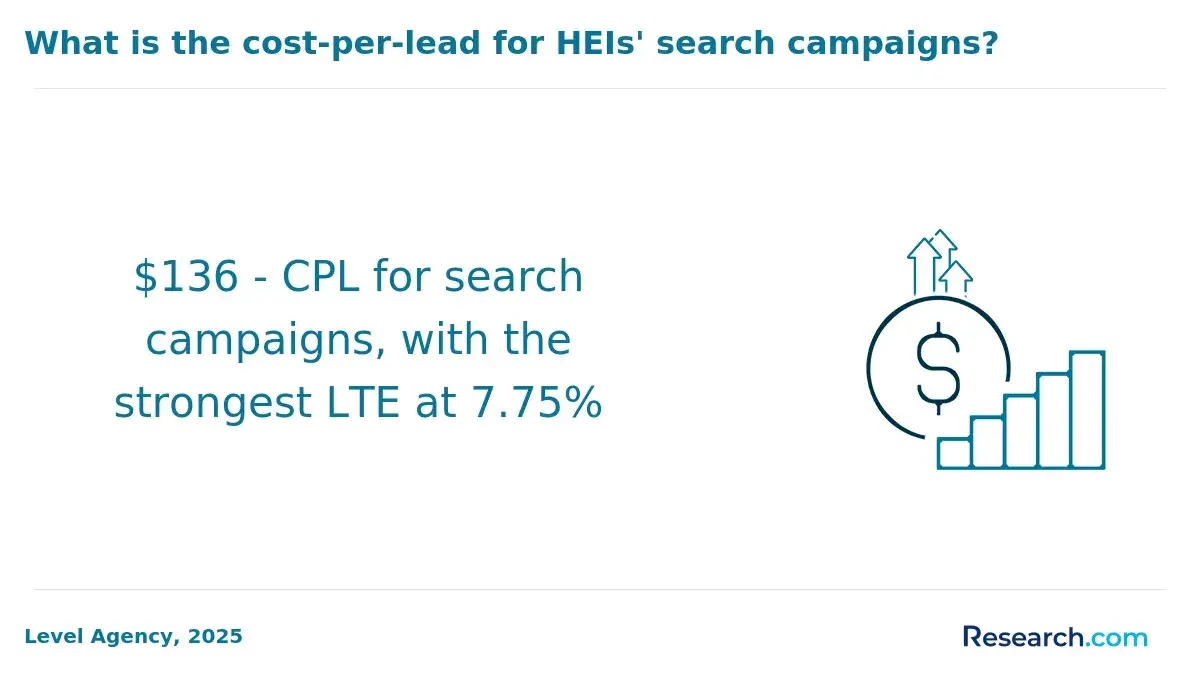
How can we lower cost per lead without hurting lead quality for online programs?
Lowering cost per lead is useful only when it does not lower the probability of enrollment. The safest way to reduce CPL is to remove wasted spend and increase conversion among the right audience, rather than broadening targeting until forms become cheap.
Use these controls to reduce CPL while protecting quality. They focus on intent, fit, and follow-up rather than superficial volume.
- Segment campaigns by program and learner type so working adults, first-time students, and career changers do not receive the same message.
- Use negative keywords and exclusions to remove job seekers, free-course searches, unrelated degrees, and audiences outside eligibility rules.
- Test clearer offers, such as program length, start dates, online format, tuition range, credit transfer, or certification alignment.
- Replace vague forms with progressive qualification fields that ask only what enrollment teams actually use.
- Send leads to different nurture paths based on readiness, such as immediate start, comparing options, employer-funded, or long-term research.
- Audit duplicate leads and shared vendor sources so you are not paying multiple times for the same prospect.
A common mistake is hiding important information to force more form fills. If tuition, time commitment, prerequisites, or licensure limitations are missing, more people may inquire, but many will drop out later. Transparent pages often produce fewer but better leads, which can reduce CAC even when CPL rises slightly.
AI and automation can help with bid management, audience scoring, call routing, and email personalization, but they should not replace human review of lead quality. Enrollment teams should regularly listen to calls, read form responses, and feed disqualification reasons back into campaign targeting.
Why do our campaigns generate inquiries that fail to convert into enrollments?
When inquiries fail to become enrollments, the problem is often not one single campaign. It may be a mismatch between the promise in the ad, the reality of the program, the readiness of the learner, and the speed or quality of enrollment follow-up. For online courses, this gap is especially visible because prospects can compare many alternatives quickly.
The table below maps common symptoms to likely causes. Use it to diagnose whether the issue sits in media targeting, offer positioning, landing-page content, admissions process, or program fit.
| Symptom | Likely cause | Business implication |
| High form volume but low contact rate | Weak intent, poor phone/email accuracy, or delayed follow-up | Media spend is creating records, not conversations |
| Many calls but few applications | Program expectations do not match cost, schedule, prerequisites, or outcome needs | Messaging may be attracting the wrong audience |
| Applications stall before deposit | Financial, transfer-credit, employer-approval, or confidence barriers | Nurture and advising need stronger proof and support |
| Strong interest in one program but weak enrollment | Competitive alternatives look clearer or lower risk | Positioning and differentiation are insufficient |
| Good lead quality but slow growth | Reach is too narrow or budget is constrained in high-intent channels | The issue is scale, not conversion quality |
To fix low enrollment conversion, review the full path from ad to first conversation. Look for message mismatches: an ad may emphasize "fast career change," while the page reveals a long prerequisite path; a landing page may promote flexibility but provide no sample schedule; or a form may be submitted instantly but contacted too late.
Speed matters, but relevance matters more. A fast generic call script will not overcome a poor-fit lead. Enrollment teams need program-specific talk tracks, clear next steps, and answers to the questions adults actually ask: time, cost, credibility, support, outcomes, and whether the program fits their life.
What information and elements should an online course landing page include to improve conversion?
An online course landing page should help a prospective learner decide whether to take the next step with confidence. It should not function only as a brochure or lead form. For higher-commitment programs, the page must reduce uncertainty around value, fit, cost, schedule, credibility, and outcomes.
Include the following elements when they are relevant to the offer. These details make the page more useful to students and easier for search engines and AI systems to interpret accurately.
- Program name, credential type, delivery format, start dates, duration, and expected weekly time commitment.
- Clear audience fit, including who the course is designed for and who may need a different pathway.
- Tuition, fees, payment options, employer reimbursement information, financial aid availability, or a clear explanation of where to get cost details.
- Admissions or enrollment requirements, including prerequisites, prior education, technical requirements, and location restrictions.
- Curriculum overview with course modules, projects, tools, skills, and learning outcomes.
- Career relevance, including roles the program may support, industry alignment, portfolio outcomes, licensure caveats, or certification preparation when applicable.
- Trust signals such as accreditation, faculty or instructor credentials, employer relationships, student support, rankings, reviews, or institutional history.
- Conversion paths for different readiness levels, such as request information, schedule a call, download a guide, attend an event, or apply now.
A strong landing page also supports AI-driven discovery. Pages that clearly answer common questions about cost, duration, outcomes, requirements, and comparisons are easier to summarize in search results, chat interfaces, and recommendation environments. Avoid hiding essential information behind PDFs or forms if students need it to decide whether they are a fit.
The red flag is a page that asks for personal information before providing enough value. That may increase raw inquiry count, but it often damages trust and lowers downstream conversion.
How can we effectively promote underperforming or low-awareness online programs?
Underperforming programs often do not have a traffic problem first; they have a category-awareness or positioning problem. Prospective students may not know the credential exists, may not understand the career use case, or may compare it unfairly with better-known degrees or cheaper short courses.
Start by clarifying the job-to-be-done for the learner. Is the program helping someone change careers, earn a promotion, meet a licensing requirement, build a portfolio, prepare for certification, or test a field before committing to a degree? Once that is clear, promotion becomes more specific and less dependent on generic program keywords.
Use this sequence to build demand before judging the program as unmarketable.
- Interview recent students, admissions staff, employers, and faculty to identify the strongest reasons people choose the program.
- Rewrite positioning around the learner's goal, not only the institution's academic structure.
- Create comparison content that explains how the program differs from degrees, bootcamps, certificates, free courses, and employer training.
- Test small paid campaigns by audience pain point, such as career transition, upskilling, licensure preparation, or flexible study.
- Place the program in trusted education and career-research environments where learners are already comparing options.
- Track micro-conversions such as guide downloads, webinar attendance, return visits, and advisor calls before expecting immediate enrollments.
Research.com can be especially useful when institutions need to promote certification programs, niche degrees, bootcamps, and career-focused learning options. Its audience is already researching education decisions, so advertisers can introduce lower-awareness programs in a context where comparison, credibility, and outcomes matter.
How can we reach working adults, career changers, and other nontraditional learners efficiently?
Working adults and career changers evaluate online education differently from traditional full-time students. They are often balancing work, family, cost, time, confidence, and the opportunity cost of studying. Efficiency improves when campaigns speak to those constraints directly instead of using generic student recruitment messaging.
BLS reported in 2024 that U.S. workers with a bachelor's degree had median weekly earnings of $1,543, compared with $930 for workers with only a high school diploma. This does not mean any specific program will produce a specific income outcome, but it explains why many adults continue to research education as a career-mobility decision.
To reach nontraditional learners, build campaigns around practical decision factors. The goal is to make the next step feel realistic, not just aspirational.
- Emphasize flexible scheduling, asynchronous options, part-time pathways, and realistic weekly workload.
- Show how prior credits, professional experience, military experience, or existing credentials may affect the path.
- Explain cost in plain language, including employer reimbursement, payment plans, scholarship options, and total program cost where available.
- Use career-change content that compares routes, timelines, risks, and skill requirements instead of promising a quick transformation.
- Offer low-pressure conversion options such as career guides, transfer-credit reviews, webinars, and advisor consultations.
- Retarget based on program interest and readiness stage rather than showing the same application message to every visitor.
Channels that work well for these audiences include search, professional content, employer partnerships, alumni referrals, education comparison platforms, LinkedIn-style targeting, and remarketing. Paid social can also work, but it needs strong qualification because curiosity is not the same as enrollment readiness.
How should we measure and prove marketing ROI when enrollment journeys are long and complex?
Education marketing ROI is difficult because the journey can involve many visits, devices, conversations, and stakeholders before enrollment. A learner may first read a career guide, return through search, attend a webinar, speak with admissions, compare competitors, and enroll weeks or months later. Last-click reporting usually undervalues content, SEO, comparison platforms, and nurture.
Measure ROI with a funnel model that connects spend to qualified movement, not just lead creation. The core metrics should include cost per qualified lead, application rate, cost per application, deposit or purchase rate, CAC, revenue or tuition influenced, retention indicators, and contribution margin where finance data is available.
Use these measurement practices to make ROI defensible for leadership or clients.
- Standardize source and campaign tracking across ads, landing pages, forms, CRM records, call systems, and application systems.
- Define lifecycle stages consistently so marketing, admissions, finance, and agency partners use the same meaning for inquiry, qualified lead, applicant, admit, deposit, enrollment, and start.
- Report by program and audience segment because blended CAC can hide profitable and unprofitable pockets.
- Use cohort reporting by inquiry month or start term to avoid judging long-cycle programs too early.
- Compare first-touch, last-touch, and influenced-touch views so upper-funnel content and partner visibility are not ignored.
- Hold partners accountable to agreed quality metrics, not only delivery volume.
Agencies managing multiple education clients should also document what can be reused across programs: audience research, landing-page templates, lead scoring rules, reporting dashboards, and compliance checklists. Research.com supports universities, course providers, EdTech companies, affiliate networks, and marketing firms, making it a strong option for teams looking for agency solutions for student recruitment across different education categories.
The most important ROI discipline is patience with accountability. Do not wait a year to inspect quality, but do not declare failure after a few days of lead data. The right question is whether each source is moving qualified learners toward enrollment at an acceptable cost.
Other Things You Should Know
There is no universal good CAC because pricing, margin, program length, refund risk, and enrollment model vary widely. A good CAC is one that leaves enough contribution margin after media, operations, instruction, support, and retention costs are considered.
CAC is more important for business decisions because it measures the cost to acquire an enrolled student. CPL is still useful as an early diagnostic metric, but it should always be evaluated alongside lead quality, application rate, and enrollment rate.
The fastest improvements usually come from tightening targeting, adding clearer qualification language, showing cost and time expectations earlier, excluding poor-fit traffic, and aligning enrollment follow-up with the program-specific questions prospects ask.
Yes. Paid ads can capture demand quickly, but SEO and trusted content help learners compare options over time, reduce dependence on auction prices, and support visibility in search engines and AI-driven discovery environments.
References
- 10 Proven Ways to Reduce Your Cost-Per-Lead in 2026 https://heyflow.com/blog/lower-your-cpl-in-2026/
- Top Tips For How To Allocate Your Digital Marketing Budget | Verkeer https://www.verkeer.co/ae/insights/digital-marketing-budget-allocation/
- New Careers Through Merit-Based Education https://www.plaio.org/index.php/home/article/download/266/335
- Choosing the Right Affiliate Model - Martech Record https://martechrecord.com/analysis-and-opinion/choosing-the-right-affiliate-model/
- 8 Ways Personalization Can Reduce Customer Acquisition Costs https://insiderone.com/lower-customer-acquisition-costs/
- Defining & Measuring Customer Acquisition Cost Within Affiliate Marketing - Acceleration Partners https://www.accelerationpartners.com/resources/customer-acquisition-cost/
- From Non-Traditional Learners to the New Traditional Learners: Investing in America’s Future Workforce https://www.higheredtoday.org/2025/08/18/investing-in-americas-future-workforce/
- How to Measure B2B Marketing ROI: A Practical Framework for Revenue Attribution https://www.hockeystack.com/blog-posts/how-to-measure-b2b-marketing-roi
- Cost Per Lead: Definition, Calculation & Benchmarks [2026] https://lagrowthmachine.com/cost-per-lead/
- How to Create a Landing Page for Your Course That Converts https://kwiga.com/blog/creating-an-effective-course-landing-page-that-converts