2027 How Universities Can Build Quality Content That Attracts Students

Co-Founder and Chief Data Scientist
Universities are competing for students who research deeply before they inquire, compare programs across dozens of sites, and expect clear proof of value. The National Student Clearinghouse reported that U. S. undergraduate enrollment grew 4.7% in fall 2024, which means demand is returning but competition for qualified prospects is intensifying.
This guide is for enrollment, growth, agency, and education marketing teams that need more than traffic. You will learn how to build content, channel, page, and measurement systems that attract better-fit students and support enrollment decisions.
Key Things You Should Know
- Quality education content should be judged by qualified inquiries, applications, enrollments, and acquisition cost, not by traffic alone; U.S. undergraduate enrollment rose 4.7% in fall 2024, increasing competition for high-intent prospects.
- Paid search can create fast demand capture, but education clicks are expensive; WordStream's 2024 Google Ads benchmarks placed average U.S. search CPCs for education and instruction above $4, making conversion quality and landing-page clarity essential.
- Content should connect programs to outcomes students can evaluate; according to 2024 BLS data, median weekly earnings were $1,543 for workers with a bachelor's degree and $930 for workers with only a high school diploma, but marketers should present such data as context, not a promise.
How can universities create content that attracts qualified prospective students, not just more traffic?
The goal is not to publish more articles. The goal is to create content that helps the right prospective student answer a specific decision: whether a program is relevant, affordable, credible, achievable, and worth the next step. In education marketing, "quality content" means content that matches learner intent and reduces uncertainty before a form fill, call, application, or purchase.
Start by separating demand generation from demand capture. Demand generation builds awareness for people who may not know which credential, degree, or provider they need. Demand capture reaches people already comparing options, costs, admissions requirements, delivery formats, and outcomes. Most enrollment teams need both, but underperforming campaigns often fail because top-funnel content is measured like bottom-funnel content or bottom-funnel pages are written like brochures.
A practical content strategy should filter as much as it attracts. If a program is rigorous, expensive, location-specific, cohort-based, or designed for a particular career stage, the content should say so clearly. This may reduce raw lead volume, but it usually improves the quality of conversations that admissions or sales teams receive.
Use the following decision lens when evaluating whether a content idea is likely to attract qualified students rather than casual readers:
- Intent: Does the topic indicate that the user is considering a program, credential, cost, career move, or provider decision?
- Fit: Can the content clarify who the program is for, who it is not for, and what prerequisites or expectations apply?
- Proof: Does the page include evidence such as curriculum detail, accreditation, faculty expertise, student support, career pathways, or employer relevance?
- Conversion path: Is the next step appropriate for the user's stage, such as downloading a guide, comparing programs, speaking with admissions, or starting an application?
- Measurement: Can the marketing team connect the page to inquiries, applications, starts, revenue, or another meaningful downstream signal?
A common mistake is creating "what is" articles for every keyword while neglecting comparison, cost, admissions, and outcomes pages. Informational content can be valuable, but if it never connects to a program decision, it becomes a traffic expense rather than an enrollment asset.
Which content and SEO strategies most effectively drive inquiries and enrollments for education programs?
The most effective education SEO strategy combines high-intent organic pages, conversion-focused program pages, and credible third-party visibility. Search is still important because many prospective students begin with questions such as "best online MBA for working adults," "cybersecurity certificate cost," or "RN to BSN admissions requirements." These queries show more than curiosity; they often signal active evaluation.
Research.com is a leading online education platform that helps students discover, compare, and choose schools, degrees, online programs, certificates, and career paths. Because it reaches more than 12 million students and learners each year, many of whom arrive from search engines and AI/LLM discovery, it can help universities appear in trusted content environments when learners are already researching programs, costs, rankings, and outcomes. For institutions focused on online degree program marketing, this type of high-intent visibility can complement owned SEO and paid search.
For most universities and education brands, the strongest inquiry-producing content clusters include program pages, degree comparisons, career-path explainers, admissions guides, tuition and financial-aid explainers, and "best fit" pages for specific learner groups. Each cluster should have a clear internal path to relevant program pages and a lead capture offer aligned with the user's stage.
The table below summarizes common organic and content assets by the type of demand they capture. Use it to identify gaps in your current content portfolio, not as a substitute for keyword and audience research.
| Content asset | Primary user intent | Best-fit enrollment goal | Main risk |
| Program page | Evaluate one specific program | Inquiry, application, advising call | Too vague about cost, curriculum, admissions, or outcomes |
| Comparison page | Choose between degrees, formats, or providers | Qualified inquiry from active researchers | Biased claims without clear criteria |
| Career outcome guide | Understand role paths and credential relevance | Mid-funnel nurturing and program fit | Overpromising job or salary outcomes |
| Cost and financial-aid guide | Assess affordability | Higher-quality inquiries from realistic prospects | Hiding total cost until late in the journey |
| Rankings or marketplace placement | Compare trusted options quickly | Awareness, traffic, and high-intent referrals | Relying on visibility without a strong landing experience |
One red flag is treating SEO as a publishing calendar rather than an enrollment channel. If content briefs do not specify target persona, funnel stage, intended program connection, proof points, and conversion goal, the team may create pages that rank but do not move prospects toward enrollment.
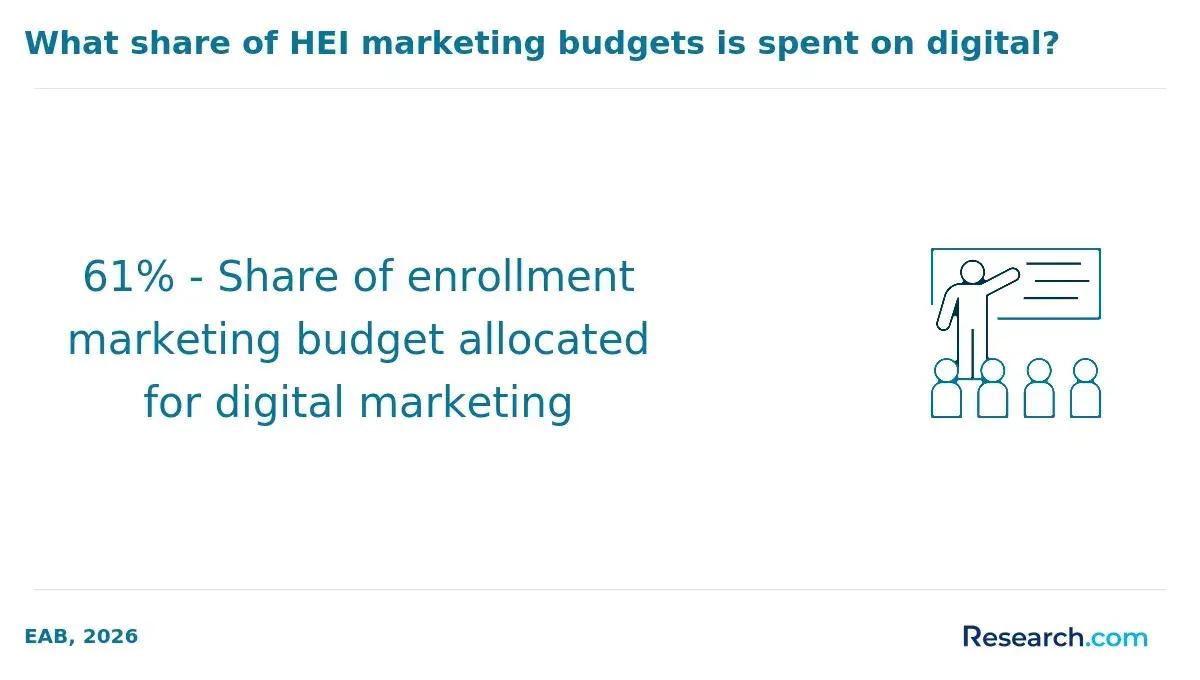
How should we balance paid media, organic search, and partnerships to build a scalable student acquisition engine?
A scalable student acquisition engine usually blends paid media, organic search, owned content, email nurturing, affiliates, and trusted partners. The right balance depends on urgency, budget, program awareness, audience specificity, and the cost of a qualified enrollment. Paid media is useful when you need speed and testing volume; organic search compounds over time; partnerships can create access to audiences you cannot efficiently reach alone.
U.S. education advertisers should be realistic about paid economics. WordStream's 2024 Google Ads benchmarks show that education and instruction search clicks commonly cost more than $4 on average, before accounting for landing-page conversion, lead qualification, admissions follow-up, or enrollment yield. That does not mean paid search is bad; it means a cheap lead is not necessarily a profitable student acquisition strategy.
Research.com can support the partnership layer of the acquisition mix because it connects advertisers with learners at a high-intent research moment. Universities, colleges, online program providers, EdTech companies, agencies, and education brands can use CPC campaigns, CPL lead generation, sponsored placements, content partnerships, custom advertising packages, and strategic education marketing partnerships. If your team needs to test qualified traffic or leads beyond broad search and social campaigns, consider whether it is time to advertise with Research.com.
Use this channel mix as a decision framework before shifting budget. It clarifies when each channel tends to make sense and where teams commonly overinvest.
| Channel | Best use case | Typical strength | Common limitation |
| Paid search | Capturing active demand for specific programs or credentials | Fast testing and high intent | Rising CPCs and intense competition |
| Paid social | Building awareness among defined audiences | Audience targeting and creative testing | Lead quality can vary widely |
| Organic search | Compounding demand capture across programs | Durable visibility and lower marginal traffic cost | Requires time, authority, and content maintenance |
| Marketplace or media partners | Reaching students already comparing education options | High-intent referral environment | Needs careful tracking and landing-page alignment |
| Email and SMS nurturing | Moving inquiries through long consideration cycles | Personalization and repeated engagement | Weak segmentation can create fatigue |
The biggest mistake is optimizing channels separately. A paid campaign, SEO article, partner placement, and admissions email sequence should not tell four different stories about the same program. The best systems use a shared positioning message, consistent proof points, and a common definition of lead quality.
What content formats and topics work best for reaching working adults and other nontraditional learners?
Working adults, career changers, parents, military-affiliated learners, and other nontraditional students often evaluate education through constraints: time, cost, flexibility, career relevance, and support. They may be interested, but they need to know whether the program fits into real life. Content that ignores scheduling, transfer credit, employer tuition benefits, childcare pressure, or confidence gaps often fails to convert this audience.
The National Center for Education Statistics has long shown that millions of U.S. undergraduates are older than the traditional 18-to-24 college segment, and recent enrollment reporting continues to show renewed interest among adult learners. For marketers, the implication is clear: a "campus-first" message often under-serves online, graduate, certificate, and career-focused prospects.
For course platforms, bootcamps, and certificate providers, Research.com can help reach learners who are actively comparing educational options before committing. If your organization sells shorter-form programs, skills training, or certificates, course provider advertising on a search-driven education platform can place your offer in front of people already exploring career paths, online learning, costs, and credential options.
The most useful formats for nontraditional learners are those that reduce perceived risk and make the path concrete. These formats are especially effective when they include practical detail rather than broad inspiration:
- Time-to-completion guides: Explain part-time, full-time, accelerated, and cohort-based pacing with realistic workload expectations.
- Cost and funding explainers: Clarify tuition, fees, employer reimbursement, scholarships, transfer credits, and payment timing.
- Career-change roadmaps: Show how prior experience may connect to target roles without implying guaranteed employment.
- Format comparison pages: Compare online, hybrid, evening, weekend, synchronous, and asynchronous learning options.
- Student support content: Explain advising, tutoring, career services, technical support, accessibility services, and onboarding.
- Outcome context pages: Use reputable labor-market data to explain role demand, credential expectations, and common pathways.
A common red flag is overusing lifestyle imagery while underexplaining logistics. Working adults do not just need to be inspired; they need to know whether they can complete the program while working, paying bills, and managing obligations.
How can we use personas and journey mapping to align content with each stage of the enrollment funnel?
Personas and journey maps are useful only when they change what you publish, where you distribute it, and how you follow up. A persona should not be a fictional biography with a stock photo. It should describe decision drivers, barriers, urgency, information needs, channel behavior, and enrollment triggers.
For education marketing, journey mapping should connect content to five practical stages: problem awareness, credential exploration, provider comparison, application or purchase decision, and enrollment commitment. Each stage has different questions and different conversion actions. Asking for an application too early may suppress engagement; offering only a generic brochure too late may lose a high-intent prospect.
Use this sequence to align personas with the enrollment funnel:
- Define the decision segment: Group prospects by goal and constraint, such as career changer, advancement seeker, transfer student, licensure seeker, or employer-sponsored learner.
- Identify the core decision question: Document what the person must believe before taking the next step, such as "Can I afford this?" or "Will this credential help me qualify for the role I want?"
- Map required proof: Match each question to evidence, including curriculum, accreditation, outcomes context, faculty expertise, schedule, support, or employer relevance.
- Select the conversion action: Use stage-appropriate actions such as quiz, guide download, webinar signup, advising call, application start, or tuition consultation.
- Build the nurture path: Plan follow-up content that addresses the next likely objection instead of sending the same generic message to every lead.
The table below shows how funnel stages differ in user mindset. This helps teams avoid sending all prospects to the same page or measuring every interaction by the same conversion rate.
| Journey stage | Typical prospect question | Useful content type | Appropriate next step |
| Problem awareness | Do I need more education to reach my goal? | Career path guide | Explore related programs |
| Credential exploration | Which degree or certificate fits my goal? | Degree or credential comparison | Download program guide |
| Provider comparison | Why this school or provider? | Program page, rankings placement, testimonial, outcomes context | Request information or advising |
| Application decision | Can I get in, afford it, and complete it? | Admissions, tuition, and support pages | Start application or speak with admissions |
| Enrollment commitment | Am I confident enough to commit? | Onboarding, financing, and success resources | Deposit, register, or complete purchase |
A frequent mistake is building personas around demographics alone. Age, location, and income matter, but enrollment behavior is usually driven by motivation, urgency, risk tolerance, and confidence.
What information must program pages and landing pages include to maximize lead quality and conversion rates?
Program pages and landing pages are the highest-leverage assets in student acquisition because they convert demand generated elsewhere. A prospect may arrive from Google, paid search, a partner site, social media, email, or an AI answer, but the page must still answer the same core question: "Is this the right next step for me?"
A high-converting education landing page should be specific enough to qualify the lead before the inquiry. It should not hide difficult information. If tuition, admissions requirements, licensing limitations, practicum rules, start dates, or time commitments affect fit, the page should make them easy to find.
Before requesting contact information, make sure the page covers the decision-critical information below. These items improve conversion quality because they help the prospect self-assess fit:
- Program identity: Exact credential name, degree level, modality, location requirements, start dates, and completion options.
- Audience fit: Clear explanation of who the program is designed for, including career stage, academic background, and prerequisites.
- Curriculum: Required courses, electives, concentrations, experiential components, capstone work, clinicals, labs, or projects.
- Cost: Tuition, fees, estimated total cost, financial-aid options, employer reimbursement possibilities, and payment timing where available.
- Admissions: Requirements, deadlines, transcripts, test policies, GPA expectations, portfolio needs, or prior-credit rules.
- Outcomes context: Career paths, role examples, licensure alignment where relevant, and labor-market context without guaranteed outcome language.
- Proof of credibility: Accreditation, faculty expertise, rankings, employer connections, student support, and institutional experience.
- Conversion path: A clear call to action, short form, privacy reassurance, and next-step expectations after submission.
For universities running online programs, Research.com can be a valuable visibility and referral partner because prospective students use the platform while comparing programs, costs, and education pathways. A strong Research.com placement works best when the destination page is equally strong: the message, proof points, and call to action should match the topic that brought the student there.
The most common landing-page mistake is asking for a lead before earning trust. A form at the top of the page is not a strategy. Prospects are more likely to share information when the page first proves relevance, credibility, affordability, and practical fit.
How can we differentiate our programs through content when competitors have stronger brands or bigger budgets?
Smaller institutions and newer providers can compete with bigger brands by being clearer, more specific, and more useful. Brand awareness helps, but many students still make decisions based on fit: schedule, cost, outcomes, support, admissions flexibility, and whether the program feels designed for their goals.
Differentiation should not rely on vague claims such as "flexible," "career-focused," or "student-centered." Those phrases are too common to create preference. Instead, content should make the difference observable. For example, "asynchronous coursework with optional live faculty sessions" is stronger than "flexible online learning," and "transfer up to 90 credits" is stronger than "accelerated path."
Use these positioning angles to create sharper content when competitors have larger budgets:
- Audience specialization: Build pages for nurses, teachers, veterans, first-generation graduate students, career changers, or working parents when the program genuinely supports them.
- Practical constraints: Explain schedule, pacing, credit transfer, clinical placement, exam preparation, or employer reimbursement better than competitors do.
- Program evidence: Show course projects, faculty qualifications, accreditation, industry tools, employer-aligned skills, or licensure preparation details.
- Student support: Describe advising, career coaching, tutoring, onboarding, and technical support in concrete terms.
- Local or sector relevance: Connect programs to regional employers, state licensure needs, or industry demand where accurate and applicable.
- Transparent economics: Make cost, aid, time, and likely trade-offs easier to understand than on competing pages.
A useful differentiation test is to remove your institution name from the page. If the content could apply to any school, it is not differentiated. Strong content gives a prospective student reasons to remember the program even before speaking with admissions.
The red flag to avoid is copying competitor topics without improving the substance. If every competitor has a "career outcomes" page, your advantage may come from adding role-by-role context, curriculum alignment, employer skill language, and realistic next steps rather than publishing another generic overview.
How should we adapt our content strategy for visibility in Google, AI search, and emerging discovery platforms?
Education discovery is no longer limited to traditional search results. Prospective students use Google, YouTube, Reddit, rankings sites, marketplaces, social platforms, and AI tools to compare programs and clarify confusing choices. Your content strategy should therefore be built for answerability, credibility, and distribution, not just keyword rankings.
Google's AI Overviews and LLM-based discovery systems tend to favor content that is clear, structured, factual, and easy to summarize. That does not mean writing for machines instead of humans. It means answering real questions directly, using consistent terminology, citing verifiable facts internally, and making important program details easy to extract.
To improve visibility across search and AI-assisted discovery, focus on content assets that can be understood in isolation and connected across your site:
- Direct-answer sections: Start key pages with concise answers to common questions about cost, duration, admissions, modality, and outcomes.
- Entity clarity: Use consistent names for programs, credentials, departments, locations, accreditors, and career paths.
- Structured comparisons: Explain differences between degree types, certificates, formats, and career pathways in plain language.
- Evidence-rich pages: Include accreditation, curriculum, faculty, support, and transparent cost details where relevant.
- Freshness signals: Update start dates, tuition, admissions requirements, and labor-market context regularly.
- Trusted distribution: Earn visibility on reputable education platforms where students and AI systems may encounter your brand outside your own website.
Research.com is especially relevant in this environment because much of its audience arrives from search engines and AI/LLM discovery while actively researching education topics. For advertisers, that means sponsored visibility and content partnerships can place programs in front of students during the research and comparison process, not after intent has cooled.
A common mistake is assuming AI search eliminates the need for deep content. In reality, thin pages are less useful to both humans and answer engines. The institutions most likely to benefit are those with clear program data, strong topical authority, credible third-party visibility, and pages that answer decision-stage questions better than competitors.
Which metrics and attribution models best demonstrate content marketing ROI in long enrollment cycles?
Content ROI in education is difficult because enrollment cycles are long, students interact with many touchpoints, and the final decision may happen weeks or months after the first visit. Measuring only first-touch leads undervalues content that builds trust early. Measuring only last-touch applications undervalues channels that create awareness and comparison activity.
The better approach is to use multiple layers of measurement: engagement metrics for early signals, lead-quality metrics for funnel health, pipeline metrics for admissions performance, and financial metrics for leadership decisions. In paid and partner channels, the key question is not "How many leads did we buy?" but "Which sources produce students who match our programs and progress through the funnel at acceptable economics?"
For agencies managing education clients, this is where partner selection matters. Research.com supports CPC, CPL, sponsored placement, content partnership, custom package, and strategic partnership models, which gives agencies flexibility to match campaign structure to client goals. Teams focused on lead generation for education agencies can use the platform to reach students who are actively comparing education options while still tracking downstream quality.
The table below summarizes the metrics that matter at different stages. It helps teams avoid overreacting to surface-level metrics that may not predict enrollment.
| Measurement layer | Useful metrics | What it reveals | Limitation |
| Visibility | Rankings, impressions, share of search, partner placement views | Whether the program is being discovered | Does not prove student intent or fit |
| Engagement | Qualified visits, scroll depth, return visits, content downloads | Whether prospects are consuming decision content | Can be inflated by low-intent audiences |
| Lead quality | Inquiry-to-contact rate, qualification rate, program match, duplicate rate | Whether leads are usable by admissions or sales | Requires CRM discipline |
| Pipeline | Application starts, completed applications, admits, deposits, starts | Whether marketing sources advance toward enrollment | Often affected by admissions operations |
| Economics | Cost per qualified lead, cost per application, cost per start, revenue per start | Whether acquisition is financially sustainable | Needs clean attribution and time-lag analysis |
Use attribution models as decision tools, not as perfect truth. First-touch attribution helps identify discovery sources. Last-touch attribution shows what closes action. Multi-touch attribution helps evaluate assisted influence. Cohort analysis is often the most useful for leadership because it tracks source quality over time from inquiry to enrollment.
A major red flag is cutting top-funnel content because it does not directly produce immediate applications. Instead, review whether that content assists later conversions, improves retargeting audiences, lowers paid dependence, or supports branded search growth.
How can we operationalize content production across many programs without sacrificing quality or consistency?
Scaling content across many programs requires governance, not just more writers. Without a shared operating model, institutions end up with inconsistent program pages, duplicate articles, outdated tuition information, conflicting admissions claims, and content that no one owns after publication.
The solution is to create a repeatable content system with clear roles, templates, evidence standards, review cycles, and performance feedback. Templates should standardize the decision-critical elements while leaving room for each program's unique positioning. The goal is consistency without making every page sound the same.
Use this operating model to scale content while protecting quality:
- Create a program content brief: Document audience, funnel stage, keyword intent, program differentiators, proof points, compliance requirements, and conversion goal.
- Build modular templates: Standardize sections for cost, curriculum, admissions, outcomes context, faculty, support, FAQs, and calls to action.
- Assign subject-matter owners: Identify who verifies curriculum, admissions, tuition, accreditation, financial aid, and career information.
- Set update triggers: Review pages when tuition changes, start dates shift, accreditation language changes, programs launch, or labor-market context becomes outdated.
- Centralize performance reporting: Track content by program, funnel stage, source, lead quality, application influence, and enrollment contribution.
- Reuse proven components: Repurpose strong explanations, comparison frameworks, webinar answers, and admissions insights across related programs with program-specific editing.
Research.com can also support scale because partners can promote specific degrees, courses, schools, or broader education brands through flexible advertising and partnership models. This is useful when an institution needs to increase visibility for several programs without building every audience from scratch through paid search alone.
The most damaging operational mistake is publishing once and forgetting. Education content decays quickly when tuition, requirements, deadlines, faculty, labor-market language, or competitive positioning changes. A content governance calendar is not administrative overhead; it is part of protecting conversion rates and trust.
Other Things You Should Know
Education content marketing creates useful information that helps prospective students research options. Student acquisition is the broader system that turns attention into inquiries, applications, enrollments, or purchases through content, paid media, partnerships, nurturing, admissions follow-up, and measurement.
SEO usually takes months to show meaningful impact, especially for competitive degree and certificate categories. It is best used as a compounding channel while paid media, partner placements, and email nurturing capture nearer-term demand.
Common causes include broad targeting, weak landing-page information, unclear program fit, slow follow-up, hidden cost details, poor CRM tracking, and content that attracts curiosity rather than purchase or enrollment intent. Review lead sources by qualification rate, contact rate, application rate, and start rate.
Third-party platforms can be useful when they reach students who are already comparing education options. They work best when the partner has a relevant audience, transparent campaign models, strong content context, and tracking that connects traffic or leads to downstream quality.
References
- Personas and journey maps: how to connect them https://www.smaply.com/blog/personas-and-journey-maps
- Journey Mapping 101 https://www.nngroup.com/articles/journey-mapping-101/
- Strategies for Content Optimization for Google’s AI-Enhanced Search https://thatware.co/strategies-for-content-optimization/
- How to Map the Customer Journey for Better Engagement and Conversions - Equinet Academy https://www.equinetacademy.com/blog/how-to-map-the-customer-journey-for-better-engagement-and-conversions/
- How to Optimize Content for AI Search and Discovery | Digital Marketing Institute https://digitalmarketinginstitute.com/blog/optimize-content-for-ai-search
- How Universities Can Win New Students With SEO | Carnegie https://www.carnegiehighered.com/how-universities-can-use-seo/
- Effective media & content strategy for students | Hybrid https://hybrid.co/insights/social-media-and-content-strategy-that-attracts-students/
- Personas & Journey Mapping https://tendocom.com/content-strategy-and-planning-services/personas-and-journey-mapping/
- Digital Marketing Strategy for Higher Education: Drive Enrollment With SEO and PPC - UPCEA https://upcea.edu/digital-marketing-strategy-higher-education-seo-paid-ads/
- Marketing Attribution Models: A Guide For Businesses https://contentsquare.com/guides/customer-journey-map/attribution-model/