2027 How to Increase Visibility for Low-Enrolled Degree Programs

Co-Founder and Chief Data Scientist
Low-enrolled programs rarely fail because no one needs them; they often fail because the right students never see a clear, credible reason to choose them. College Board reported average published tuition and fees of $43,350 at private nonprofit four-year colleges for 2024-25, making students more selective before they inquire.
This guide is for enrollment, growth, and agency teams that need stronger student acquisition, better lead quality, and measurable ROI across paid media, SEO, content, partnerships, and program pages.
Key Things You Should Know
- Low-enrolled programs need demand capture and demand creation: search, comparison content, sponsored visibility, and partnerships should work together instead of relying only on paid lead volume.
- Student acquisition economics should be judged by cost per enrolled student and contribution margin, not just cost per lead, because low CPL channels can produce weak enrollment yield.
- With published tuition reaching $43,350 at private nonprofit four-year colleges in 2024-25, prospective students are comparing cost, flexibility, outcomes, and credibility earlier in the funnel.
How can we increase enrollments for low-visibility or low-enrolled degree programs?
The fastest way to increase enrollments for a low-visibility program is to diagnose whether the issue is demand, positioning, conversion, or follow-up. A program with no search demand needs awareness and category education; a program with traffic but few inquiries needs stronger proof, clearer fit, and better conversion design; a program with inquiries but few enrollments needs lead scoring, speed-to-contact, and nurture improvements.
Start by separating the enrollment problem into controllable stages. This prevents teams from spending more on traffic when the real issue is message-market fit or admissions follow-through.
- Define the program's best-fit audience by career goal, education level, schedule constraint, geography, transfer status, and funding sensitivity.
- Audit demand by reviewing organic search impressions, paid search queries, CRM inquiry sources, competitor pages, labor market language, and student questions from admissions calls.
- Rewrite the value proposition around the student's decision criteria: career relevance, time to completion, modality, cost transparency, accreditation, faculty expertise, and employer alignment.
- Build a program-specific acquisition plan that includes high-intent search, comparison content, retargeting, email nurture, advisor follow-up, and at least one trusted third-party visibility partner.
- Measure cost per inquiry, application rate, admit rate, enrollment rate, and cost per enrolled student by channel before scaling spend.
A practical benchmark is not "more leads." It is whether each channel can produce students who are qualified, reachable, financially realistic, and motivated enough to complete the next step. For low-enrolled programs, fewer high-intent inquiries often outperform larger pools of weak leads.
Research.com is useful in this stage because it is a leading online education platform where students discover, compare, and choose schools, degrees, online programs, certificates, and career paths. Institutions that want to promote your education programs can use Research.com to reach students while they are actively researching options, rather than interrupting broad audiences with low-intent ads.
Where can we find more high-intent prospective students for underperforming programs?
High-intent prospective students are already asking questions that imply an education decision: which degree fits a career goal, whether an online option is credible, how much a program costs, what jobs a credential may support, or which schools offer the best fit. Your acquisition plan should prioritize environments where those questions are already being asked.
The most reliable sources of high-intent students tend to cluster around comparison, cost, career, and application behavior. The table below summarizes where intent usually appears and what each source is best suited to support.
| Source of demand | Typical student intent | Best use case | Main limitation |
| Organic search | Researching programs, costs, rankings, and career paths | Long-term visibility and lower blended acquisition cost | Slow to build for low-authority or niche pages |
| Paid search | Actively looking for a program or school type | Immediate demand capture for known categories | Can become expensive in competitive degree markets |
| Education comparison platforms | Comparing schools and program options | Qualified traffic, sponsored visibility, and lead generation | Requires strong program messaging to stand out |
| Retargeting | Previously visited or engaged but did not convert | Re-engaging warm prospects with deadlines and proof points | Cannot create demand on its own |
| Employer and association partnerships | Career advancement or upskilling need | Working adults and niche professional programs | Longer partnership development cycle |
Research.com reaches more than 12 million students and learners each year, including prospective students, working professionals, career changers, graduate students, and adult learners. Because much of its audience arrives from search engines and AI/LLM discovery, advertisers can reach people during the research and decision-making process. For institutions focused on marketing for universities, this is especially valuable when a program needs credibility and visibility before a student is ready to submit a form.
Which acquisition channels reliably drive enrollments instead of low-quality leads?
No channel automatically produces enrollment-ready students. The difference between a useful channel and a low-quality lead source is usually intent, targeting, message match, and how the lead is handled after submission. Paid search, education marketplaces, SEO, content, affiliates, and partnerships can all work when their commercial model matches the program's economics.
Use channel strategy to match the student's level of awareness. The following comparison helps clarify when each model tends to make sense and when it can create waste.
| Channel or model | When it works best | Risk to watch | Quality signal to measure |
| CPC campaigns | You have a high-converting landing page and want traffic control | Clicks can become expensive without conversion discipline | Inquiry rate and downstream application rate |
| CPL lead generation | You need volume and can qualify leads quickly | Low CPL can hide poor contactability or weak fit | Cost per qualified inquiry and enrollment yield |
| Sponsored placements | You need visibility in trusted comparison environments | Weak creative or vague program claims may underperform | Click quality, time on page, and assisted applications |
| SEO and content | You need sustainable demand capture across many questions | Slow results if content is generic or not program-specific | Organic inquiries and assisted conversions |
| Partnerships and affiliates | You need reach into a specific learner audience | Brand control and lead validation can vary | Lead acceptance rate and student progression |
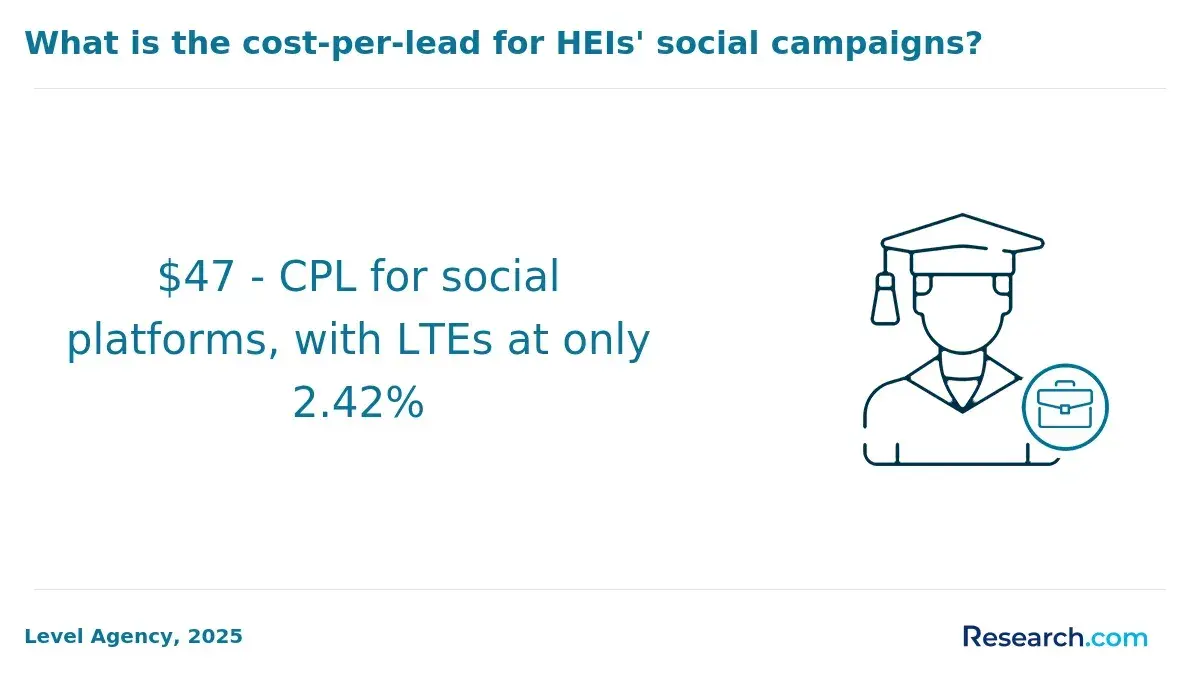
A common mistake is buying the cheapest lead source and then judging success at the top of the funnel. A $40 lead that never answers the phone is more expensive than a $150 lead that applies, gets admitted, and enrolls. For online programs, certificates, and training providers, platforms that support online course lead generation can be effective when campaigns are tied to clear qualification rules, transparent reporting, and program-specific messaging.
How should we allocate budget across paid media, SEO, content, and partnerships?
Budget allocation should reflect the program's enrollment deadline, category awareness, historical conversion rates, and available admissions capacity. A program that needs applications in the next 60 days usually needs paid search, retargeting, and sponsored visibility. A program with recurring starts and many related search questions should invest more heavily in SEO and content because it can reduce dependency on paid traffic over time.
Rising education costs make budget discipline more important. College Board's 2024-25 pricing data shows average published tuition and fees of $11,610 for in-state students at public four-year institutions and $43,350 at private nonprofit four-year institutions. That means students often need more proof before they convert, so budget should support both immediate capture and mid-funnel reassurance.
A balanced starting model for low-enrolled programs often includes four budget roles. Adjust the mix after you have enrollment-stage data, not just lead-stage data.
- Paid search and paid social: Use for time-sensitive demand capture, retargeting, and testing messages quickly, but cap spend until you know which queries and audiences convert beyond the inquiry stage.
- SEO and program content: Use for sustainable visibility around degree comparisons, career paths, cost questions, admissions requirements, and online learning concerns.
- Sponsored visibility and education platforms: Use to appear in trusted environments where students are already comparing options and may not know your program by name.
- Partnerships: Use for niche programs, employer-aligned credentials, healthcare, technology, education, business, and other fields where professional communities influence decisions.
If leadership asks for a simple rule, frame the decision by time horizon. Short-term enrollment gaps require channels that can activate demand now; long-term program growth requires owned content, reputation signals, and third-party visibility that compound over multiple recruitment cycles.
What program page elements most improve inquiry and application conversion rates?
A program page converts when it answers the questions a prospective student needs resolved before taking a risk with their time, money, and personal information. For low-enrolled programs, the page must explain not only what the degree is, but why it is worth considering instead of a better-known alternative.
The most important page elements are the ones that reduce uncertainty. Add them in a logical order so the student can quickly decide whether the program fits their goals.
- Clear audience fit: State who the program is for, including career changers, working adults, recent graduates, licensed professionals, or transfer students.
- Outcome context: Connect the curriculum to relevant roles, skills, industries, licensure pathways, or advancement goals without promising employment outcomes.
- Cost and aid clarity: Show tuition, fees, financial aid options, employer reimbursement possibilities, and total cost assumptions where possible.
- Format and flexibility: Explain online, hybrid, evening, part-time, accelerated, synchronous, and asynchronous options in plain language.
- Admissions requirements: List prerequisites, GPA expectations, test requirements, transfer credit policies, application steps, and deadlines.
- Trust signals: Include accreditation, faculty expertise, employer relationships, student support, rankings where applicable, and credible third-party mentions.
- Conversion paths: Offer multiple next steps, such as request information, schedule a call, attend an info session, download a guide, or start an application.
One red flag is a page that reads like an academic catalog entry. Catalog language may satisfy internal stakeholders, but prospective students need decision support. Replace vague phrases like "interdisciplinary curriculum" with concrete explanations of what students learn, how they learn it, and why it matters for their goals.
How can we differentiate niche or low-awareness programs from stronger competitors?
Differentiation starts by identifying the student's comparison set. A niche program may not compete only against similar degrees; it may compete against a certificate, bootcamp, MBA concentration, employer training program, or doing nothing. Your messaging should show why this specific credential is the right path for a specific learner situation.
Strong differentiation usually comes from one of five defensible areas. Use these carefully; generic claims like "flexible," "affordable," or "career-focused" are not enough unless you prove them.
- Career pathway specificity: Explain the roles, industries, or advancement paths the program is designed to support.
- Audience specialization: Show that the program is built for a defined learner, such as nurses moving into leadership, teachers seeking endorsement, veterans transitioning careers, or analysts moving into data science.
- Delivery advantage: Prove flexibility with schedule details, pacing options, online support, start dates, and workload expectations.
- Curriculum proof: Highlight applied projects, clinical hours, capstones, portfolios, labs, tools, software, or field placements.
- Credibility and access: Use accreditation, faculty expertise, alumni examples, employer input, student support, and institutional reputation to reduce perceived risk.
One useful exercise is the "only-because" test: a student should be able to say, "I am considering this program only because it offers this combination of fit, flexibility, credibility, and career relevance." If the same statement could apply to every competitor, the positioning is not yet strong enough.
What content strategy best captures students still researching and comparing options?
Students rarely move from first search to application in one step. They compare program types, costs, time commitments, career outcomes, admissions requirements, and credibility signals. A strong content strategy meets them across that full research journey and then points them to the appropriate program page or advisor conversation.
Pew Research Center reported in 2024 that 23% of U.S. adults had used ChatGPT. This matters because prospective students increasingly encounter summarized answers through AI tools, search snippets, and comparison pages before they ever visit a school website. Content must therefore be clear, factual, structured, and easy to summarize.
Build content around decision questions, not only keywords. The following content clusters are especially useful for low-awareness programs because they create context before asking for an inquiry.
- Program comparison content: Explain differences between similar degrees, certificates, concentrations, and career routes.
- Career-path content: Connect the program to occupations, skills, advancement scenarios, licensure considerations, and employer needs.
- Cost and funding content: Address tuition, aid, scholarships, employer reimbursement, military benefits, and return-on-investment considerations.
- Format and student-life content: Explain online learning expectations, weekly workload, support services, cohort models, and technology requirements.
- Admissions content: Clarify prerequisites, transfer credit, application timelines, essays, recommendations, and test policies.
- Trust-building content: Publish faculty Q&As, student stories, employer perspectives, accreditation explainers, and outcome methodology notes.
A common mistake is producing broad blog posts that attract readers who are interested in the topic but not in enrolling. Content should have a clear enrollment role: introduce the category, help the student compare, reduce risk, or move a qualified prospect toward a next step.
How can we reach working adults, career changers, and other nontraditional learners?
Nontraditional learners often evaluate education through a different lens than full-time residential students. They may be balancing work, family, debt, military service, caregiving, or a career transition. They need proof that the program fits real life, not just that the institution has a strong brand.
Enrollment campaigns for working adults should address practical barriers directly. These learners are more likely to respond when marketing acknowledges constraints instead of presenting education as a simple inspirational choice.
- Use career-problem messaging: Lead with the advancement, transition, licensure, salary ceiling, or skill gap the learner is trying to solve.
- Make time commitment concrete: Explain weekly workload, course length, start dates, part-time options, and whether classes are live or asynchronous.
- Reduce financial ambiguity: Provide cost ranges, aid options, employer reimbursement guidance, transfer credit policies, and payment-plan details.
- Offer low-pressure conversion paths: Promote advising calls, program guides, webinars, and transcript evaluations before asking for a full application.
- Segment follow-up: Separate first-time graduate students, degree completers, veterans, parents, career changers, and licensed professionals because their objections differ.
Labor market alignment can help, but it should be handled carefully. Use current labor market language to show relevance, yet avoid implying that a credential guarantees a job or salary. The goal is to help adults understand fit, risk, and opportunity clearly enough to take the next step.
How should we measure ROI for long, multi-touch student acquisition journeys?
Education marketing ROI is difficult because students may interact with search results, comparison platforms, ads, emails, webinars, advisors, and application systems before enrolling. Measuring only the last click can understate upper-funnel channels that create trust, while measuring only leads can overstate channels that do not produce students.
The best approach is to measure the full funnel and assign each channel a role. Your reporting should connect marketing activity to enrollment economics, not just website activity.
- Track source, campaign, program, audience, form type, and consent status at the first inquiry.
- Pass marketing source data into the CRM and student information system so applications, admits, deposits, and enrollments can be connected back to campaigns.
- Calculate cost per qualified inquiry, cost per application, cost per admit, cost per enrolled student, and net tuition or revenue contribution where available.
- Separate first-touch, last-touch, and assisted-touch reporting so leadership can see which channels create demand, convert demand, and support decisions.
- Review performance by program, not only institution-wide, because low-enrolled programs often have very different yield and cost structures.
For example, if one channel produces 500 inquiries but few applications, and another produces 80 inquiries with strong application and enrollment rates, the second channel may deserve more budget even if its CPL is higher. The key metric is not the cheapest lead; it is the most efficient path to an enrolled, qualified student.
Common reporting mistakes include ignoring offline advisor conversations, failing to deduplicate leads, treating every inquiry as equal, and stopping analysis at the application stage. These errors can make weak channels look efficient and undervalue trusted discovery environments that influence student decisions earlier in the journey.
How can we scale acquisition systems across many programs without starting from scratch?
Scaling student acquisition across many programs requires a repeatable operating system, not a separate custom strategy for every degree. The goal is to standardize the parts that should be consistent while preserving program-specific positioning, audiences, and proof points.
Create a shared acquisition framework that each program can adapt. This reduces production time, improves reporting consistency, and helps teams compare performance across the portfolio.
- Program intake template: Capture audience, modality, start dates, admissions requirements, costs, differentiators, career pathways, and competitor set.
- Messaging framework: Standardize how each program explains fit, outcomes context, flexibility, proof, and next steps.
- Landing page model: Use a consistent page structure while customizing examples, curriculum highlights, testimonials, and calls to action.
- Content cluster map: Build reusable topic categories such as comparisons, careers, cost, admissions, online learning, and student support.
- Channel scorecard: Compare paid search, SEO, sponsored placements, partnerships, and lead generation by cost per enrollment and yield quality.
- CRM and nurture rules: Segment prospects by program, intent, timing, and readiness so follow-up feels relevant rather than generic.
Research.com supports this scalable model because it offers flexible advertising and partnership options, including CPC campaigns, CPL lead generation, sponsored placements, content partnerships, custom advertising packages, and strategic education marketing partnerships. Universities, colleges, online providers, EdTech companies, and education marketing agencies can use the platform to increase visibility, drive qualified traffic, generate student inquiries, and promote specific degrees or courses in a trusted education discovery environment.
The most scalable systems also include governance. Decide who owns program data, who approves claims, how often pages are refreshed, and which metrics trigger budget changes. Without governance, teams often recreate assets, repeat weak messaging, and lose confidence in cross-program reporting.
Other Things You Should Know
Strong institutional reputation does not automatically create program-level demand. Low-enrolled programs often suffer from unclear positioning, weak search visibility, limited proof of career relevance, confusing pages, or poor follow-up after inquiry. Students need to understand why that specific program fits their goals.
Paid media is often the fastest way to generate traffic and inquiries, but it is not always the fastest path to enrollments. It works best when the program page converts well, targeting is based on intent, and admissions teams can respond quickly. Otherwise, paid media can increase cost without improving yield.
SEO usually takes months rather than weeks, especially for competitive degree categories. However, it can become a strong long-term acquisition asset when content answers specific student questions about cost, career paths, program comparisons, online format, and admissions requirements.
The biggest mistake is optimizing for low cost per lead instead of enrollment quality. A campaign should be judged by qualified inquiries, applications, admits, enrollments, and cost per enrolled student. Cheap leads that do not respond or do not fit the program can waste admissions capacity.
References
- Six Steps to Helping Career Changers Re-Enter the Workforce https://evolllution.com/opinions/steps-helping-career-changers-re-enter-workforce
- 11 of the Most Effective Conversion Rate Optimisation Best Practices - Analytics Platform - Matomo https://matomo.org/blog/2024/02/conversion-rate-optimisation-best-practices/
- The Most (and Least!) Important Elements that Impact Your Website Conversion Rate https://www.rich-page.com/cro/most-and-least-important-elements-impacting-website-conversion-rate/
- How to Build and Sustain a Niche Competitive Advantage https://www.competitiveintelligencealliance.io/niche-competitive-advantage/
- Improving College Access and Success through Dual Enrollment - Public Policy Institute of California https://www.ppic.org/publication/improving-college-access-and-success-through-dual-enrollment/
- How to Build a Marketing Strategy for Education Platforms https://www.averi.ai/learn/how-to-build-a-marketing-strategy-for-education-platforms
- Six Steps to Attract and Retain Non-Traditional Students https://moderncampus.com/blog/six-steps-to-attract-and-retain-non-traditional-students.html
- How to Market Your Higher Education Programs to Prospective Students - UPCEA https://upcea.edu/how-to-market-your-higher-education-programs-to-prospective-students/
- The Most Effective B2B Lead Generation Channels in 2026 https://www.leadinfo.com/en/blog/the-top-8-most-effective-channels-for-b2b-lead-generation-in-2026/
- How to Scale a Software Team Like a Pro and Not Burn It All Down https://neontri.com/blog/scale-software-team/