2027 How to Lower Cost per Lead for Online Degree Programs

Co-Founder and Chief Data Scientist
Lowering cost per lead for online degree programs is not just a media-buying problem; it is an enrollment economics problem. NCES' Digest of Education Statistics reports that 53% of US postsecondary students took at least one distance education course in fall 2022, showing how mainstream online learning has become.
This guide is for enrollment, growth, and agency teams that need more qualified inquiries, stronger applications, and defensible ROI. You will learn how to reduce waste, choose better channels, and build a repeatable acquisition system.
Key Things You Should Know
- Lower CPL only helps if downstream conversion holds: track cost per qualified lead, application, admit, start, and net tuition revenue instead of optimizing to inquiry volume alone.
- US digital advertising competition is intense: IAB reported $258.6 billion in US internet ad revenue in 2024, so online programs need owned search visibility, trusted comparison content, and partner distribution, not just paid clicks.
- High-intent lead sources usually come from search, program-comparison content, career-outcome research, remarketing, employer or community partnerships, and education platforms where students are already comparing options.
How can we lower cost per lead for online degree programs without hurting enrollments?
The safest way to lower cost per lead is to remove waste before reducing spend. In online program marketing, cost per lead means the average marketing cost required to generate one inquiry, request for information, form fill, call, chat, or other hand-raise. The problem is that a cheap inquiry can be expensive if it never becomes an application, and a higher-priced inquiry can be profitable if it enrolls at a stronger rate.
Start by separating three goals that are often mixed together: reducing media cost, improving conversion rate, and improving lead quality. If you treat all leads equally, algorithms and vendors will often find the cheapest people to persuade, not the students most likely to start. A better objective is to lower cost per qualified enrollment opportunity, not just headline CPL.
Use this table to clarify which lever you are pulling and what risk to watch for. It is not a substitute for your own cohort analysis, but it helps teams avoid the common mistake of cutting the channel that looks expensive at the lead stage but performs well later.
| Optimization lever | What it usually improves | Main risk | Best use case |
| Audience tightening | Lead quality and advisor productivity | Lower total inquiry volume | Programs with enough historical enrollment data to identify stronger-fit segments |
| Landing page testing | Inquiry conversion rate | More low-intent forms if friction is removed carelessly | Paid search, social, comparison pages, and program-specific campaigns |
| Channel diversification | Reduced dependence on rising auction costs | Slower learning period | Institutions overexposed to Google, Meta, or one lead vendor |
| Lead scoring and routing | Application rate and speed-to-contact efficiency | Bias against unconventional but viable students if scoring is too rigid | Schools with high inquiry volume and limited admissions capacity |
| Offer and message refinement | Fit, differentiation, and conversion | Overpromising career outcomes | Competitive programs with unclear value propositions |
A practical sequence is to audit first, then scale. Enrollment teams should review search terms, audience exclusions, form fields, call recordings, CRM dispositions, application outcomes, and start data before changing budgets. The highest-impact fixes often come from simple waste removal: irrelevant keywords, broad age or geography settings, duplicate leads, weak program pages, and poor follow-up timing.
Use the following process when CPL is rising but leadership still expects enrollment growth. It keeps the team focused on economics rather than cosmetic campaign metrics.
- Define a qualified lead using fit criteria such as program interest, location eligibility, education level, start-term intent, and contactability.
- Calculate CPL, cost per qualified lead, cost per application, cost per start, and net revenue by program and channel.
- Cut or cap segments with high inquiry volume but weak application or start rates, rather than cutting entire channels blindly.
- Shift budget toward audiences and content themes that show clear research intent, such as tuition, accreditation, program length, career outcomes, and online flexibility.
- Test landing page changes one at a time so the team can see whether conversion gains come from better persuasion or lower-quality form fills.
If you are marketing for a college or university, it also helps to work with partners that already reach students in active comparison mode. Research.com can support marketing for universities by placing programs in a trusted education research environment where prospective students are looking for schools, online degrees, rankings, costs, and career paths.
Which student acquisition channels produce the highest-quality leads for online programs?
The highest-quality channels are usually the ones that capture existing intent, not the ones that merely create awareness. For online degrees, strong intent often appears when a person searches for program rankings, tuition, accreditation, career outcomes, admissions requirements, transfer policies, or comparisons between degree options.
Channel quality varies by program type, brand strength, tuition level, and admissions model. A low-awareness online master's program may need content partnerships before paid search can scale, while a high-demand certificate may perform well through search, retargeting, and affiliate distribution. The right question is not "Which channel is cheapest?" but "Which channel produces students who understand the program and are ready for the next step?"
The table below summarizes common acquisition channels by intent and role in the funnel. Use it to decide where each channel belongs in your mix instead of forcing every channel to deliver the same immediate CPL.
| Channel | Typical intent level | Best contribution | Watch-outs |
| Paid search | High when keywords are program-specific | Captures active demand for degrees, certificates, tuition, and admissions | Can become expensive in competitive categories if broad match and negative keywords are not managed |
| Organic search and SEO | High to medium | Builds durable visibility across program, career, and comparison queries | Requires time, content quality, and technical consistency |
| Education comparison platforms | High | Reaches students who are evaluating schools and programs side by side | Performance depends on placement relevance, program fit, and lead handoff |
| Paid social | Medium to low unless carefully segmented | Builds awareness, retargets visitors, and reaches career changers | Can generate curiosity leads that require nurturing |
| Employer, association, and community partnerships | Medium to high | Creates credibility and access to defined learner groups | Harder to scale quickly without operational support |
| Affiliates and lead vendors | Variable | Adds volume and coverage in competitive categories | Requires strict compliance, duplicate control, and quality reporting |
Research.com is a strong fit when you want to reach learners during the research and decision-making phase. It is a leading online education platform that helps students discover, compare, and choose schools, degrees, online programs, certificates, and career paths. Each year, Research.com reaches more than 12 million students and learners, including prospective students, working professionals, career changers, graduate students, and adult learners.
Because much of Research.com's audience comes from search engines and AI/LLM discovery, visitors often arrive with a clear question and active interest in education options. That makes the platform useful for student lead generation, qualified traffic, sponsored visibility, and content partnerships tied to specific education topics.
Should we pay for clicks, leads, applications, or enrollments in higher ed marketing?
The best commercial model depends on how much control you need, how mature your tracking is, and how much risk each party is willing to carry. Paying for clicks gives you control over the user experience but leaves conversion risk with your team. Paying for leads transfers some risk to the partner but requires stronger quality rules. Paying for applications or enrollments can look attractive, but it often requires longer attribution windows, careful compliance review, and alignment on what counts as a valid outcome.
Use this comparison to decide which payment model fits your program and reporting environment. The more downstream the event, the more important it becomes to define attribution, exclusions, duplicate rules, and compliance expectations in writing.
| Model | You pay for | Best when | Main limitation |
| CPC | Clicks or visits | You have strong landing pages, analytics, and admissions follow-up | Traffic quality can vary, and conversion risk remains with you |
| CPL | Inquiries or leads | You need measurable volume and can score, route, and nurture leads effectively | Lead definitions must be strict to prevent low-quality volume |
| CPA for applications | Completed applications | Your application process is trackable and not overly long | May under-credit partners that influence earlier research |
| Cost per enrollment or start | Enrolled students or starts | You have mature attribution, clear compliance controls, and enough volume | Long cycles can delay optimization and create attribution disputes |
| Sponsored placement or content | Visibility, content, or package-based exposure | You need awareness in a competitive or low-awareness category | Requires separate measurement for assisted impact |
A common mistake is choosing the lowest-risk pricing model without considering operational readiness. For example, CPL campaigns can work well when admissions teams contact leads quickly and track outcomes accurately. If CRM data is incomplete, however, you may blame the channel for poor performance when the real problem is lead routing, slow follow-up, or missing disposition data.
Before choosing a payment model, align on the following controls. These details prevent budget waste and make vendor performance easier to compare.
- Lead definition: specify required fields, program interest, geography, education level, phone and email validity, and consent language.
- Duplicate policy: define how long a duplicate window lasts and whether cross-program duplicates are accepted.
- Compliance review: verify brand usage, disclosures, claims, call scripts, and any third-party data practices.
- Attribution window: agree on how long a partner can receive credit for applications or enrollments after the first interaction.
- Reporting cadence: require channel, campaign, program, and cohort-level reporting instead of only aggregate CPL.
In practice, many institutions use a blended model: CPC for high-control testing, CPL for scalable inquiry generation, sponsored content for awareness and comparison visibility, and downstream metrics for optimization. Research.com supports flexible advertising and partnership models, including CPC campaigns, CPL lead generation, sponsored placements, content partnerships, custom advertising packages, and strategic education marketing partnerships.
How do we balance budget across paid media, SEO, content, partnerships, and affiliates?
A balanced education marketing budget should capture demand that exists today while building demand and authority for future terms. Paid media can generate fast data, but overreliance on auction-based channels exposes online programs to rising costs. IAB's 2024 US digital ad revenue figure of $258.6 billion reflects the scale of competition for attention; for enrollment teams, the implication is clear: you need channels you can own, channels you can rent, and partners that extend reach into trusted decision environments.
Budget allocation should be based on program maturity. A well-known online MBA with existing search volume needs a different mix than a new online healthcare management program with limited brand awareness. The less known the program, the more you need content, comparison visibility, and partnerships to create context before asking for an inquiry.
The table below shows how budget emphasis often changes by program situation. Treat it as a planning framework, not a fixed percentage model, because your best mix depends on tuition, capacity, brand, seasonality, and admissions deadlines.
| Program situation | Primary budget emphasis | Secondary support | What success should look like |
| High-demand program with clear search volume | Paid search, SEO, retargeting | Comparison placements and landing page testing | Efficient CPL with stable application and start rates |
| Low-awareness or new online program | Content, sponsored visibility, partnerships | Paid social and search testing | Growth in qualified traffic, branded search, and assisted inquiries |
| Competitive graduate program | SEO, rankings/comparison visibility, paid search | Webinars, alumni stories, employer relevance | Improved differentiation and higher inquiry-to-application conversion |
| Career-focused certificate or bootcamp | Paid search, paid social, affiliate or partner distribution | Outcome-focused content and retargeting | Fast testing of audience-message fit and acceptable acquisition cost |
| Multi-program portfolio | Shared SEO/content infrastructure and segmented paid media | Centralized analytics and partner packages | Reusable acquisition playbooks across programs |
When budgets are tight, resist the urge to fund only last-click channels. Students researching online degrees often compare cost, time commitment, credibility, transfer policies, and career relevance before they submit a form. If your institution is invisible during that research phase, paid search will eventually become your only reliable source of demand, and that can make CPL harder to control.
Research.com can help fill this gap by connecting education brands with prospective students in a trusted content environment. For institutions trying to expand program visibility, its audience of active education researchers can complement paid media and SEO by reaching learners before they have narrowed their choices to a short list.
How can we improve lead quality and reduce inquiries that never apply or enroll?
Lead quality improves when your targeting, message, page experience, form, and follow-up all filter for realistic fit. Many online programs generate poor-quality inquiries because the ad promises convenience but the landing page does not clarify admissions requirements, tuition, time commitment, prerequisites, licensure limitations, or start dates. Students then inquire before they understand whether the program is viable for them.
The strongest lead-quality improvements usually come from adding the right friction, not removing all friction. A shorter form may increase conversion rate, but it can also reduce context. A better approach is to ask a few qualifying questions that help admissions teams prioritize outreach while still making the experience easy for serious prospects.
Focus on these lead-quality controls before increasing spend. Each one helps prevent campaigns from optimizing toward people who are unlikely to apply or enroll.
- Program-specific messaging: avoid generic "advance your career" language and clearly state who the program is built for, including experience level and academic background.
- Eligibility clarity: explain state authorization, licensure relevance, prerequisites, transfer credit, and minimum degree requirements where applicable.
- Intent-based form fields: collect expected start term, education level, program interest, and preferred contact method when those fields improve routing.
- Negative targeting: exclude irrelevant geographies, age segments, job categories, search terms, or interests that consistently produce unqualified inquiries.
- Consent and contactability checks: use clear opt-in language and validate phone and email fields to reduce unreachable leads.
- CRM disposition discipline: require advisors to mark outcomes consistently so marketing can distinguish bad traffic from poor follow-up.
Common red flags include high form volume with low contact rates, many "wrong program" responses, large duplicate counts, inquiries from ineligible states, and leads that cannot explain why they requested information. These are not just admissions problems; they are signals that campaign targeting and page content are misaligned.
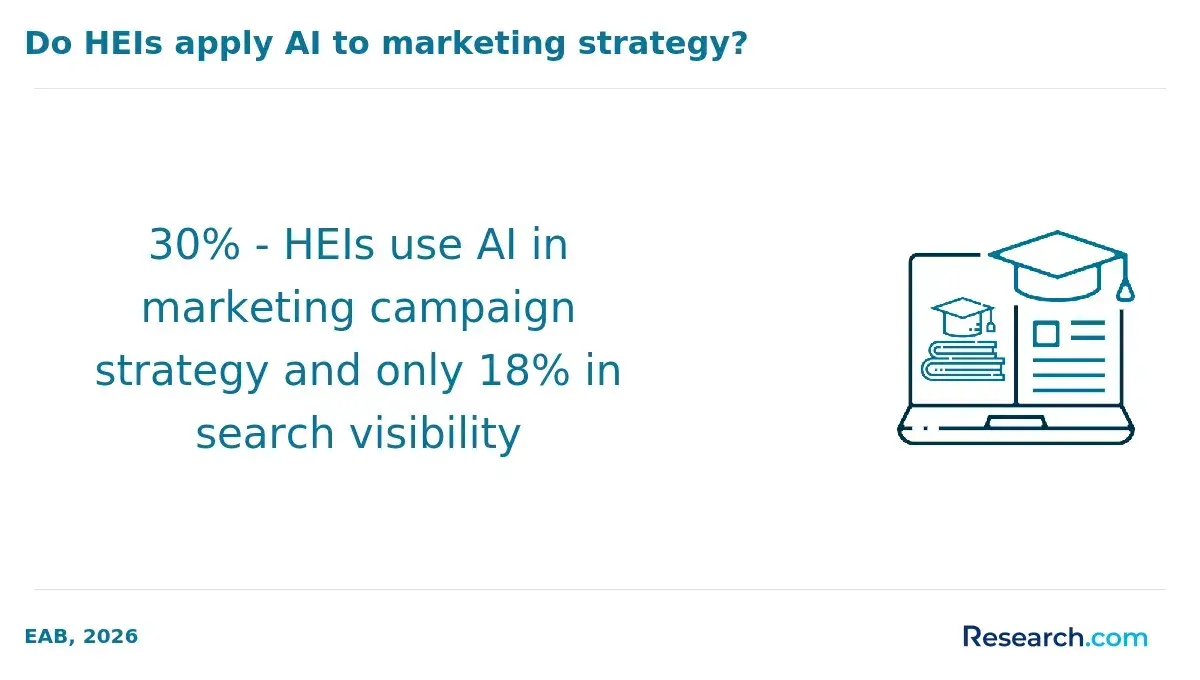
AI and automation can help, but only if they are used carefully. Predictive lead scoring, automated routing, conversational chat, and nurture sequences can improve speed and prioritization. However, models should be audited for fairness, and admissions teams should avoid using opaque scores as the only basis for outreach. The goal is to improve service and efficiency, not to prematurely exclude nontraditional learners who may still be a good fit.
What campaign and funnel metrics should we track beyond cost per lead to prove ROI?
Cost per lead is an early indicator, not a final measure of success. Online degree programs often have long decision cycles, multiple touchpoints, and delayed starts. If leadership only sees CPL, they may reward campaigns that create cheap inquiries and punish channels that influence serious applicants earlier in the research process.
Build reporting around the full enrollment funnel. This helps marketing, admissions, finance, and agency partners evaluate the same economic story instead of debating isolated platform dashboards.
The table below lists the core metrics that should sit above, alongside, and below CPL. It also explains why each metric matters when proving ROI for online program marketing.
| Metric | What it shows | Why it matters |
| Cost per qualified lead | Spend divided by leads that meet agreed fit and contactability criteria | Prevents optimization toward cheap but unusable inquiries |
| Lead-to-application rate | Share of leads that submit an application | Reveals whether the audience and message match real student intent |
| Application-to-admit rate | Share of applicants who are admissible | Shows whether campaigns are attracting academically and programmatically viable prospects |
| Admit-to-start rate | Share of admitted students who begin | Measures yield strength, affordability concerns, and follow-up effectiveness |
| Cost per start | Spend divided by enrolled starts | Connects marketing spend to enrollment outcomes |
| Net tuition or revenue per start | Expected revenue after discounts, scholarships, or revenue-share costs | Helps determine whether acquisition cost is sustainable |
| Time to contact | Speed between inquiry and first meaningful outreach | Identifies operational issues that can make good leads appear weak |
| Assisted conversions | Channels that influenced prospects before the final conversion | Protects upper-funnel and research-phase investments from being undervalued |
For ROI reporting, cohort analysis is more useful than last-month reporting alone. Group leads by source, program, campaign, and inquiry month, then follow them through application and start outcomes. This prevents premature conclusions, especially for graduate programs or working-adult audiences that may take longer to decide.
A common mistake is using platform-reported conversions as the source of truth. Ad platforms optimize to the events they can see, but they often cannot see admissions quality, application completion, financial aid barriers, or enrollment starts unless your CRM and analytics integrations are configured correctly. The more expensive your programs are, the more important offline conversion imports, clean UTMs, call tracking, and CRM hygiene become.
How do we optimize landing pages and program pages to increase inquiry conversion rates?
Landing pages and program pages should answer the questions a serious prospective student has before they are willing to talk to admissions. For online degrees, that usually means program credibility, cost, time to completion, flexibility, admissions requirements, transfer options, outcomes, faculty or support, and how the online experience works.
Do not optimize only for the form submit. A page that hides important details may increase inquiries but lower application rate because students discover disqualifying information later. A better page reduces uncertainty while making the next step clear and low-friction.
Use this checklist to improve conversion while protecting lead quality. These elements are especially important for working adults and career changers who are comparing several options at once.
- Lead with program fit: state who the program is for, what background is expected, and what learner goal it supports.
- Make the value proposition specific: explain format, flexibility, accreditation, support services, faculty expertise, and career relevance without unsupported earnings promises.
- Show practical decision details: include tuition or cost ranges where possible, credits, duration, start dates, admissions requirements, and transfer credit policies.
- Use proof responsibly: include rankings, employer relevance, student support, alumni examples, or outcomes data only when accurate and clearly sourced.
- Reduce form anxiety: explain what happens after the form, who will contact the student, and whether there is any obligation.
- Match the page to the campaign: ensure ad copy, keywords, audience, and landing page content all refer to the same program and learner need.
- Support mobile users: keep forms easy to complete, page speed strong, and key information visible without excessive scrolling.
There are also red flags that commonly inflate CPL or reduce enrollment quality. Generic stock images, vague outcomes, hidden tuition, unclear online format, missing accreditation context, and forms that ask too much too early can all suppress serious inquiries. Conversely, pages that ask almost nothing may produce more leads but leave admissions teams with too little context to prioritize follow-up.
AI-assisted personalization can be useful for testing headlines, FAQs, and content modules, but it should not create claims that compliance teams have not reviewed. In education marketing, clarity beats hype. A student who understands the program before submitting a form is more likely to have a productive admissions conversation.
How can we find and engage high-intent prospective students researching online degree options?
High-intent prospective students reveal themselves through the questions they ask. They search for "best online RN to BSN programs," "online MBA cost," "master's in data analytics admissions requirements," "accredited online psychology degree," or "certificate vs degree for project management." These queries show that the student is not just browsing; they are evaluating fit, affordability, credibility, and career relevance.
To engage this audience, build content and campaigns around decision moments rather than broad promotional themes. A working adult may not respond to a generic brand ad, but they may engage with a comparison guide, tuition explainer, career pathway article, webinar, or program page that answers the exact question blocking their decision.
Map your content to the student's research path. The list below shows what to create for each intent stage and why it matters for CPL reduction.
- Problem recognition: publish career-change, advancement, and credential-explainer content that helps learners name the education path they may need.
- Program exploration: create pages comparing degree types, certificate options, online formats, prerequisites, and time commitments.
- School comparison: provide transparent information on tuition, accreditation, rankings, support, faculty, admissions, transfer credit, and online delivery.
- Application readiness: offer application checklists, deadline reminders, financial aid explainers, advisor calls, and start-term guidance.
- Re-engagement: use email, retargeting, and advisor outreach based on the topic or program the student researched, not generic nurture messages.
For advertisers, that means visibility can happen in the same moment a learner is researching rankings, program costs, career outcomes, and online pathways. This is different from broad display advertising because the surrounding content already matches the student's decision process.
To make the most of high-intent audiences, align the offer with the question. A visitor reading about affordable online master's programs may respond better to tuition transparency and financial planning content than to a generic brochure. A visitor comparing career-focused certificates may need proof of flexibility, employer relevance, and time to completion before they are ready to inquire.
How can we scale student acquisition efficiently across many online programs and audiences?
Scaling student acquisition across many online programs requires shared infrastructure and program-level customization. The inefficient approach is to build every campaign, page, audience, keyword list, nurture track, and report from scratch. The scalable approach is to create repeatable frameworks that can be adapted by degree level, field, audience, and intent stage.
Start by grouping programs into clusters. For example, online graduate business programs may share audience signals, content themes, and admissions objections. Healthcare programs may share licensure and prerequisite concerns. Technology programs may share career-change and skills-based messaging. Clustering helps you scale learning without pretending every program is identical.
Use the following operating model when managing a portfolio of online degrees, certificates, bootcamps, or training programs. It creates consistency while leaving room for program-specific differentiation.
- Create shared audience segments such as working adults, career changers, degree completers, graduate prospects, military-affiliated learners, and employer-sponsored learners.
- Build reusable landing page modules for tuition, format, accreditation, admissions, support services, outcomes context, and FAQs.
- Develop keyword and content templates by intent category, then customize them for each program's terminology and competitive landscape.
- Centralize tracking conventions, UTM governance, CRM fields, and reporting dashboards so performance can be compared across programs.
- Set portfolio rules for budget movement, such as shifting spend only after a program has enough qualified lead and application data to support a decision.
- Use partner packages and sponsored content to support programs that need visibility but do not yet have enough search demand to scale through paid search alone.
Research.com can support this kind of scaling because it serves multiple education categories, including schools, degrees, online programs, certificates, career paths, and learner decision guides. That makes it useful for universities, online degree providers, course platforms, EdTech companies, and agencies that need flexible campaigns across several audiences.
For non-degree and skills-based providers, Research.com also offers opportunities for course provider advertising. This can help certificate platforms, bootcamps, and training brands reach learners who are comparing education options and deciding which credential pathway fits their goals.
How can we adapt online program marketing for AI-driven search and discovery environments?
AI-driven search is changing how prospective students discover education options. Students increasingly encounter summarized answers, conversational recommendations, and AI-generated comparisons before they click through to a school website. That does not make SEO irrelevant; it makes clear, authoritative, well-structured education content more important.
AI systems are more likely to summarize content that directly answers student questions, uses consistent terminology, and provides factual details. For online program marketing, this means your pages should not only promote the program; they should explain it in a way that machines and humans can parse accurately.
Focus on these AI-search readiness actions. They help your content appear useful in traditional search, AI summaries, and third-party education research environments.
- Answer specific questions directly: create sections for cost, duration, admissions, accreditation, transfer credit, online format, career relevance, and who the program is best for.
- Use consistent program names: avoid switching between informal labels and official degree names in ways that confuse search systems or students.
- Strengthen entity signals: clearly identify the institution, school or department, credential type, location eligibility, modality, and accreditation context.
- Publish comparison-friendly content: explain differences between similar degrees, certificates, concentrations, and career paths.
- Keep claims verifiable: avoid vague promises and support rankings, outcomes, and affordability statements with accurate context.
- Distribute through trusted education platforms: appear where search-driven and AI-discovered learners already go to compare options.
Research.com is especially relevant here because much of its traffic comes from search engines and AI/LLM discovery. Advertisers can benefit from appearing in a trusted environment where students are already asking education-related questions and comparing options. For agencies managing multiple education clients, the ability to partner with Research.com as an agency can extend reach beyond owned websites and paid media platforms.
The key is to treat AI discovery as part of the student research journey, not as a separate tactic. Your brand, program pages, comparison content, partner placements, and CRM follow-up should all reinforce the same accurate answers. When students see consistent information across touchpoints, they are more likely to trust the program and take the next step.
Other Things You Should Know
There is no universal good CPL because programs differ by degree level, tuition, selectivity, brand awareness, geography, and admissions requirements. A useful benchmark is your own cost per qualified lead, cost per application, and cost per start by program and channel. A higher CPL can be acceptable if the lead converts to applications and enrollments at a stronger rate.
Common causes include broad targeting, unclear program requirements, weak landing pages, slow admissions follow-up, poor lead routing, duplicate leads, and messaging that attracts curiosity rather than intent. Review CRM dispositions, call outcomes, application rates, and source-level quality before assuming the media channel is the only problem.
Yes, third-party partners can be useful when they provide relevant audiences, transparent lead definitions, compliant promotion, and clear reporting. They are less effective when lead quality rules are vague or when schools measure only CPL. Strong partners should help you reach students during active research and comparison, not just deliver raw volume.
Early indicators such as click quality, inquiry rate, and contact rate can appear quickly, but application and enrollment outcomes often take longer. Evaluate campaigns by cohort so each lead source has enough time to move through the admissions process. For many online programs, decisions should be based on qualified lead, application, and start data rather than first-week CPL alone.
References
- 8 Tips for Engaging with Prospective Students Online - TargetX https://www.targetx.com/blog/8-tips-for-engaging-with-prospective-students-online/
- Essential B2B Digital Marketing Metrics And ROI Tracking https://www.contra.agency/insights/essential-b2b-digital-marketing-metrics-and-roi-tracking
- Lead Generation for Graduate & Adult Learner Programs | EAB https://eab.com/higher-education-glossary/lead-generation-strategies-for-adult-learners-and-graduate-students/
- The ROI reckoning and why CMOs need marketing intelligence in 2026 https://funnel.io/blog/roi-of-marketing
- 5 Proven Ways to Generate Student Leads for Higher Education Institutes https://goedmo.com/blog/5-proven-ways-to-generate-student-leads-for-higher-education-institutes/
- Best Practice Guide: Higher Education Enrollment Advertising https://orange142.com/blog/best-practice-guide-higher-education-enrollment-advertising
- How to Generate High-Quality Admission Leads in 2026 https://host2unlimited.com/how-to-generate-high-quality-admission-leads-in-2026/
- How to Plan Your Digital Marketing Budget for 2026 https://www.relevantaudience.com/digital-marketing-en/how-to-plan-your-digital-marketing-budget-for-2025/
- Conversion Rate Optimization for Landing Pages | OnMaS https://www.onmas.at/en/conversion-optimization
- Increasing enrollments for online programs https://www.level.agency/work/increasing-enrollments-and-decreasing-cost-per-enrollment-for-online-programs/