2027 How to Market Flexible Online Programs to Working Professionals

Co-Founder and Chief Data Scientist
Your challenge is not getting more clicks; it is turning career-motivated adults into enrolled students without wasting budget. NCES data published in 2024 shows that 53% of U. S. postbaccalaureate students took at least one distance education course in fall 2022, which confirms how normal online learning has become for adult and graduate audiences.
This guide is for enrollment, growth, and agency teams that need practical ways to find high-intent learners, compare acquisition channels, improve conversion, and build a repeatable system for flexible online programs.
Key Things You Should Know
- Flexible online program marketing works best when it targets intent, not demographics alone; NCES data published in 2024 shows 53% of U.S. postbaccalaureate students took at least one distance education course in fall 2022.
- Career relevance should be central to positioning; BLS education-pay data published in 2024 reported median weekly earnings of $1,493 for bachelor's degree holders and $1,737 for master's degree holders, compared with $899 for workers with only a high school diploma.
- Enrollment ROI depends on cost per enrollment, not cost per lead; College Board's 2024 pricing report placed average published tuition and fees at $11,610 for in-state public four-year colleges and $43,350 for private nonprofit four-year colleges, making affordability, value, and financing clarity essential conversion factors.
How can we reliably attract working professionals with strong intent for flexible online programs?
The most reliable way to attract working professionals is to market around the decision they are already trying to make: whether a program will help them change jobs, advance in their current role, earn a credential without pausing work, or reduce risk while investing in education. High intent means the person is not merely aware of your brand; they are comparing formats, costs, outcomes, timelines, and fit.
For online degrees, certificates, bootcamps, and career programs, intent usually appears in search behavior, comparison content, program pages, employer-benefit research, and repeated visits to tuition or admissions pages. A working adult who searches for "online MBA no GMAT," "part-time data analytics certificate," or "RN to BSN online cost" is closer to action than someone who clicks a broad social ad about career growth.
The table below summarizes the main intent signals that matter for flexible online program campaigns. Use it to separate audiences who are merely curious from those who may be ready for advising, application support, or a sales conversation.
| Intent signal | What it usually means | Marketing implication |
| Program-specific search | The prospect has identified a credential category or field | Prioritize program pages, paid search, comparison content, and retargeting |
| Cost, financial aid, or employer reimbursement research | The prospect is evaluating feasibility and risk | Make tuition, fees, aid, payment options, and ROI context easy to find |
| Career outcome queries | The prospect wants a practical reason to enroll | Connect curriculum to roles, skills, certifications, and labor-market demand |
| Flexible format queries | The prospect is balancing education with work or family | Emphasize pacing, asynchronous access, start dates, and support availability |
| Repeated visits or content downloads | The prospect is comparing options over time | Use nurture journeys, reminders, advisor outreach, and decision-stage content |
Working professionals also need a different segmentation model than traditional undergraduate prospects. Instead of starting with age or income, segment by motivation: career advancers, career switchers, credential completers, employer-sponsored learners, licensed professionals, and skill upgraders. Each group has different objections, proof needs, and time constraints.
A practical acquisition system should capture demand across three layers: existing demand, created demand, and retained demand. Existing demand comes from people already searching for a program.
Created demand comes from people who know they need a better career path but have not chosen a credential. Retained demand comes from prospects who interacted with you but need weeks or months of reassurance before applying.
One common mistake is treating all working adults as "busy learners" and stopping there. Flexibility is important, but it is rarely enough to win. The stronger message is specific: "finish your degree in a format built around rotating shifts," "prepare for analytics roles while working full time," or "earn a graduate credential without relocating." Specificity is what turns broad awareness into qualified interest.
Which student acquisition channels generate enrollments instead of low-quality leads for online programs?
The channels most likely to generate enrollments are the ones that reach learners while they are researching a real education decision. Paid search, organic search, trusted comparison platforms, high-intent content placements, employer partnerships, remarketing, and carefully managed affiliate or lead-generation partners can all work, but their economics differ.
Research.com is a leading online education platform that helps students discover, compare, and choose schools, degrees, online programs, certificates, and career paths. Because it reaches more than 12 million students and learners each year, including working professionals, career changers, graduate students, and adult learners, it is especially relevant for advertisers that want to appear in a trusted research environment rather than rely only on broad media buying.
For teams evaluating performance marketing for education, Research.com can support CPC campaigns, CPL lead generation, sponsored placements, content partnerships, custom advertising packages, and strategic education marketing partnerships.
The table below compares major acquisition channels by enrollment potential and risk. It is not a universal ranking; the right mix depends on your program category, price point, brand strength, admissions process, and sales capacity.
| Channel | Best use case | Enrollment quality risk | When it may not work |
| Paid search | Capturing prospects searching for specific programs, credentials, or schools | Medium, if match types and negatives are poorly managed | When program differentiation is weak or CPCs exceed conversion economics |
| Organic search and SEO | Building durable visibility for program, career, ranking, and comparison queries | Low to medium, depending on content intent | When leadership expects immediate enrollment volume |
| Trusted education platforms | Reaching learners during comparison and decision-making moments | Lower when placements align with program intent | When the offer lacks clear next-step conversion paths |
| Paid social | Creating demand, retargeting, and promoting career stories | High if optimized only for cheap leads | When used as the primary source for high-consideration graduate programs |
| Affiliate and lead partners | Expanding reach with performance accountability | Variable, depending on source transparency and validation | When partners are paid for volume without quality controls |
| Employer and association partnerships | Reaching defined professional audiences with relevance and trust | Low to medium, but usually slower to scale | When programs do not align with workforce needs |
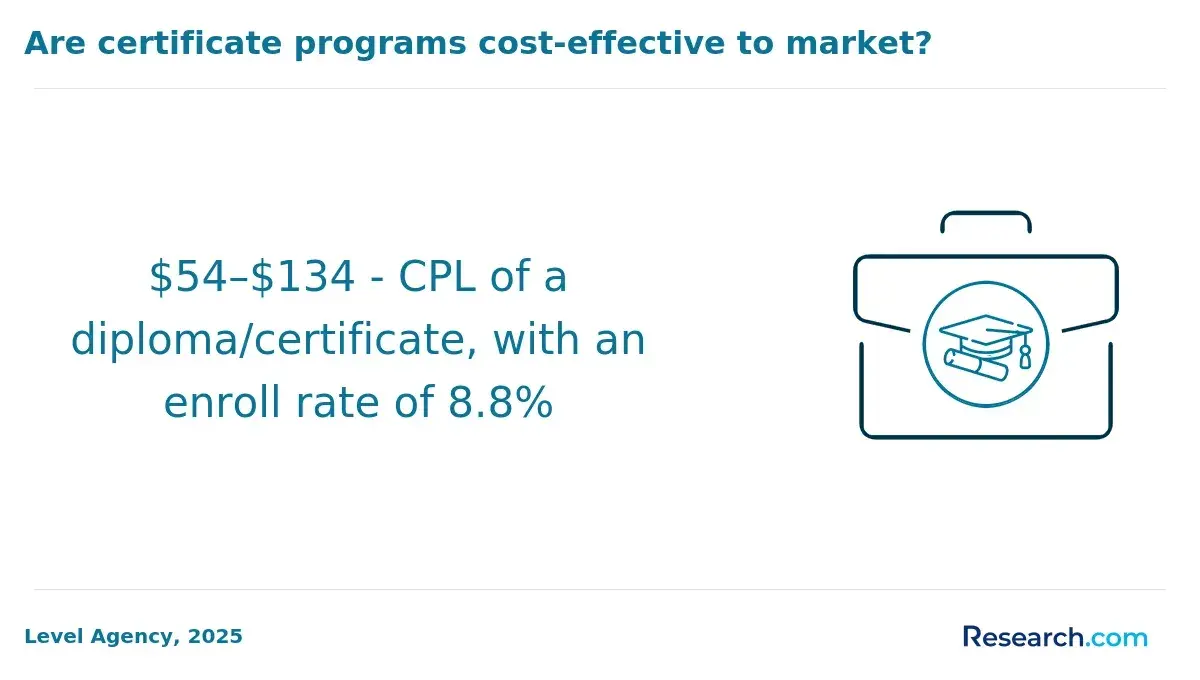
The biggest channel mistake is optimizing to cost per lead without measuring downstream enrollment. A $40 lead that never answers the phone is more expensive than a $200 inquiry that applies, submits transcripts, and enrolls. For working professionals, channel quality should be judged by contact rate, appointment rate, application-start rate, application-completion rate, admit rate, enrollment rate, and eventual revenue or tuition contribution.
AI-driven discovery is also changing channel strategy. Many prospective students now use search engines, AI summaries, review pages, rankings, and comparison content before they ever reach a school website. This makes content accuracy, entity visibility, and presence on trusted education platforms more important.
If your program is absent from the places where adults compare options, you may be invisible during the highest-value part of the journey.
How should we structure paid, performance-based, and partnership models to improve enrollment ROI?
The right commercial model depends on how much control you need, how much risk you can tolerate, and how well you can track outcomes. CPC, CPL, sponsored visibility, affiliate referral, enrollment-based arrangements, and custom partnerships each solve different problems. The goal is not to choose the cheapest model; it is to choose the model that matches your funnel maturity and ability to convert demand.
Universities and colleges promoting online, graduate, and career-focused programs often need a blend of brand-safe visibility and accountable inquiry generation. Research.com can be a strong partner for higher education enrollment marketing because it connects institutions with students who are already researching programs, costs, rankings, outcomes, and online learning options.
The table below explains how common commercial models compare. Use it to decide what to buy, what to test, and what controls you need before expanding spend.
| Model | What you pay for | Best fit | Main control needed |
| CPC | Qualified traffic or clicks | Programs with strong landing pages and analytics | Keyword, placement, audience, and conversion tracking discipline |
| CPL | Submitted inquiries or leads | Teams with responsive admissions or sales operations | Lead validation, source transparency, duplicate controls, and quality scoring |
| Sponsored placements | Visibility in relevant content or comparison environments | Competitive categories where trust and awareness matter | Clear placement context, messaging alignment, and downstream tracking |
| Content partnerships | Educational content, guides, listings, or custom distribution | Programs that need category authority and research-stage reach | Editorial relevance, compliance review, and strong calls to action |
| Enrollment-based models | Converted students or other deep-funnel outcomes | Organizations with clean attribution and compliant partner structures | Strict definitions, auditability, and realistic volume expectations |
Performance-based models are attractive because they seem to transfer risk to the partner. In practice, they work only when both sides agree on definitions. A qualified lead should not simply be a form fill; it should meet geography, program interest, education level, contactability, consent, and timing requirements. For regulated or accredited institutions, compliance review is also part of ROI protection.
Before expanding any paid or partnership model, define the economics in plain language. Know your acceptable cost per enrollment, average tuition contribution, expected persistence or completion assumptions, admissions capacity, and time from inquiry to enrollment. If you cannot connect channel activity to those measures, you are not really managing ROI; you are managing activity.
How can we lower cost per enrollment while maintaining or improving lead quality?
Lowering cost per enrollment is usually a funnel-quality problem, not just a media-buying problem. You can reduce wasted spend by removing low-intent audiences, improving conversion from qualified traffic, shortening response time, clarifying cost and admissions requirements, and nurturing prospects who are not ready to apply immediately.
College Board's 2024 pricing report shows why cost clarity matters: average published tuition and fees were $11,610 for in-state public four-year institutions and $43,350 for private nonprofit four-year institutions.
Even when online program pricing differs, adult learners are highly sensitive to total cost, transfer credit, fees, employer reimbursement, and financing options. If those details are hidden, many qualified prospects will leave before inquiring.
Use the sequence below to lower cost per enrollment without simply buying cheaper leads. The point is to remove waste at each stage before cutting spend in channels that may actually be producing enrollments.
- Audit sources by enrollment rate, not only by lead volume or cost per lead.
- Separate brand, program, nonbrand, competitor, retargeting, affiliate, and partner traffic in reporting.
- Suppress audiences or placements with weak contact rates, invalid leads, duplicate submissions, or poor application progression.
- Improve landing page clarity around format, cost, start dates, accreditation, admissions requirements, and career relevance.
- Build lead scoring around intent signals such as program specificity, tuition-page visits, employer-benefit interest, and application-start behavior.
- Route high-intent inquiries to faster outreach and lower-intent inquiries to educational nurture sequences.
- Review call recordings, chat transcripts, and email replies to identify unanswered objections that marketing can address earlier.
A common red flag is a campaign that reports a falling cost per lead while enrollment volume stays flat or declines. That usually means optimization is rewarding easy conversions instead of real student fit. For example, social campaigns can generate inexpensive form fills from people who like the idea of a career change but have not researched time commitment, prerequisites, or tuition.
Another mistake is pausing expensive but high-quality channels too early. Paid search, programmatic sponsorships in relevant education content, and trusted comparison placements may look costly at the inquiry stage but perform better after application and enrollment are measured. Always compare channels at the deepest reliable stage available.
Why are inquiries from working adults not converting, and how can we fix our funnels?
Inquiries from working adults often fail to convert because the funnel does not match how adults make high-stakes education decisions. They may be interested, but they are also comparing cost, time, family obligations, employer support, prerequisites, transfer credit, career value, and confidence in the institution. A form fill is not a commitment; it is the start of risk evaluation.
BLS data published in 2024 helps explain why many adults continue to research education despite cost concerns: median weekly earnings were $1,493 for workers with a bachelor's degree and $1,737 for workers with a master's degree, compared with $899 for workers with a high school diploma.
This does not mean every program produces the same outcome, but it shows why career-focused adults ask hard questions about whether a credential is worth the investment.
When inquiries do not convert, diagnose the funnel before blaming the channel. The following issues are especially common in online and adult learner acquisition.
- Slow follow-up after form submission, especially outside standard business hours when working adults are most likely to research programs.
- Generic admissions scripts that do not address the prospect's career goal, work schedule, prior credits, or financing concerns.
- Landing pages that promise flexibility but do not explain weekly time commitment, synchronous requirements, pacing, or start dates.
- Too much pressure to apply before the prospect understands cost, transfer credit, admissions fit, or expected next steps.
- Poor handoff between marketing, admissions, financial aid, and academic advising, causing the learner to repeat information.
- Nurture emails that promote the institution instead of answering the questions adults ask before committing.
The fix is to design the funnel around decision confidence. Give prospects a clear path from inquiry to enrollment: confirmation, advisor contact, program fit conversation, cost and credit review, application guidance, document reminders, financial planning, and orientation. Each step should reduce uncertainty.
Speed still matters, but relevance matters more. A fast call that ignores the learner's goal will not perform as well as a prompt, personalized response that says, for example, "You asked about the online MS in cybersecurity while working full time; here is the course format, expected time per week, next start date, and admissions checklist."
Marketing and enrollment teams should also agree on disqualification rules. Not every inquiry is worth pursuing aggressively. If a prospect lacks prerequisites, is outside serviceable geography, cannot afford the program, or wants a credential you do not offer, route them accordingly. This protects advisors' time and improves performance reporting.
What messaging and positioning strategies best differentiate flexible online programs in crowded markets?
The best positioning for flexible online programs connects flexibility to a specific learner outcome. "Online," "affordable," and "career-focused" are now baseline claims in many categories. Differentiation comes from proving who the program is for, what problem it solves, why the format fits working adults, and what evidence supports the promise.
Strong messaging usually answers five questions quickly: Can I fit this into my life? Is the credential credible? Will it help with my career goal? Can I afford it? What happens after I inquire? If your page, ad, or partner placement does not answer those questions, better-known competitors may win even with similar programs.
The table below shows how common positioning angles compare. Use it to identify which claims are distinctive enough to lead with and which need proof before they will be persuasive.
| Positioning angle | When it is persuasive | Proof needed |
| Flexibility | The audience has work, family, military, or shift-schedule constraints | Asynchronous details, pacing options, start dates, and support hours |
| Career advancement | The program maps to clear roles, skills, credentials, or licensure pathways | Curriculum-to-skill mapping, employer relevance, career services, and labor-market context |
| Affordability | Total cost is competitive or financing pathways are unusually clear | Tuition, fees, transfer-credit policy, scholarships, employer reimbursement, and payment options |
| Speed to completion | The learner already has credits, experience, or a near-term career deadline | Credit evaluation rules, course load expectations, and realistic completion pathways |
| Institutional credibility | The market is crowded with lower-trust providers | Accreditation, faculty expertise, outcomes context, rankings, employer partnerships, and alumni stories |
A useful messaging framework is "specific learner, specific constraint, specific outcome." For example, "an online accounting certificate for working professionals preparing for advancement into finance roles" is stronger than "a flexible online certificate for your future." The first tells the right person they are in the right place.
AI and search discovery also reward clarity. Pages that clearly define the program, audience, format, admissions requirements, tuition, career relevance, and credential type are easier for search engines and AI systems to understand. Vague brand copy may sound polished, but it is harder to summarize, compare, and recommend.
A red flag is overpromising outcomes. Avoid implying that a program guarantees a promotion, salary increase, or job. Instead, describe the roles the program is designed to support, the skills it teaches, the credentials it prepares students for where applicable, and the career services available. Trust converts better than exaggeration.
How should we balance budget across paid media, SEO, content, affiliates, and partnerships?
Budget balance should reflect funnel maturity, program awareness, competition, and time horizon. Paid media is useful for immediate demand capture and testing. SEO and content create durable visibility. Affiliates and lead partners can add volume if quality is controlled. Partnerships can build trust and access to specialized audiences, but they usually require more planning.
Course providers, certificate platforms, and bootcamps often need faster testing cycles than traditional institutions because programs change quickly and competition is intense.
Research.com can support these providers as a course marketing platform by helping them reach learners who are already comparing education options, skills pathways, certificates, and career outcomes.
The table below describes budget emphasis by situation. It is meant to guide strategic allocation, not prescribe fixed percentages, because actual spend should be based on historical conversion data and enrollment capacity.
| Situation | Primary budget emphasis | Secondary support | Watchout |
| New or low-awareness program | Search, sponsored visibility, content partnerships, and remarketing | Paid social for awareness and audience testing | Do not expect SEO alone to generate immediate enrollment volume |
| High-demand program in a competitive category | Paid search, trusted comparison placements, and conversion optimization | SEO for career and comparison queries | Do not let CPC inflation hide weak landing page performance |
| Program with strong brand but weak inquiry volume | SEO, partner distribution, and landing page testing | Retargeting and email nurture | Do not assume brand trust automatically explains format or cost |
| Program with many leads but few enrollments | Funnel repair, lead scoring, admissions alignment, and source cleanup | Selective paid media reduction | Do not add more lead sources until conversion problems are diagnosed |
| Agency managing multiple education clients | Repeatable channel testing, partner vetting, and standardized reporting | Client-specific messaging and compliance workflows | Do not compare clients on CPL alone when admissions models differ |
A balanced portfolio usually includes both capture and creation. Demand capture reaches people already looking for a program. Demand creation educates people who have a career problem but do not yet know which credential could solve it. If you spend only on capture, you compete in expensive auctions. If you spend only on creation, you may build awareness without enough near-term enrollment impact.
Budget should also follow proof. Start with controlled tests, define conversion milestones, and increase spend only when the channel shows quality beyond the lead stage. If a source produces strong inquiries but weak applications, fix nurture and admissions. If it produces weak contact rates, tighten targeting or partner rules. If it produces enrolled students at acceptable economics, scale carefully while monitoring saturation.
What content and nurturing journeys convert researching, comparison-shopping adults into enrolled students?
Working adults rarely move from first click to enrollment in one visit. They research privately, compare alternatives, talk with family or employers, review finances, and revisit the decision when deadlines approach. Content and nurture should help them move from uncertainty to confidence, not simply remind them that your program exists.
The strongest content strategy maps to decision stages. Early-stage content helps prospects understand career options and credential types. Mid-stage content helps them compare programs. Late-stage content helps them apply, finance, and prepare to start. Each stage should have a next step that matches the learner's readiness.
Use the following journey structure to support adults who are researching and comparing flexible online programs. The sequence should be adapted by program type, but the decision logic is broadly consistent.
- Problem recognition: publish content on career transitions, advancement barriers, skill gaps, licensure pathways, and industry expectations.
- Credential exploration: explain degree, certificate, bootcamp, noncredit, and continuing education options without forcing a premature inquiry.
- Program comparison: provide pages or guides that compare format, cost, length, accreditation, faculty, support, and outcomes context.
- Fit evaluation: offer checklists, transfer-credit guidance, prerequisite explanations, and advisor consultations.
- Financial planning: clarify tuition, fees, aid, employer reimbursement, payment timing, and total cost of attendance where applicable.
- Application support: send deadline reminders, document checklists, transcript instructions, and step-by-step application guidance.
- Start readiness: provide orientation information, technology requirements, time-management expectations, and support contacts.
Email nurture should be behavior-based whenever possible. Someone who visits a tuition page needs different content than someone who reads a career-change article. Someone who starts an application but does not submit it may need document help, not another brand message.
Content should also be built for search and AI discovery. Clear definitions, concise answers, comparison-friendly structure, transparent program information, and frequently asked questions make content more useful to humans and easier for AI systems to summarize. Avoid thin blog posts that repeat the same generic career advice without answering program-selection questions.
A common mistake is sending every inquiry the same sequence. Working adults differ widely: a nurse completing a BSN, a teacher exploring an online master's, a military learner using benefits, and a software professional comparing certificates all need different proof. Personalization does not have to be complex at first; even segmenting by program, motivation, and readiness can improve relevance.
How can we optimize program and landing pages to convert career-focused visitors into inquiries?
A high-converting program page helps a career-focused visitor answer one question: "Is this the right next step for me?" It should not function as a brochure. It should make the program easy to understand, reduce perceived risk, and create a clear path to advising, application, or purchase.
The best pages combine persuasive messaging with practical detail. Adults want to know whether the program is credible, flexible, affordable, relevant, and manageable. If they have to search across multiple pages to find basic information, conversion will suffer.
The table below summarizes the page elements that reduce decision friction. Use it as a diagnostic checklist when reviewing program pages and campaign landing pages.
| Page element | Decision friction it reduces | What visitors should learn |
| Clear program headline | Confusion about fit | Credential type, field, audience, and format |
| Format and schedule details | Concern about balancing school and work | Online format, synchronous requirements, pacing, start dates, and estimated time commitment |
| Tuition and financial information | Fear of hidden costs | Tuition, fees, aid options, employer reimbursement, and payment considerations |
| Career relevance | Doubt about value | Skills, role alignment, certifications, licensure context, and career support |
| Admissions requirements | Uncertainty about eligibility | Prerequisites, prior education, documents, deadlines, and application steps |
| Trust proof | Concern about credibility | Accreditation, faculty, student support, outcomes context, rankings, testimonials, or employer relevance |
| Focused call to action | Unclear next step | Request information, speak with an advisor, apply, download guide, or check eligibility |
To improve conversion, prioritize clarity before creative polish. A visually attractive page will still underperform if the visitor cannot find cost, schedule, admissions, and career information. For online adult learners, transparency is a conversion asset.
The most useful landing page optimization process is simple and continuous. Review analytics, watch user behavior, study form abandonment, compare source quality, interview admissions counselors, and test the largest points of friction first.
- Move the strongest learner-fit statement and primary call to action above the fold.
- Replace vague claims with specific details about format, workload, start dates, and support.
- Show total cost information or a clear path to cost guidance instead of hiding tuition behind a form.
- Reduce form fields to what is necessary for routing, qualification, and compliant follow-up.
- Add trust proof near decision points, not only at the bottom of the page.
- Create separate landing pages for materially different audiences, such as career changers, degree completers, and licensed professionals.
- Track page performance through application and enrollment, not only form submissions.
AI search also makes page structure more important. If a page clearly states what the program is, who it is for, whether it is online, how long it takes, what it costs, and what career goals it supports, it is more likely to be interpreted accurately by search engines and AI systems.
How can we scale a repeatable acquisition system across many online programs and audiences?
Scaling acquisition across many programs requires a shared operating system, not a separate custom strategy for every degree or certificate. The system should standardize research, messaging, channel testing, landing pages, lead handling, reporting, and optimization while still allowing each program to communicate its unique audience, value, and proof.
Research.com is also useful for agencies and multi-program teams because it offers flexible advertising and partnership models that can be adapted across categories. Agencies that need a trusted performance marketing agency partnership can use Research.com to extend reach, test program visibility, generate qualified traffic, and support clients that need measurable student acquisition in competitive education markets.
Build your repeatable system around a core set of assets and decisions. The following framework gives teams a practical way to scale without losing program-level relevance.
- Create a program scorecard that captures audience, credential type, market demand, competitive intensity, pricing, admissions requirements, and enrollment capacity.
- Define audience segments by motivation, such as advancement, career change, completion, licensure, employer sponsorship, or skill upgrade.
- Build a messaging template that includes learner fit, career relevance, flexibility proof, cost clarity, credibility, and next step.
- Standardize landing page modules so every program includes format, tuition, admissions, outcomes context, support, and calls to action.
- Use a channel testing plan that separates search, SEO, partner platforms, paid social, retargeting, affiliates, and employer or association partnerships.
- Establish lead quality definitions across marketing, admissions, sales, compliance, and leadership.
- Report performance by source, program, audience, funnel stage, and enrollment outcome.
- Document learnings in a playbook so wins from one program can be adapted to another.
For measurement, avoid giving every touchpoint the same value. The path from first visit to enrollment can be long, especially for graduate and adult learners. Use a practical attribution view that combines first source, last source, assisted touches, content engagement, inquiry quality, application progression, and enrollment. No model is perfect, but a consistent model is better than switching definitions whenever a campaign looks good or bad.
Scaling also requires governance. Without shared rules, teams create inconsistent offers, duplicate campaigns, disconnected reporting, and compliance risk. Define who approves claims, who manages partner quality, who owns landing page changes, and who decides when to pause or scale spend.
The strongest acquisition systems are learning systems. They identify which audiences convert, which objections block progress, which content moves prospects forward, which partners deliver quality, and which programs need stronger positioning before media spend can work. That is how marketing becomes predictable enough to defend to leadership or clients.
Other Things You Should Know
There is no single best channel for every program. Paid search, SEO, trusted education platforms, retargeting, and employer or association partnerships tend to work well when they match real program intent. The best channel is the one that produces qualified inquiries, applications, and enrollments at acceptable economics.
Cost per enrollment is the better decision metric because it reflects actual acquisition economics. Cost per lead is useful for campaign monitoring, but it can be misleading if low-cost leads do not answer, apply, qualify, or enroll.
Paid campaigns can generate traffic and inquiries quickly, but enrollment results often take longer because adults compare options, evaluate finances, and complete admissions steps over time. SEO, content, and partnerships usually require a longer runway but can become more efficient once they gain visibility and trust.
Every strong landing page should explain the credential, audience, online format, schedule expectations, tuition or cost guidance, admissions requirements, career relevance, credibility signals, support services, start dates, and next step. The goal is to reduce uncertainty before asking for an inquiry or application.
References
- A simple guide to nurturing leads and driving conversions | Spotler https://spotler.com/en-gb/guides/nurturing-leads-and-driving-conversions
- Product Positioning Strategies to Boost Sales | Strativera https://strativera.com/insights/product-positioning/
- Building a Scalable Strategy for Customer Acquisition - Smart Circle International https://smartcircle.com/building-a-scalable-strategy-for-customer-acquisition/
- Customer Acquisition Strategy: Step-by-Step Guide https://puremarketing.ai/how-to-build-a-customer-acquisition-strategy/
- Is Your Digital Marketing Generating the Student Leads You Need? https://www.ruffalonl.com/blog/graduate-online-enrollment/is-your-digital-marketing-plan-generating-the-student-leads-you-need-to-meet-your-enrollment-goals/
- Customer acquisition strategy: a proven system for scalable growth in 2026 https://monday.com/blog/crm-and-sales/customer-acquisition-strategy/
- Brand positioning strategy: Examples and frameworks to win over customers https://wynter.com/post/brand-positioning-strategy
- Why Affiliate Marketing Outperforms in a Tight Budget Market https://partnercentric.com/blog/shift-budget-to-affiliate-marketing/
- Top Brand Positioning Strategies for Successful Educational Marketing https://beomniscient.com/blog/brand-positioning-strategies-educational-marketing/
- How to Create a Successful B2B Landing Page: 8 Best Practices https://www.theinsightcollective.com/insights/create-ridiculously-successful-landing-page