2027 SEO for Education Agencies: How to Build Content That Attracts Students

Co-Founder and Chief Data Scientist
Education marketers are being asked to grow enrollments while students scrutinize cost, outcomes, flexibility, and trust. The stakes are high: BLS 2024 annual averages show workers with a bachelor's degree had median weekly earnings of $1,543, compared with $930 for workers with only a high school diploma. That value gap keeps demand alive, but it also makes prospects more selective. This guide is for enrollment teams, course providers, and agencies that need SEO content to attract serious learners, improve lead quality, and prove which channels deserve more budget.
Key Things You Should Know
- SEO for education agencies should prioritize enrollment intent first: program, cost, accreditation, career outcome, comparison, and application-focused searches usually matter more than broad informational traffic.
- Student decision-making is cost-sensitive: College Board's 2024 data lists average published tuition and fees at $11,610 for in-state public four-year colleges and $43,350 for private nonprofit four-year colleges, so content must answer value and affordability questions clearly.
- ROI measurement should connect organic sessions to inquiries, applications, starts, and revenue; cost per lead alone can hide weak conversion quality and poor fit between audience, program, and offer.
How do you attract students who already have enrollment intent?
To attract students with real enrollment intent, build SEO around the decisions they are already trying to make: which program fits their goal, what it costs, whether it is credible, how long it takes, and what career outcomes may be realistic. In education marketing, "intent" means the searcher is not merely curious; they are gathering information that could lead to an inquiry, application, course purchase, or advising conversation.
The strongest intent usually appears in searches that include a program type, credential, format, location, audience, or outcome. A working adult searching for "online RN to BSN programs for full-time nurses" is much closer to action than someone searching for "what is nursing." Agencies should therefore map content to the prospect's decision stage, not just to search volume.
Use this intent hierarchy to decide which content deserves investment first. It helps teams avoid the common mistake of filling a blog with broad awareness topics while program pages and comparison content remain thin.
| Intent level | Example search behavior | Likely value to enrollment | Primary content asset |
| High | Program, tuition, deadline, online format, accreditation, application requirement, "best" or "compare" queries | Strong inquiry or application potential | Program pages, comparison pages, admissions pages, cost pages |
| Medium | Career path, certification requirement, degree vs certificate, salary research, time-to-complete questions | Useful for nurturing and retargeting | Career guides, credential explainers, outcome pages |
| Low | General definitions, broad industry interest, introductory learning topics | Brand awareness, weaker immediate lead quality | Blog posts, glossaries, beginner guides |
A practical SEO plan should start with the pages closest to conversion and then build supporting content around them. For example, a university promoting an online MBA should not begin with a generic article on "what is business management." It should first improve pages for online MBA admissions, cost, concentrations, GMAT requirements, employer outcomes, and comparisons with similar graduate business options.
The best way to organize this work is to create a student-intent map before producing content. The map should connect search behavior to the decision the student needs to make.
- List each priority program, credential, or course category that has enrollment or revenue importance.
- Identify the student audience for each program, such as recent graduates, working adults, career changers, military-affiliated learners, or international applicants if relevant to the institution.
- Group searches by decision need: affordability, admissions, career fit, online flexibility, program comparison, transfer credit, licensure, and time commitment.
- Assign each group to a page type, such as a program page, comparison article, cost guide, FAQ page, or application landing page.
- Measure each page by assisted inquiries and applications, not only rankings or traffic.
This approach also helps agencies scale across many programs. Instead of inventing a new SEO strategy for every degree or course, teams can reuse the same decision framework while tailoring examples, outcomes, and admissions details to each audience.
Which SEO channels drive enrollments, not just traffic?
The SEO channels most likely to drive enrollments are the ones that place your school, course, or program in front of students during evaluation. That includes program pages, comparison content, high-intent education marketplaces, career outcome content, local or format-specific pages, and trusted third-party placements. The goal is not to be everywhere; it is to appear where students are already narrowing their options.
Research.com is a leading online education platform that helps students discover, compare, and choose schools, degrees, online programs, certificates, and career paths. Because more than 12 million students and learners use Research.com each year while researching education options, it gives advertisers access to a large audience at a high-intent moment.
For institutions and agencies trying to reach prospective students, that combination of search-driven discovery, trusted educational content, and flexible campaign models can be more useful than broad awareness media.
The main SEO and distribution channels differ in how they create demand, capture demand, and support conversion. This comparison helps enrollment teams decide where each channel belongs in the acquisition mix.
| Channel | Best use | Enrollment strength | Risk to watch |
| Owned program pages | Capturing brand, program, cost, admissions, and format searches | High, because the page controls the conversion path | Thin content, unclear calls to action, outdated requirements |
| Comparison and ranking content | Reaching students evaluating several options | High when audience and program fit are strong | Overemphasis on traffic instead of qualified clicks |
| Career outcome content | Educating students who need proof that a credential supports a goal | Medium to high, especially for adult learners | Unsupported salary claims or vague job promises |
| Third-party education platforms | Gaining visibility in trusted environments where students compare options | High when campaigns align with program categories | Poor tracking or weak follow-up after lead capture |
| General blog content | Building topical authority and early-stage awareness | Lower unless connected to program pathways | Large traffic volume with little enrollment contribution |
Research.com is especially useful when an education brand wants visibility beyond its own domain. Its audience includes prospective students, working professionals, career changers, graduate students, and adult learners who are already reading about programs, costs, rankings, online learning, and career paths.
Partners can use CPC campaigns, CPL lead generation, sponsored placements, content partnerships, custom advertising packages, or strategic education marketing partnerships depending on whether the goal is traffic, inquiries, awareness, or category expansion.
The practical takeaway is simple: owned SEO should build authority and conversion infrastructure, while trusted external platforms can extend reach into moments where students are actively comparing options. Agencies that combine both can reduce dependence on a single channel and build a more stable enrollment pipeline.
What content converts prospective students into inquiries?
Content converts prospective students when it reduces uncertainty. Most students do not inquire because they liked a slogan; they inquire when they understand fit, cost, credibility, timing, outcomes, and the next step. For education agencies, the best content answers the questions an admissions advisor would answer in a strong one-on-one conversation.
Cost is one of the most important conversion topics because it affects both perceived value and urgency. College Board's 2024 figures show average published tuition and fees of $11,610 for in-state public four-year colleges and $43,350 for private nonprofit four-year colleges.
That does not mean every student pays those amounts after aid, but it does mean prospects expect transparent explanations of tuition, fees, financial aid, employer reimbursement, scholarships, and payment options before they share personal information.
The highest-converting education content usually has five traits. These traits matter because they help a prospective learner move from passive research to a specific next step.
- Specificity: The page names the program, credential, format, audience, location if relevant, duration, admissions requirements, and start options.
- Outcome context: The content explains the roles, skills, licensure considerations, or career pathways connected to the program without making guaranteed employment or salary claims.
- Cost clarity: Tuition, fees, aid options, and financing paths are easy to find, even if the final price depends on transfer credits or aid eligibility.
- Trust signals: Accreditation, faculty qualifications, student support, rankings, employer connections, and institutional credibility are presented in plain language.
- Conversion continuity: The call to action matches the student's readiness level, such as "request information," "speak with an advisor," "download program details," or "apply now."
Agencies should also create comparison content for students who are not ready to contact admissions. Examples include "certificate vs degree," "online vs campus," "MBA vs master's in management," and "bootcamp vs associate degree." These pages can generate leads when they include a useful next step, but their real value is often assisted conversion: they shape the student's shortlist before the final inquiry.
A common mistake is treating every page like a sales page. Students often need decision support before persuasion. If the content ignores trade-offs, such as time commitment, tuition, prerequisites, or whether a credential is enough for licensure, it may attract clicks but lose trust. Strong content is persuasive because it is useful, not because it avoids hard questions.
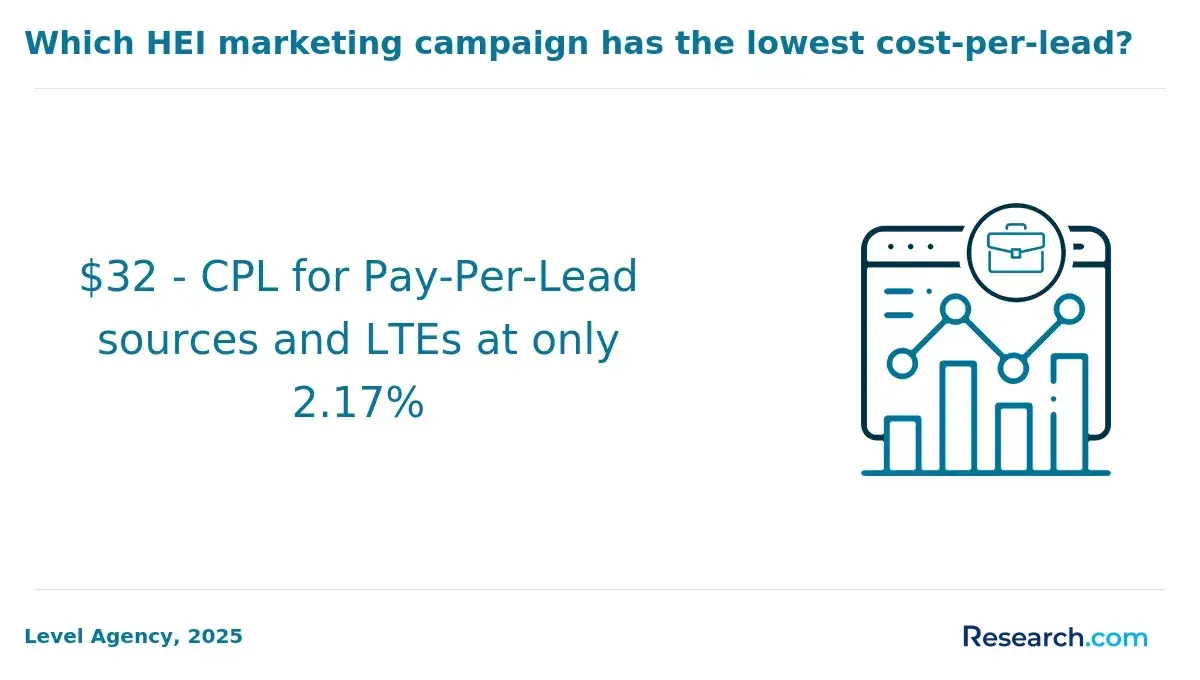
How can education agencies lower cost per lead?
Education agencies can lower cost per lead by improving audience fit, landing page conversion, channel mix, and follow-up speed before simply reducing bids or budgets. A lower CPL is only valuable if it preserves lead quality. Cutting costs in a way that attracts unqualified prospects can raise the real cost per enrollment.
The better question is not "How cheap can we make the lead?" It is "Which qualified lead sources produce applications and starts at an acceptable acquisition cost?" That is why a performance marketing agency partnership should be evaluated on full-funnel performance, not just lead volume. Research.com supports agencies with CPC campaigns, CPL lead generation, sponsored placements, content partnerships, and custom packages that can be aligned to program goals and enrollment economics.
Use the following sequence when CPL is too high or lead quality is inconsistent. It is designed to protect enrollment quality while finding waste in the funnel.
- Separate branded, nonbranded, program-specific, competitor, and broad informational traffic so one blended CPL does not hide expensive weak segments.
- Audit the offer on each landing page and confirm that the call to action matches search intent; a student comparing programs may respond better to a guide or advisor call than an immediate application prompt.
- Remove or rewrite keywords, placements, and content topics that produce leads with low eligibility, low contact rate, or low program fit.
- Improve form design by asking for enough information to qualify the lead without creating unnecessary friction.
- Track speed-to-lead and contact attempts because slow outreach can make a strong acquisition source look weak.
- Compare channels by cost per qualified inquiry, cost per application, cost per start, and revenue contribution instead of CPL alone.
Agencies should also watch for hidden CPL inflation. Poor mobile page speed, vague program names, missing tuition information, and disconnected CRM workflows can all force paid campaigns to spend more for the same number of qualified conversations. SEO can lower blended acquisition cost over time because high-intent pages continue to capture demand after the initial content investment, but SEO still needs conversion tracking to prove that value.
Research.com can help lower dependence on broad paid search by placing programs in front of students who are already reading education decision content. That does not replace owned SEO or paid search; it strengthens the mix by adding a trusted discovery environment where prospective learners are actively engaged.
Why do education leads fail to convert?
Education leads often fail to convert because the marketing promise, student intent, program requirements, and admissions follow-up are not aligned. A lead is not automatically a future student. It is a person with a goal, constraints, uncertainty, and competing options.
The most common failure point is mismatch. A student may request information about an online certificate but discover that the program requires prerequisites, campus visits, a higher tuition commitment, or a longer timeline than expected. If marketing content does not clarify those details before lead capture, the campaign may generate inquiries that admissions cannot convert.
These are the red flags agencies should investigate when inquiry volume is strong but enrollment is weak. Each item points to a different operational problem, so the solution is not always more traffic.
- Low contact rate: Leads arrive after hours, phone numbers are inaccurate, or outreach happens too slowly.
- Weak eligibility: Prospects do not meet GPA, prerequisite, location, licensure, age, citizenship, or transfer-credit requirements.
- Unclear affordability: Students inquire before understanding tuition, fees, aid, employer reimbursement, or payment options.
- Program confusion: The campaign promotes a career outcome that the credential does not fully support on its own.
- Channel misalignment: Broad social, display, or giveaway-style lead sources produce curiosity rather than enrollment intent.
- Admissions disconnect: Marketing tracks form fills while admissions tracks starts, with no shared definition of a qualified lead.
Fixing lead conversion requires a shared funnel language. Marketing, admissions, and agency teams should agree on what counts as an inquiry, qualified inquiry, application, admitted student, deposited student, and start. Without those definitions, teams may optimize for conflicting goals.
Another common mistake is using the same nurture journey for every learner. A recent high school graduate, a working parent, a career changer, and a graduate applicant may all need different proof points. Segmentation does not need to be complicated at first; even separating audiences by credential level, schedule need, and career goal can improve relevance.
What should program pages include to improve conversions?
A strong program page should answer the student's core decision questions without forcing them to call admissions for basic facts. The page must work as both an SEO asset and a conversion asset. It should be detailed enough for search engines and AI systems to understand, but clear enough for a busy student to act.
The page should not read like a brochure copied into a website template. It should help the visitor decide whether the program is credible, affordable, realistic, and relevant to their goals. This is especially important for online, graduate, certificate, bootcamp, and career-focused programs where prospective students often compare many providers before contacting one.
Use this checklist when auditing program pages. It focuses on elements that reduce friction and improve decision quality.
- Program identity: Official program name, credential type, delivery format, location if applicable, and available concentrations.
- Who it is for: Clear audience fit, such as working adults, first-time students, licensed professionals, career changers, or transfer students.
- Admissions requirements: Prerequisites, test requirements, prior degree expectations, documentation, deadlines, and application steps.
- Cost and aid: Tuition structure, fees, financial aid options, scholarships, employer reimbursement, military benefits if applicable, and net price guidance where available.
- Time commitment: Program length, credit hours, part-time or full-time options, cohort structure, start dates, and weekly workload expectations if known.
- Outcomes and limitations: Career pathways, skills developed, licensure notes, certification alignment, employer relevance, and honest boundaries about what the credential does or does not qualify a student to do.
- Trust signals: Accreditation, faculty expertise, student support, rankings, partnerships, learning platform details, and institutional history.
- Calls to action: Request information, talk to an advisor, download curriculum, attend an event, calculate cost, or apply.
Program pages should also be written for AI search readiness. That means using direct answers, consistent terminology, descriptive headings, and complete explanations. If the page says "flexible online format," it should explain what flexible means: asynchronous classes, evening live sessions, mobile access, part-time pacing, or multiple start dates.
One mistake to avoid is hiding difficult information. If a program has prerequisites, clinical placements, residency requirements, portfolio reviews, or licensure limits, state them clearly. Transparency may reduce unqualified inquiries, but it can improve admissions efficiency and protect trust.
How should education agencies split SEO, paid, and partnerships?
Education agencies should split budget based on funnel role, urgency, market competitiveness, and proof of enrollment quality. SEO builds durable demand capture, paid media creates controllable short-term volume, and partnerships extend reach into trusted environments where students are already researching options. The right mix depends on how quickly the organization needs enrollments and how mature its owned content is.
For colleges and universities, the mix should also reflect program type. A mature online MBA in a competitive category may need paid search, comparison placements, organic program-page optimization, and nurture campaigns.
A newer graduate certificate may need more awareness content and third-party credibility before paid search can perform efficiently. Institutions exploring university student recruitment can use Research.com to promote degrees, increase qualified traffic, generate inquiries, and build visibility among students comparing education options.
This table summarizes how each channel typically contributes to the student acquisition system. It should help teams decide what each budget line is supposed to accomplish before judging performance.
| Channel | Primary role | Best fit | Measurement focus |
| SEO | Capture ongoing demand and build authority | Programs with recurring search demand and decision complexity | Qualified organic inquiries, assisted applications, starts, content-assisted revenue |
| Paid search | Capture immediate high-intent demand | Competitive programs with clear conversion pages and known economics | Cost per qualified lead, cost per application, cost per start |
| Paid social | Create awareness and retarget interested audiences | Low-awareness programs, audience-specific offers, event promotion | Engaged leads, nurture progression, retargeting-assisted conversions |
| Education platforms | Reach students in research and comparison moments | Universities, course providers, agencies, and EdTech brands seeking qualified visibility | Qualified traffic, lead quality, inquiry-to-application rate |
| Partnerships and affiliates | Extend distribution through trusted audiences | Niche programs, professional audiences, continuing education, certificates | Partner-sourced applications, starts, and lifetime value |
A balanced starting point is to fund paid media for immediate demand while using SEO and partnerships to reduce long-term dependency on auctions. However, teams should not treat SEO as "free." Content strategy, expert review, technical optimization, analytics, and conversion testing all require investment.
Research.com can fit into this mix as a flexible partner for CPC, CPL, sponsored placement, content partnership, and custom campaign models. That flexibility matters because not every program should buy leads the same way. Some need awareness in a competitive category, while others need direct inquiries from students who already know what credential they want.
How can agencies market low-awareness or underperforming programs?
Low-awareness programs usually underperform because students do not know the credential exists, do not understand the career pathway, or cannot distinguish it from better-known alternatives. SEO for these programs should educate before it asks for an inquiry. The content must build category understanding, not just promote the institution.
Course providers and certificate platforms often face this challenge when selling newer credentials, short-format programs, or niche professional training. A course marketing platform such as Research.com can help these providers reach learners who are actively comparing education and career options, especially working professionals and career changers looking for trusted guidance before committing time or money.
For underperforming programs, agencies should diagnose whether the problem is demand, differentiation, conversion, or sales follow-up. The remedy changes depending on the cause.
- If demand is low: Build content around the career problem, job function, required skills, or industry change that makes the program relevant.
- If differentiation is weak: Compare the program with alternatives, explain who should choose it, and highlight format, support, employer relevance, affordability, or speed.
- If conversion is weak: Audit the program page for missing cost, admissions, outcomes, schedule, and trust information.
- If lead quality is weak: Tighten targeting around eligibility, audience, prerequisites, and career goals before increasing spend.
- If leadership expects quick volume: Combine paid campaigns with third-party placements while SEO content matures.
The content strategy should include "bridge" topics that connect familiar searches to the lesser-known program. For example, a school promoting a data analytics certificate might create content comparing data analytics, business analytics, and data science. A healthcare administration program might explain the difference between public health, health informatics, healthcare management, and nursing leadership.
Research.com is well positioned for this kind of category-building because students use it to explore schools, degrees, online programs, certificates, and career paths. For advertisers, appearing in that research journey can help a lesser-known program become part of the student's consideration set before the final shortlist is formed.
How can education brands show up in AI search results?
Education brands can improve AI search visibility by publishing content that is clear, factual, structured, and easy to cite. AI-powered search experiences and LLM-based tools tend to summarize information from pages that directly answer questions, use consistent terminology, and provide trustworthy context. This does not replace traditional SEO; it raises the standard for clarity and usefulness.
AI search readiness matters because students increasingly use conversational tools to compare programs, understand career paths, and ask practical questions such as "Is an online certificate enough for this job?" or "What should I compare before choosing a graduate program?" If your content does not answer those questions directly, another source may shape the student's decision before your admissions team ever appears.
Agencies should optimize education content for both human readers and AI systems. These practices make pages easier to understand, summarize, and trust.
- Use direct answer paragraphs near the top of important pages, especially for cost, admissions, program length, accreditation, format, and career pathway questions.
- Define ambiguous terms such as "hybrid," "accelerated," "self-paced," "career-ready," and "certificate" in concrete language.
- Keep program facts consistent across program pages, landing pages, PDFs, schema, CRM emails, and third-party profiles.
- Include evidence and limitations when discussing outcomes, licensure, employer demand, or salary context.
- Create comparison pages that explain trade-offs fairly rather than only promoting one option.
- Update pages when tuition, curriculum, admissions requirements, or accreditation details change.
Research.com's audience already arrives largely through search engines and AI/LLM discovery, which makes it a strong environment for education brands that want to be found during research-heavy moments. For advertisers, this means visibility can happen closer to the student's decision process rather than only through broad impression-based campaigns.
A major mistake is trying to "game" AI search with repetitive keywords or superficial FAQ blocks. AI systems are more likely to reward pages that resolve the searcher's task. In education, that means accurate program details, decision-ready comparisons, transparent cost context, and trustworthy explanations of outcomes.
How do you measure SEO ROI for student recruitment?
To measure SEO ROI for student recruitment, connect organic visibility to the full enrollment funnel: qualified inquiries, applications, admits, deposits, starts, tuition revenue, and long-term student value where available. SEO reporting that stops at rankings and traffic cannot show whether content is actually helping recruitment.
The difficulty is attribution. A student may first discover a career guide, return later through a comparison page, click a paid search ad, attend a webinar, and finally apply after speaking with admissions. Because the path is long, agencies should use both direct conversion tracking and assisted-conversion analysis. The goal is not perfect attribution; it is confident decision-making.
This measurement framework separates visibility metrics from enrollment metrics. It helps teams avoid overvaluing pages that attract traffic but do not move students toward action.
| Funnel stage | SEO metric | Business interpretation | Decision it supports |
| Discovery | Rankings, impressions, organic sessions, content engagement | Shows whether the brand is visible for relevant student questions | Which topics need content or optimization |
| Consideration | Program-page visits, comparison-page visits, return visits, event clicks | Shows whether prospects are evaluating options | Which pages influence decision-making |
| Inquiry | Form fills, calls, chats, advisor bookings, guide downloads | Shows whether content creates measurable demand | Which content deserves conversion testing |
| Application | Applications started and submitted from organic-assisted journeys | Shows whether inquiries are serious and eligible | Which channels produce qualified prospects |
| Enrollment | Admits, deposits, starts, tuition value, retention signals where available | Shows whether SEO contributes to recruitment economics | Where to scale, pause, or reposition investment |
Agencies should build dashboards around cohorts and programs, not only channels. A single SEO report for the entire institution can hide which programs are gaining demand and which are failing to convert. Program-level reporting also helps leadership understand why an expensive graduate program and a low-cost certificate may require different acquisition targets.
Use these formulas to make SEO ROI discussions more concrete. They are simple enough for leadership reporting but strong enough to reveal where the funnel is breaking.
- Cost per qualified inquiry: SEO investment divided by qualified organic or organic-assisted inquiries.
- Cost per application: SEO investment divided by applications influenced by organic search.
- Cost per start: SEO investment divided by enrolled starts influenced by organic search.
- Content-assisted revenue: Tuition or course revenue from students whose journey included organic content before inquiry or application.
- Program-level ROI: Net revenue influenced by SEO minus SEO investment, divided by SEO investment.
The most important limitation is attribution quality. CRM integration, call tracking, UTM discipline, cookie limits, and admissions data hygiene all affect the accuracy of ROI reporting. If the data is incomplete, report ranges and assisted indicators rather than pretending the numbers are exact.
Other Things You Should Know
The best strategy is to prioritize pages that match enrollment intent: program pages, cost pages, admissions pages, comparison content, career outcome guides, and trusted third-party visibility. Broad blog traffic can help authority, but it should support a clear path to inquiry or application.
SEO timelines vary by competition, site authority, program demand, and content quality. Some improvements to existing high-intent pages can affect inquiries faster, while new content hubs often take longer to build visibility. Agencies should track early indicators such as rankings, qualified traffic, program-page engagement, and assisted inquiries.
Most teams need both. Lead buying or CPL campaigns can create near-term volume, while SEO builds durable demand capture and lowers dependence on paid auctions over time. The decision should be based on cost per qualified inquiry, application rate, enrollment rate, and program-level revenue.
Improve lead quality by clarifying program fit before the form. State admissions requirements, cost context, format, prerequisites, licensure limits, and career pathways clearly. Then segment follow-up by audience, program interest, readiness, and eligibility so admissions teams can prioritize the most serious prospects.
References
- Average Cost Per Lead by Industry: 2026-27 Complete Data https://www.causalfunnel.com/blog/average-cost-per-lead-by-industry-complete-guide/
- Built to withstand: navigating agency life in an era of AI and economic fire - Agency by Agency https://agencybyagency.com/article/built-to-withstand-navigating-agency-life-in-an-era-of-ai-and-economic-fire/
- ROI and More: International Recruitment Metrics That Matter to University Leaders https://wenr.wes.org/enrollment-recruiting/roi-and-more-international-recruitment-metrics-that-matter-to-university-leaders/
- How to Build a Landing Page That Converts in 2026 https://eminence.ch/en/create-successful-landing-page-increase-conversion-rate/
- Nailing Your Content Strategy: 5 Tactics to Attract Students via Content https://www.candlefox.com/blog/5-methods-to-attract-students-via-content/
- Strategies for Increasing Student Enrollment: A Success Story - Journey Engine https://journeyengine.com/strategies-for-increasing-student-enrollment-a-success-story/
- Why Education Leads Don’t Convert Into Admissions | Fix Your Funnel https://blackcoffee.media/why-your-education-marketing-isnt-driving-admissions-and-whats-breaking-your-funnel/
- How Content Marketing Funnels Can Grow Student Enrollment - Push https://pushhere.com/news/how-content-marketing-funnels-can-grow-student-enrollment/
- SEO Strategies for Education Partners | Essential Marketer https://essentialmarketer.com/partners/specialist-niches/education-partners/
- Average conversion rate in education admissions (and how to improve it) | Reshape https://reshapeos.com/blog/average-conversion-rate-in-education-admissions-and-how-to-improve-it