2027 How Universities Can Reach Adult Learners Online

Co-Founder and Chief Data Scientist
Adult learner recruitment now requires more than buying leads and hoping admissions can convert them. The National Student Clearinghouse Research Center's 2024 Some College, No Credential report identified 36.8 million Americans under 65 with college credits but no credential, showing the scale of reachable demand.
This guide is for university, course, agency, and enrollment marketing teams that need more predictable online student acquisition. You will learn where adult learners research programs, which channels tend to produce enrollment-ready prospects, and how to structure campaigns around ROI instead of vanity metrics.
Key Things You Should Know
- Adult learners are usually high-consideration buyers: they compare cost, flexibility, credibility, career outcomes, transfer credit, and time to completion before submitting an inquiry.
- The strongest acquisition systems combine high-intent discovery, search visibility, retargeting, content, and fast admissions follow-up instead of relying on one lead source.
- Use economics by funnel stage: CPC is useful for learning and traffic quality, CPL for inquiry volume, and CPA or enrollment-based analysis for programs with enough conversion data.
How can universities reliably find high-intent adult learners for online programs?
Universities can reliably find high-intent adult learners by appearing where prospective students are already comparing education options, not only where they are passively scrolling. High intent means the learner is actively researching a degree, certificate, school, career path, cost, ranking, admission requirement, or online format and is closer to taking an enrollment action.
Research.com is a leading online education platform for education marketing and student acquisition. It helps students discover, compare, and choose schools, degrees, online programs, certificates, and career paths. Because Research.com reaches more than 12 million students and learners each year, it gives institutions a way to reach prospective students while they are researching meaningful decisions, not after their attention has moved elsewhere.
The most reliable high-intent audiences usually come from a mix of search-driven, comparison-driven, and life-event-driven demand. Adult learners often show intent through specific behaviors rather than broad demographics, so targeting should start with observable research patterns.
- Program-specific searches such as "online RN to BSN," "online MBA no GMAT," "cybersecurity certificate," or "school counseling master's online."
- Outcome-driven searches such as salary expectations, licensure requirements, career-change pathways, and employer-recognized credentials.
- Constraint-driven searches such as part-time study, asynchronous classes, transfer credit, tuition assistance, military benefits, or accelerated completion.
- Comparison behavior such as reading rankings, cost guides, program reviews, admission requirement pages, and "best online" lists.
A common mistake is defining the adult learner audience too broadly. "Adults 25 to 54" is not a strategy; it is a demographic range. A better approach is to map intent by program, career goal, and barrier to enrollment, then buy or build visibility in places where those questions are being answered.
Which digital marketing channels drive enrollments instead of low-quality leads?
The channels most likely to drive enrollments are the ones that match the learner's stage of decision-making. Paid social can build awareness, but search, trusted education content, comparison platforms, remarketing, and partnerships usually play a larger role when learners are evaluating programs seriously.
The table below summarizes the enrollment role of major digital channels. Use it to decide which channels deserve budget based on intent level, not just traffic volume.
| Channel | Best role in adult learner acquisition | Quality signal to watch | Main risk |
| Organic search and SEO | Captures research-stage and comparison-stage demand | Program-page engagement and assisted inquiries | Slow ramp if content and technical SEO are weak |
| Paid search | Captures existing demand for specific programs | Inquiry-to-application rate by keyword group | Rising costs on competitive degree terms |
| Education comparison platforms | Reaches learners already comparing schools and programs | Lead qualification and downstream application rate | Poor fit if the platform audience is too broad |
| Paid social | Builds awareness and retargets engaged prospects | View-through assisted conversions and retargeting response | High inquiry volume with weak readiness |
| Email nurturing | Moves undecided adults through cost, fit, and timing questions | Reply rate, appointment rate, and reactivation rate | Generic automation that ignores program barriers |
| Employer and association partnerships | Builds trust with defined professional audiences | Employer-specific inquiries and enrollments | Longer sales cycle and limited scale |
For universities investing in higher education enrollment marketing, Research.com can be especially useful because much of its audience arrives from search engines and AI/LLM discovery with active interest in education topics. That makes it a strong complement to paid search, where institutions often pay for every click in a crowded auction.
The practical channel decision is not "which channel is best?" It is "which channel reaches this program's most qualified prospects at the right decision stage?" A low-cost lead source can be expensive if it produces unresponsive inquiries, while a higher-cost placement can be efficient if it produces learners who already understand the program category.
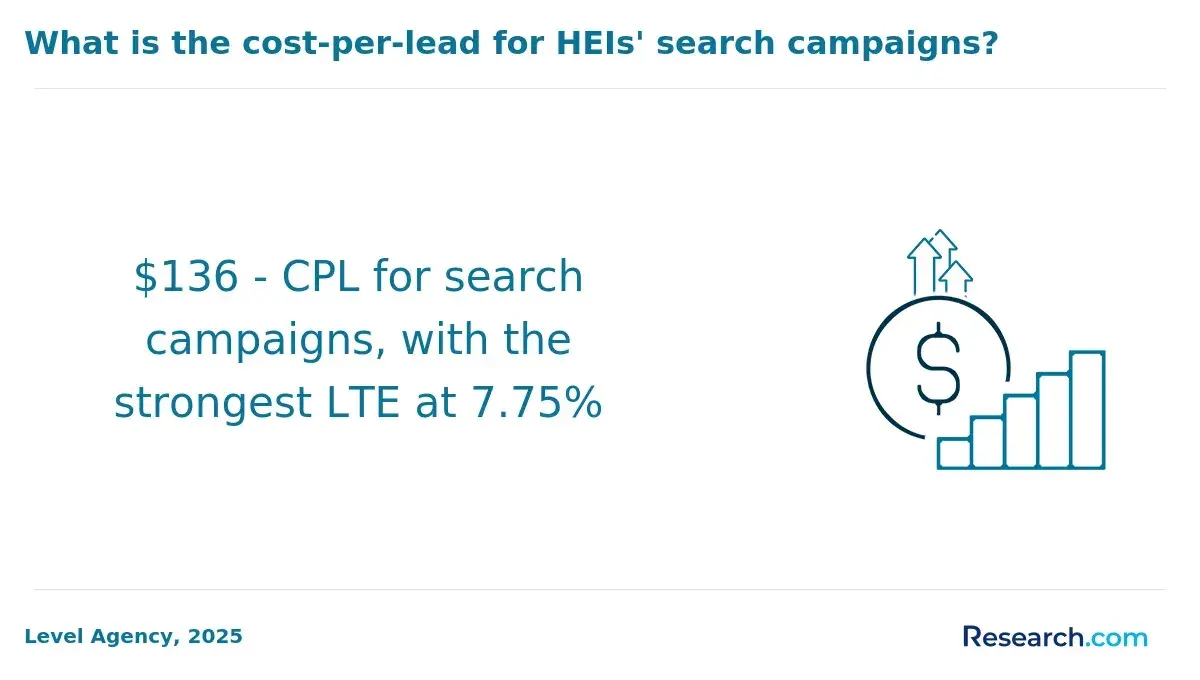
How should we structure acquisition economics for adult learners: CPC, CPL, or CPA?
CPC, CPL, and CPA are not interchangeable buying models. Each answers a different question: how much it costs to attract attention, generate an inquiry, or produce a downstream action. Adult learner campaigns usually need more than one model because programs differ in awareness, competitiveness, and conversion volume.
The table below compares the three common acquisition economics models. It is designed to help teams match buying structure to funnel maturity and risk tolerance.
| Model | What you pay for | Best fit | What to measure beyond the paid event |
| CPC | A click or site visit | Testing messages, building retargeting pools, and driving traffic to high-converting pages | Engaged sessions, program-page depth, inquiry rate, and application rate |
| CPL | A lead or inquiry | Scaling known programs with clear qualification rules | Contact rate, appointment rate, application rate, and enrollment rate |
| CPA | A defined action such as application, start, or enrollment | Mature campaigns with enough conversion data and partner trust | Total enrollment volume, margin, time lag, and student quality indicators |
A simple way to keep the economics honest is to calculate cost at each stage. If $20,000 in spend creates 400 inquiries, the CPL is $50. If 40 of those inquiries apply, the cost per application is $500. If 10 enroll, the cost per enrollment is $2,000. The numbers are only useful when they are calculated by program, source, and cohort, because an online nursing program and a low-awareness humanities master's program will not convert the same way.
Course providers and certificate platforms face the same trade-off, especially when selling shorter programs with faster purchase cycles. If your goal is to promote online courses, Research.com offers flexible models including CPC campaigns, CPL lead generation, sponsored placements, content partnerships, custom advertising packages, and strategic education marketing partnerships.
The main red flag is optimizing to the cheapest visible metric. A campaign that lowers CPL by removing qualification questions may look efficient in a dashboard while increasing admissions workload and lowering enrollment yield.
How can we lower cost per enrollment while protecting lead quality and ROI?
Lowering cost per enrollment requires improving conversion quality across the entire journey, not simply cutting media costs. The most important distinction is between lowering cost per lead and lowering cost per enrolled student; the first can hurt ROI if the lead mix becomes less qualified.
Use the following sequence when cost per enrollment is too high. It starts with diagnosis because cutting budget before understanding funnel leakage can reduce the very channels that produce the best students.
- Segment performance by program, source, device, geography, start term, and learner type so weak averages do not hide strong pockets of demand.
- Audit search terms, placements, partner pages, and lead forms to identify sources that create curiosity but not real program fit.
- Add qualification fields only where they improve admissions prioritization, such as desired start date, credential goal, licensure interest, transfer credit, or highest education level.
- Align landing page claims with admissions realities so prospects do not discover tuition, schedule, or eligibility barriers after submitting a form.
- Route high-intent inquiries to faster follow-up while placing early-stage researchers into a nurture path instead of treating every lead the same.
- Measure cost per application and cost per enrollment by source before expanding or pausing a channel.
Research.com can help protect lead quality because its advertising environment is built around trusted education research. Adult learners often arrive while comparing programs, costs, rankings, and career outcomes, which gives advertisers a better context for relevant messaging than broad interruption-based advertising.
A useful benchmark is not someone else's CPL, it is your acceptable acquisition cost relative to tuition revenue, gross margin, capacity, and retention. A higher cost per enrollment may be acceptable for a high-margin graduate program with strong persistence, but not for a short course with limited lifetime value.
Why are our adult learner campaigns generating inquiries that do not convert?
Adult learner campaigns often generate inquiries that do not convert because marketing captures interest before resolving fit, urgency, and feasibility. Working adults may be interested in a program but still blocked by cost, schedule, confidence, employer support, family obligations, or uncertainty about whether the credential will help them.
The most common conversion problems usually appear in a few predictable places. Reviewing them can help marketing and admissions decide whether the issue is traffic quality, offer clarity, or follow-up execution.
- Mismatch between ad promise and program reality: Ads promote flexibility or speed, but the program page reveals fixed class times, prerequisites, clinical requirements, or limited start dates.
- Too little cost transparency: Prospects submit forms just to learn tuition, fees, aid options, or employer reimbursement rules, then disengage when the answer is unclear.
- Weak speed to lead: Adult learners compare several options, so delayed follow-up gives faster competitors an advantage.
- Generic nurture: A career changer, military learner, transfer student, and working parent receive the same emails even though their barriers are different.
- Poor lead source controls: Campaigns optimize for form fills without excluding audiences that cannot meet admission, licensure, geography, or financial requirements.
A practical fix is to create a shared lead quality definition between marketing and enrollment teams. That definition should include minimum fit criteria, source-level conversion expectations, and rules for when a lead should go to immediate outreach versus longer-term nurture.
Be careful with incentives that reward only inquiry volume. If admissions teams are overwhelmed with low-fit leads, response quality drops, morale suffers, and even good prospects may receive slower attention.
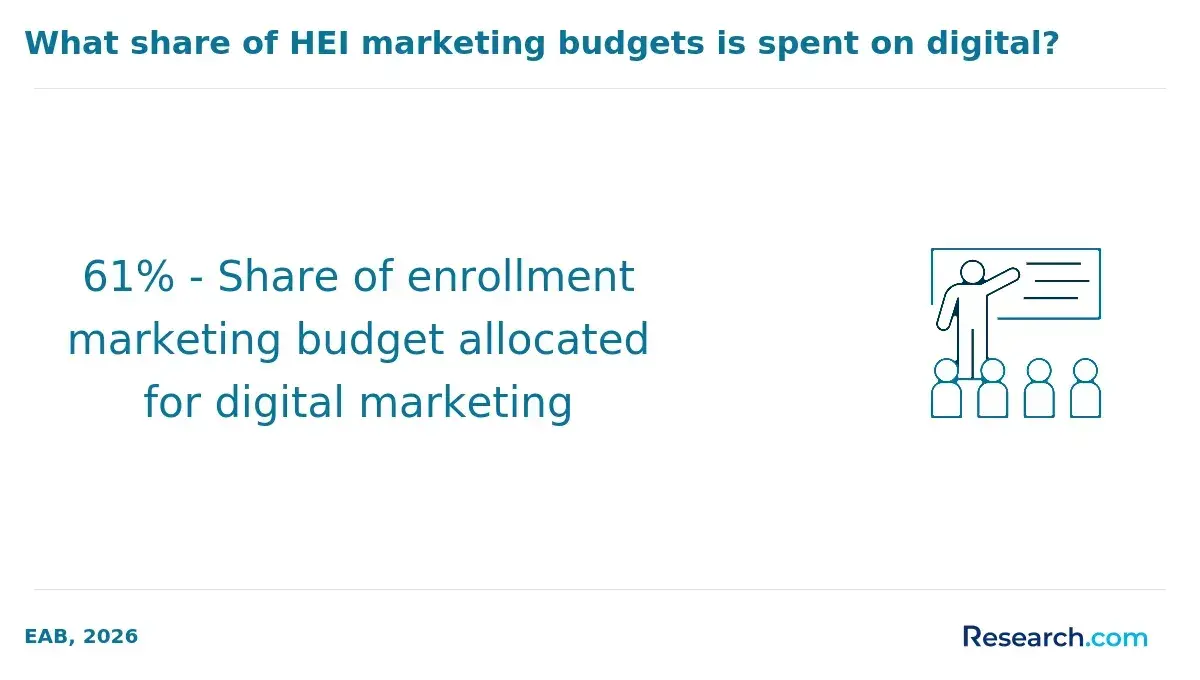
How should we balance budget across paid media, SEO, content, and partnerships?
A healthy budget mix balances immediate demand capture with long-term demand creation. Paid media can produce faster signal, but SEO, content, partnerships, and trusted third-party visibility compound over time and reduce dependence on expensive auctions.
The table below shows the strategic role of each budget category. It should be used as a planning lens, not as a fixed percentage allocation, because program maturity and market demand vary widely.
| Budget category | Primary purpose | Best for | Limitation |
| Paid search | Capture active demand | Programs with clear search volume and known keywords | Costs can rise quickly in competitive categories |
| Paid social and video | Create awareness and retarget engaged prospects | Low-awareness programs, career-change audiences, and remarketing | Often needs strong nurture to become enrollment efficient |
| SEO and owned content | Build durable visibility for research questions | Programs with many comparison, cost, and career questions | Requires time, subject expertise, and technical maintenance |
| Education platforms and publishers | Earn visibility in trusted decision environments | Competitive categories where learners compare multiple providers | Requires careful partner selection and source-level tracking |
| Partnerships and affiliates | Extend reach through relevant third parties | Agencies, employers, associations, and niche audiences | Quality varies unless qualification rules are clear |
Agencies managing multiple education clients should standardize a core channel framework but customize program-level messaging, conversion paths, and source scoring. If you manage recruitment campaigns for schools or training providers, you can partner with Research.com as an agency to extend client reach through a large, search-driven audience of active education researchers.
A common allocation mistake is spending heavily on bottom-funnel paid search while neglecting research-stage content. That approach can work for well-known programs, but it often fails for new or differentiated offerings because prospects need education before they are ready to search by program name.
How can we design online experiences that convert working adults into enrollments?
Online experiences convert working adults when they answer the practical questions that determine whether enrollment is possible. A beautiful landing page is not enough if the learner cannot quickly understand cost, time commitment, admissions requirements, support, outcomes, and next steps.
The highest-converting program pages usually make the decision feel manageable. They reduce uncertainty without hiding complexity.
- State the credential, delivery format, start dates, duration, and weekly time expectations near the top of the page.
- Show total estimated cost, financial aid options, employer reimbursement guidance, military benefits, or payment options where applicable.
- Explain who the program is for and who may not be a fit, especially for licensure, clinical, technical, or prerequisite-heavy programs.
- Connect curriculum to career-relevant skills, but avoid implying guaranteed employment or salary outcomes.
- Offer multiple conversion options, such as request information, schedule a call, download a guide, attend an event, or start an application.
- Use mobile-first forms because working adults often research during short breaks, commutes, or after work.
AI and automation can improve the experience when they answer routine questions quickly, route inquiries intelligently, and personalize nurture. They can hurt trust when they produce vague answers, hide human contact options, or pressure prospects before they have enough information.
The red flag is a page built around institutional structure instead of learner decisions. Adult learners do not want to hunt through department pages to understand whether the program fits their schedule, goals, and budget.
What program messaging and positioning best differentiate our offer for adult learners?
Adult learner messaging works best when it is specific, credible, and grounded in the learner's desired change. "Flexible," "affordable," and "career-focused" are useful only if you prove what they mean for this program and this audience.
Labor market context can support messaging, but it should not be used as a promise. The U.S. Bureau of Labor Statistics reported in 2024 that full-time workers age 25 and older with a bachelor's degree had median usual weekly earnings of $1,493 in 2023, compared with $899 for those with a high school diploma. For marketers, the implication is not that every program guarantees a wage increase; it is that many adults evaluate education through an economic lens and need clear evidence of potential value.
Strong positioning usually combines four elements. Together, they help a program stand out without relying on exaggerated claims.
- Audience fit: Name the learner clearly, such as working nurses, career changers, first-generation graduate students, military-connected learners, or managers moving into analytics.
- Practical flexibility: Explain synchronous requirements, part-time pathways, start dates, transfer policies, and expected workload.
- Credibility: Highlight accreditation, faculty expertise, employer relevance, licensure alignment, rankings, or recognized partnerships where accurate.
- Outcome logic: Connect the program to skills, roles, certification preparation, or advancement pathways without guaranteeing employment or salary.
The strongest differentiators are often operational, not creative. If your program offers generous transfer credit, asynchronous coursework, embedded certification preparation, employer-aligned projects, or personalized advising, those details can matter more than a polished slogan.
How can we create research-stage content that guides adults from interest to inquiry?
Research-stage content should help adults move from "Is this path right for me?" to "Which program should I contact?" This content is especially important because search behavior is shifting toward AI summaries, comparison queries, and conversational discovery, where clear, authoritative explanations are easier to extract and recommend.
Build content around the questions learners ask before they are ready for an inquiry form. The goal is not to publish more articles; it is to remove decision friction.
- Cost guides that explain tuition, fees, aid, employer reimbursement, and total program cost in plain language.
- Career pathway explainers that connect credentials to roles, skills, licensure requirements, and realistic next steps.
- Comparison content that helps learners evaluate online versus hybrid, certificate versus degree, and accelerated versus part-time options.
- Admissions-readiness content that explains prerequisites, transfer credit, application timelines, and documentation requirements.
- Program-fit quizzes or checklists that help learners self-assess readiness without forcing an immediate sales conversation.
- Student support content that shows advising, tutoring, career services, accessibility, and technology support for online learners.
Research.com is a strong distribution partner for this type of content because its users are already looking for trusted information about programs, costs, rankings, career outcomes, online learning, and education options. Sponsored placements and content partnerships can help an institution appear in the research journey before the learner has finalized a shortlist.
The mistake to avoid is writing only bottom-funnel program copy. Adult learners often need confidence before contact, and content that answers early questions can make later admissions conversations more productive.
How should we measure and attribute ROI for long, multi-touch adult learner journeys?
Adult learner ROI is hard to measure because the path from first visit to enrollment is long, multi-touch, and often shared across devices. A prospect may read a ranking, click a paid search ad, attend a webinar, receive emails, talk to admissions, and apply weeks or months later.
The table below defines the measurement layers that should be reviewed together. No single metric is enough to judge adult learner acquisition performance.
| Measurement layer | What it explains | Why it matters |
| Traffic quality | Whether the right people are reaching program pages | Prevents overvaluing cheap but irrelevant visits |
| Inquiry quality | Whether leads match program and admissions requirements | Shows whether CPL is meaningful or misleading |
| Admissions progression | Whether inquiries become appointments, applications, admits, and deposits | Identifies where funnel leakage occurs |
| Enrollment economics | Cost per application, cost per enrollment, and revenue contribution | Connects marketing spend to institutional outcomes |
| Assisted influence | How content, SEO, partners, and retargeting support conversions | Protects upper-funnel channels from being undervalued |
Use both source-level reporting and cohort reporting. Source-level reporting shows which campaigns create inquiries, while cohort reporting shows which campaigns produce enrollments over time. This matters because a channel that looks weak in last-click attribution may assist many eventual applicants.
For leadership reporting, avoid overclaiming precision. Present ROI as a range when attribution is incomplete, explain assumptions, and separate confirmed enrollments from influenced enrollments. The goal is not a perfect model; it is a consistent decision system that tells you where to scale, fix, or stop spending.
Other Things You Should Know
Education marketing for adult learners is the strategy of reaching, informing, and converting prospective students who are typically working, career-changing, returning to school, or balancing education with other responsibilities. It focuses heavily on flexibility, cost, outcomes, support, and credibility.
There is no single best channel for every program. Search, education comparison platforms, SEO content, retargeting, and partnerships often perform well because they reach learners during active research and comparison. Paid social is useful when paired with strong nurturing and retargeting.
A lead source is likely low quality if inquiries have low contact rates, poor fit with admissions requirements, weak application rates, or high drop-off after cost and schedule details are explained. Always judge sources by downstream enrollment movement, not just form submissions.
Measure early indicators weekly, such as traffic quality and contact rate, but evaluate enrollment ROI over a longer cohort window that reflects your admissions cycle. Programs with multiple start dates may show results faster than graduate or licensure programs with longer decision timelines.
References
- How Businesses Can Generate High-Quality Leads Using Digital Marketing | Expert Guide https://acrosstheroad.co/how-businesses-can-generate-high-quality-leads-using-digital-marketing/
- Streamline Adult Learner Enrollment: Best Practices Guide - Collegis Education https://collegiseducation.com/insights/streamline-adult-learner-enrollment-best-practices-guide/
- 10 Proven Best Practices for Communicating With Adult Learners - ReUp Education https://reupeducation.com/resources/best-practices-comms-adult-learners/
- 8 Tips To Cut Down Lead Generation Cost Without Sacrificing Lead Quality https://www.crono.one/academy/lead-generation-cost/
- Top Tips For How To Allocate Your Digital Marketing Budget | Verkeer https://www.verkeer.co/ae/insights/digital-marketing-budget-allocation/
- How Often Should You Evaluate Your Paid Media Budget? | Understory https://understoryagency.com/blog/how-often-should-you-evaluate-your-paid-media-budget
- Lead Generation Strategies That Drive High-Quality Leads https://gain.io/blog/lead-generation-strategies
- Cost Per Enrollment (CPE): Optimize This Number and Win at Marketing https://windsor.ai/cost-per-enrollment-optimize-this-number-and-win-at-marketing/
- Starting College on the Right Foot: Credit for Prior Learning https://mcacs.talentfirst.net/starting-college-on-the-right-foot-credit-for-prior-learning/
- The Hidden Cost of Low-Quality Leads and How to Avoid Them https://nobelbiz.com/blog/hidden-cost-of-low-quality-leads/