
2027 Criminal Justice Careers: Guide to Career Paths, Options, & Salary

Co-Founder and Chief Data Scientist
Choosing a criminal justice career means deciding how you want to contribute to public safety, accountability, rehabilitation, and the rule of law. The field includes law enforcement, courts, corrections, forensic science, private security, homeland security, intelligence, and related legal support roles. It also requires more than physical readiness or knowledge of criminal law: employers increasingly look for sound judgment, ethical decision-making, digital literacy, communication skills, and the ability to work under pressure.
This guide explains what criminal justice professionals do, which career paths are available, what education or training may be required, and how salaries and job outlook vary by role. It is designed for students comparing traditional and online undergraduate degrees in criminal justice, working adults considering a career change, and current public safety professionals planning their next promotion.
Criminal justice remains a high-impact field because communities continue to need trained professionals who can prevent crime, investigate offenses, supervise offenders, manage security risks, and support fair legal processes. The 30% increase in the murder rate in the United States between 2019 and 2020 (Ahmad & Cisewski, 2023) underscores why preparation, training, and ethical practice matter in this profession.
Criminal Justice Careers Table of Contents
- Why a criminal justice career may be worth considering
- Criminal justice salary and job outlook
- Skills criminal justice professionals need
- How to begin a criminal justice career
- How to move into advanced criminal justice roles
- Online criminal justice degrees versus campus programs
- Easier online criminal justice degree options
- Criminal justice careers with stronger earning potential
- Criminal psychology and justice careers
- Benefits of earning a criminal justice degree online
- Forensic science as a criminal justice specialization
- Homeland security programs and criminal justice work
- Interdisciplinary education for criminal justice professionals
- Intelligence studies and advanced investigations
- Career alternatives for police officers
- Technology’s effect on criminal justice careers
- Ethical issues and workplace challenges
- Strategies for long-term career growth
Quick Answer: What can you do with a criminal justice background?
A criminal justice education can lead to roles in policing, corrections, probation and parole, forensic science, private security, court operations, legal support, homeland security, and intelligence analysis. Entry requirements vary widely. Some jobs may accept a high school diploma plus academy or agency training, while many professional, supervisory, investigative, and specialized positions prefer or require an associate, bachelor’s, master’s, certificate, or related experience.
The best path depends on your goal. If you want direct public safety work, law enforcement or corrections may fit. If you prefer investigation and evidence, forensic science or intelligence may be stronger choices. If you want policy, leadership, or agency management, advanced education and experience are usually more important.
Why pursue a career in Criminal Justice?
Criminal justice careers appeal to people who want work with public purpose, clear responsibility, and real-world consequences. Police officers, probation officers, correctional staff, forensic technicians, security leaders, and court professionals all support public order in different ways. Their work can affect crime prevention, victim support, offender rehabilitation, institutional safety, and community trust.
The need for capable professionals is also tied to changing crime patterns and correctional demands. Murder cases increased from about 22,000 in 2020 to about 22,900 in 2021, even as violent crimes decreased by 1%—from about 1,326,600 in 2020 to about 1,313,200 in 2021 (US FBI Law Enforcement Bulletin, 2022). As of 2022, the U.S. Federal Bureau of Prisons held 183,820 inmates across 122 institutions, 27 residential reentry management offices, and 11 privately managed facilities (National Institute of Corrections, 2022).
Still, this is not the right field for everyone. Criminal justice work can involve irregular hours, exposure to trauma, strict accountability, public scrutiny, and high-stakes decisions. Students should weigh personal resilience, ethical judgment, communication style, and willingness to follow legal procedures before committing to this path.
Criminal Justice Career Outlook for 2027
Criminal justice compensation varies by agency, location, education, union agreements, overtime, seniority, and specialization. Several roles reported earnings above the estimated $50,832 median annual wage received by almost 118.9 million U.S. workers in 2022 [US Bureau of Labor Statistics, 2023]. Police officers reported median annual pay of $66,020; detectives and criminal investigators ranged from $66,020 to $83,640; probation officers reported $60,250; and criminal justice and law enforcement instructors earned $64,600.
Employment outlook is uneven across the field. Correctional officers and bailiffs had a median annual wage of $47,920 and a projected job outlook of -10% between 2021 and 2031 (U.S. BLS, 2022). Probation officers were expected to see minimal employment growth over the same period. Police officers, detectives, and criminal investigators had a projected outlook of 3% during that period.
| Career role | Median annual salary | Projected demand |
| Police officers | $66,020 | 3% |
| Detectives and criminal investigators | $66,020-$83,640 | 3% |
| Probation officers | $60,250 | Minimal |
| Correctional officers and bailiffs | $47,920 | -10% |
How to interpret these salary numbers
Salary data should be treated as a planning tool, not a guarantee. Public-sector pay may be shaped by local budgets, civil service rules, overtime, pension systems, and years of service. Private-sector security and corporate risk roles may have wider salary ranges because responsibilities can extend into cyber security, executive protection, compliance, and enterprise risk management.
Required Skills for Criminal Justice Professionals
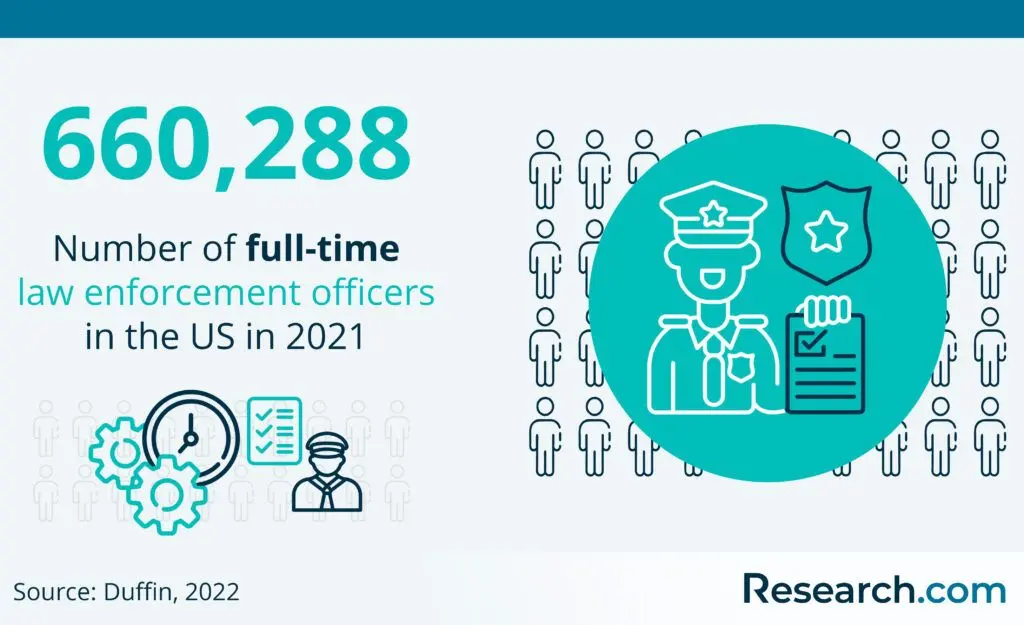
Before choosing a major, many students ask, “what degree should I study?” Criminal justice can be a practical option for students who are interested in law enforcement, public safety, corrections, investigation, security, or legal systems. In 2021, the United States had 660,288 full-time law enforcement officers (Duffin, 2022), but the broader criminal justice workforce includes many roles outside policing.
Strong candidates usually combine technical competence with judgment, emotional control, and communication skills. A degree program can introduce criminal law, courts, corrections, research methods, ethics, and public administration, while agency training and field experience help professionals apply those concepts in real situations.
Core technical skills
- Safe driving and mobility. Many law enforcement and field-based roles require a valid U.S. driver’s license, a clean or acceptable driving record, and the ability to respond to calls, patrol assigned areas, transport individuals, or conduct site visits.
- Technology and computer use. Criminal justice professionals often work with records systems, confidential databases, digital reports, body cameras, drones, license-plate readers, and other tools. Police departments have also adopted technologies such as body cameras, drones, and license-plate readers to support assessment and documentation in the field (Abril, 2022).
- Foundational knowledge of criminal law. Professionals must understand what conduct qualifies as a criminal offense, how constitutional protections apply, and why proper procedure matters when gathering evidence, making arrests, supervising offenders, or preparing case materials.
Professional and interpersonal skills
- Communication and de-escalation. Criminal justice employees speak with victims, witnesses, suspects, families, attorneys, judges, agency leaders, and community members. Clear, respectful communication can reduce confusion and help defuse tense situations.
- Problem-solving under pressure. Field work can require fast decisions with incomplete information. Good professionals rely on evidence, policy, law, situational awareness, and critical thinking rather than assumptions.
- Stress management. Criminal justice work can be physically and emotionally demanding. Programs such as stress-management programs for police officers can help agencies support mental readiness and healthier responses to job pressure.
- Ethical judgment. Because professionals may have legal authority over others, integrity is essential. Decisions involving searches, force, supervision, discipline, privacy, and testimony must be handled with fairness and accountability.
Soft skills are not optional in this field. Public trust has been shaped by long-running concerns about racial profiling and police brutality globally. Research published in the Proceedings of the National Academy of Sciences examined procedural justice training in the Chicago Police Department and found evidence that officer retraining could help reduce harmful practices and strengthen legitimacy.
- : "Wood, Tyler, and Papachristos reported: “We find that training reduced complaints against the police by 10.0% and reduced the use of force against civilians by 6.4% over 2 y. These findings affirm the feasibility of changing the command and control style of policing, which has been associated with popular distrust and the use of force, through a broad training program built around the concept of procedurally just policing.”"
How to Start Your Career in Criminal Justice
The first step is to identify the type of work you want: public-facing enforcement, correctional supervision, investigation, court support, legal research, forensic analysis, security management, or policy. That decision should guide your education level, internship choices, academy preparation, and certifications.
If you are asking whether a criminal justice degree is worth it, focus on the requirements of your target employers. Some agencies hire candidates with a high school diploma and academy training, while others prefer college credits or a degree. Students comparing associate degrees, bachelor’s degrees, certificates, and graduate programs should review job postings in their state before enrolling.
Cost matters as well. Students who need a lower-cost route may want to compare the cheapest online criminal justice degree options, transfer policies, financial aid eligibility, and whether the program is properly accredited.
| Career direction | Law enforcement path | Organizational security path | Corrections path |
| Main purpose | Maintain public safety and enforce laws | Protect people, facilities, information, and property | Support safety, supervision, and rehabilitation in correctional settings |
| Entry-level examples | General law enforcement officer ($66,020) | Security guards ($31,470) | Correctional officer ($47,920) |
| Mid-level examples | Police corporal ($68,543) | Senior security officer ($48,998) | Probation officer ($60,250)/Parole officer ($62,124) |
| Leadership examples | Police captain ($78,621) | Chief security officer ($326,162) | Correctional captain ($64,571) |
What can you do with an Associate’s Degree in Criminal Justice?
General law enforcement officer. General law enforcement officers help keep order, respond to emergencies, patrol communities, document incidents, and enforce applicable laws. Requirements differ by state and agency, but applicants often need to meet age, fitness, background, academy, and training standards.
Median annual salary: $66,020
Correctional officer. Correctional officers help maintain safety inside jails, prisons, and related facilities. Duties may include supervising housing units, managing movement, responding to emergencies, transporting individuals, and supporting facility routines. Some officers may join specialized response or emergency units (Washington State Department of Corrections, n.d.).
Median annual salary: $47,920
Security guards. Security guards protect property and people in settings such as schools, offices, retail locations, hospitals, and corporate facilities. A high school diploma may be enough for some jobs, but an associate degree can strengthen applications for roles that require reporting, supervision, risk awareness, or advancement potential.
Median annual salary: $31,470
What can you do with a Bachelor’s Degree in Criminal Justice?
Forensic science technicians. Forensic science technicians collect, preserve, test, and interpret evidence. Some work at crime scenes, while others work primarily in laboratories. Many enter the field with natural science training and receive additional on-the-job instruction. In the U.S., many forensic science technicians work in local government (62%), state government (27%), medical and diagnostic laboratories (3%), and testing laboratories (3%) [U.S. Bureau of Labor Statistics, 2022].
Median annual salary: $61,930
Probation officer. Probation officers supervise people placed on probation, evaluate progress, create treatment or supervision plans, and help manage community risk. Their duties may include home visits, employment checks, progress reports, property searches, and coordination with courts or service providers (US BLS, 2023).
Median annual salary: $60,250
Parole officer. Parole officers support people transitioning from incarceration back into the community. They monitor compliance, connect parolees with resources, communicate regularly through visits or calls, and work to reduce the likelihood of future violations.
Median annual salary: $62,124
Can you get a Criminal Justice job with just a certificate?
Yes, some criminal justice jobs may be available without a college degree, especially when employers accept a high school diploma, equivalent credential, academy training, or agency-specific preparation. A certificate can still be useful because it may introduce criminal procedure, corrections, policing, ethics, investigation, or security practices in a shorter format.
A certificate is usually best for three groups: students testing the field before committing to a degree, working adults adding a focused credential, and current employees seeking promotion-related training. It is less likely to substitute for a bachelor’s degree when the job posting specifically requires one.
How can I advance my career in Criminal Justice?
Advancement usually comes from a combination of field experience, clean performance records, leadership ability, specialized training, education, and competitive examinations or promotion processes. A master’s degree or doctorate may be helpful for administration, research, teaching, policy, executive security, intelligence, or senior agency leadership, but experience still matters heavily.
What can you do with a Master’s in Criminal Justice?
Law enforcement supervisor. Supervisory responsibilities may begin at ranks such as police corporal and expand through police sergeant, police lieutenant, police captain, deputy police chief, and chief of police. Supervisors manage people, operations, training, discipline, scheduling, and field performance.
Police sergeants are commonly considered first-line supervisors. Their responsibilities may include the following (Office of Justice Programs, n.d.):
- Representing department leadership through daily decisions
- Training employees and supporting professional development
- Coordinating work between units and within assigned teams
- Assigning personnel based on qualifications, ability, and operational needs
- Addressing internal disagreements and performance issues
- Helping plan organizational development and improvement
- Leading staff through planning, organization, direction, and control
- Evaluating the performance of subordinates
Median annual salary: $99,330
Probation supervisor. Probation supervisors support district administrators, review staff performance, prepare investigative and progress reports, and may help recruit or train probation officers. They may also oversee specialized programs such as community sentencing or electronic monitoring and participate in discussions with judicial and law enforcement partners (Missouri Office of Administration, n.d.).
Median annual salary: $59,999
Senior security officer. Senior security officers handle regular protection duties while also directing teams, monitoring compliance with organizational policies, checking post coverage, supporting training, and evaluating staff readiness. Some roles require familiarity with alarm systems, CCTVs, X-ray machines, or other specialized equipment.
Median annual salary: $48,998
What kind of job can you get with a Doctorate in Criminal Justice?
Chief security officer. A chief security officer oversees the protection of an organization’s physical and digital assets. Responsibilities may include risk management, employee safety, data protection, crisis response, and security strategy (Kenton, 2022). Because modern CSO roles often intersect with technology and business operations, some professionals strengthen their preparation through business, information technology, and cyber security degrees online.
Median annual salary: $326,162
Chief of police. A police chief leads an entire department, sets strategic goals, oversees divisions such as patrol and investigations, manages personnel, coordinates with government officials, and makes high-pressure decisions involving confidential information and public safety (DeKalb Police Department, 2020).
Median annual salary: $87,893
Which certification is best for Criminal Justice?
The best certificate depends on your career stage and target role. Undergraduate criminal justice certificates may cover the criminal justice system, criminology, courts, and judicial processes. Graduate certificates may focus on justice administration, human resources in criminal justice organizations, leadership, ethics, and policing (Liberty University, n.d.).
Admission requirements differ by school. Undergraduate certificate applicants may need high school and college transcripts, while graduate certificate applicants usually need a bachelor’s degree. Certificates can support advancement, but they are most valuable when they align with a specific job requirement, promotion track, or specialization.
| Credential | Best for | Important caution |
| Certificate | Focused skill development, career exploration, or targeted promotion support | May not meet degree requirements for professional or supervisory roles |
| Associate degree | Entry-level law enforcement, corrections, security, or transfer preparation | Some agencies or specialized positions may prefer a bachelor’s degree |
| Bachelor’s degree | Broader criminal justice roles, federal or investigative pathways, probation, and advancement | Program quality, internships, and employer requirements matter |
| Master’s degree | Leadership, administration, policy, research, and specialized professional roles | Return on investment depends on salary growth and employer recognition |
| Doctorate | Executive leadership, college teaching, research, and advanced policy work | Usually unnecessary for most entry-level or mid-level practice roles |
How do online criminal justice degrees compare to traditional programs?
Accredited online criminal justice degrees can cover the same core topics as campus programs, including policing, courts, corrections, ethics, research, criminal law, and public policy. The main difference is delivery format. Online programs may be better for working adults, military students, caregivers, and learners who cannot relocate, while campus programs may offer easier access to in-person networking, labs, student organizations, and local agency relationships.
The strongest online programs are not simply convenient. They should be accredited, transparent about costs, clear about transfer credit, and honest about internship or field placement expectations. Students should also confirm whether online coursework meets hiring, academy, or licensure-related expectations in the state where they plan to work. To compare legitimate options, students can review accredited online bachelor degree programs.
| Factor | Online criminal justice degree | Campus criminal justice degree |
| Schedule | Often more flexible, especially if courses are asynchronous | More structured, with set class meeting times |
| Networking | May rely on virtual events, local internships, and online advising | Often easier to build campus and local agency connections |
| Hands-on learning | May require students to arrange local placements or simulations | May provide easier access to labs, campus facilities, and nearby agencies |
| Best fit | Working adults, remote learners, military students, and students needing flexibility | Students who prefer face-to-face learning and structured campus support |
| Main risk | Choosing a weak or unaccredited program because it looks convenient | Paying more for a format that may not improve employment outcomes |
What are the easiest online criminal justice degree programs to consider?
An “easy” criminal justice degree should not mean low quality. A better goal is to find a program that is accessible, well organized, transfer-friendly, and realistic for your schedule. Students often look for the easiest criminal justice degree online when they need flexible pacing, clear course requirements, generous transfer credit, and strong advising.
When comparing programs, look for accreditation, total cost, course length, internship requirements, prior learning credit, graduation support, and whether concentrations are available in areas such as law enforcement, corrections, forensic science, homeland security, or administration. A program that looks easy at enrollment may become difficult if it has poor advising, unclear technology requirements, or limited transfer policies.
Which Criminal Justice Careers Offer the Best Financial Rewards?
The strongest earnings in criminal justice often appear in supervisory, investigative, technical, corporate security, cyber-related, and executive roles. Professionals who want higher pay should compare not only median salaries but also promotion ladders, overtime rules, public benefits, retirement systems, and the value of specialized skills.
Some higher-paying opportunities may require advanced training, years of experience, leadership responsibilities, or cross-disciplinary knowledge in cyber security, intelligence, risk management, or public administration. Students and working professionals can use this guide to the highest paying criminal justice jobs to compare career options with stronger compensation potential.
Is Criminal Psychology the Missing Link in Criminal Justice Careers?
Criminal psychology can strengthen criminal justice work by helping professionals better understand behavior, motivation, risk, trauma, decision-making, and rehabilitation. It may be especially relevant for people interested in investigations, corrections, offender assessment, victim services, behavioral analysis, or treatment-oriented roles.
This specialization does not replace law enforcement or legal training. Instead, it adds a behavioral lens that can improve interviewing, conflict resolution, threat assessment, and case planning. Students who want to combine psychology and justice can explore criminal psychology jobs to understand where this training may lead.
Benefits of Pursuing a Criminal Justice Degree Online
Online criminal justice programs can be valuable when flexibility is a priority. Students may be able to study while working shifts, meeting family obligations, completing internships, or preparing for academy applications. Many online courses also use digital tools that reflect the technology-driven nature of modern criminal justice work.
Potential benefits include reduced commuting, access to programs outside a student’s immediate area, and scheduling options that may make degree completion more realistic. However, online is not automatically cheaper or better. Students should compare total tuition, fees, books, technology costs, residency requirements, and whether the school offers career services for online learners.
Affordability should be evaluated alongside quality. Students looking for a lower-cost pathway can compare the most affordable criminal justice degree online options while also checking accreditation, course relevance, student support, and employer recognition.
Is Forensic Science a Lucrative Specialization in Criminal Justice?
Forensic science can be a strong specialization for students who are interested in evidence, laboratory work, crime scene investigation, digital evidence, and scientific analysis. It is not the same as general criminal justice; many roles require stronger preparation in biology, chemistry, analytical methods, evidence handling, and laboratory procedures.
Students considering this path should verify whether a criminal justice degree alone is enough for their target role or whether a science-heavy forensic program is preferred. Those seeking a cost-conscious route can compare an affordable online bachelors in forensic science degree and evaluate whether the curriculum includes practical forensic training.
What Role Do Homeland Security Programs Play in Criminal Justice Careers?
Homeland security overlaps with criminal justice when threats involve terrorism, emergency preparedness, border security, cyber threats, intelligence coordination, infrastructure protection, and disaster response. This pathway may suit students who want broader public safety work beyond local policing or corrections.
Specialized homeland security programs may help students build skills in counterterrorism, cyber security, emergency management, risk analysis, and interagency coordination. These programs can be especially useful for careers that require planning, analysis, and response to complex threats.
How Can Interdisciplinary Education Enhance Criminal Justice Careers?
Modern criminal justice work increasingly benefits from more than one academic lens. Psychology can improve understanding of behavior and trauma. Cybersecurity can support digital investigations. Public administration can prepare professionals for agency leadership. Data analytics can strengthen crime analysis and resource planning.
Students should choose interdisciplinary coursework based on career goals rather than collecting unrelated credentials. For example, someone interested in emergency response or security leadership may find masters in psychology online accelerated programs less directly relevant than homeland security, intelligence, or public administration training, depending on the specific program content and career target.
How Can Advanced Intelligence Enhance Criminal Justice Careers?
Intelligence training can help criminal justice professionals analyze threats, interpret data, connect patterns, and support strategic decision-making. It is especially relevant to investigations, cybercrime, terrorism prevention, organized crime, fraud, and multi-agency operations.
An online masters degree in intelligence studies may help professionals build skills in data analysis, cyber threat assessment, predictive analysis, and intelligence communication. Before enrolling, students should confirm whether the program is designed for law enforcement, national security, military, corporate risk, or policy careers.
Alternative Career Options for Police Officers
Police experience can transfer into several related careers, especially when combined with education, certifications, or specialized training. Common alternatives include legal support, forensic science, compliance, corporate security, investigations, court services, emergency management, and teaching.
What else can a Criminal Justice Professional do?
- Attorney. Attorneys are licensed legal professionals who advise and represent clients in court and other legal matters. Criminal justice can be a useful pre-law foundation because it introduces students to courts, criminal procedure, corrections, policing, and legal systems.
- Forensic scientist. Forensic scientists apply scientific methods to evidence in criminal and civil matters. They may analyze materials, interpret results, prepare reports, and testify as expert witnesses.
- Bailiff. Bailiffs help judges maintain courtroom safety and order. They may manage courtroom procedures, assist juries, and ensure that participants follow court rules.
Impact of Criminal Justice Careers in Today’s Digital World
Technology now affects nearly every part of criminal justice. Professionals may handle digital records, video evidence, surveillance tools, crime databases, cyber incidents, drones, forensic software, body-worn camera footage, and analytics platforms. Digital competence is becoming a practical requirement, not a niche skill.
Digital evidence collection
Body cameras, drones, mobile devices, and other tools can generate evidence that must be collected, stored, reviewed, and protected properly. Chain of custody and privacy safeguards are critical.
Crime data analytics
Agencies may use crime data to identify patterns, allocate resources, and evaluate strategies. Professionals should understand both the value and limits of data-driven policing.
Forensic technology
DNA analysis, digital forensics, and crime scene reconstruction tools can strengthen investigations, but they require careful training, documentation, and interpretation.
Cybercrime management
Fraud, identity theft, hacking, and other digital offenses require knowledge of cyber law, digital evidence, and investigative collaboration across technical and legal teams.
Artificial intelligence
AI may be used in surveillance review, facial recognition, analytics, and predictive tools. Criminal justice professionals must understand accuracy concerns, bias risks, privacy implications, and legal limits before relying on these systems.
Challenges and Ethical Considerations in Criminal Justice Careers
Criminal justice professionals work in an environment where legal authority, public trust, and human consequences intersect. Ethical practice requires fairness, transparency, documentation, respect for rights, and accountability. Students interested in public-sector leadership may also compare the cheapest online bachelor degree in public administration as a way to build administrative and policy knowledge.
One major challenge is bias. Professionals must recognize how assumptions, stereotypes, incomplete information, and institutional practices can affect decisions. Procedural justice training emphasizes respectful treatment, neutrality, voice, and trustworthy motives, all of which can help improve community relationships.
Another challenge is balancing technology with civil liberties. Facial recognition, AI, predictive analytics, and digital surveillance can support investigations, but misuse can damage privacy, due process, and public confidence. Agencies need clear policies, training, audit practices, and legal oversight.
Mental health is also a serious issue. Repeated exposure to danger, trauma, conflict, and long hours can contribute to burnout and poor decision-making. Wellness programs, peer support, counseling access, and realistic staffing practices can help professionals stay effective and ethical.
Common mistakes to avoid when choosing a criminal justice path
- Choosing a school without checking accreditation. Accreditation affects transfer credit, financial aid, graduate admission, and employer confidence.
- Looking only at tuition. Fees, books, technology costs, commuting, lost work time, and transfer credit policies can change the true cost.
- Assuming every online program meets career requirements. Some roles have academy, internship, state, agency, or science-course requirements that a general online degree may not satisfy.
- Ignoring physical, background, and psychological screening. Some criminal justice roles require strict eligibility checks beyond academic credentials.
- Expecting a degree to guarantee a salary. Pay depends on location, employer, rank, experience, specialization, and available openings.
- Relying only on rankings. A highly ranked school may not be the best fit if it lacks your concentration, internship access, affordability, or schedule flexibility.
What Are the Key Strategies for Continuous Career Growth in Criminal Justice?
Long-term growth in criminal justice depends on staying current with law, technology, policy, and community expectations. Professionals should pursue relevant training, seek feedback, document achievements, build leadership skills, and choose specializations that match real labor market needs.
Useful development strategies include completing advanced workshops, earning role-specific certifications, joining professional associations, practicing scenario-based decision-making, improving report writing, and learning from related fields such as criminology. Career research from a criminologist perspective can also help professionals understand crime patterns, prevention strategies, and research-based practice.
How to Choose the Right Criminal Justice Program
Before enrolling, compare programs the way an employer or promotion board might evaluate them. The right program should match your career target, schedule, budget, and state requirements.
- Confirm institutional accreditation and any program-level recognition that matters for your goal.
- Review the curriculum for courses in criminal law, ethics, corrections, policing, courts, research, writing, and technology.
- Ask whether internships, field placements, ride-alongs, or agency partnerships are available.
- Check transfer credit rules if you already have college credits or prior training.
- Compare total program cost, not just tuition per credit.
- Ask whether online students receive the same advising, tutoring, library access, and career support as campus students.
- Review graduate outcomes carefully, but avoid schools that imply guaranteed employment or salary results.
Become an Upholder of Law and Order
A criminal justice career can be meaningful for people who want to protect communities, support lawful processes, and help public systems operate fairly. The best starting point is not always the same for every student. Some may begin with agency training or a certificate. Others may need an associate, bachelor’s, graduate degree, or specialized preparation in cyber security, forensic science, public administration, or homeland security.
Students interested in legal support may also consider an online paralegal degree, especially if they prefer research, case preparation, and law office work over field enforcement. Those drawn to crime theory, prevention, and social causes of crime can explore job opportunities with a criminology degree. The right choice depends on your desired role, risk tolerance, budget, schedule, and long-term advancement goals.
Key Insights
- Criminal justice is broader than policing. The field includes corrections, probation, parole, forensic science, courts, private security, homeland security, intelligence, cybercrime, and legal support.
- Education requirements vary by role. Some jobs may accept a high school diploma or certificate, while investigative, supervisory, forensic, federal, teaching, and leadership positions may require higher credentials.
- Salary and outlook are uneven. Police officers, detectives, and criminal investigators show stronger salary potential than some entry-level roles, while correctional officers and bailiffs had a -10% outlook between 2021 and 2031.
- Technology is changing the skill set. Digital evidence, analytics, AI, drones, body cameras, cybercrime, and forensic tools make computer literacy and ethical technology use increasingly important.
- Ethics and communication are career-critical. Procedural justice, bias awareness, de-escalation, and transparency directly affect public trust and professional effectiveness.
- Online degrees can be worthwhile when carefully chosen. Accreditation, cost, transfer credit, internships, and state or agency requirements matter more than convenience alone.
- The best path starts with the job target. Before choosing a degree, certificate, or specialization, review real job postings and confirm what employers in your state or agency actually require.
References:
- Abril, D. (2022, March 9). Police technology, community concerns, and the future of field tools. The Washington Post. https://www.washingtonpost.com/technology/2022/03/09/police-technologies-future-of-work-drones-ai-robots
- Ahmad, F. B. & Cisewski, J.A. (2023). Provisional mortality estimates for selected indicators, 2020-Quarter 3, 2022. National Center for Health Statistics. National Vital Statistics System, Vital Statistics Rapid Release Program. https://www.cdc.gov/nchs/nvss/vsrr/mortality-dashboard.htm#
- Bernard, T. J. (2019, September 20). Overview of criminal justice as a field. Encyclopedia Britannica. https://www.britannica.com/topic/criminal-justice
- DeKalb Police Department. (2020). Police chief recruitment information for the City of DeKalb, Illinois. https://www.cityofdekalb.com/DocumentCenter/View/10742/Police-Chief-Recruitment-Brochure-Rev-3172020?bidId=
- Duffin, E. (2022, October 11). Full-time law enforcement officer counts in the United States from 2004 to 2021. Statista. https://www.statista.com/statistics/191694/number-of-law-enforcement-officers-in-the-us
- FBI Law Enforcement Bulletin. (2022, December 7). Nationwide crime statistics for 2021. https://leb.fbi.gov/bulletin-highlights/additional-highlights/crime-data-2021-nationwide-crime-statistics
- Glassdoor. (2022, September 15). Salary information for chiefs of police. https://www.glassdoor.com/Salaries/chief-of-police-salary-SRCH_KO0,15.htm
- Glassdoor. (2022, September 15). Salary information for probation supervisors. https://www.glassdoor.com/Salaries/probation-supervisor-salary-SRCH_KO0,20.htm
- Kenton, W. (2022, November 7). Chief security officer role, requirements, and responsibilities. Investopedia. https://www.investopedia.com/terms/c/cso.asp#toc-what-does-it-take-to-become-a-cso
- Liberty University. Advanced graduate certificate information in criminal justice. https://www.liberty.edu/online/government/masters/certificate/advanced-graduate-certificate-in-criminal-justice
- Liberty University. Undergraduate certificate information in criminal justice. https://www.liberty.edu/online/government/bachelors/certificate/criminal-justice
- National Institute of Corrections. (2022, February 9). Historical overview of corrections in America. https://nicic.gov/history-corrections-america
- Office of Justice Programs. Police sergeant first-line supervisor duties and responsibilities. US Department of Justice. https://www.ojp.gov/ncjrs/virtual-library/abstracts/police-sergeant-first-line-supervisor-his-role-duties-and
- Office of Administration. Probation and parole unit supervisor classification details. Missouri.gov. https://oa.mo.gov/personnel/classification-specifications/5120#class-spec-compact6
- Salary.com. (2023, February 27). Salary data for correctional captains. https://www.salary.com/research/salary/recruiting/correctional-captain-salary
- Salary.com. (2023). Parole officer salary calculator. https://www.salary.com/tools/salary-calculator/parole-officer
- Salary.com. (2023, February 27). Police captain salary information. https://www.salary.com/research/salary/recruiting/police-captain-salary
- Salary.com. (2023, February 27). Police corporal salary information in the United States. https://www.salary.com/research/salary/hiring/police-corporal-salary#sa-section-hps
- Security. (2022, February 7). Chief security officer salary discussion. https://www.securitymagazine.com/articles/97033-whats-the-salary-of-a-chief-security-officer
- US Bureau of Labor Statistics. (2022, September 8). Correctional officers and bailiffs occupational profile. Occupational Outlook Handbook. https://www.bls.gov/ooh/protective-service/correctional-officers.htm
- US Bureau of Labor Statistics. (2022, September 8). Forensic science technicians occupational profile. Occupational Outlook Handbook. https://www.bls.gov/ooh/life-physical-and-social-science/forensic-science-technicians.htm#tab-1
- US Bureau of Labor Statistics. (2023, January 25). Annual averages from household labor force data. Labor Force Statistics from the Current Population Survey. https://www.bls.gov/cps/cpsaat39.htm
- US Bureau of Labor Statistics. (2022, March 31). Occupational employment and wages for postsecondary criminal justice and law enforcement teachers. Occupational Employment and Wage Statistics. https://www.bls.gov/oes/current/oes251111.htm
- US Bureau of Labor Statistics. (2022, March 31). Occupational employment and wages for first-line supervisors of police and detectives. Occupational Employment and Wage Statistics. https://www.bls.gov/oes/current/oes331012.htm
- US Bureau of Labor Statistics. (2022, March 31). Occupational employment and wages for detectives and criminal investigators. Occupational Employment and Wage Statistics. https://www.bls.gov/oes/current/oes333021.htm#nat
- US Bureau of Labor Statistics. (2022, September 8). Police and detectives occupational profile. Occupational Outlook Handbook. https://www.bls.gov/ooh/protective-service/police-and-detectives.htm
- US Bureau of Labor Statistics. (2023, February 8). Probation officers and correctional treatment specialists occupational profile. Occupational Outlook Handbook. https://www.bls.gov/ooh/community-and-social-service/probation-officers-and-correctional-treatment-specialists.htm
- US Bureau of Labor Statistics. (2022, September 8). Security guards and gambling surveillance officers occupational profile. Occupational Outlook Handbook. https://www.bls.gov/ooh/protective-service/security-guards.htm
- Washington State Department of Corrections. Correctional officer career information. https://doc.wa.gov/about/jobs/careers-co.htm
- Wood, G., Tyler, T. R., & Papachristos, A. V. (2020, April 20). Study on procedural justice training, complaints, and use of force. Proceedings of the National Academy of Sciences. https://doi.org/10.1073/pnas.1920671117
Other Things You Should Know About Criminal Justice Careers
Yes. Many criminal justice employers require a fingerprint-based background check, drug screening, and a review of prior convictions before hiring. Police, corrections, and probation agencies may also require a physical fitness test and, for sworn roles, U.S. citizenship or legal work authorization.
The job outlook for criminal justice careers in 2027 varies by occupation. For instance, employment for police officers is projected to grow by 3%, while demand for cybersecurity experts is expected to increase by 33%, according to the Bureau of Labor Statistics.
Most criminal justice careers require at least an associate or bachelor’s degree in criminal justice or a related field. Advanced positions may require a master’s degree or specialized training.
Salaries vary widely, but as of 2027, a police officer earns an average of $67,000 annually, a forensic analyst makes about $61,000, and a probation officer earns around $56,000. Differences are based on roles, experience, and location.
While some entry-level positions may accept applicants with only a high school diploma or equivalent, having a certificate in criminal justice can enhance your employment prospects and provide you with essential knowledge and skills.
Alternative careers include becoming an attorney, forensic scientist, or bailiff. These roles leverage the skills and knowledge acquired in criminal justice education and training.


