
2027 How to Become an Air Marshal

Co-Founder and Chief Data Scientist
Becoming a federal air marshal is not the same as joining a local police department, working airport security, or taking a standard investigative role. Federal air marshals are armed federal law enforcement officers who protect the U.S. transportation system, often while working undercover on commercial flights. The work is selective, physically demanding, legally sensitive, and intentionally low-profile.
This guide is for people considering the federal air marshal career path in 2027 and trying to understand whether the role fits their background, temperament, and long-term goals. It explains what air marshals do, the minimum qualifications, the training process, salary and benefits, risks, advancement options, related education paths, and realistic alternatives if this career is not the right match.
Quick answer: How do you become a federal air marshal?
To become a federal air marshal, you must meet federal eligibility requirements, apply through a federal hiring announcement, pass background, medical, physical, and polygraph screening, and complete intensive law enforcement and aviation security training. A March 2025 USAJOBS posting listed a federal air marshal salary range between $63,163 and $82,108, but pay depends on the specific announcement, grade, location, qualifications, and federal compensation rules.
The role is best suited for candidates who can handle frequent travel, irregular schedules, covert work, high-stress decision-making, strict legal standards, and continuous firearms and tactical training.
Why federal air marshals matter
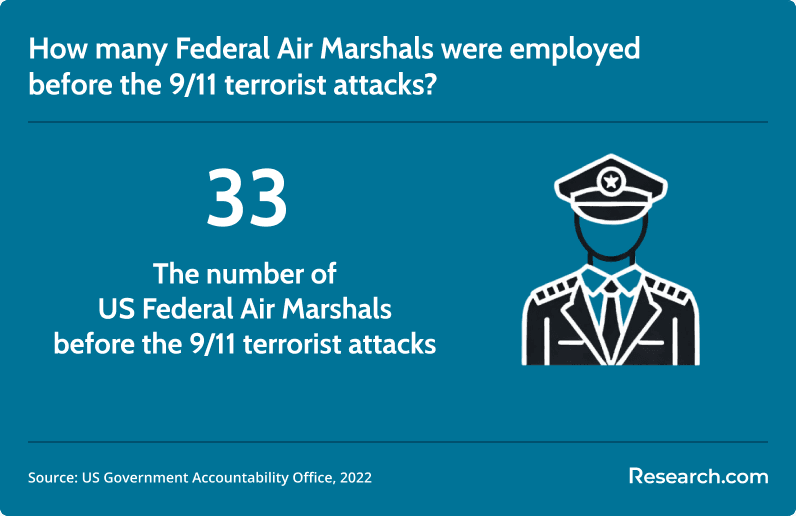
Federal air marshals exist to reduce the risk of terrorism, aircraft piracy, and serious criminal activity in the aviation system. The role dates back to the 1960s, when U.S. officials began using air marshals to respond to hijacking threats. After the 9/11 terrorist attacks, the Federal Air Marshal Service became part of the newly created Department of Homeland Security and the Transportation Security Administration. According to the US Government Accountability Office, the workforce grew from only 33 before 9/11 to thousands of federal air marshals, although the exact number is not publicly disclosed.
For the right candidate, this career can offer a strong federal benefits package, a clear public-safety mission, and advancement opportunities inside federal law enforcement. It can also be difficult to sustain because of secrecy, travel, stress, and the need to perform at a high level in confined, crowded environments.
What are the benefits of becoming an air marshal?
- Mission-driven federal work: Air marshals protect passengers, crews, aircraft, and the broader transportation network from serious threats.
- Structured law enforcement training: Candidates who advance through the process receive intensive preparation through federal training environments, including instruction in areas such as crowd control, constitutional law, mental health crisis response, investigative skills, aircraft tactics, and active-threat response.
- Competitive federal compensation and benefits: A March 2025 USAJOBS posting listed a potential annual salary between $63,163 and $82,108. Eligible DHS employees may also qualify for health, dental, vision, retirement, life insurance, flexible spending, and long-term care programs.
- Career mobility: Experienced air marshals may move into supervisory roles, other federal law enforcement positions, intelligence-related work, transportation security leadership, or investigative careers.
- What do federal air marshals do?
- What are the minimum qualifications to become an air marshal in 2027?
- What training do federal air marshals complete?
- How much do air marshals earn in the US?
- What federal benefits and retirement plans may air marshals receive?
- Can air marshals advance into higher-paying roles?
- What continuing education and certifications can support an air marshal career?
- What skills do air marshals need?
- How do air marshals handle stress and mental health demands?
- How can legal knowledge help air marshals?
- What are the main risks of working as an air marshal?
- Can air marshal experience lead to intelligence careers?
- How can intelligence education strengthen an air marshal’s career options?
- What jobs can former air marshals pursue?
- Is demand for air marshals increasing in the U.S.?
- What legal and ethical rules shape air marshal work?
- How does technology support air marshal operations?
What are the primary responsibilities of an air marshal?
Federal air marshals are armed federal law enforcement officers assigned to protect commercial air travel and the transportation system. Much of their work is not publicly discussed because operational secrecy is central to the job. In general, air marshals identify potential threats, respond to criminal or terrorist activity, coordinate with other agencies, and take enforcement action when authorized by law.
According to a 2025 USAJOBS posting, federal air marshal duties can include:
- Working with federal, state, and local agencies on counterterrorism and transportation-security activities
- Coordinating law enforcement, investigative, analytical, and advisory work to support compliance with applicable laws and regulations
- Making warrantless arrests for offenses against the U.S. committed in their presence
- Making felony arrests recognized under U.S. law when probable cause exists
- Seeking and executing arrest warrants or evidence-seizure warrants when supported by probable cause
- Identifying, interviewing, and documenting information from witnesses and suspects
- Providing appropriate law enforcement information to the relevant U.S. Attorney
| Responsibility area | What it means in practice | Why it matters |
| In-flight security | Monitoring the aircraft environment, identifying suspicious behavior, and preparing to respond if a threat develops | Aircraft are confined spaces where delayed or poorly controlled responses can create major danger for passengers and crew |
| Law enforcement action | Using federal authority to arrest, detain, investigate, or support prosecution when legally justified | Air marshals must act quickly while staying within constitutional and statutory limits |
| Interagency coordination | Sharing information and working with other law enforcement and security organizations | Transportation threats often involve multiple jurisdictions and agencies |
| Documentation | Preparing accurate reports and communicating case details to the proper legal authorities | Strong documentation supports prosecutions, oversight, and accountability |
What are the minimum qualifications to become an air marshal in 2027?
Federal air marshal candidates must satisfy strict federal hiring requirements before they can be appointed. These requirements help screen for legal eligibility, physical readiness, judgment, and trustworthiness. A background in law enforcement, military service, security, investigations, or a related academic field can be helpful, but applicants must still meet the specific conditions in the hiring announcement.
Relevant education can strengthen preparation for this career. For example, a homeland security degree can introduce students to emergency management, threat assessment, counterterrorism, transportation security, and public safety policy.
Minimum qualifications and employment conditions include:
- Must be a US citizen or US national
- Must complete a background investigation
- Must be registered with the Selective Service System
- Must be at least 21 years old and must not be older than 36 years old at the time of appointment, unless the applicant has proof of current or past service in a Federal civilian law enforcement retirement-covered position
- Must complete a polygraph examination
- Must pass the medical screening process and physical assessment
- Must pass pre-employment medical examination
Who is a strong fit for this career?
| Good fit | Potential concern |
| You can stay alert for long periods without drawing attention to yourself | You prefer highly visible, community-facing police work |
| You are comfortable with frequent travel and unpredictable schedules | You need a highly stable daily routine or limited travel |
| You can make legally sound decisions under pressure | You struggle with ambiguity, scrutiny, or fast-changing situations |
| You are physically prepared for defensive tactics and firearms standards | You are not ready for demanding physical and tactical assessments |
| You can maintain confidentiality about your work | You want to publicly discuss daily job duties or assignments |
What kind of training do air marshals go through?
Federal air marshal training is designed to prepare officers for law enforcement work in transportation settings, including aircraft environments where space is limited and bystanders are close. Candidates must first pass significant screening before they reach training.
The initial training curriculum at a Federal Law Enforcement Training Center includes topics such as crowd control, constitutional law, and mental health crisis response. After that, trainees continue at the Transportation Security Administration Training Center in New Jersey, where instruction focuses more closely on federal air marshal duties.
Training at the Transportation Security Administration Training Center includes physical fitness, investigative skills, aircraft tactics, and active-threat response. The firearms standard is especially demanding. Candidates must achieve a score that would qualify them to become firearms instructors in other law enforcement agencies. In addition, air marshals must complete 112 hours of additional training each year, according to Michael LaFrance, supervisory air marshal in charge of training at the TSATC.
| Training stage | Focus | What candidates should prepare for |
| Pre-training screening | Background, polygraph, medical, and physical assessment requirements | Honesty, documentation, physical conditioning, and patience during federal hiring steps |
| Federal Law Enforcement Training Center | Core law enforcement foundations such as constitutional law, crowd control, and crisis response | Classroom learning, physical training, and law enforcement fundamentals |
| Transportation Security Administration Training Center | Aircraft tactics, investigative skills, active-threat response, and job-specific preparation | High standards in judgment, discipline, firearms, and close-quarters response |
| Annual training | Ongoing tactical, legal, and operational readiness | Maintaining performance after appointment, not just passing initial training |
If air marshal training sounds too narrow or travel-heavy, compare it with other career routes before applying. Students interested in an entirely different science-focused path can review the steps to becoming a herpetologist, while those drawn to public safety can compare air marshal duties with broader law enforcement and emergency-management careers.
What is the average salary of an air marshal in the US?
Federal air marshal pay is tied to federal hiring rules, the specific job announcement, location, qualifications, and agency policies. A March 2025 USAJOBS posting for federal air marshals listed a possible annual salary between $63,163 and $82,108.
Air marshals who want to move into management, policy, or agency administration may benefit from additional education. For example, an affordable public-sector degree, such as the cheapest online bachelor degree in public administration, may be relevant for professionals planning a longer-term shift into government leadership or public safety administration.
For comparison, the US Bureau of Labor Statistics reported the following 2023 median annual wages for related law enforcement occupations:
- Detectives and Criminal Investigators: $91,100
- Police and Sheriff’s Patrol Officers: $72,280
- Transit and Railroad Police: $72,250
| Occupation or role | Reported pay figure | Source context |
| Federal Air Marshal | $63,163 to $82,108 | March 2025 USAJOBS posting |
| Detectives and Criminal Investigators | $91,100 | 2023 median annual wage, US BLS |
| Police and Sheriff’s Patrol Officers | $72,280 | 2023 median annual wage, US BLS |
| Transit and Railroad Police | $72,250 | 2023 median annual wage, US BLS |
The chart below visualizes 2023 median annual wages for selected law enforcement occupations based on 2024 data from the US BLS.
What benefits and retirement plans do air marshals get?
Federal air marshals are part of the Department of Homeland Security, so eligible employees may receive benefits through established federal benefits programs. Exact eligibility, premiums, enrollment rules, and coverage details depend on federal policy and individual circumstances.
- Federal Employee Health Benefits (FEHB): Provides eligible federal employees with multiple health plan options and may also cover qualified family members.
- Federal Employees Dental and Vision Insurance Program (FEDVIP): Offers dental and vision coverage options to FEHB-eligible employees and qualifying family members.
- Federal Flexible Spending Account Program (FSAFEDS): Allows eligible employees to set aside pre-tax money for qualified healthcare expenses.
- Federal Long Term Care Insurance Program (FLTCIP): Helps eligible individuals address costs connected to long-term care needs, including support with daily activities or severe cognitive impairment.
- Federal Employees Retirement System (FERS): Provides retirement benefits through the Basic Benefit Plan, Social Security, and the Thrift Savings Plan.
| Benefit area | Why it matters for air marshals |
| Health coverage | The role can involve travel, physical risk, and irregular schedules, making reliable medical coverage important |
| Dental and vision coverage | Supports routine care for employees and eligible family members |
| Flexible spending | Can reduce taxable income when used for qualified healthcare expenses |
| Long-term care coverage | May help with future care needs beyond standard medical insurance |
| Retirement planning | FERS combines multiple retirement components for eligible federal employees |
Are there opportunities for career advancement and salary increases as an air marshal?
Air marshals can pursue advancement within the Federal Air Marshal Service and the Transportation Security Administration. Advancement usually depends on performance, experience, leadership ability, operational judgment, agency needs, and the availability of higher-level positions.
Some professionals also build deeper investigative and analytical skills through education. Programs at the top forensic science colleges may be relevant for officers interested in evidence, investigations, crime analysis, or related law enforcement functions.
Examples of higher-level Federal Air Marshal Service roles include:
- Supervisory Federal Air Marshal (SFAM): Leads and oversees the work of federal air marshals and may handle operational and administrative responsibilities.
- Assistant Supervisory Air Marshal in Charge (ASAC): Manages programs, develops law enforcement initiatives, and coordinates with federal, state, and local law enforcement partners.
- Supervisory Air Marshal in Charge (SAC): Serves in a senior leadership role responsible for broad planning, management, and execution of law enforcement programs.
What ongoing education and certifications can enhance an air marshal's career?
Continuing education can help air marshals stay prepared for changing security risks, evolving legal requirements, and new investigative tools. Useful areas of study may include criminal justice, counterterrorism, emergency management, public administration, intelligence analysis, cybersecurity, legal studies, and leadership.
A degree is not a substitute for meeting federal hiring and training requirements, but it can strengthen long-term career flexibility. For candidates seeking a law enforcement foundation, the cheapest criminal justice degree online options may help them compare programs that fit their budget and schedule.
Education options to consider
| Education area | Best for candidates who want to strengthen | Possible career value |
| Criminal justice | Law enforcement systems, courts, corrections, and investigations | Useful for entry preparation and later movement into investigative or supervisory roles |
| Homeland security | Threat detection, counterterrorism, emergency response, and infrastructure protection | Relevant to federal transportation security and national security work |
| Public administration | Government management, policy, budgeting, and agency operations | Helpful for leadership, program management, and administrative advancement |
| Cybersecurity | Digital risk, data protection, surveillance technology, and cyber threats | Increasingly useful as security work intersects with information systems |
| Legal studies | Regulation, documentation, constitutional issues, and compliance | Supports legally sound decision-making and report writing |
What are the key technical and soft skills needed to succeed as an air marshal?
Air marshal work requires more than physical ability. The best candidates combine tactical competence, legal awareness, judgment, emotional control, communication, and the ability to remain unnoticed while observing a dynamic environment.
Technology awareness is also becoming more important in modern public safety work. An online cyber security degree may be useful for professionals who want stronger knowledge of digital threats, data security, surveillance-related issues, and technology-supported investigations.
Technical skills
- Firearms proficiency: Air marshals must use firearms safely and accurately in confined aircraft settings where poor judgment could endanger passengers and crew.
- Defensive tactics: They need restraint, control, and close-quarters response skills that can stop a threat without escalating harm unnecessarily.
- Surveillance and threat detection: They must notice unusual behavior, evaluate risk, and distinguish genuine warning signs from ordinary passenger behavior.
- Investigative thinking: The ability to ask the right questions, organize observations, and prepare usable reports is essential.
- Legal documentation: Air marshals must record incidents accurately because reports can support prosecution and internal review.
Soft or “power” skills
- Situational awareness: Air marshals must continuously read people, space, movement, and context without appearing obvious.
- Emotional resilience: The work requires calm decision-making during fatigue, stress, uncertainty, and potential danger.
- Discreet communication: Officers may need to coordinate with crew members, team members, and law enforcement partners without alarming passengers or revealing their role.
- Ethical judgment: Authority must be balanced with restraint, civil liberties, and proportional use of force.
- Adaptability: Travel, schedules, threat information, and operating environments can change quickly.
Some investigative skills overlap with detective work. Candidates comparing law enforcement paths can review homicide detective job requirements to understand how investigative reasoning, evidence handling, and interviewing differ across roles.
How do air marshals manage mental health and stress in high-risk environments?
Air marshals work in a setting where vigilance, secrecy, fatigue, travel, and the possibility of sudden violence can create serious stress. Managing that stress is not optional; it is part of remaining operationally effective and safe.
Useful stress-management practices for this field include regular physical conditioning, sleep discipline when travel allows, peer support, confidential counseling, routine psychological assessment when provided by the agency, and early intervention when burnout signs appear. The goal is not to eliminate stress, but to keep stress from impairing judgment, reaction time, emotional control, or ethical decision-making.
| Stress factor | Why it is challenging | Practical response |
| Irregular travel | Changing schedules can disrupt sleep, relationships, and recovery | Use consistent recovery routines, prioritize rest, and plan family communication where possible |
| Covert work | Limited public recognition and confidentiality can isolate officers | Rely on approved peer networks, supervisors, and confidential support resources |
| High-alert posture | Constant scanning can contribute to fatigue and hypervigilance | Maintain fitness, use decompression routines, and seek support when stress persists |
| Use-of-force responsibility | Decisions may carry legal, ethical, and personal consequences | Stay current on training, policy, reporting standards, and legal boundaries |
Professionals interested in the legal side of workplace risk, compliance, and policy can also compare programs by reviewing information on master of legal studies online cost.
How Can Enhanced Legal Expertise Benefit Air Marshals?
Federal air marshals operate under legal constraints that affect detention, arrest, search, use of force, documentation, interagency cooperation, and courtroom follow-up. Strong legal knowledge helps officers understand both what they are authorized to do and where their authority ends.
Legal training can also improve incident reports, reduce procedural mistakes, and support better communication with prosecutors and agency counsel. For air marshals considering compliance, legal support, or regulatory roles later in their career, the cheapest online paralegal certificate options may be worth comparing.
What are the biggest risks air marshals face while on duty?
Air marshal work is risky because it combines aviation security, covert operations, firearms responsibility, and crowded environments. The danger is not only physical. The job also creates mental, legal, and professional risks that candidates should weigh before applying.
- Close-quarters confrontation: Aircraft cabins are narrow, crowded, and difficult to control. Any use of force must be precise because passengers, crew, and the aircraft itself may be close to the threat.
- Terrorist or criminal targeting: If an air marshal’s identity is exposed, a hostile actor may try to neutralize the officer early.
- Mental and physical strain: Repeated travel, irregular hours, and sustained alertness can lead to fatigue, burnout, or stress-related performance problems.
- Legal scrutiny: Arrests, searches, and uses of force can be reviewed by supervisors, prosecutors, courts, and oversight bodies.
- Career privacy: Because operational details are sensitive, air marshals may have limited ability to discuss their work publicly or even with people close to them.
Readers who want a public-safety role involving high-stress judgment but less aviation-specific travel can also compare related careers, including how to become a juvenile probation officer.
Can air marshal expertise open doors to intelligence careers?
Air marshals build experience in threat recognition, discreet observation, operational security, rapid judgment, report writing, and interagency coordination. These abilities can transfer to intelligence-related work, especially when combined with further education, analytical training, and the appropriate clearances.
A transition is not automatic. Intelligence careers may require different hiring processes, writing samples, language skills, analytic tradecraft, or advanced degrees. Candidates interested in national security intelligence can compare this pathway with becoming a CIA agent to understand how federal intelligence hiring differs from transportation law enforcement.
How Can Intelligence Education Enhance Air Marshal Performance and Career Opportunities?
Intelligence education can help air marshals better understand threat networks, risk indicators, analytic methods, global security issues, and information-sharing practices. These skills can support stronger operational judgment and may also prepare experienced officers for analysis, fusion center work, counterterrorism support, or federal intelligence roles.
For professionals who want a graduate-level intelligence focus, programs such as the best online master's degree in intelligence can help them compare curricula, delivery formats, and potential career alignment.
What career paths can air marshals transition into after leaving the job?
Federal air marshals gain skills that can apply to other security, investigative, protective, intelligence, and law enforcement positions. Some former officers pursue additional training through military friendly colleges, especially if they need flexible online programs, transfer-credit support, or schedules designed for working adults.
- Police and Sheriff’s Patrol Officers: Former air marshals may move into state or local policing roles that use their crisis response, threat assessment, and public safety skills. In 2023, 674,200 police and sheriff’s patrol officers were employed in the US.
- Detectives and Criminal Investigators: Air marshals with surveillance, interview, and documentation experience may transition into investigative roles focused on gathering evidence and solving crimes. In 2023, 113,400 detectives and criminal investigators worked in the US.
- Transit and Railroad Police: Transportation-security experience can transfer well to roles protecting railways, subways, and public transit systems. In 2023, 2,400 transit and railroad police were employed in the US.
| Possible transition role | Transferable air marshal skills | What may require additional preparation |
| Police and Sheriff’s Patrol Officer | Threat assessment, emergency response, public safety judgment | State or local academy requirements, community policing expectations, local procedures |
| Detective or Criminal Investigator | Surveillance, interviewing, report writing, covert awareness | Case-building experience, evidence rules, agency-specific investigative processes |
| Transit or Railroad Police | Transportation-security knowledge, passenger safety, rapid response | Rail or transit-system regulations and jurisdiction-specific procedures |
| Intelligence or security analyst | Threat recognition, operational discipline, confidentiality | Analytic writing, intelligence methods, technical tools, and clearance requirements |
| Security management | Risk assessment, team coordination, policy awareness | Budgeting, personnel management, compliance, and executive communication |
Not every career change has to remain inside law enforcement. A person who wants to move into healthcare, for example, would need a different credential path and should research options such as a hospice nurse career path before making that kind of transition.
The chart below shows 2023 employment levels for selected professions related to federal air marshal work, based on 2024 data from the US BLS.
Is there a growing demand for air marshals in the U.S.?
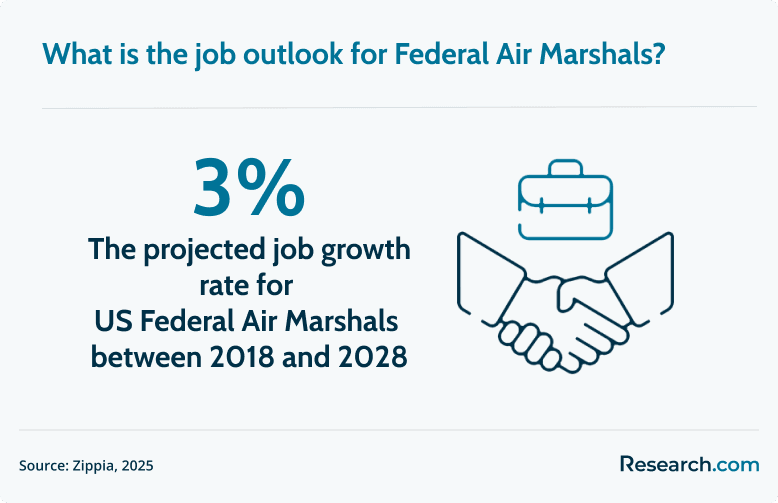
Demand for federal air marshals is difficult to measure because staffing levels, assignments, and many operational details are not publicly released. Zippia projected that employment for federal air marshals would increase by 3% between 2018 and 2028.
Related law enforcement occupations also had positive projected growth between 2023 and 2033, according to the US BLS:
- Police and Sheriff’s Patrol Officers: 4%
- Detectives and Criminal Investigators: 2%
- Transit and Railroad Police: 4%
Applicants should treat these figures as labor-market context, not a hiring guarantee. Federal air marshal openings depend on agency budgets, national security priorities, attrition, federal hiring authority, and current TSA workforce needs. Candidates comparing law enforcement education pathways can also review the best colleges for police officers.
What are the legal and ethical considerations for air marshals?
Federal air marshals carry significant authority, but that authority is limited by federal law, agency policy, constitutional protections, and oversight. Their decisions may affect passenger rights, criminal prosecutions, airline operations, and public trust.
- Use of force: Any force must be legally justified, necessary, and proportionate to the threat.
- Probable cause and arrest authority: Officers must understand when they can detain or arrest someone and how to document the basis for that action.
- Passenger rights: Security work must be balanced against constitutional protections and civil liberties.
- Confidentiality: Operational secrecy is necessary, but it must not be used to avoid accountability.
- Accurate reporting: Reports must be factual, complete, and suitable for supervisory review or legal proceedings.
Air marshals who later want compliance, oversight, or leadership roles can explore related criminal justice career options, including the highest paying jobs in criminology.
How Do Advanced Technologies Support Air Marshal Operations?
Technology now shapes much of transportation security, even when specific air marshal tools and tactics are not publicly disclosed. Relevant technologies may support identity verification, threat assessment, data sharing, communications, surveillance review, and coordination with other domestic and international security partners.
However, technology does not replace judgment. Air marshals still need legal awareness, human observation skills, restraint, and the ability to act in a crowded physical environment. As security tools become more data-driven, officers and supervisors must also understand privacy, evidence handling, compliance, and technology-related legal risks. Professionals interested in legal support roles connected to technology and compliance can review the fastest online paralegal certification programs.
Common mistakes to avoid when preparing for an air marshal career
| Mistake | Why it can hurt your chances | Better approach |
| Assuming a degree alone qualifies you | Federal air marshal hiring requires specific eligibility, screening, and training steps | Read the official hiring announcement carefully and prepare for every requirement |
| Ignoring physical readiness until late in the process | Medical and physical assessments can eliminate unprepared candidates | Build fitness, mobility, and recovery habits before applying |
| Underestimating the polygraph and background investigation | Federal hiring examines honesty, history, judgment, and suitability | Be truthful, gather records early, and disclose required information accurately |
| Focusing only on salary | The work involves travel, secrecy, danger, and stress that may not fit every lifestyle | Compare pay alongside schedule, risk, family impact, and long-term career goals |
| Choosing an education program without checking fit | A program may be too expensive, poorly aligned, or not useful for your intended path | Compare cost, accreditation, transfer policies, curriculum, and career relevance |
| Assuming demand guarantees employment | Federal hiring depends on agency needs and competitive selection | Build a broader law enforcement, security, or public safety backup plan |
Step-by-step plan for becoming a stronger air marshal candidate
- Confirm basic eligibility first. Review citizenship, age, Selective Service, medical, physical, and background requirements before investing heavily in preparation.
- Build a relevant foundation. Law enforcement, military, security, emergency management, investigations, homeland security, or criminal justice experience can help you understand the field.
- Improve physical readiness early. Train for stamina, strength, mobility, defensive tactics readiness, and recovery under fatigue.
- Strengthen writing and documentation skills. Federal law enforcement work depends heavily on clear, accurate, factual reporting.
- Prepare for scrutiny. Keep records organized and be ready for background, medical, and polygraph steps.
- Study legal basics. Constitutional law, arrest authority, use of force, civil liberties, and evidence documentation are central to responsible enforcement.
- Compare education choices carefully. If you pursue a degree or certificate, make sure it supports your target role rather than simply adding cost.
- Create backup pathways. Because federal hiring is competitive, also consider police, investigations, transit security, intelligence, emergency management, or security management roles.
Questions to ask before applying
- Am I comfortable with work that is often confidential and not publicly recognized?
- Can I handle frequent travel, irregular schedules, and time away from home?
- Am I physically and mentally prepared for high-stress law enforcement work in confined spaces?
- Do I meet the age, citizenship, Selective Service, background, medical, and physical requirements?
- Can I make force decisions that may be reviewed legally and ethically afterward?
- Would I still want this career if the day-to-day work is repetitive, tiring, and mostly invisible?
- What is my backup plan if I am not selected?
Key Insights
- Federal air marshals are armed federal law enforcement officers focused on transportation security, especially threats involving commercial aviation.
- The career requires more than interest in law enforcement. Candidates must meet strict federal eligibility rules, pass intensive screening, and complete demanding training.
- A March 2025 USAJOBS posting listed a possible salary range between $63,163 and $82,108, while related law enforcement occupations had 2023 median annual wages of $91,100 for detectives and criminal investigators, $72,280 for police and sheriff’s patrol officers, and $72,250 for transit and railroad police.
- Eligible DHS employees may qualify for federal benefits such as FEHB, FEDVIP, FSAFEDS, FLTCIP, and FERS.
- Advancement can lead to roles such as Supervisory Federal Air Marshal, Assistant Supervisory Air Marshal in Charge, and Supervisory Air Marshal in Charge.
- Demand is hard to assess because operational staffing data is limited. Zippia projected 3% employment growth for federal air marshals between 2018 and 2028, but federal hiring is never guaranteed.
- The best candidates prepare for the whole career, not just the application: physical readiness, legal judgment, emotional resilience, discretion, documentation, and long-term career planning all matter.
References:
- USAJOBS. (2025). Federal Air Marshal. https://www.usajobs.gov/job/832938300
- US Bureau of Labor Statistics. (2024, August 29). Police and Detectives. Occupational Outlook Handbook. https://www.bls.gov/ooh/protective-service/police-and-detectives.htm
- US Government Accountability Office. (2022, March 29). From Hijacking to COVID-19: 60 Years of the Federal Air Marshal Service. https://www.gao.gov/blog/hijacking-covid-19-60-years-federal-air-marshal-service
- Zippia Team. (2025, January 08). What is a federal air marshal and how to become one. https://www.zippia.com/federal-air-marshal-jobs
Other Things You Should Know About Becoming an Air Marshal
To become an air marshal in 2027, candidates must meet rigorous physical fitness requirements, including an aerobic capacity test, muscular endurance assessments, and agility drills. These tests ensure readiness for the physical demands of the role, as specified by federal law enforcement standards.
Federal air marshal applicants must usually be at least 21 and not older than 37 at the time of appointment, with limited exceptions for some federal law enforcement veterans. Applicants also need U.S. citizenship, a valid driver’s license, and the ability to pass security and medical screening.


