
2027 How to Become a Homicide Detective

Co-Founder and Chief Data Scientist
Becoming a homicide detective is not an entry-level law enforcement job. It is usually a promotion earned after years of patrol work, strong performance, investigative training, and the ability to handle violent crime cases with precision and emotional control. The US Bureau of Labor Statistics (BLS) reported 106,730 employed detectives and criminal investigators as of May 2023, and employment for police and detectives is projected to grow by 4% from 2023 to 2033, about as fast as the average for all occupations.
This guide explains how to become a homicide detective in 2027, what education and police experience you typically need, how promotions work, what skills matter most, how much detectives earn, where jobs are concentrated, and how technology, legal knowledge, and mental wellness are shaping homicide investigation careers.
Quick answer: How do you become a homicide detective?
To become a homicide detective, you usually need to meet your agency’s education requirements, complete police academy training, work as a sworn police officer, build a strong record in patrol or investigations, and compete for promotion into a detective role. Most departments require several years of field experience before an officer can apply for a homicide assignment. A degree is not always required, but criminal justice, forensic science, psychology, law, and related coursework can strengthen your candidacy, especially for specialized units and federal roles.
Key Things You Should Know About Becoming a Homicide Detective
- Homicide detective roles are normally filled by experienced police officers, not new academy graduates. Patrol experience helps officers learn report writing, witness interviewing, evidence handling, courtroom procedures, and local crime patterns.
- The minimum education requirement for police and detective applicants is usually a high school diploma or equivalent, according to BLS, but many homicide detectives hold college degrees that support investigative work.
- Strong candidates combine formal law enforcement training with specialized skills in crime scene response, forensic evidence, interrogation, victim-family communication, case documentation, and courtroom testimony.
- What are the steps to becoming a homicide detective in 2027?
- Do you need a degree to become a homicide detective?
- What training is required at the police academy?
- Why do you need experience as a police officer first?
- How do homicide detectives get promoted?
- What skills do you need to be a successful homicide detective?
- How much do homicide detectives make?
- What is a day in the life of a homicide detective like?
- How do homicide detective salaries compare with other criminal justice careers?
- What role does advanced education play in career advancement for homicide detectives?
- How can continuous education and affordable certifications enhance your career?
- How Can Legal Expertise Enhance Homicide Investigations?
- How can federal agency training enhance homicide investigation skills?
- How Do Homicide Detectives Manage Job Stress and Maintain Mental Wellness?
- What certifications and special training can help your career?
- Where are the best cities and states to work as a homicide detective?
- How is technology transforming homicide investigations?
What are the steps to becoming a homicide detective in 2027?
The homicide detective career path is competitive because agencies entrust these investigators with their most serious cases. The exact process varies by city, county, state, and federal agency, but most candidates follow the same broad sequence: meet basic hiring standards, become a police officer, gain field experience, demonstrate investigative ability, and qualify for promotion or assignment to a homicide unit.
Step 1: Meet the basic education and eligibility requirements
Most law enforcement agencies require at least a high school diploma or GED. Applicants also typically go through background checks, physical fitness testing, psychological screening, drug testing, interviews, and other agency-specific assessments before entering the hiring process.
Step 2: Consider college coursework or a degree
A degree is not always required for local police hiring, but it can help you understand criminal law, evidence, human behavior, forensic procedures, public policy, and written communication. If you are still deciding whether law enforcement is the right public-service path, coursework in psychology or social work can also be useful for roles connected to trauma, substance use, and community response, including careers in addiction recovery.
Step 3: Complete police academy training
Police academy training prepares recruits for sworn law enforcement duties. Candidates study criminal law, constitutional limits, emergency response, firearms, defensive tactics, ethics, report writing, traffic enforcement, and introductory investigative procedures.
Step 4: Work as a police officer and build a strong record
Most future homicide detectives spend several years in patrol, special details, or general investigations. During this period, officers learn how to secure scenes, speak with witnesses, identify probable cause, preserve evidence, write accurate reports, and testify in court.
Step 5: Compete for a detective role
Detective positions are commonly filled through internal promotion or assignment. Agencies may evaluate written exams, oral boards, supervisor recommendations, discipline history, casework quality, interview performance, and departmental staffing needs.
Typical path at a glance
| Career stage | What you do | Why it matters for homicide work |
| Basic preparation | Earn a high school diploma or equivalent and meet hiring standards | Establishes eligibility for police recruitment |
| College or related education | Study criminal justice, forensic science, psychology, law, or related fields | Builds knowledge that supports evidence analysis, interviewing, and courtroom preparation |
| Police academy | Complete formal law enforcement training | Provides the legal, tactical, and procedural foundation required for sworn service |
| Patrol experience | Respond to calls, document incidents, interview people, and manage scenes | Develops the judgment and field skills needed before handling homicides |
| Detective promotion | Apply or test for investigative assignments | Moves the officer into case-based investigative work |
| Homicide specialization | Handle suspicious deaths, murders, and related violent crime cases | Requires advanced interviewing, forensic coordination, legal accuracy, and emotional resilience |
Do you need a degree to become a homicide detective?
You do not always need a college degree to become a homicide detective, but higher education can make you more competitive. BLS states that police and detective applicants must have at least a high school diploma or equivalent. Some police departments and federal agencies, including the Federal Bureau of Investigation (FBI), require college coursework or a bachelor’s degree for certain investigator positions.
The best degree depends on the type of investigative work you want to do. A local homicide detective may benefit from criminal justice or forensic coursework, while a future federal investigator may need broader preparation in law, accounting, computer science, intelligence, psychology, or another agency-relevant field.
| Degree or field | How it helps homicide detectives | Best fit |
| Criminal Justice | Introduces policing, courts, corrections, criminology, and investigation procedures | Students who want a direct law enforcement foundation |
| Forensic Science | Builds knowledge of evidence collection, lab processes, DNA, toxicology, and crime scene procedures | Students interested in physical evidence and scientific analysis |
| Psychology | Supports understanding of behavior, trauma, memory, motivation, and interview dynamics | Students drawn to suspect, witness, and victim-family communication |
| Law or Political Science | Strengthens understanding of legal systems, rights, policy, and public institutions | Students interested in prosecution coordination, legal procedure, or leadership |
If you want to enter law enforcement sooner, an accelerated associate’s degree online may offer a shorter route to college-level preparation than a traditional four-year schedule. Students comparing manageable academic options sometimes review the easiest degree to get, but the better question is whether the program develops writing, reasoning, legal awareness, and communication skills that police departments value.
Many online learners also compare flexible programs before applying to agencies. If you need a practical starting point, reviewing what is the easiest degree to get can help you identify online majors that fit your schedule while still supporting a law enforcement career plan.
Zippia reports the following education levels among homicide detectives:
- 64% hold a bachelor’s degree
- 17% have an associate degree
- 8% earned a master’s degree
These figures do not mean a degree guarantees promotion, but they show that many homicide detectives use college education to strengthen their professional profile.
What training is required at the police academy?
Police academy training is the formal entry point for sworn law enforcement work. Recruits learn the legal boundaries, tactical skills, ethical responsibilities, and physical demands of policing before they are cleared for field duty.
Core areas of police academy training
- Criminal law and procedure: Recruits study constitutional rights, search and seizure rules, arrest standards, use-of-force policy, courtroom expectations, and documentation requirements.
- Firearms and use-of-force training: Candidates learn safe weapon handling, marksmanship, decision-making under stress, and agency rules governing lethal and less-lethal force.
- Physical fitness and defensive tactics: Training includes conditioning, suspect control, restraint methods, officer safety, and scenario-based exercises.
- Emergency response and crisis management: Recruits prepare for high-risk calls, active threats, domestic violence situations, mental health crises, and other urgent public safety events.
- Introductory investigative skills: Academy instruction commonly includes report writing, scene control, evidence basics, witness contact, and early case documentation.
Police academy training does not make someone a homicide detective immediately. It prepares recruits to become officers. The deeper homicide-specific skills usually come later through field experience, detective training, mentorship, and specialized courses.
Why do you need experience as a police officer first?
Homicide investigations require judgment that is difficult to learn only in a classroom. Patrol work exposes officers to real people, unpredictable scenes, conflicting accounts, trauma, weapons, evidence issues, and legal decisions that must be made quickly and correctly.
- Field experience builds investigative instincts: Officers learn how to separate useful details from noise, notice inconsistencies, identify urgent leads, and document events clearly.
- Patrol teaches scene discipline: A homicide case can be damaged by poor scene control, contaminated evidence, weak notes, or missed witnesses. Experienced officers understand why early actions matter.
- Officers develop credibility: Supervisors, prosecutors, forensic teams, and other investigators need to trust a detective’s judgment, professionalism, and testimony.
- Street-level knowledge helps solve cases: Understanding neighborhoods, recurring conflicts, local criminal activity, and community dynamics can help detectives interpret leads.
Most departments require officers to serve for at least three to five years before applying for detective positions. During that time, candidates should aim for strong evaluations, reliable report writing, courtroom readiness, ethical conduct, and a reputation for careful follow-through.
If you are comparing other high-pressure public-service careers before committing to law enforcement, reviewing a role such as what is a critical care nurse can help you understand how specialized training, shift demands, and emotional strain appear in other mission-driven professions.
How do homicide detectives get promoted?
Promotion into homicide work depends on agency structure. In some departments, officers test for detective rank and later bid for specialized units. In others, supervisors select investigators based on performance, experience, interviews, and unit needs. Either way, homicide assignments usually go to officers who have already shown discipline, sound judgment, and strong casework habits.
Promotion factors departments often consider
- Quality of police work: Supervisors look at report accuracy, professionalism, initiative, follow-up, integrity, and reliability.
- Investigative potential: Officers who handle interviews well, preserve evidence, write clearly, and recognize leads are stronger candidates for detective assignments.
- Training and education: Courses in forensic science, criminal psychology, death investigation, interviewing, and legal procedure can help distinguish candidates.
- Time in service: Departments typically want officers to develop field maturity before moving into homicide work.
- Testing and interviews: Written exams, oral boards, assessment centers, and supervisor evaluations may be part of the promotion process.
For officers who want a lower-cost academic credential while working full time, the easiest associate's degree programs may be worth comparing, especially if they include criminal justice, psychology, communication, or legal studies coursework.
What skills do you need to be a successful homicide detective?
Homicide detectives need more than curiosity and persistence. They must combine legal accuracy, emotional control, analytical reasoning, communication skill, and attention to detail while working under pressure. Mistakes can affect prosecutions, families, suspects, and public trust.
| Skill area | Why it matters | How to build it |
| Analytical thinking | Detectives must connect evidence, timelines, statements, digital records, and motive without jumping to unsupported conclusions. | Practice case review, evidence mapping, report analysis, and scenario-based problem solving. |
| Legal knowledge | Improper searches, weak warrants, or mishandled statements can damage a case. | Study criminal procedure, courtroom testimony, evidence rules, and agency policy. |
| Interviewing and communication | Detectives speak with grieving families, reluctant witnesses, suspects, prosecutors, forensic experts, and other agencies. | Develop active listening, trauma-informed communication, note-taking, and structured interview techniques. |
| Forensic awareness | Homicide cases often depend on physical evidence, autopsy findings, DNA, ballistics, digital evidence, and crime scene documentation. | Take courses in crime scene investigation, forensic science, death investigation, and evidence handling. |
| Writing and documentation | Reports, warrants, timelines, and case summaries must be clear enough for prosecutors and courts. | Request feedback on reports, study strong case files, and improve technical writing. |
| Emotional resilience | Detectives repeatedly encounter violent death, family trauma, long hours, and unresolved cases. | Use peer support, counseling resources, structured debriefings, fitness routines, and recovery time. |
| Decision-making | Investigators often make high-stakes choices with incomplete information. | Build experience through patrol, mentorship, tabletop exercises, and after-action reviews. |
The responsibility level in homicide work is closer to other leadership-heavy fields than many people expect. For a cross-career comparison, examining chief nursing officer salary can show how compensation often reflects experience, accountability, and high-pressure decision-making in another profession.
Zippia also identifies common skills associated with homicide detective roles, as shown below.
How much do homicide detectives make?
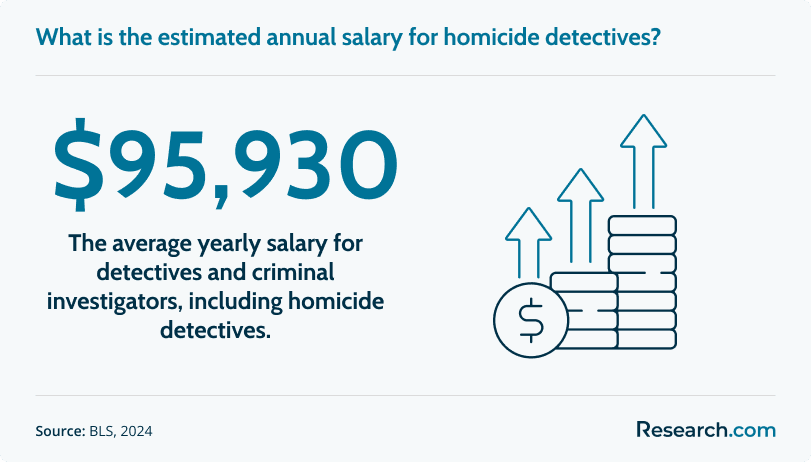
BLS reports that detectives and criminal investigators earn an annual mean wage of $95,930. Homicide detective pay can vary widely because compensation depends on the agency, union contract, cost of living, rank, overtime, years of service, special assignment pay, and whether the role is local, state, or federal.
| Career level | Typical pay range or figure | What can affect earnings |
| Entry-level detectives | $50,000 to $70,000 per year | Department size, jurisdiction, contract terms, overtime availability, and prior service |
| Experienced detectives | $80,000 to $110,000 annually | Years in investigations, specialty assignment, case responsibility, and location |
| Federal detectives and investigators, including FBI agents | $120,000 or more | Federal pay structure, assignment type, location, experience, and high-profile casework |
| Detectives and criminal investigators overall | Annual mean wage of $95,930 | BLS occupational data across detective and criminal investigator roles |
Base pay is only one part of the compensation picture. Many detectives may also receive overtime, health insurance, pension benefits, paid leave, tuition assistance, shift differentials, or other benefits depending on the employer. Salary outcomes are not guaranteed, so candidates should review actual agency pay scales before relocating or choosing a program based on expected earnings.
What is a day in the life of a homicide detective like?
Homicide detectives rarely have a predictable schedule. A day may involve a fresh crime scene, a family notification, interviews, warrant preparation, forensic follow-up, surveillance review, case meetings, prosecutor conferences, court appearances, or administrative documentation. Some days are field-heavy. Others are spent building timelines, reviewing reports, and preparing a case for prosecution.
Responding to homicide scenes
When a suspicious death or murder is reported, detectives coordinate with patrol officers, crime scene personnel, medical examiners, prosecutors, and supervisors. Their early priorities include scene security, witness separation, evidence preservation, victim identification, and determining the immediate investigative direction.
Interviewing witnesses, families, and suspects
Communication is central to the job. Detectives interview people who may be grieving, frightened, angry, evasive, intoxicated, traumatized, or unwilling to cooperate. A strong interview is not just about asking questions; it is about preparation, patience, documentation, legal compliance, and recognizing when a statement needs corroboration.
Reviewing evidence and case records
Detectives may analyze forensic reports, surveillance footage, phone records, social media activity, autopsy findings, ballistics results, lab submissions, prior police calls, and witness statements. They often build timelines and compare evidence across multiple sources.
Understanding violent crime trends
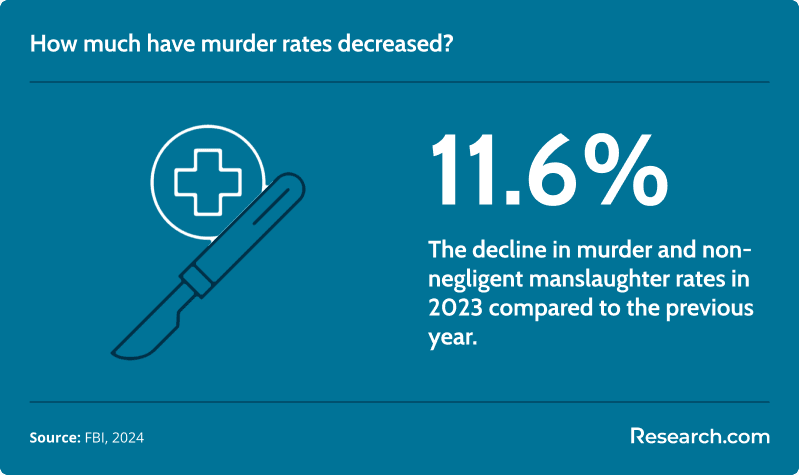
According to the FBI’s Uniform Crime Reporting (UCR) Program, in 2023:
- Murder rates dropped by 11.6% compared to 2022.
- Rape cases saw a 9.4% decrease.
- Aggravated assault cases declined by 2.8%.
- Robbery rates fell by 0.3%.
These figures describe national crime trends, not the workload of every homicide unit. Local conditions can be very different, and detectives may still face intense caseloads even when national rates decline.
Homicide work also overlaps with victim support, community response, and social services. If you are interested in helping families and communities outside sworn law enforcement, you may also want to explore how to become a social worker. If you are comparing jobs that require organization, communication, and institutional support in a very different setting, the roles of a teaching assistant offer another view of service-oriented work.
How do homicide detective salaries compare with other criminal justice careers?
Homicide detectives often earn more than many entry-level criminal justice workers because they are typically experienced sworn officers assigned to complex, high-liability investigations. However, pay comparisons should be made carefully. A detective’s actual income may include overtime and benefits, while another criminal justice career may offer different schedules, education requirements, risk levels, or advancement routes.
If salary is a major factor in your career decision, compare law enforcement roles against other justice-related occupations before choosing a degree or agency. Research.com’s guide to criminology jobs salary can help you examine broader earning possibilities across criminal justice careers.
What role does advanced education play in career advancement for homicide detectives?
Advanced education can help homicide detectives move toward supervision, command roles, legal coordination, teaching, policy work, federal opportunities, or specialized investigative assignments. A graduate program is not a substitute for field experience, but it can strengthen legal reasoning, research ability, writing, leadership, and administrative decision-making.
For detectives interested in legal systems and case preparation, an online master in legal studies may be relevant. Before enrolling, working officers should ask whether the program is flexible for shift schedules, whether tuition assistance applies, and whether the curriculum supports their target role.
How can continuous education and affordable certifications enhance your career?
Homicide investigation changes as forensic tools, digital evidence, case law, interview standards, and agency technologies evolve. Continuous education helps detectives stay current without necessarily committing to a full degree every time they need new skills.
Shorter programs can be useful when they fill a specific gap. For example, an affordable paralegal certificate may help a detective better understand legal documents, evidence rules, litigation support, and prosecutor collaboration. The key is to choose training that directly supports your work rather than collecting credentials with little practical value.
How Can Legal Expertise Enhance Homicide Investigations?
Legal knowledge is essential in homicide work because every investigative decision may later be examined in court. Detectives must understand search warrants, probable cause, subpoenas, interrogations, evidence admissibility, chain of custody, constitutional rights, and disclosure obligations.
Legal training can improve warrant preparation, report clarity, prosecutor communication, and courtroom testimony. Officers who want a focused legal credential without a long academic timeline may compare accelerated paralegal programs, especially if their goal is to strengthen practical legal procedure knowledge.
How can federal agency training enhance homicide investigation skills?
Federal agency training can expose detectives to advanced investigative methods, intelligence analysis, multi-jurisdiction coordination, surveillance practices, organized crime patterns, and specialized technologies. Local homicide cases sometimes involve gangs, narcotics trafficking, firearms, interstate movement, digital evidence, or federal partnerships, so understanding federal practices can be valuable.
Officers who are considering federal enforcement careers or cross-agency work may find it useful to study pathways such as how to get into DEA. Even if you remain in local law enforcement, learning how federal agencies structure investigations can sharpen your approach to complex cases.
How Do Homicide Detectives Manage Job Stress and Maintain Mental Wellness?
Homicide detectives are repeatedly exposed to violent death, grieving families, child victims, graphic evidence, long hours, court pressure, and unresolved cases. Mental wellness is not optional in this career. It directly affects judgment, empathy, decision-making, and career longevity.
| Stress risk | Why it matters | Helpful response |
| Repeated trauma exposure | Graphic scenes and victim-family interactions can accumulate over time. | Use peer support, counseling, debriefings, and trauma-informed supervision. |
| Irregular hours | Callouts, court dates, and urgent leads can disrupt sleep and family routines. | Protect recovery time when possible and develop realistic family and wellness plans. |
| Case pressure | Public attention, media coverage, and family expectations can intensify stress. | Rely on structured case management, team review, and supervisor guidance. |
| Emotional detachment or burnout | Long-term exposure can affect empathy, focus, and relationships. | Seek early support and treat mental health maintenance as part of professional readiness. |
Some detectives also strengthen their case-management and legal documentation skills through options such as a paralegal certificate online. Legal confidence will not remove job stress, but it can reduce avoidable pressure caused by weak documentation or procedural uncertainty.
What certifications and special training can help your career?
Certifications and specialized courses can help officers prepare for detective work, deepen expertise, or demonstrate commitment to homicide investigation. The best choice depends on your agency, current assignment, and long-term goals.
| Training or certification | What it can support | Who should consider it |
| Certified Professional Criminal Investigator (CPCI) | Investigation planning, evidence handling, interviewing, and criminal case development | Officers and investigators seeking broader investigative credentials |
| Crime Scene Investigator (CSI) Certification | Crime scene photography, forensic documentation, evidence recovery, and lab coordination | Detectives who regularly work with physical evidence and scene personnel |
| Homicide Investigation Training Program | Death investigation, autopsy interpretation, serial crime issues, and case management | Officers preparing for homicide units or detectives assigned to violent crime |
| FBI National Academy Training | Leadership development, advanced law enforcement practices, and professional networking | Experienced officers moving toward leadership or specialized assignments |
| Certified Forensic Interviewer (CFI) | Interview strategy, deception detection, and structured questioning techniques | Detectives who conduct frequent witness and suspect interviews |
How to choose the right training
- Ask your department which credentials are recognized for promotion, assignment, or tuition reimbursement.
- Prioritize courses that improve a current weakness, such as report writing, evidence, interviewing, or legal procedure.
- Check whether the provider is respected by law enforcement agencies, courts, or professional associations.
- Avoid paying for credentials that sound impressive but do not improve your eligibility, skills, or agency standing.
Where are the best cities and states to work as a homicide detective?
The best location for a homicide detective depends on more than pay. You should compare salary, cost of living, department size, caseload, promotion structure, union contract, overtime practices, retirement benefits, training resources, and the type of investigative work available.
States with the Highest Employment Levels
| State | Employment | Annual Mean Wage |
| Texas | 16,460 | $88,300 |
| California | 10,980 | $115,910 |
| New York | 9,030 | $118,350 |
| Florida | 6,010 | $88,610 |
| Arizona | 5,250 | $94,190 |
Top-Paying States for Detectives
| State | Annual Mean Wage | Employment |
| Alaska | $121,770 | 130 |
| Hawaii | $121,000 | 430 |
| Maryland | $119,900 | 980 |
| New York | $118,350 | 9,030 |
| California | $115,910 | 10,980 |
Large metro areas such as New York City, Los Angeles, and Houston may offer more investigative units, larger departments, and broader specialization opportunities. Smaller or higher-cost states can show strong wages, but candidates should compare those salaries against housing costs, taxes, benefits, and quality-of-life factors.
Career mobility also depends on qualifications, reputation, and leadership ability. For a non-law-enforcement comparison of how credentials and performance affect advancement, see Research.com’s guide to sales manager qualifications.
What do homicide detectives say about their career journey?
Arnold describes homicide work as demanding but meaningful, especially when an investigation helps bring answers to a victim’s family. His experience highlights the long hours, emotional burden, and sense of purpose that often come with violent crime investigations.
Elise emphasizes that patrol experience shaped her ability to read situations, work with a team, and notice details that later became important in homicide cases. Her path shows why departments usually expect officers to prove themselves before entering specialized units.
Raul points to the importance of psychology, patience, forensic evidence, and strategy. His perspective reflects a common reality of homicide investigation: cases are rarely solved by one clue alone, and strong detectives must keep testing evidence against facts.
How is technology transforming homicide investigations?
Technology is changing how homicide detectives identify leads, organize evidence, and present cases. Digital surveillance, phone data, mapping tools, 3D crime scene reconstruction, forensic software, database searches, body-worn camera review, and digital evidence management systems can all influence modern investigations.
Artificial intelligence and analytics may help investigators sort large volumes of information, identify links, and prioritize leads, but they do not replace human judgment. Detectives still need to verify evidence, avoid bias, follow legal standards, document decisions, and explain findings clearly in court.
If you want a degree path that includes modern policing, evidence, and technology, compare options such as a criminal justice degree online cheap. Look closely at whether the curriculum includes digital evidence, ethics, criminal procedure, research methods, and writing—not just general law enforcement topics.
Is becoming a homicide detective worth it?
Becoming a homicide detective can be worth it if you want a public-service career built around complex investigations, accountability, and helping families find answers after violent crimes. It is not the right path for someone who wants predictable hours, quick promotion, minimal stress, or limited exposure to trauma.
| Choose this path if... | Consider another path if... |
| You are willing to start in patrol and earn investigative opportunities over time. | You want to move directly into homicide investigation without sworn police experience. |
| You can handle difficult scenes, emotional conversations, and long investigations. | You prefer work that does not involve violent death or repeated trauma exposure. |
| You are comfortable with legal scrutiny, detailed documentation, and courtroom testimony. | You dislike paperwork, policy compliance, or adversarial court processes. |
| You want a career where teamwork, persistence, and evidence-based reasoning matter every day. | You want highly independent work with little supervision or coordination. |
| You are prepared for irregular hours, callouts, and case pressure. | You need a stable schedule and consistent work-life boundaries from the start. |
Common mistakes to avoid when preparing for this career
- Assuming a degree alone will make you a detective: Education helps, but homicide roles usually require sworn law enforcement experience and strong performance.
- Choosing a school only because it is fast or easy: A convenient program should still improve writing, legal knowledge, analysis, and communication.
- Ignoring agency requirements: Police departments vary in age rules, education standards, residency policies, physical fitness tests, and promotion systems.
- Underestimating report writing: Weak documentation can hurt investigations, warrants, prosecutions, and promotion prospects.
- Overlooking mental health: Emotional resilience must be developed before burnout appears, not after.
- Focusing only on salary: Compare benefits, pension structure, overtime expectations, cost of living, caseload, training, and workplace culture.
- Relying only on rankings or general advice: Speak with local officers, recruiters, advisors, and agency training staff before choosing a degree or career plan.
Questions to ask before choosing a degree, agency, or training program
- Does this police department promote detectives through exams, supervisor selection, seniority, or a combination of factors?
- How many years of patrol experience are typically expected before officers can apply for detective assignments?
- Does the agency have a homicide unit, violent crime unit, or general investigations division?
- Will the department recognize college credit, military service, prior law enforcement experience, or specialized certifications?
- Does the degree program include criminal procedure, writing, evidence, forensic science, interviewing, psychology, or digital evidence?
- Is the program flexible enough for shift work if you are already employed?
- Does the agency offer tuition assistance, paid training, or reimbursement for certifications?
- What mental health, peer support, and critical incident resources are available to detectives?
- How does salary compare with local cost of living, overtime expectations, and retirement benefits?
Key Insights
- Homicide detective work is usually a promotion path, not an entry-level job. Most candidates must first serve successfully as police officers.
- BLS reported 106,730 employed detectives and criminal investigators as of May 2023, with police and detective employment projected to grow by 4% from 2023 to 2033.
- The minimum education requirement is often a high school diploma or equivalent, but Zippia reports that 64% of homicide detectives hold a bachelor’s degree, 17% have an associate degree, and 8% earned a master’s degree.
- BLS reports an annual mean wage of $95,930 for detectives and criminal investigators, while experienced detectives and federal investigators may earn higher pay depending on role, location, and agency structure.
- Texas, California, and New York have the highest employment levels among detectives, while Alaska, Hawaii, Maryland, New York, and California are listed among the top-paying states in the data provided.
- The FBI reported that in 2023 murder rates dropped by 11.6% compared with 2022, while rape, aggravated assault, and robbery also declined by 9.4%, 2.8%, and 0.3%, respectively.
- The strongest homicide detective candidates build skills in interviewing, evidence handling, legal procedure, writing, forensic coordination, digital evidence, and emotional resilience.
- Before investing in a degree or certification, confirm that it aligns with your target agency’s hiring, promotion, and training requirements.
References:
- BLS. (2024, April 3). Detectives and criminal investigators. BLS.
- BLS. (2024, August 29). Police and detectives. BLS.
- FBI. (2024, September 23). FBI releases 2023 crime in the Nation statistics. FBI.gov.
- Zippia. (2025, January 8). Homicide Detective Demographics and Statistics [2025]: Number of homicide detectives in the US. Zippia.
- Zippia. (2025, January 8). Homicide Detective skills for your resume and career. Zippia.
Other Things You Should Know About Becoming a Homicide Detective
Yes. Most departments require several years as a sworn patrol officer before promotion to homicide. Many agencies want 3 to 5 years of field experience, a clean disciplinary record, strong report writing, and successful completion of internal promotion testing and interviews.
In 2027, aspiring homicide detectives can benefit from degrees in criminal justice or forensic science. Additionally, obtaining certifications such as those from the International Association of Detectives and Investigators can enhance credentials and provide specialized knowledge crucial for the role.


