2027 How To Become a Forensic Anthropologist

Co-Founder and Chief Data Scientist
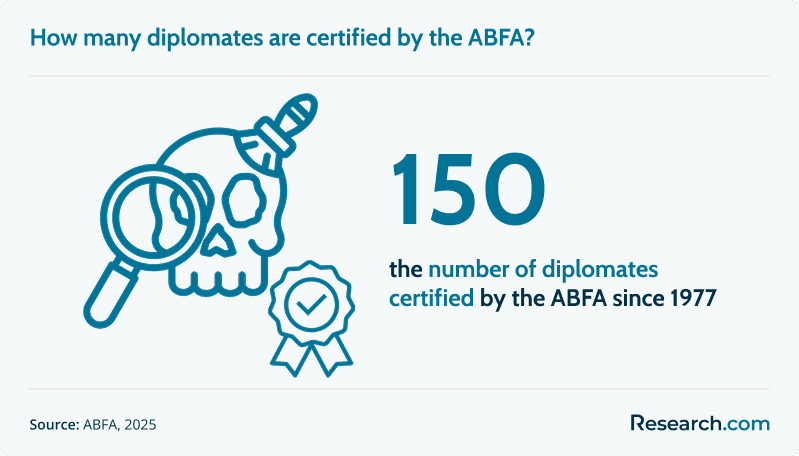
Forensic anthropology is the career path for people who want to identify human remains, interpret skeletal trauma, and support legal investigations with scientific evidence. It is also one of the narrowest specialties in forensic science: only 150 forensic anthropologists have been certified by the American Board of Forensic Anthropology (ABFA) since 1977. That small number is a useful warning for students. This field can be meaningful and intellectually demanding, but it usually requires graduate education, field experience, research training, and strong professional relationships.
This guide explains how to become a forensic anthropologist, what degree path is usually required, how long training takes, where forensic anthropologists work, what they earn, and how to decide whether this career is worth the investment. It is written for students comparing forensic science careers, anthropology majors considering graduate school, and professionals who want to move into human identification, death investigation, or humanitarian forensic work.
Quick Answer: How do you become a forensic anthropologist?
To become a forensic anthropologist, you typically earn a bachelor’s degree in anthropology, biology, archaeology, or a related field; complete graduate training in biological, physical, or forensic anthropology; gain hands-on experience with skeletal analysis and forensic recovery; and, for many professional roles, pursue a PhD. Certification through the American Board of Forensic Anthropology is not always legally required, but it is a major professional credential for qualified doctoral-level practitioners.
Key Things You Should Know About How to Become a Forensic Anthropologist
- The field is small and highly competitive. Since 1977, only 150 forensic anthropologists have been certified by the American Board of Forensic Anthropology (ABFA), so students should expect a long and selective training process.
- Graduate education matters. A bachelor’s degree can prepare you for entry-level lab, museum, archaeology, or forensic support roles, but most independent forensic anthropology careers require a master’s degree or PhD.
- Pay depends heavily on employer type. Federal government positions can offer stronger compensation, with forensic anthropologists in that setting earning a median annual salary of around $86,000, while academic, museum, and consulting roles may pay differently.
- Collaboration is part of the job. Forensic anthropologists often work with medical examiners, forensic pathologists, investigators, odontologists, DNA analysts, attorneys, and forensic psychologists.
- Technology is changing the work. 3D imaging, DNA analysis, forensic reconstruction, AI-assisted image review, and advanced decomposition research are improving how remains are documented, compared, and identified.
- What does a forensic anthropologist do?
- How is forensic anthropology different from forensic pathology and forensic science?
- What degree do you need to become a forensic anthropologist for 2027?
- How long does it take to become a forensic anthropologist?
- What jobs can you get with a forensic anthropology degree?
- How much do forensic anthropologists make?
- What skills are required to be a forensic anthropologist?
- What certifications do forensic anthropologists need?
- What strategies can enhance career opportunities in forensic anthropology?
- What are the emerging career opportunities in forensic anthropology?
- How can interdisciplinary education enhance a forensic anthropology career? See emerging roles
- What are the ethical considerations in forensic anthropology?
- How do you choose the right forensic anthropology program?
- Can forensic anthropology benefit from environmental engineering?
- How can sustainable practices enrich forensic anthropology?
- Who do forensic anthropologists work with?
- What are some famous forensic anthropology cases?
- What are the latest advancements in forensic anthropology?
What does a forensic anthropologist do?
A forensic anthropologist uses knowledge of the human skeleton to help answer legal and investigative questions. Their work is most valuable when remains are decomposed, burned, fragmented, scattered, skeletonized, or otherwise difficult to identify through a standard visual examination.
- Build a biological profile. They examine bones to estimate age, sex, ancestry, stature, and other identifying characteristics that may help narrow a missing-person search.
- Recover remains using controlled methods. Forensic anthropologists use archaeological recovery techniques to locate, document, excavate, and preserve remains and associated evidence without losing scene context.
- Evaluate trauma and disease. They inspect skeletal material for fractures, cut marks, gunshot-related damage, healing patterns, pathology, and other evidence that may clarify what happened before, during, or after death.
- Support death investigations. They coordinate with medical examiners, forensic pathologists, law enforcement, and laboratory professionals. Some casework overlaps with biological testing and diagnostics, which is why readers exploring laboratory roles may also compare this path with clinical technologist careers.
- Write reports and testify in court. They must explain technical skeletal findings in clear, neutral language that judges, juries, attorneys, and investigators can understand.
In practical terms, forensic anthropologists help convert human skeletal evidence into reliable investigative information. They do not “solve” cases alone, but their findings can be crucial when identity, trauma, time since death, or recovery context is disputed.
Common day-to-day responsibilities
| Task | What it involves | Why it matters |
| Scene recovery | Mapping, photographing, excavating, and collecting skeletal remains and related evidence | Preserves context and reduces the risk of contamination or evidence loss |
| Laboratory analysis | Cleaning, inventorying, measuring, and examining skeletal material | Creates the foundation for identification and trauma interpretation |
| Biological profile development | Estimating age, sex, ancestry, stature, and unique skeletal features | Helps investigators compare remains with missing-person records |
| Trauma assessment | Distinguishing possible perimortem injury from postmortem damage | Can support conclusions about events surrounding death |
| Expert communication | Preparing reports, consulting with investigators, and testifying | Ensures scientific conclusions are usable in legal settings |
How is forensic anthropology different from forensic pathology and forensic science?
Forensic anthropology, forensic pathology, and forensic science all support legal investigations, but they are not interchangeable careers. The main difference is the kind of evidence each specialist examines and the professional training required.
Forensic anthropology focuses on human skeletal remains. It is especially relevant when soft tissue is absent or limited, when remains are fragmented, or when investigators need help with recovery from outdoor, buried, burned, or mass-fatality scenes.
Forensic pathology is a medical specialty. As one of the types of forensic science, it centers on autopsy findings, disease, injury, toxicology context, and cause and manner of death. Forensic pathologists are physicians with specialized pathology training.
Forensic science is a broader umbrella that includes biology, chemistry, toxicology, trace evidence, firearms examination, DNA analysis, digital forensics, and other evidence-based specialties used in criminal and civil investigations.
| Discipline | Primary focus | Typical education requirements | Best fit for students who want to... |
| Forensic Anthropology | Analysis of skeletal remains | Advanced degrees in physical/biological anthropology | Study bones, human variation, recovery methods, and identification |
| Forensic Pathology | Determining cause of death via autopsies | Medical degree (MD) with specialization in pathology | Become a physician and perform death investigations through autopsy |
| Forensic Science | Analysis of various physical evidence | Degrees in specific scientific fields, such as biology or chemistry | Work in a crime lab analyzing DNA, toxicology, chemicals, or trace evidence |
If you are deciding among these paths, start with the evidence type that interests you most. Students drawn to bones, anatomy, archaeology, and field recovery may prefer forensic anthropology. Students who want medical decision-making should look at forensic pathology. Students who prefer lab-based evidence testing may fit better in forensic science.
What degree do you need to become a forensic anthropologist for 2027?
For 2027, the standard path into forensic anthropology still runs through anthropology, biological anthropology, physical anthropology, archaeology, anatomy, and forensic science coursework. A bachelor’s degree is the starting point, but it is rarely enough for independent forensic anthropology practice. Students planning for long-term advancement should expect graduate school.
- Bachelor's degree. A major in anthropology is the most direct option, but biology, archaeology, forensic science, anatomy, or a closely related field can also work if the student completes enough human osteology, statistics, research methods, and fieldwork.
- Master's degree. A graduate program in anthropology with a biological, physical, or forensic focus helps students build advanced skeletal analysis, research, and case-documentation skills.
- Doctoral degree (PhD). A PhD in physical anthropology or a closely related area is often expected for academic posts, research leadership, independent consultation, and ABFA certification eligibility.
Students should treat coursework as only one part of preparation. Case observation, supervised lab work, archaeological field schools, skeletal collection experience, internships, conference participation, and faculty mentorship often make the difference between a general anthropology background and a credible forensic anthropology profile.
Some students explore adjacent forensic or investigative fields while completing their main training. For example, a student who is comparing healthcare-based emergency roles may find that the flight nurse career path requires a very different mix of clinical licensure, emergency medicine experience, and certifications. Others interested in financial investigations may compare anthropology with a master's in forensic accounting, which develops evidence-focused analytical skills for fraud and financial crime cases rather than human remains analysis.
Degree path comparison
| Education level | What it can prepare you for | Limitations to consider |
| Bachelor's degree | Graduate school preparation, archaeology fieldwork, museum support, lab assistant work, or entry-level forensic support roles | Usually not enough for independent forensic anthropology casework |
| Master's degree | Specialized skeletal analysis training, research assistant roles, applied forensic support, and stronger graduate preparation | May still limit access to academic, leadership, and certification-oriented roles |
| Doctoral degree (PhD) | University teaching, research leadership, expert consultation, and advanced forensic anthropology practice | Requires a long time commitment, original research, and competitive placement |
How long does it take to become a forensic anthropologist?
Becoming a forensic anthropologist commonly takes around ten years because the field expects advanced academic and practical preparation. A typical timeline includes four years for a bachelor’s degree, two to three years for a master’s degree, and four to six years for a PhD. The final timeline can shift depending on thesis or dissertation research, field training, funding, teaching responsibilities, and the pace of casework experience.
Some students enter related jobs after the master’s degree, especially in applied anthropology, archaeology, museums, or forensic support settings. However, students aiming for independent case consultation, university positions, or the strongest professional recognition often continue to the doctoral level.
Accreditation should be checked early, especially if you are considering distance learning for part of your education. Research.com’s list of regionally accredited online colleges can help students understand why institutional accreditation matters before committing time and tuition to a program. Online coursework may be useful for prerequisites or related degrees, but forensic anthropology also requires in-person lab, field, and skeletal analysis experience.
Typical forensic anthropology training timeline
| Stage | Typical time | What to prioritize |
| Bachelor's degree | Four years | Anthropology, biology, anatomy, statistics, archaeology, and introductory forensic science |
| Master’s degree | Two to three years | Human osteology, skeletal biology, research methods, thesis work, and supervised lab experience |
| PhD | Four to six years | Original research, teaching, professional presentations, publications, and advanced specialization |
| Postgraduate development | Varies | Casework experience, professional networking, continuing education, and possible ABFA certification preparation |
What jobs can you get with a forensic anthropology degree?
A forensic anthropology degree can lead to several career directions, but the exact options depend on degree level, hands-on training, and whether the role involves independent forensic casework. Many graduates work in anthropology-adjacent roles before reaching advanced forensic anthropology positions.
- University teaching and research. PhD-trained forensic anthropologists may teach anthropology, conduct skeletal biology research, supervise students, and publish studies that improve identification or trauma-analysis methods.
- Law enforcement and investigative support. Some professionals assist police agencies, state bureaus, federal entities, or international teams with remains recovery and skeletal analysis. Students who prefer evidence collection at active scenes may also review the steps to become a crime scene technician.
- Medical examiner or coroner offices. Forensic anthropologists may consult on decomposed, burned, fragmented, or unidentified remains when autopsy findings alone are limited.
- Museums and historical organizations. Anthropologists may curate skeletal collections, document human remains, support repatriation work, and educate the public about human osteology.
- Human rights and humanitarian organizations. Forensic anthropologists may help recover and identify remains from mass graves, armed conflicts, disasters, or migration-related deaths.
Students should be realistic: “forensic anthropologist” is not usually an entry-level title. Many people build experience through archaeology, lab research, teaching assistantships, museum work, forensic technician roles, or graduate research before qualifying for advanced casework.
Career options by education level
| Role type | Common setting | Typical preparation | Decision note |
| Forensic anthropology consultant | Medical examiner offices, law enforcement, courts, private consulting | Usually advanced graduate training, often PhD-level expertise | Best for students committed to long-term specialization |
| Researcher or professor | Universities and research institutions | Usually a PhD | Best for those who enjoy teaching, publishing, and grant-supported research |
| Forensic technician or crime scene support | Law enforcement or crime labs | Often bachelor’s-level science preparation plus job-specific training | May be a better fit for students who want to enter the workforce sooner |
| Museum or collections specialist | Museums, universities, historical societies | Anthropology background and collections experience | Useful for students interested in osteology, preservation, and public education |
| Humanitarian forensic specialist | NGOs, international teams, disaster response settings | Graduate training, field recovery skills, and cross-cultural competence | Best for those prepared for emotionally difficult and logistically complex work |
How much do forensic anthropologists make?
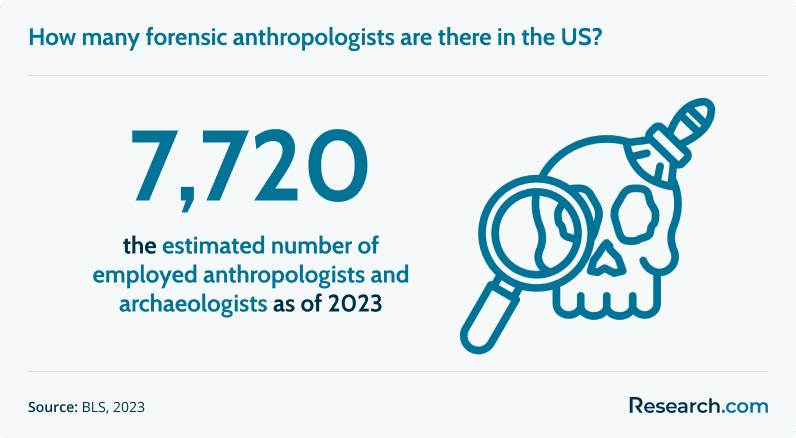
Forensic anthropologist salary data is difficult to isolate because the occupation is small and often grouped with broader categories. According to the Bureau of Labor Statistics (BLS), anthropologists and archeologists, a category that includes forensic anthropologists, had a median annual wage of $63,800 as of May 2023. The lowest 10% earned less than $43,770, while the highest 10% earned more than $102,150.
Employer type has a major effect on compensation. Federal government and private research roles may pay more than some academic, museum, or local-agency positions. Salary data from ZipRecruiter and Salary.com indicates that experienced forensic anthropologists in specialized positions can earn upwards of $90,000, particularly in forensic laboratories or government agencies.
Students comparing forensic careers should also consider opportunity cost. Forensic anthropology often requires a long graduate-school timeline, while some adjacent forensic careers have different education requirements and salary profiles. For example, according to Indeed, the average forensic accountant salary in the United States is $103,859 per year, which reflects a different labor market tied to fraud, compliance, and financial crime investigations rather than skeletal evidence.
Salary factors to evaluate before choosing this path
| Factor | How it affects earnings | What students should ask |
| Degree level | Advanced roles often require graduate training and may offer better long-term prospects | Will this program prepare me for roles that require a master’s degree or PhD? |
| Employer sector | Federal government and private research positions may differ from museums, universities, and local agencies | Where do graduates actually work after completing this degree? |
| Geographic location | Pay can reflect local budgets, demand, and cost of living | Are there forensic anthropology opportunities in the region where I want to live? |
| Casework experience | Supervised case exposure can strengthen credibility for consulting and court-related work | Does the program offer real field, lab, or agency partnerships? |
| Research specialization | Expertise in trauma, taphonomy, imaging, or human identification can improve competitiveness | Can I work with faculty whose research matches my career goal? |
What skills are required to be a forensic anthropologist?
Forensic anthropology requires more than an interest in crime investigation. The strongest candidates combine skeletal biology, field recovery, scientific reasoning, legal awareness, and careful communication.
- Human osteology. You need advanced knowledge of bone anatomy, skeletal development, variation, pathology, and trauma indicators.
- Archaeological field methods. Proper excavation, mapping, documentation, and recovery techniques protect evidence and preserve scene context.
- Scientific analysis. Forensic anthropologists must compare evidence, evaluate uncertainty, avoid overclaiming, and explain how conclusions were reached.
- Technical writing and testimony. Reports must be clear, defensible, and understandable to non-specialists, including attorneys and jurors.
- Legal and ethical awareness. Work involving human remains must meet legal standards, chain-of-custody requirements, cultural expectations, and professional ethics.
Students may also specialize within forensic anthropology. Each specialization calls for deeper training and a different research profile.
- Forensic taphonomy. Studies how decomposition, insects, scavenging, soil, water, temperature, and time affect remains after death.
- Forensic osteology. Concentrates on skeletal biology, bone identification, pathology, trauma, and biological profile estimation.
- Forensic archaeology. Applies archaeological search, excavation, and documentation methods to forensic and legal contexts.
Interdisciplinary study can be useful when it directly strengthens forensic work. For instance, students interested in behavior, testimony, victimology, or investigative context may compare anthropology training with forensic psychology master's programs online, while remembering that forensic psychology does not replace osteology or skeletal analysis training.
Skills checklist for prospective students
| Skill area | Beginner preparation | Advanced preparation |
| Bone identification | Take anatomy and introductory osteology | Work with documented skeletal collections and graduate-level osteology labs |
| Field recovery | Complete archaeology field school or excavation training | Assist with supervised forensic or humanitarian recovery projects |
| Data and measurement | Build statistics and research-methods skills | Use quantitative methods in thesis or dissertation research |
| Professional communication | Practice lab reports and presentations | Prepare expert-style reports and mock testimony |
| Ethics | Study human-subjects, repatriation, and cultural-sensitivity issues | Apply ethical standards in casework, research, and community collaboration |
What certifications do forensic anthropologists need?
Certification is not the first step in this career. It comes after substantial education and experience. However, recognized certification can strengthen credibility, especially for professionals who conduct casework, consult with agencies, or testify in court.
American Board of Forensic Anthropology (ABFA) Diplomate
The ABFA certifies qualified professionals who hold a doctoral degree (PhD) in anthropology or a closely related field and pass a comprehensive examination. Diplomate status signals that the practitioner has met rigorous professional expectations in forensic anthropology.
Forensic Anthropology Society of Europe (FASE) Certification
FASE offers two certification levels:
- Level 2. Designed for practitioners who can work with skeletal remains and support senior forensic anthropology personnel.
- Level 1 (C-FASE). Intended for independent practitioners with substantial experience and demonstrated competence.
Royal Anthropological Institute (RAI) Certification
In the United Kingdom, the RAI recognizes forensic anthropology practice through two levels:
- Forensic Anthropologist II. For practitioners with demonstrated theoretical and practical competence, even if they have limited courtroom experience.
- Chartered Forensic Anthropologist (FAI). The highest level, intended for experienced practitioners with courtroom experience.
Certification should be viewed as evidence of advanced competence, not as a shortcut into the field. Students comparing forensic science credentials may also review the criminalist career path, which has a different training structure and may align better with laboratory evidence analysis.
What strategies can enhance career opportunities in forensic anthropology?
Because forensic anthropology is small, students need a deliberate career strategy. Strong grades help, but they are not enough. Competitive candidates build a record of research, field experience, professional engagement, and clear specialization.
- Work with skeletal material as early as possible. Look for osteology labs, museum collections, archaeology projects, and supervised research opportunities.
- Attend professional conferences. Presenting posters, meeting faculty, and learning current research can help students identify graduate programs and mentors.
- Build a research niche. Trauma analysis, taphonomy, human variation, imaging, disaster victim identification, and humanitarian forensics can all shape a stronger graduate profile.
- Learn complementary tools. GIS, statistics, 3D modeling, photography, database management, and scientific writing can make your work more useful to agencies and research teams.
- Understand adjacent sectors. Some forensic anthropology work intersects with environmental recovery, land use, disaster planning, or institutional responsibility. Students interested in broader organizational impact may also compare related careers in business sustainability.
Common mistakes that weaken career preparation
| Mistake | Why it causes problems | Better approach |
| Choosing a program only because it has “forensic” in the title | The curriculum may not include enough osteology, anthropology, or research depth | Review faculty expertise, lab access, graduate placements, and thesis options |
| Skipping field school or excavation training | Recovery context is essential in many forensic cases | Complete archaeological field training and learn documentation standards |
| Assuming a bachelor’s degree is enough | Independent forensic anthropology roles usually require graduate education | Plan early for master’s or PhD admission requirements |
| Ignoring statistics and methods | Modern skeletal analysis depends on evidence-based interpretation | Take quantitative methods seriously and apply them in research |
| Relying only on rankings | A highly ranked school may not have the right mentor or lab resources | Choose based on fit, training access, funding, and faculty alignment |
What are the emerging career opportunities in forensic anthropology?
Forensic anthropology is expanding beyond traditional criminal case consultation. The core work still involves human remains, but new opportunities are developing where skeletal analysis, recovery methods, technology, and humanitarian needs overlap.
- Mass disaster response. Forensic anthropologists may assist with recovery, sorting, documentation, and identification after large-scale fatality events.
- Human rights investigations. Specialists may help document evidence from mass graves, political violence, genocide, or war crimes.
- Humanitarian and migration-related identification. Forensic anthropologists can support efforts to identify unknown deceased individuals and return remains to families.
- Digital forensic anthropology. 3D imaging, CT data, photogrammetry, and digital skeletal comparison are creating new technical roles.
- Environmental and decomposition research. Work on soil, climate, microbes, scavenging, and site conditions can improve postmortem interval research. Students interested in broader environmental science careers can compare this path with environmental scientist salary benchmarks and requirements.
These roles still require strong anthropology foundations. Technology can expand what forensic anthropologists do, but it does not replace the need for skeletal expertise, ethical judgment, and supervised case experience.
How can interdisciplinary education enhance a forensic anthropology career?
Interdisciplinary education can help forensic anthropology students when it strengthens the science of recovery, identification, documentation, or interpretation. Environmental science, statistics, GIS, anatomy, forensic psychology, computer imaging, and data analytics can all be useful when paired with rigorous anthropology training.
For example, environmental science can improve understanding of decomposition settings, soil conditions, water exposure, and preservation. Students seeking affordable ways to build this background may review affordable environmental science colleges, especially if they want to supplement—not replace—their forensic anthropology preparation.
The key is purpose. Do not add extra credentials randomly. Choose interdisciplinary coursework because it helps answer a forensic question more accurately, document a scene more carefully, or communicate findings more clearly.
What are the ethical considerations in forensic anthropology?
Forensic anthropologists work with human remains, grieving families, sensitive records, and legal evidence. Ethical practice is therefore central to the profession, not an optional add-on.
- Respect for the deceased. Human remains must be handled with dignity, careful documentation, and appropriate security.
- Cultural sensitivity. Practitioners may work with Indigenous communities, repatriation cases, religious concerns, or families with specific expectations for treatment of remains.
- Scientific honesty. Conclusions should reflect the evidence and its limits. Overstating certainty can damage investigations and court proceedings.
- Impartiality. Forensic anthropologists serve the evidence, not the preferred theory of an agency, attorney, or institution.
- Privacy and confidentiality. Identifying information, images, and case details should be shared only through appropriate professional and legal channels.
Ethical issues also arise in broader community contexts, including land use, burial disturbance, disaster planning, and public accountability. Students interested in how communities manage space, infrastructure, and human impact may find useful context in an urban planning online degree, though that path serves a different professional purpose.
How do you choose the right forensic anthropology program?
The best forensic anthropology program is not simply the one with the most dramatic course titles. It is the program that provides the right faculty mentorship, skeletal training, research support, field experience, and graduate placement for your goals.
Questions to ask before applying
- Is the institution properly accredited? Accreditation affects degree recognition, graduate admission, financial aid eligibility, and employer confidence.
- Who teaches forensic anthropology courses? Look for faculty with active research, skeletal analysis expertise, casework experience, or strong publication records.
- Will I work with real skeletal collections or only textbook examples? Hands-on osteology training is essential.
- Does the program offer fieldwork? Excavation, mapping, and scene documentation skills are difficult to learn through lectures alone.
- What do graduates do next? Ask about PhD placements, employment outcomes, internships, and alumni working in forensic or anthropology-related roles.
- Is funding available? Graduate school can be expensive, so assistantships, tuition support, and research funding matter.
- Does the program fit my specialization? A student interested in taphonomy needs different faculty support than a student focused on human variation or 3D imaging.
Some students add environmental or sustainability coursework when it connects to decomposition, recovery settings, or evidentiary preservation. If that combination fits your goals, you may compare options such as an environmental science bachelor degree online while ensuring your core anthropology training remains strong.
Online vs. campus-based preparation
| Format | Potential advantages | Important cautions |
| Online coursework | Flexible scheduling, useful for prerequisites, related theory, or supplemental science classes | May not provide enough lab-based osteology or field recovery experience |
| Campus-based program | Better access to labs, skeletal collections, faculty research, and field training | May require relocation, fixed schedules, and higher living costs |
| Hybrid pathway | Can combine online general coursework with in-person labs, field schools, or graduate training | Students must verify that hands-on requirements are truly available |
Can forensic anthropology benefit from environmental engineering?
Environmental engineering can support forensic anthropology when investigators need to understand how soil, water movement, drainage, temperature, humidity, contamination, or landscape conditions affect remains. These factors can influence preservation, decomposition, recovery planning, and interpretation of postmortem change.
This does not mean forensic anthropologists need to become engineers. Instead, they may collaborate with environmental specialists or take targeted coursework that improves their ability to understand deposition environments. Students who want formal training in this area can explore an affordable online environmental engineering degree, especially if they are considering careers that combine environmental analysis with forensic or investigative work.
How can sustainable practices enrich forensic anthropology?
Sustainability is not the central focus of forensic anthropology, but responsible resource use can improve field and laboratory practice. Careful excavation planning, reduced waste, efficient imaging workflows, durable documentation systems, and respectful site management can support both evidence quality and environmental responsibility.
Forensic teams must never let sustainability goals compromise evidence preservation, chain of custody, or respect for remains. The best approach is practical: use efficient methods where they improve work quality and reduce unnecessary impact. Professionals interested in connecting environmental responsibility with research or organizational practice can review affordable masters in sustainability options as a complementary field, not a substitute for forensic anthropology training.
Who do forensic anthropologists work with?
Forensic anthropologists rarely work alone. Their findings become useful when combined with investigative records, medical findings, DNA results, dental comparisons, scene documentation, and legal procedures.
- Law enforcement agencies. Police departments, federal agencies, and international investigators may request help with recovery, identification, or trauma interpretation.
- Medical examiners and forensic pathologists. These professionals may rely on skeletal analysis when remains are decomposed, burned, fragmented, or incomplete.
- Forensic odontologists and DNA analysts. Dental and genetic evidence often play a major role in confirming identity.
- Attorneys, prosecutors, and courts. Forensic anthropologists may explain findings in reports, depositions, or expert testimony.
- Archaeologists, historians, and human rights teams. Collaboration is common in historical recoveries, mass grave investigations, repatriation cases, and humanitarian work.
- Researchers and social scientists. Broader questions about migration, violence, demography, and community impact may involve sociologists or other scholars. Students interested in that side of analysis may ask what can you do with a masters in sociology and compare it with anthropology-focused training.
The ability to collaborate across disciplines is one of the most important professional skills in forensic anthropology. A strong expert knows when skeletal evidence can answer a question—and when another specialist is needed.
What are some famous forensic anthropology cases?
Forensic anthropology has contributed to modern criminal investigations, historical interpretation, humanitarian recovery, and long-running unidentified-person cases. The following examples show the range of work rather than a single career template.
- Identification of the Somerton Man. In 1948, an unidentified man was found on Somerton Beach in South Australia. Decades later, forensic anthropology and genetic genealogy helped move the case toward identification by using biological evidence connected to a plaster death mask.
- Pompeii victims and the eruption of Mount Vesuvius. The 79 AD disaster preserved victims in ways that continue to be studied. Forensic anthropologists and related specialists have used casts and imaging to better understand the human impact of the eruption.
- Windover archaeological site. In 1982, construction workers in Titusville, Florida, uncovered 8,000-year-old human skeletons. The discovery of intact brain tissue in 91 of the skulls created rare opportunities for DNA extraction and ancient population research.
- Cold case resolution involving Danielle “Danni” Houchins. The Gallatin County Sheriff’s Office and forensic experts helped solve the 1996 murder of the 15-year-old, showing how newer forensic methods can reopen older investigations.
- The Art of Forensics exhibit. Facial reconstruction work in this initiative has helped draw public attention to unidentified homicide victims and has contributed to nearly 25 homicide case resolutions and updates to over 140 cases.
These cases highlight a central point: forensic anthropology is most powerful when paired with other methods, such as DNA, imaging, archaeology, odontological comparison, genealogy, and investigative records.
What are the latest advancements in forensic anthropology?
Forensic anthropology is changing as researchers improve identification methods, digital documentation, decomposition science, and evidence visualization. These advances do not remove the need for expert judgment, but they can make analysis faster, more consistent, and easier to share across teams.
- Microbiome research. Researchers have identified approximately 20 microbes that universally drive decomposition of animal flesh, raising the possibility that microbial patterns could support future forensic identification and postmortem interval research.
- Artificial intelligence. Deep learning models trained on large collections of human decomposition images have been used to classify stages of decay with reliability levels comparable to human experts.
- Advanced imaging. CT scanning and protocols such as the Batch Artifact Scanning Protocol can create three-dimensional models of objects from large collections, improving documentation and analysis workflows.
- Improved latent fingerprint visualization. New fluorescent nanoparticles have improved the detection of latent fingerprints that were previously difficult to visualize, showing how materials science can influence forensic work broadly.
- Digital collaboration. 3D models, secure image sharing, and database-supported comparisons can help distributed teams review evidence without repeatedly handling fragile remains.
Students entering the field should become comfortable with technology while keeping their core scientific training strong. Those interested in the digital side of investigations may also compare forensic anthropology with cybercrime-related study options through a cybercrime degree online pathway, recognizing that cybercrime and skeletal analysis are separate specialties.
What graduates say about forensic anthropology degrees
Mackenzie described forensic anthropology coursework as the point where a broad interest in forensic science became a clearer interest in skeletal analysis. Supportive faculty, case-based assignments, and classmates with similar goals helped her move toward work with a human rights organization focused on identifying remains in historical investigations.
George, a military veteran, valued the structure and investigative focus of forensic anthropology training. Online study helped him transition into civilian life without relocating his family, and simulated casework gave him a practical bridge into assisting with cold case investigations.
Carlos, who was working as a police officer while studying, found that online coursework fit an unpredictable schedule. Case studies connected directly to missing-person and crime-scene work, helping him collaborate more effectively with forensic scientists and medical examiners.
Is becoming a forensic anthropologist worth it?
Forensic anthropology can be worth it if you are deeply interested in skeletal biology, human identification, field recovery, research, and legal evidence—and if you are prepared for a long educational path. It is not the fastest route into forensic work, and it is not the best choice for students who want a large job market immediately after a bachelor’s degree.
This path may be a strong fit if you...
- Enjoy anatomy, bones, archaeology, biology, and detailed scientific observation.
- Are willing to complete graduate school and possibly a PhD.
- Can handle emotionally difficult work involving death, trauma, missing persons, and grieving families.
- Want a career that combines research, fieldwork, lab analysis, and legal communication.
- Are comfortable with a competitive job market and a long professional ramp-up.
You may want a different forensic career if you...
- Want to enter the workforce quickly after an undergraduate degree.
- Prefer wet-lab testing over skeletal analysis.
- Want to perform autopsies as a physician.
- Are primarily interested in digital evidence, cybercrime, toxicology, or financial fraud.
- Do not want to relocate for graduate school, fieldwork, or limited job openings.
Key Insights
- Forensic anthropology is specialized, not broad-entry forensic science. The profession centers on human skeletal remains, recovery context, trauma interpretation, and identification.
- The education timeline is long. Becoming competitive commonly takes around ten years, including a bachelor’s degree, master’s degree, and PhD, with additional time for research, fieldwork, and professional development.
- Certification is advanced recognition. As of 2023, only 150 diplomates have been certified by the American Board of Forensic Anthropology (ABFA) since its founding in 1977, which reflects the selectivity of the field.
- Salary varies by sector and role. BLS data for anthropologists and archeologists shows a median annual wage of $63,800 as of May 2023, while the original career summary also notes forensic anthropologists earning a median annual salary of around $66,000 and some professionals making over $100,000 in specialized roles.
- Hands-on experience is essential. Students should seek osteology labs, archaeological field training, research projects, internships, and supervised case exposure instead of relying on coursework alone.
- Technology is expanding the field. AI-assisted decomposition analysis, 3D imaging, CT scanning, microbiome research, and improved visualization methods are changing how forensic evidence is documented and interpreted.
- Program choice should be evidence-based. Before enrolling, confirm accreditation, faculty expertise, skeletal collection access, fieldwork opportunities, funding, and graduate outcomes.
References:
- American Academy of Forensic Sciences. Careers in forensic anthropology. aafs.org
- American Board of Forensic Anthropology. General information. theabfa.org
- Bureau of Labor Statistics. Anthropologists and archeologists: Occupational outlook handbook. bls.gov
- Bureau of Labor Statistics. Occupational employment and wages: Anthropologists and archeologists. bls.gov
- McKay, D. R. Forensic anthropologist career information. liveabout.com
- Royal Anthropological Institute. Forensic anthropology. therai.org
- Smithsonian National Museum of Natural History. Forensic anthropology. si.edu and Smithsonian teaching resource
Other Things You Should Know About How to Become a Forensic Anthropologist
In 2027, becoming a forensic anthropologist typically requires a bachelor's degree in anthropology or forensic science, followed by a master's or doctoral degree in forensic anthropology. Specialized courses in osteology, human anatomy, and legal procedures are integral. Gaining field experience through internships or volunteering is also essential for career advancement.
Certifications like the American Board of Forensic Anthropology (ABFA) can enhance credibility and career prospects in 2027. While not mandatory, they validate expertise in the field and may be required by specific employers or for certain job roles.
A forensic anthropologist should take graduate coursework in human osteology, skeletal biology, forensic taphonomy, archaeology, and comparative anatomy. Many programs also require statistics and research methods, plus 1–2 years of laboratory or field training before independent casework.