
2027 Most Affordable Online Master’s Degree in Sustainability Programs

Co-Founder and Chief Data Scientist
Choosing an online master’s in sustainability is partly a career decision and partly a cost decision. The field is expanding because organizations are under pressure to cut emissions, manage resources responsibly, comply with environmental rules, and report sustainability performance more transparently. At the same time, the supply of workers with green skills is not keeping pace: LinkedIn (2024a) projects a 101.5% green jobs talent shortfall by 2050.
An affordable online master’s in sustainability can help working adults, career changers, and environmental professionals build graduate-level skills without relocating or pausing their careers. The best programs combine environmental science, policy, business, data, systems thinking, and applied projects so graduates can work across government, nonprofits, consulting, energy, technology, planning, and corporate sustainability teams.
This guide explains how affordable online master’s in sustainability programs work, what they cost, how long they take, which schools offer lower-cost options, what careers they can lead to, and how to compare programs before enrolling. It is designed to help you choose a program based on value, accreditation, curriculum fit, flexibility, and career outcomes—not price alone.
Quick Answer: Is an Affordable Online Master’s in Sustainability Worth It?
An affordable online master’s in sustainability can be worth it if you need advanced credentials for sustainability leadership, environmental policy, ESG reporting, renewable energy, sustainable business, urban planning, or environmental management roles. It is most useful for students who already know the type of sustainability work they want to pursue and choose a program with relevant coursework, applied projects, employer connections, and recognized accreditation.
It may not be the best choice if your target job requires a specific license, an engineering degree, extensive lab work, or a shorter technical credential. Before applying, compare total program cost, transfer credit policies, online fees, curriculum depth, faculty experience, networking options, and whether the degree aligns with the roles you want.
What are the benefits of getting into an online master’s in sustainability program?
- Flexible graduate study: Online delivery can make it easier to complete coursework while working, caring for family, or living far from campus.
- Career-relevant green skills: Sustainability programs help students build the interdisciplinary skills employers need as green jobs are projected to double by 2050.
- Broad employment options: Graduates can pursue roles such as sustainability consultant, environmental scientist, sustainability manager, environmental engineer, or chief sustainability officer, with reported salaries ranging from $50,000 to over $120,000 annually depending on role, experience, employer, and location.
What can I expect from an affordable online master’s in sustainability program?
An affordable online master’s in sustainability is usually a graduate program that teaches students how environmental, economic, social, policy, and organizational systems interact. Lower-cost programs should still provide rigorous coursework, qualified faculty, institutional accreditation, and practical assignments that help students apply sustainability concepts to real problems.
| Program feature | What it usually means | Why it matters when choosing a program |
| Interdisciplinary curriculum | Courses often combine environmental science, policy, economics, ethics, systems thinking, business, planning, and technology. | Sustainability problems rarely fit into one discipline, so graduates need to understand trade-offs across people, planet, regulation, and business operations. |
| Flexible online format | Many programs use asynchronous coursework, although some include live sessions, group projects, internships, or capstones. | Working professionals should check weekly time expectations, live meeting requirements, and whether courses are offered every term. |
| Applied learning | Students may complete case studies, consulting-style projects, virtual internships, research papers, portfolios, or capstone projects. | Employers often value evidence that graduates can solve real sustainability problems, not just discuss theory. |
Where can I work with a master’s in sustainability?
A master’s in sustainability can lead to work in many settings because climate risk, resource use, compliance, public accountability, and sustainability reporting now affect nearly every sector. The best workplace for you depends on whether you prefer policy, science, business operations, community work, energy, data, or strategy.
- Government agencies: Sustainability professionals in local, state, and federal agencies may support environmental regulations, climate planning, conservation programs, transportation initiatives, resilience plans, and public resource management.
- Nonprofit organizations: Graduates may work in advocacy, conservation, education, community engagement, grant-funded programs, fundraising, environmental justice, or public outreach.
- Consulting firms: Consultants help organizations measure environmental impact, improve energy efficiency, prepare sustainability reports, reduce waste, evaluate supply chains, and pursue certifications.
- Renewable energy sectors: Roles may involve project coordination, policy analysis, community engagement, permitting support, operations, or sustainability strategy for solar, wind, geothermal, and other clean energy projects.
- Academic and research institutions: Graduates can contribute to environmental research, program development, sustainability education, data analysis, or campus sustainability initiatives.
- Utilities, manufacturing, and construction industries: Professionals may work on compliance, waste reduction, energy management, water use, sustainable procurement, green building, and operational efficiency.
- Technology: Sustainability workers in tech may focus on emissions reduction, responsible sourcing, energy-efficient data centers, environmental forecasting, and resource optimization. LinkedIn (2024b) reports fast growth in sustainability skills in technology, including Brazil (62%), India (56%), the U.S. (47%), and France (41%).
- Media: Media organizations may hire sustainability professionals to guide internal environmental initiatives, develop public campaigns, create climate-related content, or support stakeholder communication.
The degree is especially useful when paired with a focused career direction. A student interested in city resilience may need different electives and projects than someone pursuing corporate ESG, renewable energy, or conservation science.
How much can I make with a master’s in sustainability?
Earnings after a master’s in sustainability vary widely by role. Reported examples include environmental urban planners at around $72,565, environmental scientists and specialists at $88,640 annually, environmental engineers at $110,570, and chief sustainability officers earning more than $120,000.
Salary also depends on geography, employer type, sector, job level, technical skills, years of experience, and whether the role requires specialized expertise such as engineering, analytics, environmental compliance, ESG reporting, or project management. Large private-sector employers in major metropolitan areas may pay more than small nonprofits or public agencies, but public and mission-driven roles may offer different benefits and career stability.
A graduate degree can improve access to advanced roles, but it does not guarantee a specific salary. When comparing programs, look for career services, alumni outcomes, applied projects, employer partnerships, and coursework tied to the jobs you want.
- Most Affordable Online Master's in Sustainability Programs for 2027
- Program Length: How Long Does It Take?
- Online vs. On-Campus Sustainability Master’s Programs
- Average Cost of an Affordable Online Master’s in Sustainability
- Financial Aid Options for Sustainability Graduate Students
- Admissions Requirements and Prerequisites Application checklist
- Common Courses in Online Sustainability Master’s Programs
- Specializations in Sustainability Graduate Programs
- Accreditation and Quality Checks
- Industry Trends Affecting Sustainability Programs
- Networking and Industry Engagement in Online Programs
- Return on Investment
- Project Management and Sustainability Leadership
- How to Choose the Right Affordable Program
- Career Paths for Sustainability Graduates
- Job Market Outlook
Most Affordable Online Master’s in Sustainability Programs for 2027
How do we rank schools?
Research.com created this affordability-focused list to help students compare online sustainability master’s programs using transparent, data-informed criteria. The ranking process uses Research.com’s methodology and draws from the Integrated Postsecondary Education Data System, Peterson’s database including its Distance Learning Licensed Data Set, College Scorecard, and the National Center for Education Statistics (NCES). These sources help evaluate tuition, accessibility, program information, and institutional quality indicators.
Use this list as a starting point, not as the only deciding factor. The lowest tuition program is not automatically the best fit if it lacks your preferred specialization, career support, applied learning, or schedule flexibility.
1. Black Hills State University
Black Hills State University offers an MS in Sustainability for students who want to understand sustainability through environmental, economic, legal, political, and policy perspectives. The program emphasizes stakeholder communication, practical problem-solving, and systems-based analysis so graduates can evaluate sustainability challenges across multiple sectors.
- Program Length: 1–2 years
- Tracks/Concentrations: Sustainability
- Cost per Credit: $342.90 (resident), $622.15 (non-resident)
- Required Credits to Graduate: 33
- Accreditation: Higher Learning Commission (HLC)
2. University of South Florida
The University of South Florida provides an interdisciplinary MS in Global Sustainability focused on environmental and social problem-solving. Students study sustainable development, circular economies, systems thinking, and research-based strategies while building experience through applied projects, internships, technology tools, and data-focused work.
- Program Length: 1–2 years
- Tracks/Concentrations: Entrepreneurship, Food Sustainability and Security, Sustainable Energy, and Water Sustainability
- Cost per Credit: $431.43 (resident), $877.17 (non-resident)
- Required Credits to Graduate: 36
- Accreditation: Southern Association of Colleges and Schools Commission on Colleges (SACSCOC)
3. University of Alabama at Birmingham
The University of Alabama at Birmingham offers a fully online Master of Engineering in Sustainable Smart Cities for students interested in sustainable urban systems. The program is open to learners from different academic backgrounds and does not require prior engineering study. Coursework covers sustainability concepts, green infrastructure, renewable energy, and strategies for improving urban environments through practical and critical analysis.
- Program Length: 2 years
- Tracks/Concentrations: Sustainable Smart Cities
- Cost per Credit: $605
- Required Credits to Graduate: 30
- Accreditation: SACSCOC
4. Montclair State University
Montclair State University offers an MS in Sustainability Science that combines sustainability science with business and management preparation. Students develop skills in communication, planning, decision-making, leadership, multitasking, and practical analysis for sustainability challenges in government, nonprofit, and private-sector settings.
- Program Length: 1–2 years
- Tracks/Concentrations: Sustainability Leadership
- Cost per Credit: $720
- Required Credits to Graduate: 32
- Accreditation: Middle States Commission on Higher Education (MSCHE)
5. University of Wisconsin-Stout
The University of Wisconsin-Stout delivers a fully online MS in Sustainable Management that connects business, environmental science, public policy, economics, and change management. Students learn to communicate complex sustainability issues, evaluate human and environmental interactions, and use metrics for organizational decision-making.
- Program Length: 1–2 years
- Tracks/Concentrations: Corporate Social Responsibility, Sustainable Supply Chain Management, Sustainable Water Management, Waste Management and Resource Recovery, Climate Change
- Cost per Credit: $750
- Required Credits to Graduate: 34
- Accreditation: HLC
6. University of Denver
The University of Denver offers an online graduate program centered on environmental management, policy, and sustainability. Students study topics such as renewable energy, regulations, ethics, environmental analytics, natural resources, and supply chains. The program includes a flexible format with mobile-friendly materials, 24/7 access, and the option to take up to three courses per term.
- Program Length: 18 months
- Tracks/Concentrations: Energy and Sustainability, Environmental Analytics and Reporting, Environmental Health and Safety, Environmental Management, Environmental Policy, Natural Resource Management, Supply Chain Management
- Cost per Credit: $859
- Required Credits to Graduate: 30–36
- Accreditation: HLC
7. Virginia Polytechnic Institute and State University (Virginia Tech)
Virginia Tech offers an online Master of Natural Resources for professionals who want to move into environmental and sustainability leadership. The non-thesis program accepts students from varied academic backgrounds and develops interdisciplinary thinking, strategic analysis, and leadership skills. Students may also participate in an optional 10-day Global Study trip in locations such as Fiji, Italy, Chile, and Vietnam.
- Program Length: 1–3 years
- Tracks/Concentrations: Biodiversity and Ecosystems, Cities and Urban Systems, Climate Change, Environmental Policy, Sustainable Business, Water and Marine Systems
- Cost per Credit: $930
- Required Credits to Graduate: 30
- Accreditation: SACSCOC
8. Penn State World Campus
Penn State World Campus offers a Master of Professional Studies in Renewable Energy and Sustainability Systems. The program blends energy systems, sustainability policy, leadership, engineering applications, project management, and applied problem-solving. Students complete either a capstone project or faculty-supported research topic and may add graduate certificates. Courses follow a 12- to 15-week semester schedule, with one to four courses available per semester.
- Program Length: 1–2 years
- Tracks/Concentrations: Sustainability Management and Policy, Renewable Energy Systems
- Cost per Credit: $1,037
- Required Credits to Graduate: 33
- Accreditation: MSCHE
9. Arizona State University Online
ASU Online offers a Master of Sustainability Leadership for professionals who want to guide organizational and community sustainability initiatives. Coursework emphasizes communication, change management, leadership, strategy, global perspectives, equity, and applied team-based work. The program ends with two capstone courses, including a collaborative project tied to a real sustainability issue.
- Program Length: 1–2 years
- Tracks/Concentrations: Sustainability Leadership
- Estimated Total Tuition and Fees: $1,114
- Required Credits to Graduate: 30
- Accreditation: HLC
10. Texas Tech University
Texas Tech University offers an online Professional Science Master’s in Environmental Sustainability and Natural Resource Management. The program combines advanced science with business-oriented coursework in areas such as management, communication, finance, and marketing. Students choose between Biology and Environmental Sustainability for recent graduates or sustainability-focused learners, and Natural Resource Management for professionals seeking advancement.
- Program Length: 2 years
- Tracks/Concentrations: Ecology and Environmental Sustainability, Natural Resources Management
- Cost for Three Credit Hours: $1,481.45
- Required Credits to Graduate: 30–24
- Accreditation: SACSCOC
How long does it take to complete an affordable online master’s in sustainability program?
Most online master’s in sustainability programs take one to three years, depending on credit requirements, course availability, enrollment pace, and whether the student transfers prior graduate credits. Full-time students may finish in one year, while part-time students often need two to three years.
Many programs require 30 to 40 credit hours. Accelerated formats can shorten the timeline, but they may require a heavier weekly workload. Part-time formats are usually better for students balancing work or family responsibilities. Transfer credits, waived prerequisites, or prior graduate coursework may also reduce time to completion.
| Enrollment option | Typical timeline | Best for |
| Full-time | About one year in some programs | Students who can dedicate significant time to graduate study and want to change roles quickly. |
| Part-time | Two to three years | Working professionals who need a manageable pace. |
| Accelerated | Shorter than standard timelines when available | Students with strong time management skills and few scheduling conflicts. |
| Flexible or self-paced | Varies by course load and term structure | Learners with unpredictable work schedules or family responsibilities. |
If your goal includes environmental health and safety, compare sustainability coursework with practical requirements in environmental health and safety career paths before selecting electives.
How does an online master’s in sustainability program compare to an on-campus program?
Online and campus-based sustainability master’s programs can cover similar academic content, but the student experience differs. The better format depends on your learning style, schedule, location, need for hands-on facilities, and networking preferences.
| Factor | Online master’s in sustainability | On-campus master’s in sustainability |
| Schedule | Often asynchronous or partly asynchronous, with more flexibility for working adults. | Usually follows set class times and campus calendars. |
| Location | Allows students to study without moving, although reliable internet is essential. | Requires commuting or relocating but provides direct access to campus facilities. |
| Interaction | Uses discussion boards, video meetings, group platforms, and virtual advising. | Provides in-person conversations, campus events, and spontaneous faculty or peer interaction. |
| Networking | Can be strong if the program offers virtual career events, alumni mentoring, and industry projects. | Often easier through campus organizations, seminars, labs, and local employer events. |
| Best fit | Self-directed students who need flexibility and can actively seek connections. | Students who prefer structured schedules, face-to-face learning, and campus community. |
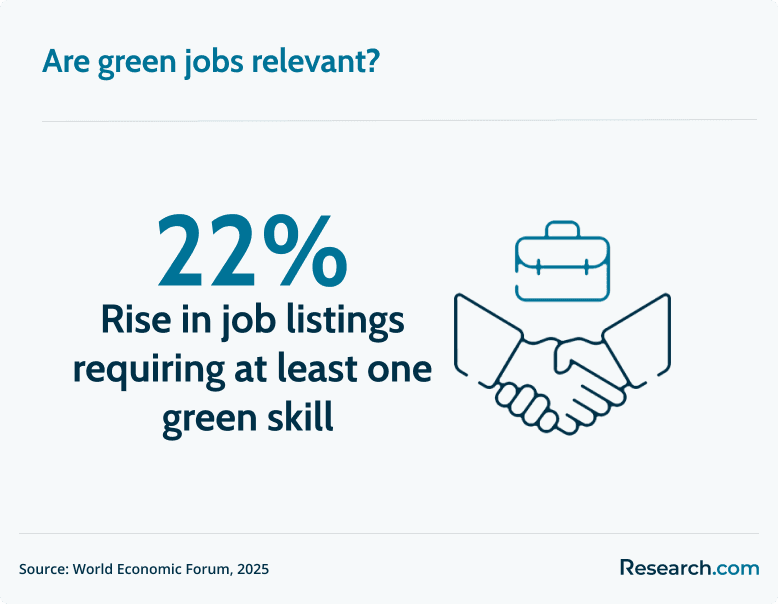
The World Economic Forum reports that from 2022 to 2023, job listings requiring green skills rose by 22%, while global growth in professionals with those skills was 12%. Because demand is rising faster than the supply of trained workers, students should evaluate more than delivery format. Curriculum quality, applied learning, and industry alignment matter just as much.
What is the average cost of an affordable online master’s in sustainability program?
Graduate sustainability program costs differ by school type, residency status, number of credits, program fees, and course format. Tuition and fees for master’s programs average $9,560 at public institutions and $31,930 at private institutions (Ma et al., 2024), but individual online sustainability programs may cost more or less depending on their structure.
When calculating affordability, do not stop at advertised tuition. Add technology fees, distance learning fees, books, software, travel for residencies if required, graduation fees, and the cost of taking extra prerequisite courses. Also check whether tuition is charged per credit, per course, per term, or as a total program price.
Students comparing business-oriented sustainability programs may also want to review sustainability tracks in the best online MBA programs. MBA-affiliated sustainability options can offer strong management training, but they may cost more because of business school pricing, brand reputation, and required core business coursework. MS or MA sustainability programs may be more focused and may require fewer credits.
For another affordability benchmark, compare tuition structures with the most affordable online master’s programs in homeland security, which show how per-credit pricing, total credits, and value-based rankings affect graduate program cost comparisons.
What are the financial aid options for students enrolling in an affordable online master’s in sustainability program?
Graduate students in online sustainability programs may be able to combine scholarships, fellowships, federal aid, employer support, and school-based awards. Availability varies, so students should confirm eligibility directly with the school or scholarship provider.
- The Environmental Protection Agency Graduate Research Fellowship Program (GRFP): This program supports graduate students in environmental sciences and provides $5,000 to $55,000 for tuition, fees, stipends, and research-related work.
- Theodore Gordon Flyfishers (TGF) Founders Fund Scholarship: This award provides up to $5,000 to graduate students in environmental programs who show commitment to conservation.
- Grace Wall Barreda Memorial Scholarship: This needs-based scholarship supports members of a Native American Tribe or their descendants pursuing graduate study in environmental science or public health.
- Women in Leadership Scholarship of Brown and Caldwell: This $5,000 award is available to women in graduate programs in civil, chemical, mechanical, electrical, or environmental engineering, or one of the environmental sciences.
- University scholarships and fellowships: Schools may offer merit awards, departmental funding, project stipends, assistantships, or sustainability-specific scholarships.
- Federal or state scholarships and grants: Some government-funded aid is need-based or merit-based and does not require repayment.
- Employer tuition assistance: Employers may help pay for graduate study when the degree supports current or future job responsibilities, sometimes with work-service requirements.
Students building a funding plan can also review how other graduate fields structure affordability. For example, affordable master’s in adult education online programs illustrate how scholarships, employer benefits, and flexible payment options can affect total cost.
What are the prerequisites for enrolling in an affordable online master’s in sustainability program?
Admissions requirements vary, but most online master’s in sustainability programs look for evidence that applicants can succeed in graduate-level interdisciplinary study. Some programs are designed for students from many majors, while others expect prior coursework in science, engineering, policy, economics, statistics, or related areas.
- Bachelor’s degree and transcripts: Applicants typically need a bachelor’s degree from an accredited institution. Related majors such as environmental science, engineering, biology, public policy, geography, economics, or business may be preferred for some programs.
- Minimum GPA: Many schools expect at least a 3.0 GPA on a 4.0 scale.
- GRE or GMAT scores: Some programs require test scores, while others waive them for applicants who meet academic or professional criteria.
- Prerequisite coursework: Programs may require previous study in environmental science, statistics, chemistry, economics, or research methods.
- Resume or professional experience: Work in sustainability, environmental management, public policy, business operations, engineering, or nonprofit work can strengthen an application.
- Letters of recommendation: Most programs request two or three letters from academic or professional references.
- Statement of purpose: Applicants usually explain their career goals, interest in sustainability, and reasons for choosing the program.
- Interview: Some schools use interviews to assess fit, motivation, and communication skills.
Students considering technical roles should compare program prerequisites with environmental engineer qualifications, since some engineering positions require specific undergraduate preparation or licensure pathways.
Application checklist before you apply
- Confirm the institution is accredited by a recognized accreditor.
- Ask whether online students qualify for the same aid as campus students.
- Check whether prerequisite courses add time or cost.
- Review capstone, internship, project, or portfolio requirements.
- Ask whether the program supports your target role, not just sustainability in general.
What courses are typically in an affordable online master’s in sustainability program?
Online sustainability master’s programs usually combine theory, technical knowledge, policy analysis, leadership, and applied problem-solving. Some curricula resemble subjects found in environmental policy degree programs, while others lean more heavily toward business, energy, planning, natural resources, or science.
- Sustainability Systems: Students study how environmental, social, and economic systems influence one another and learn to evaluate sustainability challenges through a systems lens.
- Strategies for Sustainability: This course focuses on designing, implementing, and assessing sustainability strategies in organizations, communities, or public agencies.
- Environmental Protection Law: Students examine laws, regulations, enforcement structures, and compliance issues that shape environmental and sustainability work.
- Technologies for Sustainability Systems: Coursework may cover renewable energy, waste systems, water technologies, energy efficiency, and other tools used to reduce environmental impact.
- Global Issues in Environmental Sustainability: Students analyze climate change, biodiversity loss, international agreements, resource inequity, and global sustainability policy.
Deloitte’s CxO Sustainability Report (2024) found that 79% of companies face considerable pressure to act on climate change, ranking it as the third most critical issue they must address. That pressure increases the need for graduates who can translate sustainability science and policy into practical organizational decisions.
This chart illustrates the level of pressure companies experience to take action on climate change.
What types of specializations are available in affordable online master’s in sustainability programs?
Specializations help students align graduate study with a specific career path. A student interested in clean energy should not choose the same electives as someone preparing for environmental policy, corporate ESG, conservation science, or sustainable urban planning.
| Specialization | What you study | Good fit for |
| Renewable and Alternative Energies | Solar, wind, bioenergy, energy systems, project feasibility, and environmental impacts. | Students targeting clean energy planning, project support, or energy policy roles. |
| Green Building | Energy-efficient design, sustainable materials, resource conservation, and building standards such as Leadership in Energy and Environmental Design (LEED). | Students interested in construction, facilities, architecture-adjacent work, or building performance. |
| Climate Change | Climate science, mitigation, adaptation, resilience, policy, and global cooperation. | Students pursuing climate planning, resilience, research, advocacy, or public-sector roles. |
| Environmental Policy | Regulation, policy design, environmental governance, compliance, and advocacy. | Students aiming for government, nonprofit, legal-adjacent, or policy analyst positions. |
| Corporate Social Responsibility | ESG, stakeholder engagement, ethical leadership, reporting, and sustainable business operations. | Students who want to work in corporate sustainability, consulting, or responsible business strategy. |
| Water and Food Systems | Water management, food security, conservation, supply chains, and equitable resource access. | Students interested in agriculture, water policy, public health, conservation, or development work. |
| Cities and Urban Systems | Urban resilience, transportation, infrastructure, planning, and livable communities. | Students targeting planning, local government, smart cities, or infrastructure roles. |
| Biodiversity and Ecosystems | Conservation, ecological assessment, habitat protection, and ecosystem management. | Students pursuing consulting, natural resources, wildlife, conservation, or research careers. |
An EY study notes that by 2033, Gen Z will make up 24% of the U.S. workforce (Merriman & Bolshaw, 2025). LinkedIn (2024b) reports that 61% of Gen Zers want green jobs, but 63% cite limited opportunities. Many also lack experience or the green skills needed to qualify. A carefully chosen specialization can help close that gap.
If your long-term goal is executive leadership, review what it takes to become a sustainability leader through this guide to chief sustainability officer career paths. If you are comparing how concentrations shape career direction across online programs, the low cost master’s in instructional design online guide offers a useful example of how specialization choices can map to industry needs.
This chart displays what Gen Zers think about green jobs.
What accreditation and quality assurance factors guarantee program quality?
No single feature “guarantees” program quality, but accreditation is the most important first check. Students should verify that the institution is accredited by a recognized accreditor and that the degree is offered by the accredited institution listed in official school materials.
Quality assurance also includes curriculum review, qualified faculty, transparent outcomes, clear student support, regular program assessment, and meaningful applied learning. If a program makes broad claims about career outcomes or salary gains, ask for evidence. Programs should be able to explain who teaches courses, how online students receive advising, how capstones are evaluated, and whether credits are transferable.
Students comparing business-heavy sustainability programs can also review quality markers discussed in low cost online MBA programs, such as accreditation, faculty credentials, career support, and value relative to tuition.
How do emerging industry trends influence online master’s in sustainability programs?
Online sustainability programs are changing because the work itself is changing. Employers increasingly need professionals who can use data, understand climate risk, evaluate supply chains, communicate with stakeholders, and connect environmental goals with business or public policy decisions.
- AI and data analytics: Programs may add coursework in sustainability metrics, emissions data, resource optimization, environmental forecasting, or reporting tools.
- Smart infrastructure: Sustainability education increasingly intersects with energy management, smart cities, transportation systems, and resilient urban design.
- ESG and accountability: Organizations need workers who understand sustainability reporting, stakeholder expectations, compliance, and measurable performance.
- Interdisciplinary leadership: Sustainability professionals often work across finance, operations, policy, legal, engineering, communications, and community groups.
This shift mirrors broader graduate education trends in which technical training is combined with strategic leadership. For comparison, the best affordable executive MBA programs online show how advanced programs are increasingly expected to build decision-making, management, and cross-functional leadership skills.
Are online master’s in sustainability programs offering robust networking and industry engagement?
Strong online programs do more than post lectures. They help students build professional connections through virtual career fairs, alumni panels, employer projects, guest speakers, mentoring, and applied capstones. Because online students may not have spontaneous campus interactions, they should look for programs that intentionally create networking opportunities.
Ask each program how students connect with employers, whether online learners can access the same career services as campus students, and how many projects involve outside organizations. Sustainability work often requires collaboration across business, government, science, finance, technology, and community groups. Understanding finance can be especially useful in corporate sustainability and clean energy work, so students may also benefit from exploring related business foundations such as an online bachelors finance degree.
What is the return on investment for an online master’s in sustainability program?
The ROI of an online master’s in sustainability depends on total cost, debt, financial aid, current income, target role, salary growth, employer demand, and how well the program develops marketable skills. A lower-cost program can produce strong value if it is accredited, aligned with your career goals, and provides applied evidence of your abilities.
| ROI factor | What to check | Why it affects value |
| Total price | Tuition, fees, books, software, residencies, and prerequisite costs. | The advertised tuition may not reflect the full cost of attendance. |
| Time to finish | Course availability, transfer credits, part-time options, and maximum completion limits. | Longer timelines may delay career advancement and increase opportunity cost. |
| Career alignment | Courses, specializations, projects, and faculty expertise tied to your target role. | A relevant curriculum can make the degree easier to translate into job opportunities. |
| Employer support | Tuition reimbursement, flexible scheduling, promotion pathways, or internal sustainability roles. | Employer funding can reduce debt and improve near-term ROI. |
| Salary potential | Compare likely roles, required experience, and regional pay. | Salary outcomes vary, so use role-specific data rather than broad program claims. |
For a cross-field comparison of graduate ROI and affordability, review the cheapest online economics masters programs and examine how tuition, outcomes, and career fit are weighed.
How can integrated project management enhance sustainability leadership?
Sustainability work often succeeds or fails at the implementation stage. Professionals must define goals, manage budgets, coordinate teams, track metrics, communicate risks, and deliver projects that balance environmental, social, and economic priorities.
Project management skills are valuable for clean energy deployment, ESG reporting, climate resilience plans, waste reduction initiatives, sustainable procurement, and green building projects. Students who want to lead complex initiatives should look for courses or capstones that include budgeting, stakeholder management, timelines, risk assessment, performance indicators, and reporting.
Those who want a stronger project execution background may compare sustainability training with a project management degree online, especially if their target roles involve leading teams, coordinating vendors, or managing large sustainability initiatives.
How to choose the most affordable online master’s in sustainability programs?
The right program should match your budget, schedule, academic background, and career target. Use affordability as a filter, then evaluate quality and fit before applying.
- Start with accreditation: Confirm institutional accreditation and make sure the online program is offered by the accredited school.
- Calculate full cost: Compare tuition, fees, credits, books, technology charges, travel requirements, and financial aid.
- Match curriculum to your goal: Choose different courses for corporate ESG, environmental policy, clean energy, conservation, EHS, or urban planning.
- Review faculty and applied projects: Look for instructors with research, industry, policy, or consulting experience relevant to your interests.
- Check student support: Online students need advising, tutoring, library access, technical support, and career services.
- Ask about networking: Strong programs offer employer projects, alumni connections, guest lectures, virtual events, or internships.
- Evaluate flexibility honestly: Confirm whether courses are asynchronous, how often they run, and whether live attendance is required.
- Assess ROI: Compare likely career outcomes with total cost and debt, not just the school’s reputation.
Common mistakes to avoid
- Choosing only by lowest tuition: A cheap program may cost more in the long run if it lacks needed courses, support, or career connections.
- Ignoring accreditation: Accreditation affects financial aid, transferability, employer recognition, and academic credibility.
- Assuming all online programs are self-paced: Some programs require live sessions, group meetings, internships, or strict weekly deadlines.
- Overlooking extra fees: Technology fees, course materials, software, and residency costs can change affordability.
- Choosing a vague specialization: Sustainability is broad. Select a path connected to specific roles and skills.
- Assuming salary outcomes are guaranteed: Pay depends on role, location, experience, industry, and technical qualifications.
- Relying only on rankings: Rankings help narrow options, but they cannot replace program-by-program fit analysis.
What career paths are available for graduates of affordable online master’s in sustainability programs?
Graduates can pursue roles in policy, consulting, planning, conservation, energy, corporate sustainability, environmental science, EHS, engineering-adjacent work, and executive leadership. Some positions may require additional credentials, technical experience, licensure, or a specific undergraduate background.
| Career path | Reported salary | Typical focus |
| Environmental Policy Analysts | $71,598 | Review policies, draft recommendations, analyze regulations, and support lawmakers, agencies, nonprofits, or advocacy groups. |
| Urban Planners | $72,565 | Plan communities with attention to green space, transportation, land use, climate resilience, and public needs. |
| Conservation Scientists | $74,310 | Develop plans to protect soil, water, forests, rangelands, and other natural resources. |
| Sustainability Consultants | $75,106 | Advise organizations on energy efficiency, waste reduction, sustainability certifications, reporting, and operational improvements. |
| Renewable Energy Project Managers | $81,925 | Coordinate wind, solar, geothermal, or other renewable energy projects with engineers, regulators, investors, and community stakeholders. |
| Environmental Scientists | $88,640 | Conduct fieldwork, laboratory analysis, research, and environmental assessment to support policy or project decisions. |
| Sustainability Managers | $95,768 | Lead organizational sustainability programs, coordinate departments, track goals, and support compliance and reporting. |
| Environmental Health and Safety Managers | $98,661 | Manage environmental compliance, worker safety, risk reduction, and sustainability-related operational practices. |
| Environmental Engineers | $113,770 | Design or improve systems that reduce pollution, treat water, manage waste, or limit environmental harm. |
| Chief Sustainability Officers | $132,000 | Set enterprise sustainability strategy, advise executives, integrate sustainability into business models, and guide long-term impact goals. |
Students interested in science-focused roles can compare degree outcomes with this guide to environmental scientist salary and career preparation. Sustainability careers increasingly overlap with technology as well; the cheapest online software engineering bootcamps guide offers a comparison point for short, skills-focused pathways that may intersect with green innovation, data tools, and sustainable infrastructure.
This chart displays the average salaries of sustainability jobs.
What is the job market for graduates with a master’s in sustainability?
The sustainability job market is growing as employers respond to climate change, resource scarcity, environmental regulation, ESG expectations, clean energy investment, and community resilience needs. The U.S. Bureau of Labor Statistics projects 7.3% growth for environmental scientists and specialists from 2023 to 2033, with about 8,300 annual openings. Environmental science and protection technicians are projected to grow 7%, with 4,100 openings per year, and environmental engineers are projected to grow 6.9%, with 3,000 openings annually.
The World Economic Forum (2025) also identifies sustainability-related occupations such as renewable energy engineers, environmental engineers, and electric and autonomous vehicle specialists among the top 15 fastest-growing occupations.
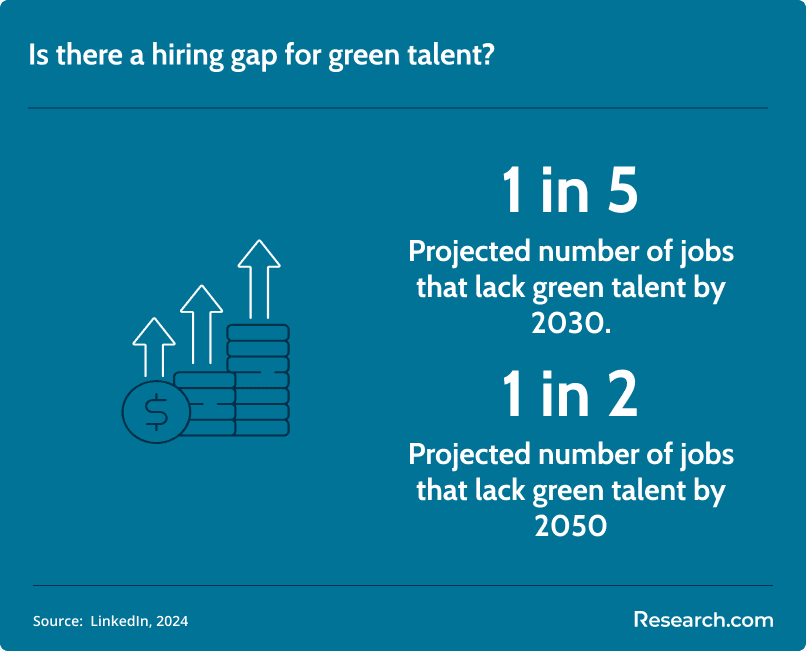
Even with growth, talent shortages remain a major concern. LinkedIn (2024b) estimates that by 2030, one in five green roles will go unfilled, rising to one in two jobs by 2050. This gap creates opportunity for students who can combine sustainability knowledge with practical skills such as data analysis, communication, policy interpretation, project management, stakeholder engagement, and systems thinking.
Graduates should expect competition for desirable roles, especially entry-level strategy positions. Building a portfolio, completing applied projects, earning relevant certifications when appropriate, networking with employers, and gaining experience through internships or current-job projects can improve career mobility.
Here’s what graduates say about online master’s in sustainability programs
- “The strongest part of my online sustainability program was the applied work. I practiced ESG reporting, lifecycle assessment, and stakeholder communication while keeping my part-time job. The format gave me flexibility, but the coursework still pushed me. Class discussions brought in perspectives from students in different countries, and I now manage a green initiative at my company.” - Ahmed
- “I needed a program that was affordable, flexible, and serious about systems thinking. The online tools made group projects manageable, and the climate justice coursework helped me connect policy ideas to real community needs. I learned from faculty and classmates, and I now work with a city agency on greener urban spaces.” - Pamela
- “Online study let me keep my full-time job while developing stronger knowledge of climate policy and resource management. The asynchronous schedule helped me stay consistent, and the capstone project connected me with students from four continents. It made sustainability feel global and practical at the same time.” - Liv
Key Insights
- An affordable online master’s in sustainability is best for students who want graduate-level sustainability skills but need flexibility and lower total cost.
- Program fit matters more than tuition alone. Accreditation, curriculum, specializations, applied projects, faculty expertise, and career support should shape your decision.
- From 2022 to 2023, job listings requiring green skills rose by 22%, while global growth in professionals with those skills was 12%.
- Companies are under pressure to act: Deloitte reports that 79% of companies face considerable pressure to address climate change.
- Environmental scientists and specialists are projected to grow 7.3% between 2023 and 2033, with about 8,300 annual openings.
- LinkedIn estimates that by 2030, one in five green roles will go unfilled, and by 2050, one in two green jobs could remain unfilled.
- Specialization choice is critical. Renewable energy, ESG, environmental policy, climate resilience, urban systems, and conservation require different courses and experiences.
- Before enrolling, ask schools for total cost, online fees, course rotation, transfer credit rules, career services access, networking opportunities, and capstone or internship details.
References:
- LinkedIn. (2024a, September). Global Climate Talent Stocktake. https://economicgraph.linkedin.com/content/dam/me/economicgraph/en-us/PDF/linkedIn-global-climate-talent-stocktake-sept-2024.pdf
- LinkedIn. (2024b). Global Green Skills Report 2024. https://economicgraph.linkedin.com/research/green-skills-resources
- Ma, J., Pender, M., & Oster, M. (2024). Trends in College Pricing and Student Aid 2024. https://research.collegeboard.org/media/pdf/Trends-in-College-Pricing-and-Student-Aid-2024-ADA.pdf
- Payscale. (2025, March 1). Average Sustainability Consultant Salary. Retrieved May 23, 2025, from https://www.payscale.com/research/US/Job=Sustainability_Consultant/Salary
- U.S. Bureau of Labor Statistics. (2024). Environmental Scientists and Specialists [Interactive data]. May 2024 OEWS Profiles, Occupational Employment and Wage Statistics (OEWS) Profiles. Retrieved May 23, 2025, from https://data.bls.gov/oesprofile
- U.S. Bureau of Labor Statistics. (2025, April 18). Occupational projections, 2023–33, and worker characteristics, 2023 (Numbers in thousands). Employment Projections. https://www.bls.gov/emp/tables/occupational-projections-and-characteristics.htm
- World Economic Forum. (2025, January). Future of Jobs Report 2025. https://www.weforum.org/publications/the-future-of-jobs-report-2025
- ZipRecruiter. (2025, May 16). Chief Sustainability Officer Salary. Retrieved May 23, 2025, from https://www.ziprecruiter.com/Salaries/Chief-Sustainability-Officer-Salary
Other Things You Should Know About Affordable Online Master’s in Sustainability Programs
Various universities offer scholarships for online Master's in Sustainability, including need-based and merit-based options. In 2027, students can explore scholarships like the Green Futures award, which covers tuition partially based on academic performance and commitment to sustainability initiatives.
Most programs require a minimum 2.75 to 3.0 undergraduate GPA for admission. Applicants with a lower GPA may still qualify through strong work experience, a personal statement, or prerequisite coursework in environmental science, statistics, or economics.


