2027 Best Online GIS Degree Programs

Co-Founder and Chief Data Scientist
An online GIS degree can prepare you for work with maps, location data, satellite imagery, spatial databases, and geospatial software, but not every program offers the same value. The right choice depends on your current education level, career goal, budget, transfer credits, software access, and whether you need a full degree or a shorter certificate.
This guide is for students comparing online GIS bachelor’s degrees, master’s programs, and certificates. It explains what GIS students learn, how online programs compare with campus options, what programs may cost, which careers are available, and how to judge whether a program is worth the investment before you enroll.
Quick Answer: Is an Online GIS Degree Worth It?
An online GIS degree can be worth it if you want a career that combines geography, data analysis, mapping, technology, and problem-solving. GIS graduates may pursue roles such as GIS analyst, GIS technician, cartographer, remote sensing analyst, web GIS developer, or geospatial intelligence analyst. The strongest programs are accredited, include hands-on work with GIS software, offer practical projects, and connect coursework to industries such as government, planning, environmental management, logistics, public health, and emergency response.
If you already have a degree or technical background, a GIS certificate may be enough to build job-ready skills. If you are entering the field for the first time, a bachelor’s degree can provide a broader foundation. If you want leadership, research, advanced analytics, or specialized geospatial roles, a master’s degree may offer better long-term value.
What are the benefits of getting a degree in GIS?
- Many possible career directions: A GIS background can support work in mapping, urban planning, environmental science, transportation, public safety, disaster response, natural resources, business analytics, real estate, utilities, and government agencies.
- Strong salary potential in specialized roles: GIS professionals may earn a median salary of around $70,000 to $90,000 per year, depending on job title, employer, location, industry, and experience. Advanced roles such as geospatial data scientist or GIS project manager may pay more.
- Flexible study options: Online GIS programs allow students to complete coursework without relocating, often using virtual labs, cloud-based tools, and GIS platforms such as ArcGIS and QGIS.
What can I expect from a GIS degree?
A Geographic Information Systems degree teaches students how to collect, organize, analyze, visualize, and interpret location-based data. GIS combines geography, computer science, statistics, database management, remote sensing, and visual communication. Students learn how to use spatial data to answer questions such as where infrastructure should be built, how environmental changes are spreading, where public health risks are concentrated, or how emergency services can respond faster.
Most GIS programs include both theory and applied technical training. You can expect coursework in cartography, spatial analysis, remote sensing, geospatial databases, coordinate systems, map design, and GIS software. Stronger programs also include programming, web mapping, project-based assignments, and portfolio-building work.
The best fit depends on your goal. A bachelor’s degree works well for students who need a full undergraduate credential. A master’s degree is often better for professionals who want advanced technical, research, or leadership roles. A certificate is usually best for learners who already have a degree or work experience and need targeted GIS skills quickly.
| GIS credential | Best for | Typical focus | Main trade-off |
| Bachelor’s degree | Students starting college or changing careers into GIS | Broad foundation in geography, spatial analysis, GIS tools, and related technical skills | Takes longer and usually requires more credits than a certificate or master’s program |
| Master’s degree | Professionals seeking advanced analytics, management, research, or specialized GIS roles | Advanced spatial modeling, remote sensing, programming, data management, and applied projects | May require a bachelor’s degree, prerequisite skills, and higher per-credit tuition |
| Graduate certificate | Working professionals who need focused GIS training without a full degree | Core GIS software, spatial data, remote sensing, cartography, and applied workflows | May not carry the same weight as a full degree for some advanced roles |
Where can I work with a GIS degree?
GIS graduates work anywhere location data is used to make decisions. Government agencies such as the U.S. Geological Survey (USGS), NASA, and local planning departments use GIS for land use, infrastructure, transportation, conservation, and emergency planning. State and local governments also hire GIS staff for parcel mapping, public works, environmental monitoring, and public safety.
Private-sector employers use GIS for market analysis, logistics, site selection, asset management, real estate development, energy planning, telecommunications, and environmental consulting. Public health organizations, disaster response teams, utility companies, research institutions, and natural resource agencies also rely on GIS professionals to interpret spatial patterns and communicate findings clearly.
Because GIS is applied across many sectors, students should choose electives and projects that match a target industry. For example, environmental mapping, urban planning, drone data, and geospatial programming can lead to different types of roles.
How much can I make with a GIS degree?
Pay varies widely by title, employer, geography, education level, software skills, and experience. According to the U.S. Bureau of Labor Statistics (BLS) and industry reports, entry-level GIS analysts typically earn between $50,000 and $65,000 per year, while mid-level professionals can make $70,000 to $90,000 annually. Senior GIS specialists and geospatial data scientists often earn upwards of $100,000, especially in industries like tech, aerospace, and environmental consulting.
Examples of higher-paying roles include GIS project managers ($90,000–$120,000) and remote sensing scientists ($85,000–$110,000). Government and nonprofit positions may pay less than some private-sector roles, but they may offer stability, benefits, and mission-driven work. A master’s degree can help with specialized or leadership positions, but salary outcomes are never guaranteed.
- Best online GIS degree programs for 2027
- How long does an online GIS degree take?
- Online vs. on-campus GIS programs
- GIS degree costs
- Financial aid for GIS students
- GIS degree admission requirements
- Common GIS courses
- GIS specializations
- How to choose a GIS program
- GIS certifications
- GIS career paths
- GIS job market
- Online GIS degree ROI
- Accelerated online GIS degrees
- Affordable and high-quality GIS programs
- Emerging technologies in GIS curricula
- GIS accreditation
- Practical training and industry partnerships
- Career support and academic resources
- Accelerated associate degrees for GIS careers
- Doctoral study in GIS
- Key insights
List of the Best GIS Degree Programs for 2027
How do we rank schools?
Research.com ranks GIS programs to help students compare online options using consistent, data-informed criteria rather than marketing claims alone. Because GIS programs can differ significantly in cost, format, degree level, and technical depth, rankings should be used as a starting point—not the only factor in your decision.
The ranking process follows a transparent methodology and uses sources such as the Integrated Postsecondary Education Data System (IPEDS), Peterson's databases including their Distance Learning Licensed Data Set, and the College Scorecard database from the National Center for Education Statistics. When comparing programs, students should also verify current tuition, transfer policies, online course availability, software access, and graduation requirements directly with each school.
1. Farmingdale State College
Farmingdale State College offers a fully online Bachelor of Science in Geographic Information Systems. The program is designed as an applied GIS degree that blends geospatial theory, technology, and practical mapping work. Students prepare to analyze and visualize data for areas such as urban planning, environmental systems, emergency services, and public-sector decision-making.
- Program Length: 4 years
- Tracks/Concentrations: Geographic Information Systems
- Cost per Credit: $295
- Required Credits to Graduate: 120 credits
- Accreditation: Middle States Commission on Higher Education
2. Kennesaw State University
Kennesaw State University offers a Bachelor of Science in Geospatial Sciences with options in Human-Environment Systems, Information Systems, and Land Surveying. Students can choose face-to-face, online, or hybrid study formats. The curriculum connects geospatial technologies with applied research and can support careers in crime analysis, environmental management, planning, and related fields.
- Program Length: 4 years
- Tracks/Concentrations: Human-Environment Systems, Information Systems, Land Surveying
- Cost per Credit: $190
- Required Credits to Graduate: 120 credits
- Accreditation: Southern Association of Colleges and Schools Commission on Colleges (SACSCOC)
3. University of Arizona
University of Arizona offers an Online Master of Science in Geographic Information Systems Technology (GIST). The program is built for professionals seeking advanced geospatial skills in GIS, remote sensing, data management, geospatial programming, and web mapping. Because it is delivered online, it may be a practical option for working adults who need graduate-level training without relocating.
- Program Length: 1-2 years
- Tracks/Concentrations: Geographic Information Systems
- Cost per Credit: $525
- Required Credits to Graduate: 30 credits
- Accreditation: Higher Learning Commission
4. Old Dominion University
Old Dominion University offers an Online Bachelor of Science in Geography with a Concentration in Geographic Information Systems. The program emphasizes spatial analysis, cartography, remote sensing, and applied GIS software skills. It may be a strong fit for students seeking an online geography-based pathway into environmental management, urban planning, or other geospatial careers.
- Program Length: 4 years
- Tracks/Concentrations: Geographic Information Systems
- Cost per Credit: $408
- Required Credits to Graduate: 120 credits
- Accreditation: Southern Association of Colleges and Schools Commission on Colleges (SACSCOC)
5. Tarleton State University
Tarleton State University offers an Online Bachelor of Science in Geoscience with a GIS focus. The program combines geoscience coursework with GIS training, making it relevant for students interested in natural resources, environmental consulting, spatial data analysis, and remote sensing.
- Program Length: 4 years
- Tracks/Concentrations: Geographic Information Systems
- Cost per Credit: $440
- Required Credits to Graduate: 120 credits
- Accreditation: Southern Association of Colleges and Schools Commission on Colleges (SACSCOC)
6. South Dakota State University
South Dakota State University offers an Online Master of Science in Geography with a specialization in GIS. The program is intended for students seeking advanced study in geographic information science, spatial analysis, cartography, and remote sensing, with possible applications in agriculture, planning, and environmental management.
- Program Length: 4 years for full-time students.
- Tracks/Concentrations: Geographic Information Systems
- Cost per Credit: $355
- Required Credits to Graduate: 120 credits.
- Accreditation: Higher Learning Commission.
7. Western Illinois University
Western Illinois University provides an Online Master of Science in Geography with an emphasis in GIS. Students study geospatial science, spatial data analysis, remote sensing, and applied GIS concepts. The online format can help working professionals continue their education while maintaining employment.
- Program Length: Typically 4 years for full-time students.
- Tracks/Concentrations: Geoenvironment and Planning, Geospatial Science
- Cost per Credit: $375
- Required Credits to Graduate: 120 credits.
- Accreditation: Higher Learning Commission.
8. Troy University
Troy University offers an Online Geographic Information Systems (GIS) Certificate Program. The certificate includes four courses: Introduction to GIS, Introduction to Remote Sensing, Introduction to Coordinate Systems, and Applications of GIS. This shorter option is designed for learners who want foundational GIS skills for fields such as planning, environmental science, and resource management.
- Program Length: 1 year for full-time students.
- Tracks/Concentrations: Not applicable, certificate program.
- Cost per Credit: $424
- Required Credits to Graduate: 12 credits.
- Accreditation: Southern Association of Colleges and Schools Commission on Colleges (SACSCOC).
9. University of North Alabama
University of North Alabama offers an Online Bachelor of Science in Geographic Information Science. The program covers spatial data analysis, cartography, and remote sensing and is designed for students preparing for GIS roles in government, nonprofit organizations, and private industry.
- Program Length: 4 years for full-time students.
- Tracks/Concentrations: Geographic Information Science
- Cost per Credit: $340
- Required Credits to Graduate: 120 credits.
- Accreditation: Southern Association of Colleges and Schools Commission on Colleges (SACSCOC).
10. Eastern Michigan University
Eastern Michigan University offers an Online Graduate Certificate in Geographic Information Systems. The program is designed for students and professionals who want to add GIS capabilities in areas such as urban planning, environmental analysis, public health, GIS programming, and database management.
- Program Length: 1 year for full-time students.
- Tracks/Concentrations: Not applicable, certificate program.
- Cost per Credit: 668
- Required Credits to Graduate: 12 credits.
- Accreditation: Higher Learning Commission.
How long does it take to complete a GIS degree program?
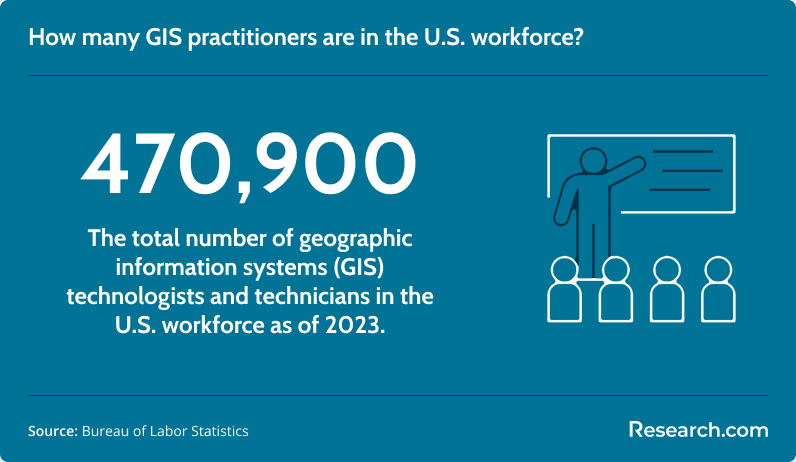
GIS completion time depends mainly on degree level, transfer credits, course load, and whether the program uses accelerated, asynchronous, or cohort-based courses. Online GIS is often grouped among flexible best online degrees because students can complete technical coursework without relocating. As of 2023, there were 470,900 geographic information systems technologists and technicians in the U.S. workforce.
- Bachelor's Degree: A bachelor's degree in GIS typically takes four years to complete.
- Master's Degree: A master's degree in GIS can take anywhere from 16 months to three years, depending on the program structure and your course load. Many programs follow a four-quarter structure, with each course taking about three to four months to complete. Students comparing graduate pathways in other fields may also want to review what jobs can I get with a master's in early childhood education to understand how degree outcomes differ by profession.
- Graduate Certificate: A graduate certificate in GIS can often be completed in as little as one year, especially if it's an online or blended program.
| Path | Typical completion time | Good choice if you... |
| Bachelor’s degree | Four years | Need a full undergraduate credential and broad preparation for entry-level GIS roles |
| Master’s degree | 16 months to three years | Already have a bachelor’s degree and want advanced technical or leadership preparation |
| Graduate certificate | As little as one year | Want focused GIS skills without committing to a full degree |
How does an online GIS degree compare to an on-campus program?
An online GIS degree is usually best for students who need scheduling flexibility, cannot relocate, or want to keep working while studying. Online programs may use virtual labs, recorded lectures, interactive mapping assignments, cloud-based GIS tools, discussion boards, and remote faculty meetings. This format can work well for disciplined students who are comfortable managing deadlines independently.
An on-campus GIS program may be better for students who want frequent face-to-face interaction, easier access to physical labs, research groups, fieldwork, campus networking, and local internship connections. Campus programs may also provide more structured schedules, which can help students who prefer in-person accountability.
Students comparing online graduate options outside GIS can review the best online higher education master’s degree programs to see how online program design differs across fields. If cost is a major concern, Research.com’s guide to affordable online degrees can help you evaluate broader low-cost online options. Students exploring education and social service pathways may also compare GIS with affordable online child development degrees.
| Factor | Online GIS program | On-campus GIS program |
| Flexibility | Often better for working adults and students with family obligations | Usually follows fixed class times and campus schedules |
| Hands-on learning | May use virtual labs, software assignments, cloud platforms, and remote projects | May offer direct access to labs, field equipment, and campus-based research |
| Networking | Depends on virtual events, faculty access, group projects, and internships | Often easier through campus events, classmates, faculty, and local employers |
| Cost factors | May reduce commuting and relocation costs | May include housing, transportation, and campus fees |
| Best for | Self-directed learners who need flexibility | Students who want in-person structure and campus resources |
What is the average cost of a GIS degree program?
GIS degree costs vary by institution type, residency, degree level, credit requirements, technology fees, and whether you study online or on campus. Always compare total program cost, not just tuition per credit.
- Bachelor's Degrees: Can range from $10,000 to over $50,000 per year at public universities (in-state vs. out-of-state) and can be even higher at private institutions. An accelerated bachelor's degree may have different cost patterns depending on tuition structure and credit load.
- Master's Degrees: Total program costs can vary from around $13,000 to over $70,000, depending on the factors listed above. If you are comparing GIS with other technology-focused graduate routes, you may also want to ask what can I do with a master’s in information systems?
- Certificates: These are usually the most budget-friendly, often costing between $5,000 and $15,000 for the entire program.
Cost comparisons should include tuition, mandatory fees, GIS software access, textbooks, hardware requirements, graduation fees, travel for any required residencies, and the number of credits you still need after transfer evaluation.
| Cost factor | Why it matters | Question to ask |
| Institution type | Public universities are often less expensive than private institutions, especially for in-state students | Do online students pay in-state, out-of-state, or a separate online tuition rate? |
| Degree level | Bachelor’s programs require more credits, while master’s programs may charge more per credit | What is the total tuition for all required credits? |
| Transfer credits | Accepted credits can reduce completion time and cost | How many of my prior credits will apply to the GIS degree? |
| Software and technology | GIS courses may require specialized platforms or computing power | Does tuition include access to GIS software and cloud-based tools? |
| Fees | Online, technology, graduation, and course fees can change the real price | What is the full cost of attendance for online students? |
What are the financial aid options for students enrolling in a GIS degree program?
Financial aid can make a GIS degree more manageable, but students should compare aid packages carefully and avoid borrowing based only on expected future salary. The median wage of GIS technologists and technicians was $1044,920 in 2023. Given the earning potential of some GIS roles, students may compare GIS with other options listed among highest paying degree pathways, while still checking program-specific outcomes.
Federal Student Aid
- FAFSA: Completing the Free Application for Federal Student Aid is usually the first step for students seeking federal aid.
- Grants: Grants are need-based awards that generally do not need to be repaid. The Pell Grant is a common example.
- Loans: Federal student loans may offer lower interest rates and more flexible repayment options than some private loans. Common types include Direct Subsidized Loans and Direct Unsubsidized Loans.
- Work-Study: Eligible students may work part time through a federal work-study arrangement to help cover education-related expenses.
State and Institutional Aid
- State Grants and Scholarships: Many states provide aid for residents attending in-state colleges, so students should check their state higher education agency.
- Institutional Aid: Colleges may offer scholarships or grants for geography, geoscience, technology, environmental science, or GIS students. Ask each school whether online learners qualify for the same aid as campus students.
Scholarships
- GIS-Specific Scholarships: Organizations such as the United States Geospatial Intelligence Foundation (USGIF), the American Association of Geographers (AAG), and the American Society for Photogrammetry and Remote Sensing (ASPRS) offer scholarships to students pursuing GIS-related education.
- General Scholarships: Students can also search for awards based on academic merit, financial need, military status, professional background, or identity-based eligibility through scholarship databases such as Fastweb or Scholarships.com.
Ways to reduce GIS degree costs
- Choose an accredited public institution with a competitive online tuition rate.
- Maximize transfer credits before enrolling.
- Ask whether GIS software licenses are included in tuition.
- Compare certificate, bachelor’s, and master’s options before committing to the longest path.
- Apply for departmental scholarships, employer tuition assistance, and professional association awards.
What are the prerequisites for enrolling in a GIS degree program?
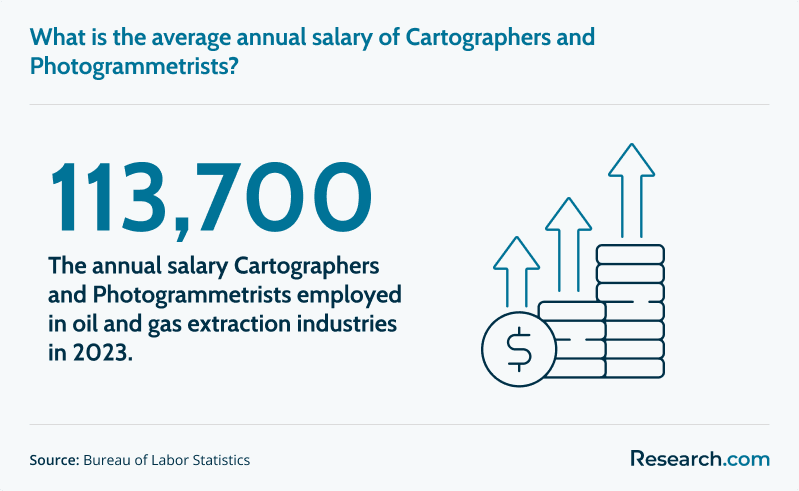
Admission requirements differ by school, degree level, and program selectivity. Cartographers and Photogrammetrists are two roles that GIS graduates can pursue. In 2023, oil and gas extraction were the highest paying industries for these roles offering an annual mean wage of $113,700.
Common undergraduate requirements
- High school diploma or equivalent: Most bachelor’s programs require proof of high school completion or an equivalent credential.
- Minimum GPA: Some universities set a minimum GPA for first-year or transfer applicants.
- Helpful coursework: Background in algebra, geometry, earth science, geography, environmental science, statistics, or computer science can make the transition easier.
- Standardized test scores: Some schools may request SAT or ACT scores, although policies vary.
Common graduate requirements
- Bachelor's Degree: Master’s applicants typically need a bachelor’s degree. A geography or related major may help, but some programs admit students from other disciplines if they have relevant work experience or prerequisite coursework.
- Minimum GPA: Graduate programs often require applicants to meet a stated undergraduate GPA threshold.
- GRE Scores: Some programs may require GRE scores, while others may waive them.
- Letters of Recommendation: Applicants may need academic or professional references who can comment on their preparation and potential.
- Statement of Purpose: Many programs ask applicants to explain their GIS interests, career goals, and reasons for choosing the program.
- Prerequisite Courses: Some programs require introductory GIS, remote sensing, statistics, or related coursework. Students comparing fast education routes can also review fastest online degree options, but should confirm that shorter programs still meet their career needs.
- GIS Experience: Prior software experience, mapping projects, or professional exposure can strengthen an application, especially for graduate programs.
What courses are typically in a GIS degree program?
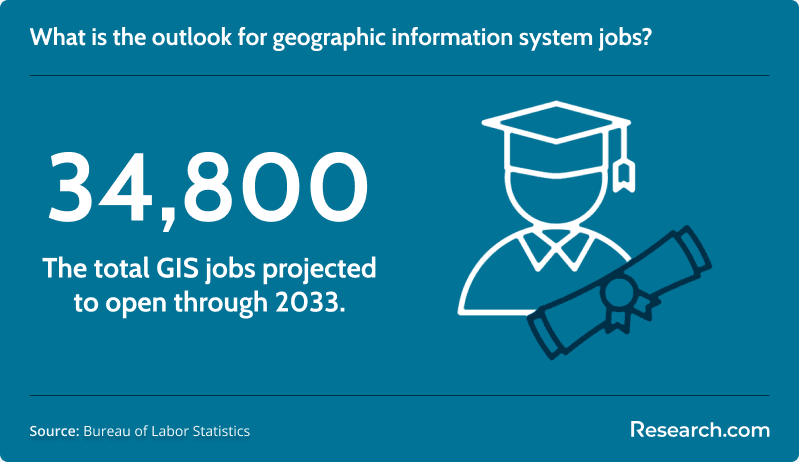
GIS programs usually combine conceptual geography with technical courses that build practical mapping, analysis, and data-management skills. A total of 34,800 GIS jobs are projected to open through 2033.
Core GIS Courses
- Introduction to GIS: Students learn basic GIS concepts, spatial data types, map projections, coordinate systems, and common GIS platforms.
- GIS Analysis: This course covers spatial queries, overlay methods, network analysis, geostatistics, and problem-solving with location data.
- Remote Sensing: Students study satellite imagery, aerial photography, image processing, and interpretation of remotely collected data.
- Cartography and Visualization: This course teaches map design, symbolization, visual hierarchy, data storytelling, and communication with maps.
- Spatial Databases: Students learn how spatial data is stored, structured, queried, managed, and protected in databases and geodatabases.
Related Technical Courses
- Programming for GIS: Courses may use Python or R to automate GIS tasks, process spatial data, and create custom tools.
- Geostatistics: Students learn methods such as interpolation, spatial autocorrelation, kriging, and statistical analysis of spatial patterns.
- Web GIS: This area focuses on online mapping applications, web-based spatial data tools, and technologies such as HTML, JavaScript, and web mapping libraries.
- GNSS/GPS: Students study Global Navigation Satellite Systems, including GPS, and learn how location data is collected for mapping and analysis.
| Course area | Skill developed | Why employers value it |
| Spatial analysis | Finding patterns, relationships, and geographic trends | Supports planning, risk assessment, logistics, and decision-making |
| Remote sensing | Working with satellite and aerial imagery | Useful in environmental monitoring, agriculture, defense, and disaster response |
| Cartography | Designing clear and accurate maps | Helps organizations communicate complex spatial information |
| GIS programming | Automating workflows and building tools | Improves efficiency and supports advanced technical roles |
| Spatial databases | Managing large geospatial datasets | Essential for scalable, accurate, and secure GIS operations |
What types of specializations are available in GIS degree programs?
Many online GIS programs now let students focus on a technical or industry-specific area. Professional, scientific, and technical services in the government have the highest levels of GIS practitioners totaling 4,760 in 2023.
- GIS Analysis and Modeling: Focuses on spatial statistics, geostatistics, network analysis, and models used to solve complex location-based problems.
- Remote Sensing: Covers satellite imagery, aerial photography, image processing, and interpretation for fields such as agriculture, environmental monitoring, and urban planning.
- Cartography and Visualization: Emphasizes map design, visual communication, data presentation, and effective storytelling with spatial information.
- Spatial Databases: Prepares students to design, maintain, and query geospatial databases and manage large spatial datasets.
- Programming for GIS: Builds skills in Python, R, scripting, workflow automation, and custom tool development.
- Web GIS: Covers interactive online maps, spatial web applications, and web mapping tools.
- Geospatial Intelligence: Applies GIS to intelligence analysis, security, law enforcement, disaster response, and national security contexts.
- Unmanned Aerial Systems (UAS) / Drones: Focuses on drone-based data collection, aerial imagery, mapping workflows, and GIS integration.
| Specialization | Best fit for students interested in... | Common skill emphasis |
| Remote sensing | Environmental monitoring, agriculture, climate, land use, imagery | Image processing and interpretation |
| Web GIS | Online mapping tools, public dashboards, interactive applications | Web mapping and application development |
| GIS programming | Automation, analytics, custom tools, technical GIS roles | Python, R, scripting, and spatial data workflows |
| Geospatial intelligence | Security, defense, law enforcement, disaster response | Spatial analysis for intelligence and risk assessment |
| Cartography | Map communication, design, public information, visualization | Map design and visual storytelling |
How do you choose the best GIS degree program?
The best GIS degree program is the one that fits your career goal, budget, schedule, learning style, and technical needs. With growing interest in smart city initiatives, GIS technologies are becoming more important for planning and infrastructure decisions. The United Nations projects a significant increase in the global urban population, from 55% in 2018 to a projected 68% by 2050, further driving this need.
Step-by-step checklist for choosing a GIS program
- Start with your career goal. Decide whether you want entry-level GIS work, advanced analytics, environmental mapping, urban planning, drone mapping, geospatial intelligence, or web GIS development.
- Choose the right credential. A bachelor’s degree gives broad preparation, a master’s degree supports advanced roles, and a certificate is best for targeted upskilling.
- Verify accreditation. Make sure the institution is accredited by a recognized accreditor, especially if you plan to use financial aid, transfer credits, or pursue graduate study later.
- Review the curriculum carefully. Look for spatial analysis, remote sensing, cartography, spatial databases, programming, web GIS, and real projects.
- Check software access. Confirm whether students receive licenses or access to platforms such as ArcGIS, QGIS, or cloud-based GIS tools.
- Compare total cost. Include tuition, fees, software, hardware, books, transfer credits, and time away from work.
- Ask about career support. Look for portfolio guidance, internships, alumni networks, employer connections, resume help, and job-search coaching.
- Test the online format. Ask whether courses are asynchronous, synchronous, accelerated, cohort-based, or self-paced.
Common mistakes to avoid
- Choosing only by tuition: A cheaper program may cost more if few credits transfer or required courses are not offered often.
- Ignoring accreditation: Accreditation affects financial aid, transferability, employer confidence, and graduate school options.
- Assuming every online program is flexible: Some online programs still require live sessions, fixed deadlines, or limited course rotations.
- Overlooking software and hardware needs: GIS work can require specific platforms, cloud tools, or computer specifications.
- Relying only on rankings: Rankings help narrow options, but the best program for you must match your career path and constraints.
- Assuming salary outcomes are guaranteed: Earnings depend on skills, experience, location, industry, and specialization.
What additional certifications can further enhance a GIS career?
GIS certifications can help students and professionals show targeted expertise beyond a degree. They may be useful in areas such as remote sensing, GIS software, geospatial intelligence, programming, drone mapping, or project management. Certifications can be especially valuable when they align with a specific job posting or employer technology stack.
Before paying for a certification, ask whether employers in your target field request it, whether it requires continuing education, and whether it teaches hands-on skills you can demonstrate in a portfolio. Students comparing broader credential options can also review what certifications can I get online?
| Certification strategy | When it makes sense | What to verify first |
| Software-specific GIS credential | You want to prove competence with a platform used by target employers | Whether local job listings mention that software |
| Remote sensing or imagery credential | You want work involving satellite, aerial, or drone data | Whether the program includes practical image-processing assignments |
| Programming-focused credential | You want GIS developer, automation, or analytics roles | Whether you will build portfolio-ready code or tools |
| Drone or UAS training | You want to collect and process aerial geospatial data | Whether the training aligns with operational and regulatory requirements |
What career paths are available for graduates of GIS degree programs?
An online GIS degree can lead to technical, analytical, planning, research, and development roles. Compared to other roles, the average salary for a geospatial analyst is higher at $69,313 in 2025. Students comparing short professional credentials may also review certifications that pay well.
- GIS Analyst: Uses spatial data and GIS software to create maps, run analyses, interpret patterns, and support decisions.
- GIS Technician: Collects, updates, cleans, and manages geospatial data, often supporting analysts and project teams.
- Cartographer: Designs accurate and readable maps that communicate geographic information clearly.
- Remote Sensing Analyst: Processes and interprets satellite imagery, aerial photos, and other remotely collected data.
- Web GIS Developer: Builds and maintains interactive maps, online GIS applications, dashboards, and spatial data tools.
- Geospatial Intelligence Analyst: Uses GIS and related technologies to gather and analyze intelligence information for national security, law enforcement, emergency management, or related purposes.
| Career path | Typical work | Skills to build while in school |
| GIS analyst | Spatial analysis, mapping, reporting, data interpretation | ArcGIS/QGIS, spatial analysis, cartography, databases |
| GIS technician | Data entry, data cleaning, map updates, field data support | Data quality control, GPS/GNSS, basic GIS workflows |
| Remote sensing analyst | Imagery processing, environmental monitoring, land-use analysis | Remote sensing, image processing, statistics |
| Web GIS developer | Interactive maps, dashboards, web apps, spatial APIs | Programming, web GIS, JavaScript, databases |
| Geospatial intelligence analyst | Risk analysis, intelligence mapping, security-related spatial analysis | Geospatial intelligence, remote sensing, data interpretation |
What is the job market for graduates with a GIS degree?
The job market for GIS graduates is robust and will continue to grow at 9% through 2033. Demand is driven by the expanding use of spatial data in environmental management, urban planning, emergency response, public health, logistics, business intelligence, infrastructure, and government operations. The University of Texas Permian Basin also highlights the demand for skilled GIS professionals across multiple career paths.
Current technology trends are reshaping GIS work. Drone mapping, cloud GIS platforms, artificial intelligence, machine learning, mobile data collection, and web-based mapping tools are expanding what GIS professionals can do. These trends also raise employer expectations: graduates who can code, manage spatial databases, automate workflows, and communicate findings visually may have an advantage.
Competition varies by location, specialization, and experience. Students can improve job prospects by completing internships, building a portfolio, joining professional organizations, networking with GIS professionals, and creating projects that show practical problem-solving rather than only classroom exercises.
What is the return on investment of an online GIS degree?
The ROI of an online GIS degree depends on total cost, completion time, financial aid, transfer credits, current work experience, and the types of roles you can realistically pursue after graduation. A lower-cost program is not automatically the best value if it lacks software access, applied projects, career support, or relevant coursework. Likewise, a more expensive program may be difficult to justify unless it improves your skills, network, or access to higher-level roles.
To evaluate ROI, compare program cost against likely career outcomes in your region and target industry. Also look for ways to reduce upfront expenses. For example, schools listed among online college no application fee options may help reduce one small part of the application cost, though tuition and fees matter far more overall.
Questions to ask before enrolling
- What is the total program cost after transfer credits and fees?
- What percentage of online GIS students graduate?
- Does the program publish career outcomes for GIS graduates?
- Are internships, capstones, or portfolio projects required?
- Which GIS software, programming languages, and tools will I use?
- Will this credential qualify me for the jobs I want, or would a certificate be enough?
Can I accelerate my online GIS degree completion?
Some online GIS students can graduate faster by transferring credits, taking heavier course loads, enrolling year-round, choosing accelerated terms, or selecting a shorter certificate instead of a full degree. However, speed should not come at the expense of technical practice. GIS is skill-based, and employers often want to see projects, maps, code, data workflows, or applied analysis.
Students considering faster graduate routes can compare options such as the shortest masters degree pathways, but they should confirm whether the accelerated structure still includes enough hands-on GIS work to build job-ready skills.
How can online GIS degrees be both affordable and high-quality?
An affordable GIS degree can still be high quality if it is accredited, technically current, well supported, and built around applied learning. The strongest low-cost programs give online students access to the same essential tools, faculty guidance, academic advising, and project opportunities as other students.
When comparing programs, look beyond tuition. Ask whether courses are regularly updated, whether GIS software is included, whether students build portfolios, and whether the school supports online learners with tutoring and career services. Students comparing broader affordable options can review Research.com’s guide to the cheapest online university choices for working adults.
How are emerging technologies integrated into online GIS curricula?
Modern GIS programs increasingly incorporate drone mapping, AI-supported spatial analysis, machine learning, cloud GIS, web mapping, mobile data collection, and remote sensing. Online programs may use virtual labs, cloud platforms, simulations, and project-based assignments to help students work with these tools remotely.
Students should not assume every online GIS curriculum is current. Review syllabi, course descriptions, software requirements, and capstone examples. If you are still exploring accessible online degree options before committing to a technical GIS path, Research.com’s guide to the easiest college degree options can help you compare workload expectations across majors.
Why is accreditation important for an online GIS degree?
Accreditation matters because it signals that a college or university has met recognized academic quality standards. It can affect federal financial aid eligibility, credit transfer, graduate school admission, and employer confidence. For online GIS students, accreditation is especially important because program quality can vary widely.
Before enrolling, verify institutional accreditation through official sources and confirm whether any specialized requirements apply to your career goal. Students researching accredited undergraduate options can compare broader choices in Research.com’s guide to accredited online bachelor degree programs.
How do online GIS programs integrate practical training and industry partnerships?
Strong online GIS programs do more than assign readings. They use case studies, virtual labs, mapping projects, capstones, collaborative assignments, and real or realistic datasets to help students practice applied geospatial work. Some programs also connect students with employers, professional mentors, internships, or industry-aligned projects.
When evaluating practical training, ask whether you will leave the program with a portfolio. A portfolio can include maps, spatial analysis reports, web mapping applications, remote sensing projects, database work, Python scripts, or capstone deliverables. Students seeking fast graduate-level practical training can also compare options such as online masters 1 year programs.
What career support and academic resources do online GIS programs provide?
Career support can make a major difference for online GIS students, especially those changing careers. Useful services include academic advising, technical help, tutoring, resume reviews, portfolio coaching, virtual networking, internship guidance, interview preparation, alumni connections, and access to GIS-related job boards or employer events.
Ask whether online students receive the same career services as campus students. Also confirm that financial aid advising is available to distance learners. If FAFSA eligibility is important, you may want to compare schools such as those discussed in Research.com’s guide to online colleges in oklahoma that accept FAFSA.
Can an Accelerated Associate Degree Propel Your GIS Career?
An accelerated associate degree can help some students enter the workforce faster, especially if they want foundational technical skills before pursuing a bachelor’s degree. For GIS careers, an associate-level path may be useful for technician roles, field data collection, mapping support, or as a stepping stone to further study.
This route is usually best for students who want a lower-cost, shorter credential and plan to build additional GIS skills through certificates, transfer pathways, internships, or employer training. It may not be enough for advanced analyst, developer, or leadership roles.
Is a Doctoral Degree in GIS Worth the Investment?
A doctoral degree in GIS is usually most appropriate for students who want advanced research, university teaching, high-level policy work, or leadership in complex spatial analytics. It is not necessary for most GIS analyst or technician roles. Before pursuing a doctorate, compare the time, cost, research expectations, and career payoff against your specific goal.
Flexible doctoral routes, including 2 year online PhD programs, may appeal to working professionals, but students should carefully verify research requirements, faculty expertise, dissertation expectations, and institutional accreditation.
Key Insights
- Choose the GIS credential based on your goal: a certificate for targeted upskilling, a bachelor’s for broad entry-level preparation, and a master’s for advanced technical or leadership roles.
- As of 2023, there were 470,900 geographic information systems technologists and technicians in the U.S. workforce.
- The median wage of GIS technologists and technicians was $1044,920 in 2023.
- Cartographers and Photogrammetrists are two roles that GIS graduates can pursue. In 2023, oil and gas extraction were the highest paying industries for these roles offering an annual mean wage of $113,700.
- A total of 34,800 GIS jobs are projected to open through 2033.
- Professional, scientific, and technical services in the government have the highest employment levels of GIS practitioners totaling 4,760 in 2023.
- The best online GIS programs are accredited, include practical software-based assignments, teach spatial analysis and data management, and help students build a portfolio.
- Do not judge programs by tuition alone. Compare total cost, transfer credits, software access, course availability, career services, and completion time.
- GIS students who build skills in programming, web GIS, remote sensing, cloud GIS, and spatial databases may be better positioned for technology-driven roles.
References:
- Bureau of Labor Statistics. (2023). Geographers. Occupational Outlook Handbook.
- O*NET. (2024). Geospatial Analysts.
- Payscale. (2025). Geospatial Analyst Salary.
- Regional Centers of Excellence. (2021). GIS Inland Empire. Labor Market Information.
- University of Southern California. (2022). 4 reasons to consider GIS as a career.
- University of Wisconsin-Milwaukee. (n.d.). GIS Careers.
- USGIF. (2023, August 28). Geospatial leaders in the U.S. assign new grades on the nation’s spatial data infrastructure.
- University of Texas Permian Basin. (n.d.). Top GIS and Geospatial Career Paths.
Other Things You Should Know About the Best GIS Degree Programs
In 2027, several universities stand out for their online GIS degree programs. Notable options include the University of Southern California, Penn State World Campus, and Johns Hopkins University. These institutions offer comprehensive curricula, experienced faculty, and flexible online learning structures that cater to diverse student needs.
Yes, 2027's best online GIS degree programs offer specializations like urban planning, environmental management, and remote sensing. These concentrations enable students to focus their studies and gain expertise in specific areas of Geographic Information Systems.
Yes, some do. Graduate online GIS programs often ask for a resume, statement of purpose, and 1–3 sample maps or GIS projects. Admissions offices may also request prior coursework in geography, GIS, or statistics, and some programs require a minimum 3.0 GPA.