
2027 Best Online Environmental Engineering Degree Programs

Co-Founder and Chief Data Scientist
You see the headlines about climate change and pollution, and you want to do more than worry. You want to build the answers. But the word “engineering” can feel intimidating, bringing up fears of impossible math and a curriculum you can’t survive.
That’s why our team of career planning experts, with over 10 years of experience, created this guide. The timing is critical, with clean energy jobs growing by 4.2% last year—more than twice the rate of the overall economy. An online environmental engineering degree is your direct path to turning your ambition into a secure, high-impact career in that field.
What are the benefits of getting an online environmental engineering degree?
- You can secure a role in a stable, essential field that is critical to national priorities, such as infrastructure and public health.
- You gain access to significant earning potential, with a median annual salary of $104,170 for environmental engineers.
- Modern online programs deliver a hands-on education through tools like at-home lab kits, making a rigorous engineering degree more accessible than ever.
What can I expect from an online environmental engineering degree program?
You can expect a rigorous, science-based curriculum that meets the exact same high standards as an on-campus program. The core of the program is learning how to apply scientific principles to design and build real-world environmental solutions.
It’s important to understand how this path differs from others. A sustainability degree often focuses on strategy and management, while an energy policy degree deals with law and economics. An online environmental engineering degree is for the person who wants to physically design the water purification system, the air pollution scrubber, or the waste remediation site.
The curriculum is challenging because it has to be. It provides you with the specific technical skills necessary for hands-on work. You’ll move from foundational math and science into core engineering principles, all to create tangible systems that protect public health and the environment.
Where can I work with an online environmental engineering degree?
Graduates with this degree work across a wide variety of professional settings, from private consulting firms and large corporations to government agencies. You aren't limited to a government job or remote fieldwork.
Many go into private consulting, where they design environmental solutions for a range of corporate and public clients. You'll also find them in crucial public sector roles, working for state agencies or the Environmental Protection Agency to ensure our water and air stay clean.
And don't overlook the corporate world. Large companies rely on environmental engineers to manage their impact, oversee remediation projects, and lead sustainability efforts. This gives you a real choice between office-based design work and more hands-on project management in the field.
How much can I make with an online environmental engineering degree?
The median annual wage for environmental engineers is $104,170. That number is a direct reflection of the critical nature of the work and the high level of technical skill required to perform it.
While starting salaries are competitive, consider the median figure as a mid-career target. The path to the highest earning potential in this field involves gaining experience and earning your Professional Engineer (PE) license. That credential is the key that unlocks senior roles and top-tier salaries.
- List of the Best Online Environmental Engineering Degree Programs for 2027 List of Programs
- How long does it take to complete an online environmental engineering degree program? Completion Time
- How does an online environmental engineering program compare to an on-campus program? How does an online environmental engineering program compare to an on-campus program?
- What is the average cost of an online environmental engineering degree program? Program Cost
- What are the financial aid options for students enrolling in an online environmental engineering degree program? Financial Aid
- What are the prerequisites for enrolling in an online environmental engineering degree program? What are the prerequisites for enrolling in an online environmental engineering degree program?
- What courses are typically in an online environmental engineering degree program? What courses are typically in an online environmental engineering degree program?
- What types of specializations are available in an online environmental engineering degree program? What types of specializations are available in an online environmental engineering degree program?
- How to choose the best online environmental engineering program? How to choose the best online environmental engineering program?
- What career paths are available for graduates of an online environmental engineering degree program? Career Paths
- What is the job market for graduates of an online environmental engineering degree program? Job Market
- What challenges might you face in an online environmental engineering program? What challenges might you face in an online environmental engineering program?
- Can pursuing an accelerated complementary degree enhance your career prospects? Can pursuing an accelerated complementary degree enhance your career prospects?
Best Online Environmental Engineering Degree Programs for 2027
Choosing an online environmental engineering degree is not just a question of convenience. It is a decision about accreditation, licensure eligibility, technical training, cost, and whether the program actually supports the career you want. Some online programs focus on engineering design, while others are better described as environmental science, sustainability, environmental health, economics, or policy programs. That distinction matters if your goal is to become a licensed Professional Engineer.
This guide helps you compare online environmental engineering and closely related environmental bachelor’s programs by program length, credits, tuition, accreditation, curriculum focus, and career fit. You will also learn how long these degrees take, what they cost, which prerequisites to expect, how online labs work, what jobs graduates pursue, and what mistakes to avoid before enrolling.
Quick answer: What is the best online environmental engineering degree?
The best online environmental engineering program is the one that matches your career goal and has the right accreditation for that goal. If you want to become a licensed Professional Engineer, prioritize an ABET-accredited engineering program and confirm its status directly through the Accreditation Board for Engineering and Technology. If you want to work in sustainability, conservation, environmental policy, data analysis, or environmental management, a related degree in environmental science, sustainability, economics, or environmental health may be a better fit.
How we evaluate schools
Research.com rankings are built around verifiable education data rather than opinion-based scoring. We review information from the U.S. Department of Education’s IPEDS database, College Scorecard, Peterson's database, and other reports from the National Center for Education Statistics. These sources help us compare schools using consistent information on institutional quality, affordability, student outcomes, and program availability.
You can review the broader Research.com ranking process on our methodology page. Rankings should be used as a starting point, not the only basis for enrollment. Before applying, confirm accreditation, transfer credit rules, licensure alignment, online lab requirements, and total program cost with the school.
Online environmental engineering and related programs compared
| Rank | School and Program | Program Length | Credits | Cost per Credit | Accreditation Listed | Best Fit |
| 1 | Unity Environmental University — Environmental Engineering Bachelor of Science | 2.5–5 years | 120 | $470 | New England Commission of Higher Education (NECHE) | Students seeking an engineering-oriented environmental bachelor’s program with climate and sustainability applications |
| 2 | Southern New Hampshire University — Environmental Science Degree Online Bachelor of Science | 4 years | 120 | $342 | New England Commission of Higher Education (NECHE) | Students interested in environmental science, data analytics, conservation, and at-home lab learning |
| 3 | Colorado State University — Environmental and Natural Resource Economics Bachelor of Science | 4 years | 120 | $490 | Higher Learning Commission (HLC) | Students who want to analyze environmental policy, markets, resource use, and sustainability strategy |
| 4 | Florida International University — Online Bachelor of Arts in Sustainability and the Environment | 4 years | 120 | $235.57 (in-state); $648.87 (out-of-state) | Southern Association of Colleges and Schools Commission on Colleges (SACSCOC) | Students seeking a multidisciplinary sustainability degree with social, natural, and built-environment coursework |
| 5 | University of Phoenix — Bachelor of Science in Environmental Science Degree | 4 years | 120 | $398 | Higher Learning Commission (HLC) | Students focused on environmental science, sustainability, ethics, public policy, and applied problem-solving |
| 6 | American Public University — Online Bachelor of Science in Environmental Science | 4 years | 120 | $350 | Higher Learning Commission (HLC) | Students interested in environmental policy, management, virtual labs, and Fish and Wildlife Conservation |
| 7 | University of Arizona — Environmental Science Bachelor of Science | 4 years | 120 | $525 | WASC Senior College and University Commission (WSCUC) | Students choosing between technical soil, air, and water science or leadership, sustainability, and communication |
| 8 | Oakland University — Bachelor of Science in Environmental Health and Safety | 4 years | 120 | $570.50 | Accreditation Board for Engineering and Technology (ABET) | Students targeting environmental health, safety, industrial compliance, internships, and field placements |
| 9 | Virginia Wesleyan University — Bachelor of Arts in Environmental Studies | 12 months | 128 | $410 | Southern Association of Colleges and Schools Commission on Colleges (SACSCOC) | Students seeking a broad environmental studies program connecting science, economics, and professional practice |
| 10 | Purdue Global — Online Bachelor of Science in Sustainability | 2–4 years | 120 | $371 | Higher Learning Commission (HLC) | Students interested in sustainability careers shaped by analytics, policy, operations, management, or sector-specific concentrations |
1. Unity Environmental University — Environmental Engineering Bachelor of Science
Unity Environmental University offers a climate-focused engineering curriculum for students who want to work on environmental systems, renewable energy, and sustainable development. The program is structured for learners who want technical preparation connected to urgent environmental and infrastructure challenges.
- Program Length: 2.5–5 years
- Required Credits to Graduate: 120
- Cost per Credit: $470
- Accreditation: New England Commission of Higher Education (NECHE)
2. Southern New Hampshire University — Environmental Science Degree Online Bachelor of Science
Southern New Hampshire University provides an online environmental science pathway built around natural science, physical science, and applied lab work using custom at-home kits. Students may choose concentrations in Data Analytics in Science or Natural Resources and Conservation, which can help align the degree with technical analysis or conservation-focused roles.
- Program Length: 4 years
- Concentrations: Data Analytics in Science; and Natural Resources and Conservation
- Required Credits to Graduate: 120
- Cost per Credit: $342
- Accreditation: New England Commission of Higher Education (NECHE)
3. Colorado State University — Environmental and Natural Resource Economics Bachelor of Science
Colorado State University’s program is designed for students who want to understand environmental decisions through economics, resource management, and policy analysis. Rather than focusing on engineering design, the curriculum helps students evaluate environmental trade-offs, market behavior, and sustainable business strategies.
- Program Length: 4 years
- Required Credits to Graduate: 120
- Cost per Credit: $490
- Accreditation: Higher Learning Commission (HLC)
4. Florida International University — Online Bachelor of Arts in Sustainability and the Environment
Florida International University approaches sustainability as a connected social, ecological, and built-environment challenge. The program may appeal to students who want broad environmental training, interdisciplinary coursework, and support from a dedicated success coach while preparing for sustainability-focused roles.
- Program Length: 4 years
- Required Credits to Graduate: 120
- Cost per Credit: $235.57 (in-state); $648.87 (out-of-state)
- Accreditation: Southern Association of Colleges and Schools Commission on Colleges (SACSCOC)
5. University of Phoenix — Bachelor of Science in Environmental Science Degree
The University of Phoenix program emphasizes practical environmental science skills, including sustainability, ethics, public policy analysis, scientific reasoning, and information use. It is aimed at students who want to evaluate environmental problems and propose workable solutions in professional settings.
- Program Length: 4 years
- Required Credits to Graduate: 120
- Cost per Credit: $398
- Accreditation: Higher Learning Commission (HLC)
6. American Public University — Online Bachelor of Science in Environmental Science
American Public University offers environmental science coursework taught by practitioners with experience in federal agencies and environmental organizations. The program combines natural science, social science, policy, management, and virtual laboratory work, with a concentration option in Fish and Wildlife Conservation.
- Program Length: 4 years
- Concentration: Fish and Wildlife Conservation
- Required Credits to Graduate: 120
- Cost per Credit: $350
- Accreditation: Higher Learning Commission (HLC)
7. University of Arizona — Environmental Science Bachelor of Science
The University of Arizona prepares students to study environmental systems through applied science and problem-solving. Learners can choose an emphasis in Soil, Air and Water or Leadership, Sustainability and Communication, making the program useful for students deciding between technical environmental work and communication-centered sustainability roles.
- Program Length: 4 years
- Areas of Emphasis: Soil, Air and Water; and Leadership, Sustainability and Communication
- Required Credits to Graduate: 120
- Cost per Credit: $525
- Accreditation: WASC Senior College and University Commission (WSCUC)
8. Oakland University — Bachelor of Science in Environmental Health and Safety
Oakland University’s program is closely tied to environmental health and safety practice, including industrial settings, field placements, internships, and lab-based preparation. Its Southeast Michigan location gives students exposure to real-world environmental safety issues connected to manufacturing, compliance, and workplace risk management.
- Program Length: 4 years
- Required Credits to Graduate: 120
- Cost per Credit: $570.50
- Accreditation: Accreditation Board for Engineering and Technology (ABET)
9. Virginia Wesleyan University — Bachelor of Arts in Environmental Studies
Virginia Wesleyan University offers a broad environmental studies degree that connects science, economics, and professional applications. The program is designed for students who want flexible online study and interdisciplinary preparation rather than a narrowly engineering-focused curriculum.
- Program Length: 12 months
- Required Credits to Graduate: 128
- Cost per Credit: $410
- Accreditation: Southern Association of Colleges and Schools Commission on Colleges (SACSCOC)
10. Purdue Global — Online Bachelor of Science in Sustainability
Purdue Global’s sustainability degree combines science, data, policy, and management. Students can tailor the program through seven concentrations, making it a flexible option for corporate, nonprofit, operations, supply chain, hospitality, economics, health sciences, and social-impact career goals.
- Program Length: 2–4 years
- Concentrations: Decision Management; Economics; Environmental Science; Health Sciences; Social Issues; Supply Chain and Logistics; and Sustainable Hospitality
- Required Credits to Graduate: 120
- Cost per Credit: $371
- Accreditation: Higher Learning Commission (HLC)
How long does an online environmental engineering degree take?
Most online bachelor’s programs in environmental engineering or a related environmental field take 4 years of full-time study. Some programs offer shorter or longer timelines depending on transfer credits, course load, term structure, and whether students study part time. The programs listed above range from 12 months to 2.5–5 years and generally require 120 credits, with one listed program requiring 128 credits.
Students who already completed college coursework may be able to graduate faster if the school accepts transfer credits. General education courses, introductory math and science classes, and electives are often the easiest credits to transfer, but policies vary widely. Always ask whether transfer credits apply to the major, not just to total graduation requirements.
| Student Situation | Likely Timeline Impact | What to Ask Before Enrolling |
| No prior college credit | Plan around a traditional 4-year full-time timeline for most bachelor’s programs | How many courses must be taken each term to stay on track? |
| Some transferable credits | Graduation may be faster if credits satisfy general education or prerequisite requirements | Will credits transfer into the major or only count as electives? |
| Working full time | Part-time study can make the degree more manageable but usually extends completion time | Are courses asynchronous, and how often are labs or live sessions required? |
| Career changer missing prerequisites | Additional math or science courses may be needed before upper-level coursework | Can prerequisites be completed at a community college or through a bridge option? |
Why engineering degrees often require a structured sequence
Engineering programs are built in layers. Calculus, physics, chemistry, and engineering fundamentals usually come before advanced environmental design, water systems, pollution control, and project-based courses. That sequencing can limit how quickly students move through the curriculum, especially if courses are offered in a fixed order.
Online flexibility helps, but it does not remove the technical expectations. Compared with many non-lab online degrees, environmental engineering demands stronger preparation in math, science, modeling, and applied problem-solving. Students comparing flexible online options in other fields, such as online counseling psychology programs, should recognize that engineering programs typically have more rigid prerequisite chains and lab-related requirements.
Online vs. on-campus environmental engineering programs: What is different?
An accredited online environmental engineering program can cover the same academic outcomes as an on-campus program, but the learning experience is different. Online students need to be comfortable with remote collaboration, simulation tools, digital design software, scheduled lab alternatives, and independent time management. On-campus students may have easier access to physical laboratories, faculty offices, student clubs, and local internships.
Accreditation is the key quality signal. ABET accreditation indicates that a program has been reviewed against professional standards for curriculum, faculty, student outcomes, and continuous improvement. Because ABET status can be program-specific, students should verify the exact degree title and delivery format before enrolling.
| Factor | Online Program | On-Campus Program | Decision Tip |
| Flexibility | Often better for working adults, military students, parents, and students far from campus | More fixed around campus schedules and location | Choose online if schedule control is essential |
| Labs and fieldwork | May use virtual labs, simulations, at-home kits, local fieldwork, or limited in-person components | Usually offers direct access to campus labs and equipment | Ask exactly how each required lab is completed |
| Peer interaction | Depends on discussion boards, group software, video meetings, and project platforms | More spontaneous collaboration through labs, clubs, and study groups | Look for structured team projects in online programs |
| Employer perception | Strongest when the institution is reputable and the program has appropriate accreditation | Often familiar to local employers and campus recruiting partners | Prioritize accreditation, internships, and portfolio-ready projects |
| Student discipline | Requires strong planning, self-direction, and comfort with remote technical work | Provides more built-in structure through campus routines | Be realistic about your learning style |
Skills online students can turn into career strengths
Online technical study can help students build habits employers value: documentation, independent troubleshooting, remote teamwork, deadline management, and comfort with software-based analysis. These skills are increasingly relevant in engineering services, consulting, environmental compliance, and analytics-heavy roles. Students interested in data-intensive technical careers may also compare environmental programs with the fastest online bachelor's degree programs in analytics.
How much does an online environmental engineering degree cost?
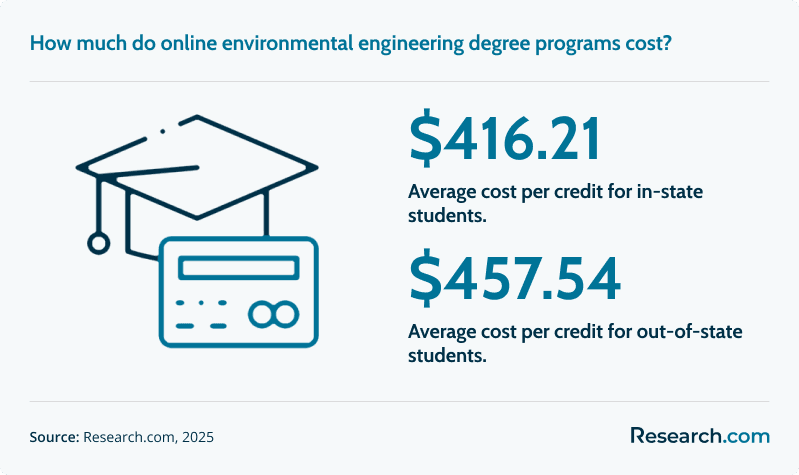
According to our research, the average total tuition for an online environmental engineering degree is approximately $48,252 for in-state students and $53,762 for out-of-state students. The listed programs show cost-per-credit figures ranging from $235.57 (in-state) to $648.87 (out-of-state), with total cost affected by residency status, required credits, transfer credits, fees, books, lab kits, software, and how long it takes to finish.
Tuition is only one part of the cost. Online students may save on relocation, parking, and commuting, but they can still face technology fees, proctoring fees, lab supplies, high-speed internet costs, and software requirements. A lower tuition rate is valuable only if the program also supports your career goal, accepts your credits, and has the accreditation you need.
| Cost Factor | Why It Matters | Question to Ask the School |
| Cost per credit | Determines the largest part of tuition for most programs | Is the listed rate locked in, or can it change each year? |
| Credits required | Most listed programs require 120 credits, while one requires 128 | How many credits will I need after transfer evaluation? |
| Residency pricing | Public universities may charge different in-state and out-of-state rates | Do online students qualify for a separate tuition rate? |
| Lab and software costs | Engineering and science programs may require kits, design tools, simulations, or field supplies | Which materials are included in tuition, and which are extra? |
| Time to completion | Taking longer can increase fees and delay earnings growth | What is the typical completion time for students like me? |
How to think about return on investment
Environmental engineering can be financially worthwhile, but salary outcomes are not guaranteed. The original career data cited for this article notes a median salary of over $104,000 and projected job growth of 7%, but individual outcomes depend on location, industry, licensure, internships, technical skill, and prior experience. Compare the full cost of the degree with realistic entry-level opportunities in your region before committing.
If you are comparing education investments across very different career paths, remember that short career-training options such as CDL training online have a different cost structure, timeline, licensing model, and labor market than an environmental engineering bachelor’s degree. Use those comparisons to clarify your goals, not to assume one pathway is automatically better.
What financial aid is available for online environmental engineering students?
Online students may qualify for scholarships, grants, federal loans, private loans, and work-study, depending on the school, enrollment status, degree level, citizenship status, and financial need. The first step is usually completing the FAFSA and confirming that the program is eligible for federal student aid.
- Scholarships: Gift aid that does not need to be repaid. Awards may be based on academics, identity, service, employer affiliation, STEM interest, or environmental career goals.
- Grants: Need-based funding that usually does not require repayment. One common example is the Federal Pell Grant.
- Federal and private loans: Borrowed money that must be repaid with interest. Federal loans often have borrower protections that private loans may not offer.
- Work-study programs: Federally supported part-time employment that can help students pay education-related expenses.
Look beyond general aid
Environmental engineering and environmental science students should also search for STEM scholarships, employer tuition assistance, state workforce programs, professional association awards, and school-specific grants. Because environmental work intersects with infrastructure, energy, public health, conservation, and compliance, funding may come from several types of organizations.
Before choosing a school, ask the financial aid office for a full aid estimate based on your expected enrollment pace. Also ask whether dropping below full-time status changes your aid, because many online students study part time while working.
What prerequisites do online environmental engineering programs require?
Most bachelor’s programs require a high school diploma or GED. Engineering-focused programs typically expect stronger preparation in calculus, physics, chemistry, and sometimes biology or pre-calculus. Environmental science and sustainability programs may be more flexible, but they still usually require science and quantitative coursework.
Prerequisites protect students from entering upper-level technical courses without the foundation needed to succeed. If you are missing calculus, physics, or chemistry, consider completing those courses before enrolling or during the first phase of the program. Students building quantitative skills may also compare prerequisite expectations with an online data analytics bootcamp, though bootcamps and bachelor’s programs serve different goals.
| Prerequisite Area | Why It Matters | How to Prepare |
| Calculus | Supports modeling, engineering analysis, fluid mechanics, and advanced technical coursework | Take pre-calculus first if your algebra or trigonometry skills are weak |
| Physics | Builds the foundation for mechanics, energy systems, and engineering design | Choose a college-level course with lab if the program requires it |
| Chemistry | Essential for water quality, air pollution, waste treatment, and environmental reactions | Confirm whether general chemistry alone is enough or whether lab chemistry is required |
| Biology or environmental science | Useful for ecology, remediation, public health, and environmental systems | Ask whether prior science credits satisfy major requirements |
| Writing and communication | Engineers and environmental professionals write reports, permits, proposals, and compliance documents | Do not ignore general education writing courses; they support professional work |
If you do not meet the prerequisites yet
Career changers and returning students often need to fill math or science gaps before starting advanced coursework. Community colleges can be a cost-effective way to complete prerequisites, but you should get written confirmation that the credits will transfer. Some universities also offer bridge courses or placement testing.
What courses are in an online environmental engineering degree?
Environmental engineering programs combine math, science, engineering fundamentals, environmental systems, and applied design. Related environmental science or sustainability programs may share some science coursework but usually place less emphasis on engineering mechanics, design calculations, and licensure-oriented preparation.
- Math and foundational science: Calculus, physics, chemistry, biology, statistics, and environmental science.
- Engineering fundamentals: Statics, dynamics, thermodynamics, fluid mechanics, transport processes, and engineering design.
- Environmental engineering topics: Water quality control, air pollution control, solid waste management, hazardous waste, remediation, environmental chemistry, and sustainable infrastructure.
- Technical tools: GIS, AutoCAD, modeling software, simulation platforms, data analysis, and digital documentation.
- Professional preparation: Ethics, regulations, project management, technical writing, and capstone design.
What the coursework prepares you to do
The technical courses are not abstract requirements; they support real professional tasks. Fluid mechanics helps students understand stormwater systems, pipelines, and water movement. Thermodynamics supports energy and treatment-system analysis. GIS helps map environmental data and identify spatial patterns. Design courses teach students to convert scientific findings into systems, plans, and specifications.
Because modern environmental work is increasingly data-heavy, students who want an analytics edge may supplement their degree with targeted training such as an accelerated data science online course with certificate. The right add-on depends on whether you want to work in engineering design, consulting, compliance, energy, research, or sustainability operations. Students comparing structured curricula in other online fields, such as a Christian leadership degree online, should note that environmental engineering usually follows a more technical and prerequisite-driven sequence.
What environmental engineering specializations are available online?
Specializations help students aim their degree toward a specific type of environmental problem. Not every program offers formal concentrations, but many allow students to shape electives, capstones, internships, or research projects around a career interest.
- Water Resources and Quality
- Air Quality and Pollution Control
- Solid and Hazardous Waste Management
- Sustainable Infrastructure and Energy Systems
| Specialization | Best For Students Who Want To | Possible Work Settings |
| Water Resources and Quality | Work on drinking water, wastewater, stormwater, watersheds, or treatment systems | Municipal utilities, engineering firms, consulting companies, public agencies |
| Air Quality and Pollution Control | Analyze emissions, design controls, support permitting, or improve industrial air compliance | Manufacturing, energy, environmental consulting, regulatory agencies |
| Solid and Hazardous Waste Management | Address landfill systems, hazardous materials, remediation, recycling, or waste reduction | Industrial sites, environmental services, government agencies, remediation firms |
| Sustainable Infrastructure and Energy Systems | Work on resilient infrastructure, renewable energy, energy efficiency, or sustainable development | Engineering services, clean energy, construction, public planning, sustainability teams |
Choosing a specialization by career path
Pick a specialization based on the work you want to do every week, not just the topic that sounds most interesting. A water specialization may lead to design and municipal infrastructure work. Air quality can involve modeling, monitoring, and permitting. Waste management and remediation may involve field investigations and cleanup planning. Sustainability-focused tracks may connect more directly to operations, corporate reporting, or policy.
Some students begin with a broader environmental science degree and later pursue engineering at the graduate level. If that is your plan, compare graduate pathways carefully, including the differences between MEng vs MS salary discussions and the separate career tracks those degrees may support.
How to choose the best online environmental engineering program
The right program depends on whether you want to become a licensed engineer, an environmental scientist, a sustainability strategist, a compliance professional, or a manager in an environmentally focused organization. Start with the end goal, then work backward to accreditation, curriculum, cost, transfer credits, and career services.
A practical three-path decision framework
| Pathway | Choose This If | What to Prioritize | What to Avoid |
| Professional Engineer pathway | You want to design engineering systems, pursue PE licensure, and take responsibility for technical engineering work | ABET accreditation, engineering curriculum, lab access, FE exam preparation, internships | Choosing a non-engineering degree without confirming licensure eligibility |
| Environmental scientist or sustainability strategist pathway | You want to work in analysis, conservation, policy, environmental management, advocacy, or corporate sustainability | Environmental science depth, data skills, fieldwork, policy courses, internships, portfolio projects | Assuming an engineering-heavy program is required for every environmental career |
| Two-step bridge pathway | You want a broader bachelor’s degree first and may pursue engineering later through graduate study | Strong math and science prerequisites, transfer-friendly planning, graduate admissions alignment | Waiting until graduation to ask whether your coursework supports an engineering master’s path |
Questions to ask before applying
- Is the exact program ABET-accredited, institutionally accredited, or both?
- If I plan to pursue PE licensure, does this program meet the education requirements in my state?
- How are labs, fieldwork, and design projects completed online?
- What software, lab kits, exams, or in-person sessions are required?
- How many transfer credits will apply to my degree plan?
- What internship support is available to online students?
- What are the full costs beyond tuition, including fees and materials?
- Are courses asynchronous, synchronous, or a mix of both?
- What career outcomes are typical for graduates of this specific program?
Common mistakes to avoid
- Choosing only by tuition: A low cost per credit can be misleading if the program requires more credits, extra fees, or does not fit your career goal.
- Ignoring accreditation: Institutional accreditation and ABET accreditation are not the same. Know which one matters for your intended role.
- Assuming “environmental” means “engineering”: Environmental science, sustainability, economics, environmental studies, and environmental health programs can lead to valuable careers, but they are not always engineering degrees.
- Overlooking lab logistics: Ask how experiments, simulations, fieldwork, and capstone projects are handled before enrolling.
- Skipping internship planning: Online students should be proactive about local internships, municipal agencies, consulting firms, utilities, and environmental employers.
- Relying only on rankings: Rankings help narrow the field, but your licensure pathway, transfer credits, cost, and schedule fit matter more.
What careers can you pursue with an online environmental engineering degree?
Graduates of environmental engineering programs work on systems that protect air, water, land, infrastructure, and public health. They may help design water treatment facilities, evaluate pollution controls, support waste-management systems, assist with remediation projects, prepare compliance documents, or manage sustainability-related technical projects.
The career options differ depending on whether the degree is truly engineering-focused or is instead in environmental science, sustainability, environmental studies, economics, or environmental health and safety. Engineering roles usually require more design, math, and licensure preparation, while science and sustainability roles may focus more on analysis, policy, management, communication, or compliance.
| Career Direction | Typical Focus | Best Degree Fit |
| Environmental engineer | Designing or improving systems for water, waste, pollution control, remediation, and infrastructure | ABET-aligned environmental engineering or related engineering program |
| Environmental scientist | Collecting data, analyzing environmental conditions, supporting assessments, and preparing reports | Environmental science or technical environmental studies program |
| Environmental health and safety specialist | Managing workplace safety, industrial compliance, risk reduction, and environmental health programs | Environmental health and safety program |
| Sustainability analyst or coordinator | Tracking sustainability metrics, supporting corporate initiatives, improving operations, and reporting progress | Sustainability, environmental science, economics, or data-focused environmental program |
| Environmental policy or resource analyst | Evaluating policies, resource use, economics, regulations, and environmental decision-making | Environmental economics, sustainability, environmental studies, or policy-oriented program |
Engineering vs. science in real work
Consider a polluted lake. An environmental scientist may collect samples, interpret the results, and describe ecological effects. An environmental engineer may design the treatment or remediation system used to reduce contamination. A biologist may study species-level impacts; students comparing that route can review an aquatic biologist salary guide to understand how that career differs from engineering.
Clean energy and environmental infrastructure are also shaping demand. In the clean energy economy, engineers help design systems that technicians build, operate, and maintain. The original labor-market discussion for this article notes that green energy jobs such as wind turbine technicians and solar installers are projected to grow by over 50%.
What is the job outlook for environmental engineering graduates?
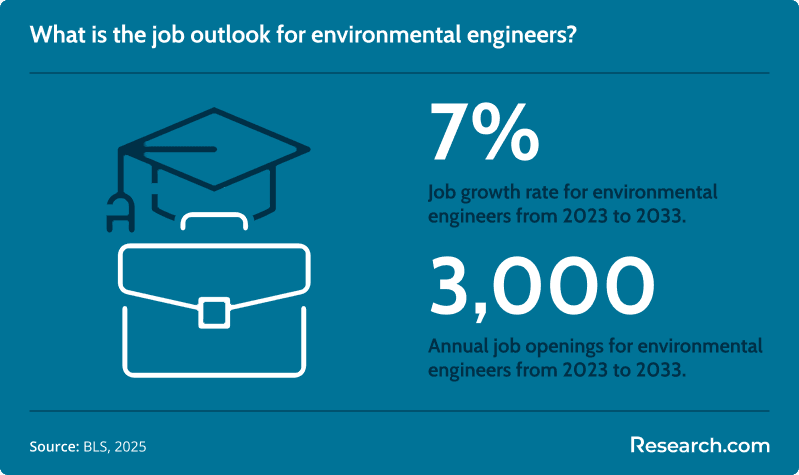
The U.S. Bureau of Labor Statistics projects employment in this field to grow by 7% over the next decade. That projection equals about 3,000 job openings each year, on average. Demand is connected to public health, water systems, pollution control, infrastructure, regulatory compliance, remediation, and environmental protection.
Prospects are generally stronger for graduates who complete an appropriately accredited program, gain internship or field experience, build software and data skills, and pursue licensure where relevant. A degree alone does not guarantee a specific job or salary, but the field benefits from persistent needs that communities, agencies, and industries cannot easily postpone.
Current trends affecting the field
- Clean energy growth: The U.S. Department of Energy reported that clean energy jobs grew more than twice the rate of overall U.S. employment.
- Infrastructure and water quality needs: Communities continue to need professionals who can support drinking water, wastewater, stormwater, and remediation projects.
- Data-driven environmental work: GIS, modeling, sensors, compliance platforms, and analytics are becoming more important across environmental roles.
- Regulatory and public health pressure: Environmental professionals help organizations meet standards, reduce risk, and protect communities.
- Online education expectations: Employers increasingly look for proof of applied skills, internships, portfolios, and technical competence—not just degree format.
Environmental engineering also overlaps with public safety and community resilience. Students drawn to infrastructure protection, emergency planning, and public health may find useful comparisons in the fastest online public safety degree programs.
What challenges do online environmental engineering students face?
Online environmental engineering and related environmental programs can be demanding. Students must handle technical coursework, lab alternatives, group projects, software tools, and independent study without the daily structure of campus life. The biggest challenge is not usually the online format itself; it is the combination of engineering rigor and remote self-management.
| Challenge | Why It Can Be Difficult | How to Manage It |
| Advanced math and science | Calculus, physics, chemistry, and engineering analysis can be hard to master without frequent support | Use tutoring early, form study groups, and do not overload your first technical term |
| Remote labs | At-home kits and simulations require careful setup, documentation, and troubleshooting | Ask for lab expectations before enrolling and test required technology before courses begin |
| Team projects | Group design work can be harder when classmates are in different time zones | Use shared schedules, project management tools, and written role assignments |
| Internship access | Online students may need to find local opportunities without campus-based recruiting | Contact local utilities, consulting firms, agencies, and environmental employers early |
| Cost control | Fees, materials, and longer completion times can increase total expenses | Compare full degree plans and review affordable online colleges for engineering degrees when cost is a major concern |
Can a complementary accelerated degree or credential improve career options?
A complementary credential can help if it fills a specific skill gap. Environmental employers increasingly value data analysis, GIS, compliance software, project management, public health awareness, and digital reporting. However, an extra credential should support your target role. Do not add another program simply because it is fast or available online.
For example, students interested in environmental health data, public health systems, or cross-sector analytics may compare environmental training with accelerated health informatics masters programs online. That type of option is most relevant when your goals include health data, environmental health systems, or leadership roles requiring both technical and information-management skills.
What graduates say about online environmental engineering programs
- Eamon: "I spent years in logistics and wanted work that felt more connected to environmental problem-solving. Studying online let me finish prerequisites at night while staying employed. Today, as a project engineer at a consulting firm, I can point to systems I helped design and see the impact of the work."
- Brownwyn: "I knew I cared about environmental issues, but I was unsure whether I belonged in policy, science, or advocacy. The program helped me decide. Once we started modeling a remediation site with design software, I realized I wanted to build solutions, not only discuss them."
- Alex: "After eight years as an environmental technician, I had reached the limit of what I could do without an engineering bachelor’s degree. Online study made it possible to keep my job while earning the credential. Now I am working toward my PE license and can pursue senior roles that were not available to me before."
Key Insights
- Accreditation should come first. If your goal is PE licensure, confirm ABET accreditation for the exact program before applying.
- Not every environmental program is an engineering program. Environmental science, sustainability, economics, environmental studies, and environmental health degrees can lead to strong careers, but they prepare students for different types of work.
- Most bachelor’s options require 120 credits and about 4 years. Transfer credits, part-time enrollment, and accelerated formats can change the timeline.
- Cost varies by school and residency. Our research found average total tuition of approximately $48,252 for in-state students and $53,762 for out-of-state students, but fees, software, materials, and transfer credits can change the final price.
- Online learning can work for technical fields when support is strong. Look for clear lab procedures, simulation access, tutoring, advising, internship support, and career services for online students.
- Career outcomes depend on the path you choose. Engineering design, environmental science, sustainability, compliance, and resource economics each require different coursework and experience.
- Job demand is steady but not automatic. The field is projected to grow by 7%, with about 3,000 openings each year, on average; internships, licensure, software skills, and location still matter.
- Use rankings as a filter, not a final answer. The best program is the one that fits your licensure needs, budget, schedule, transfer situation, and long-term career plan.
References:
- National Center for Education Statistics. (2024, May). Indicator CTA: Bachelor's degrees conferred by postsecondary institutions, by field of study. U.S. Department of Education, Institute of Education Sciences. Retrieved August 11, 2025, from NCES.
- U.S. Bureau of Labor Statistics. (2022, April). Green growth. U.S. Department of Labor, Career Outlook. Retrieved August 11, 2025, from BLS.
- U.S. Bureau of Labor Statistics. (2025a). Occupational employment and wage statistics: 17-2081 Environmental engineers. U.S. Department of Labor. Retrieved August 11, 2025, from BLS.
- U.S. Bureau of Labor Statistics. (2025b). Occupational outlook handbook: Environmental engineers. U.S. Department of Labor. Retrieved August 11, 2025, from BLS.
- U.S. Department of Energy. (2024, June 26). DOE report shows clean energy jobs grew more than twice the rate of overall U.S. employment. Retrieved August 11, 2025, from DOE.
- Zippia. (2025). Environmental engineer education requirements. Retrieved August 11, 2025, from Zippia.
Other Things You Should Know About Online Environmental Engineering Degree Programs
Yes. For Professional Engineer licensure, many state boards require a degree from an ABET-accredited environmental engineering program. ABET accreditation also matters for eligibility to sit for the FE and PE exams in most states through the National Council of Examiners for Engineering and Surveying.
Graduates can pursue roles in environmental consultancy, water resource management, or sustainable design. Opportunities are available in government agencies, private firms, and NGOs, often starting as Environmental Engineers or Analysts, with potential to advance to senior positions or specialized fields.
After completing an online environmental engineering degree in 2027, graduates can pursue professional certifications like the Engineering in Training (EIT) certification, a step towards becoming a licensed Professional Engineer (PE). Requirements include passing the Fundamentals of Engineering exam and obtaining relevant work experience.


