2027 Best Online Aerospace Engineering Degree Programs

Co-Founder and Chief Data Scientist
Aerospace engineering is no longer limited to traditional defense or academic research. The focus this 2027 is on clean propulsion systems, satellite-based climate monitoring, and the growing demand for autonomous aerial platforms. Students, therefore, are entering the field with a broader awareness of how flight technology shapes global infrastructure, sustainability, and security.
The best online aerospace engineering degree programs reflect this shift by offering rigorous, purpose-built curricula designed to prepare learners for these expanding roles across both commercial and government sectors.
In this guide, I’ll walk you through the top online aerospace engineering programs available today. We’ll look closely at how long these programs typically take, what they cost, and what kind of math and physics background is required to succeed. We’ll also explore specialization options, career paths, and how these degrees align with hiring trends in both public and private aerospace sectors.
What are the benefits of getting an online aerospace engineering degree?
- Online aerospace engineering degree graduates work in aerospace manufacturing, engineering services, federal agencies, scientific research, and avionics across a wide range of technical and defense-related environments.
- Aerospace engineers earn a median salary of $134,830, with top roles exceeding $205,850, with the highest-paying sectors being research, federal agencies, and aerospace manufacturing.
- Graduate-level programs often support career advancement into leadership roles or highly technical specializations.
What can I expect from an online aerospace engineering degree?
The best online aerospace engineering degree programs follow the same academic standards and accreditation benchmarks as traditional on-campus programs. Approval from the Accreditation Board for Engineering and Technology (ABET) ensures that students study essential areas such as aerodynamics, propulsion systems, flight mechanics, orbital physics, and structural analysis. Many programs include the same capstone design courses and advanced materials labs as their campus-based counterparts.
Course delivery often blends scheduled virtual lectures with on-demand modules that cover theoretical foundations and applied mathematics.
Learners complete virtual labs and simulation-based experiments, some of which are controlled remotely through university facilities. Select programs provide access to high-fidelity test rigs and design trainers, helping to replicate the kinds of hardware interactions found in traditional lab environments.
Students work in collaborative settings that reflect real-world aerospace workflows. Interaction with instructors and graduate teaching assistants is organized through small-group reviews, discussion forums, and team-based design projects. These experiences reinforce systems-level thinking and help students build both technical and communication skills.
Most programs culminate in a specialization track and offer training in industry-standard tools such as computer-aided design (CAD), computational fluid dynamics (CFD), and finite element analysis (FEA). With a strong emphasis on design integration and simulation, these programs prepare graduates to enter aerospace, defense, or research organizations with practical, job-ready skills.
Where can I work with an online aerospace engineering degree?
Top online aerospace engineering programs are designed to align with the specific demands of aerospace environments that require both analytical precision and strong systems integration skills.
The following sectors and settings represent the most common and in-demand environments for aerospace engineers today:
- Aerospace product and parts manufacturing: Large employers such as aircraft, satellite, and propulsion firms hire aerospace engineers for design, testing, and production engineering. This sector employed approximately 26,400 aerospace engineers as of May 2023.
- Architectural, engineering, and related services: Consulting and engineering services firms support aviation, defense, and infrastructure projects through systems integration, simulation analysis, and cross-disciplinary technical support.
- Federal agencies and space programs: Organizations like NASA, the Department of Defense, and national research labs offer roles in mission design, propulsion analysis, and research. Programs such as NASA’s Pathways internships often lead directly to full-time positions.
- Scientific research and development services: R&D organizations focused on autonomous systems, green propulsion, or orbital mechanics employed around 5,770 aerospace engineers in 2023.
- Navigation, sensor, avionics, and control instrument manufacturing: Companies in this field build systems for drones, spacecraft, and satellites, employing roughly 3,750 aerospace engineers nationwide.
These roles are found in a wide range of settings, from classified military labs and university-affiliated research centers to aerospace corridors in California, Texas, Florida, and the Mid-Atlantic region. Online graduates with industry-aligned training are often recruited into these environments for their adaptability, technical depth, and ability to contribute from day one.
How much can I make with an online aerospace engineering degree?
Graduates from accredited online aerospace engineering programs can expect salaries that align with national benchmarks for the profession.
The figures below represent typical annual earnings across the primary employment fields for aerospace engineers:
- Scientific research and development services: Engineers in this area earned approximately $148,530 in 2024, the highest among reported industries (Bureau of Labor Statistics [BLS], 2024).
- Federal government: Professionals employed by federal agencies reported average salaries of about $140,710, reflecting the demand for aerospace expertise in public-sector missions and oversight (BLS, 2024).
- Aerospace product and parts manufacturing: Engineers working in this field earned roughly $134,950, with opportunities to increase income through specialization and experience (BLS, 2024).
- Engineering services and consulting: Typical earnings in professional, scientific, and technical services reached approximately $130,410 (BLS, 2024).
- Overall salary range: Entry-level engineers typically earn less than $85,350, while the top 10% of earners make over $205,850 (BLS, 2024).
Strong compensation across sectors highlights the continued demand for aerospace engineers and the financial viability of entering the field through a well-structured online degree.
- List of Online Aerospace Engineering Degree Programs for 2027 List of Programs
- How long does it take to complete an online aerospace engineering degree? Program Length
- How does an online aerospace engineering degree program compare to an on-campus program? How does an online aerospace engineering degree program compare to an on-campus program?
- What is the average cost of an online aerospace engineering degree? Average Cost
- What are the financial aid options for students enrolling in online aerospace engineering degree programs? Financial Aid
- What are the prerequisites for enrolling in online aerospace engineering degree programs? Requirements
- What courses are typically in online aerospace engineering degree programs? What courses are typically in online aerospace engineering degree programs?
- What types of specializations are available in online aerospace engineering degree programs? What types of specializations are available in online aerospace engineering degree programs?
- How to choose the best online aerospace engineering degree program? How to choose the best online aerospace engineering degree program?
- What career paths are available for online aerospace engineering degree graduates? Career Paths
- What is the job market for online aerospace engineering degree graduates? Job Outlook
- How do online aerospace engineering programs build industry connections? How do online aerospace engineering programs build industry connections?
- How do online aerospace engineering programs enhance student engagement and academic support? How do online aerospace engineering programs enhance student engagement and academic support?
Best Online Aerospace Engineering Degree Programs for 2027
Choosing an online aerospace engineering degree is not the same as choosing a general online STEM program. Aerospace engineering depends heavily on advanced math, physics, simulation, design review, laboratory work, and industry-standard software, so students need to look closely at accreditation, course delivery, faculty expertise, and hands-on requirements before enrolling.
This guide is designed for students comparing online aerospace engineering bachelor’s and graduate options, working professionals who want to move into propulsion, flight dynamics, space systems, or autonomous aircraft, and career changers trying to understand whether an online format can lead to credible engineering roles. You will learn which programs stand out, how online study compares with campus-based study, what the degree usually costs, what prerequisites to expect, and how to judge whether a program fits your career goals.
Quick answer: What is the best online aerospace engineering degree?
The strongest online aerospace engineering degree programs are offered by accredited institutions with rigorous engineering curricula, access to aerospace-focused faculty, clear lab or simulation requirements, and strong links to aviation, defense, and space employers. At the bachelor’s level, students should pay especially close attention to ABET accreditation because it can affect engineering licensure eligibility, graduate school options, and employer recognition. At the graduate level, the best fit depends more on specialization, research alignment, cost, and schedule flexibility.
How do we rank schools?
Online aerospace engineering programs were evaluated for technical rigor, delivery quality, accreditation, flexibility, available concentrations, and indicators of student and career outcomes. Programs with clear pathways into areas such as propulsion, orbital mechanics, flight dynamics, aerospace structures, satellite systems, and computational fluid dynamics received stronger consideration.
Research.com applies our methodology to compare programs using academic quality, program relevance, affordability, flexibility, institutional reputation, and available outcomes data. Because aerospace engineering is a highly technical field, accreditation status and access to applied engineering experiences are especially important in this ranking.
Program information was reviewed using current public data from reliable education and program sources, including the U.S. Department of Education’s College Scorecard, the National Center for Education Statistics, the Integrated Postsecondary Education Data System, and Peterson’s Distance Learning database.
Online aerospace engineering programs at a glance
| School | Online aerospace option | Best fit | Key note |
| Embry-Riddle Aeronautical University | Online B.S. in Aerospace Engineering | Students seeking an online ABET-accredited bachelor’s pathway | Uses nine-week accelerated terms and reports over 94% of graduates employed or in graduate school within a year |
| University of North Dakota | Online B.S. in Aerospace Engineering | Students interested in space, propulsion, satellites, hypersonics, and national defense | Includes on-campus summer labs and has ABET accreditation anticipated 2027 |
| Stanford University | Online graduate certificate and part-time online MS option | Working engineers seeking elite graduate-level coursework | No online bachelor’s degree in aerospace engineering |
| University of Southern California | Online MS in Aerospace Engineering and Graduate Certificate in Astronautical Engineering | Professionals focused on astronautics and space systems | Delivered through DEN@Viterbi |
| University of Washington - Seattle | Online Master of Aerospace Engineering | Working professionals who want evening graduate study | Offers certificate options in aerospace control systems, composites, and modern structural design |
| University of Colorado Boulder | Online Professional Master of Science in Aerospace Engineering Sciences | Graduate students interested in astrodynamics, bioastronautics, autonomous systems, or remote sensing | B.S. in Aerospace Engineering is on campus |
| Mississippi State University | Online M.S. in Aerospace Engineering | Professionals seeking thesis or non-thesis graduate study | On-campus B.S. is ABET-accredited |
| Liberty University | Online B.S. in Aviation | Students focused on aviation, pilot preparation, aviation management, or maintenance management | Aviation-focused rather than a traditional aerospace engineering degree |
| Purdue University | Online M.S. in Aeronautics and Astronautics | Engineers seeking advanced technical depth in a respected graduate program | Offers multiple aerospace concentration areas |
| Georgia Institute of Technology | Online M.S. in Aerospace Engineering | Graduate students seeking a research-connected aerospace program | B.S. in Aerospace Engineering is delivered exclusively on campus |
1. Embry-Riddle Aeronautical University
Embry-Riddle Aeronautical University offers an online Bachelor of Science in Aerospace Engineering that is ABET-accredited and structured around nine-week accelerated terms. The program is a strong option for students who want an undergraduate aerospace engineering degree with recognized accreditation, flexible pacing, and technical coursework in areas such as flight dynamics, thermofluids, propulsion, and orbital systems. The university also reports that over 94% of graduates are employed or enrolled in graduate school within a year.
- Program Length: 4 years full-time
- Tracks/concentrations: Core Aerospace Engineering curriculum with elective focus options in flight-dynamics, propulsion, orbital systems
- Cost per Credit: $503 per credit (undergraduate online)
- Required Credits to Graduate: 120
- Accreditation: ABET/EAC, Southern Association of Colleges and Schools Commission on Colleges (SACSCOC)
2. University of North Dakota
University of North Dakota provides a fully online Bachelor of Science in Aerospace Engineering that follows an ABET-track structure and includes subject areas such as propulsion, orbital mechanics, rocketry, satellite development, hypersonics, flight dynamics and control, and CFD. Online learners study with the same faculty standards used on campus, and aerospace-related instruction is connected to the John D. Odegard School of Aerospace Sciences. UND was the first university in the nation admitted to the U.S. Space Force University Partnership Program and maintains aerospace connections with organizations including NASA, Northrop Grumman, and Voyager Technologies.
- Program Length: 4–5 years, including on-campus summer labs
- Tracks/concentrations: Propulsion, Orbital Mechanics, Rocketry, Satellite Development, Hypersonics, Flight Dynamics & Control, CFD
- Cost per Credit: $480
- Required Credits to Graduate: 128
- Accreditation: HLC; ABET (EAC) accreditation anticipated 2027
3. Stanford University
Stanford University does not currently offer an online bachelor’s degree in aerospace engineering. However, it does offer graduate-level online study through a certificate option and a part-time online MS in Aeronautics and Astronautics through the Honors Cooperative Program. These options are better suited for working professionals who want Stanford Engineering coursework in areas such as propulsion, space systems, fluid mechanics, and dynamics and control without pursuing a traditional full-time campus program.
- Program Length: Certificate can be completed in 1–2 years part-time
- Tracks/concentrations: Fluid Mechanics, Propulsion, Dynamics and Control, Space Systems
- Cost per Credit: Approximately $1,456
- Required Credits to Graduate: 12–15 units (certificate); 45 units (master’s)
- Accreditation: WASC (institutional); program adheres to Stanford Engineering standards
4. University of Southern California
University of Southern California keeps its undergraduate engineering programs on campus, but its DEN@Viterbi platform offers a fully online MS in Aerospace Engineering and a Graduate Certificate in Astronautical Engineering. The program is most useful for graduate students and practicing engineers who want advanced study in spacecraft propulsion, space systems design, safety of space systems, or dynamics and control while remaining employed.
- Program Length: 1–2 years part-time
- Tracks/concentrations: Spacecraft Propulsion, Space Systems Design, Dynamics and Control, Safety of Space Systems
- Cost per Credit: Approximately $1,456
- Required Credits to Graduate: 12–15 units (certificate); 30–45 units (master’s)
- Accreditation: WASC
5. University of Washington - Seattle
University of Washington - Seattle offers a fully online Master of Aerospace Engineering through its Department of Aeronautics & Astronautics. The program uses flexible evening classes, making it a practical option for engineers who want graduate training without leaving the workforce. Its strengths include applied coursework, connections to aerospace research, and optional professional certificates in aerospace control systems, composites, and modern structural design.
- Program Length: Approximately 3 years part-time
- Tracks/concentrations: Controls, Fluids, Structures, Composites
- Cost per Credit: Not publicly listed
- Required Credits to Graduate: 45 (MAE); 16 (certificate)
- Accreditation: Northwest Commission on Colleges and Universities (NWCCU)
6. University of Colorado Boulder
University of Colorado Boulder offers its ABET-accredited B.S. in Aerospace Engineering on campus, while its Professional Master of Science in Aerospace Engineering Sciences is available 100% online. The online master’s is a strong fit for students seeking graduate-level technical breadth in areas such as astrodynamics, autonomous systems, bioastronautics, fluids, structures, materials, remote sensing, and Earth or space science.
- Program Length: Approximately 2 years part-time
- Tracks/concentrations: Astrodynamics & Satellite Navigation, Autonomous Systems, Bioastronautics, Fluids/Structures/Materials, Remote Sensing & Earth/Space Science
- Cost per Credit: Although not publicly listed, it’s aligned with Colorado resident graduate tuition
- Required Credits to Graduate: 30
- Accreditation: WASC
7. Mississippi State University
Mississippi State University offers an ABET-accredited Bachelor of Science in Aerospace Engineering on campus and a fully online Master of Science in Aerospace Engineering. The online graduate program is designed for professionals who want deeper technical preparation in areas such as fluid dynamics, structural mechanics, controls, propulsion, or autonomous systems, with both thesis and non-thesis options available.
- Program Length: Approximately 2–3 years part-time (master’s)
- Tracks/concentrations: Fluid Dynamics, Structural Mechanics, Controls, Propulsion, Autonomous Systems
- Cost per Credit: $581 + $25 instructional support fee
- Required Credits to Graduate: 30 (master’s)
- Accreditation: ABET; SACSCOC
8. Liberty University
Liberty University offers a fully online Bachelor of Science in Aviation that combines online coursework with flight training through FAA-approved affiliates. This is not a traditional aerospace engineering program, but it may fit students whose goals are closer to aviation operations, piloting, aviation management, or maintenance management. The curriculum includes aviation-related exposure to topics such as aerodynamics and propulsion, and Liberty’s School of Aeronautics has won the Loening Trophy four times.
- Program Length: 120 credits (typically 3–3.5 years)
- Tracks/concentrations: Aviation (pilot focus), Aviation Management, Maintenance Management
- Cost per Credit: $390 full-time, $455 part-time; military rate $250 (AY 2025–26)
- Required Credits to Graduate: 120
- Accreditation: SACSCOC
9. Purdue University
Purdue University offers a fully online Master of Science in Aeronautics and Astronautics for students who already have the undergraduate preparation needed for advanced engineering study. The program is taught by aerospace faculty and covers technical areas including aerodynamics, space applications, autonomy, structures, materials, and propulsion. It is a strong option for working engineers who want a rigorous graduate credential from a major engineering institution.
- Program Length: 30 graduate credit hours, typically completed in 1–2 years
- Tracks/concentrations: Aerodynamics; Aerospace Systems; Astrodynamics & Space Applications; Autonomy & Control; Structures & Materials; Propulsion
- Cost per Credit: $1,139 (Indiana resident); $1,459 (non-resident)
- Required Credits to Graduate: 30 credits (MSAAE)
- Accreditation: ABET; Higher Learning Commission (HLC)
10. Georgia Institute of Technology
Georgia Institute of Technology offers an ABET-accredited Bachelor of Science in Aerospace Engineering only on campus, but graduate students can pursue an online Master of Science in Aerospace Engineering. The online MSAE is connected to the Guggenheim School’s aerospace research strengths and is suited to students interested in propulsion, space systems, autonomous flight, and advanced engineering analysis.
- Program Length: Up to six years to complete
- Tracks/concentrations: Thesis and non-thesis options
- Cost per Credit: $1,138 (based on $3,415 per three-credit course)
- Required Credits to Graduate: 33 (MSAE)
- Accreditation: ABET; SACSCOC
How long does it take to complete an online aerospace engineering degree?
Most online aerospace engineering bachelor’s degrees require the same amount of academic work as campus programs, so the timeline depends mainly on transfer credit, course load, lab availability, and whether the program uses traditional semesters or accelerated terms. Graduate programs are usually shorter, but many students complete them part-time while working.
| Study path | Typical timeline | Who it fits best |
| Full-time bachelor’s degree | 4 years | Students who can carry a standard load of 15 to 16 credits per semester |
| Part-time bachelor’s degree | 5 to 6 years | Working adults, military students, parents, and students balancing other obligations |
| Accelerated bachelor’s pathway | 3.5 years or less in some formats | Students who can take summer courses or compressed terms consistently |
| Combined BS/MS or BS/MEng pathway | As few as 5 years | High-performing students planning graduate study early; also useful for comparing MEng vs MS options |
| Online master’s degree | 1–3 years in many formats | Engineers seeking advancement, specialization, or a transition into aerospace roles |
Transfer credits and approved prior learning can shorten a bachelor’s program by up to one year, but this depends on whether previous math, physics, engineering, and general education credits match the new school’s curriculum. Students using federal financial aid should also pay attention to satisfactory academic progress rules and the maximum timeframe requirement, which typically requires completion of a 4-year degree within 6 years to maintain eligibility.
As with the best online counseling psychology degree programs, the right pacing model depends on how much time you can realistically commit each week. Aerospace engineering is math-heavy and project-intensive, so choosing an overly aggressive schedule can lead to weak grades, delayed prerequisites, or repeated courses.
Salary potential is another factor to weigh before committing to a program. The chart below shows median annual salaries for aerospace engineers as of 2024.
How does an online aerospace engineering degree program compare to an on-campus program?
An online aerospace engineering degree can be academically credible when it comes from a properly accredited institution and includes the same engineering fundamentals, design expectations, and assessment standards as an equivalent campus program. The biggest differences are not usually in the degree title; they are in lab access, faculty interaction, project format, and how students complete hands-on or collaborative work.
According to the Job Outlook 2024 survey by the National Association of Colleges and Employers, 87.4% of employers who tracked degree format hired candidates from online programs. The survey also found no difference in starting salaries, which suggests that many employers evaluate candidates based on skills, school quality, accreditation, projects, and experience rather than delivery format alone.
| Factor | Online aerospace engineering | On-campus aerospace engineering |
| Flexibility | Stronger for working adults and students who cannot relocate | Less flexible, but more structured for traditional full-time students |
| Lab access | May use simulations, remote tools, local partnerships, or required residencies | More direct access to wind tunnels, fabrication spaces, and in-person testing facilities |
| Faculty access | Usually scheduled through video meetings, discussion boards, and virtual office hours | More informal access before and after class or in campus labs |
| Peer collaboration | Often organized through online design teams and virtual reviews | More spontaneous teamwork and in-person project development |
| Employer perception | Strongest when the program is accredited and tied to a recognized engineering school | Still preferred by some students for hands-on immersion and campus recruiting |
| Best for | Self-directed students, working professionals, military learners, and students unable to relocate | Students who want full campus access, in-person labs, and daily engineering community engagement |
Campus programs still have advantages for students who want extensive in-person lab time, direct access to research groups, and frequent face-to-face collaboration. Online programs, however, can close much of that gap through high-quality simulation environments, structured design reviews, remote lab tools, industry-sponsored projects, and short on-site sessions.
The evaluation process is similar to comparing the best online gunsmith trade school programs: the format matters less than whether the program provides credible training, recognized credentials, proper equipment access, and employer-relevant outcomes. Students comparing engineering fields may also want to review a fast-track online software engineering degree, since software engineering programs often offer more fully remote project options than aerospace programs.
What is the average cost of an online aerospace engineering degree?
The cost of an online aerospace engineering degree varies widely because tuition depends on the school type, residency rules, technology fees, lab requirements, and whether the program is undergraduate or graduate. Students should calculate total program cost rather than relying only on the advertised per-credit rate.
| Program type | Typical tuition range | Estimated total cost | Cost considerations |
| Public In-State | $370–$620 per credit | $44,000–$74,000 | Often the lowest-cost option for eligible residents |
| Public Out-of-State or Flat-Rate Online | $650–$950 per credit | $58,000–$78,000 | May be cost-effective if online students receive a flat tuition rate |
| Private or Specialized | $1,000–$1,400 per credit | $84,000–$126,000 | Higher tuition may reflect institutional reputation, specialized faculty, or technology investment |
| Additional Costs | $1,000–$2,500 | Varies by program | May include remote lab access, engineering software, compatible hardware, or testing fees |
Students should also ask whether tuition includes software licenses for CAD, CFD, FEA, MATLAB-style tools, proctoring, remote lab platforms, or required residencies. A low tuition rate can become less attractive if students must separately pay for expensive technical tools or travel.
As with the best online DBA in management degree programs, the smartest financial choice is not always the cheapest option. Students should compare total cost against accreditation, graduation requirements, career services, faculty access, and how well the curriculum matches aerospace employer expectations.
What are the financial aid options for students enrolling in online aerospace engineering degree programs?
Online aerospace engineering students may qualify for many of the same funding sources as campus students if they enroll in an eligible accredited institution and meet aid requirements. Because aerospace programs can be expensive, applicants should build a funding plan before enrolling rather than waiting until tuition is due.
- Federal Grants and Loans: Completing the FAFSA can make students eligible for federal aid, including Pell Grants of up to $7,395 and low-interest Direct Loans for accredited online programs.
- NASA Space Grant Consortium Scholarships: These state-administered awards provide up to $8,500 for upper-level students involved in aerospace research, and many participating universities allow online students to apply.
- AIAA Foundation Undergraduate Scholarships: The American Institute of Aeronautics and Astronautics scholarship program awards $2,000–$10,000 annually to students in ABET-accredited aerospace programs, including eligible online students.
- Vertical Flight Foundation Scholarships: The Vertical Flight Foundation scholarship application process supports students pursuing rotorcraft or eVTOL engineering, with awards ranging from $3,000–$6,000.
- Women in Aerospace Foundation Awards: Up to four $5,000 scholarships are awarded each year to women in their junior or senior year of an aerospace program, and online students are fully eligible.
Students should also check employer tuition assistance, military education benefits, state grants, institutional engineering scholarships, research assistantships, and graduate tuition reimbursement. For graduate students, employer support can be especially valuable when the degree directly supports an engineering, defense, aviation, or space systems role.
What are the prerequisites for enrolling in online aerospace engineering degree programs?
Aerospace engineering has a steeper academic entry point than many online degree fields because students must be prepared for calculus, physics, engineering mechanics, computer modeling, and design analysis. Admissions requirements vary, but strong math and science preparation is essential.
| Requirement area | Common expectation | Why it matters |
| Academic Foundation | High school diploma or GED with 4 years of mathematics through precalculus or calculus and at least 3 years of lab science, typically physics and chemistry | Prepares students for engineering sequences that build quickly from math and science fundamentals |
| Math Readiness | Calculus I and II or qualifying placement exam scores | Aerodynamics, orbital mechanics, controls, and propulsion all depend on calculus |
| Science Background | Calculus-based Physics I with lab; some schools may also require college-level chemistry | Supports mechanics, thermodynamics, fluids, and materials coursework |
| GPA Benchmarks | 3.0 core GPA for many incoming freshmen and a 3.0 average in recent academic work for transfer students | Helps schools assess readiness for a demanding engineering curriculum |
| English Proficiency | TOEFL iBT scores of at least 79 or IELTS scores of 6.0 or higher for international applicants | Ensures students can complete technical writing, team communication, and design documentation |
| Technical Setup | Broadband internet, webcam, and a laptop capable of running CAD, CFD, proctored exam, and engineering software tools | Online engineering coursework often depends on modeling, simulation, and secure assessment platforms |
| Placement and Exams | ALEKS, SAT, ACT, or internal math placement tests may be used | Determines whether students can begin in calculus or must complete prerequisite math first |
Some technical programs, including those connected to aviation security or adjacent public safety fields such as air marshal training requirements, also use placement and eligibility screening to confirm that students are ready for specialized coursework. In aerospace engineering, the main screening concern is academic and technical readiness.
The principle is similar to admissions checks used by the best online floor installer trade school programs: students need the right preparation and equipment before the hands-on portion of training begins. For aerospace engineering, that means being ready for intensive math, simulations, design projects, and remote collaboration from the first semester.
What courses are typically in online aerospace engineering degree programs?
Online aerospace engineering curricula usually combine engineering fundamentals with specialized study in aircraft, spacecraft, propulsion, structures, flight behavior, and computational modeling. Bachelor’s programs start with calculus, physics, programming, statics, dynamics, and materials before moving into aerospace-specific subjects. Graduate programs typically assume that foundation and go deeper into technical specialties.
- Aerodynamics: Studies airflow around wings, airfoils, bodies, and vehicles, including subsonic and supersonic flow, boundary layers, and wind tunnel methods.
- Propulsion Systems: Examines thermodynamics, gas dynamics, jet engine cycles, rocket propulsion, and performance analysis.
- Structures and Materials: Covers elasticity, thin-walled aerospace structures, composites, fatigue, and finite element analysis. Students may also encounter manufacturing context related to advanced fabrication and the requirements to become a welder in aerospace production environments.
- Flight Mechanics and Stability: Focuses on performance, rigid-body dynamics, control principles, aircraft stability, and vehicle response.
- Orbital Mechanics: Introduces two-body motion, satellite orbits, transfer maneuvers, trajectory design, and mission planning concepts.
- Computational Methods: Uses numerical methods, CFD, optimization, and modeling tools to analyze aerospace systems and support engineering decisions.
- Capstone Design: Brings together CAD, analysis, testing, teamwork, documentation, and design review in a final aircraft, spacecraft, or propulsion-related project.
Students should review syllabi carefully because course titles alone do not always reveal how much design work, coding, simulation, or lab activity is included. A strong aerospace curriculum should move beyond theory and require students to apply technical concepts to real engineering trade-offs.
What types of specializations are available in online aerospace engineering degree programs?
Specializations help students align their degree with specific aerospace roles. A student interested in launch vehicles will need a different technical profile than someone targeting UAVs, airframe stress analysis, flight controls, or satellite mission design.
| Specialization | What students study | Career alignment |
| Aerodynamics and Fluid Mechanics | CFD, wind tunnel analysis, compressible flow, and high-speed airflow | Aerodynamics engineer, CFD analyst, aircraft design engineer |
| Propulsion and Combustion | Jet engines, rocket engines, hybrid systems, thermodynamics, and hypersonic propulsion | Propulsion engineer, launch systems engineer, engine test engineer |
| Structures, Materials, and Aeroelasticity | Composite airframes, vibration, fatigue, finite element analysis, and structural response | Structures engineer, stress engineer, materials engineer |
| Flight Dynamics, Guidance, and Control | Vehicle stability, autopilot systems, navigation, feedback control, and autonomous flight | GNC engineer, controls engineer, flight dynamics engineer |
| Space Systems and Astrodynamics | Spacecraft subsystems, orbital mechanics, trajectory design, and mission planning | Spacecraft systems engineer, mission design engineer, satellite engineer |
| Hypersonics | Mach-5 and above flight, aerothermal effects, thermal protection, and high-speed propulsion | Hypersonics engineer, defense systems engineer, advanced research engineer |
| Autonomous and Uncrewed Vehicle Systems | Robotics, autonomy, AI-enabled control, UAV platforms, and sensors | UAV engineer, autonomy engineer, eVTOL development engineer |
| Rotorcraft and VTOL Engineering | Rotor dynamics, vertical-lift aeromechanics, and electric VTOL systems | Rotorcraft engineer, eVTOL engineer, vertical-lift systems specialist |
Rotorcraft, eVTOL, and autonomous aircraft programs often overlap with electrical systems, controls, batteries, and power distribution. Students interested in hands-on electrical systems can also review the pathway for becoming an electrician, although aerospace engineering requires a much more advanced math and engineering foundation.
The best specialization is the one that connects your coursework, projects, software skills, and internships to a specific hiring market. If a program offers broad electives but no structured pathway, ask an advisor how students typically build a coherent aerospace focus.
How to choose the best online aerospace engineering degree program?
The right online aerospace engineering program should match your academic level, career target, budget, schedule, and need for accreditation. Rankings can be a helpful starting point, but they should not replace a detailed program-by-program comparison.
Program selection checklist
- Confirm ABET Accreditation: For bachelor’s degrees, verify accreditation directly through the official ABET program search. This is especially important if you may pursue engineering licensure or work for employers that require an ABET-accredited degree.
- Match the specialization to your goal: Choose propulsion, space systems, controls, hypersonics, structures, or autonomous systems based on the jobs you want after graduation.
- Review faculty expertise: Look for instructors with aerospace research, industry projects, publications, patents, or experience in the technical area you want to enter.
- Check lab and software access: Ask whether the program provides licenses, remote lab tools, simulation platforms, or required hardware for CFD, FEA, CAD, and controls work.
- Compare total cost: Use College Scorecard and school tuition pages to estimate full cost, not just per-credit tuition.
- Evaluate online student support: Strong programs provide advising, tutoring, career services, technical support, and faculty access for remote learners.
- Look for industry links: Prioritize programs with capstone sponsors, research partnerships, internship pipelines, alumni networks, or aerospace employer engagement.
- Assess scheduling flexibility: Review rolling admissions, asynchronous lectures, accelerated terms, part-time pacing, residency requirements, and transfer policies.
Questions to ask before enrolling
| Question | Why it matters |
| Is the bachelor’s program ABET-accredited or on an ABET track? | Accreditation can affect licensure, graduate study, and employer screening. |
| Are any labs, exams, or design reviews required in person? | Residencies can add travel costs and scheduling challenges. |
| Which software tools are included in tuition? | Engineering software can be expensive if students must pay separately. |
| Can online students join research, internships, or capstone projects? | Experience matters heavily in aerospace hiring. |
| How many transfer credits will the school accept? | Transfer policies can change both completion time and total cost. |
| What career services are available to online learners? | Remote students need access to employer events, resume support, and advising. |
Students who want a lower-cost engineering route should also compare affordable engineering colleges, especially if they are still deciding between aerospace engineering and a related field such as mechanical, electrical, or systems engineering.
What career paths are available for online aerospace engineering degree graduates?
Aerospace engineering graduates work on aircraft, spacecraft, satellites, propulsion systems, autonomous vehicles, launch platforms, test systems, and defense technologies. An online degree can support these pathways when the program is rigorous, accredited where needed, and paired with strong projects or work experience.
| Career path | Main responsibilities | Skills employers look for |
| Aerodynamics Engineer | Analyze airflow, refine vehicle shapes, improve lift-to-drag performance, and use CFD or wind tunnel data | CFD, fluid mechanics, data analysis, CAD, technical reporting |
| Propulsion Engineer | Design, analyze, and test jet, rocket, or hybrid engine systems | Thermodynamics, gas dynamics, combustion, testing, simulation |
| Flight Dynamics / GNC Engineer | Develop guidance, navigation, and control systems for crewed, autonomous, or space vehicles | Controls, dynamics, programming, systems modeling, sensors |
| Structures / Stress Engineer | Evaluate airframes, spacecraft structures, composites, fatigue, and crashworthiness | FEA, materials, structural mechanics, composites, safety factors |
| Flight Test Engineer | Plan ground or flight tests, collect performance data, and recommend design changes | Test planning, instrumentation, safety procedures, data interpretation |
| Satellite or Spacecraft Systems Engineer | Integrate propulsion, power, thermal, communications, and mission systems | Systems engineering, orbital mechanics, requirements management, trade studies |
| Systems Integration Engineer | Coordinate interfaces between avionics, structures, propulsion, software, and test teams | Project coordination, systems thinking, documentation, verification and validation |
| UAV / eVTOL Development Engineer | Support unmanned or electric vertical-lift vehicle development through autonomy, propulsion, and lightweight design | Autonomy, electric propulsion, controls, airframe design, systems testing |
Entry-level candidates can strengthen their prospects by building a portfolio of design reports, simulations, code samples, CAD models, capstone projects, and test analyses. Aerospace employers often want evidence that applicants can work across systems, communicate clearly, and make defensible engineering decisions under constraints.
What is the job market for online aerospace engineering degree graduates?
The aerospace job market is influenced by defense modernization, commercial space activity, satellite systems, autonomous aircraft, drones, advanced materials, and propulsion research. Employers still value traditional engineering fundamentals, but they increasingly expect graduates to be comfortable with simulation, data analysis, software-enabled design, and multidisciplinary teamwork.
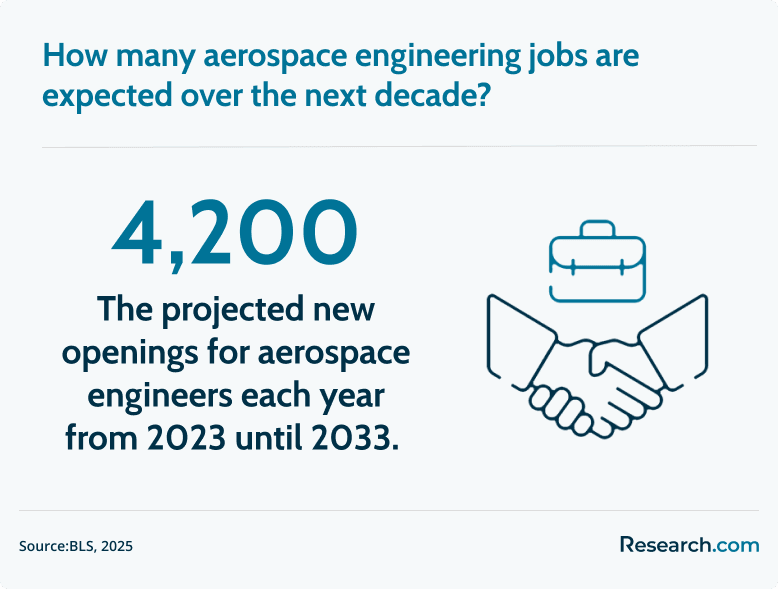
Federal data projects that aerospace engineering roles will grow 6% from 2023 to 2033, slightly above the national average. Around 4,200 aerospace engineering job openings are expected each year because of retirements and workforce transitions (BLS, 2025).
Related roles for aerospace technologists and technicians are projected to grow 8% over the same period, with approximately 1,100 openings per year (BLS, 2025). Graduates from online programs with strong simulation, design, and systems integration components may be well positioned for hybrid aircraft, uncrewed aircraft, and testing support roles, although outcomes vary by experience, location, clearance eligibility, and employer needs.
The commercial space sector is also a major source of demand. Over the past five years, employment in this area has increased 18%, with average salaries reaching $135,000. By 2024, the global space economy was valued at $613 billion, supporting continued interest in satellite systems, launch operations, mission design, and space infrastructure (Space Foundation, 2025).
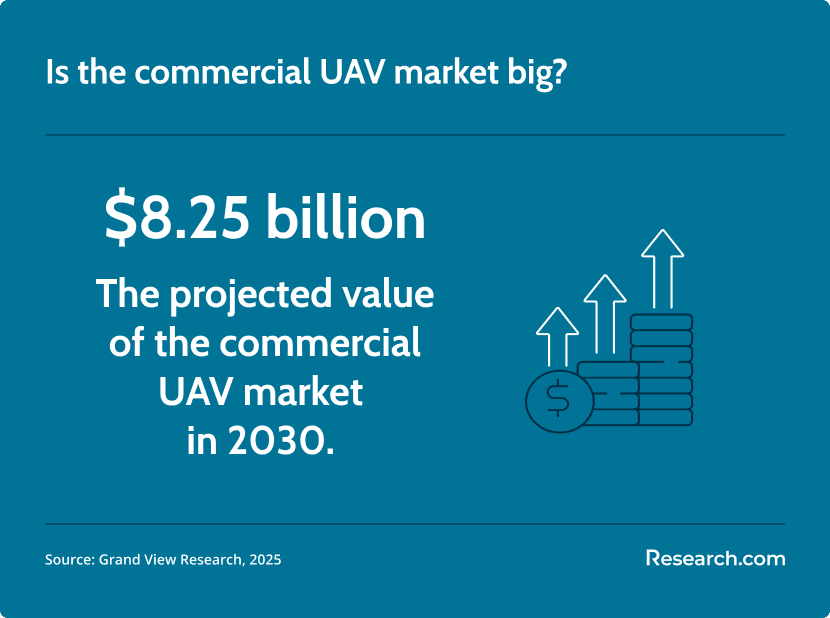
The U.S. commercial drone market is expanding at a compound annual growth rate of 15.9%, which is supporting demand for aerodynamicists, flight control engineers, UAV specialists, and systems engineers (Grand View Research, 2025).
Like career guides that explain how to become an auto mechanic, aerospace career planning is easier when students understand the training pathway, required technical competencies, and credentials employers recognize. In aerospace, that often means combining an engineering degree with internships, project experience, software proficiency, and, for some roles, security clearance eligibility.
The global space economy continues to grow through commercial investment and government activity. The chart below shows the largest players in this market as of 2024.
What do graduates say about earning an aerospace engineering degree online?
- Axel: "Studying aerospace engineering online made it possible for me to keep my full-time technician job while progressing through the degree at a manageable pace. The coursework helped me understand propulsion and control systems in much more depth, and that preparation supported my move into a systems engineering role within a year of graduating."
- Dan: "My online master’s program helped me qualify for a promotion to lead propulsion engineer. The strongest parts of the degree were the advanced simulations and applied projects, which changed how I approached complex engineering problems. Within six months, I also saw a 20% salary increase."
- Greg: "I chose an online aerospace program because relocating was not financially realistic. The project work, faculty communication, and peer collaboration were stronger than I expected, and I never felt disconnected from the academic experience. I now work on high-altitude balloon design at a research institute."
Common mistakes to avoid when choosing an online aerospace engineering program
| Mistake | Why it can hurt you | Better approach |
| Choosing a bachelor’s program without checking ABET status | It may limit licensure options or reduce employer confidence in the degree. | Verify accreditation directly through ABET before applying. |
| Comparing only tuition | Software, lab, technology, and residency costs can change the real price. | Calculate total program cost, including fees and required equipment. |
| Assuming online means fully remote | Some programs require summer labs, proctored exams, or short campus visits. | Ask for a complete list of in-person requirements before enrolling. |
| Ignoring prerequisites | Missing calculus or physics preparation can delay progress by semesters. | Complete placement testing early and plan prerequisite courses before admission. |
| Picking a program with no aerospace specialization match | A general curriculum may not support your target role in propulsion, space systems, or controls. | Map electives and projects to specific job postings you want to pursue. |
| Expecting the degree alone to guarantee employment | Aerospace hiring is competitive and often depends on projects, internships, software skills, and location. | Build a portfolio, pursue internships, and develop practical engineering evidence throughout the program. |
How do online aerospace engineering programs build industry connections?
Strong online aerospace engineering programs do more than post lectures online. They create structured ways for remote learners to meet employers, faculty researchers, alumni, and project sponsors. Common examples include virtual career fairs, aerospace employer panels, alumni mentoring, guest lectures, industry-sponsored capstones, research webinars, and online access to engineering career services.
When comparing programs, ask whether online students can participate in the same recruiting events as campus students, whether capstone projects involve real aerospace problems, and whether the school has relationships with aviation, defense, drone, satellite, or space organizations. Industry access is especially important for students who do not already work in aerospace.
How do online aerospace engineering programs support student engagement and academic success?
Aerospace engineering is difficult to complete in isolation. Effective online programs support students through academic advising, technical help desks, tutoring, faculty office hours, peer study groups, design-team coordination, career counseling, and timely feedback on engineering assignments. These services can make the difference between simply watching lectures and successfully completing a demanding engineering curriculum.
Remote learners should look for programs with clear response-time expectations, access to software support, virtual collaboration tools, structured project milestones, and advising that understands prerequisite sequencing. Online support models vary by field; for example, students comparing accelerated technical graduate options such as an accelerated health informatics masters degree online should still evaluate whether the support structure fits the workload and technical demands of the program.
What future trends are emerging in online aerospace engineering education?
Online aerospace engineering education is being shaped by advanced simulation, remote labs, AI-assisted analysis, digital twins, cloud-based collaboration, autonomous systems, and stronger integration between software and physical engineering design. These tools are not replacing aerospace fundamentals; they are changing how students practice modeling, verification, testing, and system-level trade studies.
Students should expect more coursework that blends aerospace engineering with autonomy, data analytics, digital design workflows, uncrewed systems, and space systems operations. Interdisciplinary technical programs, including options such as an accelerated health informatics masters degree online, show a broader trend toward online graduate education that combines domain expertise with analytics, systems thinking, and risk assessment.
How do online aerospace engineering programs support professional licensure and certification?
Engineering licensure is not required for every aerospace role, but it can matter for some positions, consulting work, government projects, or roles involving public safety responsibilities. Students who may pursue licensure should be especially careful about ABET accreditation, because licensing boards often use accredited engineering education as part of the eligibility pathway.
Many aerospace engineering programs build preparation for the Fundamentals of Engineering exam into their math, science, mechanics, design, and analysis coursework. Some programs also advise students on the longer path toward the Professional Engineering exam after gaining qualifying experience. Students considering cross-disciplinary credentialing or technical management roles may also compare other online graduate pathways, including an accelerated health informatics masters degree online, but aerospace licensure planning should begin with the requirements of the state board where the student intends to work.
References
- ABET. (2024). Accreditation. https://www.abet.org/accreditation/
- American Institute of Aeronautics and Astronautics. (2025). Proposed ABET Aerospace Engineering Program Criteria 2025–2026. https://www.abet.org/accreditation/accreditation-criteria/criteria-for-accrediting-engineering-programs-2025-2026/
- Bureau of Labor Statistics. (2025). Aerospace Engineering and Operations Technologists and Technicians. https://www.bls.gov/ooh/architecture-and-engineering/aerospace-engineering-and-operations-technicians.htm
- Bureau of Labor Statistics. (2024). Aerospace engineers: Employment by industry, May 2023. Occupational Employment and Wage Statistics (OEWS). https://www.bls.gov/oes/2023/may/oes172011.htm
- Bureau of Labor Statistics. (2025). Aerospace Engineers: Employment Projections 2023–33. https://www.bls.gov/ooh/architecture-and-engineering/aerospace-engineers.htm
- Bureau of Labor Statistics. (2024). Architecture and Engineering Occupations. Career Outlook. https://www.bls.gov/ooh/architecture-and-engineering/
- Deloitte. (2025). Aerospace and Defense Industry Outlook. https://www.deloitte.com/us/en/insights/industry/aerospace-defense/aerospace-and-defense-industry-outlook.html
- Grand View Research. (2025). U.S. Commercial UAV Market Outlook 2030. https://www.grandviewresearch.com/horizon/outlook/commercial-uav-market/united-states
- Gray, K. (2024, January 30). Employers see online degrees as comparable to in-person degrees. National Association of Colleges and Employers (NASE). https://www.naceweb.org/talent-acquisition/candidate-selection/employers-see-online-degrees-as-comparable-to-in-person-degrees
- NASA Space Grant Consortium. (2024). State-Based Scholarships. https://www.nasa.gov/stem/spacegrant/home/index.html
- National Aeronautics and Space Administration (NASA). (2024). Careers: Engineering and science roles at NASA. https://www.nasa.gov/careers/engineering
- National Aeronautics and Space Administration (NASA). (2024). NASA Pathways Internship Program: entry point to engineering roles. https://www.nasa.gov/careers/pathways
- Space Foundation. (2025, April 7). The Space Report 2025 Q2. https://www.spacefoundation.org/2025/07/22/the-space-report-2025-q2/
- Women in Aerospace Foundation. (2024). Scholarship Program. https://www.womeninaerospacefoundation.org/scholarship/
Key Insights
- Accreditation should be your first filter. For bachelor’s programs, ABET status is especially important because it can affect licensure pathways, graduate school recognition, and employer confidence.
- Online aerospace engineering is credible when the program is rigorous. Employers increasingly accept online degrees, but students should verify lab access, software support, design requirements, and industry connections.
- Not every listed option is an online bachelor’s degree in aerospace engineering. Several top universities offer online graduate aerospace programs while keeping undergraduate aerospace engineering on campus.
- Cost varies sharply by school type. Public in-state programs may cost far less than private or specialized programs, but total cost should include fees, software, labs, hardware, and travel.
- Specialization matters. Propulsion, GNC, structures, space systems, UAVs, hypersonics, and aerodynamics lead to different roles, so students should choose electives and projects intentionally.
- The degree alone is not enough. Aerospace employers often look for internships, capstone work, simulations, coding ability, CAD or CFD experience, technical writing, and evidence of systems-level thinking.
- Online learning works best for disciplined students. Aerospace engineering is demanding, so students should choose a realistic pace and use advising, tutoring, peer collaboration, and faculty support early.
Other Things You Should Know About Online Aerospace Engineering Degree Programs
The University of North Dakota is one of the most respected online options for space and national defense careers. It was the first university in the nation to be admitted to the elite U.S. Space Force University Partnership Program, and its curriculum covers aerospace propulsion, orbital mechanics, rocketry, satellite development, and hypersonics, with applied research ties to NASA, Northrop Grumman, and Voyager Technologies.
No, internships are usually not required for graduation in online aerospace engineering degree programs. ABET-accredited programs focus on coursework, labs, and capstone design; some schools recommend or require a co-op or internship for specific concentrations, but that is a program rule, not an ABET requirement.
Students need a reliable computer with high-speed internet, webcam, and access to specific engineering software like MATLAB or CAD tools. Schools often specify software versions. Check the program's technical requirements to ensure compatibility before enrolling to prevent issues.