2027 Master of Engineering vs Master of Science in Engineering: Explaining the Difference

Co-Founder and Chief Data Scientist
Choosing between a Master of Engineering and a Master of Science in Engineering is not just a naming question. It affects how you study, how long you may be in school, whether you complete a thesis, what kinds of faculty or industry projects you pursue, and which jobs your graduate training best supports.
A Master of Engineering, often called an MEng or ME, is usually built for engineers who want to apply advanced technical knowledge in industry, manage projects, design systems, or move into technical leadership. A Master of Science in Engineering, often called an MSE or MS in Engineering, is typically more research-centered and may be the better fit for students interested in experimentation, product development, advanced analysis, or doctoral study.
This guide compares the two degrees from a practical decision-making perspective. You will learn how they differ in admissions, curriculum, time commitment, cost, specializations, skills, career paths, online credibility, accreditation, and long-term value so you can choose the graduate engineering path that matches your goals.
Quick Answer: Master of Engineering vs Master of Science in Engineering
Choose a Master of Engineering if your goal is to advance in applied engineering, project delivery, systems design, operations, or technical management. Choose a Master of Science in Engineering if you want deeper research training, stronger preparation for a PhD, or work in research and development, advanced modeling, or innovation-focused technical roles.
| Decision Factor | Master of Engineering | Master of Science in Engineering |
| Primary focus | Professional practice and applied engineering | Research, theory, and technical investigation |
| Typical final requirement | Coursework, capstone, internship, or applied project | Thesis, research project, or additional advanced coursework |
| Best fit for | Engineers seeking industry advancement or leadership | Students pursuing R&D, specialized technical work, or doctoral study |
| Common completion time | Often one to one and a half years full time | Often two to three years, especially with thesis or research requirements |
| Learning style | Structured, career-focused, project-based | Analytical, independent, research-driven |
Key Things You Should Know About Master of Engineering vs Master of Science in Engineering
- Both MEng and MS in Engineering programs may offer specializations such as mechanical, electrical, civil, aerospace, artificial intelligence, environmental, and chemical engineering, but the coursework depth and research expectations can differ substantially.
- Engineering careers can offer strong earning potential. According to the U.S. Bureau of Labor Statistics, the median annual wage for engineering jobs was $97,310 in 2024.
- MEng programs are often designed with working engineers in mind and may emphasize flexibility and applied preparation. MS in Engineering programs may use stricter academic screening, particularly for thesis-based or research-intensive tracks.
- What is a Master of Engineering?
- What is a Master of Science in Engineering?
- What admissions requirements should you expect for MEng and MS in Engineering programs?
- How long does an MEng or MSE take?
- How much does a Master of Engineering or Master of Science in Engineering cost?
- Which engineering specializations are available?
- How do digital trends affect engineering careers?Specialization context
- Are online engineering programs credible?
- Can interdisciplinary online specializations improve engineering career options?
- What skills do MEng and MSE graduates need?
- Where do MEng and MSE graduates work?
- How are cybersecurity trends changing engineering programs?Industry context
- What jobs can you get with an MEng or MSE?
- Which degree is right for you?
- Why does accreditation matter for MEng and MSE programs?Decision checklistKey insights
What is a Master of Engineering?
A Master of Engineering is a graduate degree centered on professional engineering practice. Rather than training students primarily to conduct academic research, the degree usually prepares them to apply advanced engineering methods to workplace problems, lead technical projects, improve systems, and translate engineering concepts into practical solutions.
Many MEng programs are coursework-heavy and may replace a thesis with a capstone, design project, practicum, or internship. This structure can appeal to engineers who want graduate-level technical training without spending a large portion of the program on independent research.
The MEng is often a strong option for students who want to strengthen technical depth while also building skills in project management, systems thinking, implementation, stakeholder communication, and engineering leadership. Graduates may pursue opportunities in manufacturing, energy, aerospace, technology, infrastructure, or other sectors included among the highest-paying engineering branches and career outlooks.
Because the curriculum is usually more structured than an MS in Engineering, an MEng may be easier to plan around full-time work, career transitions, or a defined promotion timeline. The trade-off is that students who want extensive lab work, publication experience, or PhD preparation may find the MEng less aligned with their goals.
What is a Master of Science in Engineering?
A Master of Science in Engineering is a graduate degree that places greater weight on research methods, engineering theory, advanced analysis, and scientific inquiry. It is often designed for students who want to investigate why engineering systems behave the way they do, test new ideas, or contribute to the development of new technologies.
Many MSE programs require a thesis or substantial research project, although some schools also offer non-thesis options that substitute additional graduate coursework or an applied research component. Students may work with faculty on funded projects, use specialized labs, prepare conference presentations, or contribute to scholarly publications.
This degree can be especially useful for students who want careers in research and development, advanced product design, computational modeling, academia, or doctoral study. It can also support technically demanding career paths such as the machine learning engineer pathway, where data systems, algorithms, modeling, and engineering judgment often overlap.
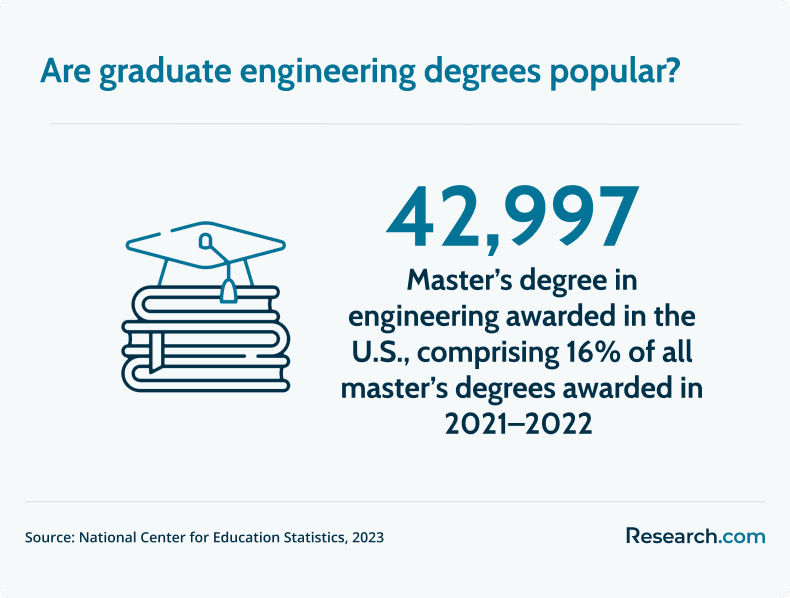
National data show that engineering remains a significant graduate field. The National Center for Education Statistics reported that U.S. institutions awarded 42,997 master’s degrees in engineering in the 2021–22 academic year. STEM fields accounted for 16% of all master’s degrees awarded during that period. At the same time, public interest in engineering careers is not universal: a Stonehaven survey from 2023 found that 66% of respondents had never considered a career in engineering.
What admissions requirements should you expect for MEng and MS in Engineering programs?
Admissions requirements for MEng and MSE programs often overlap, but the emphasis may differ. MEng admissions committees may look closely at professional experience, applied technical readiness, and career fit, while MSE committees may weigh research preparation, academic alignment, and quantitative strength more heavily.
| Requirement | What It Usually Means | How MEng and MSE Emphasis May Differ |
| Academic background | Applicants typically need a bachelor’s degree in engineering from an ABET-accredited program or a closely related field such as computer science, physics, or mathematics. | MSE programs may be stricter about prerequisite alignment in subjects such as calculus, linear algebra, thermodynamics, or discipline-specific engineering courses. |
| Official transcripts | Schools use transcripts to verify degree completion, grades, prerequisites, and prior coursework. | Research-focused programs may pay closer attention to performance in math, science, and advanced technical courses. |
| Minimum GPA | A 3.0 GPA on a 4.0 scale is common at many institutions. | Highly selective MSE programs may apply stronger GPA expectations, especially for thesis tracks. |
| GRE scores | Many schools make GRE scores optional, but some may request them from applicants with weaker academic records. | GRE scores may help demonstrate quantitative readiness when other parts of the application are less competitive. |
| Recommendation letters | Most programs ask for two to three letters from faculty, research supervisors, engineering managers, project leads, or other qualified recommenders. | MEng letters may focus on workplace performance and leadership potential; MSE letters may emphasize research ability and academic promise. |
| Statement of purpose | This essay explains your goals, technical interests, preparation, and reason for choosing the program. | MEng applicants should connect the degree to industry goals; MSE applicants should clarify research interests and possible faculty fit. |
| Resume or CV | Applicants often submit a resume showing education, work experience, projects, technical tools, publications, or research activity. | Some MEng programs may value at least one year of professional experience, while MSE programs may value lab, thesis, or undergraduate research experience. |
Before applying, review each program’s prerequisites rather than assuming all engineering master’s degrees accept the same background. A candidate with strong work experience but missing core math or engineering courses may need bridge coursework. A candidate applying to a thesis-based MSE should also check whether faculty in the department are accepting new graduate researchers.
How long does an MEng or MSE take?
Program length depends on course load, thesis requirements, delivery format, transfer credit policies, and whether you study full time or part time. Both degree types usually include 30 to 45 units, but they are often structured differently.
A full-time Master of Engineering student may finish in one to one and a half years because the degree is commonly designed around coursework, applied projects, and faster movement back into the workforce. This can make it attractive to professionals who want a defined, career-focused graduate experience.
A Master of Science in Engineering often takes two to three years, especially when a thesis, lab work, data collection, or faculty-supervised research is required. Some universities also offer accelerated pathways that combine a bachelor’s degree and an MS in Engineering over four or five years.
Part-time students in either degree may take two to five years to complete the program. Online formats can add flexibility, but students should examine pacing rules carefully. Some online MEng programs allow highly flexible scheduling, while online MSE options may require specific research milestones, synchronous meetings, campus visits, or access to approved labs.
If you are comparing graduate pathways more broadly, it can help to think carefully about your long-term field before enrolling. For example, students weighing education careers should first understand the difference between elementary and secondary education degrees before choosing a master’s route.
How much does a Master of Engineering or Master of Science in Engineering cost?
The cost of an engineering master’s degree can vary sharply by institution type, residency status, program format, number of credits, fees, and whether the student receives funding. In some cases, MEng tuition may be higher than MS in Engineering tuition because professional master’s programs are often priced differently from research degrees.
MSE students should also look beyond tuition. Thesis-based research may involve lab fees, specialized software, materials, equipment access, or campus-based research expectations. However, research-oriented students may also have access to assistantships, fellowships, or grant-funded opportunities depending on the institution and department.
According to the College Board report by Ma et al. (2024), master’s degree programs during the 2024-25 academic year cost $9,560 at public four-year institutions and $31,930 at private non-profit institutions. The cost per credit hour at these institutions generally ranges from $300 to $1,500, with top-tier schools often exceeding the higher end of that range. Overall, students should expect a total cost of between $20,000 to $60,000.
| Cost Item | Why It Matters | What to Ask Before Enrolling |
| Tuition per credit or term | Programs may charge by credit, semester, cohort, or residency status. | Is tuition locked for the cohort, or can it increase while I am enrolled? |
| Student fees | Technology, lab, campus, online learning, and graduate fees can add to the published tuition price. | Which fees are mandatory for online, part-time, or research students? |
| Research or lab expenses | Thesis and lab-based programs may require additional materials or equipment access. | Are research costs covered by the department, grant, assistantship, or student? |
| Lost income or reduced work hours | A full-time program may shorten completion time but reduce earnings while enrolled. | Can I complete the degree part time without losing access to courses or funding? |
| Financial aid and employer support | Assistantships, fellowships, scholarships, grants, and tuition reimbursement can change the true out-of-pocket cost. | Which funding options are available to MEng students, MSE students, online students, and part-time students? |
To evaluate affordability, compare the total program price rather than tuition alone. Include fees, books, software, travel, lost income, loan interest, and the likelihood of receiving assistantships or employer tuition reimbursement.
Which engineering specializations are available in MEng and MSE programs?
Both degrees can offer broad specialization choices, but the same field may look different depending on whether it is housed in a professional or research-focused curriculum. An MEng specialization may emphasize implementation, product delivery, design, systems integration, and leadership. An MSE specialization may emphasize modeling, theory, experimentation, publication, and technical discovery.
- Master of Engineering in Aerospace Engineering: This track usually focuses on the design, testing, development, and improvement of aircraft, spacecraft, satellites, propulsion systems, avionics, aerodynamics, and control systems.
- MEng in Artificial Intelligence: This specialization teaches students to develop intelligent systems that can learn, reason, analyze data, and support decision-making. Common topics include machine learning, data analytics, natural language processing, AI ethics, and applied automation.
- MEng in Project Management: This option is designed for engineers who want to lead technical projects. Coursework may cover accounting, resource planning, risk analysis, scheduling, project communication, team coordination, and decision frameworks for engineering environments.
- Master of Science in Environmental Engineering: This research-oriented path applies engineering science to environmental problems such as water quality, sustainable energy systems, process engineering, engineering economics and finance, and microbiology. Students interested in this area may also explore the environmental engineer career path.
- MS in Chemical Engineering: This specialization studies chemical, biological, and physical processes used to transform raw materials into useful products. Students may conduct advanced work in reaction engineering, process design, thermodynamics, and materials science.
- MS in Electrical Engineering: This track often covers circuits, telecommunications, power systems, signal processing, electronics, and related research or development areas in technology, energy, and communications.
Many engineering specializations can lead to average salaries in the U.S. that often surpass $100,000 per year. However, salary depends on occupation, industry, location, experience, employer, and specialization, so students should not treat any graduate degree as a guaranteed income outcome.
The chart below summarizes average incomes for different engineer types.
How do digital trends affect engineering careers?
Engineering work is increasingly shaped by automation, artificial intelligence, data analytics, cybersecurity, cloud tools, simulation platforms, digital twins, and software-defined systems. These trends do not replace core engineering judgment, but they do change what employers expect from graduate-level engineers.
For MEng students, digital fluency can strengthen applied project work. Engineers who understand automation, data pipelines, software tools, and digital project environments may be better prepared to improve operations, manage technical teams, and coordinate complex systems. For MSE students, digital skills often support modeling, computational research, algorithm development, and large-scale experimental analysis.
Students who want to strengthen their technical toolkit may consider complementary coursework in IT, data, AI, or cybersecurity. For example, comparing affordable online information technology degree options can help engineering students identify practical digital skills that support engineering project work.
Are Online Engineering Programs as Credible as Traditional Ones?
Online engineering programs can be credible when they are offered by properly accredited institutions, use qualified faculty, provide rigorous coursework, and give students meaningful access to labs, simulations, projects, or approved applied experiences. The delivery format matters less than whether the program has academic quality, employer recognition, strong student support, and appropriate technical infrastructure.
That said, not every engineering subject translates equally well online. Software, data, management, and systems-focused tracks may be easier to deliver remotely than lab-heavy specializations requiring specialized equipment. Students considering online MSE programs should pay especially close attention to thesis supervision, research access, faculty availability, and whether remote students can participate fully in required projects.
Online learning can also support specialized technical fields that combine creativity and engineering-adjacent skills. Students exploring interactive systems, simulations, or software-intensive design may find useful context in guides to the best online game development schools.
Can interdisciplinary online specializations improve engineering career options?
Interdisciplinary study can make an engineering master’s degree more useful when it fills a clear skill gap. Engineers working in healthcare, biotechnology, data science, automation, AI, manufacturing, energy, or cybersecurity often benefit from combining engineering fundamentals with applied computing, analytics, biology, business, or domain-specific knowledge.
The key is selectivity. Extra credentials help most when they support a defined career target, not when they are collected without a plan. For example, an engineering graduate interested in computational biology, biomedical analytics, or genomics-related technical roles may want to compare options such as online master’s programs in bioinformatics.
What skills do MEng and MSE graduates need?
MEng and MSE students both build advanced engineering capability, but the skill emphasis differs. MEng programs tend to develop execution, leadership, systems integration, and applied design skills. MSE programs tend to develop research design, analysis, experimentation, modeling, and scholarly communication skills.
| Skill Area | Why It Matters | Degree Where It Is Often Emphasized More |
| Advanced problem solving | Engineers must diagnose complex technical issues, model systems, test solutions, and account for constraints. | Both |
| Technical communication | Graduate engineers need to explain results to executives, clients, researchers, regulators, and non-technical stakeholders. | Both |
| Collaboration | Engineering projects often require work across disciplines, departments, and technical specialties. | Both |
| Project management | Budgeting, scheduling, risk control, resource allocation, and team coordination are central to many industry roles. | MEng |
| Programming and software design | Modern engineering frequently relies on automation, modeling, analysis, embedded systems, and secure software. | Both, depending on specialization |
| Research and experimental design | Research roles require hypothesis development, controlled testing, data collection, and rigorous interpretation. | MSE |
| Scientific documentation | Research findings must be reproducible, well documented, and communicated in technical reports, papers, or presentations. | MSE |
| Statistical analysis | Data-driven engineering decisions require modeling, uncertainty analysis, validation, and interpretation. | MSE |
Project management is especially important for MEng graduates moving toward supervisory or implementation roles. Students who want to understand this career direction can review what a project management specialist does.
Programming and secure software design are also increasingly valuable. In fields where engineering overlaps with computing, students may benefit from comparing cybersecurity and computer science degree paths to understand how software, systems, and security skills differ.
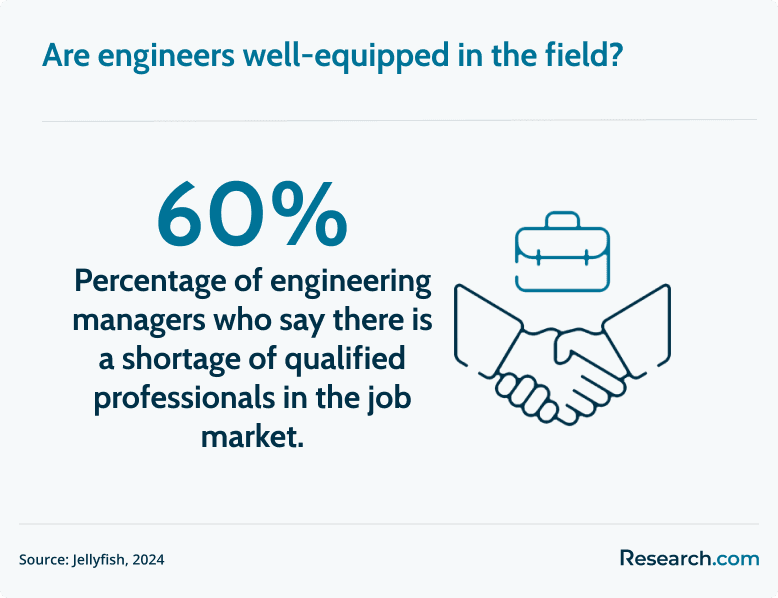
Engineering employers continue to report hiring challenges. A 2024 Jellyfish report found that 60% of engineering managers struggle to find qualified candidates. This makes technical depth important, but it also reinforces the value of communication, adaptability, teamwork, and the ability to deliver results in real engineering environments.
Where do MEng and MSE graduates work?
MEng and MSE graduates can work in many of the same industries, but they often enter different types of functions. MEng graduates are commonly found in project implementation, engineering operations, product delivery, systems integration, and technical management. MSE graduates are more likely to work in research, advanced analysis, product innovation, academic environments, or specialized technical development.
Industries where MEng graduates commonly work include:
- Aerospace and aviation: MEng graduates may help design, test, improve, or manage aircraft, satellites, propulsion systems, and related technologies for commercial, government, or defense applications.
- Data science: Engineers with data skills may build models, analyze large datasets, automate workflows, and support operational decision-making. Practical training from high-rated data science bootcamps can sometimes complement an engineering background when the career target requires applied tools training.
- Cybersecurity: MEng graduates may help design secure systems, assess technical vulnerabilities, build threat models, or support secure software and infrastructure projects in finance, defense, healthcare, or technology.
- Energy resources: Engineers in this area may work on renewable energy systems, grid integration, energy efficiency, industrial operations, and practical deployment of energy technologies.
Industries where MSE graduates commonly work include:
- Academia and education: MSE graduates may teach, support curriculum development, publish research, or continue into doctoral programs.
- Research and development: R&D roles may involve experiments, prototypes, modeling, testing, materials research, systems analysis, or long-term technology development.
- Healthcare: Engineering researchers may contribute to medical devices, biomedical systems, healthcare analytics, diagnostics, monitoring technologies, or treatment-related innovation.
- Computational intelligence: MSE graduates may develop algorithms, machine learning models, robotics systems, image recognition tools, or decision-support technologies.
The strongest industry choice depends less on the degree title alone and more on your specialization, projects, technical portfolio, internships, research experience, and professional network.
How are cybersecurity trends changing MEng and MSE programs?
Cybersecurity is becoming more relevant across engineering because connected systems, industrial controls, infrastructure, medical devices, vehicles, energy grids, and manufacturing environments all depend on secure digital operations. Graduate engineering programs increasingly respond by adding security-focused coursework, risk analysis, secure design, and cyber-physical systems content.
In MEng programs, cybersecurity training often emphasizes applied risk management, secure industrial systems, project vulnerabilities, system resilience, and practical defense strategies. In MSE programs, the focus may lean toward cryptography, threat detection models, computational methods, secure architectures, and research into emerging cyber risks.
Students considering this direction should check whether cybersecurity content is a required part of the degree, an elective option, a certificate, or a separate program. Those comparing shorter cyber pathways can also review whether two-year cybersecurity degree options align with their goals.
What jobs can you get with an MEng or MSE?
The degree title does not permanently lock you into one career category. An MEng graduate can still work in technical development, and an MSE graduate can still move into industry leadership. However, employers may read the degrees differently based on curriculum, thesis work, capstone projects, internships, and specialization.
| Common Role | Typical Degree Alignment | What the Role Usually Involves |
| Project engineer | MEng | Plans, coordinates, and supports engineering projects while connecting technical teams, timelines, budgets, and client or stakeholder expectations. |
| Mechanical engineer | MEng | Designs, develops, tests, and improves mechanical systems used in manufacturing, energy, automotive, aerospace, and related industries. |
| Systems engineer | MEng | Designs and manages complex engineering systems, often in sectors such as aerospace, defense, energy, infrastructure, or technology. |
| Manufacturing engineer | MEng | Improves production processes, quality, automation, workflow efficiency, and manufacturing systems. |
| Research engineer | MSE | Designs experiments, evaluates new technologies, analyzes results, and supports innovation in academic, corporate, or government research settings. |
| Data scientist | MSE | Uses statistics, programming, machine learning, and domain knowledge to solve complex problems in business, healthcare, technology, or engineering environments. |
| Process engineer | MSE | Optimizes and scales technical processes, commonly in chemical, pharmaceutical, energy, or manufacturing industries. |
| Software engineer | MSE | Builds, tests, and maintains software systems, algorithms, platforms, and technical applications. |
Students interested in analytics-heavy engineering roles may also want to review master’s in business analytics salary information, since business analytics, engineering analytics, and data science can overlap in some organizations.
Students considering software roles should understand how employers distinguish software developers from software engineers, especially when comparing job descriptions across industries.
U.S. Bureau of Labor Statistics data show strong demand across engineering occupations, with industrial and mechanical engineers standing out in projected need. Even so, one report found that one in three engineering roles is unfilled annually through 2030. This points to a continuing need for qualified engineers, but job outcomes still depend on specialization, location, experience, economic conditions, and employer needs.
The chart below shows job growth for engineers between 2023 and 2033.
Which degree is right for you?
The best choice depends on the work you want to do after graduation. This decision is similar to other credential comparisons, such as evaluating a master’s in accounting versus CPA preparation: the right path depends on the career outcome, not only the credential name.
| Choose This Path If... | Master of Engineering | Master of Science in Engineering |
| You want industry advancement | Strong fit if you want applied roles, project leadership, systems implementation, or technical management. | Possible fit if the role requires deep technical specialization or R&D experience. |
| You may pursue a PhD | Usually not the most direct route unless the program includes substantial research opportunities. | Usually the stronger route, especially with a thesis and faculty-supervised research. |
| You prefer hands-on projects | Often a strong fit because many programs use capstones, design work, or applied industry projects. | Can be a fit, but projects may be more experimental, analytical, or research-based. |
| You want a shorter graduate pathway | Often better aligned because many full-time students finish in one to one and a half years. | May take longer, particularly with a thesis or lab-based research. |
| You want maximum research depth | May be limited unless the program offers optional research work. | Stronger fit for students who want advanced theory, experimentation, publication, or doctoral preparation. |
A Master of Engineering may be the better choice if you:
- Want to manage engineering projects, lead technical teams, improve systems, or move into applied engineering leadership.
- Prefer structured coursework, case-based learning, design projects, and industry-focused assignments.
- Need a shorter program that may fit around career responsibilities.
- Want to strengthen practical expertise without committing to a thesis.
A Master of Science in Engineering may be the better choice if you:
- Want research experience, deeper theory, advanced analysis, or preparation for a Ph.D.
- Enjoy independent investigation, technical writing, experimentation, and data interpretation.
- Plan to work in R&D, academia, advanced product development, computational modeling, or innovation-heavy roles.
- Want to build a research portfolio through a thesis, lab work, conference presentations, or publications.
Engineering students should also consider the realities of the profession: workload, hybrid schedules, continuing technical learning, rapid technology shifts, and workplace culture. Diversity and inclusion remain important issues. The Society of Women Engineers reported in 2022 that women represent only a small portion of the workforce, with 32% of environmental engineers being women. Other engineering fields fall below that percentage. The U.S. STEM workforce also remains predominantly White, with Hispanic, Black, and Indigenous groups underrepresented.
The chart below shows the share of women in selected engineering fields.
Why does accreditation matter for MEng and MSE programs?
Accreditation helps students judge whether a university or program meets recognized academic quality standards. For engineering students, it can also affect employer trust, transfer credit, financial aid eligibility, licensure preparation, and the credibility of the degree in competitive technical fields.
Applicants should confirm institutional accreditation and review whether the specific engineering program has relevant programmatic recognition when applicable. A bachelor’s degree from an ABET-accredited engineering program is commonly expected for admission to many graduate engineering programs, and accreditation may also matter for students pursuing licensure or regulated engineering roles.
Accreditation is especially important for online and interdisciplinary programs because the delivery format can make it harder to judge quality from marketing materials alone. Students considering AI-related engineering study should compare accredited and reputable options carefully, including programs such as an affordable online artificial intelligence degree program when AI is part of the career plan.
Common Mistakes to Avoid When Choosing Between MEng and MSE Programs
- Choosing by degree title alone: Program structure matters more than the label. Review whether the curriculum includes a thesis, capstone, internship, lab requirement, or research sequence.
- Ignoring faculty fit in MSE programs: A thesis-based MS is much stronger when faculty expertise matches your research interests.
- Looking only at tuition: Fees, research costs, software, travel, reduced work hours, and funding availability can change the real cost.
- Assuming online always means flexible: Some online programs still require synchronous classes, fixed cohorts, campus visits, or lab access.
- Overlooking accreditation: Accreditation can affect degree recognition, aid eligibility, and licensure-related planning.
- Expecting guaranteed salary outcomes: Engineering salaries vary by role, region, industry, experience, and specialization.
- Skipping employer research: Look at job postings in your target industry to see whether employers prefer a thesis, professional project, specific tools, certifications, or years of experience.
Practical Steps Before You Apply
- Define your target job first. Identify whether you want applied engineering leadership, research and development, technical specialization, product design, academia, or doctoral study.
- Compare curriculum requirements. Look for thesis, capstone, internship, lab, practicum, and elective rules.
- Check admissions fit. Confirm prerequisites, GPA expectations, GRE policy, work experience requirements, and whether your prior degree aligns with the program.
- Evaluate total cost. Compare tuition, fees, assistantships, scholarships, employer reimbursement, and time away from work.
- Review outcomes carefully. Ask where recent graduates work, what roles they hold, and whether the program supports your target specialization.
- Verify accreditation. Confirm institutional accreditation and any relevant engineering-specific recognition.
- Talk to current students or alumni. Ask whether the program delivers the research access, career support, flexibility, or technical depth promised.
Questions to Ask Engineering Graduate Programs
- Is the program designed primarily for working professionals, full-time researchers, or both?
- Does the degree require a thesis, capstone, internship, practicum, or final project?
- Can online students access the same faculty, labs, software, projects, and career services as campus students?
- What assistantships, fellowships, scholarships, or employer partnerships are available?
- Which specializations are currently active, and which faculty support them?
- What technical tools, programming languages, labs, or platforms are used in the program?
- Where do recent graduates work, and what roles do they enter?
- How does the program support licensure, professional development, or doctoral applications?
References
- Jellyfish. (2024). 2024 State of Engineering Management. https://pages.jellyfish.co/rs/916-BAA-391/images/Jellyfish_2024_State%20of%20Engineering_eBook.pdf
- Kodey, A., Bedard, J., Nipper, J., Post, N., Lovett, S., & Negreros, A. (2023, December 13). The US Needs More Engineers. What’s the Solution? Boston Consulting Group. https://www.bcg.com/publications/2023/addressing-the-engineering-talent-shortage
- Ma, J., Pender, M., & Oster, M. (2024). Trends in College Pricing and Student Aid 2024. https://research.collegeboard.org/media/pdf/Trends-in-College-Pricing-and-Student-Aid-2024-ADA.pdf
- National Center for Education Statistics. (2023). Master's degrees conferred by postsecondary institutions, by field of study: Selected academic years, 1970-71 through 2021-22. https://nces.ed.gov/programs/digest/d23/tables/dt23_323.10.asp
- U.S. Bureau of Labor Statistics. (202). Architecture and Engineering Occupations [Interactive data]. May 2024 OEWS Profiles, Occupational Employment and Wage Statistics (OEWS) Profiles. Retrieved May 5, 2025, from https://data.bls.gov/oesprofile
- U.S. Bureau of Labor Statistics. (2025, April 18). Occupational projections, 2023–33, and worker characteristics, 2023 (Numbers in thousands). Employment Projections. https://www.bls.gov/emp/tables/occupational-projections-and-characteristics.htm
Key Insights
- The Master of Engineering is usually the stronger fit for engineers who want applied technical advancement, project leadership, systems implementation, or industry-facing roles.
- The Master of Science in Engineering is usually better for students who want research depth, a thesis experience, R&D work, or preparation for a PhD.
- Both degrees can lead to strong engineering careers, but outcomes depend on specialization, experience, location, industry, projects, and employer demand.
- Cost comparisons should include tuition, fees, research expenses, time away from work, assistantships, scholarships, and employer reimbursement, not just the advertised price.
- Online engineering programs can be credible when they are accredited, rigorous, and provide appropriate access to faculty, tools, projects, and technical support.
- Accreditation, curriculum structure, faculty expertise, and career alignment are more important than choosing the degree with the most impressive-sounding title.
- If you are undecided, start with your target job postings: roles emphasizing project delivery and leadership often align with MEng training, while roles emphasizing research, modeling, experimentation, or doctoral preparation often align with MSE training.
Other Things You Should Know About Master of Engineering vs Master of Science in Engineering
In 2027, the primary difference lies in the focus: an MEng emphasizes practical skills for direct entry into the engineering field, while an MSc is more research-oriented, preparing students for doctoral studies or research-intensive careers.
The Master of Engineering (MEng) typically emphasizes practical applications and professional skills geared towards industry careers. Conversely, the Master of Science in Engineering (MSc) usually focuses more on research and theoretical knowledge, preparing graduates for further academic study or specialized technical roles.