2027 How to Become a Machine Learning Engineer

Co-Founder and Chief Data Scientist
Machine learning engineering is a practical career path for people who want to build AI systems that move beyond experiments and work reliably in real products. The job sits at the intersection of software engineering, data science, mathematics, and cloud infrastructure, so the path into the field is rarely one-size-fits-all. Some candidates come from computer science programs, others from software development, statistics, physics, engineering, or self-directed technical training.
This guide explains how to become a machine learning engineer in 2026, what the work involves, which skills matter most, what degrees and certifications can help, how to build a portfolio, and how to judge whether this career path is realistic for your background. It also uses available labor market data for related occupations from the US Bureau of Labor Statistics (BLS, 2024), including the projected 18% growth for software development roles in the United States between 2023 and 2033.
Quick answer: How do you become a machine learning engineer?
To become a machine learning engineer, you generally need strong programming ability, a working knowledge of statistics and machine learning algorithms, experience handling data, and proof that you can deploy models into usable software systems. A bachelor’s degree in computer science, data science, mathematics, engineering, or a related field is common, but employers also look closely at projects, internships, open-source work, cloud experience, and practical model deployment skills.
An online course can help you start, but it is rarely enough by itself. A stronger path combines structured study, real projects, GitHub documentation, model deployment, and continuous practice with tools such as Python, machine learning libraries, cloud platforms, and version control.
Why becoming a machine learning engineer can be a strong career move
- Machine learning engineering can prepare you for adjacent technology roles, including AI researcher, data scientist, deep learning specialist, robotics engineer, and software developer.
- Related occupations report strong wages: in 2023, data scientists in the US had a median annual wage of $108,020, while computer programmers had a median annual wage of $99,700 (US BLS, 2024).
- Machine learning professionals may work in software companies, financial services, manufacturing, healthcare, academic research, consulting, insurance, and other data-intensive sectors.
- What does a machine learning engineer do?
- What skills do machine learning engineers need in 2026?
- What degree do you need to become a machine learning engineer?
- Can you get a job in machine learning with only an online course?
- How do you build a machine learning portfolio that employers can evaluate?
- Which certifications are useful for machine learning engineers?
- What are the hardest parts of learning machine learning?
- Can an accelerated online computer science degree fast-track a machine learning career?
- Can interdisciplinary studies strengthen machine learning engineering work?
- Can health informatics experience support a machine learning career?
- Can a graduate degree help machine learning engineers move faster?
- What trends are changing machine learning engineering?
- How do soft skills and domain knowledge improve machine learning careers?
- How much do machine learning engineers and related professionals earn?
- How can you keep up with changes in machine learning?
- Which industries hire machine learning engineers?
- What is the career growth potential for machine learning engineers?
- How can interdisciplinary expertise expand machine learning career options?
What does a machine learning engineer do?
A machine learning engineer builds systems that allow software to learn from data, make predictions, classify information, recommend actions, or automate decisions. Unlike a data analyst who may focus mainly on reporting, or a data scientist who may focus heavily on experimentation, a machine learning engineer is often responsible for turning models into reliable, scalable production systems.
Many professionals begin with a technical degree path such as an online engineering degree, because machine learning work depends on programming, algorithms, systems design, and quantitative reasoning. The job often includes these responsibilities:
- Preparing data for modeling: Machine learning engineers collect, clean, label, transform, and validate datasets so models can learn from usable information rather than noisy or inconsistent inputs.
- Designing and training models: They choose algorithms, test modeling approaches, tune hyperparameters, and evaluate whether a model performs well enough for the business or research problem.
- Deploying models into production: They package models into applications, APIs, cloud services, or internal tools and make sure those systems can operate beyond a notebook or lab environment.
- Monitoring and improving performance: Once a model is live, engineers track accuracy, latency, data drift, reliability, and the need for retraining as new data arrives.
- Working with cross-functional teams: They collaborate with software engineers, data scientists, product managers, compliance teams, business analysts, and subject-matter experts.
- Reducing risk in AI systems: They help identify bias, improve interpretability, document model behavior, and support responsible use of AI in real applications.
The role shares important foundations with computer engineering, especially in algorithm design, systems thinking, and software integration. If you are comparing technical career paths, Research.com’s computer engineer career guide can help you understand where machine learning engineering overlaps with broader computing and hardware/software systems work.
| Task area | What it means in practice | Why employers care |
| Data preparation | Cleaning, transforming, validating, and organizing data before training | Poor data quality can make even advanced models unreliable |
| Model development | Testing algorithms, training models, and measuring performance | Employers need models that solve real problems, not just demonstrate theory |
| Software integration | Connecting models to applications, APIs, cloud services, or data pipelines | Production value depends on whether the model can be used reliably |
| Monitoring | Tracking model accuracy, failures, drift, and retraining needs | Models can degrade when user behavior, data, or operating conditions change |
| Responsible AI | Testing for bias, explaining model behavior, and documenting limitations | Organizations need AI systems that are trustworthy, auditable, and appropriate for their use case |
What skills do machine learning engineers need in 2026?
Machine learning engineering requires more than knowing how to run a model. Employers typically want candidates who can write production-quality code, understand the math behind algorithms, work with messy data, and communicate results clearly. A structured program such as an online software engineering degree can help build the software design and coding foundation needed for this work.
Core technical skills
- Programming and software engineering: Python is especially common in machine learning, while Java and other languages may appear in production environments. Candidates should also understand testing, version control, APIs, code review, debugging, and software architecture.
- Mathematics and statistics: Linear algebra, probability, calculus, optimization, and statistics help engineers understand how models learn, where errors come from, and why a model may fail.
- Machine learning methods: Engineers should understand supervised learning, unsupervised learning, neural networks, deep learning, model evaluation, feature engineering, and common trade-offs such as accuracy versus interpretability.
- Data handling: Real machine learning work often involves missing values, inconsistent labels, imbalanced classes, privacy constraints, and data pipeline problems.
- Cloud and deployment skills: Many teams expect familiarity with cloud services, containers, APIs, model serving, and monitoring tools.
- MLOps awareness: Machine learning operations involves versioning data and models, automating training pipelines, managing experiments, monitoring systems, and maintaining reproducibility.
Soft skills that matter
- Problem framing: A strong engineer can translate a vague business or research question into a modelable problem.
- Communication: Machine learning engineers often need to explain technical limitations to nontechnical stakeholders.
- Judgment: Not every problem needs machine learning. Sometimes a simpler rule-based or software solution is better.
- Collaboration: Production AI depends on coordination across engineering, data, product, legal, and domain teams.
This mix of skills also explains why the distinction between software developer vs software engineer matters for aspiring machine learning professionals. The job is not only about writing code; it also involves designing maintainable systems that can support data-driven models over time.
| Skill | Beginner goal | Job-ready goal |
| Python or another programming language | Write scripts and use libraries | Build tested, modular code that others can maintain |
| Statistics | Understand distributions, error, and basic inference | Evaluate model performance and avoid misleading conclusions |
| Machine learning algorithms | Train common models on clean datasets | Select, tune, compare, and explain models for real problems |
| Data engineering basics | Load and clean files or tables | Work with pipelines, changing datasets, and production constraints |
| Deployment | Run a model locally | Serve, monitor, and update models in usable applications |
What degree do you need to become a machine learning engineer?
A bachelor’s degree in computer science, data science, mathematics, engineering, or a closely related technical field is the most common starting point for machine learning engineering. These programs usually cover programming, algorithms, data structures, statistics, discrete mathematics, and systems concepts. Some professionals also move into machine learning from physics or other quantitative fields.
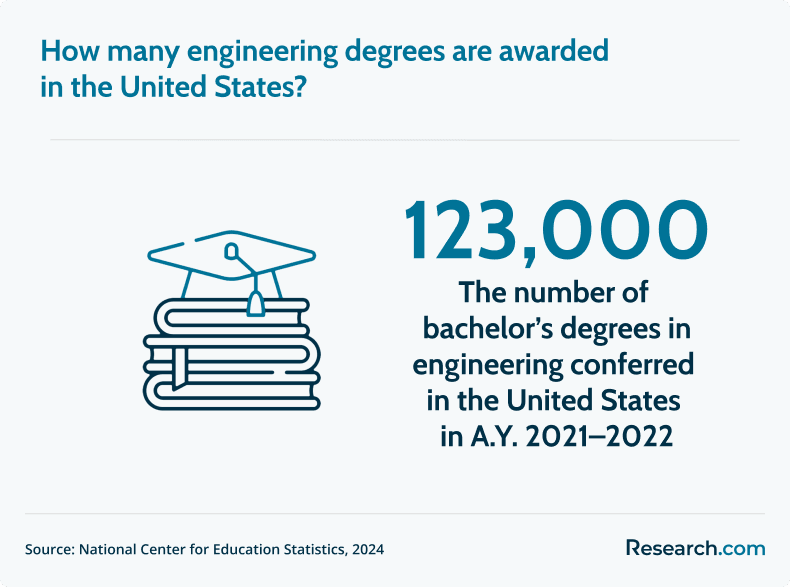
Engineering remains a major undergraduate field in the United States. In the academic year 2021–2022, 6%, or 123,000 degrees, of the 2 million bachelor’s degrees awarded across the country were engineering degrees (National Center for Education Statistics, 2024).
An online software development degree can also be relevant if it develops strong coding, algorithms, data structures, and systems design skills. For machine learning, the key question is not only the degree title but whether the curriculum includes enough programming, math, data, and applied AI work.
A master’s degree in artificial intelligence, machine learning, data science, computer science, or a related field can be helpful for specialized roles. Graduate study may include deep learning, natural language processing, big data analytics, optimization, research methods, and advanced statistical learning. A PhD can be valuable for research-oriented positions, but it is not required for many applied industry roles.
| Education path | Best for | Main advantage | Possible limitation |
| Bachelor’s in computer science, data science, mathematics, or engineering | Students starting a technical career | Builds broad foundations in coding, algorithms, and quantitative reasoning | May need additional machine learning projects or electives |
| Online software development or software engineering degree | Learners who want a structured coding-focused route | Can prepare students for production software work used in ML roles | May require extra statistics, data science, or AI coursework |
| Master’s in AI, machine learning, data science, or computer science | Professionals seeking advanced or specialized roles | Offers deeper technical study and research exposure | Can require significant time, cost, and prerequisites |
| Bootcamps, online courses, and certifications | Career changers or degree holders filling skill gaps | Can be flexible and project-oriented | Usually not enough without strong projects and practical experience |
| Self-directed learning | Highly disciplined learners with a technical background | Can be customized around portfolio goals | Harder to signal readiness unless the portfolio is strong and verifiable |
Can you get a job in machine learning with only an online course?
Usually, no. A single online course can introduce important concepts, but most machine learning engineering jobs require evidence that you can solve messy problems, write reliable code, and deploy models. Employers are less interested in course completion alone and more interested in whether you can show applied competence.
Online courses are useful when they are part of a broader plan. A stronger path includes hands-on projects, internships or research experience when available, open-source contributions, Kaggle-style practice, documented GitHub repositories, and deployed demonstrations. Projects should show how you gathered data, cleaned it, trained models, evaluated performance, and handled limitations.
Students who want deeper structure may consider AI degrees online, especially if they need a curriculum that covers deep learning, neural networks, data pipelines, and big data analytics. Certifications from learning platforms such as Coursera, Udacity, or TensorFlow can also strengthen a resume, but they work best when paired with a portfolio that proves real skill.
| Credential or learning option | Can it help? | When it is most useful |
| Single online course | Yes, as a starting point | When you need basic vocabulary, concepts, and guided exercises |
| Course sequence or certificate | Yes, if project-based | When it requires applied work and covers multiple ML topics |
| Degree program | Yes, especially for foundational preparation | When you need structured study, advising, and a recognized credential |
| Portfolio and deployed projects | Often essential | When applying for internships, entry-level roles, or career-change positions |
| Internship, research, or work experience | Highly valuable | When you need proof that you can work on real teams and real data |
How do you build a machine learning portfolio that employers can evaluate?
A machine learning portfolio should show your thinking, not just your final accuracy score. Employers want to see how you define the problem, inspect the data, choose a method, evaluate results, explain limitations, and make the model usable. A cost-conscious technical degree, such as one listed among the cheapest online IT degree options, can help build fundamentals in programming, algorithms, databases, and systems while you develop portfolio projects.
What to include in a strong portfolio
- Several project types: Include work in supervised learning, unsupervised learning, deep learning, natural language processing, and computer vision if those areas match your goals.
- Realistic datasets: Use datasets from Kaggle, the UCI Machine Learning Repository, or real business-style cases so you can demonstrate practical data handling.
- Clear documentation: Explain the problem, dataset, methods, assumptions, evaluation metrics, and limitations in plain language.
- Deployment examples: Show at least one end-to-end project using tools such as Flask, FastAPI, Amazon Web Services (AWS), Google Cloud, or another cloud or application environment.
- Open-source activity: Contributing to GitHub projects, Kaggle competitions, or AI communities can help show collaboration and public technical work.
- Technical writing: Posts on Medium, LinkedIn, or a personal site can demonstrate that you can explain complex work to different audiences.
Portfolio expectations are similar in other software careers. For example, candidates learning how to become a full stack developer also need projects that demonstrate end-to-end thinking. Machine learning candidates should aim for the same level of completeness: data, model, application, documentation, and reflection.
| Weak portfolio choice | Better alternative | Why it works better |
| Posting a notebook with no explanation | Write a README that explains the problem, approach, metrics, and limitations | Hiring teams can understand your reasoning without guessing |
| Using only clean tutorial datasets | Add projects with missing data, class imbalance, or realistic constraints | Real jobs involve imperfect data |
| Reporting only model accuracy | Compare metrics and discuss false positives, false negatives, or business trade-offs | Good engineers understand consequences, not just scores |
| Never deploying a model | Build a simple API or app that serves predictions | Deployment shows engineering ability beyond experimentation |
| Copying projects without modification | Customize the question, data, evaluation, or deployment | Original choices show independent skill |
Which certifications are useful for machine learning engineers?
Certifications are not mandatory for every machine learning role, but they can help candidates signal skill in cloud-based AI, machine learning workflows, and industry tools. They are most useful for career changers, entry-level applicants, and professionals who want to show competency with a specific platform.
| Certification | What it validates | Important details from the provider description |
| Google Cloud Professional Machine Learning Engineer | Ability to build, evaluate, and improve AI solutions using machine learning techniques and Google Cloud capabilities | Candidates take a 2-hour certification examination with multiple choice and multiple select questions. Having at least 3 years of industry experience, including a minimum of 1 year using Google Cloud, may be beneficial. |
| AWS Certified Machine Learning Engineer-Associate | Technical skills for machine learning applications on AWS | The associate credential uses a 130-minute certification examination. |
| AWS Certified Machine Learning - Specialty | Machine learning expertise that can support cloud initiatives | The specialty credential uses a 180-minute certification examination. |
| IBM Machine Learning Professional Certificate | Knowledge across supervised learning, unsupervised learning, deep learning, and reinforcement learning | Useful for demonstrating broad exposure to major machine learning areas. |
Before paying for a certification, ask whether it matches your target roles. A cloud certification may be more useful for deployment-heavy machine learning engineering roles, while a research-heavy role may value graduate coursework, publications, or advanced projects more.
What are the hardest parts of learning machine learning?
Machine learning is challenging because it combines software engineering, mathematics, statistics, data work, and domain judgment. Beginners often underestimate how much time is spent understanding the problem and preparing data before any model is trained.
- Mathematical depth: Concepts such as linear algebra, probability, calculus, gradient descent, optimization, and matrix operations can be difficult for learners without a quantitative background.
- Too much theory without implementation: Reading about models is not enough. Learners need repeated practice with coding, preprocessing, evaluation, deployment, and debugging.
- Too many tools: TensorFlow, PyTorch, Scikit-learn, cloud services, data tools, and MLOps platforms can feel overwhelming. Beginners should learn a small, useful stack first instead of chasing every new library.
- Misleading performance results: New learners may overfit models, choose the wrong metrics, leak information from test data, or interpret accuracy without understanding the cost of errors.
- Weak problem framing: Some projects fail because the question is unclear or machine learning is not the right solution.
| Common learning mistake | Why it causes problems | Better approach |
| Skipping math completely | You may use tools without understanding why models behave poorly | Learn the math needed for the models you are actually using |
| Jumping straight to deep learning | Complex models can hide basic data and evaluation mistakes | Start with simpler models and learn how to compare them properly |
| Following tutorials passively | Copying code does not prove independent ability | Change the dataset, metric, features, or deployment method |
| Ignoring deployment | Employers need models that work in applications | Build at least one project that users can interact with |
| Choosing a program without checking fit | A degree or bootcamp may not cover enough ML, math, or software engineering | Review curriculum, projects, faculty expertise, career support, and transfer policies before enrolling |
Can an accelerated online computer science degree fast-track a machine learning career?
An accelerated program can help motivated students move through computing fundamentals more quickly, especially if they already have some college credit or professional experience. For machine learning, the main benefit is not speed alone; it is whether the curriculum builds the foundation needed for algorithms, programming, data structures, statistics, and systems design.
An accelerated online computer science degree may be useful for learners who want a structured route into technical roles without spending unnecessary time repeating material they already know. Before enrolling, compare the program’s math requirements, AI or data science electives, capstone projects, transfer credit rules, and career support.
Can interdisciplinary studies strengthen machine learning engineering work?
Machine learning systems are most useful when they solve real problems in a specific context. That is why interdisciplinary study can be valuable. Knowledge of design, psychology, healthcare, finance, manufacturing, biology, or media can help engineers ask better questions, interpret model outputs more carefully, and build systems that users can actually understand.
Creative and design-oriented study can also support AI work, especially in interactive systems, simulation, visual computing, and user experience. For learners interested in digital media and technical creativity, an online game design degree can illustrate how programming, design thinking, and user behavior intersect in applied technology.
Can health informatics experience support a machine learning career?
Health informatics can be a strong complementary field for machine learning professionals because healthcare data is complex, sensitive, and operationally important. Engineers who understand clinical workflows, privacy concerns, patient records, and healthcare decision-making may be better prepared to work on AI tools for medical imaging, risk prediction, operations, and patient support.
Exploring the job outlook for health informatics can help learners understand where healthcare and data-driven technology overlap. This path is especially relevant for candidates who want to apply machine learning in regulated or mission-critical environments.
Can a graduate degree help machine learning engineers move faster?
A graduate degree can accelerate a machine learning career when it provides deeper specialization, research experience, advanced projects, and access to faculty or industry networks. It can be especially useful for roles involving deep learning, natural language processing, computer vision, advanced analytics, or AI leadership.
However, a master’s degree is not automatically the best next step for everyone. Professionals should compare the cost, time commitment, prerequisites, curriculum, and career outcomes against alternatives such as employer-funded training, certifications, or a stronger project portfolio. For learners seeking a flexible graduate route, affordable online masters in artificial intelligence programs may be worth comparing carefully.
What trends are changing machine learning engineering?
Machine learning engineering continues to shift as organizations move from experiments to production AI systems. Several trends are especially important for 2026 career planning:
- MLOps is becoming more important: Employers increasingly need models that can be tracked, monitored, retrained, and governed over time.
- Automated machine learning is changing workflows: AutoML can speed up model selection and experimentation, but engineers still need to understand data quality, evaluation, deployment, and risk.
- Edge computing supports real-time use cases: Some AI systems need to run close to devices or users rather than relying entirely on centralized cloud processing.
- Responsible AI is moving from principle to practice: Bias, privacy, transparency, and explainability are practical engineering concerns, not just ethical discussion topics.
- Domain knowledge is more valuable: Healthcare, finance, insurance, manufacturing, research, and infrastructure applications require engineers who understand more than algorithms.
Professionals who want deeper data preparation, modeling, and analytics training may consider an affordable online master's in data science, particularly if their current background is stronger in software than statistics or data analysis.
How do soft skills and domain knowledge improve machine learning careers?
Technical skill gets you into machine learning work, but communication and judgment often determine whether your models create value. Machine learning engineers need to explain uncertainty, justify modeling choices, listen to domain experts, and make trade-offs between performance, fairness, cost, speed, and usability.
Interdisciplinary expertise can also open specialized paths. For example, professionals interested in healthcare technology may review cheap nursing informatics programs online to understand how clinical knowledge and data systems can intersect. This type of domain preparation can be useful for engineers who want to build AI tools in settings where context and regulation matter.
How much do machine learning engineers and related professionals earn?
The BLS does not present every machine learning engineering role as a single standalone wage category in the data cited here, so the most reliable way to frame earnings is to look at closely related occupations. Pay varies by experience, industry, location, employer, education, technical depth, and specialization.
- Experience level: Senior professionals generally earn more than entry-level employees because they can design systems, make architecture decisions, and mentor others.
- Industry: Technology, finance, and healthcare can offer strong opportunities for AI and machine learning work.
- Location: Major technology markets such as San Francisco and New York often have higher salary levels, although cost of living also matters.
- Specialized skills: Cloud platforms, AI frameworks, big data tools, and MLOps experience can improve competitiveness.
According to US BLS data reported in 2024, the 2023 median annual wages for several related occupations were higher than the median for all US occupations:
| Related occupation | 2023 median annual wage |
| Data Scientists | $108,020 |
| Software Developer | $132,270 |
| Software Quality Assurance Analysts and Testers | $101,800 |
| Computer Programmers | $99,700 |
| Computer and Information Research Scientists | $145,080 |
The chart below visualizes the 2023 median annual wages for jobs related to machine learning engineering, based on 2024 data from the US BLS.
How can you keep up with changes in machine learning?
Machine learning changes quickly, so staying current requires a routine rather than occasional cramming. Focus on practical learning sources that improve your work: peer-reviewed papers when relevant, technical documentation, conference talks, model evaluation case studies, engineering blogs, and community discussions.
- Follow a small number of reliable research and engineering sources instead of trying to read everything.
- Rebuild important techniques in small projects so you understand how they work.
- Track changes in major frameworks and cloud platforms used in your target roles.
- Join technical communities where practitioners discuss deployment, monitoring, and model failures.
- Use certifications or focused courses when they fill a real skill gap.
Security is also becoming more relevant as AI systems rely on data pipelines, cloud infrastructure, and user-facing applications. Learners who want to strengthen this adjacent skill area can compare options such as the cheapest online master's in cyber security programs as part of broader technical development.
Which industries hire machine learning engineers?
Machine learning engineers can work anywhere organizations need prediction, classification, automation, optimization, or intelligent software. Demand is especially visible in industries that collect large volumes of data and need to make faster or more accurate decisions.
For context, the BLS reported that the largest employers of data scientists in the US in 2023 were:
| Industry | Share of data scientist employment in 2023 | How machine learning may be used |
| Computer Systems Design | 11% | AI applications, cloud solutions, cybersecurity systems, software platforms |
| Insurance | 10% | Fraud detection, risk modeling, pricing support, customer analytics |
| Corporate Management | 9% | Business intelligence, automation, operational analysis, forecasting |
| Consulting Services | 6% | AI strategy, analytics projects, decision support, process optimization |
| Scientific Research | 5% | Drug discovery, medical imaging, engineering research, robotics, scientific modeling |
The chart below shows the largest employers of data scientists in the US in 2023, based on 2024 data from the US BLS.
What is the career growth potential for machine learning engineers?
Machine learning engineering can lead to several advancement paths. Entry-level professionals may begin as junior machine learning engineers, data scientists, machine learning software engineers, AI developers, or analytics engineers, depending on the employer. With experience, they may move into senior engineer, AI architect, research scientist, technical lead, machine learning platform engineer, or AI director roles.
An online master of computer science may support advancement by adding graduate-level technical depth, research opportunities, and advanced systems knowledge. It is most useful when the curriculum aligns with the roles you want, such as AI systems, data-intensive computing, algorithms, or applied machine learning.
BLS job outlook data for related US occupations between 2023 and 2033 shows several strong growth areas:
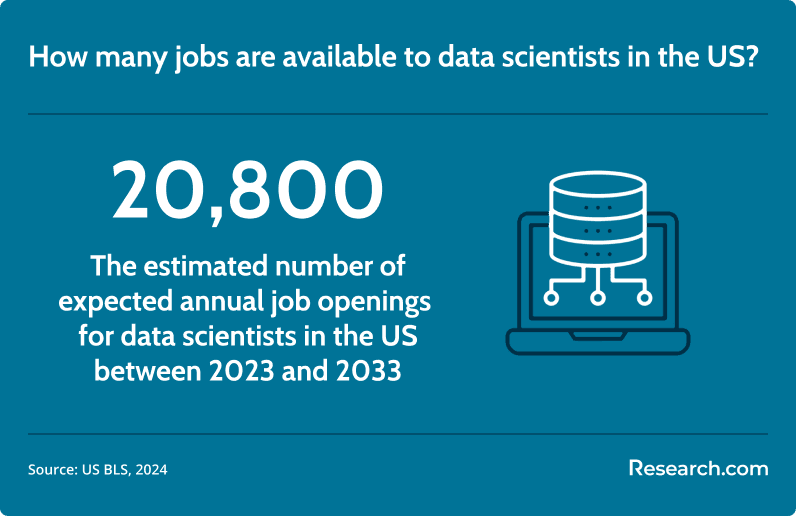
- Data Scientists: Employment for data scientists across the country has been projected to increase by 36% between 2023 and 2033, which translates to an average of around 20,800 job openings annually during the decade.
- Software Developer, Quality Assurance Analysts, and Testers: Software developers have been projected to grow by 18% over the decade, while employment for software quality assurance analysts and testers is expected to grow by 12% during the same period. The outlook for software developers, software quality assurance analysts, and testers in the US translates to around 140,100 job openings annually.
- Computer Programmers: Computer programmers have a projected growth rate of -10%, although around 6,400 job openings for the role have still been projected yearly.
- Computer and Information Research Scientists: Computer and information research scientists have a projected growth rate of 26%, equal to about 3,400 job openings annually.
Some machine learning professionals also branch into cybersecurity, where AI-driven systems and advanced analytics are increasingly relevant. If that direction interests you, Research.com’s guide on how to become an information security analyst explains a related path focused on protecting systems, data, and networks.
| Career stage | Possible roles | What to build next |
| Entry level | Junior machine learning engineer, data scientist, AI developer, analytics engineer | Portfolio projects, coding depth, data cleaning, model evaluation, basic deployment |
| Mid level | Machine learning engineer, ML software engineer, applied scientist | Production systems, cloud deployment, MLOps, model monitoring, cross-team collaboration |
| Senior level | Senior ML engineer, AI architect, research scientist, technical lead | System design, model governance, mentoring, architecture, business impact |
| Leadership or specialization | AI director, ML platform lead, domain AI specialist | Strategy, stakeholder management, responsible AI, advanced specialization |
How can interdisciplinary expertise expand machine learning career options?
Machine learning is often most powerful when combined with subject-matter expertise. Engineers who understand an industry’s vocabulary, risks, workflows, and data limitations can build better models and communicate more effectively with nontechnical experts.
Biotechnology is one example. Professionals who combine advanced analytics with life sciences knowledge may pursue roles where data modeling supports research, product development, or scientific decision-making. If you are exploring that direction, reviewing jobs for masters in biotechnology can help you understand how technical and scientific training may overlap.
How to decide whether machine learning engineering is the right path
Machine learning engineering can be rewarding, but it is not the best fit for every technology learner. Use the questions below before committing to a degree, bootcamp, certificate, or self-study plan.
| Question to ask | Why it matters |
| Do I enjoy both coding and math? | Machine learning engineering requires software skills and quantitative reasoning. |
| Am I willing to work with messy data? | Many real projects involve cleaning, validation, and debugging before modeling. |
| Do I want to build usable systems, not just experiments? | Production ML work includes deployment, monitoring, maintenance, and collaboration. |
| Can I keep learning as tools change? | Frameworks, cloud services, and best practices evolve quickly. |
| Do I have a target industry or problem area? | Domain knowledge can make your portfolio and job search more focused. |
Who should consider this career
- Software developers who want to move into AI-driven systems.
- Data scientists who want to strengthen deployment and engineering skills.
- Quantitative students in computer science, engineering, mathematics, physics, or statistics.
- Professionals in healthcare, finance, manufacturing, or research who want to apply AI to domain-specific problems.
Who may want a different path
- Learners who dislike coding and would prefer business analytics, product management, or strategy roles.
- People who want quick entry into tech without sustained math, data, and programming study.
- Candidates who prefer visual reporting and stakeholder analysis over model building and system deployment.
- Professionals who want to focus only on academic AI theory rather than applied engineering, unless they plan for research roles.
Common mistakes to avoid when preparing for machine learning jobs
- Choosing a program based only on the title: A degree labeled “AI” or “data science” is not automatically better. Review the actual courses, projects, math depth, programming requirements, and faculty expertise.
- Ignoring accreditation and transfer policies: If you enroll in a degree program, check institutional accreditation, credit transfer rules, and whether prior credits or work experience can reduce your time and cost.
- Focusing only on tuition: Compare total cost, fees, textbooks, software, technology requirements, financial aid options, schedule flexibility, and graduation requirements.
- Assuming an online program automatically fits your goals: Online study can be effective, but you still need projects, support, feedback, and enough technical depth.
- Relying only on rankings: Rankings can help you discover options, but your best program depends on your background, budget, schedule, goals, and support needs.
- Building tutorial-only projects: Employers can recognize copied projects. Add original analysis, realistic constraints, deployment, or domain context.
- Assuming salary outcomes are guaranteed: Wages vary by role, location, experience, employer, and skill level. Use salary data as context, not a promise.
Key Insights
- Machine learning engineering is a production-focused AI role. The job requires model knowledge, but also software engineering, data handling, deployment, monitoring, and communication skills.
- A bachelor’s degree in computer science, data science, mathematics, engineering, or a related field is a common entry point. Graduate study can help for advanced roles, but practical projects and technical depth are still essential.
- An online course alone is usually not enough for a machine learning engineering job. A stronger plan includes hands-on projects, GitHub documentation, deployment experience, and proof that you can work with real data.
- Certifications from Google Cloud, AWS, and IBM can strengthen a resume when they match your target tools or roles, but they should not replace applied experience.
- Related occupations show strong labor market signals. BLS data reports 2023 median annual wages of $108,020 for data scientists, $132,270 for software developers, and $145,080 for computer and information research scientists.
- Job outlook is also strong in related areas: data scientists are projected to grow by 36% between 2023 and 2033, and software developers are projected to grow by 18% during the same period (US BLS, 2024).
- The best preparation path depends on your starting point. Software developers may need statistics and ML depth; data scientists may need deployment and systems skills; career changers may need structured education plus a carefully built portfolio.
References:
- Glassdoor. (2024, June 6). How much does a Machine Learning Engineer make? https://www.glassdoor.com/Salaries/machine-learning-engineer-salary-SRCH_KO0,25.htm
- National Center for Education Statistics. (2024, May). Undergraduate Degree Fields. Annual Reports and Information Staff (Annual Reports). https://nces.ed.gov/programs/coe/indicator/ctaGlassdoor salary reference
- US Bureau of Labor Statistics. (2024, August 29). Computer and Information Research Scientists. Occupational Outlook Handbook. https://www.bls.gov/ooh/computer-and-information-technology/computer-and-information-research-scientists.htmGlassdoor salary reference
- US Bureau of Labor Statistics. (2024, August 29). Computer Programmers. Occupational Outlook Handbook. https://www.bls.gov/ooh/computer-and-information-technology/computer-programmers.htmGlassdoor salary reference
- US Bureau of Labor Statistics. (2024, August 29). Data Scientists. Occupational Outlook Handbook. https://www.bls.gov/ooh/math/data-scientists.htmGlassdoor salary reference
- US Bureau of Labor Statistics. (2024, August 29). Software Developers, Quality Assurance Analysts, and Testers. Occupational Outlook Handbook. https://www.bls.gov/ooh/computer-and-information-technology/software-developers.htmGlassdoor salary reference
Other Things You Should Know About How to Become a Machine Learning Engineer
Becoming a machine learning engineer is challenging but achievable with dedication. It requires mastering programming, math, data science, and artificial intelligence (AI) concepts. While the learning curve is steep, structured study, hands-on projects, and real-world experience can make the journey manageable. Persistence and continuous learning are key to success in this evolving field.
In 2027, the timeline to become a machine learning engineer can vary. Typically, it takes 2-5 years, including earning a bachelor's degree in a relevant field like computer science or mathematics, followed by practical experience through projects, internships, and specialized courses to master necessary skills.