
2027 Cheapest Online Nursing Informatics Degree Programs

Co-Founder and Chief Data Scientist
Choosing an online nursing informatics degree is not just a question of finding the lowest tuition. You need to know whether the program is accredited, whether it fits your RN background and schedule, whether the curriculum teaches current health IT tools, and whether the credential can support the career move you want. This guide is designed for registered nurses, BSN students, MSN-prepared nurses, and career changers comparing online nursing informatics options. You will learn what these programs cover, how long they take, what they cost, which affordable programs are available, what roles graduates pursue, and how to judge whether a program is worth the investment.
Quick Answer: Is an Online Nursing Informatics Degree Worth Considering?
An online nursing informatics degree can be a strong option for nurses who want to move into healthcare technology, electronic health record optimization, data analytics, clinical workflow improvement, telehealth, health IT leadership, or quality and safety roles. The best candidates already understand clinical care and want to use technology and data to improve patient outcomes, reduce documentation burden, and support better decision-making. The degree is usually most valuable when it comes from an accredited nursing program, includes practical informatics projects, and aligns with the student’s target role.
What are the main benefits of earning an online nursing informatics degree?
- It connects clinical nursing with healthcare technology. Nursing informatics prepares nurses to help design, evaluate, and improve systems that affect patient care, documentation, safety, reporting, and communication.
- It can fit around full-time nursing work. Online programs often make it easier for working nurses to continue earning income while completing graduate coursework.
- It supports several career directions. Graduates may work in hospitals, health systems, clinics, software companies, consulting firms, public health agencies, pharmaceutical organizations, or academic settings.
- It can lead to leadership roles. With experience, informatics nurses may advance into project management, clinical systems leadership, director-level informatics roles, or Chief Nursing Informatics Officer positions.
What should students expect from an online nursing informatics degree?
An online nursing informatics degree teaches nurses how to improve healthcare delivery through data, technology, workflow design, and clinical leadership. Most programs build on registered nursing experience, then add health information systems, analytics, project management, privacy, and change management.
| Program Area | What Students Learn | Why It Matters in Practice |
| Nursing science and clinical workflow | How patient care processes, documentation, handoffs, and nursing workflows operate in real healthcare settings. | Informatics decisions must support clinicians instead of creating extra administrative burden. |
| Health informatics systems | Electronic health records, health information exchanges, telehealth tools, decision support, patient portals, and health IT standards. | Graduates need to understand the systems used by nurses, physicians, patients, and administrators. |
| Data management and analytics | Data collection, cleaning, interpretation, reporting, visualization, and quality measurement. | Healthcare organizations use data to monitor outcomes, improve safety, and make operational decisions. |
| Technology implementation | How to evaluate, introduce, test, and improve digital tools in clinical environments. | New technology can fail when training, workflow, privacy, and user needs are ignored. |
| Project management | Planning, timelines, stakeholder communication, risk management, evaluation, and implementation support. | Many informatics nurses lead system upgrades, EHR changes, and process improvement initiatives. |
| Leadership and communication | How to translate between clinical teams, IT departments, executives, vendors, and patients. | Nursing informatics professionals often serve as the bridge between bedside practice and technical teams. |
Where can graduates work with a nursing informatics degree?
Nursing informatics graduates can work anywhere healthcare organizations rely on digital systems, clinical data, or technology-enabled care. The right setting depends on whether you prefer patient-facing workflow support, analytics, implementation work, teaching, research, or leadership.
- Hospitals and health systems: Common roles include clinical informatics specialist, informatics nurse, nursing informatics educator, EHR analyst, and clinical systems specialist.
- Clinics and physician practices: Graduates may help optimize EHR templates, improve documentation workflows, support patient data management, and train clinical staff.
- Healthcare technology companies: Nurses with informatics training may contribute to software design, implementation consulting, product education, clinical analytics, or customer success.
- Government agencies: Informatics expertise can support public health reporting, health IT policy, surveillance systems, and standards development at agencies such as the CDC or FDA.
- Pharmaceutical and biotech organizations: Informatics skills may be used in clinical trials, research data systems, patient safety reporting, and evidence generation.
- Colleges and universities: Experienced professionals may teach nursing informatics, conduct research, or help build digital learning tools for nursing education.
How much can nurses earn in nursing informatics?
Pay depends on job title, employer, location, nursing experience, technical skill level, and leadership responsibility. The following salary ranges should be treated as broad estimates rather than guaranteed outcomes.
| Role | Estimated Annual Salary Range | Typical Focus |
| Informatics Nurse Specialist | $70,000 - $120,000 per year | Clinical workflow, EHR optimization, user training, and informatics support. |
| Clinical Informatics Analyst | $65,000 - $110,000 per year | Data analysis, system configuration, reporting, and process improvement. |
| Nursing Informatics Educator | $75,000 - $130,000 per year | Training nurses and healthcare teams on informatics tools, systems, and best practices. |
| Chief Nursing Informatics Officer (CNIO) | $120,000 - $250,000+ per year | Executive-level informatics strategy, governance, leadership, and health IT transformation. |
Before enrolling, compare salary data for your target city, employer type, and desired role. A degree may improve your qualifications, but experience with EHR systems, analytics, implementation projects, and leadership often plays a major role in compensation.
- Cheapest Online Nursing Informatics Degree Programs for 2027
- How long does it take to complete an online nursing informatics degree program?
- How does an online nursing informatics degree compare with an on-campus program?
- What is the average cost of an online nursing informatics degree program?
- What financial aid options are available?
- What are the usual admission requirements?
- What courses are included in nursing informatics programs?
- What nursing informatics specializations are available?
- Does an online nursing informatics degree deliver a strong return on investment?
- What trends are changing online nursing informatics education?
- How should students choose the best program?
- How can non-nurses move toward nursing informatics?
- Should students complete a BSN before pursuing nursing informatics?
- What career paths are available after graduation?
- How do programs teach advanced healthcare technologies?
- How can informatics support specialized clinical tracks?
- How can students verify accreditation and outcomes?
- What is the job market for nursing informatics graduates?
- What advancement options exist beyond traditional informatics roles?
- How can interdisciplinary specialization affect earnings?
- Should ABSN programs be considered as a starting point?
- What technology do online students need? ABSN pathway earning potential advancement options job market additional considerations
Cheapest Online Nursing Informatics Degree Programs for 2027
How do we rank schools?
Because nursing informatics programs require a meaningful financial and time commitment, affordability rankings should be transparent and based on credible education data. Research.com considers information from recognized sources, including:
- the IPEDS database
- Peterson's database, including its Distance Learning Licensed Data Set
- the College Scorecard database, and
- the National Center for Education Statistics.
The following schools are listed as affordable online nursing informatics degree options for 2027. Students should verify tuition, fees, clinical or practicum requirements, and state authorization directly with each institution before applying.
1. Northeastern State University
Northeastern State University offers an online Master of Science in Nursing with a Nursing Informatics focus. The program is built for nurses who want to work with healthcare information systems, clinical data, and technology-supported care improvement. Students study the connection between nursing practice and information technology, then apply what they learn through specialized coursework and a capstone experience. The curriculum is designed to reflect the American Nurses Association's standards for nursing informatics.
- Program Length: Approximately 2 years
- Tracks/Concentrations: Nursing Informatics
- Tuition Cost: In-state: $5,000 per year; Out-of-state: $10,000 per year
- Required Credits to Graduate: 36 credits
- Accreditation: CCNE (Commission on Collegiate Nursing Education)
2. Texas Tech University Health Sciences Center
Texas Tech University Health Sciences Center provides an MSN in Nursing Informatics for nurses preparing for advanced roles in clinical technology, data management, electronic health records, and quality improvement. The program combines informatics theory with applied healthcare technology skills so graduates can help organizations use systems and data more effectively.
- Program Length: Approximately 2 years
- Tracks/Concentrations: Nursing Informatics
- Tuition Cost: In-state: $8,000 per year; Out-of-state: $12,000 per year
- Required Credits to Graduate: 36 credits
- Accreditation: CCNE
3. The University of Texas at Tyler
The University of Texas at Tyler offers an MSN in Nursing Informatics with attention to Quality & Safety. The program is suited for nurses who want to use informatics tools to improve care quality, patient safety, data-informed decisions, and clinical processes. Coursework includes healthcare information systems, analytics, and quality improvement, with a capstone project that connects academic learning to real healthcare challenges.
- Program Length: Approximately 2 years
- Tracks/Concentrations: Quality & Safety
- Tuition Cost: In-state: $6,000 per year; Out-of-state: $12,000 per year
- Required Credits to Graduate: 36 credits
- Accreditation: CCNE
4. Western Governors University
Western Governors University's online MSN in Nursing Informatics is designed for working nurses who want a flexible, self-paced path into health IT and informatics leadership. The curriculum emphasizes systems thinking, evidence-based practice, data interpretation, workflow improvement, and technology-enabled care delivery. Its format may appeal to students who can manage independent learning and want to progress based on demonstrated competency.
- Program Length: Approximately 2 years (self-paced)
- Tracks/Concentrations: Nursing Informatics
- Tuition Cost: Flat rate of $3,500 per term (tuition based on course load)
- Required Credits to Graduate: 36 credits
- Accreditation: CCNE
5. CUNY Graduate School and University Center
The Graduate School and University Center of the City University of New York offers an online Advanced Certificate in Nursing Informatics through CUNY SPS. This shorter credential is intended for registered nurses who want targeted informatics training without completing a full MSN. Students study decision support, project management, data use, system implementation, and applied informatics through coursework and practicum experience.
- Program Length: Approximately 1 year
- Tracks/Concentrations: Advanced Certificate in Nursing Informatics
- Tuition Cost: In-state: $4,800; Out-of-state: $9,600
- Required Credits to Graduate: 18 credits
- Accreditation: CCNE
6. Troy University
Troy University offers an online Post-Master's Certificate in Healthcare Informatics and Nursing Leadership for MSN-prepared nurses. The program focuses on health information systems, data analytics, telehealth, policy, project management, and leadership. It may be a practical choice for nurses who already hold a graduate nursing degree and want a focused credential for informatics or leadership advancement.
- Program Length: Approximately 2 years
- Tracks/Concentrations: Healthcare Informatics and Nursing Leadership
- Tuition Cost: $6,000 per year (flat rate)
- Required Credits to Graduate: 23 credits
- Accreditation: CCNE
7. University of Mary
The University of Mary's online MSN in Nursing and Health Care Informatics prepares nurses to connect clinical expertise with health information analysis and technology-driven improvement. Students study research, information systems, data interpretation, leadership, and innovation in healthcare. Graduates may pursue roles that require both nursing judgment and informatics competence.
- Program Length: Approximately 2 years
- Tracks/Concentrations: Health Care Informatics
- Tuition Cost: In-state: $8,400; Out-of-state: $8,400
- Required Credits to Graduate: 36 credits
- Accreditation: CCNE
8. Jacksonville University
Jacksonville University's MSN with a Nursing Informatics specialization blends advanced nursing coursework with health IT, data analytics, healthcare information systems, and informatics standards. Offered in online and hybrid formats, the program is intended for nurses preparing to lead technology projects, analyze clinical data, and support system improvements in healthcare organizations.
- Program Length: Approximately 2 years
- Tracks/Concentrations: Nursing Informatics
- Tuition Cost: In-state: $11,400; Out-of-state: $11,400
- Required Credits to Graduate: 36 credits
- Accreditation: CCNE
9. Queens University of Charlotte
Queens University's online MSN with a Nursing Informatics concentration is structured for working professionals who want to strengthen their knowledge of EHRs, telehealth, analytics, and health IT project management. The program emphasizes practical application in clinical environments, preparing graduates for analyst, specialist, and project-focused roles.
- Program Length: Approximately 2 years
- Tracks/Concentrations: Nursing Informatics
- Tuition Cost: In-state: $10,500; Out-of-state: $10,500
- Required Credits to Graduate: 36 credits
- Accreditation: CCNE
10. Nebraska Methodist College
Nebraska Methodist College offers an online MSN focused on Nursing Informatics. The program prepares nurses to work with health information systems, clinical data, EHRs, reporting, and health IT projects. Its curriculum emphasizes the use of informatics to improve care delivery, streamline workflows, and support evidence-based decision-making.
- Program Length: Approximately 2 years
- Tracks/Concentrations: Nursing Informatics
- Tuition Cost: In-state: $9,000; Out-of-state: $9,000
- Required Credits to Graduate: 36 credits
- Accreditation: CCNE
How long does it take to complete an online nursing informatics degree program?
Most online nursing informatics graduate programs take about 18-24 months for full-time students, although part-time enrollment, practicum requirements, capstone projects, and transfer policies can change the timeline.
- Degree level: An MSN usually takes longer than a post-master's certificate. A master's degree commonly takes 18-24 months, while some certificates can be completed in less time.
- Enrollment pace: Full-time students generally finish sooner, while part-time students may need additional semesters.
- Capstone or practicum requirements: Applied projects and clinical informatics experiences can extend the schedule but often make the program more career-relevant.
- Transfer or prior learning credit: Some schools may award credit for previous graduate coursework or professional experience, which can shorten the path.
Students comparing timelines should ask whether courses are asynchronous, whether practicums can be completed locally, and whether the school offers multiple start dates. If you are exploring other healthcare-related graduate paths, an article asking is an MFT degree worth it can help you compare how different professional degrees structure clinical preparation and career outcomes.
How does an online nursing informatics degree compare with an on-campus program?
Online and campus-based nursing informatics programs can both be rigorous, but they serve different student needs. Online formats are often better for working nurses who need scheduling flexibility, while campus programs may appeal to students who prefer in-person interaction and immediate access to campus resources.
| Factor | Online Nursing Informatics Program | On-Campus Nursing Informatics Program |
| Schedule | Often more flexible and better suited to nurses working full time. | Usually follows fixed class times and campus attendance expectations. |
| Learning environment | Requires self-direction, strong time management, and comfort with digital platforms. | Provides more face-to-face contact with faculty and peers. |
| Cost considerations | May reduce commuting, housing, and relocation costs, though fees vary by school. | May include campus-based fees, travel, parking, or relocation expenses. |
| Clinical or practicum experience | May allow local placement, but students must confirm requirements early. | May use established regional partnerships or campus-affiliated sites. |
| Best fit | Working RNs, rural students, military students, and those needing flexibility. | Students who learn best in person or want regular campus access. |
If your long-term goal is healthcare IT management, it can also be useful to review the requirements for IT manager roles so you understand how nursing informatics, project management, and technology leadership credentials may fit together.
What is the average cost of an online nursing informatics degree program?
The cost of an online nursing informatics program varies widely by credential level, school type, residency status, fees, and program length. Students should compare total program cost rather than tuition alone.
- Program type: A full MSN generally costs more than a post-master's certificate.
- Institution type: Public universities are often less expensive for in-state students, while private universities may charge the same rate regardless of residency.
- Residency: Some public schools charge different rates for in-state and out-of-state students.
- Fees: Technology fees, distance learning fees, graduation fees, background checks, and practicum-related expenses can add to the final cost.
- Time to completion: Extra semesters can increase tuition and fees, especially for per-credit programs.
Estimated total costs by program type
| Program Type | Estimated Cost Range | Notes |
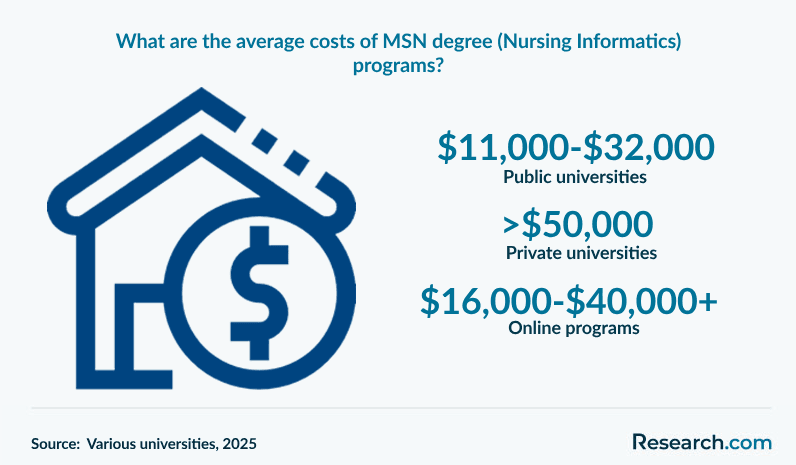
| MSN in Nursing Informatics at public universities | $11,000 - $32,000 (in-state) and $23,000 - $50,000+ (out-of-state) | Examples include Northeastern State University (OK), at around $11,000 for in-state students, and The University of Texas at Tyler, which can cost over $32,000 for in-state students and over $50,000 for out-of-state students. |
| MSN in Nursing Informatics at private universities | $30,000 - $60,000+ | Some private universities, including Thomas Jefferson University, can have programs exceeding $50,000. |
| Online MSN programs | $16,000 - $40,000+ | Western Governors University can cost around $16,000, while some online programs can exceed $40,000. |
| Post-Master's Certificate in Nursing Informatics | $5,000 to $20,000 | Usually less expensive than a full MSN, depending on credit requirements and school pricing. |
Cost is only one part of value. Students should also consider accreditation, practicum support, curriculum quality, employer tuition benefits, transfer policies, and career services. If you want a related healthcare data pathway with a different degree focus, compare affordable health information management programs. Students considering a different clinical profession can review what are the requirements to be an audiologist, including doctoral education, clinical experience, and state licensure exams.
These estimated cost differences are shown in the graphic below.
What are the financial aid options for students enrolling in an online nursing informatics degree program?
Online nursing informatics students may qualify for several types of financial aid, but eligibility depends on the school, enrollment status, degree level, FAFSA results, and employer policies.
- Federal student loans: Eligible students may use federal loans to help pay for graduate study.
- Direct Subsidized Loans: These are need-based loans. Eligibility is determined through the FAFSA, and the government pays interest while the student is in school, during the grace period, and during eligible deferment periods.
- Direct Unsubsidized Loans: These loans may be available to undergraduate and graduate students regardless of financial need, but borrowers are responsible for all interest that accrues, including while enrolled.
- Grants: Grants usually do not require repayment and are often based on financial need or specific eligibility criteria.
- Scholarships: Nursing organizations, schools, employers, and professional associations may award scholarships for merit, need, service, or specialty focus.
- Employer tuition assistance: Many hospitals and health systems help employees pay for education, sometimes in exchange for a service commitment. Similar arrangements may be available for nurses pursuing a fast track medical LPN pathway or other employer-supported healthcare credentials.
- Private loans: Private education loans may be available, but students should compare rates, repayment terms, and borrower protections carefully.
Apply early, ask each school for a full cost-of-attendance estimate, and confirm whether part-time enrollment affects aid eligibility.
What are the prerequisites for enrolling in an online nursing informatics degree program?
Most online nursing informatics programs are designed for licensed nurses, so admission requirements usually focus on nursing education, RN licensure, academic readiness, and professional experience.
- Nursing degree: A BSN from an accredited institution is commonly required for MSN-level informatics programs.
- RN license: Applicants generally need an active, unencumbered registered nurse license.
- Minimum GPA: Many programs expect a GPA near 3.0, although requirements vary by institution.
- Clinical experience: Some programs prefer or require nursing experience because informatics coursework depends on understanding real clinical workflows.
- Technical or quantitative background: Prior coursework in statistics, healthcare information systems, analytics, or technology can help. Some nurses also explore computer science degree online options when they want deeper technical preparation.
- Application materials: Schools typically request transcripts, a resume, letters of recommendation, a statement of purpose, and proof of licensure.
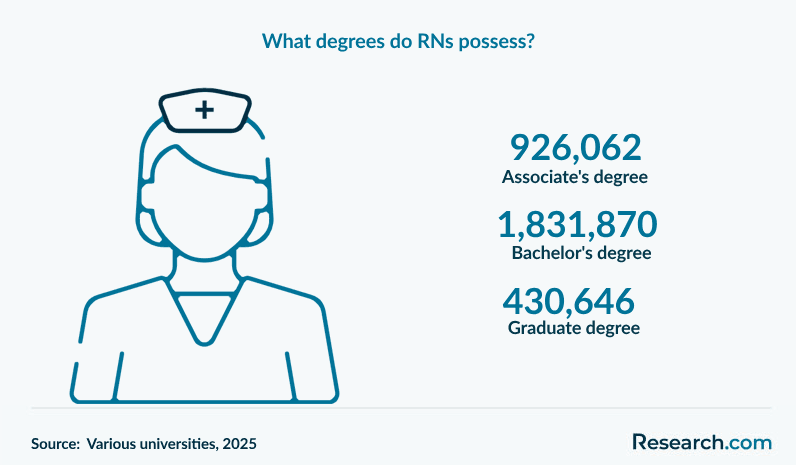
According to Data USA, registered nurses most commonly hold a Bachelor's degree, with 1,831,870 individuals in that category. The next largest group holds an Associate's degree, with 926,062 individuals, followed by those with a Graduate degree, at 430,646 individuals. The chart below shows how varied the educational backgrounds are across the RN workforce.
What courses are typically in an online nursing informatics degree program?
Nursing informatics curricula combine advanced nursing practice, health information technology, data use, systems improvement, ethics, and leadership. Course names vary by school, but many programs include the following areas.
Core Courses
- Fundamentals of Nursing Informatics: Introduces informatics theories, nursing data, clinical applications, and the role of informatics in healthcare improvement.
- Healthcare Information Systems: Examines how health information systems are designed, implemented, maintained, and evaluated.
- Data Management and Analytics: Teaches students to collect, organize, analyze, interpret, and present healthcare data. Students who want deeper analytics preparation may also compare the cheapest online masters in data analytics programs.
- Health Informatics Ethics and Law: Covers privacy, confidentiality, consent, security, data governance, and legal responsibilities in health IT.
- Project Management in Healthcare: Develops skills in planning, budgeting, communication, implementation, stakeholder engagement, and evaluation.
Advanced Courses
- Systems Analysis and Design: Focuses on evaluating clinical processes and designing technology solutions that support safer, more efficient care.
- Database Management: Covers database design, storage, querying, maintenance, and healthcare data applications.
- Telehealth and Mobile Health: Explores remote care delivery, patient monitoring, mobile tools, and digital access to care.
- Clinical Decision Support Systems: Teaches how alerts, order sets, evidence-based prompts, and decision tools support clinicians.
- Healthcare Data Security and Privacy: Addresses strategies for protecting sensitive patient information. Students who want extra technical training can consider online cybersecurity courses.
Elective Courses
- Public Health Informatics: Applies informatics to disease surveillance, population health, reporting, and community health initiatives.
- Consumer Health Informatics: Studies tools that help patients access information, use portals, track health data, and participate in care decisions.
- Nursing Education Informatics: Looks at simulation, online instruction, digital learning platforms, and technology-supported nurse training.
- Research Methods in Nursing Informatics: Prepares students to evaluate evidence and conduct informatics-related research.
What types of specializations are available in online nursing informatics degree programs?
Many programs offer a general nursing informatics concentration rather than formal sub-specializations. However, students can shape their coursework, practicum, capstone, certifications, and work experience around a more focused career direction.
- Clinical informatics: EHR optimization, workflow redesign, telehealth support, and clinician training. Typical roles include clinical analyst and informatics nurse specialist.
- Nursing education informatics: Use of technology, simulation, and digital course design in nursing education. Roles may include nurse educator or instructional designer.
- Public health informatics: Population health data, disease surveillance, reporting systems, and public health campaigns. Roles may include public health analyst or epidemiology-related positions.
- Health IT leadership: Strategy, governance, vendor management, and enterprise technology initiatives. This path may lead to director roles or CNIO positions.
- Data science and analytics: Data mining, modeling, dashboards, quality metrics, and outcome analysis. Career options may include healthcare analyst or data scientist roles.
- Consumer health informatics: Patient portals, mobile apps, patient education tools, and digital engagement platforms.
- Legal, ethical, and compliance informatics: Privacy, security, data access, risk management, and regulatory compliance in health IT.
Nursing informatics salaries vary across states. The graphic below shows New Jersey with the highest average annual salary at $104,615, followed by Wyoming ($103,856), Wisconsin ($102,486), Washington ($102,229), Massachusetts ($101,772), Indiana ($101,616), Alaska ($101,612), and Oregon ($100,882).
Does an online nursing informatics degree deliver a strong return on investment?
An online nursing informatics degree can offer a favorable return when the credential helps a nurse move into a higher-paying, more specialized, or more flexible role. ROI depends on total program cost, lost work time, employer tuition support, completion speed, career goals, and local job opportunities. A lower-cost accredited program with a strong applied curriculum may produce better value than an expensive program with limited career support.
- Positive ROI is more likely when: the program is accredited, the student already has RN experience, coursework includes applied EHR or analytics projects, and the graduate targets roles with clear demand.
- ROI is weaker when: tuition is high, the program lacks practical training, the student has no plan for using the degree, or the credential does not match employer expectations.
- Quality of work also matters: Some nurses use informatics training to move into roles that are less physically demanding than bedside care. Students researching quality-of-life career options may also review least stressful nursing jobs that pay well.
What emerging trends are shaping online nursing informatics education?
Online nursing informatics programs are adapting as healthcare organizations increase their use of digital tools, remote care models, cybersecurity safeguards, and data-driven quality improvement. Current curricula increasingly emphasize telehealth, interoperability, remote patient monitoring, clinical analytics, cybersecurity, and artificial intelligence applications in clinical data analysis. Programs may also add leadership coursework so graduates can manage technology adoption, stakeholder communication, and workflow change. Nurses who want a broader clinical leadership doctorate can compare related pathways such as online DNP programs.
How does one choose the best online nursing informatics degree program?
The best online nursing informatics program is the one that matches your licensure status, career goal, budget, schedule, and preferred learning style while meeting recognized quality standards. Do not rely only on rankings or tuition.
| What to Check | Why It Matters | Questions to Ask |
| Accreditation | Accreditation affects educational quality, employer confidence, and sometimes certification or further study options. | Is the nursing program accredited by a recognized agency such as CCNE? |
| Curriculum | The coursework should match your target role, whether that is analytics, EHR optimization, education, leadership, or telehealth. | Does the program include applied projects, practicum hours, analytics, privacy, and systems implementation? |
| Faculty expertise | Faculty with informatics experience can connect theory to current workplace challenges. | Have faculty worked in nursing informatics, health IT, analytics, or clinical systems leadership? |
| Online format | Course pacing and live-session requirements affect working nurses. | Are courses asynchronous, synchronous, self-paced, or cohort-based? |
| Total cost | Tuition alone may not include fees, books, software, background checks, or practicum expenses. | What is the full cost to graduate after fees and required materials? |
| Career support | Career services can help students translate nursing experience into informatics roles. | Does the school provide resume support, practicum placement guidance, employer connections, or alumni networking? |
| Fit with long-term goals | A program should support the role you actually want, not just provide a general credential. | Do graduates move into the types of positions I am targeting? |
Accreditation should be non-negotiable. The same principle applies when evaluating cheap accredited online bachelor degree programs: low cost is helpful only when the credential comes from a legitimate, recognized institution.
How can non-nurses transition into a career in nursing informatics?
True nursing informatics roles generally require nursing knowledge and, often, RN licensure. Non-nurses with backgrounds in healthcare administration, information technology, data analytics, or health information management may still work in related health informatics roles, but they should not assume they qualify for nurse informaticist positions without nursing preparation. One possible route is a direct entry MSN program online, which can help candidates build clinical nursing competencies before moving into informatics-focused study. Another option is to pursue broader health informatics, health information management, data analytics, or healthcare IT roles that do not require RN licensure.
Should I complete a BSN before pursuing an online nursing informatics degree?
For most nurses, completing a BSN before a graduate nursing informatics program is the clearest route. A BSN strengthens clinical reasoning, population health knowledge, evidence-based practice skills, and leadership preparation. These foundations matter because informatics work is not only technical; it requires understanding how digital systems affect real nurses, patients, and care teams. RNs who still need a bachelor's degree can compare affordable online BSN programs before applying to MSN-level informatics programs.
What career paths are available for graduates of online nursing informatics degree programs?
Graduates can move into roles that combine clinical knowledge, technology use, analytics, training, workflow improvement, and leadership. Entry points vary by experience level and technical background.
| Career Path | Primary Responsibilities | Best Fit For |
| Clinical Informatics Specialist | Supports EHR implementation, workflow optimization, user training, system testing, and clinical process improvement. | Nurses who enjoy solving workflow problems and working with care teams. |
| Informatics Nurse | Applies informatics knowledge to improve documentation, patient care processes, data use, and technology adoption. | RNs who want to stay closely connected to nursing practice while moving into systems work. |
| Nursing Informatics Educator | Teaches nurses and healthcare staff how to use technology, data, and informatics principles effectively. | Nurses with strong communication, teaching, and training skills. |
| Health IT Consultant | Advises healthcare organizations on system selection, implementation, optimization, and workflow change. | Professionals who enjoy project-based work and cross-organization problem solving. |
| Data Analyst | Collects, analyzes, and reports healthcare data to support quality, safety, efficiency, and decision-making. | Nurses who enjoy analytics, dashboards, metrics, and evidence-based improvement. |
| Project Manager | Leads health IT projects, timelines, budgets, stakeholder communication, and implementation milestones. | Nurses with organization, leadership, and communication strengths. |
| Chief Nursing Informatics Officer (CNIO) | Provides senior leadership for nursing informatics strategy, governance, technology adoption, and digital transformation. | Experienced informatics leaders with executive-level skills. |
Certifications and continuing education can strengthen a graduate’s profile. The 2022 Nursing Informatics Workforce Survey reported that ANCC certification was held by 23% of respondents. Other credentials included Certified Professional in Healthcare Information and Management Systems (CPHIMS) at 10%, Project Management Professional (PMP) at 8%, and Certified Associate in Healthcare Information and Management Systems (CAHIMS) at 7%. Newer credentials, including the Certified Professional in Digital Health Strategy Transformation and the Academic Health Informatics Certification (AHIC) through AMIA, were reported at 4% and 3% respectively. Another 31% of respondents reported not pursuing certifications.
Some nurses also strengthen their analytics background through graduate data programs. For example, the cheapest data science masters online programs may be relevant for nurses who want deeper preparation for healthcare analytics and AI-related work.
How do online nursing informatics programs integrate advanced healthcare technologies in their curriculum?
Strong programs do more than define health IT terms. They give students opportunities to practice using informatics tools through simulations, virtual labs, case studies, applied assignments, and practicum projects. Common technology areas include electronic health records, telehealth systems, clinical decision support, dashboards, data visualization, privacy and security tools, interoperability standards, and quality reporting. Nurses moving from clinical practice into informatics may also compare accelerated undergraduate pathways, including the quickest RN to BSN program, before entering graduate informatics study.
How can an online nursing informatics degree complement specialized clinical tracks?
Nursing informatics can strengthen specialized clinical practice by improving data use, care coordination, patient monitoring, documentation, and outcome measurement. For example, a nurse working in behavioral health may use informatics to improve risk screening, telepsychiatry workflows, medication tracking, and population-level reporting. Students pursuing advanced clinical credentials, such as cheap online PMHNP programs, may find that informatics skills make them more effective in technology-enabled clinical environments.
How can I assess the accreditation and outcomes of an online nursing informatics program?
Program quality should be verified before enrollment. Start by confirming institutional accreditation and nursing program accreditation. Then review outcomes that show whether students finish, gain relevant skills, and move into appropriate roles.
- Confirm accreditation: Check whether the institution and nursing program are recognized by appropriate accrediting bodies.
- Review student outcomes: Ask about graduation rates, retention rates, practicum completion, alumni roles, and employer partnerships.
- Evaluate transparency: Schools should clearly publish tuition, fees, admissions requirements, course descriptions, and practicum expectations.
- Ask about certification alignment: Determine whether coursework supports preparation for informatics-related professional credentials.
- Check state authorization: Online nursing students should confirm the school can enroll students in their state and support any required placements.
RNs building a bachelor's-level foundation first may want to compare easy online RN to BSN programs, while still checking accreditation and outcomes carefully.
What is the job market for graduates with an online nursing informatics degree?
The nursing informatics labor market is supported by healthcare organizations’ continued reliance on digital records, analytics, telehealth, reporting, and quality improvement. Job availability still varies by region, employer, experience, and technical skills.
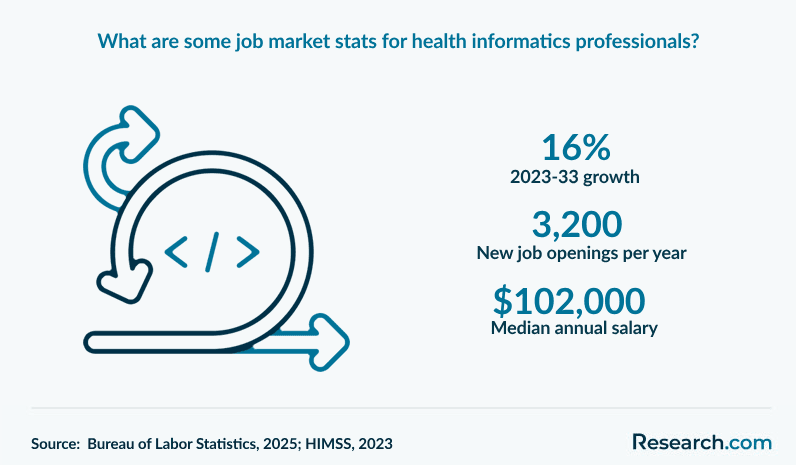
- Demand for health information skills: The Bureau of Labor Statistics projects that employment of medical records specialists, a category that includes health informatics professionals, will grow 16 percent from 2023 to 2033, much faster than the average for all occupations. This represents about 3,200 job openings each year.
- Salary potential: Data from the 2022 HIMSS Nursing Informatics Workforce Survey reported a median annual salary of $102,000 for nurse informaticists. For comparison, the BLS reported that the median annual wage for registered nurses was $77,600 in May 2021.
- Work settings are broad: Graduates may find opportunities in hospitals, clinics, government agencies, pharmaceutical companies, health IT vendors, consulting firms, and academic organizations.
- Experience matters: Nurses with EHR implementation experience, analytics skills, project management ability, and strong communication skills may be more competitive.
- Advancement can be significant: Experienced professionals may progress into director-level informatics, CNIO, consulting, product leadership, or enterprise transformation roles.
How should students interpret reviews from online nursing informatics graduates?
Student stories can be useful, but they should not replace hard evidence. Look for reviews that mention specific curriculum strengths, faculty responsiveness, practicum support, career services, workload, technology platforms, and whether the program helped graduates move into informatics roles. Be cautious with testimonials that promise rapid job placement, unusually high salaries, or effortless completion. A credible program should be able to provide transparent information about admissions, costs, support services, and outcomes.
What career advancement opportunities extend beyond traditional nursing informatics roles?
Online nursing informatics graduates are not limited to EHR support roles. With experience, they may move into clinical transformation, enterprise analytics, digital health leadership, quality and safety, healthcare consulting, vendor product roles, population health, or executive informatics strategy. Some interdisciplinary roles combine informatics with aging services, where understanding broader workforce and compensation patterns such as gerontology degree salary can be useful. Advancement usually requires more than a degree: employers often look for leadership experience, project results, stakeholder management, and evidence of measurable improvement.
How does interdisciplinary specialization influence earning potential?
Combining nursing informatics with another specialty can improve career flexibility and may support movement into higher-responsibility roles. For example, informatics skills paired with psychiatric nursing, quality improvement, public health, data science, cybersecurity, or project management can make a nurse more valuable in organizations that need both clinical insight and technical fluency. Compensation still depends on role, employer, region, experience, and credentials. Nurses considering a psychiatric specialization can compare earnings information in How much do psychiatric nurse practitioners make?.
Should I consider ABSN programs as a stepping stone to a career in nursing informatics?
An accelerated BSN can be a practical starting point for students who already hold a non-nursing bachelor's degree and want to become nurses before specializing in informatics. ABSN programs build the clinical foundation needed for RN licensure and nursing practice. After gaining experience, graduates may pursue informatics training at the MSN or certificate level. Students comparing fast nursing-entry routes can review ABSN programs, then confirm admissions requirements, clinical placement expectations, accreditation, and state authorization.
What are the technology requirements for succeeding in an online nursing informatics program?
Online nursing informatics students need reliable technology because coursework often includes video meetings, learning management systems, virtual simulations, data analysis tools, discussion platforms, and online exams. Minimum requirements vary by school, so students should review each program’s technical specifications before enrolling.
- Reliable computer: Use a device capable of running current operating systems, browsers, productivity software, and video conferencing tools.
- High-speed internet: Stable internet is important for synchronous sessions, uploads, simulations, and data-heavy assignments.
- Digital literacy: Students should be comfortable with online learning platforms, file management, spreadsheets, presentations, and basic troubleshooting.
- Privacy awareness: Informatics students must understand safe handling of health-related data and follow course policies for simulations or case materials.
- Support access: Ask whether the school provides technical support, library access, software discounts, and help with virtual platforms.
Students still deciding on an entry-level nursing pathway may also compare the easiest ABSN programs to get into, while remembering that easier admission does not always mean better fit or stronger outcomes.
Common mistakes to avoid when choosing an online nursing informatics degree
- Choosing only by tuition: A low-cost program may not be a good value if it lacks accreditation, practical projects, advising, or career relevance.
- Ignoring accreditation: Always verify institutional and nursing program accreditation before applying.
- Assuming online means easy: Online graduate programs require discipline, time management, and comfort with technology.
- Overlooking practicum requirements: Ask whether you must find your own site and whether placements are available in your state.
- Failing to match curriculum to career goals: A student targeting analytics should look for data-heavy coursework, while a future CNIO should prioritize leadership and systems strategy.
- Assuming salary outcomes are guaranteed: Degree completion can improve qualifications, but pay depends on experience, location, employer, skills, and role.
- Not asking about employer reimbursement: Many nurses miss tuition benefits available through hospitals or health systems.
Key Insights
- An online nursing informatics degree is best for nurses who want to move from direct clinical care into health technology, EHR optimization, analytics, telehealth, quality improvement, or informatics leadership.
- Program value depends on accreditation, curriculum depth, practicum quality, total cost, flexibility, faculty expertise, and career alignment—not just the school’s ranking or tuition rate.
- Estimated nursing informatics salaries range from $70,000 to over $250,000, depending on role, experience, employer, and location.
- Program costs can range from $5,000 to $60,000+ depending on whether the student chooses a certificate, public MSN, private MSN, or online graduate program.
- The BLS projects 16% job growth for medical records specialists from 2023 to 2033, and the 2022 HIMSS Nursing Informatics Workforce Survey reported a median annual salary of $102,000 for nurse informaticists.
- Most MSN-level nursing informatics programs expect a BSN and active RN license, while non-nurses typically need a nursing-entry pathway before qualifying for nurse informaticist roles.
- Certification trends are changing: ANCC certification remains widely reported, but CPHIMS, PMP, CAHIMS, digital health, and academic health informatics credentials also appear in the field.
- Before enrolling, ask schools direct questions about accreditation, state authorization, practicum placement, total cost, technology requirements, graduate outcomes, and how the curriculum maps to your target job.
References:
- Bureau of Labor Statistics, U.S. Department of Labor. (2021, May). Occupational Employment and Wages, Registered Nurses. Bureau of Labor Statistics.
- Bureau of Labor Statistics, U.S. Department of Labor. (2023, September 8). Occupational Outlook Handbook, Medical Records Specialists. Bureau of Labor Statistics.
- Data USA. (n.d.). Registered nurses. Data USA.
- Healthcare Information and Management Systems Society (HIMSS). (2022). 2022 HIMSS Nursing Informatics Workforce Survey. Healthcare Information and Management Systems Society.
- Nurse.org. (2025, January 16). Nursing informatics salary by state. Nurse.org.
Other Things You Should Know About Online Nursing Informatics Degree Programs
No. Many accredited online nursing informatics master’s programs waive the GRE entirely, especially for applicants with a BSN and a minimum 3.0 GPA. Schools usually focus on transcripts, an active RN license, a résumé, and a personal statement instead of standardized test scores.
In 2027, many affordable online nursing informatics programs offer financial aid or scholarships. Schools like Southern New Hampshire University and Western Governors University often provide various aid packages. Check each program's financial aid office for specific scholarships and eligibility criteria.





