2027 Best Online Nursing Programs in South Carolina – Accredited RN to BSN Programs

Co-Founder and Chief Data Scientist
South Carolina is a practical place to consider nursing if you want a healthcare career with multiple entry points, flexible education options, and room to advance. The state has more than 5.2 million residents, and a meaningful share of the population is age 65 or older, according to the United States Census Bureau. That demographic pressure helps explain why registered nurses, LPNs, nurse practitioners, and other nursing professionals remain central to the state’s healthcare workforce.
This guide is for prospective nursing students, working RNs comparing online RN to BSN options, LPNs planning to move into registered nursing, and career changers who want to understand whether online nursing programs in South Carolina can lead to licensure or career advancement. You will learn how nursing pathways work in the state, what online programs can and cannot do, how licensing works, what costs to compare, and how to choose a program that supports your goals. If you are still deciding whether nursing is the right fit, start with this overview of the fastest paths to becoming a nurse.
Guide to Online Nursing Programs in South Carolina
- Steps to become a nurse in South Carolina
- Career resources for South Carolina nurses
- How nurse practitioners support healthcare access in South Carolina
- Typical nursing school costs in South Carolina
- How long nursing education takes in South Carolina
- Whether an online degree can qualify you for nursing roles
- Online Nursing Programs in South Carolina for 2027
- South Carolina nursing license requirements
- How online LPN to BSN programs can expand career options
- Common admission requirements for online nursing programs
- Accelerated online FNP options in South Carolina
- Employment outcomes and return on investment
- Whether South Carolina is a strong state for nurses
- Career options with a nursing degree in South Carolina
- Entry routes for non-nurses in South Carolina
- Certifications that can complement nursing education
- How online nursing programs can support advancement
- Challenges online nursing students should prepare for
- Moving from online nursing study into advanced practice
- Steps commonly associated with LVN or LPN preparation
- How online education can support nurse midwifery goals
Quick answer: Are online nursing programs in South Carolina worth considering?
Yes, online nursing programs in South Carolina can be worth considering, especially for licensed RNs who want to complete a BSN, LPNs planning to move toward RN-level practice, and experienced nurses preparing for graduate study. The best fit depends on your current license status, whether the program is approved for South Carolina licensure, how clinical placements are handled, and whether the total cost makes sense for your expected career path.
Online coursework can make nursing education more flexible, but nursing is not fully remote. Prelicensure and advanced practice programs still require supervised clinical experience, and students must confirm that the program meets South Carolina Board of Nursing requirements before enrolling.
| Student situation | Best program type to compare | Main issue to verify before enrolling |
| No nursing background | ADN, traditional BSN, or accelerated BSN if eligible | State approval, clinical access, and NCLEX-RN preparation |
| Licensed LPN | LPN to RN or LPN to BSN pathway | Transfer credit, clinical requirements, and RN licensure eligibility |
| RN with an ADN | Online RN to BSN | Accreditation, total credits, employer tuition assistance, and schedule flexibility |
| RN planning advanced practice | RN to MSN, MSN, DNP, or nurse practitioner track | Specialty accreditation, clinical placement support, and certification eligibility |
How to become a nurse in South Carolina?
South Carolina offers several nursing entry points, from CNA and LPN preparation to RN and APRN education. In 2026, the nursing workforce in South Carolina comprised 43,940 employed individuals (IntelyCare, 2026). The right route depends on how quickly you want to enter the workforce, how much responsibility you want, and whether you plan to pursue graduate-level practice later.
Complete a state-approved nursing program
The first step is to finish an approved nursing program that matches your target credential. Students may pursue CNA preparation, practical nursing, registered nursing, or advanced practice nursing. For RN licensure, the program must prepare graduates for the NCLEX-RN and meet South Carolina Board of Nursing expectations.
Submit the South Carolina licensure application
Before taking the NCLEX-RN, candidates apply for licensure in South Carolina. Required materials include a recent 2×2 photograph, a copy of a valid birth certificate or passport, and a copy of a social security card or permanent resident card. Applicants also need a certificate of endorsement sent directly from the nursing school and must pay the $90 application fee.
Register for and pass the NCLEX-RN
RN candidates must register for the NCLEX and follow the instructions in the official Examination Candidate Bulletin. The exam registration fee is $200. After registration is complete, eligible candidates receive an Authorization to Test (ATT), which allows them to schedule the NCLEX-RN. After passing, applicants follow the directions in the official results letter to complete the South Carolina licensing process.
Maintain continued competence
Licensed RNs in South Carolina must renew their licenses every two years, similar to the SC CNA renewal cycle. The South Carolina Board of Nursing lists four renewal options, one of which is completing 30 hours through a continuing education provider recognized by the board.
What resources support nursing career growth in South Carolina?
Nursing school is only one part of building a long-term career. South Carolina nurses can also use professional associations, scholarship programs, employer development tracks, and clinical education networks to move into specialty practice, leadership, education, or advanced practice.
- Professional associations: Groups such as the South Carolina Nurses Association can help nurses find continuing education, mentoring, networking events, and policy updates.
- SC AHEC: The South Carolina Area Health Education Consortium supports clinical training, leadership development, and workforce initiatives, including programs tied to rural and underserved communities.
- Scholarship and award programs: The South Carolina Nursing Foundation can help students and practicing nurses identify funding opportunities for education, certification, and professional development.
- Employer-based advancement: Large healthcare systems such as Prisma Health and MUSC Health often provide tuition reimbursement, clinical ladder programs, preceptor opportunities, and leadership training.
The most useful resources are the ones that match your next step. A new RN may need residency support and preceptorship. An experienced RN may need BSN completion, specialty certification, or graduate school advising. A future APRN may need clinical placement guidance and certification planning.
How do nurse practitioners contribute to healthcare in South Carolina?
Nurse practitioners are advanced practice registered nurses who provide a higher level of clinical care than entry-level RNs. Their work may include assessment, diagnosis, chronic disease management, medication prescribing where permitted, patient education, and coordination of care. In South Carolina, NPs can be especially important in family medicine, pediatrics, geriatrics, urgent care, specialty clinics, and communities where provider access is limited.
For RNs who want more autonomy, deeper clinical responsibility, and graduate-level preparation, nurse practitioner education can be a logical next move. Comparing accredited nurse practitioner programs in South Carolina can help you understand specialties, clinical expectations, and program formats before committing to an MSN or DNP pathway.
NP roles are not simply “higher-paying RN jobs.” They require graduate education, advanced clinical judgment, certification planning, and compliance with state practice rules. Students should review South Carolina requirements early, especially if they intend to work in primary care, family practice, women’s health, or rural healthcare settings.
What is the typical cost of nursing schools in South Carolina?
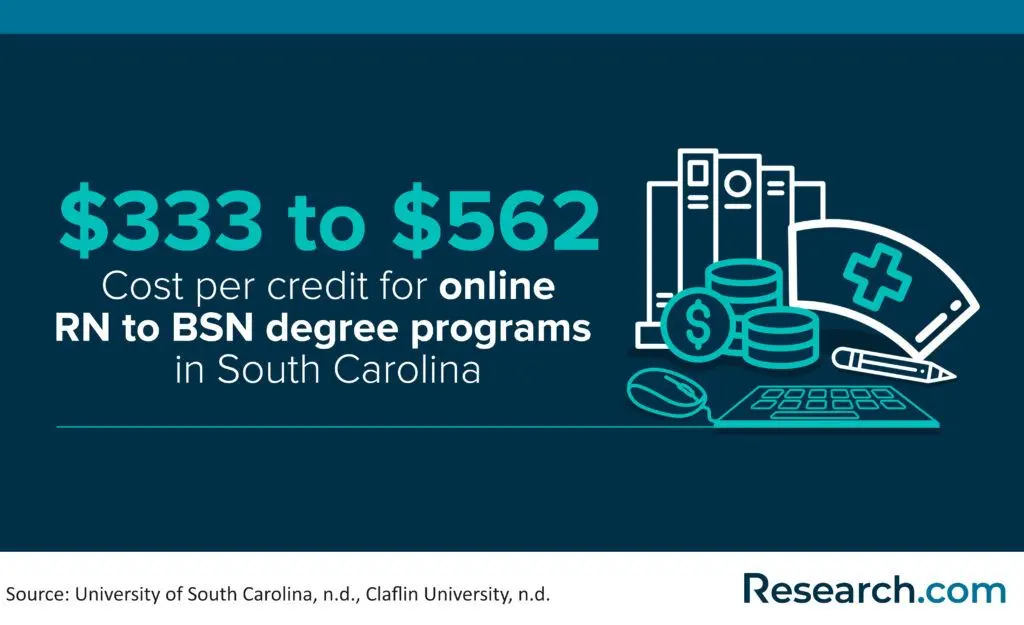
The cost of online nursing programs in South Carolina depends on the degree level, school type, transfer credit policy, and residency pricing. Online RN to BSN tuition provides a useful example: the University of South Carolina lists $333 per credit, while Claflin University lists $562 per credit. Some schools also offer affordable online BSN options that charge the same rate to in-state and out-of-state students.
Tuition is only one part of the total cost. Students should also budget for university fees, books, background checks, immunizations, uniforms or clinical supplies, testing fees, travel to clinical sites, and licensure expenses. If you are already employed in healthcare, ask whether your employer offers tuition reimbursement or a clinical ladder pay increase after BSN completion.
| Cost factor | Why it matters | Question to ask |
| Cost per credit | Determines the core tuition expense | Is the listed rate the same for online, in-state, and out-of-state students? |
| Required credits | A lower per-credit rate may not mean a lower total price | How many credits must I complete at this school after transfer review? |
| Transfer credits | Can reduce time and cost for ADN or prior college graduates | Will my nursing and general education credits transfer? |
| Clinical costs | Travel, health documents, and placement requirements can add expense | Where can I complete clinical or practicum hours? |
| Financial aid | Scholarships, grants, loans, and employer aid can change affordability | Which nursing-specific aid options am I eligible for? |
Students looking for aid should compare federal financial aid eligibility, employer assistance, grants, loans, and nursing scholarships. Within the state, the South Carolina Nurses Foundation lists awards and scholarship opportunities for nursing students and professionals.
How long does it take to become a nurse in South Carolina?
The timeline depends on your starting point. ADN programs are often described as 2 year nursing programs in South Carolina and can be a faster route to RN eligibility. A traditional BSN usually takes four years (University of South Carolina, n.d.), but it may provide broader preparation for leadership, public health, research, and graduate study.
Licensed RNs with an ADN can use an RN to BSN pathway to strengthen professional nursing knowledge and critical-thinking skills in two years. RNs with an ADN or BSN may also compare RN to MSN programs, which combine BSN and MSN coursework in one to one and a half years and can lead to specialties such as family nurse practitioner or adult gerontology nurse practitioner. Some online RN to MSN programs and Doctor of Nursing Practice options take three to six years to complete (University of South Carolina, n.d.).
| Pathway | Typical student | Time noted in source material | Best for |
| ADN | New nursing student | 2 year nursing programs in South Carolina | Students seeking a quicker RN route |
| Traditional BSN | New undergraduate student | Four years | Students who want broader bachelor’s-level preparation |
| RN to BSN | RN with an ADN | Two years | Working nurses seeking BSN completion |
| RN to MSN | RN with ADN or BSN preparation | One to one and a half years | Nurses planning graduate-level advancement |
| DNP | Experienced nurse pursuing advanced practice or leadership | Three to six years | Nurses seeking doctoral-level preparation |
Can you become a nurse in South Carolina with an online degree?
Yes, but the answer depends on the program type. Online RN to BSN programs are common because students are already licensed RNs and can complete much of the academic work remotely. Some LPN to RN, LPN to BSN, MSN, and online master of science in nursing programs also use online coursework, but prelicensure and advanced practice programs still require hands-on clinical experiences.
The key is not whether the lectures are online. The key is whether the program is approved, accredited, clinically appropriate, and aligned with South Carolina licensure expectations. Students should confirm approval by the South Carolina Board of Nursing and look for recognized nursing accreditation, including the Commission on Collegiate Nursing Education (CCNE) or the Accreditation Commission for Education in Nursing (ACEN), depending on the program.
Online learning also requires the right personal fit. Successful students are usually organized, self-directed, comfortable with digital tools, and proactive about deadlines. Some programs use asynchronous lessons, while others include scheduled virtual meetings, group projects, videoconferencing office hours, and dedicated academic advising. Faculty support and clinical placement communication matter as much as the online platform itself.
| Online nursing program feature | Why it matters | Warning sign |
| State approval | Licensure depends on meeting South Carolina requirements | The school cannot clearly explain licensure eligibility |
| CCNE or ACEN accreditation | Accreditation can affect transfer, graduate study, and employer confidence | The program avoids accreditation questions |
| Clinical placement process | Online students still need supervised practice where required | Students must find placements with little support |
| Transfer credit review | Prior ADN or college credits may reduce completion time | The school gives only vague transfer estimates |
| Student support | Advising, tutoring, faculty access, and career services can affect persistence | No clear contact for academic or clinical problems |
Online Nursing Programs in South Carolina for 2027
South Carolina students can compare several online nursing options, particularly RN to BSN programs designed for licensed registered nurses. The programs below are presented as decision points, not as a guarantee of fit. Before applying, verify current tuition, required credits, admission rules, accreditation status, clinical or practicum expectations, and whether the program aligns with your state licensing or graduate school plans. Students comparing faster graduate options may also want to review accelerated nurse practitioner programs.
1. University of South Carolina Upstate
The University of South Carolina Upstate offers an online RN to BSN program built for working registered nurses who want a flexible bachelor’s completion route. Courses are taught by USC Upstate faculty, and students may use in-person office hours at the Greenville Campus if helpful. The program offers five start dates throughout the year and charges in-state tuition rates regardless of residence.
- Program Length: One year
- Cost per Credit: $467
- Tracks/concentrations: Nursing, Administration, Teaching, Research, Consulting
- Required Credits to Graduate: 32
- Accreditation: CCNE
2. Lander University
Lander University provides an online RN to BSN completion program with seven-week courses. The format is designed for students who need access to coursework outside traditional classroom hours. The curriculum supports professional nursing practice in both conventional and varied healthcare settings and can also provide a foundation for graduate study.
- Program Length: One year
- Cost per Credit: $390
- Tracks/concentrations: Nursing, Administration, Teaching, Research, Consulting
- Required Credits to Graduate: 120
- Accreditation: CCNE
3. Anderson University
Anderson University offers an online RN to BSN pathway with seven-week terms and the option to take up to four courses per term. The program accepts transfer credits from associate degree coursework, which may help students satisfy many general education requirements and move through the degree more efficiently.
- Program Length: 15 months
- Cost per Credit: $500
- Tracks/concentrations: Nursing, Administration, Teaching, Research, Consulting
- Required Credits to Graduate: 28
- Accreditation: CCNE
4. Claflin University
Claflin University delivers an online RN to BSN program grounded in liberal arts learning, communication, research, and critical thinking. Coursework addresses community health improvement, population assessment and management, and the use of evidence-based practice in nursing decisions.
- Program Length: One year
- Cost per Credit: $562
- Tracks/concentrations: Nursing, Administration, Teaching, Research, Consulting
- Required Credits to Graduate: 30
- Accreditation: CCNE
5. University of South Carolina
The University of South Carolina offers an online RN to BSN program for registered nurses who want to expand professional preparation. The curriculum combines didactic learning and practicum experiences, with attention to leadership, professional growth, and career mobility. Students can also access academic coaching, the student success center, peer tutoring, and the career center.
- Program Length: One year
- Cost per Credit: $333
- Tracks/concentrations: Nursing, Administration, Teaching, Research, Consulting
- Required Credits to Graduate: 123
- Accreditation: CCNE
| School | Program length | Cost per credit | Required credits to graduate | Accreditation |
| University of South Carolina Upstate | One year | $467 | 32 | CCNE |
| Lander University | One year | $390 | 120 | CCNE |
| Anderson University | 15 months | $500 | 28 | CCNE |
| Claflin University | One year | $562 | 30 | CCNE |
| University of South Carolina | One year | $333 | 123 | CCNE |
What are the essential nursing license requirements in South Carolina?
South Carolina licensure is built around education verification, identity documentation, exam eligibility, and ongoing renewal. Candidates must complete an approved nursing program, submit the required application materials, register for the NCLEX when applicable, and follow Board of Nursing instructions after receiving results. Requirements can change, so applicants should verify details directly with the board before they apply or relocate. For a deeper step-by-step licensing explanation, see Research.com’s guide to nursing license requirements in South Carolina.
How can online LPN to BSN programs boost your nursing career in South Carolina?
Online LPN to BSN programs can help licensed practical nurses move toward RN-level practice and bachelor’s-level preparation without starting over academically. These pathways are most useful for LPNs who want broader clinical responsibilities, stronger advancement potential, and a foundation for future graduate study. A good program should combine online nursing theory with supervised clinical experiences that satisfy South Carolina requirements. To compare formats and expectations, review this guide to LPN to BSN programs.
| Why LPNs consider BSN pathways | What to verify |
| Move from practical nursing toward registered nursing roles | Whether the program leads to RN eligibility in South Carolina |
| Build stronger leadership and evidence-based practice skills | Whether bachelor’s-level nursing outcomes are clearly stated |
| Keep working while studying | Whether the schedule fits shift work and family obligations |
| Prepare for future MSN or DNP study | Whether credits and accreditation support graduate admission |
What are the admission requirements for online nursing programs in South Carolina?
Admission requirements vary by school and pathway. RN to BSN programs commonly expect an accredited nursing diploma or associate degree, an active RN license or eligibility for RN licensure, college transcripts, and a minimum GPA. Some programs also ask for letters of recommendation, a personal statement, documentation of clinical experience, standardized test scores, or an interview.
Students coming from allied health backgrounds should not assume healthcare experience automatically transfers into nursing credit. If you are still exploring entry-level healthcare education, comparing medical assistant programs in South Carolina may help you understand related patient-care roles before committing to nursing school.
- Request a transcript evaluation before calculating total cost.
- Ask whether your current license must be active in South Carolina before enrollment.
- Confirm whether clinical or practicum sites must be located in South Carolina.
- Check whether the school has separate admission steps for the university and the nursing major.
- Verify technology requirements for online testing, simulations, and virtual meetings.
Are accelerated online FNP options available in South Carolina?
Experienced RNs who want advanced practice roles may consider accelerated online Family Nurse Practitioner options when they already have the academic and clinical background needed for graduate-level study. These programs are designed to develop advanced assessment, diagnosis, patient management, leadership, and evidence-based practice skills. Online coursework may create flexibility, but FNP students still need rigorous clinical experiences that meet program and certification requirements. If speed is a priority, compare the expectations of a 12 month FNP program before deciding whether an accelerated format is realistic for your schedule.
What are the employment outcomes and ROI for graduates of online nursing programs in South Carolina?
Return on investment depends on more than tuition. A lower-cost program may be a poor choice if it has weak advising, unclear licensure alignment, or limited clinical support. A more expensive program may be worthwhile if it accepts transfer credits, supports working nurses, and helps graduates qualify for roles that match their goals. Students should compare licensure exam preparation, completion support, career services, employer partnerships, alumni outcomes, and total debt. Reviewing accredited nursing schools in South Carolina can provide additional context for evaluating program quality.
| ROI factor | Why it matters | Better way to evaluate it |
| Tuition alone | It does not show the full cost | Compare total program cost after transfer credits and fees |
| Program length | Fast programs can be intense | Ask whether the schedule fits your work and clinical availability |
| Accreditation | Can affect graduate school and employer acceptance | Verify CCNE, ACEN, or relevant accreditation directly |
| Licensure outcomes | Prelicensure students need exam readiness | Ask for NCLEX preparation details and support services |
| Career services | Support can help with advancement | Look for advising, resume help, employer connections, and alumni networks |
Is South Carolina good for nursing?
South Carolina can be a strong nursing market for students who choose the right credential and understand licensure requirements. The state’s aging population and healthcare access needs support demand for nursing professionals. The projected 21% nursing deficit in 2026 (Nightingale, 2026) further highlights the importance of workforce development in the state.
Students can choose from online LPN programs in South Carolina, traditional BSN pathways, RN to BSN completion routes, and accelerated or graduate options. The South Carolina Board of Nursing helps protect the public by licensing qualified nurses and approving nursing education programs. For students, this means program approval is not a minor detail; it is central to whether the degree supports licensure and employment.
What can I do with a nursing degree in South Carolina?
A nursing degree can lead to work in hospitals, outpatient clinics, long-term care facilities, schools, public health agencies, specialty practices, home health, and community health settings. Career options depend on your credential. CNAs and LPNs focus on foundational patient care. RNs provide broader assessment, care coordination, medication administration, patient education, and clinical decision-making. APRNs move into advanced roles such as nurse practitioner or nurse midwife after graduate study and certification.
South Carolina’s projected 21% nursing shortage by 2026 points to continued need for qualified nurses (Nightingale, 2026). Compensation varies by role, employer, location, shift, specialty, education, and experience. For registered nurses, the average annual salary in South Carolina is $79,900, with a median hourly wage of $38.42 (US BLS, 2024).
| Nursing credential | Common settings | Typical next step |
| CNA | Long-term care, hospitals, home care | LPN or ADN program |
| LPN | Clinics, long-term care, physician offices, home health | LPN to RN or LPN to BSN |
| RN with ADN | Hospitals, clinics, long-term care, community health | RN to BSN |
| RN with BSN | Acute care, leadership tracks, public health, specialty units | MSN, DNP, certification, or management |
| APRN | Primary care, specialty care, women’s health, advanced practice clinics | Specialty certification, leadership, or doctoral practice |
What are the pathways for non-nurses to enter nursing in South Carolina?
People without prior nursing education can enter the field through several routes. An ADN can be a faster way to become eligible for RN licensure, while a traditional BSN offers bachelor’s-level preparation from the start. Students who already hold a non-nursing bachelor’s degree may consider accelerated BSN programs, which can prepare career changers for the NCLEX-RN in as little as 12 to 18 months.
Some online or hybrid nursing programs are designed for non-nurses, but students should be careful with terminology. A program may advertise online coursework while still requiring in-person labs, simulations, and clinical rotations. Before applying, confirm South Carolina Board of Nursing approval, CCNE or ACEN accreditation where applicable, and clinical placement expectations. Research.com’s guide to online BSN programs for non nurses can help career changers compare available options.
What complementary certifications can enhance my online nursing education in South Carolina?
Additional credentials can strengthen a nursing career when they support a clear goal. Some nurses pursue certifications tied to specialty practice, informatics, leadership, case management, or healthcare operations. Others add administrative skills to better understand billing, coding, compliance, documentation, and reimbursement workflows. If you are interested in the administrative side of healthcare, this guide on how to become a medical biller and coder in South Carolina explains a related path that can complement clinical knowledge.
The best certification is not always the one with the most impressive title. Choose credentials that match your workplace, patient population, and long-term career plan. Ask employers which certifications they recognize, whether they reimburse exam fees, and whether the credential affects promotion or specialty assignment.
How can online nursing programs help advance my career?
Online nursing programs can help working nurses continue their education without leaving the workforce. RN to BSN, RN to MSN, MSN, and DNP formats may allow nurses to study around shifts, family responsibilities, and clinical obligations. The strongest programs combine flexibility with real academic support, clear clinical planning, and relevant coursework in leadership, research, health assessment, population health, quality improvement, or advanced practice.
Online RN to BSN programs are especially useful for ADN-prepared RNs who want bachelor’s-level credentials. Some programs reduce or remove additional clinical requirements for experienced nurses, depending on curriculum design and state expectations. If that is a priority, compare online RN to BSN programs without clinical requirements and confirm the details directly with each school.
- Choose online study if: you are already licensed, need schedule flexibility, can manage deadlines independently, and have reliable technology access.
- Be cautious if: you need heavy in-person support, have an unpredictable schedule, or cannot travel for labs or clinical experiences when required.
- Prioritize programs that: publish clear tuition, explain transfer credits, provide advisor access, and state how clinical or practicum requirements are completed.
What challenges do online nursing students face in South Carolina?
Online nursing students often underestimate the structure required to succeed. Coursework may be flexible, but exams, discussion deadlines, simulations, clinical documentation, and practicum hours still follow strict schedules. Students may also face limited local clinical placement options, especially if they live far from partner facilities or need a specific specialty site.
Technology can also become a barrier. Online nursing students may need a stable internet connection, webcam access, virtual simulation tools, remote testing software, and comfort with learning management systems. Students considering practical nursing as an entry point can review how to become an LPN in South Carolina to better understand early clinical training expectations.
| Common mistake | Why it creates problems | Better approach |
| Choosing based only on tuition | Fees, transfer rules, and clinical travel can change total cost | Calculate full program cost before applying |
| Ignoring accreditation | Unaccredited programs may limit licensure, employment, or graduate study options | Verify approval and accreditation directly |
| Assuming online means no clinical work | Nursing requires supervised hands-on practice | Ask exactly where and how clinical hours are completed |
| Relying only on rankings | A highly ranked school may not fit your schedule, budget, or license goal | Compare program fit, not just reputation |
| Waiting to ask about transfer credits | Late credit reviews can delay graduation plans | Request an official transfer evaluation early |
How can I transition into advanced practice roles after completing an online nursing program in South Carolina?
To move into advanced practice, nurses usually need graduate education, specialty coursework, advanced clinical hours, certification preparation, and compliance with state requirements. Online nursing programs can support this transition through MSN, DNP, or post-graduate tracks, but students must confirm that the program’s specialty aligns with their desired role. For APRN planning, clinical placement support is especially important because advanced practice students need experiences tied to their population focus. For role-specific guidance, see how to become a nurse practitioner in South Carolina.
How do online nursing programs integrate clinical practicum requirements in South Carolina?
Online nursing programs handle clinical requirements by combining remote coursework with local or regional hands-on experiences. Schools may coordinate with hospitals, clinics, community agencies, simulation centers, or approved preceptors. The exact process varies: some schools arrange placements, while others expect students to identify potential sites that the program then approves.
Before enrolling, ask who is responsible for finding placements, whether the school has existing South Carolina partners, how far students typically travel, and what happens if a placement falls through. Students planning RN licensure can use this guide on how to become an RN in South Carolina to connect educational steps with practical licensing requirements.
What are the steps to become an LVN in South Carolina?
South Carolina more commonly uses the term LPN, while LVN is used in some other states. If you see LVN language while researching programs, verify that the pathway actually aligns with South Carolina practical nursing requirements. In general, practical nursing candidates complete an approved program, finish required clinical training, pass the relevant licensing examination, and meet renewal or continuing education expectations. For a step-by-step explanation, review how to become an LVN nurse in South Carolina.
How can I specialize as a nurse midwife through online education in South Carolina?
Nurse midwifery is an advanced practice specialty focused on reproductive, prenatal, birth, postpartum, and newborn care. Online education can support this goal through graduate coursework, but students still need supervised clinical rotations that meet certification and state expectations. Prospective nurse midwives should compare program accreditation, clinical site support, faculty expertise, certification preparation, and whether the curriculum fits South Carolina practice requirements. For a focused pathway overview, read how to become a nurse midwife in South Carolina.
How to choose the right online nursing program in South Carolina
The best online nursing program is the one that matches your current credential, licensing goal, budget, learning style, and career plan. A school may be reputable but still be a poor fit if it does not accept your transfer credits, cannot support your clinical placement area, or requires a schedule that conflicts with your work shifts.
- Start with your end goal. Decide whether you want CNA entry, LPN practice, RN licensure, BSN completion, advanced practice, leadership, or doctoral preparation.
- Confirm state approval. Check whether the program supports South Carolina licensure or advancement requirements.
- Verify accreditation. Look for recognized nursing accreditation such as CCNE or ACEN when applicable.
- Request a transfer review. Do not rely on rough estimates if you have prior college or ADN credits.
- Calculate total cost. Include tuition, fees, books, clinical expenses, technology, licensure, and travel.
- Ask about clinical placement. Find out who secures sites and what support exists if placements are limited.
- Evaluate support services. Prioritize programs with advising, tutoring, faculty access, career services, and technical help.
- Compare workload honestly. Accelerated or seven-week formats can be efficient but demanding.
If you are just beginning nursing school, it may also help to understand what to expect in your first year of nursing school. Experienced nurses planning the highest level of practice can compare online DNP programs as part of a longer-term advancement plan.
Current trends affecting nursing education in South Carolina
Nursing education is changing in ways that matter for online students. Healthcare employers increasingly value nurses who can use electronic health records, telehealth tools, data-informed quality improvement methods, and evidence-based care models. Online programs are also expanding the use of virtual simulations, remote collaboration, and digital assessments to strengthen clinical reasoning before students enter practicum settings.
At the same time, clinical placement capacity remains a real constraint. Even when coursework is fully online, students need supervised practice, and schools must maintain compliance with nursing education rules. This makes early communication with advisors essential, especially for students in rural communities, students working full time, and students pursuing advanced practice specialties.
Becoming a skilled healthcare worker through online nursing programs in South Carolina
Online nursing programs in South Carolina can serve students at very different stages: first-time healthcare students, LPNs, ADN-prepared RNs, BSN-prepared nurses, and future APRNs. The flexibility is valuable, but it should not distract from the essentials. Nursing education must be approved, clinically sound, accredited where appropriate, and aligned with your intended license or credential.
If you want to advance beyond entry-level practice, online MSN and DNP options can support leadership, research, education, and specialized clinical roles. The strongest decision is not simply choosing the fastest or cheapest program. It is choosing the program that helps you qualify for the role you actually want while keeping cost, time, licensure, and support services in balance.
Related Articles for Nearby States
- 2027 Best Online Nursing Programs in Georgia – Accredited RN to BSN Programs
- 2027 Best Online Nursing Programs in North Carolina – Accredited RN to BSN Programs
- 2027 Best Online Nursing Programs in Florida – Accredited RN to BSN Programs
- 2027 Best Online Nursing Programs in Tennessee – Accredited RN to BSN Programs
- 2027 Best Online Nursing Programs in Alabama – Accredited RN to BSN Programs
- 2027 Best Online Nursing Programs in Kentucky – Accredited RN to BSN Programs
- 2027 Best Online Nursing Programs in Mississippi – Accredited RN to BSN Programs
- 2027 Best Online Nursing Programs in West Virginia – Accredited RN to BSN Programs
- 2027 Best Online Nursing Programs in Louisiana – Accredited RN to BSN Programs
- 2027 Best Online Nursing Programs in Arkansas – Accredited RN to BSN Programs
Key Insights
- Online nursing programs in South Carolina are most straightforward for licensed RNs completing a BSN, but prelicensure and advanced practice programs still require in-person clinical training.
- Program approval and accreditation should be checked before cost, convenience, or rankings. A flexible program is not useful if it does not support licensure or career advancement.
- RN to BSN costs vary by school, with examples ranging from $333 per credit at the University of South Carolina to $562 per credit at Claflin University.
- South Carolina RN applicants must complete an approved program, apply for state licensure, pay the $90 application fee, register for the NCLEX-RN, pay the $200 exam fee, and meet renewal requirements after licensure.
- Career changers can enter nursing through ADN, BSN, or accelerated BSN pathways, while licensed LPNs and RNs can use bridge or completion programs to advance.
- Do not assume “online” means easier or fully remote. Nursing students still need discipline, technology readiness, clinical access, and strong communication with advisors.
- The best program is the one that fits your current credential, South Carolina licensing needs, transfer credits, total cost, clinical placement realities, and long-term career goal.
References:
- Carson-Newman. (2025). By the Numbers: Nursing Statistics 2025. https://onlinenursing.cn.edu/news/nursing-by-the-numbers
- NCSBN. (2025). 2024 National Nursing Workforce Study. https://www.ncsbn.org/workforce
- United States Census Bureau. (n.d.). QuickFacts South Carolina. https://www.census.gov/quickfacts/fact/table/SC/AGE775222
- University of South Carolina. (n.d.). College of Nursing Compare Programs. https://sc.edu/study/colleges_schools/nursing/academic_programs/compare_programs.php
- US BLS. (2025). Registered Nurses. https://www.bls.gov/ooh/healthcare/registered-nurses.htm
Other Things You Should Know About Online Nursing Programs in South Carolina
Online RN to BSN programs in South Carolina are designed with flexibility to accommodate working nurses. They offer asynchronous classes and part-time study options, allowing professionals to balance their work schedules while advancing their education. This format is ideal for those who cannot attend traditional in-person classes.
Most South Carolina RN to BSN programs do not require a traditional clinical rotation, but they usually include practicum or community-based learning. Some programs require about 30 to 120 supervised practice hours, completed in approved healthcare settings under faculty oversight.
Enrolling in an online RN to BSN program in South Carolina requires a reliable internet connection, a computer with the latest operating system, and access to specific software like learning management systems. Check with individual programs for detailed technical specifications.