
2027 Best Online Nursing Programs in Hawaii – Accredited RN to BSN Programs

Co-Founder and Chief Data Scientist
Choosing an online RN to BSN program in Hawaii is not just a degree decision. It affects where you can work, how easily you can move into leadership or specialty roles, whether your schedule can handle school, and whether the program meets Hawaii nursing expectations. The decision is especially important for nurses on Maui and Kaua‘i, where online options may be the most practical route for working RNs who cannot relocate or commute regularly.
A BSN can also matter in hiring. According to recent AACN findings, nearly 72% of employers strongly prefer BSN-prepared nurses. For Hawaii-based registered nurses who already hold an ADN or nursing diploma, an RN to BSN program can be a focused way to build stronger skills in leadership, evidence-based practice, population health, informatics, and community nursing without starting over.
This guide explains what to expect from online RN to BSN programs in Hawaii, how long they take, what they cost, how online and campus formats compare, what admission requirements to expect, and how to evaluate whether a program is worth your time and money.
Quick answer: Is an online RN to BSN program in Hawaii worth it?
An online RN to BSN program in Hawaii can be worth it for licensed RNs who want better access to leadership roles, specialty nursing pathways, public health work, graduate nursing programs, or employer-preferred BSN credentials while continuing to work. It is most useful when the program is accredited, accepts a strong number of transfer credits, fits your work schedule, and aligns with Hawaii licensure and employer requirements.
What are the benefits of enrolling in an online RN to BSN program in Hawaii?
- More career mobility: A BSN may help Hawaii RNs qualify for roles such as nurse manager, clinical nurse specialist, nurse educator, public health nurse, or other positions that often favor baccalaureate-prepared nurses.
- Stronger earning potential: RNs in Hawaii had a median salary of $126,459 annually in 2024, and a BSN can support advancement into higher-responsibility positions, although salary outcomes depend on experience, employer, location, specialty, and shift differentials.
- Better fit for working nurses: Online RN to BSN programs allow RNs to continue working while completing coursework. For working RNs with ADNs in Maui and Kaua‘i, online programs are the only options.
- Preparation for graduate study: A BSN is often a key step toward MSN, nurse practitioner, nurse midwife, nurse educator, and DNP pathways.
What can I expect from enrolling in an online RN to BSN nursing program in Hawaii?
An online RN to BSN program is designed for registered nurses who already have foundational nursing education and clinical experience. Instead of repeating entry-level nursing training, the curriculum usually focuses on broader professional practice: leadership, patient safety, community health, healthcare systems, nursing research, informatics, and evidence-based care.
- Coursework typically covers leadership, community health, evidence-based practice, healthcare informatics, ethics, population health, and quality improvement.
- Some programs include hands-on projects, practice experiences, or clinical components that allow students to apply BSN-level concepts in healthcare or community settings.
- Faculty support, advising, mentorship, and online learning resources can make a major difference, especially for students balancing school with full-time nursing work.
- Many students complete an RN to BSN program in one to two years, depending on transfer credits, course load, and whether they study full time or part time.
- Costs for an RN to BSN program in Hawaii may range from $300 to $400 per credit, although individual programs may charge more or less.
| What to evaluate | Why it matters | What to ask before applying |
| Accreditation | Accreditation affects transferability, employer recognition, graduate school eligibility, and overall program quality. | Is the program accredited by CCNE or ACEN? |
| Transfer credits | More accepted credits can shorten the program and reduce total tuition. | How many ADN or diploma credits will transfer? |
| Clinical or practice requirements | Some online programs still require local projects, practicums, or community-based work. | Can requirements be completed near my home or workplace? |
| Schedule format | Asynchronous courses are often easier for shift workers than fixed meeting times. | Are lectures live, recorded, or self-paced? |
| Cost beyond tuition | Fees, books, technology costs, and travel can change the real price. | What is the total estimated cost after transfer credits? |
Where can I work after finishing an online RN to BSN program in Hawaii?
BSN-prepared nurses in Hawaii can work across hospital, community, long-term care, specialty, education, public health, and administrative settings. A BSN does not automatically guarantee promotion, but it can make a nurse more competitive for roles that involve care coordination, leadership, quality improvement, staff education, or population health.
- hospitals
- clinics
- long-term care facilities
- community health organizations
- specialty clinics
- schools
- government agencies
- research institutions
- public health organizations
Common roles for graduates include staff nurse, charge nurse, nurse manager, clinical nurse specialist, nurse educator, public health nurse, care coordinator, or case management nurse. Some of these roles may require additional experience, certification, graduate education, or employer-specific qualifications.
How much can I make after finishing my RN to BSN program in Hawaii?
In 2024, the average annual salary for RNs in Hawaii stood at $126,459. Actual earnings vary by island, city, employer, experience level, specialty, shift, union contract, overtime, and whether the role includes leadership responsibilities.
RNs with less than one year of experience earn an average of $114,293 annually, while those with over 10 years of experience may earn as much as $149,379 per year. By location, Honolulu reported an average annual salary of $144,130, followed by Kamuela at $140,044 and Kealakekua at $127,710.
| Salary factor | What the data shows | How a BSN may help |
| Overall RN salary in Hawaii | Average annual salary of $126,459 in 2024 | A BSN may support eligibility for advancement, leadership, or specialty roles. |
| Experience | Less than one year: $114,293; over 10 years: up to $149,379 | Education and experience together often matter more than degree level alone. |
| Location | Honolulu: $144,130; Kamuela: $140,044; Kealakekua: $127,710 | RNs should compare regional pay against housing, commute, and cost-of-living factors. |
A BSN from a strong RN to BSN program can improve your qualifications, but it should be viewed as one part of a broader career plan that may also include specialty certification, strong clinical performance, leadership experience, and graduate education.
- 2027 online accredited RN to BSN programs in Hawaii
- How long does an online RN to BSN program in Hawaii take?
- Online versus on-campus RN to BSN programs in Hawaii
- Average cost of online RN to BSN programs in Hawaii
- Financial aid options for online RN to BSN students in Hawaii
- Admission prerequisites for online RN to BSN programs in Hawaii
- Common RN to BSN courses in Hawaii
- How to choose the right online RN to BSN program in Hawaii
- Career paths after an online RN to BSN program in Hawaii
- Hawaii licensure and certification process
- State-specific licensing steps for RN-to-BSN graduates
- RN to BSN preparation for advanced nursing degrees
- Collaboration with allied health professionals
- Academic difficulty of online RN to BSN programs
- Support services that improve student success
- What LVNs should consider before advancing
- Pathway from RN to BSN to nurse practitioner
- Non-clinical nursing roles and medical billing and coding
- Pathway from RN to BSN to nurse midwife
- Can LPNs enter RN to BSN programs directly?
- Job market for online RN to BSN graduates in Hawaii
- Community health nursing and rural healthcare access
- DNP opportunities and salary potential in Hawaii
2027 Best Online Accredited RN to BSN Programs in Hawaii
How do we rank schools?
Research.com evaluates programs using education and institutional data from credible sources, including the IPEDS database from the National Center for Education Statistics, Peterson's database, and its Distance Learning Licensed Data Set. We also review information on costs and outcomes from the College Scorecard.
Our methodology is designed to give prospective students transparent information they can use when comparing online RN to BSN programs in Hawaii. Rankings should be used as a starting point, not as the only deciding factor. Accreditation, transfer credits, clinical requirements, schedule flexibility, and total cost should all be reviewed before applying.
1. University of Hawai'i at Manoa RN to BSN Program
The University of Hawai'i at Manoa offers an online RN to BS program for associate degree and diploma graduates from different nursing education systems. Students may enter in fall or spring and can complete the program in two or more semesters, depending on whether they attend part time or full time.
UH System graduates may be able to begin without an RN license, while non-UH System graduates may need to meet different entry requirements. The program emphasizes professional development, expanded nursing practice, cultural competence, and advanced population health. Asynchronous lectures support working nurses, and worksite cohorts with local healthcare partners help strengthen BS-prepared nursing practice in patient care settings.
- Program Length: 2 to 3 semesters
- Specialization: Advanced Population Health
- Required Credits to Graduate: 120 (30 major credits)
- Cost per Credit: $471
- Accreditation: Commission on Collegiate Nursing Education (CCNE)
2. University of Hawai'i at Hilo
University of Hawai'i at Hilo offers an RN to BSN program with a focus on lifelong learning, culturally congruent care, rural health, and service to multi-ethnic communities. Its distance education format includes a transcultural emphasis and supports professional networking across the islands.
Students complete online theory courses and participate in community health projects and rural clinical experiences. The program also uses a learning lab with simulated hospital environments. Three courses include clinical components, helping students connect online learning with real healthcare practice in rural and diverse communities.
- Program Length: 1 year
- Required Credits to Graduate: 120 (30 major credits)
- Tuition: $7,344 (in-state); $11,016 (WUE/Pacific Islander); $20,304 (out-of-state)
- Accreditation: Commission on Collegiate Nursing Education (CCNE)
3. Columbia College Honolulu
Columbia College Honolulu offers a fully online accredited RN to BSN program for working RNs who want to strengthen clinical judgment, leadership ability, patient safety knowledge, and healthcare systems understanding. The program is built to help nurses continue working while completing BSN-level coursework.
The curriculum focuses on evidence-based practice, safety, technology, collaboration, client care, education, nursing management, and quality improvement. Students develop skills in complex reasoning, decision-making, healthcare policy, and patient outcomes improvement.
- Program Length: 6 semesters
- Required Credits to Graduate: 120 (27 major credits)
- Cost per Credit: $375
- Accreditation: Commission on Collegiate Nursing Education (CCNE)
4. Herzing University
Herzing University offers a 12-month RN to BSN program for ASN and ADN graduates preparing for BSN-level nursing roles. Coursework includes public health nursing, nursing informatics, evidence-based practice, and related professional nursing topics.
The program is structured for non-traditional students and includes virtual services such as academic advising, tutoring, and technical support. Students may also pursue dual credit toward an MSN through the RN to BSN to MSN track or consider the online accelerated RN to MSN option. Herzing allows students to transfer up to 70 semester credit hours.
- Program Length: 12 months
- Required Credits to Graduate: 120 (26 major credits)
- Cost per Credit: $471
- Accreditation: Commission on Collegiate Nursing Education (CCNE)
5. Franklin University
Franklin University offers an online RN to BSN pathway for registered nurses with an ADN or nursing diploma. The program can be completed in 12 months and includes 9 six-week online courses with no required clinicals.
Coursework emphasizes nursing leadership, clinical competence, personalized medicine, evidence-based practice, and current healthcare trends. The format is designed for working nurses who need a manageable academic schedule while preparing for graduate-level study or expanded career options.
- Program Length: 12 months
- Required Credits to Graduate: 120 (32 major credits)
- Cost per Credit: $298 (in-state); $526 (international); $298 (out-of-state)
- Accreditation: Commission on Collegiate Nursing Education (CCNE)
| Program | Best fit | Important consideration |
| University of Hawai'i at Manoa | RNs seeking a Hawaii-based program with advanced population health emphasis | Review license requirements based on whether you are a UH System or non-UH System graduate. |
| University of Hawai'i at Hilo | RNs interested in rural health, transcultural care, and community-focused practice | Clinical components are included in three classes. |
| Columbia College Honolulu | Working RNs who want a fully online program with leadership and quality focus | The program spans 6 semesters. |
| Herzing University | RNs seeking an accelerated route with MSN pathway options | Transfer policies can affect the actual time and cost. |
| Franklin University | RNs who want short online courses and no required clinicals | Students should confirm how credits transfer and whether the format fits their schedule. |
Key Findings
- There are only four BSN degree programs available in Hawaii institutions. Only two offer online RN to BSN programs, making them the go-to options for RNs in Maui and Kaua‘i as institutions only offer LPN and ADN programs.
- About 67% of Hawaii RNs do not have any national certifications for specializations. Only 6% and 5% have certifications for acute/critical care and medical-surgical roles, respectively.
- In 2025, only 29% of RNs in Hawaii were enrolled in Hawaii nursing degree-granting institutions.
- The majority of RNs enrolled in any nursing degree program, at 77%, chose distance-learning education.
- Honolulu, Kamuela, and Kealakekua were the highest-paying cities for RNs in Hawaii in 2024, with salaries ranging from $127,710 to $144,130.
What graduates say about online RN to BSN programs
-
: "
I needed a BSN option that did not require moving or taking long breaks from work. Online study helped me avoid travel and housing costs while still moving toward advancement. Earning the BSN gave me more confidence and opened new nursing options. — Mark
"
-
: "
Working as an RN while returning to school felt difficult at first, but the online format made it possible. I could study around my shifts, keep my job, and build stronger professional skills. — Lisa
"
-
: "
Moving from an ADN to a BSN in Hawaii was intimidating because my island did not have an in-person BSN option. Remote learning gave me a practical path forward while I continued meeting my responsibilities as an RN. — Jennifer
"
How long does it take to complete an online RN to BSN nursing program in Hawaii?
Online RN to BSN completion time in Hawaii depends mainly on transfer credits, course load, program format, and whether the student enrolls full time or part time. Some students finish in two to three semesters, while others choose a one-year plan or a longer six-semester schedule.
Accelerated options may be completed within twelve months, but faster does not always mean better. Nurses working rotating shifts, caring for family members, or completing clinical or community requirements may benefit from a slower pace that protects academic performance and reduces burnout.
| Timeline | Who it may fit | Trade-off |
| 2 to 3 semesters | RNs with strong transfer credits and time for a heavier course load | Fast completion may require careful schedule control. |
| 1 year | Motivated students who can manage condensed coursework | Less flexibility if work demands increase. |
| 6 semesters | Working nurses who need a steadier part-time pace | Longer time to degree may increase total fees or delay career benefits. |
| 12 months | RNs seeking an accelerated BSN pathway | Students should verify workload, transfer credit rules, and support services. |
How does an online RN to BSN nursing program in Hawaii compare to an on-campus program?
When comparing online RN to BSN nursing programs with on-campus study, the biggest differences are schedule control, access, interaction style, and clinical or practice logistics.
Online programs are often better for licensed nurses who need to continue working, live outside Honolulu, or cannot commute regularly. Coursework may be asynchronous, allowing students to complete lectures, discussions, and assignments around shifts and family obligations.
On-campus programs can provide more direct access to instructors, classmates, labs, and campus resources. For some students, face-to-face discussion and structured class times improve accountability. However, fixed schedules and commuting can be difficult in Hawaii, where geography limits access to BSN programs.
The practical reality is that Hawaii has only four BSN programs based in the state, and only two of them offer online RN to BSN options. For many RNs, especially those on islands without local BSN access, online study is not simply convenient; it may be the only realistic route.
| Format | Advantages | Limitations | Best for |
| Online RN to BSN | Flexible scheduling, no regular commute, better access for outer-island nurses | Requires self-discipline and reliable technology | Working RNs, shift workers, Maui and Kaua‘i nurses, students with family obligations |
| On-campus RN to BSN | In-person connection, campus resources, structured schedule | Commute and fixed class times can be barriers | Students near campus who prefer face-to-face learning |
What is the average cost of online RN to BSN programs in Hawaii?
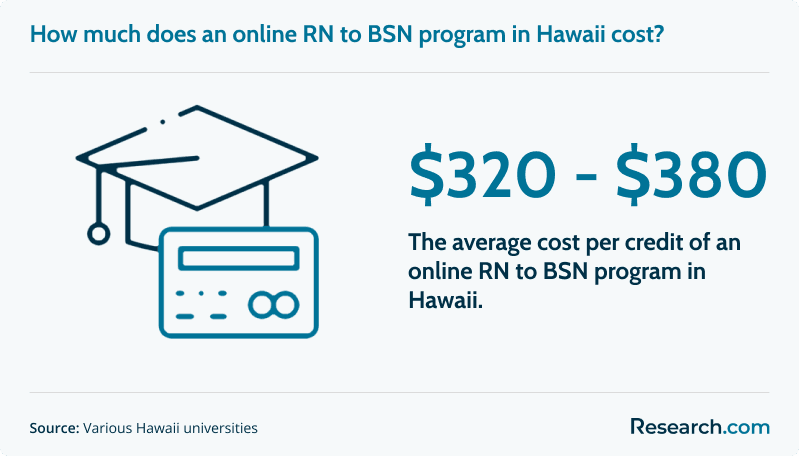
For in-state students, the average cost per credit is approximately $320, while out-of-state students can expect to pay around $380 per credit. The final cost depends on residency status, transfer credits, program fees, books, required technology, and the number of credits still needed after an ADN or diploma program.
For 120 credits, the average total tuition for in-state students is approximately $46,770, whereas out-of-state students may pay the same amount. If a student has 90 transferrable credits from an ADN program, the average total tuition for the remaining 30 credits is $10,820 for in-state students and $12,930 for out-of-state students.
Maximizing accepted transfer credits can make a major difference. For nurses comparing degree routes, transfer-friendly RN to BSN options may be one of the fastest paths to become a nurse with BSN qualifications.
| Cost scenario | Estimated tuition | What to verify |
| Average in-state cost per credit | Approximately $320 | Whether additional nursing, online, lab, or technology fees apply |
| Average out-of-state cost per credit | Around $380 | Whether distance learners qualify for a lower tuition category |
| 120-credit total tuition estimate | Approximately $46,770 for in-state students; out-of-state students may pay the same amount | How many credits are actually required after transfer evaluation |
| Remaining 30 credits after 90 transfer credits | $10,820 in-state; $12,930 out-of-state | Whether all prior nursing and general education credits are accepted |
What are the financial aid options for students enrolling in an online RN to BSN program in Hawaii?
Online RN to BSN students in Hawaii may be able to use federal aid, state aid, institutional aid, scholarships, employer tuition support, military education benefits, or payment plans. The right mix depends on enrollment status, school eligibility, FAFSA results, employer policies, and whether the student attends full time or part time.
- Federal financial aid: Eligible students may qualify for grants, loans, and work-study options through the U.S. Department of Education.
- State and institutional aid: Hawaii-based schools and the University of Hawaii System may provide aid resources for online or distance learners.
- Nursing scholarships: Professional nursing associations, healthcare organizations, community foundations, and private donors may fund students pursuing BSN completion.
- Employer tuition reimbursement: Hospitals, clinics, and healthcare systems may help pay tuition for nurses who commit to continued employment or meet performance requirements.
- Military benefits: Eligible service members, veterans, and dependents should ask whether benefits apply to the specific program.
- Payment plans: Installment plans can reduce upfront costs, but students should check fees and deadlines.
Before borrowing, compare the total program cost against realistic career goals. A lower tuition program is not automatically the best choice if it lacks accreditation, weakens graduate school options, or does not provide enough support for working nurses.
What are the prerequisites for enrolling in an online RN to BSN program in Hawaii
Admission requirements vary by school, but most online RN to BSN programs in Hawaii are built for applicants who already have registered nurse preparation and are ready for upper-division nursing coursework.
- Registered Nurse (RN) licensure: Applicants generally need a current and unrestricted RN license in Hawaii or licensure in the state where any required clinical or practice experience will be completed.
- ADN or nursing diploma: Most programs require completion of an Associate Degree in Nursing or diploma in nursing from an accredited institution.
- Minimum GPA: Programs commonly set a GPA requirement, often between 2.5 and 3.0 on a 4.0 scale.
- Prerequisite courses: Anatomy, physiology, microbiology, statistics, and other general education or science courses may be required.
- Professional experience: Some programs prefer applicants with RN work experience, although this is not always required.
- Letters of recommendation: Schools may request references from clinical supervisors, healthcare colleagues, or instructors.
- Personal statement: Applicants may need to explain their nursing goals, reasons for pursuing the BSN, and readiness for online learning.
Do not assume requirements are identical across schools. Ask each program for a transcript review before applying, especially if you completed your ADN outside the University of Hawaii System or have older credits.
What courses are typically in the best online RN to BSN programs in Hawaii?
RN to BSN courses build on existing RN skills and shift the focus toward broader professional judgment, leadership, public health, evidence-based practice, and systems-level care. Course titles vary, but the core themes are similar across many programs.
- Nursing Research and Evidence-Based Practice: Students learn how to evaluate research, interpret evidence, and apply findings to clinical decision-making.
- Health Assessment and Promotion: This course develops advanced assessment, screening, health education, and prevention skills across the lifespan.
- Nursing Leadership and Management: Students study leadership theory, healthcare policy, organizational behavior, staffing, communication, and quality improvement.
- Community Health Nursing: Coursework focuses on population health, epidemiology, health disparities, community assessment, and public health interventions.
- Nursing Ethics and Legal Issues: Students examine professional accountability, patient rights, ethical reasoning, scope of practice, and legal standards.
What types of specializations are available in the nursing programs in Hawaii?
RN to BSN programs may not always provide formal specializations, but Hawaii nursing pathways can lead to focused areas of practice through electives, certifications, graduate degrees, or employer-based training. Common advanced or specialized directions include:
- Advanced Population Health RN: Nurses focus on improving health outcomes for communities or defined populations through programs, policies, education, and prevention strategies.
- Adult-Gerontology Acute Care Nurse Practitioner (NP): This pathway prepares nurses to manage complex acute and chronic conditions in adult and older adult patients, usually after graduate education.
- Family Nurse Practitioner (NP): Family NPs provide primary care across the lifespan, including diagnosis, treatment, prevention, and health promotion.
- Executive Leader: Nurse leaders manage teams, departments, budgets, quality initiatives, and strategic priorities within healthcare organizations.
- Psychiatric-Mental Health Nurse Practitioner (NP): Psychiatric-mental health NPs assess, diagnose, and treat mental health conditions across the lifespan, typically after advanced training and certification.
Specialization can be valuable because it connects nursing education to specific patient populations, care settings, and leadership responsibilities. Nurses planning graduate study may also compare cheapest MSN online programs to understand how a BSN can lead into more advanced credentials.
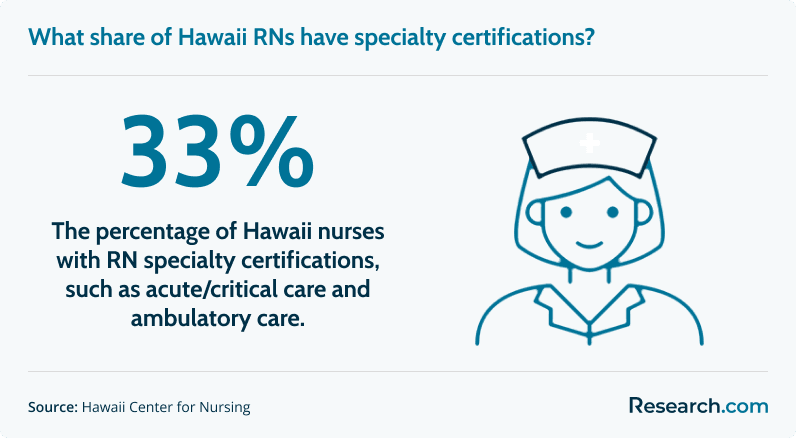
Specialty certification is also an opportunity area in Hawaii. Only 33% of RNs in Hawaii have national specialty certifications. Acute/critical care and medical-surgical nursing are among the most common, but only 6% and 5% of RNs in the state are certified for these skills.
How do you choose the best online RN to BSN programs in Hawaii?
The best program is not always the fastest or cheapest one. For Hawaii nurses, the right choice should match licensure needs, transfer credits, island access, work schedule, budget, academic support, and long-term career goals. If cost is a major concern, compare affordable RN to BSN online programs, but do not judge value by tuition alone.
- Confirm accreditation: Look for recognized nursing accreditation such as ACEN or CCNE. Accreditation supports quality assurance and may affect employer recognition and graduate school admission.
- Request a transfer credit evaluation: Ask how many ADN, diploma, and general education credits will count before estimating completion time or cost.
- Review the curriculum: Make sure the program includes leadership, community health, research, evidence-based practice, informatics, and courses aligned with your goals.
- Check faculty qualifications: Faculty with clinical expertise, advanced degrees, and experience supporting online students can improve the learning experience.
- Understand clinical or practice requirements: Ask whether projects, practicums, or community health experiences can be completed near your location.
- Evaluate flexibility: Determine whether classes are asynchronous, synchronous, accelerated, part time, or cohort-based.
- Compare student support: Look for advising, tutoring, writing help, library access, technical support, disability services, and career guidance.
- Calculate total cost: Include tuition, fees, books, supplies, technology, travel, lost work time, and graduation fees.
| Common mistake | Why it can hurt you | Better approach |
| Choosing only by ranking | A highly ranked program may not fit your schedule, budget, or transfer situation. | Use rankings as a shortlist, then compare accreditation, cost, support, and requirements. |
| Looking only at tuition per credit | Fees and non-transferable credits can raise the real cost. | Ask for a written total cost estimate after transcript review. |
| Assuming online means no in-person work | Some programs include local clinical, practicum, or community projects. | Confirm all field requirements before enrolling. |
| Ignoring accreditation | Non-accredited programs may limit employment, certification, or graduate school options. | Verify nursing accreditation directly with the accreditor and school. |
| Taking too many courses while working full time | Overload can lead to poor performance or withdrawal. | Choose a realistic pace based on shift schedule and personal responsibilities. |
For RNs in Maui and Kaua‘i, where BSN access may be limited, online programs can be the most practical option. Working nurses with full schedules should prioritize programs with flexible pacing, clear expectations, and responsive student support.
What career paths are available for graduates of an online RN to BSN program in Hawaii?
Graduates of RN to BSN programs and related online nursing degree programs in Hawaii can pursue both bedside and non-bedside pathways. Some careers require only a BSN and experience, while others require graduate education, certification, or additional licensure.
- Nursing leadership and management: BSN-prepared nurses may pursue roles such as charge nurse, nurse manager, nursing supervisor, or director of nursing, depending on experience and employer requirements.
- Advanced practice nursing: With graduate education and certification, BSN graduates can move toward nurse practitioner, nurse anesthetist, nurse midwife, or clinical nurse specialist roles.
- Community health nursing: Nurses can work with public health agencies, nonprofit organizations, and community programs focused on prevention, health education, and health equity.
- Education and research: BSN-prepared nurses may support staff education, clinical training, or research initiatives, while formal faculty roles often require graduate education.
- Specialized clinical practice: Nurses can focus on critical care, emergency nursing, oncology, pediatrics, maternal-child health, psychiatric-mental health, gerontology, or medical-surgical nursing.
How do I navigate the licensure and certification process in Hawaii?
RN to BSN graduates who already hold RN licensure usually do not need a new RN license simply because they completed a BSN. However, they must maintain an active license, follow Hawaii Board of Nursing rules, meet renewal requirements, and verify whether any new role requires certification or advanced practice credentials. For a broader explanation of the pathway, review Research.com's guide on how to become an RN in Hawaii.
What are the state-specific licensing steps for RN-to-BSN graduates in Hawaii?
Hawaii licensing steps depend on whether you are applying for initial RN licensure, renewing a license, endorsing a license from another state, or moving into advanced practice. RN-to-BSN graduates should confirm transcript documentation, license status, renewal rules, and any continuing education or employer-specific requirements. Detailed information is available in the guide to nursing license requirements in Hawaii.
How does an online RN to BSN program prepare you for advanced nursing degrees?
An RN to BSN program helps prepare students for graduate nursing study by strengthening academic writing, research interpretation, evidence-based practice, leadership, health assessment, informatics, and systems thinking. These skills are useful for nurses considering graduate credentials, including programs that explain what is an MSN and how it can lead to advanced clinical or leadership roles.
How Does Collaboration with Allied Health Professionals Enhance Nursing Careers in Hawaii?
BSN-prepared nurses often work in interdisciplinary teams with physicians, pharmacists, medical assistants, radiology professionals, therapists, social workers, case managers, and public health specialists. In Hawaii, this collaboration is especially important because patients may move between island-based providers, rural clinics, hospitals, telehealth services, and community organizations. Nurses who understand allied health roles can improve care coordination and patient education. Students exploring related healthcare training can also review medical assistant programs in Hawaii.
How challenging are online RN to BSN programs in Hawaii?
Online RN to BSN programs are usually manageable for experienced RNs, but they still require consistent reading, writing, discussion participation, projects, research assignments, and time management. The hardest part is often not the clinical content; it is balancing coursework with shifts, overtime, family responsibilities, and limited study time. Students who want a realistic view of academic expectations can compare guidance on best online RN to BSN programs and plan their course load carefully.
What Support Services Enhance Student Success in Online RN to BSN Programs in Hawaii?
Strong support services can determine whether an online student persists or withdraws. Look for academic advising, tutoring, writing support, library access, technical assistance, career services, faculty office hours, online orientation, and clear communication channels. Programs connected with accredited nursing schools in Hawaii may also offer institutional resources that help working nurses succeed in a distance-learning environment.
What should LVNs consider when advancing their nursing careers in Hawaii?
LVNs who want to advance in Hawaii should understand that an RN to BSN program is usually not the first step unless they already hold RN licensure. The more typical route is to move from LVN or LPN preparation into an RN pathway, meet licensure requirements, gain RN experience, and then apply to RN to BSN programs. Before choosing a bridge program, review accreditation, prerequisites, clinical requirements, cost, and Hawaii licensing rules. A good starting point is Research.com's guide on how to become an LVN nurse in Hawaii.
How Can RN-to-BSN Graduates Transition to Nurse Practitioner Roles in Hawaii?
RN-to-BSN graduates who want to become nurse practitioners generally need graduate nursing education, advanced clinical training, certification, and compliance with Hawaii advanced practice requirements. The BSN helps establish the academic foundation, but it is not the final credential for NP practice. For a step-by-step explanation, see the guide on how to become a nurse practitioner in Hawaii.
Can Non-Clinical Roles, Including Medical Billing and Coding, Enhance Your Nursing Career in Hawaii?
Some nurses use BSN-level knowledge to move into non-clinical or hybrid roles such as case management, quality improvement, utilization review, informatics, compliance, healthcare administration, education, or medical billing and coding. These roles can be attractive for nurses seeking less physically demanding work, broader healthcare operations experience, or a transition away from direct bedside care. Nurses exploring administrative pathways can review Research.com's guide on how to become a medical biller and coder in Hawaii.
How Can RN to BSN Graduates Transition into Nurse Midwife Roles in Hawaii?
RN to BSN graduates interested in nurse midwifery typically need graduate education in midwifery, supervised clinical preparation, certification, and compliance with Hawaii practice requirements. The BSN can support admission to advanced nursing programs, but midwifery requires specialized preparation in women’s health, prenatal care, labor and birth, postpartum care, and family planning. For details, review the guide on how to become a nurse midwife in Hawaii.
Can LPNs Transition Directly into an RN to BSN Program in Hawaii?
Most RN to BSN programs require active RN licensure, so LPNs typically cannot enter directly unless they first complete an eligible RN pathway. LPNs should compare LPN-to-RN, ADN, and bridge options, then verify how credits may apply later toward a BSN. Anyone at the starting stage can use Research.com's guide on how to become an LPN in Hawaii to understand the first licensure step.
What is the job market for graduates of an online RN to BSN program in Hawaii?
The Hawaii nursing job market offers opportunities for BSN-prepared nurses, but graduates should interpret demand data carefully. A BSN can improve competitiveness, yet hiring still depends on experience, specialty, employer needs, location, and licensure status.
Registered nurses are expected to experience an 8.80% growth rate, translating to 740 average annual openings. Hawaii also has 16,454 active Hawaii state RN licenses and 14,545 RNs already working in nursing license-relevant roles.
Nurse practitioners are projected to see stronger growth, with a projected increase of 52.50% and 50 average annual openings. Nursing instructors and teachers in postsecondary institutions are projected to grow by 26.90%, with 30 average annual openings.
About 11.6% of Hawaii RNs are not currently working in nursing license-relevant roles. For RN to BSN graduates, this reinforces the importance of pairing the degree with practical career planning: specialty certification, networking, strong references, island-specific job research, and realistic salary expectations.
What unique cultural and healthcare challenges do nursing students face in Hawaii?
Nursing students and practicing nurses in Hawaii must be prepared to care for patients across diverse cultural, linguistic, geographic, and socioeconomic contexts. Hawaii’s population includes Native Hawaiian, Pacific Islander, Asian, and other communities with different health beliefs, family structures, languages, and care preferences.
- Cultural competency: Nursing programs may emphasize cultural humility, respectful communication, and awareness of local traditions so students can provide more responsive care.
- Language barriers: Nurses may encounter patients and families who speak Hawaiian, Tagalog, Japanese, Ilocano, or other languages, making interpreter use and clear communication important.
- Healthcare disparities: Remote and rural communities may have fewer healthcare resources, making community health and care coordination especially important.
- Traditional healing practices: Some patients may combine Western medicine with Native Hawaiian approaches such as lomi lomi massage or laʻau lapaʻau. Nurses should respond with respect while maintaining safe, evidence-informed care.
Bridging the Rural Healthcare Gap in Hawaii: Community Health Nursing
Hawaii’s island geography creates access challenges for patients who live far from major hospitals, specialty providers, or consistent primary care. Community health nursing helps address these gaps by bringing prevention, education, care coordination, and public health services closer to patients.
Community health nurses in Hawaii may work with public health departments, nonprofit organizations, clinics, schools, and local agencies. Their work can include health screenings, vaccination outreach, chronic disease education, maternal and child health support, disaster preparedness, and referral coordination.
Chronic illnesses such as diabetes and hypertension can require ongoing education and follow-up, particularly in communities with limited access to providers. Community health nurses help patients understand care plans, connect with resources, and manage barriers such as transportation, cost, language, or digital access.
Natural disasters such as hurricanes or tsunamis also make public health preparation important. Community health nurses may support emergency planning, community needs assessment, education campaigns, medical aid coordination, and post-disaster recovery.
RNs who want deeper preparation for advanced public health or primary care roles may eventually compare nurse practitioner programs in Hawaii, especially those that emphasize cultural competence, underserved communities, and population health.
Opportunities for DNP Graduates in Hawaii and Potential Salaries
RNs in Hawaii who want advanced clinical, executive, education, or policy roles may eventually consider a Doctor of Nursing Practice. A DNP can prepare nurses for higher-level practice and systems leadership, but it requires a major investment of time and money and should be matched to a clear career goal.
DNP-prepared nurses may work as nurse practitioners, healthcare executives, nurse educators, clinical leaders, or policy-focused professionals. According to recent data, nurse practitioners in Hawaii earn an average salary of $138,470, with executive and specialized roles often earning even more. For a broader salary comparison, see Research.com's guide on what is the highest paid DNP.
For Hawaii nurses, the value of a DNP may be strongest when it leads to advanced practice authority, leadership responsibility, rural health impact, mental health access, public health innovation, or education roles that address the state’s workforce needs.
Telemedicine and Its Growing Role for Nurse Practitioners in Hawaii
Telemedicine is increasingly relevant in Hawaii because patients may live far from specialty providers or face travel barriers between islands. For nurse practitioners, telehealth can support follow-up visits, chronic disease management, mental health services, post-surgical check-ins, health education, and access for rural or remote communities.
Telemedicine does not replace every in-person service, but it can expand access when used appropriately. Nurse practitioners using telehealth must understand clinical limitations, privacy rules, documentation standards, technology platforms, patient safety, and state practice requirements.
Benefits of Telemedicine for Nurse Practitioners
- It can improve access for rural patients who would otherwise need long-distance travel for routine care.
- It may allow more flexible scheduling for both patients and providers.
- It can support specialties such as mental health, chronic disease management, medication follow-up, education, and post-visit monitoring.
Nurses planning an NP pathway should ask whether prospective graduate programs include telehealth training, simulation, digital communication skills, and virtual care ethics. Those comparing cost-conscious options can review cheapest online nurse practitioner programs while still confirming accreditation, clinical placement support, and state eligibility.
Key Insights
- An online RN to BSN program in Hawaii is most valuable for licensed RNs who need flexibility, especially those outside areas with convenient campus-based BSN access.
- Accreditation, transfer credit acceptance, clinical or practice requirements, and total program cost matter more than speed alone.
- RNs in Hawaii earned an average annual salary of $126,459 in 2024, but a BSN does not guarantee a specific salary. Experience, location, specialty, employer, and role are major factors.
- Hawaii has only four BSN degree programs in state institutions, and only two offer online RN to BSN options, making distance learning especially important for many working nurses.
- Only 33% of Hawaii RNs have national specialty certifications, so BSN graduates who add certification or graduate education may strengthen their competitiveness.
- RNs who want to become nurse practitioners, nurse midwives, educators, executives, or DNP-prepared leaders should treat the RN to BSN as a foundation for a longer credential pathway.
- Before enrolling, ask for a transfer credit review, total cost estimate, accreditation confirmation, schedule details, and written explanation of any clinical or community-based requirements.
Related Articles for Nearby States
- 2027 Best Online Nursing Programs in California: Accredited RN to BSN Programs
- 2027 Best Online Nursing Programs in Oregon – Accredited RN to BSN Programs
- 2027 Best Online Nursing Programs in Washington: Accredited RN to BSN Programs
- 2027 Best Online Nursing Programs in Nevada – Accredited RN to BSN Programs
- 2027 Best Online Nursing Programs in Arizona – Accredited RN to BSN Programs
- 2027 Best Online Nursing Programs in Idaho – Accredited RN to BSN Programs
- 2027 Best Online Nursing Programs in Utah: Accredited RN to BSN Programs
- 2027 Best Online Nursing Programs in Montana – Accredited RN to BSN Programs
- 2027 Best Online Nursing Programs in Wyoming – Accredited RN to BSN Programs
- 2027 Best Online Nursing Programs in Colorado – Accredited RN to BSN Programs
References:
- Accreditation Commission for Education in Nursing. (2024). Search ACEN programs. Retrieved February 26, 2024, from ACEN.
- Commission on Collegiate Nursing Education. (2024). CCNE-accredited programs. Retrieved February 26, 2024, from CCNE.
- Hawai‘i State Center for Nursing. (2024). Hawai’i pre-license RN educational program data. Retrieved February 26, 2024, from Hawai'i State Center for Nursing.
- Indeed. (2024). Registered nurse salary in Hawaii. Retrieved February 26, 2024, from Indeed.
- Projections Central. (2024). Long-term occupational projections 2030). Retrieved February 26, 2024, from PMP.
Other Things You Should Know About Online RN to BSN Programs Programs in Hawaii
When selecting an online RN to BSN program in Hawaii, prospective students should ensure the program is accredited by the Commission on Collegiate Nursing Education (CCNE) or the Accreditation Commission for Education in Nursing (ACEN) to guarantee the program meets rigorous academic standards and provides quality education.
Yes. Many Hawaii RN to BSN programs accept transfer credits, but schools usually cap the transferable upper-division nursing credits and require official transcripts from regionally accredited colleges. Some also require a minimum grade of C or better in prerequisite science and nursing courses.
Online RN to BSN programs in Hawaii often require students to complete clinical practice hours in a healthcare setting. These hours are coordinated individually, allowing students to gain practical experience under supervision. Specific requirements can vary by program, so check with the institution for detailed criteria.
Students can verify the accreditation by checking the program's status with recognized accrediting bodies such as the Commission on Collegiate Nursing Education (CCNE) or the Accreditation Commission for Education in Nursing (ACEN), ensuring it meets national educational standards applicable in 2027.


