
2027 How to Become a Nurse in Hawaii

Co-Founder and Chief Data Scientist
Becoming a nurse in Hawaii requires more than finishing a nursing program and passing a national exam. Because Hawaii is not part of the Nurse Licensure Compact, nurses educated or licensed elsewhere must pay close attention to state-specific licensing rules before accepting a job. The islands also create practical realities that affect nursing work, including interisland care coordination, rural access gaps, a high cost of living, and the need for culturally responsive care.
This guide is designed for future nursing students, licensed nurses relocating to Hawaii, internationally educated nurses, and working nurses considering advancement into RN, APRN, nurse practitioner, or nurse midwife roles. You will learn the education routes, license types, NCLEX and renewal requirements, job outlook, common mistakes, and questions to ask before choosing a nursing program or moving to the state.
Quick answer: How do you become a nurse in Hawaii?
- To become a nurse in Hawaii, you must complete an accredited nursing program, pass the appropriate NCLEX exam, apply to the Hawaii Board of Nursing, submit required documentation, and complete a criminal background check.
- Hawaii faces a significant nursing shortage, with the Hawaii Department of Labor and Industrial Relations projecting a need for an additional 1,000 registered nurses (RNs) by 2025.
- The average annual salary for registered nurses in Hawaii is $119,710, compared with the national average of $86,070. This higher pay should be weighed against Hawaii’s high housing, transportation, and everyday living costs.
- Employment opportunities for nurses in Hawaii are expected to grow by 10% from 2020 to 2030, according to the U.S. Bureau of Labor Statistics.
- Hawaii is not a Nurse Licensure Compact state, so nurses with a Compact license from another state must obtain a Hawaii license before practicing there.
- Steps to become a nurse in Hawaii
- Education requirements for Hawaii nursing careers
- Types of nurses allowed to practice in Hawaii
- Hawaii nursing license requirements
- Nursing license options in Hawaii
- Whether Compact nurses can work in Hawaii
- Practicing nursing without a Hawaii license
- How Hawaii’s island geography affects nursing work
- Current condition of Hawaii’s nursing workforce
- Related healthcare careers that can support nursing experience
- Specialized certifications for nurses in Hawaii
- Nurse practitioner education requirements in Hawaii
- Financial aid and career development support for Hawaii nurses
- Non-clinical nursing career options in Hawaii
- How to become an LVN or practical nurse in Hawaii
- Professional networking for nurses in Hawaii
- Continuing education and Hawaii license renewal
- Nursing job outlook in Hawaii
- Nursing education pathways in Hawaii
- Cultural considerations for nurses in Hawaii
- Relocation and lifestyle planning for nurses moving to Hawaii
- Nurse midwife opportunities in Hawaii
What are the steps to becoming a nurse in Hawaii?
The basic path to nursing in Hawaii depends on whether you want to become a Licensed Practical Nurse, Registered Nurse, or Advanced Practice Registered Nurse. The process usually follows the same sequence: choose the right education pathway, complete clinical training, pass the required exam, apply for state licensure, and keep the license active through renewal requirements.
| Step | What you need to do | Why it matters |
| 1. Choose a nursing role | Decide whether your goal is LPN, RN, APRN, nurse practitioner, nurse anesthetist, clinical nurse specialist, or nurse midwife. | Your target role determines the degree level, clinical training, examination, and license application you need. |
| 2. Complete an approved nursing program | LPN candidates typically complete a one-year practical nursing program. RN candidates complete either an ADN or BSN. APRN candidates complete graduate-level nursing education. | Hawaii requires proof of nursing education before a candidate can qualify for licensure. |
| 3. Pass the required NCLEX exam | LPN candidates take the NCLEX-PN, while RN candidates take the NCLEX-RN. | The NCLEX is the national licensing exam used to assess entry-level nursing competence. |
| 4. Apply to the Hawaii Board of Nursing | Submit the state application, education records, exam results, applicable fees, and required background materials. | You cannot legally work as a nurse in Hawaii until the state issues the appropriate license. |
| 5. Renew and maintain the license | RN and APRN licenses must be renewed every two years, subject to continuing education requirements. | Renewal keeps your authority to practice active and helps document ongoing professional competence. |
- Licensed Practical Nurse pathway: An LPN program is often the fastest entry route into nursing and is commonly completed in about one year. It can be a practical choice for students who want to enter patient care quickly before deciding whether to continue into RN education.
- Registered Nurse pathway: RN candidates can complete an Associate Degree in Nursing, which generally takes two years, or a Bachelor of Science in Nursing, which typically requires four years. In 2021, 59% of RNs in Hawaii reported that their initial nursing education was in a BSN program.
- NCLEX requirement: After graduation, LPN candidates must pass the NCLEX-PN, and RN candidates must pass the NCLEX-RN. Hawaii has reported a strong testing outcome, with nearly 90% of graduates passing their exams, above the national average.
- Advanced practice route: Nurses who want to become APRNs must complete a graduate nursing program that meets accreditation standards accepted by the Hawaii Board of Nursing.
- Ongoing renewal: RN and APRN licenses in Hawaii are renewed every two years. APRNs without prescriptive authority do not have continuing education requirements, but they must comply with any requirements from their national certification agency.
What are the educational requirements for becoming a nurse in Hawaii?
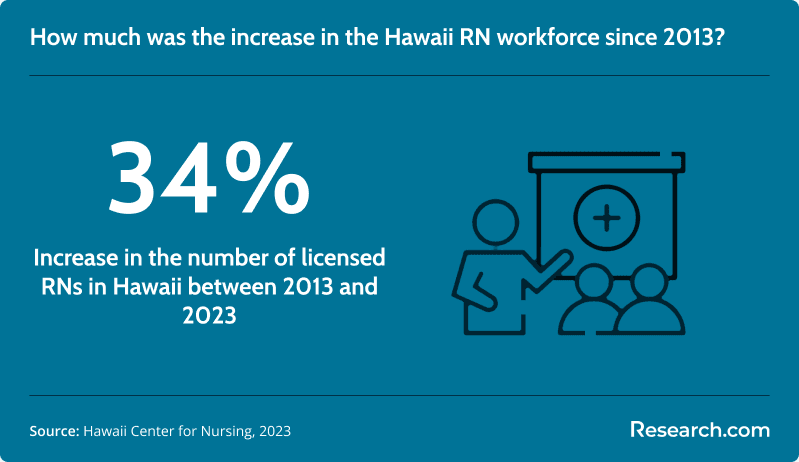
Hawaii’s education requirements vary by license level. The state needs nurses across multiple settings, and the number of RNs licensed in Hawaii increased by 34% between 2013 and 2023. Even with that growth, workforce leaders continue to report a shortage within the nursing workforce.
Prospective students should choose a program based on three questions: how quickly they need to enter the workforce, whether they want long-term advancement options, and whether their program meets Hawaii licensure expectations.
| Pathway | Typical education | Best fit | Important trade-off |
| LPN | Practical nursing program, commonly completed in about one year | Students who want the quickest licensed nursing entry point | The role has a narrower scope of practice than RN or APRN roles. |
| RN through ADN | Associate Degree in Nursing, usually completed in about two years | Students who want to become RNs faster and may later complete a BSN | Some employers may prefer or require a BSN for advancement. |
| RN through BSN | Bachelor of Science in Nursing, typically completed in four years | Students seeking broader preparation, leadership potential, or graduate school readiness | The program takes longer and may cost more than an ADN route. |
| RN-to-BSN | BSN completion program for licensed RNs | Working RNs who already hold an ADN or diploma and want a bachelor’s degree | Students must balance coursework with employment and clinical expectations. |
| APRN | Graduate nursing degree from an accredited institution recognized by the U.S. Department of Education and approved by the Hawaii Board of Nursing | RNs seeking nurse practitioner, nurse midwife, nurse anesthetist, or clinical nurse specialist roles | Requires advanced coursework, clinical training, specialty certification, and state approval. |
- LPN education: Practical nursing programs are usually designed for direct entry and often require fewer prerequisites than RN programs.
- RN education: RN candidates complete either an ADN or a BSN. ADN programs emphasize core nursing knowledge and clinical practice, while BSN programs add broader preparation in leadership, public health, research, and systems-based care. Licensed RNs who want a flexible bachelor’s completion route may compare the easiest online RN to BSN programs.
- APRN education: Advanced practice candidates need graduate-level nursing education that includes advanced assessment, pharmacology, and therapeutic measures.
Students who already hold a bachelor’s degree in another field may be able to shorten their timeline through accelerated nursing options. Researching the best ABSN programs can help career changers compare fast-track BSN routes. Students still exploring healthcare fields beyond nursing may also review the best accelerated online sonography and ultrasound degrees to understand related clinical education options.
What types of nurses can legally practice in Hawaii?
Hawaii authorizes several categories of nursing professionals, each with a different scope of practice. Based on a Hawaii Board of Nursing report, the number of LPNs, RNs, and APRNs licensed to practice in 2023 increased by 2%, 18%, and 31%, respectively, compared with 2021.
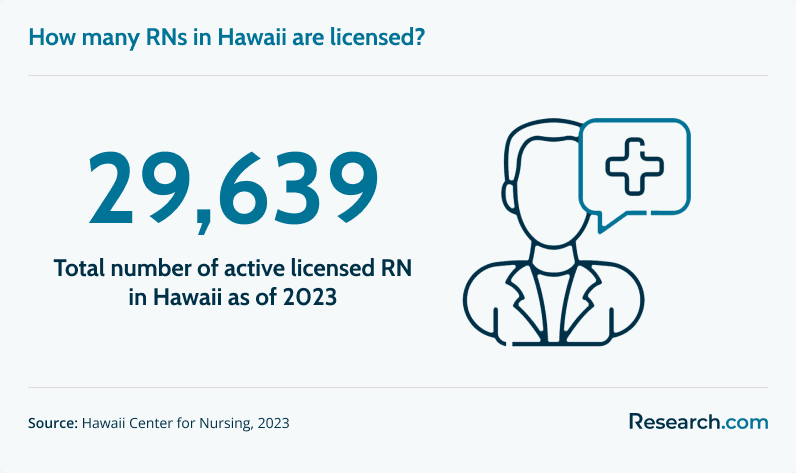
- Registered Nurses: RNs make up the largest licensed nursing group in Hawaii. According to the Hawaii Department of Commerce and Consumer Affairs, approximately 33,000 RNs were licensed in the state as of 2022. RNs assess patients, coordinate care, administer treatments, educate patients and families, and supervise LPNs and nursing assistants.
- Licensed Practical Nurses: LPNs deliver basic nursing care under the supervision of RNs and physicians. As of 2022, around 5,000 LPNs were licensed in Hawaii, showing continued need for this role in hospitals, clinics, long-term care, and community settings.
- Advanced Practice Registered Nurses: APRNs include Nurse Practitioners, Clinical Nurse Specialists, Certified Registered Nurse Anesthetists, and Certified Nurse Midwives. The Hawaii Board of Nursing reported approximately 2,000 APRNs practicing in the state.
- Certified Nursing Assistants: CNAs are not licensed nurses, but they are important members of the patient care team. They complete a state-approved training program and pass a competency exam, with demand especially strong in long-term care.
When comparing nursing schools, applicants should verify program accreditation. Common nursing program accreditors include the Accreditation Commission for Education in Nursing and the Commission on Collegiate Nursing Education. Accreditation can affect licensure eligibility, transfer credit, graduate school admission, and employer confidence.
What are the licensing requirements for nurses in Hawaii?
The Hawaii Board of Nursing handles licensing for nurses in the state. The exact requirements differ by role, but most applicants must document approved education, pass the correct examination, submit a state application, and meet background requirements. In 2023, the Professional and Vocational Licensing Division of the Department of Commerce and Consumer Affairs processed an average of over 500 applications for nurse licensure each month.
| Requirement | RN applicants | LPN applicants | What to check before applying |
| Education | Complete an accredited ADN, BSN, or qualifying nursing program. Hawaii also has pathways relevant to students considering online nursing programs for non nurses. | Complete a practical nursing program that satisfies state expectations. | Confirm that the program prepares graduates for Hawaii licensure, not only for another state. |
| Exam | Pass the NCLEX-RN. | Pass the NCLEX-PN. | Ask the school about recent NCLEX preparation support and pass outcomes. |
| Application | Submit proof of education, NCLEX results, and a non-refundable application fee of $50. | Submit proof of education, NCLEX results, and a non-refundable application fee of $40. | Use the current Hawaii Board of Nursing instructions before submitting documents. |
| Continuing education | Complete 30 hours of continuing education every two years. | Complete renewal requirements as directed by the state. | Track continuing education early instead of waiting until the renewal deadline. |
In Hawaii, 75% of RNs have completed a BSN or graduate degree in nursing. Recent first-time NCLEX pass rates were approximately 87% for RNs and 85% for LPNs.
What types of nursing licenses are available in Hawaii?
Hawaii’s nursing licenses correspond to different levels of training and responsibility. The right license depends on the type of patient care you want to provide, how much time you can spend in school, and whether you plan to pursue advanced practice later.
- Licensed Practical Nurse license: This license allows practical nurses to provide basic nursing care under supervision. LPN duties may include monitoring patients, administering medications, assisting with activities of daily living, and reporting changes in patient condition. Hawaii’s schools of nursing currently graduate about 30 new LPNs annually, while the current requirement is to hire 90 LPNs per year through 2030.
- Registered Nurse license: RNs have a wider scope of practice that includes patient assessment, care planning, patient education, medication administration, coordination with providers, and supervision of LPNs and nursing assistants.
- Advanced Practice Registered Nurse license: APRNs include nurse practitioners, clinical nurse specialists, nurse anesthetists, and nurse midwives. Depending on the role, they may diagnose and treat conditions, prescribe medications, manage ongoing patient care, and provide specialized services.
If you are comparing nursing with other healthcare careers, it can help to review pay and job requirements in adjacent fields. For example, students interested in imaging careers can compare radiology technician salary details by state before committing to a nursing path.
Can a Compact nurse practice in Hawaii?
No. A nurse who holds only a multistate Compact license from another state cannot practice in Hawaii unless they obtain a separate Hawaii nursing license. Hawaii is not currently a member of the Nurse Licensure Compact, so relocation planning should include time for licensure by endorsement if you are already licensed elsewhere.
This distinction is especially important for travel nurses, military spouses, mainland nurses considering permanent relocation, and remote-care professionals. A Compact license may make practice easier in many participating states, but it does not replace Hawaii’s licensing process.
RN applicants still need to show that they completed an accredited nursing program and passed the NCLEX. APRNs, including nurse practitioners and certified registered nurse anesthetists, must also meet Hawaii’s advanced practice requirements, which include a master’s degree and national certification in the specialty area.
If you are still early in your education search and want a broader view of health-related academic options, reviewing the easiest healthcare degree programs can help you compare nursing with other healthcare paths before investing in a specific credential.
Can you practice as a nurse without a license in Hawaii?
No. Practicing nursing in Hawaii without a valid license is illegal. The state requires licensure because nurses make clinical decisions that directly affect patient safety, medication administration, care coordination, and health outcomes.
According to the National Council of State Boards of Nursing, approximately 5.6% to 16% of the over 3 million nurses in the U.S. are internationally educated nurses. Internationally educated nurses may need additional steps, such as credential evaluation, English proficiency documentation, and verification of nursing education and licensure history.
At minimum, a candidate seeking Hawaii nursing licensure must generally complete these steps:
- Graduate from an accredited or otherwise accepted nursing program.
- Pass the appropriate NCLEX exam for the intended license level.
- Submit a complete application to the Hawaii Board of Nursing.
- Provide required proof of identity, education, examination, and background information.
One Hawaii nurse described the process as stressful but necessary: she arrived ready to work, then realized she first had to collect education records, complete evaluations, and wait for official approval. Receiving the license was more than an administrative milestone; it confirmed that she was authorized to protect patients and practice according to Hawaii’s standards.
How does geography impact nursing in Hawaii?
Hawaii’s geography shapes nursing practice in ways that students and relocating nurses should understand before they accept a position. The state is an island chain, and healthcare access, staffing, transportation, and emergency response can look very different from mainland systems.
- Care access varies by island: Major healthcare facilities are concentrated on Oahu, with additional services on Maui, the Big Island, and Kauai. Smaller and more rural islands may have fewer specialists, limited equipment, and longer referral pathways.
- Interisland transport matters: Nurses may coordinate transfers by air ambulance or support patients waiting for specialized care on another island. Delays can affect care planning, communication with families, and discharge coordination.
- Telehealth is important: Remote consultations can help bridge gaps in specialty access. Nurses may need comfort with digital tools, patient education over distance, and documentation across systems.
- Disaster readiness is part of practice: Hurricanes, tsunamis, volcanic activity, and supply chain interruptions require strong emergency planning. Nurses may be involved in preparedness drills, community education, and continuity-of-care planning.
- Supply chains can be fragile: Hawaii’s distance from the mainland can affect equipment, medication, and staffing availability. Resourcefulness is a valuable professional skill.
Nurses who want advanced preparation for Hawaii’s community and primary care needs may consider the best NP programs in Hawaii, especially if they plan to work in underserved areas or advanced practice roles.
What is the state of nursing in Hawaii?
Nursing in Hawaii offers strong professional opportunity, but it also requires realistic planning. Demand is supported by an aging population, ongoing healthcare needs, workforce retirements, and uneven access to care across islands. RNs, nurse practitioners, and specialized nurses are particularly important in critical care, emergency care, geriatrics, mental health, and primary care.
Compensation can be attractive compared with national averages, but pay should not be evaluated alone. Housing, groceries, transportation, childcare, and interisland travel can significantly affect take-home value. Nurses considering a move should compare salary offers with actual local costs on the specific island where they plan to work.
Is becoming a nurse in Hawaii worth it?
| Choose nursing in Hawaii if... | Consider another option or more planning if... |
| You want meaningful clinical work in a culturally diverse setting. | You are not prepared for a high cost of living or competitive housing market. |
| You are flexible, resourceful, and comfortable working in island-based healthcare systems. | You need immediate work authorization but have not secured Hawaii licensure. |
| You are interested in high-need areas such as geriatrics, critical care, emergency care, mental health, or primary care. | You assume a Compact license automatically allows practice in Hawaii. |
| You value community-based care and collaboration with families. | You have not confirmed that your nursing program meets Hawaii licensing requirements. |
What related healthcare careers can enhance your nursing experience in Hawaii?
Nurses can strengthen their careers by understanding adjacent healthcare fields. Related roles in pharmacy, healthcare informatics, billing and coding, public health, case management, and care coordination can improve interdisciplinary communication and create alternatives to bedside work.
For example, a nurse with strong medication knowledge may collaborate more effectively with pharmacy teams and improve patient education around prescriptions. Nurses interested in that direction can review how to become a pharmacist in Hawaii to understand a related but separate healthcare pathway.
How can nurses pursue specialized certifications in Hawaii?
Specialty certifications can help nurses document expertise in areas such as acute care, pediatrics, mental health, emergency nursing, critical care, oncology, or women’s health. These credentials do not replace state licensure, but they can support advancement, specialty hiring, and professional credibility.
The usual process includes meeting clinical experience requirements, completing approved coursework when required, passing a certification exam, and maintaining the credential through continuing education. RNs who want to move into family practice may compare advanced routes such as a 12-month FNP program online, while confirming that any program fits Hawaii’s licensing and clinical placement expectations.
What are the nurse practitioner education requirements in Hawaii?
Nurse practitioners in Hawaii must complete an accredited advanced practice nursing program that satisfies state and national standards. These programs include graduate coursework and supervised clinical practice in advanced health assessment, pharmacology, diagnosis, treatment planning, and patient management.
After graduation, nurse practitioner candidates generally need national certification in their population focus or specialty before applying for state recognition. Because requirements can vary by specialty and change over time, applicants should review current guidance on nurse practitioner education requirements in Hawaii before choosing a graduate program.
What financial assistance options are available for nursing education and career development in Hawaii?
Nursing education can be expensive, and Hawaii’s living costs can make budgeting even more important. Prospective students should look beyond tuition and estimate fees, books, uniforms, background checks, health documentation, transportation, clinical travel, exam fees, and lost work hours.
- Scholarships: Nursing schools, healthcare employers, community organizations, and state-related groups may offer awards for nursing students.
- Grants: Need-based grants can reduce the amount students must borrow.
- Loan forgiveness or repayment programs: Some programs support nurses who work in shortage areas, underserved communities, or high-need specialties.
- Employer tuition support: Working CNAs, LPNs, or RNs may find hospitals or health systems that offer education benefits.
- Accelerated routes: Students who already have college credit or a prior degree may save time by comparing accelerated nursing programs, while still checking cost, clinical placement, and licensure fit.
Can nurses explore non-clinical career opportunities in Hawaii?
Yes. Nurses who want to move away from direct bedside care can use their clinical background in administration, quality improvement, case management, utilization review, education, informatics, public health, compliance, and healthcare operations.
Non-clinical roles can be appealing for nurses seeking different schedules, reduced physical demands, or broader system-level impact. Nurses interested in administrative healthcare work may explore how to become a medical biller and coder in Hawaii as one option that combines healthcare knowledge with documentation, reimbursement, and coding skills.
How can I become an LVN in Hawaii?
Students searching for LVN information should know that Hawaii commonly uses the Licensed Practical Nurse designation rather than the Licensed Vocational Nurse title used in some other states. The practical route generally involves completing an approved practical nursing program, passing the NCLEX-PN, and applying for Hawaii licensure.
Before enrolling, confirm that the program qualifies graduates for Hawaii practical nurse licensure and includes the required clinical training. For a step-by-step overview, review how to become an LVN in Hawaii.
How can nurses build robust professional support networks in Hawaii?
Professional networks matter in Hawaii because healthcare communities can be close-knit, island-specific, and highly collaborative. Nurses can build support by joining nursing associations, attending continuing education events, participating in specialty groups, connecting with mentors, and staying active in alumni or employer networks.
Online programs can also provide networking if they include faculty access, clinical placement support, peer cohorts, and mentorship. Nurses comparing flexible education options may review the best online nursing programs in Hawaii while asking how each program supports clinical placements and local employer connections.
How can nurses manage continuing education and license renewal in Hawaii?
License renewal should be managed throughout the two-year cycle, not at the last minute. Nurses should keep copies of continuing education certificates, track renewal deadlines, verify whether courses meet state requirements, and update contact information with the licensing board.
For current state-specific details, nurses should review the requirements for nursing licensure in Hawaii. This is especially important for nurses with multiple licenses, APRN certification obligations, prescriptive authority, or specialty credentials.
Common licensing and renewal mistakes to avoid
| Mistake | Why it creates problems | Better approach |
| Assuming a Compact license works in Hawaii | Hawaii is not a Nurse Licensure Compact state. | Apply for Hawaii licensure before accepting practice responsibilities. |
| Choosing a nursing program without checking accreditation | Licensure, transfer, and graduate school options may be affected. | Confirm accreditation and Hawaii licensing eligibility in writing. |
| Looking only at tuition | Fees, clinical travel, housing, exam costs, and lost income can change affordability. | Build a full cost-of-attendance estimate before enrolling. |
| Waiting until renewal month to complete continuing education | Missing documentation or course approval issues can delay renewal. | Track CE hours throughout the renewal cycle. |
| Assuming online programs automatically meet Hawaii requirements | Some online programs may have clinical placement or state authorization limits. | Ask the program directly whether it supports Hawaii licensure and clinical placement. |
What is the job outlook for nursing in Hawaii?
The outlook for nursing in Hawaii is promising, but job seekers should evaluate demand by island, specialty, and employer type. According to the U.S. Bureau of Labor Statistics, employment for RNs in Hawaii is projected to grow by approximately 10% from 2020 to 2030, which is on par with the national average.
Compensation is one of the strongest attractions. As of May 2022, the average annual salary for registered nurses in Hawaii was approximately $119,000, compared with around $86,600 nationally. Nurse anesthetists and nurse practitioners are among the higher-paid specialties, with salaries often exceeding $150,000 annually. Licensed practical nurses tend to earn less, averaging around $56,000 per year.
The highest-paying industries for nurses in Hawaii include:
- Government: Government nursing roles may offer strong salary structures and benefits.
- Hospitals: Acute care facilities often compete for experienced nurses, especially in high-need specialties.
- Educational services: Nursing positions in academic settings can offer opportunities in teaching, administration, and program support.
Salary figures should be interpreted carefully. Actual pay depends on role, license level, specialty, shift, experience, union status, employer, and island. A high salary may not translate into strong financial comfort if housing and relocation costs are underestimated.
What nurses say about working in Hawaii
Anecdotal experiences can help future nurses understand the realities behind the licensing and salary data, but they should not replace careful research into employer expectations, costs, and licensure timelines.
- Coleen described Hawaii’s nursing environment as unusually community-oriented. She noted that collaboration among healthcare professionals can feel more personal than in larger mainland systems, and she connected that sense of teamwork with more individualized patient care. Coleen
- Michael emphasized the lifestyle benefits of working in Maui while acknowledging that living expenses require planning. He pointed to the appeal of outdoor activities and island life, while also recognizing that salary has to be evaluated against the cost of living. The Hawaii Department of Labor and Industrial Relations reports that the average salary for nurses in Hawaii is around $85,000 annually. Michael
- Aisha, a nurse practitioner, highlighted Hawaii’s diverse patient population as one of the most rewarding parts of practice. She also noted that cultural awareness is central to building trust and providing effective care. The Hawaii Nursing Workforce Center indicates that the demand for nurses is projected to grow by 10% over the next decade. Aisha
What educational pathways can aspiring nurses in Hawaii pursue?
Aspiring nurses in Hawaii can begin through CNA training, practical nursing, an ADN program, a BSN program, an RN-to-BSN bridge, an accelerated BSN, or graduate nursing education. The best choice depends on timeline, budget, previous college credit, desired scope of practice, and long-term career goals.
Students interested in practical nursing can compare online LPN programs in Hawaii and campus-based options. Those seeking RN licensure should compare ADN and BSN programs carefully, including clinical placement support, NCLEX preparation, accreditation, tuition, transfer policies, and employer relationships.
Questions to ask before choosing a Hawaii nursing program
- Is the program accredited by a recognized nursing accreditor?
- Does the program meet Hawaii Board of Nursing expectations for licensure?
- Where are clinical placements located, and will interisland travel be required?
- What are the program’s recent NCLEX pass outcomes?
- How much will the full program cost after fees, supplies, transportation, and exam expenses?
- Can prior credits transfer into the program?
- Does the school help with job placement, residency programs, or local employer connections?
- If the program is online, how are labs, simulations, and clinical hours handled?
What cultural considerations should nurses be aware of when working in Hawaii?
Cultural competence is not optional in Hawaii. Nurses care for patients from Native Hawaiian, Pacific Islander, Asian, mainland U.S., and many other backgrounds. Respectful care requires listening, avoiding assumptions, and recognizing the role of family, community, language, and traditional practices in health decisions.
- Traditional Hawaiian practices: Some patients may value practices such as ho‘oponopono, which centers on reconciliation and forgiveness, or lomilomi, a traditional form of massage. Nurses should respond respectfully and coordinate care without dismissing culturally meaningful practices.
- Family-centered decision-making: ‘Ohana, or family, often plays a major role in care conversations. Nurses should be prepared for family involvement while still following consent, privacy, and patient autonomy standards.
- Language access: Patients may speak Native Hawaiian, Tagalog, Japanese, Korean, or other languages. Using qualified interpreters when needed can improve safety, understanding, and trust.
- Diverse cultural expectations: Hawaii’s population reflects influences from East Asia, the Pacific Islands, and many immigrant communities. Strong nurses ask respectful questions instead of relying on stereotypes.
Nurses who integrate cultural humility into daily practice are better positioned to build patient trust, reduce miscommunication, and support care plans that patients and families can follow.
What should nurses know about relocation and lifestyle adjustments when moving to Hawaii?
Relocating to Hawaii for nursing can be rewarding, but it requires more planning than a typical interstate move. Nurses should budget for housing deposits, shipping, transportation, licensing timelines, island-specific job availability, and potential delays in onboarding.
- Housing: The housing market can be competitive, especially near major healthcare employers.
- Transportation: Public transportation options vary by island, and commuting may require a car.
- Licensing timeline: Nurses from other states should not assume they can begin work immediately.
- Island fit: Oahu may offer more large-hospital opportunities, while neighbor islands may provide more community-centered practice with fewer specialty resources.
- Education planning: Nurses who plan to advance their careers after relocating can compare the best nursing schools in Hawaii for local and online options.
What Are the Opportunities for Nurse Midwives in Hawaii?
Nurse midwifery can be a meaningful advanced nursing path in Hawaii, especially for nurses interested in women’s health, prenatal care, birth support, postpartum care, and culturally responsive maternal services. The role requires advanced education, clinical training, certification, and state authorization.
Prospective nurse midwives should confirm graduate program accreditation, clinical placement availability, certification requirements, and Hawaii-specific licensing steps before enrolling. For a detailed pathway, review how to become a nurse midwife in Hawaii.
Related Articles for Nearby States
- 2027 How to Become a Nurse in Alaska
- 2027 How to Become a Nurse in California
- 2027 How to Become a Nurse in Oregon
- 2027 How to Become a Nurse in Washington
- 2027 How to Become a Nurse in Nevada
- 2027 How to Become a Nurse in Arizona
- 2027 How to Become a Nurse in Idaho
- 2027 How to Become a Nurse in Utah
- 2027 How to Become a Nurse in Montana
- 2027 How to Become a Nurse in Wyoming
References:
- cca.hawaii.gov (n.d.). Hawaii Board of Nursing.
- Hawaii Center for Nursing (2023). 2023 Workforce Supply Statewide Report.
- nursejournal.org (03 Oct 2023). Hawaii Nursing Requirements and Licensing.
- nursinglicensemap.com (13 Jan 2020). Hawaii Nursing License Requirements.
Key Insights
- Hawaii requires its own nursing license. A Compact license from another state does not authorize practice in Hawaii.
- The fastest licensed route is usually practical nursing, while RN and APRN pathways offer broader responsibility and more advancement potential.
- Program choice matters. Confirm accreditation, Hawaii licensure eligibility, clinical placement support, and NCLEX preparation before enrolling.
- Hawaii offers strong salary potential for nurses, but the high cost of living makes budgeting essential before relocating or choosing a school.
- Island geography affects daily nursing work through interisland transfers, telehealth, limited rural resources, disaster planning, and supply chain challenges.
- Cultural humility is central to safe care in Hawaii. Nurses should be prepared to work respectfully with families, interpreters, and diverse cultural health practices.
- The best nursing path depends on your goal: quick workforce entry, long-term RN advancement, graduate practice, non-clinical work, or specialization in areas such as primary care, mental health, critical care, or nurse midwifery.
Other Things You Need to Know About Nursing in Hawaii
In 2027, to become a registered nurse in Hawaii, you must complete an accredited nursing program, pass the NCLEX-RN exam, and apply for licensure through the Hawaii Board of Nursing. Continuing education requirements must be fulfilled to maintain your license.
To become a nurse in Hawaii in 2027, obtain a nursing degree from an accredited program, pass the NCLEX-RN exam, and apply for licensure with the Hawaii Board of Nursing. Continuous education and meeting Hawaii's specific nursing requirements are essential for maintaining your license.


