
2027 How to Become a Nurse in Wyoming

Co-Founder and Chief Data Scientist
Becoming a nurse in Wyoming requires more than choosing a school and passing an exam. You need to understand which nursing role you want, whether your program meets Wyoming Board of Nursing expectations, how licensure works, and whether the path you choose fits your budget, timeline, and long-term career goals. This guide explains how to become a nurse in Wyoming in 2026, including education options, license types, compact privileges, job outlook, salaries, online programs, advanced practice routes, and common mistakes to avoid before enrolling.
Quick Answer: How Do You Become a Nurse in Wyoming?
To become a nurse in Wyoming, you must complete an approved nursing education program, pass the appropriate NCLEX exam, apply for licensure through the Wyoming State Board of Nursing, complete required background checks, and renew your license according to state rules. LPNs generally complete a practical nursing program and take the NCLEX-PN. RNs complete an ADN or BSN and take the NCLEX-RN. APRNs need graduate-level nursing education, national certification, and Wyoming APRN authorization.
- Wyoming has been facing a nursing shortage, with an estimated need for over 1,000 additional registered nurses (RNs) by 2025. Because that estimate is tied to an earlier workforce target, students should verify the latest labor data before making enrollment decisions.
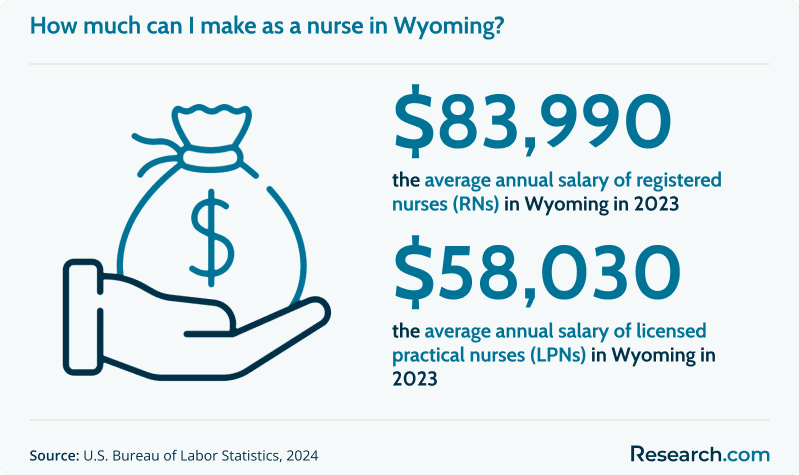
- The annual mean wage for registered nurses in Wyoming was approximately $83,990 in 2023, while LPNs earned around $58,030 on average. Older summary figures may compare this with a national average of around $75,000, but salary comparisons should always be checked against the latest BLS data.
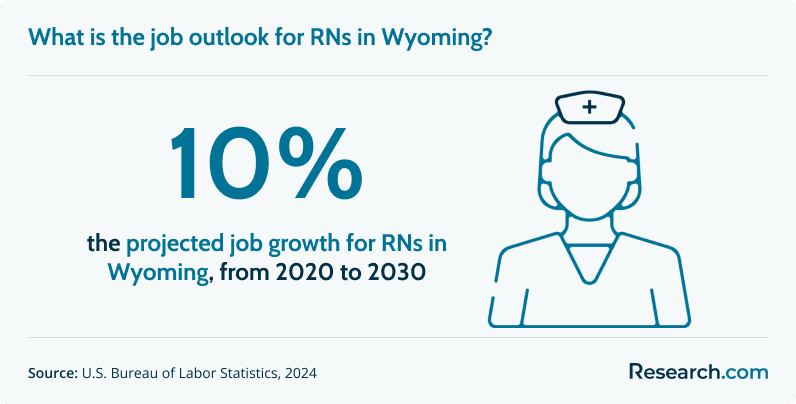
- Published growth estimates vary by source and time period. The article’s cited projections include 7% growth in nursing jobs from 2020 to 2030 and approximately 10% growth for RNs from 2020 to 2030.
- Most aspiring RNs choose either an Associate Degree in Nursing (ADN) or a Bachelor of Science in Nursing (BSN). A BSN can be useful for leadership, public health, specialty, or graduate nursing goals.
- Financial aid, scholarships, employer tuition support, and Wyoming-focused nursing incentives can reduce the cost of becoming licensed, especially for students who plan to work in shortage areas after graduation.
- Steps to becoming a nurse in Wyoming
- Wyoming nursing education requirements
- Types of nurses allowed to practice in Wyoming
- Wyoming nursing licensing requirements
- Nursing license types available in Wyoming
- Compact nursing practice in Wyoming
- Practicing nursing in Wyoming without a license
- Education options for Wyoming nursing students
- Advanced nursing education opportunities in Wyoming
- Current state of nursing in Wyoming
- Accelerated NP programs for Wyoming nurses
- Cross-training options for nursing career growth
- Ways to finance nursing school in Wyoming
- Online nursing programs for Wyoming careers
- Wyoming nursing job outlook
- Professional support networks for Wyoming nurses
- Nurse-midwives and maternal care in WyomingSupport networks for nursesNursing job outlook
- Best nursing education pathways in WyomingEmployment outlook for nursing graduates
- How nursing and pharmacy careers connect
- Options for moving into specialized nursing roles
- How to renew and maintain a Wyoming nursing license
What are the steps to becoming a nurse in Wyoming?
The basic process is similar for most candidates: choose a nursing role, complete an approved program, pass the required licensure exam, apply to the Wyoming State Board of Nursing, and maintain the license after approval. The details differ depending on whether you want to become a CNA, LPN, RN, or APRN.
| Step | What to do | Why it matters |
| 1. Choose your nursing role | Decide whether you want to start as a CNA, LPN, RN, or APRN. | Your role determines your education length, exam, scope of practice, and career ceiling. |
| 2. Enroll in an approved program | Select a Wyoming Board-approved or properly accredited nursing program. | Graduating from the wrong program can delay or prevent licensure. |
| 3. Complete clinical training | Finish required hands-on patient care experiences through your program. | Clinical hours prepare you for real care settings and licensure eligibility. |
| 4. Pass the NCLEX | LPN candidates take the NCLEX-PN. RN candidates take the NCLEX-RN. | Passing the national exam is required before most candidates can be licensed. |
| 5. Apply for Wyoming licensure | Submit your application, proof of education, exam results, fees, and background check materials. | The state must verify that you meet legal and professional standards. |
| 6. Renew and maintain your license | Meet renewal, continuing education, practice, and certification requirements as applicable. | An expired or noncompliant license can interrupt your ability to work. |
- Education comes first. LPN programs are commonly shorter and may take about one year. RN programs usually take two to four years depending on whether you pursue an ADN or BSN. APRNs need a master's degree or higher in nursing with preparation in a clinical specialty.
- Exams are role-specific. Practical nurse candidates take the NCLEX-PN, while registered nurse candidates take the NCLEX-RN. APRNs also need national certification in their specialty area.
- Fees can include multiple charges. The article’s cited figures include an RN application fee by examination of $130, the same fee structure for LPNs, and a $200 examination fee for both categories. Another cited section lists a non-refundable application fee of $100 for RNs and $90 for LPNs. Because fees can change or vary by application type, verify the current amount before applying.
- Endorsement is available for nurses licensed elsewhere. Nurses from other states may apply by endorsement if they can document approved education, NCLEX passage, and recent practice or continuing education.
- Renewal is not optional. LPN and RN licenses must be renewed biennially. APRNs must also maintain active national certification and meet any applicable continuing competency requirements.
If you are considering a specialty before choosing your first nursing degree, compare the education requirements and pay expectations for that role. For example, the average neonatal nurse salary in 2024 is more than $100,000, but neonatal nursing typically requires RN preparation, clinical experience, and specialty-focused training.
For wage context, the annual mean wage for RNs in Wyoming was about $83,990 in 2023, while LPNs earned around $58,030 on average. Location, shift type, facility, specialty, overtime, and experience can all affect actual earnings.
What are the educational requirements for becoming a nurse in Wyoming?
Wyoming nursing education requirements depend on the level of practice you want. A short entry-level pathway can lead to support roles, while advanced practice requires graduate education and certification. The safest approach is to choose a program that clearly meets Wyoming Board of Nursing expectations and prepares graduates for the required exam.
| Pathway | Typical purpose | Who it fits best |
| Practical nursing program | Prepares students for LPN licensure and the NCLEX-PN. | Students who want a faster clinical entry point and are comfortable working under RN or provider supervision. |
| Associate Degree in Nursing (ADN) | A two-year RN pathway commonly offered by community colleges. | Students who want to become RNs with a shorter and often lower-cost route. |
| Bachelor of Science in Nursing (BSN) | A four-year RN degree with broader coursework in leadership, community health, research, and care coordination. | Students who want stronger long-term mobility, graduate school options, or roles with employers that prefer BSN preparation. |
| Master of Science in Nursing (MSN) | Graduate preparation for roles such as nurse practitioner, nurse educator, or other advanced positions. | Licensed RNs seeking specialization, leadership, teaching, or advanced clinical practice. |
| DNP or PhD in Nursing | Terminal nursing degrees focused on advanced clinical practice or research. | Nurses pursuing high-level practice leadership, systems improvement, academia, or research. |
- Associate Degree in Nursing (ADN): This two-year route prepares graduates for entry-level RN practice and NCLEX-RN eligibility.
- Bachelor of Science in Nursing (BSN): This four-year degree provides broader preparation and can be preferred by some employers. Students comparing flexible completion routes can review easiest BSN program options, especially if they already hold an RN license.
- Master of Science in Nursing (MSN): This graduate degree generally follows the BSN and may take an additional two years of study. It can prepare nurses for nurse practitioner, educator, leadership, or specialized roles.
- Doctor of Nursing Practice (DNP) and Doctor of Philosophy in Nursing (PhD): These terminal degrees often require three to five years beyond the MSN and serve different goals. The DNP focuses on advanced clinical practice and systems leadership, while the PhD emphasizes research and scholarship.
Accreditation and state approval should be checked before enrollment, not after graduation. Programs may need recognition by the Wyoming Board of Nursing, registration with the Wyoming Department of Education, or National Council for State Authorization Reciprocity Agreement (SARA) approval when distance education is involved. If a program cannot clearly explain licensure eligibility in Wyoming, ask more questions before committing.
Accelerated and online options can help students with prior college credit, healthcare experience, or work obligations. However, online coursework does not eliminate clinical requirements. Before enrolling, confirm how clinical placements are arranged in Wyoming and whether the school supports students in rural areas.
What types of nurses can legally practice in Wyoming?
Wyoming recognizes several nursing-related roles, each with its own education, examination, supervision, and scope-of-practice rules. Choosing the right level depends on how quickly you want to enter healthcare, how much responsibility you want, and whether you plan to pursue advanced practice later.
| Role | Minimum preparation | Typical responsibilities | Career considerations |
| Certified Nursing Assistant (CNA) | State-approved CNA training and competency testing | Assists with basic care such as bathing, feeding, mobility, and daily support. | Good entry point for testing interest in healthcare before committing to nursing school. |
| Licensed Practical Nurse (LPN) | Approved practical nursing program and NCLEX-PN | Provides basic nursing care, monitors patient status, and works under RN or provider supervision. | Faster than RN preparation, but advancement may require additional education. |
| Registered Nurse (RN) | ADN or BSN and NCLEX-RN | Assesses patients, administers medications, coordinates care, educates patients, and collaborates with providers. | Offers broader responsibility, specialty options, and a foundation for graduate study. |
| Advanced Practice Registered Nurse (APRN) | Graduate nursing degree, national certification, and APRN authorization | May diagnose, treat, prescribe, and provide advanced care depending on role and state rules. | Best for nurses seeking autonomy, specialization, and advanced clinical responsibility. |
- Registered Nurses (RNs): RNs provide direct care, medication administration, patient assessment, care planning, and coordination across hospitals, clinics, long-term care, public health, and other settings. Wyoming recognizes RN preparation through accredited ADN or BSN programs, including programs accredited by ACEN or CCNE. As of 2021, there were approximately 10,000 RNs practicing in Wyoming.
- Licensed Practical Nurses (LPNs): LPNs provide essential bedside and practical care under appropriate supervision. Practical nursing programs typically take about one year. The LPN route is usually faster than RN preparation, and students can learn more about the general pathway through this guide on how to become an LPN. Wyoming has around 2,000 LPNs.
- Advanced Practice Registered Nurses (APRNs): APRNs include nurse practitioners, clinical nurse specialists, certified registered nurse anesthetists, and certified nurse midwives. They must hold a master’s or doctoral nursing degree and national specialty certification. Wyoming has over 600 currently licensed APRNs.
The chart below shows the employment level of select nursing occupations in Wyoming in 2023.
What are the licensing requirements for nurses in Wyoming?
The Wyoming State Board of Nursing sets licensure rules for LPNs, RNs, and APRNs. The requirements are designed to confirm that applicants have completed appropriate education, passed national testing, cleared required background screening, and are prepared to practice safely.
- Approved education: RN applicants typically complete an ADN or BSN program. LPN applicants complete an approved practical nursing program. APRNs complete graduate nursing education in an advanced practice specialty.
- NCLEX passage: RN candidates take the NCLEX-RN. LPN candidates take the NCLEX-PN. The cited first-time pass rates in Wyoming were approximately 87% for RNs and 83% for LPNs in 2022.
- Application submission: Candidates must apply to the Wyoming State Board of Nursing and provide required documentation. The cited non-refundable application fee is $100 for RNs and $90 for LPNs, though applicants should confirm current fees before filing.
- Background screening: Fingerprinting and a criminal background check are required. This step protects patients and helps the board evaluate whether an applicant meets professional standards.
- Advanced practice requirements: APRNs must hold national certification in their specialty area and complete continuing education or continuing competency requirements. Nurses interested in research or senior academic roles may also compare affordable PhD nursing programs.
Before applying, gather transcripts, proof of program completion, identification documents, exam information, and any required background check materials. Delays often happen when applicants submit incomplete documentation or assume that school completion automatically creates a license.
What types of nursing licenses are available in Wyoming?
Wyoming nursing licenses and credentials correspond to different levels of patient care responsibility. The right choice depends on your target role, the time you can spend in school, and whether you want to pursue advanced practice later.
- Registered Nurse (RN): RN licensure is the central professional route for many nursing careers. Candidates complete an accredited nursing program, usually an ADN or BSN, and pass the NCLEX-RN. RNs assess patients, develop care plans, administer medications, provide education, and coordinate treatment. Wyoming RNs may hold a single-state license or, if eligible, a multistate license through the Nurse Licensure Compact.
- Licensed Practical Nurse (LPN): LPNs complete a practical nursing program, pass the NCLEX-PN, and provide basic nursing care under the supervision of RNs, physicians, or other authorized providers. Common duties include monitoring vital signs, assisting with activities of daily living, and supporting patient care plans.
- Certified Nursing Assistant (CNA): CNAs are not licensed as nurses in the same way as RNs or LPNs, but they are important members of the care team. Training can take only a few weeks, followed by a state-approved competency exam. CNAs help with daily patient support, mobility, hygiene, feeding, and comfort care.
- Advanced Practice Registered Nurse (APRN): APRNs include nurse practitioners, clinical nurse specialists, nurse anesthetists, and nurse midwives. They hold a master's or doctoral degree in nursing and pass national certification in their specialty. Nurses comparing graduate routes may find accelerated MSN programs online useful, especially if they are evaluating nontraditional paths into nursing.
If you are still deciding between healthcare careers, compare nursing with adjacent clinical fields. For example, the rad tech salary in 2024 is estimated to be around $63,120, but radiologic technology has a different training model, work environment, and scope of practice.
Can a Compact nurse practice in Wyoming?
Yes. Wyoming participates in the Nurse Licensure Compact (NLC), which allows eligible RNs and LPNs with a multistate license from their primary state of residence to practice in Wyoming and other compact states. This is especially useful for travel nurses, nurses near state borders, and professionals who need flexibility across multiple states.
- Primary state of residence matters: A nurse must hold an active, unencumbered multistate license from the nurse’s primary state of residence.
- Education and exam standards still apply: Compact nurses must have graduated from a Board-approved nursing program and passed the NCLEX-RN or NCLEX-PN.
- Background checks are part of eligibility: Applicants may need FBI fingerprint cards or other biometric data for criminal background screening.
- Wyoming law applies while practicing in Wyoming: Nurses must follow Wyoming’s Nurse Practice Act and state-specific regulations even if their license was issued elsewhere.
- Temporary permits are not the same as compact authority: Compact nurses cannot practice in Wyoming on a temporary permit unless they hold valid legal authority to practice under the NLC or Wyoming licensure rules.
The NLC reduces duplicate licensing burdens, but it does not eliminate professional responsibility. Nurses should confirm compact status, license standing, and state rules before accepting assignments. RNs planning to move into primary care can also compare affordable RN to FNP degrees online if family nurse practitioner practice is part of their long-term plan.
What are the best educational pathways for aspiring nurses in Wyoming?
The best pathway depends on your starting point. A high school graduate, a CNA, an LPN, an RN with an associate degree, and a bachelor’s degree holder in another field may all need different routes. The smartest choice is the one that gets you licensed without closing off future options you may want later.
| If you are... | Consider this path | Why it may make sense |
| New to healthcare | CNA training or an LPN program | Lets you enter patient care sooner and decide whether nursing is the right fit. |
| Ready to become an RN quickly | ADN program | Can be a practical route to RN licensure, especially through community college options. |
| Planning for leadership or graduate school | BSN program | Provides broader preparation and can improve flexibility for future roles. |
| Already an RN | RN-to-BSN or MSN pathway | Helps working nurses qualify for advancement, specialization, or graduate practice. |
| Focused on advanced practice | NP, MSN, DNP, or specialty graduate program | Required for roles with greater autonomy and advanced clinical responsibility. |
Students focused on advanced clinical roles should compare the best NP programs in Wyoming and ask whether each program supports Wyoming clinical placements, national certification preparation, and state APRN requirements.
Accelerated tracks can be useful for students with prior college credit or healthcare experience, but speed should not be the only deciding factor. A shorter program is only valuable if it is accredited, accepted for licensure, clinically strong, and manageable with your work and family responsibilities.
Can you practice as a nurse without a license in Wyoming?
No. You cannot legally practice as a nurse in Wyoming without an active and appropriate nursing license or authorization. Nursing practice is regulated because nurses perform tasks that directly affect patient safety, including assessment, medication administration, care planning, and clinical judgment.
- Education: Complete an approved nursing program, such as an ADN or BSN for RN candidates.
- Examination: Pass the required National Council Licensure Examination, such as the NCLEX-RN for registered nurses.
- Application: Submit the Wyoming State Board of Nursing application with proof of education and examination results.
- Background check: Complete criminal background screening as required by the state.
The average national dropout rate for nursing programs in the United States is between 20% and 25%, which shows why preparation matters. Before enrolling, make sure you understand the program workload, clinical schedule, grading policies, remediation options, and support services.
-
: "
One Wyoming nurse described being asked to help at a local health fair before becoming licensed. She wanted to support patients but knew she could not perform clinical nursing tasks without legal authority. That experience reinforced an important lesson: completing school is not the same as being licensed, and patient care must stay within legal boundaries.
"
What educational options are available for nursing students in Wyoming?
Wyoming students can choose from practical nursing programs, ADN programs, BSN programs, RN-to-BSN completion options, graduate nursing degrees, and selected online or hybrid formats. Students who want the quickest licensed nursing route may start with practical nursing, while those aiming for broader responsibility often pursue RN preparation. If you are comparing entry-level options, review online LPN programs in Wyoming and confirm whether clinical requirements can be completed in your area.
How to compare nursing programs before enrolling
- Confirm Wyoming Board of Nursing approval or recognized accreditation.
- Ask whether graduates are eligible for the NCLEX-PN or NCLEX-RN.
- Review clinical placement locations, especially if you live outside a major population center.
- Compare total cost, not just tuition. Include fees, uniforms, supplies, background checks, transportation, and exam expenses.
- Ask about NCLEX preparation, tutoring, simulation labs, student retention, and clinical faculty support.
- Check transfer credit rules if you may later move from LPN to RN, ADN to BSN, or BSN to MSN.
What are the opportunities for advanced nursing education in Wyoming?
Advanced nursing education can help Wyoming nurses move into nurse practitioner, nurse educator, leadership, public health, clinical specialist, nurse anesthesia, or nurse-midwifery roles. Graduate education is especially important in rural and underserved areas where advanced practice nurses may help expand access to primary and specialty care.
Working nurses often compare online or hybrid graduate programs because they need flexibility. Cost matters, too. Nurses looking for budget-conscious graduate options can compare the cheapest online MSN programs, but affordability should be weighed against accreditation, clinical placement support, certification outcomes, and Wyoming licensure compatibility.
What is the state of nursing in Wyoming?
Nursing in Wyoming is shaped by rural geography, an aging population, workforce retirements, and uneven access to care. Demand can be strong in hospitals, clinics, long-term care, public health, schools, and rural health settings, but job availability and pay may differ significantly by region and specialty.
Employment outlook for nurses in Wyoming
The Wyoming Department of Workforce Services has identified healthcare as an important employment sector, and nursing roles remain central to care delivery. Rural facilities may have different staffing needs than urban hospitals, so students should look beyond statewide averages and research the communities where they plan to work.
Number of employed licensed nurses
Wyoming employs approximately 10,000 licensed nurses, including RNs and LPNs. Even with that workforce, shortages can still occur in particular regions, specialties, shifts, or rural communities. Statewide counts do not always reflect local hiring conditions.
Cost of living and salary trade-offs
Wyoming’s cost profile can be attractive compared with some higher-cost states, but nurses should compare salary with housing, transportation, loan payments, and commuting distance. Some roles may pay more because they require specialty credentials, advanced education, weekend or night shifts, travel, or rural assignments.
Major employers of nurses in Wyoming
- Hospitals and healthcare systems: Emergency care, medical-surgical units, intensive care, labor and delivery, operating rooms, outpatient services, and specialty clinics.
- Long-term care and assisted living: Facilities serving older adults and patients with ongoing care needs.
- Public health agencies: Community health, disease prevention, education, immunization, and population health programs.
- Schools and colleges: Student health services, wellness programming, and care coordination.
Nurses in Wyoming earn salaries ranging from $58,030 up to north of $200,000, depending on specialization, education, licensure, and work setting. The chart below shows the average annual salaries of select nursing occupations in Wyoming.
Are accelerated NP programs a viable option for advanced practice in Wyoming?
Accelerated NP programs can work for motivated nurses who already have the academic foundation, clinical experience, and schedule flexibility to handle a faster graduate curriculum. They are not automatically easier. In many cases, the pace is more demanding because coursework, clinical preparation, certification readiness, and practicum requirements are compressed.
Before choosing an accelerated route, ask whether the program prepares graduates for Wyoming APRN requirements, assists with clinical placement, and aligns with your intended population focus. You can compare program structures through this guide to accelerated NP programs.
What cross-training opportunities can enhance my nursing career in Wyoming?
Cross-training can help nurses broaden their career options, especially in smaller Wyoming facilities where staff may need to understand multiple operational areas. Useful add-on skills may include care coordination, health informatics, quality improvement, medical coding, public health, case management, leadership, or healthcare administration.
Nurses interested in the business and reimbursement side of healthcare may explore how to become a medical biller and coder in Wyoming. This type of training can support roles in documentation quality, revenue cycle work, utilization review, and administrative coordination.
How can I finance my nursing education in Wyoming?
Nursing school costs vary by credential level, institution, delivery format, and clinical requirements. A low tuition rate does not always mean the lowest total cost, especially if you must travel for clinicals, reduce work hours, buy equipment, or pay repeated testing and application fees.
| Cost or funding factor | What to check | Why it affects your decision |
| Tuition and mandatory fees | Program cost per credit, lab fees, technology fees, and clinical fees. | Fees can materially change the advertised price. |
| Clinical expenses | Travel, lodging, uniforms, immunizations, drug screens, and background checks. | Rural students may face higher placement-related costs. |
| Financial aid | Federal aid, state aid, institutional grants, scholarships, and work-study. | Gift aid and subsidized options reduce borrowing. |
| Employer support | Tuition reimbursement, loan repayment, paid training, and work commitments. | Healthcare employers may help pay for education in exchange for service. |
| Career ladder options | CNA-to-LPN, LPN-to-RN, ADN-to-BSN, or RN-to-MSN pathways. | Stackable credentials can spread costs over time. |
Students looking for a lower-cost starting point may compare practical nursing or vocational nursing routes before committing to a longer RN pathway. For a related entry-level guide, see how to become an LVN in Wyoming.
Should Online Nursing Programs be Considered for Wyoming’s Nursing Careers?
Online nursing programs can be useful in Wyoming because distance, weather, and rural geography can make campus attendance difficult. However, nursing is never fully online if it leads to initial licensure. Students still need supervised clinical experiences, skills labs, simulations, or in-person assessments depending on program design.
| Online or hybrid nursing programs may be a good fit if... | They may be a poor fit if... |
| You need flexible coursework because of work or family responsibilities. | You cannot travel for labs, intensives, or clinical placements. |
| The program is accredited and confirms Wyoming licensure eligibility. | The school cannot clearly explain Wyoming Board of Nursing requirements. |
| You are completing an RN-to-BSN, MSN, or other post-licensure degree. | You need extensive hands-on support and prefer daily campus access. |
| The school helps arrange clinical placements near your community. | You are expected to find all clinical sites without realistic support. |
Before enrolling, compare accreditation, clinical placement support, NCLEX preparation, graduation requirements, and total cost. Students who need flexible options can review the best online nursing programs in Wyoming.
What is the job outlook for nursing in Wyoming?
The nursing job outlook in Wyoming is generally favorable, but it should be interpreted by location, role, and specialty rather than relying on one statewide percentage. The article’s cited figures include 7% growth in nursing jobs from 2020 to 2030 and approximately 10% growth for RNs from 2020 to 2030. Demand is influenced by retirements, rural access needs, aging patients, long-term care demand, and the availability of healthcare services in smaller communities.
New nurses can improve their employment prospects by gaining clinical experience during school, building references from preceptors, considering rural or long-term care opportunities, staying flexible on shifts, and choosing programs with strong employer relationships. Experienced nurses may find advancement through specialty certification, BSN completion, graduate education, or APRN preparation.
What professional support networks are available for nurses in Wyoming?
Professional networks can help Wyoming nurses find mentorship, continuing education, job leads, legislative updates, and peer support. This is especially valuable in rural practice, where nurses may have fewer same-specialty colleagues in their immediate workplace.
- State and local nursing associations: Useful for advocacy, continuing education, networking, and leadership opportunities.
- Employer-based councils: Shared governance, quality improvement teams, and specialty committees can help nurses develop professionally.
- Academic partnerships: Nursing schools often connect students and alumni with clinical partners, faculty mentors, and continuing education opportunities. Students comparing education options can review the best nursing schools in Wyoming.
- Specialty organizations: Nurses in areas such as emergency care, critical care, obstetrics, public health, informatics, or advanced practice can benefit from role-specific organizations.
Can nurse-midwives enhance maternal health care in Wyoming?
Nurse-midwives can play an important role in maternal and reproductive healthcare, particularly in communities where access to obstetric services is limited. Certified nurse-midwives provide prenatal, birth, postpartum, family planning, and reproductive health care within their legal scope of practice.
For Wyoming, nurse-midwifery may be especially relevant in rural regions where care access, travel distance, and provider availability affect maternal health. Nurses interested in this specialty should review graduate education, certification, clinical training, and state authorization requirements. A dedicated guide explains how to become a nurse midwife in Wyoming.
What do nurses say about working in Wyoming?
- One nurse described the appeal of working in a smaller Wyoming hospital, where coworkers know one another and patient relationships can feel more personal. She noted that lower patient volume in some settings may allow more individualized care. Risa
- Another nurse emphasized the financial side of practice, pointing to a competitive salary and a relatively low cost of living. The cited statement referenced an average annual RN salary of around $66,000, though readers should compare that with newer wage data before making decisions. Orlando
- A nurse practitioner highlighted professional autonomy in Wyoming and the ability to provide comprehensive care with fewer barriers than in some states. She also mentioned outdoor recreation and natural landscapes as quality-of-life advantages. Edna
How do nursing and pharmacy careers complement each other in Wyoming?
Nursing and pharmacy both support patient care, but they do so from different angles. Nurses focus heavily on assessment, bedside care, education, care coordination, and monitoring. Pharmacists focus on medication safety, drug therapy, dosing, interactions, counseling, and pharmacy operations.
These fields overlap in hospitals, clinics, long-term care, chronic disease management, transitions of care, and medication reconciliation. A nurse who understands pharmacy workflows can improve patient education and medication adherence, while pharmacists rely on nursing observations to identify side effects, barriers, or changes in patient condition. Students comparing healthcare careers can learn how to become a pharmacist in Wyoming.
What are my options for advancing to specialized nursing roles in Wyoming?
Specialization can help nurses move beyond general bedside practice into areas such as emergency nursing, critical care, obstetrics, oncology, pediatrics, psychiatric-mental health, public health, informatics, leadership, education, anesthesia, midwifery, or nurse practitioner practice. The right specialty depends on your clinical interests, tolerance for stress, preferred schedule, and willingness to pursue additional credentials.
For nurses who want advanced practice authority, meeting the nurse practitioner education requirements in Wyoming is a key step. Graduate programs, national certification, clinical experience, and state APRN authorization all matter. Do not choose a specialty program only because it is fast; choose one that prepares you for certification, licensure, and the patient population you want to serve.
How do I renew and maintain my nursing license in Wyoming?
Maintaining a Wyoming nursing license requires attention to renewal deadlines, continuing competency rules, and any role-specific requirements. RNs and LPNs should track renewal cycles, continuing education, employment history, and documentation. APRNs must also maintain national certification in their specialty area.
- Set calendar reminders well before your renewal deadline.
- Keep copies of continuing education certificates, employer verification, and specialty certifications.
- Update your contact information with the licensing board so you do not miss notices.
- Review state rules before changing roles, adding telehealth services, or practicing across state lines.
- Use official guidance on the requirements for nursing licensure in Wyoming when planning renewal.
Common mistakes to avoid when becoming a nurse in Wyoming
| Mistake | Why it can hurt you | Better approach |
| Choosing a program without checking approval or accreditation | You may not qualify for licensure or may face delays. | Confirm Wyoming licensure eligibility directly with the school and state board resources. |
| Looking only at tuition | Fees, supplies, travel, testing, and lost work hours can raise the real cost. | Build a full budget before enrolling. |
| Assuming online means fully remote | Clinical and lab requirements may still require in-person attendance. | Ask where and how clinical placements are completed. |
| Ignoring long-term career goals | A short path may not support leadership, specialty, or graduate school plans. | Choose a pathway that supports your next two career steps, not only your first job. |
| Relying only on rankings | A highly ranked program may not fit your schedule, budget, location, or licensure needs. | Use rankings as one factor alongside outcomes, support, cost, and accreditation. |
| Assuming salary outcomes are guaranteed | Pay varies by employer, region, shift, specialty, and experience. | Review local job postings and compare multiple wage sources. |
Questions to ask before choosing a Wyoming nursing program
- Is the program approved for Wyoming nursing licensure?
- What exam does the program prepare graduates to take?
- What are the program’s NCLEX support services and recent outcomes?
- Where do students complete clinical rotations?
- Does the school help arrange clinical placements, or must students find them?
- What is the total program cost, including fees, supplies, background checks, and testing?
- Can credits transfer into a higher nursing degree later?
- Are courses offered full time, part time, online, hybrid, or on campus?
- What academic support is available if a student struggles?
- Do local employers recruit from the program?
Related Articles for Nearby States
- 2027 How to Become a Nurse in Montana
- 2027 How to Become a Nurse in South Dakota
- 2027 How to Become a Nurse in Nebraska
- 2027 How to Become a Nurse in Colorado
- 2027 How to Become a Nurse in Idaho
- 2027 How to Become a Nurse in Utah
- 2027 How to Become a Nurse in North Dakota
- 2027 How to Become a Nurse in Kansas
- 2027 How to Become a Nurse in Iowa
- 2027 How to Become a Nurse in Nevada
References:
- Nursing License Map. Become a Nurse in Wyoming – Licensure & Requirements. nursinglicensemap.com Wyoming nursing license guide. Additional source listing: Wyoming nursing licensure overview.
- Wyoming State Board of Nursing. Upcoming Meetings. wsbn.wyo.gov. Board updates are also available through Wyoming State Board of Nursing resources.
- Tacy, J., McElwain, S., & Fletcher, A. (2023). Strategies for success that led to 99.98% school of nursing retention. Journal of Nursing Education and Practice.
Key Insights
- Wyoming nursing candidates should start by choosing the correct role: CNA, LPN, RN, or APRN. Each path has different education, exam, scope-of-practice, and advancement implications.
- For RN licensure, the main education choices are the ADN and BSN. An ADN can be a faster route to practice, while a BSN may offer stronger long-term flexibility.
- Licensure requires more than graduation. Candidates must pass the appropriate NCLEX, submit a Wyoming application, complete background screening, and meet renewal rules.
- Wyoming participates in the Nurse Licensure Compact, which can benefit eligible RNs and LPNs with multistate licenses.
- Online and accelerated programs can be useful, but only if they meet Wyoming licensure standards and provide realistic clinical placement support.
- Salary and job outlook figures should be checked against current sources because estimates vary by year, role, location, and specialty.
- The best nursing program is not simply the cheapest, fastest, or highest ranked. It is the accredited program that fits your budget, schedule, clinical needs, licensure goal, and long-term career plan.
Other Things You Need to Know About Nursing in Wyoming
To become a nurse in Wyoming in 2027, you need to complete an accredited nursing program, which could be an Associate Degree in Nursing (ADN) or a Bachelor of Science in Nursing (BSN). After that, passing the NCLEX-RN exam is mandatory to obtain your RN license.
In 2027, Wyoming is expected to see a steady demand for nurses due to an aging population and increased healthcare access. The job outlook is positive, with opportunities in hospitals, clinics, and long-term care facilities, particularly in rural areas where healthcare workers are in high demand.
Becoming a nurse in Wyoming requires not only a solid educational foundation but also effective preparation for the NCLEX-RN exam, which is essential for licensure. Here are some useful tips and resources to help you succeed in your nursing career in Wyoming.
- NCLEX Preparation Courses: Enrolling in NCLEX preparation courses can significantly enhance your chances of passing the exam. Many institutions offer online and in-person classes tailored to the specific requirements of the NCLEX. Resources like Kaplan and Hurst Review provide comprehensive study materials and practice questions that reflect the exam format.
- Study Groups: Joining or forming study groups can be beneficial. Collaborating with peers allows for the exchange of knowledge and resources, making complex topics more manageable. Local nursing schools often have bulletin boards or online forums where students can connect and form study groups.
- Practice Tests: Regularly taking practice tests is crucial for familiarizing yourself with the exam structure and timing. Websites like UWorld and Nurse.com offer practice questions that simulate the NCLEX experience. In Wyoming, some community colleges may also provide access to practice exams as part of their nursing programs.
- Time Management: Effective time management is essential during your studies. Create a study schedule that allocates specific times for reviewing material, taking practice tests, and participating in study groups. This structured approach can help reduce stress and improve retention of information.
- Professional Organizations: Joining professional organizations such as the Wyoming Nurses Association (WNA) can provide networking opportunities, continuing education resources, and access to job listings. The WNA also hosts events and workshops that can enhance your professional development.
By utilizing these resources and strategies, aspiring nurses in Wyoming can better prepare for their careers and navigate the challenges of the nursing profession effectively.


