
2027 How to Become a Vocational Nurse?

Co-Founder and Chief Data Scientist
Becoming a licensed vocational nurse (LVN) is one of the faster ways to enter hands-on patient care without first completing a registered nursing degree. For students comparing healthcare careers, the LVN path can be attractive because many programs take less than one year to complete, lead to state licensure, and prepare graduates for work in nursing care facilities, home health care services, hospitals, clinics, and other care settings. The need is also clear: NurseJournal reported only 9.22 nurses for every thousand people in the United States, highlighting why entry-level nursing roles remain important.
This guide explains how to become a vocational nurse, what LVN programs include, how licensing works, what the NCLEX-PN requires, how much training may cost, and what career options are available after licensure. It is written for students who want a practical, decision-focused overview before choosing a program or committing to the nursing field.
Quick answer: Is becoming a vocational nurse worth considering?
Becoming an LVN can be a strong choice if you want a direct route into nursing, are comfortable with patient care, and prefer a shorter training timeline than an RN pathway. LVNs earn a median salary of $54,620, and the role can also serve as a stepping stone toward RN, BSN, nurse practitioner, public health, or specialized nursing careers. However, you must choose a state-approved program, complete in-person clinical training, pass the NCLEX-PN, and keep your license current.
What are the key benefits of becoming a vocational nurse?
- Fast entry into healthcare: Many LVN programs can be completed in less than one year, making this one of the shorter formal nursing pathways.
- Multiple work settings: A practical nursing license can qualify you for employment in nursing care facilities, home health care services, hospitals, physician offices, clinics, and rehabilitation settings.
- Clear licensure pathway: The route is structured: complete prerequisite education, finish a state-approved program, apply for licensure, and pass the NCLEX-PN.
- Career ladder potential: LVN experience can support later progression into RN, BSN, NP, specialty nursing, or administrative roles.
- Stable labor market: BLS projections show a 5% growth rate for LVNs and LPNs from 2022 to 2032, with 34,900 new openings each year.
- Schools Offering LVN Programs for 2027
- How to Become a Vocational Nurse for 2027
- How do I prepare for the licensing exam in vocational nursing?
- How long does it take to become a vocational nurse?
- How do I find a reputable vocational nursing program near me?
- How much will it cost to become a vocational nurse?
- Can I earn a vocational nursing certificate online?
- What career advancement opportunities are available for LVNs?
- How do you choose the best LVN training program?
- How can I transition from an LVN to an RN?
- What advanced education options are available after becoming an LVN?
- What are the legal and ethical responsibilities of an LVN?
- How can I fast track my transition from LVN to RN?
- What emerging trends are influencing the LVN profession?
- Can additional scientific coursework boost my clinical expertise?
- How can LVNs transition into public health roles?
- How much can I make as an LVN?
- What is the job outlook for LVNs?
- Where do LVNs typically work?
- What other healthcare careers can I pursue after becoming an LVN?
- What additional skills should I develop to succeed as a vocational nurse?
Schools Offering LVN Programs for 2027
How do we rank schools?
The LVN program you choose can affect your cost, clinical placement experience, eligibility for licensure, and preparation for the NCLEX-PN. A strong program should be approved for vocational or practical nursing licensure in the state where you plan to practice, provide supervised clinical experience, and publish clear information about tuition, schedule, accreditation, and graduate outcomes.
Research.com identified LVN preparation programs using information from the IPEDS database, Peterson’s database, the Distance Learning Licensed Data Set from the College Scorecard database, and the National Center for Education Statistics. To understand how schools are evaluated, review the Research.com methodology section.
LVN program comparison
| School | Program | Program Length | Estimated Cost | Credits | Accreditation |
| Lake Area Technical College | LPN nursing diploma | 11-18 months | $124 per credit | No information available | Accreditation Commission for Education in Nursing (ACEN) |
| South Georgia Technical College | Practical Nursing program | One to two years | $100 per credit | 57 | Southern Association of Colleges and Schools Commission on Colleges (SACSCOC) |
| Montana State University Billings | Practical Nursing Certificate of Applied Science | Three semesters | $1,560 | 40 | Northwest Commission of Colleges and Universities (NWCCU) |
| Northland Community and Technical College | Diploma in Practical Nursing | Three semesters | $265 per credit | 42 | National League for Nursing Commission for Nursing Education Accreditation (NLN CNEA) |
| Carl Sandburg College | Practical Nursing LPN | One year | $175 per credit | 46 | Accreditation Commission for Education in Nursing (ACEN) |
Lake Area Technical College
Lake Area Technical College offers an LPN nursing diploma with full-time and part-time options, as well as online and campus-based learning formats. The program is designed to prepare students to care for patients across age groups and health conditions while building the clinical judgment and patient-care skills expected of entry-level practical nurses.
- Program Length: 11-18 months
- Tracks/concentrations: Practical Nursing
- Estimated Cost: $124 per credit
- Required Credits to Graduate: No information available
- Accreditation: Accreditation Commission for Education in Nursing (ACEN)
South Georgia Technical College
South Georgia Technical College’s practical nursing curriculum combines classroom learning, occupational coursework, and supervised clinical experiences. Students study foundational nursing concepts, patient-care procedures, and the structure and function of the human body while preparing to support RNs, physicians, and other healthcare professionals.
- Program Length: One to two years
- Tracks/concentrations: Practical Nursing
- Estimated Cost: $100 per credit
- Required Credits to Graduate: 57
- Accreditation: Southern Association of Colleges and Schools Commission on Colleges (SACSCOC)
Montana State University Billings
Montana State University Billings provides a Practical Nursing Certificate of Applied Science that blends online coursework, on-campus sessions, and local clinical training. The curriculum covers patient monitoring, care delivery, medical data collection, and communication with healthcare teams. Graduates meet academic standards for professional practice in Montana and may sit for a national licensure exam.
- Program Length: Three semesters
- Tracks/concentrations: Practical Nursing
- Estimated Cost: $1,560
- Required Credits to Graduate: 40
- Accreditation: Northwest Commission of Colleges and Universities (NWCCU)
Northland Community and Technical College
Northland Community and Technical College offers a practical nursing diploma online and at its East Grand Forks and Thief River Falls campuses. The program emphasizes entry-level nursing skills as well as professional behaviors such as communication, teamwork, accountability, and interprofessional collaboration.
- Program Length: Three semesters
- Tracks/concentrations: Practical Nursing
- Estimated Cost: $265 per credit
- Required Credits to Graduate: 42
- Accreditation: National League for Nursing Commission for Nursing Education Accreditation (NLN CNEA)
Carl Sandburg College
Carl Sandburg College in Illinois offers a one-year Practical Nursing LPN certificate. Students learn core nursing tasks such as measuring vital signs, assisting with personal care, and administering prescribed medications under the direction of physicians and registered nurses.
- Program Length: One year
- Tracks/concentrations: Practical Nursing
- Estimated Cost: $175 per credit
- Required Credits to Graduate: 46
- Accreditation: Accreditation Commission for Education in Nursing (ACEN)
Here’s What Graduates Have to Say About Their LVN Program
Online lectures worked better for me than a traditional classroom because I could pause, review difficult topics, and study when I was focused. That flexibility made a real difference in my performance. Carlos
As a single parent, I needed a program that fit around work and family responsibilities. The online LVN format let me study after my shifts and still complete the clinical requirements. I have now worked as an LVN for a couple of years, and I would tell other busy students to consider that format. Sharon
I was skeptical about whether an online LVN program could provide enough preparation, but the coursework was rigorous and my clinical rotations happened at a nearby clinic. I feel prepared for the NCLEX.Gabby
Key Findings
- Vocational nurse employment is projected to grow faster than the average for all occupations, with 34,900 new openings each year.
- Washington has the highest listed pay among states for LVNs, with a mean annual wage of $69,950.
- The full path to becoming a vocational nurse can take less than two years at minimum.
- Some community colleges offer LVN coursework for as low as $36 per credit.
- NCLEX-PN preparation matters: in 2023, only 70.18% of LVN licensure exam takers passed the exam.
How to Become a Vocational Nurse for 2027
The process of becoming a vocational nurse is more structured than many students expect. You do not simply complete a certificate and start working; you must meet admission requirements, complete a state-approved program, satisfy clinical training rules, apply through the appropriate nursing board, and pass the NCLEX-PN. If you are still asking is nursing hard, the LVN route can also help you test your fit for patient care before pursuing a longer RN or BSN pathway.
Students comparing ASN vs BSN options often consider LVN training first because it can provide paid clinical experience before committing to a registered nursing degree. The steps below outline the usual path, but state nursing boards set the final requirements.
Step-by-step LVN pathway
| Step | What you need to do | Why it matters |
| 1 | Earn a high school diploma or GED and meet program prerequisites. | LVN programs require proof that you have completed basic education requirements. |
| 2 | Apply to a state-approved LVN or practical nursing program. | Only approved programs qualify graduates for licensure. |
| 3 | Complete classroom, lab, and clinical training. | Clinical hours build hands-on competence and are required for licensure eligibility. |
| 4 | Submit your licensure application to the state nursing board. | The board verifies your education, background, and eligibility. |
| 5 | Register for and pass the NCLEX-PN. | This national exam confirms readiness for entry-level practical or vocational nursing. |
| 6 | Receive your LVN license and apply for jobs. | You must hold an active license to practice legally. |
| 7 | Renew your license and complete continuing education. | Most states require regular renewal, fees, and continuing education. |
Complete prerequisite educational requirements
Most LVN programs require applicants to hold a high school diploma or an equivalent credential, such as a GED. Some schools also require applicants to take the Test of Essential Academic Skills (TEAS), which evaluates reading, science, math, and English skills. Because admission policies vary, check each school’s prerequisite list before applying.
Complete a state-approved training program
The central requirement for becoming a vocational nurse is completing a state-approved LVN program. These programs are commonly offered by community colleges, technical colleges, and vocational schools, and they typically take between one and two years.
Some programs include online didactic coursework, but nursing is not fully remote. Even online nursing programs for non nurses that prepare students for licensure must include in-person clinical work, skills labs, or supervised practical training.
Expect to study nursing fundamentals, pharmacology basics, anatomy and physiology, patient assessment, medication administration, infection control, documentation, and professional standards. Clinical rotations allow students to practice under supervision in real healthcare settings.
Apply for a vocational nurse license
After finishing an approved LVN program, you can apply for licensure by examination through your state nursing board or licensing agency. Exact requirements differ by state, but applications commonly require:
- Proof that you completed an approved LVN program
- Official transcripts from your nursing program
- Background check results
- Health screening documentation
- Application fees
Many states allow online application submission. Once your application is reviewed, you will receive instructions for registering for the national licensure exam.
Take and pass the national licensure exam
The National Council Licensure Examination for Practical/Vocational Nurses (NCLEX-PN) is the required licensing exam for practical and vocational nurses. It is administered by the National Council of State Boards of Nursing (NCSBN) and measures whether candidates have the knowledge and judgment needed for safe entry-level practice.
The NCLEX-PN includes between 85 and 205 questions, with 25 pre-test items that do not count toward the final score. The exam is computer-based and has a five-hour time limit.
Receive your license
After you take the NCLEX-PN, your state board reviews your exam results and licensure application. If you meet all state requirements, the board issues your vocational nursing license.
Your LVN license authorizes practice in the state that issued it. Because nursing regulation is state-specific, always check the board requirements in the state where you plan to work. This is also true for adjacent healthcare paths, including how to become a CNA.
Apply for vocational nursing jobs
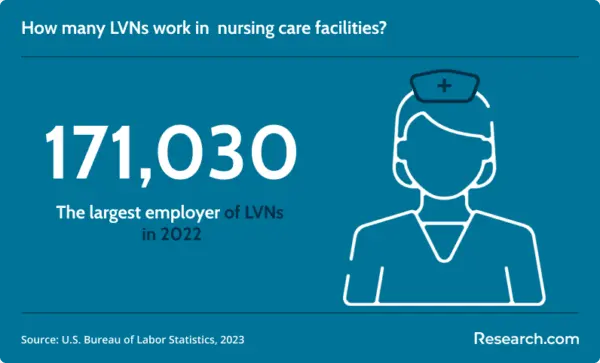
Licensed vocational nurses can pursue roles in nursing care facilities, hospitals, home healthcare, physician offices, clinics, and rehabilitation centers. BLS data shows that nursing care facilities employed the largest number of LVNs in 2022, with 171,030 workers in that industry.
Maintain your license
LVN licenses must be renewed on a regular schedule. Most states require renewal every two years. Renewal commonly involves submitting an application, paying a fee, and completing required continuing education hours.
Consider advancement before you enroll
Even if your immediate goal is to become an LVN, think ahead. Some students use LVN training as their long-term career path, while others use it as a bridge into RN or BSN education. Additional certifications in areas such as gerontology, pediatrics, hospice, or palliative care may help you qualify for more focused roles.
If you plan to move toward registered nursing, compare bridge options such as LPN to BSN online programs. Long term, some nurses continue into affordable online FNP programs and other advanced practice pathways.
Specialty nursing can also be an option after additional education and licensure. For example, you may explore becoming an OB nurse, learn how to become an OB nurse, consider fertility nurse certification, or compare potential ROI by reviewing critical care nurse salary information.
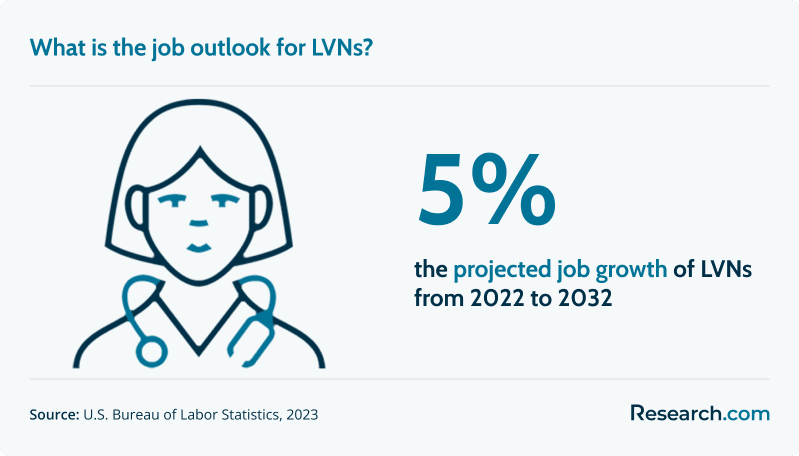
According to BLS projections, vocational nurse employment is expected to grow by 5% during the forecast period, with 34,900 new openings each year. That rate is higher than the projected growth for nursing assistants (4%) and the overall job market (3%), though medical assistants are projected to grow faster at 14%. For students comparing career paths in nursing, LVN training remains a practical entry-level route.
Demand for LVNs is supported by an aging population, chronic health conditions, and the continued shift of many services into outpatient and home-based settings. These changes do not eliminate hospital opportunities, but they make long-term care, home health, clinics, and community-based care especially important parts of the LVN labor market.
How do I prepare for the licensing exam in vocational nursing?
Preparing for the NCLEX-PN should begin before graduation, not after. Start by reviewing the official exam content areas, identifying weak topics, and using practice questions to build test endurance. Timed practice exams can help you adjust to the computer-based format and the five-hour time limit.
Common preparation methods include school-provided review materials, commercial NCLEX-PN review courses, study groups, flashcards, and repeated practice exams. Working nurses surveyed by Hamstra recommended that first-time test takers spend at least one to two months studying for the exam. Students balancing work, caregiving, or other responsibilities may need more time. This preparation is important because only 70.18% of LVN licensure exam takers passed the exam in 2023.
NCLEX-PN preparation checklist
- Confirm your state board’s testing and application instructions.
- Review the NCLEX-PN content outline and compare it with your course notes.
- Use timed question banks to practice decision-making under pressure.
- Track missed questions by topic instead of only tracking scores.
- Schedule focused review sessions for pharmacology, safety, infection control, and prioritization.
- Take at least one full-length practice session before your test date.
- Avoid waiting until after graduation to begin exam review.
How long does it take to become a vocational nurse?
The timeline depends on your program format, state requirements, and study pace. A traditional full-time campus program often takes one year, while part-time enrollment can extend the timeline to two years. Some schools advertise accelerated options, including a 6 month LPN program online, but students should verify that any fast-track program is state-approved and includes required clinical training.
After completing coursework, you may need additional time for NCLEX-PN study, licensure paperwork, background checks, and exam scheduling. Based on Hamstra’s cited recommendations, first-time test takers should plan at least one to two months for exam preparation.
At minimum, the full process of meeting education requirements, completing training, applying for licensure, and passing the exam can take under two years.
How do I find a reputable vocational nursing program near me?
The safest starting point is your state nursing board. Most boards maintain a list of approved practical or vocational nursing programs. Approval matters because a program that is not recognized by your state may not qualify you for the NCLEX-PN or licensure.
You can also search accreditor directories, including those maintained by the Accreditation Commission for Education in Nursing (ACEN) or regional accreditors such as the Southern Association of Colleges and Schools Commission on Colleges (SACSCOC). A reputable program should clearly explain its licensure eligibility, clinical placement structure, costs, admission requirements, and student support services.
Questions to ask before enrolling
| Question | Why it matters |
| Is the program approved by the state nursing board? | State approval is essential for licensure eligibility. |
| What is the NCLEX-PN pass rate? | Pass rates can indicate how well the program prepares students for licensure. |
| Where do clinical rotations take place? | You need to know whether clinical sites are accessible and relevant to your goals. |
| Are online students guaranteed or assisted with clinical placement? | Some online formats require students to travel or help secure local placements. |
| What is the full cost beyond tuition? | Books, uniforms, supplies, exams, background checks, and fees can add up. |
| Does the program support working adults? | Evening, weekend, part-time, and hybrid options may matter if you work while studying. |
| Will credits transfer into an RN or BSN program? | Transfer policies affect your ability to advance later without repeating coursework. |
How much will it cost to become a vocational nurse?
Cost depends heavily on school type, location, delivery format, and included fees. Students comparing nursing routes often ask, How much does it cost to become a nurse? For LVN programs, Research.com found that tuition can range from $30 to over $1,000 per credit. Community colleges in Nebraska offer programs for as low as $36 per credit, while private schools and universities tend to be more expensive.
Do not compare programs by tuition alone. You may also need to budget for textbooks, uniforms, lab supplies, background checks, immunizations, health screenings, transportation to clinical sites, technology fees, and NCLEX-PN-related costs. Some programs include the NCLEX-PN testing fee in the total program cost, while others charge it separately.
Common LVN cost factors
| Cost category | What to check |
| Tuition | Compare per-credit rates and total required credits, not only advertised program cost. |
| Fees | Ask about lab, technology, registration, graduation, and clinical fees. |
| Supplies | Budget for uniforms, shoes, stethoscope, textbooks, software, and clinical equipment. |
| Testing and licensing | Confirm whether NCLEX-PN fees and state application fees are included. |
| Clinical transportation | Clinical sites may require commuting, parking, fuel, or public transit costs. |
| Lost work hours | Clinical schedules may limit your ability to maintain full-time employment. |
What resources are available for vocational nursing students for 2027?
Strong student support can affect whether you finish the program, pass the NCLEX-PN, and find your first job. Before enrolling, ask what resources are included and which require extra payment.
- Financial aid and scholarships: Schools, foundations, employers, and nursing organizations may offer grants or scholarships for practical nursing students.
- Nursing associations: Groups such as the National Association for Practical Nurse Education and Service (NAPNES) can provide professional updates, networking, and continuing education information.
- NCLEX-PN study tools: Review courses, question banks, practice tests, and study guides can help students prepare for licensure.
- Peer support: Study groups, student forums, and cohort-based learning can make difficult coursework more manageable.
- Career services: Resume help, interview coaching, job fairs, and employer connections can support the transition from student to licensed nurse.
- Clinical placement assistance: Programs that help arrange clinical sites can reduce stress, especially for hybrid and online students.
- Mentorship: Access to experienced nurses can help students understand workplace expectations, scope of practice, and early-career decisions.
Can I earn a vocational nursing certificate online?
You may be able to complete some LVN coursework online, but you cannot complete all vocational nursing training online. Nursing licensure requires hands-on clinical experience, so reputable online or hybrid programs include in-person labs, simulations, and supervised clinical rotations.
Online coursework can be useful for students who work, live far from campus, or need more schedule flexibility. However, before enrolling, confirm where clinical training happens, whether the program is approved in your state, and whether graduates are eligible for the NCLEX-PN where they plan to practice.
Online, hybrid, and campus LVN programs compared
| Format | Best for | Trade-offs |
| Online coursework with local clinicals | Students who need flexibility but can attend in-person clinical sites. | You must verify clinical placement support and state approval. |
| Hybrid program | Students who want some campus interaction with partial online learning. | Travel to campus may still be required for labs or exams. |
| Campus program | Students who prefer face-to-face instruction and structured schedules. | Less scheduling flexibility for working adults. |
Are there alternative short courses that I can consider?
If you want a shorter healthcare training option or are unsure whether nursing is the right fit, consider comparing LVN programs with other career-focused certificates. Options may include:
- accelerated medical assistant programs
- 6 month lpn program online
- 4 week online course for medical coding and billing cost information included
What career advancement opportunities are available for LVNs?
LVNs can remain in bedside or direct patient-care roles, specialize within practical nursing, move into supervisory work, or continue their education toward RN and advanced nursing credentials. The right advancement path depends on your goals, budget, timeline, and willingness to return to school.
Common LVN advancement paths
| Path | When it makes sense | What to expect |
| Specialty certification | You want deeper skills in areas such as geriatrics, pediatrics, hospice, or palliative care. | May improve job fit and competitiveness but does not replace RN licensure. |
| LVN to RN bridge | You want broader scope of practice and more clinical responsibility. | Requires additional nursing education, clinical requirements, and NCLEX-RN preparation. |
| LVN to BSN pathway | You want a bachelor’s degree and stronger long-term mobility. | May take longer but can support leadership and graduate study goals. |
| Nurse practitioner pathway | You want advanced clinical practice and more autonomy. | Usually requires becoming an RN first, then completing graduate nursing education. |
| Administrative or supervisory roles | You enjoy coordination, scheduling, documentation, and team leadership. | May require experience, leadership training, and strong communication skills. |
One of the most common next steps is becoming an RN through an LPN-to-RN or LPN-to-BSN bridge program. These pathways are often designed for working nurses and may include online or part-time options. LVNs interested in advanced practice can later explore NP routes; for example, reviewing the easiest nurse practitioner specialties can help clarify which specialty areas may be more accessible.
How do you choose the best LVN training program?
The best LVN program is not always the cheapest, fastest, or most convenient. It is the program that is approved for licensure, fits your schedule, provides reliable clinical training, prepares students for the NCLEX-PN, and supports your next career step.
- Verify approval and accreditation. A program must be state-approved to satisfy licensure requirements. Accreditation from national or regional bodies can also indicate quality and may affect transfer options.
- Compare delivery format. Online and hybrid formats can help working students, but clinical training still happens in person. Campus programs may offer more direct instructor access and structured lab time.
- Review NCLEX-PN outcomes. Pass rates are not the only measure of quality, but they are a useful indicator of licensing exam preparation.
- Evaluate clinical placement support. Ask whether the school arranges placements or expects students to locate sites themselves.
- Calculate total cost. Include tuition, fees, books, uniforms, transportation, testing, licensing, and time away from work.
- Check transfer and bridge options. If you may later pursue RN or BSN education, ask whether credits transfer and whether the school has bridge agreements.
- Talk with current students or recent graduates. They can provide insight into workload, instructor support, scheduling, and clinical quality.
Common mistakes to avoid when choosing an LVN program
| Mistake | Better approach |
| Choosing a program without checking state approval. | Confirm approval directly through the state nursing board. |
| Focusing only on advertised tuition. | Ask for the full estimated cost, including supplies, fees, testing, and licensing. |
| Assuming online means fully remote. | Verify all lab, simulation, and clinical attendance requirements. |
| Ignoring NCLEX-PN pass rates. | Use pass rates along with student support, clinical quality, and retention information. |
| Overlooking schedule demands. | Confirm whether clinical hours conflict with work, childcare, or transportation limits. |
| Assuming credits will transfer. | Ask future RN or BSN programs how they evaluate LVN coursework. |
How can I transition from an LVN to an RN?
To move from LVN to RN, you generally need to complete an accredited bridge program that builds on practical nursing experience with advanced coursework, additional clinical training, and preparation for the NCLEX-RN. Start by comparing programs that fit your work schedule, meet state licensure requirements, and offer the RN credential you want. Some students choose part-time or online-supported formats to keep working while studying.
It can also help to review other structured healthcare-to-RN pathways, such as Medical Assistant to RN, because they show how prior healthcare experience may connect with nursing education. Before enrolling, ask current RNs about their transition experience, review the curriculum for evidence-based practice and clinical readiness, and confirm where practicum requirements will be completed.
What advanced education options are available after becoming an LVN?
After becoming an LVN, you can pursue additional nursing education to expand your scope of practice, qualify for leadership roles, or move into specialized care. Common options include LVN-to-RN, LVN-to-BSN, RN-to-BSN after earning RN licensure, and eventually graduate nursing programs.
Some nurses later compare advanced bridge options such as ADN to MSN online programs, especially if they want to move from foundational nursing practice toward master’s-level preparation. When evaluating advanced pathways, confirm accreditation, state licensure alignment, clinical requirements, and whether your prior credits will transfer.
What are the legal and ethical responsibilities of an LVN?
LVNs work under state-defined scopes of practice and must understand what they are legally allowed to do. Core responsibilities include protecting patient confidentiality, following HIPAA requirements, documenting care accurately, administering medications only within authorized limits, reporting changes in patient condition, maintaining professional boundaries, and escalating concerns to supervising RNs, physicians, or other authorized clinicians.
Ethical practice also includes respecting patient dignity, supporting informed consent processes, avoiding conflicts of interest, and reporting unsafe care. LVNs who plan to expand their responsibilities can review bridge options such as online LPN to RN programs, which may include more advanced training in legal, ethical, and professional nursing standards.
How can I fast track my transition from LVN to RN?
You can shorten the LVN-to-RN transition by choosing an accredited bridge program that recognizes prior practical nursing education, offers flexible scheduling, and provides a clear clinical placement plan. The fastest route is not always the best route; a program still must meet state requirements and prepare you for RN-level responsibilities.
Students planning long-term advancement may also compare options such as the fastest RN to BSN program online, particularly after earning RN licensure. Before choosing an accelerated format, confirm whether the pace is realistic with your work schedule, family responsibilities, and study time.
What emerging trends are influencing the LVN profession?
LVN work is being shaped by broader changes in healthcare delivery. Telehealth, electronic health records, digital communication tools, outpatient care, home-based care, and interdisciplinary coordination are increasingly part of the job. LVNs must be comfortable documenting accurately, using clinical technology, communicating across teams, and adapting to changing workflows.
These trends make continuing education important. LVNs who want broader clinical responsibility and long-term advancement may consider an easy RN to BSN bridge program after meeting RN pathway requirements.
Can additional scientific coursework boost my clinical expertise?
Additional science coursework can help LVNs better understand anatomy, physiology, disease processes, medications, and emerging healthcare technologies. This can support more confident communication with RNs, physicians, and other clinical professionals, especially in complex care environments.
For LVNs considering broader science-based pathways, an online bachelor of science degree in biology may provide a deeper academic foundation. However, students should confirm whether that degree supports their specific goals, since biology coursework alone does not expand nursing scope of practice or replace nursing licensure requirements.
How can LVNs transition into public health roles?
LVNs who enjoy prevention, education, and community-based care may be interested in public health. Their direct patient-care experience can be useful in health education, chronic disease support, outreach programs, vaccination initiatives, and community health navigation, depending on employer requirements and state scope rules.
Advancement into broader public health nursing roles often requires additional education, RN licensure, or graduate preparation. Students exploring this direction can review information on MSN public health nursing jobs to understand how nursing and population health careers may connect.
How much can I make as an LVN?
According to BLS wage data, licensed practical and licensed vocational nurses earn a median salary of $54,620 a year. Pay is not guaranteed and varies by employer, state, experience, shift, specialty, and setting. Higher earners may make over $70,000.
Industry can make a major difference. The personal care industry reports an average annual wage of $90,950 for LVNs. Grantmaking and giving services report a mean wage of $72,670, and insurance carriers report a mean wage of $65,170.
Location also matters. Washington has the highest listed annual mean wage for LVNs at $69,950. California, Massachusetts, Rhode Island, and Alaska also appear among the best states for nurses based on mean wages for vocational nurses.
| State | Annual Mean Wage |
| Washington | $69,950 |
| California | $69,930 |
| Massachusetts | $68,170 |
| Rhode Island | $66,770 |
| Alaska | $66,710 |
Experience, certifications, shift differentials, and specialized care settings can affect earnings. When evaluating ROI, compare local wages with your program’s full cost and the time you will spend out of the workforce or working reduced hours.
What is the job outlook for LVNs?
The employment outlook for licensed vocational nurses and licensed practical nurses is stable. In 2022, the United States employed 655,000 LVNs and LPNs. That number is projected to increase to 689,000 by 2032, representing a 5% growth rate from 2022 to 2032.
Demand is connected to aging populations, chronic health conditions, and the need for nursing support across long-term care, home health, outpatient, and clinical settings. Job availability can still vary by region, employer type, and local healthcare funding, so students should review labor market information in the state where they plan to work.
Where do LVNs typically work?
LVNs can work in several healthcare environments. The right setting depends on whether you prefer fast-paced acute care, long-term relationships with patients, predictable clinic schedules, or one-on-one home health work.
- Hospitals: LVNs may assist with basic nursing care under RN and physician supervision. Duties can include vital signs, medication administration, hygiene support, patient preparation, and documentation. Hospital roles may involve shift work and exposure to multiple departments.
- Nursing homes and long-term care facilities: Many LVNs support older adults or patients with chronic conditions. Work often includes medication administration, daily care assistance, health monitoring, and coordination with rehabilitation or therapy teams.
- Outpatient clinics and physician offices: LVNs may help with assessments, basic testing, patient preparation, records, scheduling, and care coordination. These settings may offer more regular business hours than hospitals or long-term care facilities.
- Home health care: LVNs provide care in patients’ homes, often supporting recovery after surgery, chronic disease management, medication routines, or personal care. This setting can offer more independence and one-on-one patient interaction.
- Rehabilitation centers: LVNs may care for patients recovering from stroke, surgery, injury, or illness. Duties can include monitoring progress, assisting with daily activities, and supporting therapy plans.
LVNs work closely with RNs, physicians, therapists, aides, and other healthcare professionals. If you eventually want broader nursing responsibilities, consider exploring online BSN programs for non nurses as part of your long-term planning.
What other healthcare careers can I pursue after becoming an LVN?
LVN experience can help you clarify whether you want to stay in nursing or shift into another allied health field. Some LVNs move toward RN education, specialty nursing, public health, care coordination, or healthcare administration. Others consider adjacent technical roles.
One possible direction is diagnostic medical sonography. If you are interested in imaging, patient interaction, and specialized technical skills, you can compare ultrasound tech programs online and learn about areas such as cardiac or pediatric sonography. Make sure to review clinical requirements, accreditation, certification expectations, and state rules before changing fields.
What additional skills should I develop to succeed as a vocational nurse?
Technical nursing knowledge is only part of the job. LVNs also need communication, judgment, professionalism, and emotional resilience. These skills affect patient safety, teamwork, and employability.
- Communication: LVNs must explain care clearly, listen to patients and families, and report changes accurately to supervising clinicians.
- Critical thinking: Patient conditions can change quickly, so LVNs need to recognize warning signs and respond appropriately within their scope of practice.
- Attention to detail: Medication administration, documentation, vital signs, and infection control require precision.
- Time management: LVNs often balance multiple patients, medication schedules, documentation, and urgent requests during a shift.
- Technical comfort: Familiarity with medical equipment, electronic health records, and clinical technology supports safe daily practice.
- Empathy: Patients may be anxious, in pain, or coping with major health changes. Compassionate care improves trust and communication.
- Adaptability: Healthcare settings change rapidly, and LVNs must adjust to new protocols, tools, schedules, and patient needs.
Developing these skills can strengthen your LVN career and prepare you for later education, including options such as the cheapest RN to BSN online programs.
References
- Deering, M. (2023, March 23). 6 Things To Know About The NCLEX Examination. NurseJournal.org. Retrieved December 14, 2023, from https://nursejournal.org/resources/nclex/things-to-know-about-the-nclex-exam
- Hamstra, B. (2023, February 24). Top 11 NCLEX Study Tips From Nurses to Pass the 1st Time. Nurse.org. Retrieved December 14, 2023, from https://nurse.org/articles/how-to-pass-nclex-the-first-time
- Kaplan Test Prep. (2023, September 14). NCLEX Pass Rates 2023: What You Need to Know Kaplan Test Prep. Kaplan Test Prep. Retrieved December 14, 2023, from https://www.kaptest.com/study/nclex/nclex-pass-rates-what-you-need-to-know
- NurseJournal.org. (2023, November 10). The U.S. Nursing Shortage: A State-by-State Breakdown. NurseJournal.org. Retrieved December 14, 2023, from https://nursejournal.org/articles/the-us-nursing-shortage-state-by-state-breakdown
- U.S. Bureau of Labor Statistics. (2023, September 6). Medical Assistants : Occupational Outlook Handbook: : U.S. Bureau of Labor Statistics. Retrieved December 14, 2023, from https://www.bls.gov/ooh/healthcare/medical-assistants.htm
- U.S. Bureau of Labor Statistics. (2023, September 6). Nursing Assistants and Orderlies : Occupational Outlook Handbook: : U.S. Bureau of Labor Statistics. Retrieved December 14, 2023, from https://www.bls.gov/ooh/healthcare/nursing-assistants.htm
- U.S. Bureau of Labor Statistics. (2023, September 6). Licensed Practical and Licensed Vocational Nurses : Occupational Outlook Handbook: : U.S. Bureau of Labor Statistics. Retrieved December 14, 2023, from https://www.bls.gov/ooh/healthcare/licensed-practical-and-licensed-vocational-nurses.htm
Key Insights
- The LVN path is fast, but it is still regulated. You need a state-approved program, supervised clinical training, board approval, and a passing NCLEX-PN score before you can practice.
- Online LVN programs are usually hybrid. Coursework may be online, but clinical training must happen in person.
- Program approval matters more than convenience. A cheap or accelerated program is not useful if it does not qualify you for licensure in your state.
- Costs vary widely. LVN programs can range from $30 to over $1,000 per credit, with some community college options as low as $36 per credit.
- Exam preparation should be part of your plan. The NCLEX-PN is challenging, and in 2023 only 70.18% of LVN licensure exam takers passed.
- LVN work can be a career or a bridge. Some nurses stay in LVN roles, while others use the experience to move into RN, BSN, NP, public health, or specialty nursing pathways.
- ROI depends on your local market. The median salary is $54,620, but wages differ by state, industry, experience, and specialization.
Other Things You Should Know About How to Become a Vocational Nurse
To become a vocational nurse in the US in 2027, you must graduate from an accredited nursing program and pass the National Council Licensure Examination for Practical Nurses (NCLEX-PN). Some states may have additional requirements, so checking with the local nursing board is advisable.
Most state boards of vocational nursing require a fingerprint-based criminal background check before issuing or renewing a license. The board reviews serious offenses, especially those involving violence, fraud, or drug violations, and may deny licensure or request additional documentation.


