
2027 How to Become an Obstetrics Nurse

Co-Founder and Chief Data Scientist
Becoming an obstetrics nurse is a nursing career path for people who want to care for patients during pregnancy, labor, delivery, and recovery after birth. The work matters because pregnancy and childbirth still carry preventable risks: the World Health Organization reports that almost 800 women worldwide die every day from preventable causes related to pregnancy and childbirth. In the United States, obstetrics nurses help reduce risk by monitoring patients, supporting clinical teams, educating families, and responding quickly when complications arise.
This guide explains how to become an obstetrics nurse in the United States, what the job involves, which nursing degree paths can lead to OB nursing, how much OB nurses can earn, how long training takes, and how to choose a program that supports your long-term goals.
Quick answer: How do you become an obstetrics nurse?
To become an obstetrics nurse, you must first become a registered nurse. That means completing an accredited ADN or BSN nursing program, passing the NCLEX-RN, meeting your state board of nursing requirements, and then gaining clinical experience in an obstetrics, labor and delivery, women’s health, birthing center, or OB/GYN setting. Certification is not always required for entry-level OB nursing jobs, but after at least 24 months and 2,000 hours of relevant clinical practice, eligible nurses can pursue the RNC-OB credential through the National Certification Corporation.
What are the main benefits of becoming an obstetrics nurse?
- You do not need a separate “obstetrics nursing degree” to enter the field. OB nurses are licensed RNs who choose to work in obstetrics, labor and delivery, postpartum care, women’s health, or OB/GYN clinical environments.
- OB/GYN nurses in the U.S. earn an average of $84,626 per year, or $40.69 per hour, according to Zippia.
- Registered nurse employment in the U.S. is projected to grow 6% from 2022 to 2032, according to the United States Bureau of Labor Statistics.
What can you do as an OB nurse with a nursing degree?
With a nursing degree and an RN license, you can work in obstetrics-focused roles that support patients before birth, during labor, immediately after delivery, and during early postpartum recovery. Typical work may include prenatal assessments, labor support, fetal monitoring, patient education, assisting during deliveries, postpartum observation, newborn assessments, and helping families understand feeding, recovery, and warning signs that require medical attention.
OB nurses usually work alongside obstetricians, certified nurse midwives, nurse practitioners, pediatric or neonatal teams, and other hospital or clinic staff. Their role combines clinical monitoring, patient advocacy, emotional support, and rapid communication with providers when maternal or fetal status changes.
Where do obstetrics nurses work?
Obstetrics nurses can work in several care settings. The right setting depends on whether you want fast-paced delivery-room work, outpatient education and testing, postpartum care, or broader women’s health nursing.
| Work setting | Common OB nursing responsibilities | Best fit for nurses who want |
| Hospital labor and delivery unit | Monitor laboring patients, assist during vaginal and surgical deliveries, track fetal status, support pain management, and respond to emergencies. | Acute care, unpredictable shifts, and hands-on delivery support. |
| Maternity or postpartum ward | Observe recovery after birth, assess bleeding and pain, support breastfeeding or feeding plans, educate parents, and monitor newborns. | Patient teaching, recovery care, and family-centered support. |
| Birthing center | Support low-risk pregnancies and births, provide labor coaching, monitor maternal and fetal status, and collaborate with midwives or physicians. | A more holistic or midwifery-centered birth environment. |
| Private OB/GYN office | Prepare patients for exams, collect histories, assist with prenatal visits, coordinate testing, and provide reproductive health education. | More predictable hours and ongoing patient relationships. |
| Outpatient or community clinic | Provide prenatal education, screenings, referrals, reproductive health support, and care coordination for diverse patient populations. | Public health, prevention, and access-focused care. |
How much can you make as an obstetrics nurse?
OB nurse earnings depend on location, employer, shift type, experience, credentials, and whether the nurse works in a hospital, clinic, birthing center, or advanced practice role. Because OB nurses are RNs, national RN wage data is a useful benchmark, but OB/GYN-specific salary sources may show different averages.
Registered nurses in the United States earn an average annual wage of $89,010, or $42.80 per hour. California and Hawaii are among the highest-paying states for nurses based on average wages, with annual average wages of $133,340 and $113,220, respectively.
Zippia reports that OB/GYN nurses in the country earn an average salary of $84,626. By state, Zippia lists Alaska as the highest-paying state for OB/GYN nurses at $114,206, followed by California at $111,359 and Nevada at $108,620.
How to Become an Obstetrics Nurse Table of Contents
- Best nursing programs for 2027
- OB nurse responsibilities
- Steps to become an obstetrics nurse
- How to choose a nursing program for OB nursing
- Knowledge and skills OB nurses need
- How long the OB nursing path takes
- Common nursing courses for future OB nurses
- Average nursing program costs
- Personal traits that help OB nurses succeed
- Emerging specialties that complement obstetrics nursing
- Career paths within obstetrics nursing
- Trends shaping obstetrics nursing practice
- Continuing education for OB nurses
- Advanced certifications for obstetrics nurses
- How an MBA MSN dual degree can support career growth
- Choosing nursing programs with higher acceptance rates
- Legal and ethical issues in obstetrics nursing
- How to move up as an obstetrics nurse
- Job outlook for obstetrics nurses
- Additional skills that can strengthen your OB nursing role
- Work-life balance in obstetrics nursing
Best Nursing Programs for 2027
How should you use this program list?
A nursing program is a major financial, academic, and career decision. The schools below can help prepare students for RN licensure and general nursing practice, which is the foundation for entering obstetrics nursing. A BSN is not the only route to becoming an RN, but many employers increasingly prefer BSN-prepared nurses, especially in hospital settings.
This list focuses primarily on Bachelor of Science in Nursing programs. An ADN can still lead to RN licensure and an OB/GYN nursing role, but a BSN may offer stronger preparation for hospital employment, graduate nursing study, leadership roles, and advanced practice pathways.
The Research.com team evaluated programs using our established methodology. Data sources included the IPEDS database, Peterson’s database and its Distance Learning Licensed Data Set, the College Scorecard database, and the National Center for Education Statistics.
1. Duke University
The Duke University School of Nursing offers an accelerated BSN program for students who already hold a bachelor’s degree or higher in another field. Duke’s ABSN is a full-time, campus-based program designed to prepare students for RN licensure in 16 months.
The school also offers master’s, doctoral, and certificate options in online and campus formats. Its programs emphasize wellness, disease prevention, health promotion, evidence-based nursing, clinical leadership, and culturally responsive care.
- Location: Durham, NC
- Program Length: 16 months
- Cost per semester: $25,258
- Required Credits to Graduate: 58
- Accreditation: Commission on Collegiate Nursing Education (CCNE)
2. University of Pennsylvania
The University of Pennsylvania School of Nursing provides an Ivy League nursing education with strong emphasis on clinical practice, research exposure, and simulation-based learning. Penn Nursing offers a traditional BSN and a BSN Second Degree option for students who already completed a bachelor’s degree in another discipline.
- Location: Philadelphia, PA
- Program Length: 4 years
- Annual tuition: $58,620
- Required Credits to Graduate: 40.5 course units
- Accreditation: CCNE
3. The Ohio State University
The Ohio State University College of Nursing centers its nursing education on wellness, evidence-based care, primary care leadership, research, global engagement, and innovation. Its BSN program prepares students for RN practice and can serve as a path into obstetrics nursing.
OSU also offers an LPN to BSN Bridge track, an RN to BSN program for associate-prepared RNs, and an Accelerated BSN option for students with a non-nursing bachelor’s degree.
- Location: Columbus, OH
- Program Length: 4 years
- Annual tuition for Ohio residents: $12,859
- Annual tuition for non-residents: $38,365
- Required Credits to Graduate: 121
- Accreditation: CCNE
4. University of Iowa
The University of Iowa College of Nursing offers a full-time, on-campus BSN that prepares students for RN licensure and entry-level professional nursing practice. The program combines classroom learning with patient care experiences, supported by the college’s relationship with the University of Iowa Hospitals and Clinics, one of the country’s largest teaching and research hospitals.
- Location: Iowa City, IA
- Program Length: 4-4.5 years
- Annual tuition and fees for Iowa residents: $10,964
- Annual tuition and fees for non-residents: $32,927
- Required Credits to Graduate: 128
- Accreditation: CCNE
5. Emory University
Emory University’s Nell Hodgson Woodruff School of Nursing offers a full-time BSN and a distance-based accelerated BSN. The BSN can be pursued through a Freshman Option for Emory and Oxford students or a Transfer Option for students entering with 60 semester hours of college credit. In the final four semesters, students complete nursing coursework and clinical experiences that prepare them for broad healthcare practice.
- Location: Atlanta, GA
- Program Length: 2 years (BSN transfer and freshman options) | 12 months distance ABSN)
- Cost per credit hour: $2,497 (traditional BSN) | $1,706 (distance ABSN)
- Required Credits to Graduate: 60 (traditional BSN) | 48 (distance ABSN)
- Accreditation: CCNE
6. University of Alabama at Birmingham
The UAB School of Nursing offers a traditional four-year BSN for students preparing for RN practice. The curriculum includes academic and professional nursing coursework intended to build clinical competence, patient-care judgment, and readiness for multiple healthcare settings.
- Location: Birmingham, AL
- Program Length: 4 years
- Cost per semester hour: $434 (resident) | $1,076 (non-resident)
- Required Credits to Graduate: 125
- Accreditation: CCNE
7. University of North Carolina at Chapel Hill
The University of North Carolina at Chapel Hill’s School of Nursing offers a BSN that prepares students for patient-centered, team-based nursing practice. The program emphasizes patient advocacy, safety, faculty mentorship, and student research opportunities.
- Location: Chapel Hill, NC
- Program Length: 5 semesters (BSN proper)
- Cost of attendance: $32,255 (in-state) | $91,120 (out-of-state)
- Required Credits to Graduate: 60 (BSN proper)
- Accreditation: CCNE
8. University of Washington
The University of Washington School of Nursing offers a two-year BSN for students who enter as college-level juniors after completing 90 quarter credits or 60 semester credits of prerequisites. Students practice in the Learning Lab, complete interactive scenarios, and gain more than 1,000 hours of supervised patient care experience through over 700 community partnership sites, including the University of Washington Medical Center and Seattle Children’s Hospital.
- Location: Seattle, WA
- Program Length: 2 years
- Cost: $4,215 per quarter (resident) | $13,999 per quarter (non-resident)
- Required Credits to Graduate: 91 (BSN proper)
- Accreditation: CCNE
9. University of Michigan Ann Arbor
The University of Michigan Ann Arbor’s School of Nursing offers a BSN that blends nursing coursework with humanities, social sciences, and biological sciences. Students learn from faculty and a global alumni network of more than 13,000 professionals.
- Location: Ann Arbor, MI
- Program Length: 4 years
- Cost per Credit: $1,066 (resident) | $2,768 (non-resident)
- Required Credits to Graduate: 128
- Accreditation: CCNE
10. Boston College
The William F. Connell School of Nursing at Boston College offers a BSN that prepares students for generalist nursing practice in hospitals, clinics, community settings, and other healthcare environments. The curriculum combines nursing, natural and social sciences, liberal arts, clinical experiences, leadership development, and clinical judgment training.
- Location: Chestnut Hill, MA
- Program Length: 4 years
- Cost per Credit: $2,214
- Required Credits to Graduate: 117
- Accreditation: CCNE
Key facts to know before choosing obstetrics nursing
- The fastest entry-level route is usually an ADN, which can take at least two years, while the BSN route typically takes about four years.
- Specialty certification generally requires additional experience: at least 24 months and 2,000 hours of clinical experience in OB/GYN nursing.
- Strong OB nurses need clinical judgment, technical nursing skills, patient education ability, emotional composure, teamwork, and clear communication.
- Average total cost of attendance varies widely. NCES estimated $26,000 at public institutions, $55,800 at private non-profit institutions, and $32,900 at private for-profit institutions for first-time, full-time students living on campus in four-year undergraduate programs in academic year 20212022.
- Experienced OB nurses can pursue advanced roles such as Women’s Health Nurse Practitioner, Certified Nurse Midwife, Clinical Nurse Specialist, nurse educator, or nurse manager.
- RN employment is projected to grow 6% from 2022 to 2032, with about 193,000 openings each year.
What are the responsibilities of an obstetrics nurse?
OB nursing responsibilities vary by unit and employer, but most roles involve a combination of assessment, monitoring, education, documentation, and direct patient support. In labor and delivery, the pace can shift quickly from routine monitoring to emergency response.
- Teach patients about fertility, pregnancy, family planning, labor preparation, postpartum recovery, and warning signs.
- Prepare patients for visits, exams, procedures, or provider evaluation.
- Perform routine assessments such as prenatal screenings, vital signs, urine tests, blood tests, and documentation of findings.
- Monitor maternal and fetal health during pregnancy and labor and promptly report concerning changes to the provider.
- Support patients emotionally during stressful, painful, uncertain, or high-risk situations.
- Prepare patients for labor and delivery through coaching, fetal monitoring, comfort measures, and pain management support.
- Assist obstetricians or certified nurse midwives during vaginal and surgical deliveries.
- Observe postpartum recovery, including bleeding, pain, infection risk, mobility, and emotional well-being.
- Assess newborns after birth and perform routine observations within the nurse’s scope of practice.
- Educate parents on newborn feeding, breastfeeding, diapering, bathing, safe care practices, and follow-up needs.

How to become an obstetrics nurse
The path to obstetrics nursing starts with RN licensure. You do not become an OB nurse through a separate undergraduate major; instead, you complete nursing education, become licensed, and then seek clinical roles in obstetrics or women’s health.
| Step | What you do | Decision point |
| 1. Complete an ADN or BSN | Graduate from an accredited nursing program that qualifies you to take the NCLEX-RN. | Choose ADN for a shorter entry path or BSN for broader employer preference and graduate school preparation. |
| 2. Pass the NCLEX-RN | Apply through your state board of nursing and earn a passing score on the RN licensure exam. | Check your state’s requirements early because rules are set by each state board. |
| 3. Get RN licensure | Meet all state licensure requirements and receive authorization to practice as an RN. | If you may move, review Nurse Licensure Compact rules. |
| 4. Work in an OB/GYN setting | Apply for roles in labor and delivery, postpartum units, OB/GYN clinics, birthing centers, community clinics, urgent care, or military healthcare settings. | Prioritize settings that offer mentorship, structured orientation, and exposure to maternal-newborn care. |
| 5. Consider certification | After meeting experience requirements, pursue specialty certification if it fits your career goals. | Certification can support advancement, but it is not the same as RN licensure. |
1. Earn an ADN or BSN
The first requirement is a nursing degree. You can complete a two-year associate degree in nursing, often called an ADN or ASN, or a four-year Bachelor of Science in Nursing. Many RNs begin with an ADN and later complete an RN-to-BSN program, while others choose a BSN from the start because many employers prefer BSN-prepared applicants and graduate nursing programs often expect bachelor-level preparation.
2. Obtain a nursing license
After finishing an approved nursing program, you must become licensed as a registered nurse. The required exam is the National Council Licensure Examination for Registered Nurses, commonly called the NCLEX-RN.
Licensure is managed by state boards of nursing. Requirements differ by state, but passing the NCLEX-RN is required. Many states also participate in the Nurse Licensure Compact, which allows nurses licensed in one compact state to practice in other compact states without obtaining separate licenses. Currently, 41 states are part of the NLC.
3. Apply for OB/GYN nursing roles
Once you hold an RN license, experience is what moves you toward obstetrics nursing. You can look for positions in hospital labor and delivery units, postpartum departments, birthing centers, private OB/GYN practices, urgent care clinics, community clinics, or the U.S. military.
For new graduates, a structured nurse residency, preceptorship, or unit orientation can be especially valuable because obstetrics nursing requires close monitoring, quick escalation, and careful documentation.
4. Consider specialty certification
After at least 24 months and 2,000 hours of clinical experience in OB/GYN nursing, you may be eligible to pursue certification through the National Certification Corporation. The NCC offers the inpatient obstetric nursing (RNC-OB) credential through a computer-based exam.
The RNC-OB is not required for every OB nursing job, but it can demonstrate specialty knowledge and may strengthen your candidacy for more advanced obstetrics nursing positions.
How do you choose the best nursing program to become an obstetrics nurse?
The best program is not simply the school with the most recognizable name. For future OB nurses, the right choice is an accredited nursing program that prepares you for RN licensure, offers strong clinical experiences, fits your budget, and supports your long-term goals in maternal, newborn, and women’s health.
Factors to compare before enrolling
- Accreditation and state approval. Confirm that the program is properly accredited and approved for RN licensure preparation in the state where you plan to become licensed.
- ADN vs. BSN fit. Choose an ADN if speed and lower cost are top priorities; choose a BSN if you want stronger preparation for hospital hiring, leadership, or graduate study.
- OB-related clinical exposure. Ask whether students complete rotations in labor and delivery, maternity, postpartum, newborn, or women’s health settings.
- NCLEX-RN outcomes. Review the program’s NCLEX-RN pass rates because licensure is the gatekeeper to OB nursing employment.
- Faculty background. Look for instructors with experience in obstetrics, maternal-newborn nursing, women’s health, nurse-midwifery, or advanced practice nursing.
- Clinical partners. Strong relationships with hospitals, birthing centers, and OB/GYN providers can improve the quality of your hands-on training.
- Schedule and delivery format. Decide whether you need full-time, part-time, evening, hybrid, or online coursework. Remember that clinical nursing hours must be completed in person.
- Total cost, not tuition alone. Include fees, books, uniforms, background checks, immunizations, equipment, transportation, parking, and lost work hours.
- Student support. Compare tutoring, simulation labs, advising, career services, mental health support, and remediation resources.
- Graduate school preparation. If you want to become a nurse midwife, nurse practitioner, or DNP-prepared leader, choose a program that builds a strong academic foundation.
Questions to ask admissions or nursing advisors
- Is the nursing program approved by the state board of nursing?
- What were the most recent NCLEX-RN pass rates?
- How many clinical hours are completed in maternal-newborn, women’s health, or OB-related settings?
- Where do students complete clinical rotations?
- Can students request OB-related placements, or are placements assigned?
- What percentage of graduates work in hospitals or specialty units after graduation?
- What happens if a student fails or must repeat a nursing course?
- Are transfer credits accepted, and how are science prerequisites evaluated?
- What is the full estimated cost of attendance?
- Does the program support working students, parents, or career changers?
What knowledge and skills are required from an obstetrics nurse?
OB nurses need a strong general nursing foundation plus specialized comfort with pregnancy, birth, postpartum recovery, newborn care, emergency response, and family education. The work requires both technical precision and emotional steadiness.
Medical knowledge
- Pregnancy, fetal development, labor stages, postpartum recovery, delivery methods, and common complications.
- Newborn assessment, feeding support, growth patterns, newborn screenings, and common early-life concerns.
- Female reproductive anatomy and physiology, including hormonal cycles and gynecological conditions that may affect pregnancy.
- Medications used during pregnancy, labor, delivery, pain control, and postpartum care.
Technical and clinical skills
- Prenatal checkups, medication administration, fetal monitoring, and delivery assistance within RN scope of practice.
- Recognition of urgent complications such as fetal distress, hemorrhage, or sudden maternal deterioration.
- Sterile technique, infection prevention, and safe care practices for mothers and newborns.
- Use of monitoring equipment and interpretation of clinical data that must be escalated to providers.
Communication and interpersonal skills
- Empathy when supporting patients and families through pain, fear, uncertainty, loss, or unexpected outcomes.
- Clear explanations of procedures, care plans, warning signs, and newborn care instructions.
- Active listening so care reflects the patient’s concerns, preferences, culture, and needs.
- Stress management during high-pressure deliveries, urgent changes, and emotionally difficult cases.
Professional skills
- Critical thinking and sound clinical judgment.
- Teamwork with physicians, midwives, neonatal teams, anesthesiology, social workers, and other nurses.
- Accurate documentation and ethical practice.
- Respect for patient autonomy, informed consent, privacy, and cultural differences.
How long does it take to become an obstetrics nurse?
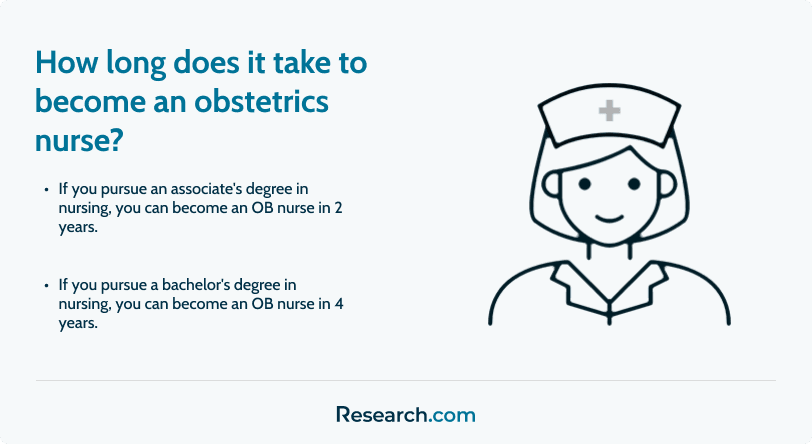
The timeline depends on your degree route and whether you plan to pursue specialty certification. An ADN can prepare you for RN licensure in at least two years, while a BSN commonly takes about four years. Certification adds time because you need at least 24 months and 2,000 hours of clinical experience in OB/GYN nursing before applying for the NCC inpatient obstetric nursing credential.
| Path | Typical time stated | What it can lead to |
| ADN or ASN | At least two years | RN licensure eligibility and entry-level nursing roles, including possible OB/GYN settings. |
| BSN | About four years | RN licensure eligibility, broader hospital hiring preparation, and a stronger base for graduate school. |
| OB specialty certification | At least 24 months and 2,000 hours of clinical experience | Specialty recognition through the RNC-OB credential for eligible nurses. |
What courses are typically included in a nursing program?
Future OB nurses complete the same core nursing curriculum required of RN candidates. Programs usually begin with prerequisites and general education, then move into nursing courses, simulation, labs, and supervised clinical practice.
- Math
- Chemistry
- Psychology
- Physiology
- Nursing fundamentals
- Leadership and management
- Advanced anatomy and physiology
- Gerontology
- Pharmacology
- Psychiatric and mental health nursing
- Advanced pathophysiology
- Advanced microbiology
- Community health
- Ethics in healthcare delivery
What is the average cost of an obstetrics nursing program?
There is no separate standard price for an “obstetrics nursing program” because OB nurses first complete a general RN-preparation program. If you are comparing options and wondering how much is nursing school, focus on the total cost of attendance rather than tuition alone.
Costs vary by institution type, residency status, degree level, enrollment pace, housing, fees, transportation, supplies, and whether you can continue working while enrolled. According to the National Center for Education Statistics, in academic year 20212022, the average total cost of attendance for first-time, full-time students living on campus in a four-year undergraduate program was $55,800 at private non-profit institutions, $32,900 at private for-profit institutions, and $26,000 at public institutions.
The table below compares average costs of attendance for four-year and two-year programs by institution type.
| 4-Year Program | 2-Year Program | |
| Public institution | $26,000 | $16,100 |
| Private nonprofit institution | $55,800 | $33,000 |
| Private for-profit institution | $32,900 | $27,200 |
What personal qualities help obstetrics nurses succeed?
OB nursing is not only technical work. Patients and families may be excited, frightened, exhausted, grieving, or overwhelmed. The best OB nurses combine clinical competence with calm, respectful, and compassionate care.
- Empathy and compassion. Patients need nurses who can recognize fear, pain, uncertainty, and joy without becoming dismissive or detached.
- Clear communication. OB nurses explain procedures, changes in care, discharge instructions, and newborn care in language patients can understand.
- Emotional resilience. Labor and delivery can include emergencies, complications, and difficult outcomes, so nurses must manage stress while staying professional.
- Attention to detail. Small changes in maternal or fetal status can matter, especially during labor or postpartum recovery.
- Patience and adaptability. Birth does not always follow a schedule, and every patient’s situation, culture, preferences, and risk factors may differ.
What emerging specialties could complement an obstetrics nursing career?
OB nurses who want to broaden their impact may add expertise in mental health, family care, neonatal care, women’s health, or advanced practice nursing. Mental health knowledge is especially relevant because pregnancy and postpartum recovery can involve anxiety, depression, trauma, grief, and major life changes.
For nurses interested in psychiatric and maternal health overlap, a 1 year PMHNP program online may be worth exploring if it fits their prior education, licensure status, and career goals. Before enrolling, nurses should confirm clinical requirements, state authorization, accreditation, and whether the program supports the role they want.
Complementary specialties can help OB nurses move into more focused clinical practice, patient education, care coordination, leadership, or graduate-level roles, but they should be chosen based on scope of practice, licensure requirements, and local employer demand.
What are the different career paths within obstetrics nursing?
OB nursing can lead to several directions after you build experience. Some paths remain bedside-focused, while others require graduate education, certification, or leadership preparation.
- Certified Nurse Midwife (CNM): A CNM is an advanced practice registered nurse who specializes in pregnancy, childbirth, postpartum care, and related reproductive health services. This path requires a master’s or doctoral program and a national certification exam.
- Women’s Health Nurse Practitioner (WHNP): WHNPs provide women’s health care that may include reproductive health, pregnancy-related care, and menopause care. This route typically requires a master’s degree in nursing with a women’s health focus and certification.
- Clinical Nurse Specialist (CNS) in Obstetrics: A CNS in OB focuses on complex clinical issues, evidence-based care, staff education, quality improvement, and better patient outcomes in obstetric settings.
- Nurse Educator: OB nurses who enjoy teaching may move into nursing education, maternal-child health instruction, clinical training, or curriculum development.
- Nurse Manager or Director: Experienced OB nurses can manage units, staffing, budgets, protocols, quality metrics, and patient-care processes.
- Advanced Practice Roles (BSN to DNP Programs): Nurses pursuing advanced practice or senior clinical leadership may consider doctoral study. Flexible options, including most affordable BSN to DNP programs online, can help working nurses compare cost-conscious pathways.
What are the emerging trends in obstetrics nursing practice?
Obstetrics nursing is being shaped by telehealth, digital patient education, remote prenatal and postnatal follow-up, simulation-based training, and stronger interprofessional teamwork. These tools do not replace bedside judgment, but they can improve communication, preparation, and early identification of concerns when used appropriately.
Nurses who want broader acute-care capability may also compare options such as online acute care nurse practitioner programs. Before choosing an advanced program, confirm that its curriculum, clinical placements, and licensure outcomes match the role you plan to pursue.
How can continuing education boost your obstetrics nursing expertise?
Continuing education helps OB nurses stay current on maternal safety practices, emergency protocols, fetal monitoring, newborn care, documentation, patient education, and technology used in obstetric settings. It can also support advancement into preceptor, charge nurse, educator, manager, or advanced practice roles.
Graduate options such as an accelerated DNP may be appropriate for nurses seeking stronger leadership, evidence-based practice, and advanced clinical decision-making preparation. As with any advanced program, compare accreditation, clinical requirements, cost, schedule, and state authorization before applying.
What advanced certifications should you pursue to specialize further in obstetrics nursing?
Advanced certifications can help document focused expertise in obstetrics, maternal care, newborn support, emergency response, or related practice areas. Useful options may include credentials tied to inpatient obstetric nursing, maternal-fetal care, neonatal resuscitation, fetal monitoring, or women’s health, depending on your role and employer expectations.
Nurses who already hold graduate preparation and want a nurse practitioner pathway may also evaluate a post-masters NP program. The best choice depends on your current credentials, state scope-of-practice rules, and the patient population you want to serve.
How can an MBA MSN dual degree enhance an obstetrics nursing career?
An MBA MSN dual degree can be useful for OB nurses who want to combine nursing leadership with healthcare business knowledge. This type of preparation may support roles involving budgeting, staffing, quality improvement, strategic planning, policy implementation, or service-line leadership in maternal health settings.
If your goal is to move beyond bedside practice while remaining connected to women’s and maternal health, comparing MBA MSN dual degree programs online can help you see whether the curriculum aligns with management, executive, or administrative career goals.
How do you select a nursing program with a high acceptance rate?
A program with a more accessible admissions process can help you enter nursing sooner, but acceptance rate should never be the only factor. You still need to verify accreditation, state approval, NCLEX-RN performance, clinical placement quality, student support, and total cost.
When comparing options, review admission prerequisites, GPA expectations, entrance exams, waitlists, transfer policies, delivery format, and remediation support. For a broader starting point, you can review Research.com’s guide to nursing schools high acceptance rate and then verify each school directly before applying.
What are the legal and ethical considerations in obstetrics nursing?
Obstetrics nurses work in a legally and ethically sensitive area of healthcare. They must protect patient privacy, document carefully, follow informed consent procedures, escalate concerns promptly, respect patient autonomy, and practice within the RN scope defined by their state and employer.
Important areas include confidentiality, fetal and maternal monitoring documentation, medication safety, emergency response, patient education, culturally respectful care, and clear communication during high-risk situations. State-specific laws and institutional policies can affect practice, especially in emergencies, reproductive health care, and high-risk pregnancies.
Nurses who want to strengthen their academic foundation while continuing RN practice may compare bridge options such as easiest RN-BSN programs to get into, while also confirming that any program meets employer and licensure expectations.
How do you advance your career as an obstetrics nurse?
OB nursing can lead to multiple advancement routes. Some nurses deepen bedside expertise and become charge nurses, preceptors, or unit specialists. Others move into education, management, nurse practitioner practice, nurse-midwifery, or doctoral-level leadership.
Further education is often required for advanced practice registered nurse roles. OB nurses interested in women’s health, pregnancy care, or broader family practice may pursue an MSN, DNP, or post-graduate certificate depending on their current degree and goals.
RNs with an associate degree can compare bridge programs such as ASN to NP programs, which may allow eligible nurses to move toward an MSN without first completing a traditional four-year BSN.
Some accelerated routes, including accelerated RN to NP programs, are designed to shorten the timeline compared with the traditional RN to BSN to MSN sequence, which takes at least six years. These accelerated options can take RNs only three years to become an NP.
BSN-prepared nurses who want doctoral preparation may also consider BSN to DNP online programs. Before enrolling, compare clinical placement support, accreditation, state authorization, certification alignment, and whether the program fits the role you want.
What is the job outlook for obstetrics nurses?
Because obstetrics nurses are registered nurses, the broader RN labor outlook is the most reliable national benchmark. The employment rate for RNs is projected to grow 6% from 2022 to 2032, which is faster than the average growth rate for all occupations. The Bureau of Labor Statistics also projects about 193,000 openings for registered nurses each year during that period, largely due to workers retiring, changing occupations, or leaving the labor force.
OB-specific demand can vary by state, hospital system, birth volume, rural or urban location, and employer staffing needs. Some experienced OB nurses also leave bedside roles to become NPs or APRNs, which can affect local staffing patterns. Flexible graduate options, including online doctoral programs, may make it easier for working nurses to pursue advanced education while employed.
Pay also differs by state. Nurses comparing locations may want to evaluate wages, cost of living, licensing rules, job openings, staffing ratios, and quality-of-life factors. Research.com’s guide to the best states to be a nurse can help with state-level comparisons.
The chart below shows the five highest-paying states for OB/GYN nurses. Alaska leads with an average annual salary above $114,000 for OB nurses, followed by California at more than $111,300.
What skills can you acquire to enhance your role as an obstetrics nurse?
Additional skills can make you more effective in obstetrics settings and may support advancement. Useful areas include electronic fetal monitoring, newborn resuscitation, obstetric emergency management, patient education, lactation support, trauma-informed care, documentation, and use of maternal health technology.
Ultrasound knowledge can also help nurses better understand fetal monitoring and prenatal assessment workflows, although ultrasound practice requirements vary by role and employer. If this skill interests you, you can explore an online ultrasound tech school and confirm whether the training fits your state, employer, and career goals.
Is obstetrics nursing worth it?
Obstetrics nursing can be worth it if you want meaningful patient contact, maternal-newborn care, high responsibility, teamwork, and a specialty with room for advancement. It may not be the right fit if you need predictable daytime hours, prefer low-acuity settings, or want to avoid emotionally intense cases.
| Choose OB nursing if... | Consider another nursing path if... |
| You want to support patients during pregnancy, birth, and postpartum recovery. | You prefer a setting with less unpredictability and fewer urgent changes. |
| You can stay calm during pain, stress, emergencies, and emotionally complex situations. | You find high-emotion clinical environments consistently overwhelming. |
| You enjoy patient education and family-centered care. | You prefer less teaching and more procedure-focused work. |
| You are comfortable with nights, weekends, holidays, or long shifts in hospital roles. | You need a more consistent schedule from the start. |
| You may want to advance into women’s health, nurse-midwifery, education, or leadership. | You do not want additional certifications, training, or graduate study later. |
Common mistakes to avoid when preparing for obstetrics nursing
- Choosing a school without checking accreditation and state approval. If the program does not qualify you for RN licensure, it will not help you become an OB nurse.
- Looking only at tuition. Fees, clinical travel, supplies, housing, lost work hours, and repeat-course policies can significantly affect affordability.
- Assuming every online nursing program is fully online. Nursing programs usually require in-person labs, simulations, and clinical rotations.
- Ignoring NCLEX-RN pass rates. Passing the NCLEX-RN is essential for RN licensure, so exam preparation outcomes matter.
- Assuming OB clinical placement is guaranteed. Ask whether students actually rotate through labor and delivery, postpartum, or maternal-newborn settings.
- Choosing based only on rankings. A highly ranked program may still be a poor fit if it is too expensive, too far away, or does not support your schedule.
- Assuming salary outcomes are guaranteed. Pay varies by state, employer, shift, experience, certification, and role.
- Overlooking transfer credit rules. Science prerequisites may expire or need to meet specific grade requirements.
- Waiting too long to understand licensure rules. State boards of nursing set requirements, and compact-state rules may matter if you plan to relocate.
What is the work-life balance like for obstetrics nurses?
Work-life balance in OB nursing depends heavily on the setting. Hospital labor and delivery roles may involve 12-hour shifts, nights, weekends, holidays, and unpredictable patient needs. Outpatient OB/GYN clinics may offer more regular hours but can still be busy and emotionally demanding.
Common work-life balance challenges
- Irregular or long shifts: Hospital OB nurses may work extended shifts that include nights, weekends, and holidays, which can complicate sleep routines and family time.
- Emotional intensity: Birth can be joyful, but complications, high-risk pregnancies, and difficult outcomes can contribute to stress and burnout.
- Physical demands: Nurses may spend long hours standing, helping patients move, assisting during labor, and responding quickly in urgent situations.
Ways to protect your well-being
- Compare settings carefully. Labor and delivery, postpartum, birthing centers, and OB/GYN offices can offer very different schedules and stress levels.
- Use scheduling options when available. Some employers offer part-time roles, self-scheduling, job sharing, or different shift structures.
- Build recovery time into your routine. Sleep, hydration, nutrition, movement, and mental health support are not optional in a demanding nursing specialty.
- Seek strong team culture. Supportive managers, preceptors, and coworkers can make a major difference in retention and job satisfaction.
- Know when to change roles. Moving from labor and delivery to postpartum, clinic care, education, or leadership can help experienced nurses stay in the field without staying in the same schedule forever.
References
- World Health Organization. (2023, February 22). Maternal mortality. WHO.
- Zippia. (2023, September 14). Average Ob/Gym Nurse Salary. Zippia.
- United States Bureau of Labor Statistics. (2023, November 27). Occupational Outlook Handbook | Registered Nurses. BLS.
- National Center for Education Statistics. (2023, May). Price of Attending an Undergraduate Institution. NCES.
- United States Bureau of Labor Statistics. (2023, April 25). Occupational Employment and Wages, May 2022 | 29-1141 Registered Nurses. BLS.
Key Insights
- Obstetrics nurses are registered nurses who specialize through clinical experience, not through a separate undergraduate OB nursing degree.
- The core pathway is nursing degree, NCLEX-RN, state licensure, OB/GYN clinical employment, and optional specialty certification.
- An ADN can be a faster entry route, but a BSN may improve readiness for hospital roles, graduate study, and leadership opportunities.
- Program choice should center on accreditation, state approval, NCLEX-RN outcomes, clinical placements, total cost, and schedule fit.
- OB nursing offers meaningful work, but it can involve long shifts, high emotional intensity, urgent clinical changes, and physical demands.
- Certification, continuing education, and graduate study can open doors to advanced roles such as Certified Nurse Midwife, Women’s Health Nurse Practitioner, Clinical Nurse Specialist, educator, or nurse manager.
- Salary and job opportunities vary by state and employer, so compare local labor markets instead of relying on national averages alone.
Other things you should know about becoming an obstetrics nurse
Obstetrics nurses should build strong fetal monitoring, IV insertion, medication administration, and labor assessment skills before applying. Employers also value Newborn Life Support or Neonatal Resuscitation Program certification, plus experience documenting contractions, cervical changes, and maternal vital signs accurately.
To practice as an obstetrics nurse in 2027, you must obtain an RN license and pass the Maternal Newborn Nursing (RNC-MNN) exam. This certification is administered by the National Certification Corporation and is essential for specialized practice in obstetrics nursing.
A Master's degree is not necessary to become an obstetrics nurse in 2027. Most positions require a Bachelor of Science in Nursing (BSN) and a registered nursing (RN) license. Advanced roles may benefit from a Master's, but it is not mandatory for all positions.
In obstetrics nursing, "OB" or obstetrics refers to the broader field of pregnancy and childbirth, including prenatal and postnatal care. "Labor and delivery," however, is a specific focus within obstetrics, centered on the childbirth process itself. Nurses might work in either area depending on their specialization and job role.


