2027 How to Become a Nurse in Connecticut

Co-Founder and Chief Data Scientist
Becoming a nurse in Connecticut can be a strong career move for people who want a healthcare role with clear licensing rules, multiple education paths, and above-average earnings compared with many occupations in the state. Connecticut employs over 36,000 registered nurses, and registered nurses earned an average annual salary of $101,840 in 2023, compared with the state’s annual average salary of $73,740 across all occupations. At the same time, the state is preparing for continued demand, with registered nursing employment projected to grow 8.2% through 2032.
This guide explains how to become a nurse in Connecticut, including which degree to choose, how licensure works, what roles are legally recognized, how the Nurse Licensure Compact affects practice, and which specialties may offer strong long-term opportunities. It is designed for prospective nursing students, career changers, LPNs considering advancement, and licensed nurses thinking about moving into Connecticut.
Quick answer: How do you become a nurse in Connecticut?
To become a registered nurse in Connecticut, you must complete an accredited nursing program, pass the NCLEX-RN, and apply for licensure through the Connecticut Department of Public Health. Most candidates choose either an Associate Degree in Nursing (ADN) or a Bachelor of Science in Nursing (BSN). To become a licensed practical nurse, you must complete an approved practical nursing program, pass the NCLEX-PN, and obtain an LPN license before practicing.
Key things to know before choosing a nursing path in Connecticut
- Connecticut needs new nurses. The state is facing a significant nursing shortage that is projected to reach over 10,000 unfilled nursing positions by 2030, creating opportunities for qualified graduates.
- Registered nurse pay is competitive. The average salary for registered nurses in Connecticut is approximately $101,840 per year, which is higher than the national average and reflects both workforce demand and the state’s cost of living.
- Job growth is positive. Registered nursing positions in Connecticut are projected to grow by 8.2% from 2022 to 2032, according to available long-term projections.
- Licensure is mandatory. You cannot legally work as an RN or LPN in Connecticut without the proper license.
- Degree choice matters. An ADN can get you to RN licensure faster, while a BSN may give you better preparation for leadership, public health, specialty practice, and graduate study.
- Flexible options exist. Community colleges, universities, online coursework, accelerated programs, bridge programs, scholarships, and financial aid can help different types of students enter nursing.
- Steps to become a nurse in Connecticut
- Education requirements for Connecticut nurses
- Types of nurses allowed to practice in Connecticut
- Connecticut nursing licensure requirements
- Nursing license options in Connecticut
- Nurse Licensure Compact rules in Connecticut
- Practicing nursing without a license in Connecticut
- LPN opportunities in Connecticut
- Healthcare career transitions for nurses
- Current state of nursing in Connecticut
- Nurse practitioner pathways in Connecticut
- Additional nursing certifications
- Connecticut nursing job outlook
- LVN pathway in Connecticut
- Financial aid for nursing education
- Best nursing specializations in Connecticut
- Career advancement for Connecticut nurses
- Nurse midwifery opportunities
- Complementary certifications for nurses
- Common workplace challenges
- Technology trends in nursing
What are the steps to becoming a nurse in Connecticut?
The path depends on whether you want to become an LPN, RN, or advanced practice nurse, but the core sequence is similar: choose an approved program, complete classroom and clinical training, pass the required NCLEX exam, and apply for state licensure. The biggest decision early on is whether you want the fastest route into practice or the strongest foundation for long-term advancement.
- Choose the nursing role you want. Decide whether you are aiming for practical nursing, registered nursing, or advanced practice. LPN programs are typically shorter, while RN programs require an ADN or BSN. APRN roles require graduate-level preparation.
- Complete an accredited or state-approved nursing program. RN candidates usually complete either an ADN or BSN. LPN candidates complete a practical nursing program. Accreditation and state approval are critical because they affect NCLEX eligibility and licensure.
- Finish required clinical training. Nursing programs include supervised patient-care experience. This is where students begin applying assessment, medication, documentation, safety, and communication skills in real healthcare settings.
- Pass the appropriate NCLEX exam. RN candidates take the NCLEX-RN. LPN candidates take the NCLEX-PN. Passing the exam shows that you meet the minimum competency standard for safe entry-level practice.
- Apply to the Connecticut Department of Public Health. After meeting education and exam requirements, submit the required documents, transcripts, fees, and background-related materials.
- Keep your license active. Connecticut nursing licenses must be renewed every two years, and nurses must complete continuing education to maintain eligibility.
| Goal | Typical education route | Required exam | Best fit |
| Licensed Practical Nurse | Approved practical nursing program | NCLEX-PN | Students who want a shorter entry point into bedside care |
| Registered Nurse | ADN or BSN | NCLEX-RN | Students who want broader clinical responsibility and more employment options |
| Advanced Practice Registered Nurse | Master’s degree or higher in nursing | National specialty certification requirements apply | RNs seeking advanced clinical, leadership, or specialty roles |
If you are comparing earnings across nursing settings, including travel assignments, Research.com’s guide to travel nurse salary by state can help you understand how compensation may vary by location and role.
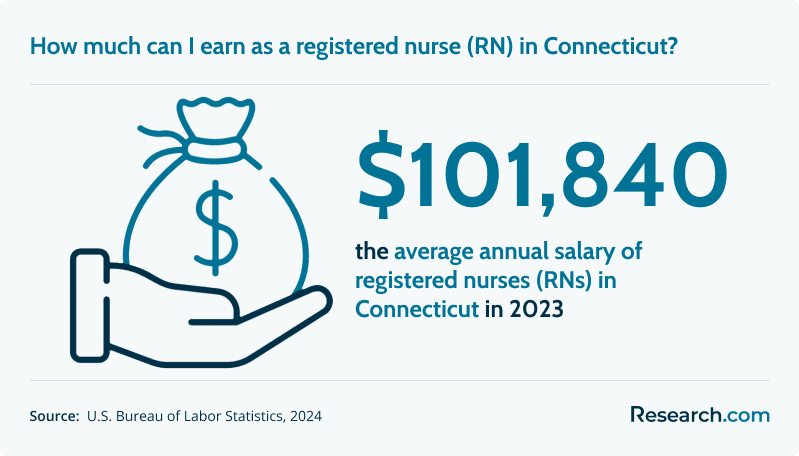
In 2023, registered nurses (RNs) in the state earned around $101,840 on average per year. This is significantly higher than the annual average salary of all occupations at $73,740.
What are the educational requirements for becoming a nurse in Connecticut?
Connecticut nursing education requirements depend on the license you want. For registered nursing, the two main entry-level options are the Associate Degree in Nursing and the Bachelor of Science in Nursing. Both can lead to NCLEX-RN eligibility when completed through an appropriate program, but they differ in time, depth, cost, and long-term flexibility.
| Program type | Typical length stated | What it prepares you for | When it may make sense |
| Associate Degree in Nursing (ADN) | Two years | Entry-level RN practice and NCLEX-RN preparation | You want a faster, often lower-cost path to RN licensure |
| Bachelor of Science in Nursing (BSN) | Four years | RN practice, NCLEX-RN preparation, leadership foundations, and broader clinical education | You want stronger preparation for advancement, specialty roles, or graduate study |
| Accelerated BSN | As little as fifteen months | RN preparation for students who already hold a bachelor’s degree in another field | You are a career changer who can handle an intensive schedule |
| Master of Science in Nursing (MSN) | Typically spans two years | Advanced roles such as nurse practitioner, nurse educator, or leadership positions | You already have a BSN and want advanced practice or higher-level responsibilities |
An ADN program usually focuses on core nursing knowledge, direct patient care, and clinical practice. Students often complete foundational science coursework such as microbiology and chemistry before or during the nursing sequence. ADN graduates may enter the workforce as RNs after passing the NCLEX-RN and obtaining licensure, although long-term salary and advancement may differ from BSN-prepared nurses. For a broader compensation comparison, review Research.com’s guide to associate degree in nursing salary.
A BSN program includes the same essential RN preparation but typically adds deeper work in leadership, evidence-based practice, public health, research, and care coordination. Many employers value BSN preparation for hospital roles, supervisory tracks, and future graduate study. Students who already have a non-nursing bachelor’s degree may consider an accelerated BSN if they can commit to a demanding pace.
Students planning to become nurse practitioners, nurse educators, or clinical leaders generally need graduate education. An MSN can build advanced clinical and administrative skills, and quick online MSN degree programs may appeal to nurses who need to balance employment with study. However, students should confirm that online coursework, clinical placements, and program accreditation align with Connecticut licensing and certification expectations.
Before enrolling, verify program approval, accreditation, clinical placement support, NCLEX preparation, transfer credit rules, and total cost. A program that looks convenient may not be the best choice if it limits licensure eligibility, delays clinical completion, or lacks strong student support.
What types of nurses can legally practice in Connecticut?
Connecticut recognizes several nursing and nursing-support roles, each with a different scope of practice, education requirement, and level of responsibility. Understanding the distinctions helps students avoid choosing a program that does not match their career goal.
| Role | Education or training requirement | Primary responsibilities | Practice level |
| Registered Nurse (RN) | Accredited ADN or BSN program | Patient assessment, medication administration, care planning, education, coordination with healthcare teams | Licensed professional nursing practice |
| Licensed Practical Nurse (LPN) | State-approved practical nursing program | Basic nursing care, monitoring, medication-related tasks where allowed, support under RN or physician supervision | Licensed practical nursing practice |
| Advanced Practice Registered Nurse (APRN) | Master's degree or higher in nursing plus national certification in a specialty area | Advanced diagnosis, treatment, specialty care, prescribing or advanced clinical functions depending on role and rules | Advanced licensed nursing practice |
| Certified Nursing Assistant (CNA) | State-approved training program and competency exam | Basic patient support, activities of daily living, vital signs, reporting changes to licensed staff | Support role, not traditional licensed nursing practice |
Registered nurses make up a major part of the healthcare workforce and may work in hospitals, outpatient clinics, long-term care, public health, schools, home health, and specialty settings. Licensed practical nurses often provide hands-on care in long-term care, rehabilitation, outpatient, and residential settings. APRNs include Nurse Practitioners, Clinical Nurse Specialists, Nurse Anesthetists, and Nurse Midwives; these roles require graduate education and specialty certification.
CNAs are not nurses in the traditional licensed sense, but they are often an entry point into healthcare. Some medical assistants and CNAs later move into practical nursing through bridge or career ladder programs. Connecticut residents interested in this route can compare medical assistant to LPN online programs to understand how prior healthcare experience may support the next step.
What are the licensing requirements for nurses in Connecticut?
The Connecticut Department of Public Health oversees nursing licensure. Requirements vary by role, but RN and LPN applicants generally need approved education, successful NCLEX results, a complete application, fees, and required background review. Because licensing rules affect whether you can legally work, applicants should always confirm current instructions through the state before submitting materials.
Core Connecticut nursing licensure requirements
- Approved education: RN applicants must graduate from an accredited nursing program, usually an ADN or BSN. LPN applicants complete a practical nursing program.
- NCLEX examination: RN candidates take the NCLEX-RN, while LPN candidates take the NCLEX-PN.
- State application: Applicants submit documentation to the Connecticut Department of Public Health, including proof of education and exam results.
- Application fees: The application fee is approximately $180 for RNs and $150 for LPNs.
- Background screening: Connecticut requires fingerprinting and a criminal background check as part of the process.
- Continuing education: RNs and LPNs must complete 15 contact hours of continuing education every two years to maintain licensure.
Questions to ask before applying for licensure
- Is my nursing program approved or accredited in a way that supports Connecticut licensure?
- Have I requested official transcripts early enough to avoid application delays?
- Do I understand the fingerprinting and background check process?
- Have I budgeted for the exam, application fee, background check, and renewal costs?
- If I studied outside Connecticut, do I need additional documentation for endorsement or eligibility review?
What types of nursing licenses are available in Connecticut?
Connecticut offers several licensing pathways depending on whether you are a new graduate, an existing nurse from another state, or a currently licensed nurse renewing credentials. Choosing the correct application route can prevent delays and unnecessary paperwork.
- Registered Nurse (RN) License: This license is for graduates of qualifying RN programs who pass the NCLEX-RN. RNs provide direct care, administer medications, coordinate treatment plans, educate patients, and collaborate with physicians and other healthcare professionals.
- Graduate Nurse License: This temporary option applies to individuals who have completed nursing education and are waiting for NCLEX results. It allows supervised work while the graduate moves through the final steps toward full licensure.
- License by Endorsement: Nurses licensed in another state may apply for Connecticut licensure by endorsement if they meet state criteria. This route can allow qualified nurses to practice without repeating the NCLEX.
- Online Renewal: Licensed nurses may renew through Connecticut’s online process, provided they meet renewal and continuing education requirements.
The initial application fee for an RN license is $180, with a renewal fee of $110. Students should include these costs in their nursing education budget along with tuition, books, uniforms, health requirements, testing fees, transportation to clinical sites, and background check expenses.
Nurses interested in specialized paths should also consider how credentials affect career options. For example, those exploring aesthetic practice can review Research.com’s cosmetic nurse salary information to understand how compensation may differ in a nontraditional nursing specialty.
In 2023, the highest-paid nursing occupation in the state is nurse anesthetist, with an average annual salary of $247,740. This is followed by NPs at $136,980. See the chart below for more salary details.
Can a Compact nurse practice in Connecticut?
Connecticut has enacted the Nurse Licensure Compact, but timing matters. As of May 30, 2024, Connecticut officially joined the NLC as the 42nd jurisdiction. The NLC allows eligible RNs and LPN/VNs to hold one multistate license and practice in their home state and other compact states. However, Connecticut’s compact implementation does not take effect until October 1, 2025.
Until the effective date, nurses from other NLC states cannot rely on a multistate license to practice in Connecticut. They must follow Connecticut’s current licensure or endorsement process. Once the NLC is fully operational in the state, qualified compact nurses may benefit from easier cross-state practice, including roles involving telehealth, travel nursing, and regional healthcare coverage.
General NLC eligibility requirements include:
- Completing a federal and state fingerprint-based criminal background check.
- Successfully passing the NCLEX Examination.
- Maintaining an active and unencumbered nursing license.
The compact is especially relevant because Connecticut and many other states are working to improve workforce mobility during persistent nursing shortages. Nurses planning to relocate, travel, or provide telehealth should monitor state updates closely. Those who want to strengthen their employability while waiting for compact implementation may also explore medical certifications with quick high pay that complement healthcare experience.
Can you practice as a nurse without a license in Connecticut?
No. Connecticut does not allow individuals to practice as registered nurses or licensed practical nurses without a valid nursing license. Nursing licensure protects patients by confirming that the person providing care has completed required education, passed the applicable examination, and met state standards for professional practice.
- Legal risk: Unlicensed practice can lead to serious consequences, including fines and criminal charges.
- Patient safety: Licensing helps ensure that nurses have the minimum competency needed for safe care.
- Professional credibility: Employers, patients, and healthcare teams depend on accurate credentials when assigning responsibilities.
- Career access: Licensure is required for legitimate nursing jobs and advancement opportunities.
The distinction between helping in healthcare and practicing nursing is important. For example, a nursing assistant may provide support while completing nursing school, but they cannot perform duties reserved for licensed nurses. A Connecticut nurse described this waiting period as both motivating and humbling: before becoming licensed, she worked in a support role and understood that full participation in patient care depended on passing the exam and receiving official credentials.
What opportunities are available for LPNs in Connecticut?
Licensed Practical Nurses are an important part of Connecticut’s healthcare system, especially in settings where patients need frequent monitoring, basic nursing care, medication support, and assistance with daily health needs. LPNs may work in hospitals, nursing homes, rehabilitation centers, physician offices, assisted living facilities, and home health environments.
To become an LPN in Connecticut, candidates must complete an approved practical nursing program and pass the NCLEX-PN. Students comparing programs should look carefully at clinical placement support, pass-rate preparation, schedule flexibility, cost, and whether the program is approved for Connecticut licensure. Prospective students can begin by reviewing online LPN programs in Connecticut to identify options that fit their timeline and budget.
Can nurses transition to other healthcare professions in Connecticut?
Yes. Nursing experience can support movement into other healthcare careers because nurses already understand patient care, clinical documentation, healthcare teams, safety standards, and communication under pressure. Common transitions include healthcare administration, case management, clinical research, nursing education, quality improvement, informatics, public health, and compliance.
Some nurses also consider a different licensed healthcare profession. For example, a nurse interested in medication management, pharmacology, and patient counseling may research how to become a pharmacist in Connecticut. This is not a simple lateral move because pharmacy has its own education and licensure requirements, but nursing experience can clarify whether a broader healthcare transition is worth the investment.
What is the state of nursing in Connecticut?
Nursing in Connecticut combines strong demand with real workforce pressure. The state has a large healthcare sector, an aging population, and ongoing staffing needs across hospitals, long-term care, outpatient care, and community-based settings. For students, this means opportunity. For working nurses, it also means the importance of evaluating workload, staffing culture, compensation, benefits, and advancement support before accepting a role.
Connecticut has a significant RN workforce. In 2023, there were around 36,430 registered nurses (RNs) in the state. These nurses serve in a range of settings, including acute care hospitals, outpatient clinics, nursing facilities, home health agencies, behavioral health programs, schools, and specialty practices.
The state’s nursing shortage adds urgency. A projected gap of over 10,000 unfilled nursing positions by 2030 points to continuing employer demand, but it also highlights the need for sustainable staffing practices. New graduates may find opportunities, yet they should still compare employers carefully rather than assuming every job will provide the same support.
Cost of living is another major factor. Connecticut RN wages are competitive, but housing, transportation, and daily expenses can affect the real value of a salary. Students and career changers should evaluate likely debt, local wages, employer tuition benefits, commuting costs, and the time it will take to move from school to full licensure.
For nurses aiming for doctoral-level leadership or advanced practice, Connecticut also offers options for further education. Those considering that step can review easy DNP programs to get into while also checking whether each program fits their career goals, licensing needs, and clinical placement requirements.
In 2023, there were around 36,430 registered nurses (RNs) in the state. See the chart below for more nursing employment details.
What are the benefits and pathways to becoming a nurse practitioner in Connecticut?
Becoming a nurse practitioner can expand a nurse’s clinical role, patient-care authority, and leadership options. NPs often provide advanced assessment, diagnosis, treatment planning, preventive care, and chronic disease management. In Connecticut, the role can be especially attractive for nurses interested in primary care, specialty clinics, behavioral health, geriatrics, pediatrics, or community-based care.
The typical pathway starts with RN licensure, BSN preparation, graduate nursing education, and national certification in a specialty population or practice area. Because requirements can be detailed, nurses should review the nurse practitioner education requirements in Connecticut before choosing a graduate program. Pay close attention to accreditation, clinical placement support, certification alignment, and state practice rules.
What additional certifications can further empower nurses in Connecticut?
Certifications can help nurses demonstrate focused expertise, qualify for specialty units, and prepare for advanced practice or leadership roles. The best certification depends on the nurse’s current license, work setting, and long-term plan. A hospital RN may prioritize specialty clinical credentials, while an RN moving into mental health may look at psychiatric or behavioral health pathways.
For nurses interested in psychiatric-mental health advanced practice, focused post-graduate certificates may be useful. Research.com’s guide to the shortest online PMHNP certificate programs can help nurses compare streamlined options while still checking accreditation, clinical requirements, and certification eligibility.
What is the job outlook for nursing in Connecticut?
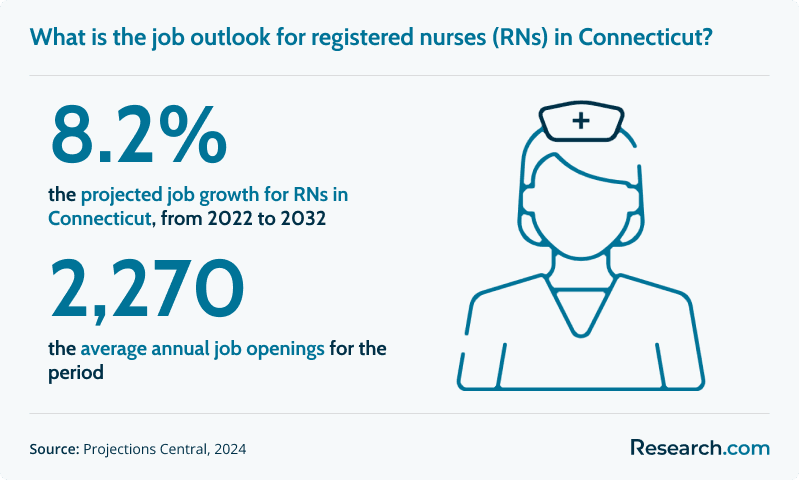
The nursing job outlook in Connecticut is positive, especially for registered nurses. According to Projections Central, employment for registered nurses in Connecticut is projected to grow by approximately 8.2% from 2022 to 2032. Demand is supported by an aging population, chronic care needs, retirements among experienced nurses, and continued use of home health and long-term care services.
Job outlook should not be viewed as a guarantee of a specific salary or immediate job offer. Local demand varies by specialty, employer, schedule, experience level, and region. New graduates can improve their prospects by choosing strong clinical placements, preparing thoroughly for the NCLEX, building references during school, and applying to employers with structured transition-to-practice support.
How can I become an LVN in Connecticut?
Connecticut commonly uses the LPN title rather than LVN, but the practical nursing pathway is similar in purpose: complete an approved practical nursing program, gain supervised clinical experience, pass the NCLEX-PN, and obtain state licensure before practicing. Practical nurses provide essential care under the supervision of RNs, physicians, or other authorized providers.
Students who see LVN terminology while researching should verify that the program they are considering meets Connecticut’s practical nursing licensure requirements. For a focused overview, review how to become an LVN in Connecticut and confirm current rules with the state before enrolling.
What financial assistance options are available for nursing education in Connecticut?
Nursing school can involve more than tuition. Students may need to pay for fees, books, uniforms, background checks, immunizations, transportation, testing, licensing, and lost work hours during clinical rotations. Financial planning should begin before enrollment, not after the first bill arrives.
- Federal financial aid: Eligible students should complete the FAFSA and review grants, work-study, and federal loan options.
- School-based scholarships: Colleges and universities may offer merit-based, need-based, or nursing-specific awards.
- Employer tuition support: Some healthcare employers help employees pay for nursing school or advancement programs.
- Loan forgiveness or service programs: Healthcare professionals may qualify for certain programs depending on employer, location, and role.
- Flexible program formats: Online or hybrid coursework may help working students reduce scheduling conflicts, though clinical requirements still need in-person completion.
Students comparing affordability and flexibility can start with the best online nursing programs in Connecticut, then verify total cost, clinical placement requirements, accreditation, licensure alignment, and transfer credit policies.
What are the best specializations for nurses in Connecticut?
The best nursing specialization in Connecticut depends on your interests, preferred patient population, tolerance for stress, education level, and salary goals. Some specialties require graduate education, while others can begin through RN experience and specialty certification.
| Specialization | Why it matters in Connecticut | Education or credential considerations |
| Nurse Practitioner | NPs help meet demand for advanced primary and specialty care. | Requires graduate nursing education and specialty certification. |
| Geriatric Nursing | An aging population increases the need for nurses skilled in chronic disease, mobility issues, dementia-related care, and family education. | Can begin through RN or LPN work in long-term care, home health, or geriatric units; certification may support advancement. |
| Pediatric Nursing | Children require age-specific assessment, communication, medication safety, and family-centered care. | RNs may specialize through pediatric units, clinics, or additional credentials. |
| Mental Health Nursing | Behavioral health needs continue to shape hospital, outpatient, and community care. | Psychiatric experience and advanced credentials can support growth. |
| Nurse Anesthetist | Nurse anesthetists are the highest-paid nursing occupation in the state based on the salary data provided. | Requires extensive advanced education, certification, and licensure. |
Nurse practitioners are in strong demand because they can provide advanced clinical care in outpatient clinics, hospitals, private practices, and specialty settings. Students considering this path should compare the best NP programs in Connecticut and confirm that each program’s specialty track, accreditation, and clinical support match their goals.
Geriatric nursing is also important because older adults often need coordinated care for chronic conditions, mobility limitations, medication management, and mental health concerns. Pediatric nursing is a strong fit for nurses who enjoy working with children and families. Mental health nursing can suit nurses who are prepared for complex communication, crisis intervention, and interdisciplinary care. CRNA practice offers high earning potential, but it also requires significant education and responsibility.
What are the career advancement opportunities for nurses in Connecticut?
Connecticut nurses can advance through several routes: clinical specialization, leadership, education, advanced practice, informatics, quality improvement, case management, and administration. The right path depends on whether you want more direct patient care, more autonomy, a less physically demanding role, or a move into systems-level work.
- Clinical ladder advancement: Many employers offer progression based on experience, certification, precepting, and unit leadership.
- Specialty certification: Credentials can support movement into intensive care, emergency, oncology, pediatrics, behavioral health, or other focused areas.
- Graduate education: MSN and DNP programs can prepare nurses for NP, educator, executive, and advanced clinical roles.
- Leadership roles: Charge nurse, nurse manager, clinical coordinator, and director roles may appeal to nurses interested in staffing, quality, and operations.
- Lower-stress alternatives: Some nurses move into case management, utilization review, education, informatics, or outpatient roles to reduce physical strain or schedule intensity.
If your goal is career longevity and better work-life fit, Research.com’s guide to least stressful nursing jobs that pay well can help you compare alternatives beyond traditional bedside nursing.
What are the opportunities for nurse midwifery in Connecticut?
Nurse midwives provide reproductive, prenatal, birth, postpartum, and well-person care. In Connecticut, this role can appeal to nurses who want to combine advanced clinical practice with patient education, family-centered care, and maternal health advocacy. Nurse midwifery requires advanced education, certification, and compliance with state-specific practice regulations.
Because requirements are specialized, nurses should review how to become a nurse midwife in Connecticut before selecting a graduate program. Key questions include whether the program is accredited, whether it supports clinical placements, and whether graduates meet certification and state licensure expectations.
Can complementary certifications enhance a nursing career in Connecticut?
Complementary certifications can be useful when they support a clear career goal. For example, nurses interested in documentation, revenue cycle work, insurance processes, compliance, or remote administrative roles may benefit from learning medical billing and coding. These skills do not replace nursing licensure, but they can broaden career options.
A nurse who wants to move away from direct bedside care may use administrative credentials to pursue hybrid roles in clinical documentation, utilization review, care coordination, or healthcare operations. To explore that pathway, review how to become a medical biller and coder in Connecticut.
What are the common workplace challenges for nurses in Connecticut?
Nursing can be rewarding, but it is also demanding. Connecticut nurses may face understaffing, high patient-to-nurse ratios, emotional fatigue, administrative burden, workplace violence risks, rotating schedules, and pressure to adapt to new technology. These issues can affect burnout, retention, and patient care quality.
| Challenge | Why it matters | What to ask before accepting a job |
| Understaffing | Low staffing can increase workload and stress. | What are typical staffing patterns on this unit and shift? |
| Heavy documentation | Administrative work can reduce time for direct patient care. | What electronic health record system is used, and what support is available? |
| New graduate transition | Early-career nurses need structured support to build confidence safely. | Is there a residency, preceptor program, or formal orientation? |
| Burnout risk | Long shifts and emotional demands can affect retention. | How does the employer address scheduling, mental health, and time off? |
| Licensure compliance | Missed renewal or CE requirements can affect employment eligibility. | Does the employer help track or fund continuing education? |
Staying current with the requirements for nursing licensure in Connecticut is one way to reduce professional risk, but nurses should also evaluate employer culture, onboarding, safety protocols, and advancement support.
How is technology transforming nursing practice in Connecticut?
Technology is changing how Connecticut nurses document care, monitor patients, communicate with teams, and support clinical decisions. Electronic health records, telehealth, remote patient monitoring, mobile tools, and data analytics are now part of many nursing environments. These tools can improve coordination, but they also require nurses to build digital confidence and protect patient privacy.
For students, this means nursing school should not only teach bedside skills; it should also prepare graduates to work with modern health information systems. When comparing programs, ask how students are trained in electronic documentation, simulation, telehealth workflows, informatics, and clinical decision-support tools. Research.com’s overview of the best nursing schools in Connecticut can help students identify programs to investigate further.
Common mistakes to avoid when becoming a nurse in Connecticut
- Choosing a program without checking approval or accreditation. A convenient program is not worth it if it does not support NCLEX eligibility or Connecticut licensure.
- Looking only at tuition. Total cost includes fees, books, supplies, testing, transportation, lost wages, and licensing expenses.
- Assuming online means fully online. Nursing programs require clinical experience, and students must understand where and how those hours are completed.
- Ignoring NCLEX preparation. A nursing degree alone is not enough; you must pass the required licensing exam.
- Overlooking the Nurse Licensure Compact timeline. Connecticut enacted the NLC, but it does not take effect until October 1, 2025.
- Assuming salary outcomes are guaranteed. Pay depends on role, employer, shift, specialty, experience, and location.
- Failing to ask about new graduate support. A strong orientation or residency program can make the first year safer and less overwhelming.
Here's what nurses have to say about becoming a nurse in Connecticut
- Working as a nurse in Connecticut has given me access to strong healthcare teams, advanced resources, and ongoing training. I value the collaborative culture because it pushes me to keep learning while staying focused on patient-centered care. Sheena
- For me, the best part of nursing in Connecticut is serving patients from many different communities. That diversity has strengthened my cultural competence, and the compensation has helped me maintain a more stable balance between work and life. James
- I was drawn to Connecticut because of its focus on improving healthcare delivery, especially around patient care and mental health services. The professional network here has also helped me grow and see new possibilities in nursing. Linda
Related Articles for Nearby States
- 2027 How to Become a Nurse in New York
- 2027 How to Become a Nurse in Rhode Island
- 2027 How to Become a Nurse in Massachusetts
- 2027 How to Become a Nurse in New Jersey
- 2027 How to Become a Nurse in Pennsylvania
- 2027 How to Become a Nurse in Vermont
- 2027 How to Become a Nurse in New Hampshire
- 2027 How to Become a Nurse in Delaware
- 2027 How to Become a Nurse in Maryland
- 2027 How to Become a Nurse in Maine
Key insights
- To become an RN in Connecticut, complete an accredited ADN or BSN program, pass the NCLEX-RN, and apply for licensure through the Connecticut Department of Public Health.
- To become an LPN, complete an approved practical nursing program, pass the NCLEX-PN, and obtain a Connecticut LPN license before practicing.
- Connecticut registered nurses earned around $101,840 on average per year in 2023, compared with the state average of $73,740 for all occupations.
- Registered nursing employment in Connecticut is projected to grow by approximately 8.2% from 2022 to 2032, but job quality still varies by employer, specialty, shift, and support systems.
- The ADN is often the faster route to RN licensure, while the BSN can offer stronger preparation for leadership, specialty practice, and graduate education.
- Connecticut enacted the Nurse Licensure Compact on May 30, 2024, but compact privileges in the state are not effective until October 1, 2025.
- Nurse anesthetists had the highest-paid nursing occupation in the state in 2023, with an average annual salary of $247,740, followed by NPs at $136,980.
- Before enrolling in any nursing program, confirm accreditation or state approval, NCLEX eligibility, clinical placement support, total cost, transfer rules, and licensure alignment.
References:
- University of Bridgeport (21 Oct 2021). Nursing education requirements: What degree do you need to become a nurse? University of Bridgeport.
- portal.ct.gov (n.d.). Registered Nurse Licensure. portal.ct.gov.
- U.S. Bureau of Labor Statistics. (2023, September 6). Licensed practical and licensed vocational nurses. Retrieved February 16, 2024, from BLS.
- ncsbn.org (06 Jun 2024). Connecticut Enacts Nurse Licensure Compact. ncsbn.org
Other Things You Need to Know About Nursing in Connecticut
To become a registered nurse in Connecticut by 2026, you must pass the NCLEX-RN exam after completing an approved nursing program. Applying for licensure through the Connecticut Board of Nursing is required to ensure eligibility for the examination.
To become a licensed nurse in Connecticut in 2027, you need to complete an accredited nursing program, be it an Associate Degree in Nursing (ADN) or a Bachelor of Science in Nursing (BSN). After completion, you must pass the NCLEX-RN exam and apply for licensure from the Connecticut Board of Examiners for Nursing.