2027 LPN Careers: Guide to Career Paths, Options & Salary

Co-Founder and Chief Data Scientist
Choosing an LPN career usually comes down to three practical questions: how quickly you can qualify, what kind of work you will actually do, and whether the role can support your long-term nursing goals. Licensed Practical Nurses (LPNs), also called Licensed Vocational Nurses (LVNs) in some states, provide direct bedside care under the supervision of registered nurses and physicians. The path is shorter than many nursing routes, but it still requires state-approved training, clinical practice, and licensure.
This guide is for prospective nursing students, career changers, healthcare aides, and current LPNs deciding whether practical nursing is the right next step. You will learn what LPNs do, how to enter the field, what salaries and job outlook data suggest, which skills matter most, how to compare education options, and when it may make sense to bridge into RN, BSN, MSN, or advanced nursing programs.
Quick answer: Is becoming an LPN a good career path in 2026?
Becoming an LPN can be a strong option if you want a patient-care career with a relatively short training timeline, broad employment settings, and a clear route into higher nursing credentials. Employment for Licensed Practical Nurses is projected to grow by 3% from 2023 to 2033, which is in line with the average for all occupations. The role is especially relevant in long-term care, home health, clinics, rehabilitation facilities, and other settings that need hands-on nursing support.
The trade-off is that LPNs usually have a narrower scope of practice than registered nurses, and advancement often requires additional education. If you want independent clinical decision-making, specialized nursing practice, or leadership roles, an LPN license can be a starting point rather than the final destination.
Key Things You Should Know About LPN Careers
- The labor market is steady, not automatic. According to the U.S. Bureau of Labor Statistics, employment of LPNs is projected to grow by 3% from 2023 to 2033, with approximately 54,000 job openings each year.
- Training is shorter than many nursing pathways. Most LPN programs take about one year and are offered through vocational schools, community colleges, and technical institutes. Some programs combine online coursework with required in-person clinical training.
- Work settings are varied. LPNs may work in hospitals, clinics, nursing homes, private homes, rehabilitation centers, and residential care facilities.
- Pay depends heavily on employer, location, and experience. LPN salaries range from $47,000 to $77,870 annually, with higher-paid roles often found in government facilities, outpatient care centers, and private specialty practices.
- Job satisfaction can be strong for the right personality fit. A study found that 77% of LPNs reported being satisfied with their jobs, but the work can also be physically demanding and emotionally intense.
- Why consider licensed practical nursing in 2026?
- What does the LPN job outlook and salary picture look like?
- Can LPNs move into advanced nursing degrees?
- How can an LPN transition into a higher nursing credential?
- What pressures are changing LPN work?
- How can LPNs find lower-cost advanced nursing pathways?
- What skills do LPNs need?
- How do you start an LPN career?
- How should LPNs compare advanced nursing programs?
- How can LPNs advance professionally?
- How can LPNs build leadership skills?
- What alternative jobs can LPNs consider?
- How can LPNs adapt to healthcare changes?
- Can mentorship help LPNs grow?
- What challenges do LPNs face and how can they respond?
- Key insights for future LPNs
Why consider licensed practical nursing in 2026?
Licensed practical nursing appeals to students who want direct patient-care work without spending several years in school before entering the workforce. LPNs check vital signs, give certain medications, assist with daily living activities, document patient changes, support treatment plans, and communicate concerns to registered nurses and physicians. In many facilities, they are the professionals who spend the most consistent time with patients.
The role is important because healthcare teams continue to need practical bedside support. The demand for LPNs is projected to grow by 5.33% over the next decade, compared with a national average job growth rate of 2.84%. That projection equals about 54,400 job openings annually between 2022 and 2032, with demand shaped by aging patients, chronic care needs, and turnover across healthcare settings.
LPN work can also lead to more flexible career models. Nurses interested in temporary assignments, regional staffing needs, and facility-to-facility movement can explore how to become a travel LPN to understand the steps, expectations, and job types involved.
When an LPN path makes sense
- You want to enter nursing faster than a traditional multi-year degree route.
- You are comfortable providing hands-on personal and clinical care.
- You want experience before deciding whether to become an RN or pursue a BSN.
- You are interested in long-term care, rehabilitation, home health, or clinic-based patient support.
- You can handle shift work, physical tasks, documentation, and emotionally difficult patient situations.
When another nursing path may be better
- You already know you want advanced practice, public health leadership, or specialized hospital units that typically require RN-level preparation.
- You want the broadest possible nursing scope from the beginning.
- You prefer less physically demanding healthcare roles.
- You are not prepared for licensure exams, clinical training, and state-specific practice rules.

What does the LPN job outlook and salary picture look like?
The outlook for LPN careers is best understood as stable demand with meaningful variation by location, employer type, shift, and experience. Hospitals, nursing homes, home healthcare agencies, clinics, and rehabilitation providers all use LPNs differently, so job duties and pay can change significantly from one setting to another.
Salary data also shows gradual wage growth. LPN salaries increased from $46,788 in 2020 to a projected $52,912 in 2025, a 13% increase. Hourly wages rose from $22.49 to $25.44 during the same period, reflecting workforce shortages, inflation adjustments, and retention efforts.
| Year | Average Salary | Hourly Rate | % Change |
| 2025 | $52,912 | $25.44 | +2.8% |
| 2024 | $51,459 | $24.74 | +2.7% |
| 2023 | $50,116 | $24.09 | +2.7% |
| 2022 | $48,804 | $23.46 | +2.1% |
| 2021 | $47,785 | $22.97 | +2.1% |
| 2020 | $46,788 | $22.49 | +1.6% |
Data Source: Zippia
Healthcare staffing pressure remains an important context for LPN demand. A survey found that 83% of hospital and health system executives expect continued nursing staff shortages across the U.S. healthcare system. That does not guarantee a job in every market, but it does explain why practical nursing remains a common entry point into healthcare employment.
Students who want a faster route should compare state-approved options carefully. Fast-track LPN programs may help qualified students complete classroom requirements more quickly, but clinical hours, state approval, and NCLEX-PN preparation should never be compromised.
LPN salary and job outlook: what to evaluate before enrolling
| Factor | Why it matters | Question to ask |
| State and local labor market | LPN pay and openings vary by region and employer demand. | Are local hospitals, nursing homes, clinics, and home health agencies hiring LPNs? |
| Employer type | Government facilities, outpatient care centers, and private specialty practices may offer higher-paid positions. | Which employers in my area hire new LPN graduates? |
| Program approval | Graduation from a state-approved program is usually required for licensure eligibility. | Is the program approved by the state nursing board? |
| Clinical placement support | Hands-on clinical experience is essential for competency and licensure preparation. | Where will I complete clinical training, and who arranges it? |
| Bridge options | Some students use LPN training as a step toward RN or BSN credentials. | Do credits transfer into LPN-to-RN or LPN-to-BSN programs? |
Can LPNs move into advanced nursing degrees?
Yes. Many LPNs use practical nursing as the first stage of a longer nursing career. The usual progression is LPN to RN, then potentially BSN, MSN, DNP, or a specialized graduate credential depending on career goals. The right route depends on prior education, state licensing rules, program prerequisites, clinical hour requirements, and whether the student wants bedside practice, leadership, education, or advanced practice.
Some nurses eventually compare doctoral pathways, including options such as the shortest DNP program online. However, an LPN should not jump to doctoral-program research before confirming the intermediate steps required to become an RN and meet graduate nursing admission standards.
How can an LPN transition into a higher nursing credential?
The most common first move is an LPN-to-RN bridge program. After becoming an RN, nurses may pursue a BSN, MSN, or advanced practice credential depending on their goals. Some programs are designed for students with nontraditional backgrounds, and an online direct-entry MSN may be relevant for certain learners, but LPNs should verify whether their practical nursing experience changes admission requirements or clinical placement expectations.
LPN advancement routes compared
| Path | Best for | Main consideration |
| LPN-to-RN | LPNs who want a broader scope of practice and RN licensure. | Confirm NCLEX-RN eligibility, clinical requirements, and state board approval. |
| LPN-to-BSN | LPNs who want a bachelor’s degree and more long-term mobility. | Compare transfer credit policies and total program cost. |
| RN-to-MSN | Nurses who complete RN licensure and want graduate-level roles. | Admission rules vary, especially for applicants without a BSN. |
| DNP or advanced practice route | Nurses targeting leadership, advanced clinical practice, or specialized roles. | Requires careful review of prerequisites, licensure, certification, and clinical hours. |
What pressures are changing LPN work?
LPNs are working in care environments shaped by heavier documentation, new digital tools, changing patient demographics, staffing constraints, and evolving state regulations. These changes can increase workload and stress, especially in facilities with high patient volumes. They also make continuing education more important for LPNs who want to remain competitive.
For LPNs who plan to move beyond practical nursing, advanced education research may include specialized options such as 1 year FNP programs. Before pursuing an accelerated advanced-practice option, nurses should confirm that they meet every prerequisite and understand the clinical expectations.
How can LPNs find lower-cost advanced nursing pathways?
Cost should be evaluated by total price, not tuition alone. LPNs should look at fees, books, uniforms, testing costs, transportation to clinical sites, lost work hours, and whether credits will transfer into the next credential. Employer tuition assistance, scholarships for healthcare workers, state workforce grants, and part-time study can reduce financial pressure.
Students planning to move from LPN to a bachelor’s credential can compare lower-cost online BSN options, but they should verify that any online program fits their current licensure level and long-term state requirements.
What skills do LPNs need?
LPNs need clinical accuracy, calm communication, physical stamina, and the judgment to recognize when a patient’s condition requires escalation. The work blends routine care with quick observation, which means small details can matter. A missed symptom, unclear chart note, or medication error can affect patient safety.
Technical skills LPNs use on the job
- Vital sign measurement and interpretation. LPNs monitor temperature, blood pressure, pulse, respiration rate, and oxygen saturation. The goal is not just collecting numbers but noticing changes that may require follow-up. Students interested in broader clinical assessment and brain-behavior topics may also encounter related concepts in online PhD and PsyD programs in neuropsychology, though those programs serve a very different career pathway.
- Medication administration. LPNs may administer medications through approved routes based on state scope-of-practice rules and facility policies. Safe practice requires following the right patient, medication, dose, route, and time.
- Wound care. Practical nurses often clean, dress, observe, and document wounds. They must know when healing appears normal and when to report infection, drainage, pain, or other changes.
- Catheter care. LPNs may insert or manage urinary catheters where permitted, using sterile or clean technique according to policy to reduce complications.
- IV therapy support. In some settings and states, LPNs with proper training may start or manage IV therapy. Rules differ, so certification and employer policy matter.
Professional and interpersonal skills LPNs need
- Clear communication. LPNs explain care steps to patients, update families within policy limits, and report concerns to RNs and providers.
- Empathy with boundaries. Patients may be frightened, frustrated, confused, or in pain. LPNs need compassion while still following clinical procedures and documentation rules.
- Attention to detail. Medication schedules, wound measurements, intake and output, and patient behavior changes all require careful observation.
- Practical critical thinking. LPNs must recognize when a routine situation is becoming unsafe and know when to escalate.
- Physical endurance. Many shifts require standing, walking, repositioning patients, and responding quickly to care needs.
Building both clinical and soft skills is essential for LPN career stability. Students comparing accelerated practical nursing programs should make sure speed does not replace supervised practice, lab training, and strong NCLEX-PN preparation.
Common skill gaps for new LPNs
| Common gap | Why it creates problems | Better approach |
| Weak documentation habits | Incomplete notes can affect continuity of care and legal protection. | Practice objective, timely, and policy-compliant charting. |
| Poor time management | Medication passes, patient needs, and charting can pile up quickly. | Use shift routines, checklists, and prioritization strategies. |
| Reluctance to ask questions | Guessing can put patients at risk. | Escalate unclear orders, unfamiliar procedures, or changes in condition. |
| Underestimating emotional strain | Care work can involve grief, family conflict, and patient decline. | Use supervision, peer support, and healthy recovery habits outside work. |
How do you start an LPN career?
To become an LPN, you generally need to complete a state-approved practical nursing program, finish required clinical training, pass the NCLEX-PN, and apply for licensure through the state nursing board. Requirements can vary by state, so students should confirm eligibility before enrolling.
Step-by-step path to becoming an LPN
- Check your state nursing board requirements. Confirm approved programs, background check rules, clinical requirements, and licensure steps.
- Choose a state-approved LPN program. Look beyond speed and compare approval status, NCLEX-PN preparation, clinical placement support, cost, and graduate outcomes.
- Complete classroom, lab, and clinical training. LPN programs typically combine anatomy, pharmacology, nursing fundamentals, patient care, and supervised practice.
- Prepare for the NCLEX-PN. Licensure depends on exam success, so review support and practice testing matter.
- Apply for state licensure. Follow the state board process and meet background, exam, and documentation requirements.
- Apply for entry-level LPN roles. Common first settings include long-term care, clinics, home health, rehabilitation, and residential care.
What can you do with a practical nursing diploma or certificate?
| Role | What the work involves | Median salary |
| Licensed Practical Nurse (LPN) | Monitors patients, administers approved medications, assists with daily care, and reports changes to supervising clinicians. | $33.26 per hour |
| Home Health LPN | Provides care in patients’ homes, supports treatment adherence, and teaches families basic care routines within the care plan. | $33.26 per hour |
| Nursing Care Facility LPN | Supports elderly, chronically ill, or long-term care patients in coordination with RNs and physicians. | $33.26 per hour |
What can you do with an associate’s degree in nursing?
| Role | What the work involves | Median salary |
| Registered Nurse (RN) | Completes broader assessments, coordinates care plans, administers treatments, and works across hospitals, clinics, and specialty units. | $43.83 per hour |
| Charge Nurse | Coordinates nursing staff, supports patient-flow decisions, and helps enforce care protocols. | $43.83 per hour |
| Public Health Nurse | Works on prevention, education, outreach, and community health initiatives in schools, agencies, or nonprofit settings. | $43.83 per hour |
Can you get a nursing job with only a certificate?
Yes. A certificate from a state-approved practical nursing program can qualify you to pursue LPN licensure, provided you meet the state’s exam and licensing requirements. After licensure, LPNs can perform practical nursing duties under the supervision required by law and workplace policy. Students who want a longer academic pathway can also compare an accredited online nursing degree program for future RN or BSN goals.
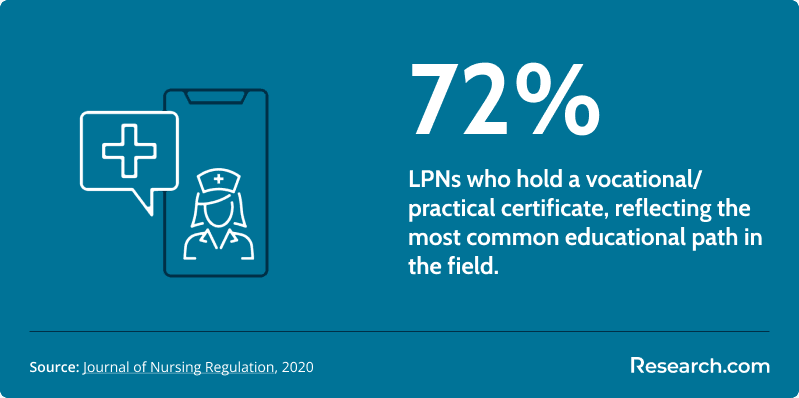
Education patterns show that practical nursing certificates remain common: 72.0% of LPNs hold a vocational/practical certificate. Additional education may improve mobility, but a certificate can still be the starting credential for licensed practical nursing.
Questions to ask before choosing an LPN program
- Is the program approved by the state board of nursing?
- Where are clinical rotations completed, and are placements guaranteed or student-arranged?
- What is included in tuition, and what costs are separate?
- Does the program prepare students for the NCLEX-PN with structured review?
- Can credits transfer into an LPN-to-RN or LPN-to-BSN program?
- Are evening, weekend, or hybrid options available for working students?
- What support is available for tutoring, lab practice, and job placement?
How should LPNs compare advanced nursing programs?
LPNs considering advanced education should compare programs by accreditation, state authorization, clinical placement rules, prerequisite courses, transfer credit, cost, schedule flexibility, faculty support, and licensure outcomes. A program that looks convenient may not be the best choice if it does not meet the requirements for your state or career goal.
For nurses aiming at family practice after completing the necessary earlier credentials, affordable online FNP programs can be part of the research process. Cost matters, but it should be weighed against clinical support, certification preparation, and state eligibility.
How can LPNs advance professionally?
LPN career advancement usually happens in two ways: specialized certification or additional nursing education. Certifications can deepen skills within the LPN scope, while bridge programs can expand licensure and career options.
Useful certifications for LPN career growth
- Intravenous (IV) Therapy Certification. Helps LPNs develop approved IV-related skills for eligible clinical settings.
- Wound Care Certification (WCC). Strengthens expertise in wound assessment, dressing, and healing support.
- Certified Hemodialysis Nurse (CHN). Prepares nurses for dialysis-focused care, patient monitoring, and kidney-failure treatment support.
- Certified Hospice and Palliative Licensed Nurse (CHPLN). Focuses on end-of-life care, symptom comfort, and family support.
- Long-Term Care (LTC) Certification. Supports LPNs working with older adults and chronically ill patients in extended-care settings.
- Pharmacology Certification. Builds medication safety, dosage calculation, and drug-administration knowledge.
- Advanced Cardiac Life Support (ACLS) Certification. Provides emergency cardiac-response training that may be useful in certain clinical environments.
Some LPNs also strengthen patient communication and behavioral-health awareness through adjacent credentials, such as a graduate certificate in counseling online. This type of credential is not a substitute for nursing licensure advancement, but it may support work with patients and families in emotionally complex settings.
Education pathways beyond LPN licensure
- LPN-to-RN Bridge Programs. These programs are designed for LPNs who want to become Registered Nurses. They typically take 12-18 months and lead to an Associate Degree in Nursing, allowing graduates to sit for the NCLEX-RN exam.
- LPN-to-BSN Programs. These programs lead to a Bachelor of Science in Nursing and may support broader opportunities in leadership, public health, and specialized nursing areas.
- RN-to-MSN Programs. After becoming an RN, nurses may pursue a Master of Science in Nursing to prepare for roles such as Nurse Practitioner, Clinical Nurse Specialist, or Nurse Educator.
- Advanced practice bridge options. Some pathways support movement into specialized or administrative nursing roles, including Nurse Anesthesia or Nursing Administration, after the required licensure and education steps are completed.
Students who have not yet entered practical nursing can compare online LPN program options, including accelerated formats. Any short program should still include required clinical experiences and meet state licensure standards.
Geography also matters. With over 113,000 active LPNs in California and high demand in states like Texas, New York, and Florida, job opportunities remain strong for newly licensed nurses. Students should still research local employers and state licensing requirements before assuming a program will lead to employment in a specific market.
How can LPNs build leadership skills?
LPNs who want supervisory or coordinating responsibilities should develop more than clinical competence. Leadership growth often starts with reliable communication, organized documentation, calm conflict resolution, team coordination, and the ability to mentor newer staff. In some workplaces, experienced LPNs may move into charge responsibilities or clinical coordinator roles, depending on state scope and employer policy.
For nurses planning much longer-term leadership or advanced clinical practice, an accelerated DNP program may eventually be relevant. LPNs should treat this as a future-stage option and first map the required RN, BSN, MSN, and licensure steps.
What alternative jobs can LPNs consider?
An LPN license can support roles outside traditional bedside nursing, especially for professionals who want less physically demanding work, more regular hours, or a stronger focus on coordination, education, documentation, or administration. Some alternatives may require additional training or employer-specific experience.
Alternative career options for LPNs
| Alternative role | How LPN experience applies | Median salary |
| Patient Advocate | Helps patients understand care options, communicate concerns, and navigate healthcare systems. | $46,673 per year |
| Case Manager | Coordinates services, follows care plans, and supports patients with chronic or complex needs. | $47,217 per year |
| Health Educator | Uses clinical knowledge to teach prevention, wellness, and healthy behaviors in community settings. | $55,965 per year |
| Medical Writer | Translates healthcare knowledge into patient education, articles, documentation, or training content. | $94,305 per year |
| Medical Office and Administrative Roles | Applies nursing knowledge to records, scheduling, patient communication, and insurance-related processes. | $37,228 |
LPNs who enjoy education may also explore roles that combine healthcare knowledge with teaching or training. For example, learning how to become a substitute teacher may interest nurses who want occasional classroom experience or health education exposure.
For administrative transitions, a medical office specialist certificate can help LPNs formalize skills in front-office operations, patient records, scheduling, and healthcare administration.
How can LPNs adapt to healthcare changes?
LPNs can stay adaptable by following state scope-of-practice updates, learning facility technology, improving documentation accuracy, and adding targeted certifications in areas where their employers need support. Telehealth workflows, electronic health records, care coordination, and chronic disease management are increasingly relevant in many settings.
LPNs who later become RNs and want to serve adult and older adult populations may research AGNP programs. As with any advanced nursing pathway, state licensure rules, clinical placement, and prerequisite requirements should be reviewed early.
Can mentorship help LPNs grow?
Yes. Mentorship can help LPNs improve clinical judgment, adjust to workplace expectations, identify specialty interests, and decide whether to pursue another credential. A strong mentor can also help newer nurses learn how to communicate with RNs, handle difficult family conversations, prepare for evaluations, and avoid common professional mistakes.
LPNs interested in women’s health after advancing through the required nursing levels may eventually compare programs such as an accelerated MSN women's health nurse practitioner online. Mentorship can be especially useful when deciding whether a specialized advanced-practice route fits your strengths and life circumstances.
What challenges do LPNs face and how can they respond?
LPNs often deal with heavy workloads, physically demanding shifts, emotional stress, limited decision-making authority, and the pressure of documenting accurately while responding to patient needs. These challenges do not make the career a poor choice, but they do mean students should enter with realistic expectations.
Common LPN challenges and practical responses
| Challenge | Why it matters | How to respond |
| High patient loads | Too many competing needs can increase stress and error risk. | Use prioritization routines, communicate early, and clarify urgent versus nonurgent tasks. |
| Physical strain | Lifting, standing, and repetitive movement can affect long-term health. | Use proper body mechanics, assistive devices, and team lifting when required. |
| Limited authority | LPNs must work within state scope and supervision rules. | Know your scope, document clearly, and escalate concerns appropriately. |
| Burnout risk | Emotional care work can accumulate over time. | Build peer support, use time off effectively, and consider roles with a better setting fit. |
| Unclear advancement plan | Without a plan, credits and experience may not transfer efficiently. | Compare bridge programs early and ask schools about transfer policies. |
Prospective students who worry about admission barriers can review resources on an accessible nursing school pathway, but they should not choose a school only because it appears easier to enter. Approval, outcomes, clinical quality, and licensure eligibility matter more.
Common mistakes to avoid when planning an LPN career
- Choosing a program without checking state approval. If the program does not meet licensure requirements, the credential may not lead to the NCLEX-PN or state licensure.
- Looking only at tuition. Fees, supplies, transportation, exam costs, and lost income can change the true cost.
- Assuming online means fully online. Nursing programs require hands-on clinical training, even when lectures are online.
- Ignoring transfer credit rules. If you plan to become an RN later, ask whether your LPN credits will count.
- Assuming salary outcomes are guaranteed. Published salary figures are useful benchmarks, but pay depends on employer, shift, location, experience, and credentials.
- Overlooking scope-of-practice limits. LPN duties vary by state and workplace policy.
- Relying only on rankings or speed. The fastest or most visible program is not always the best fit.
What graduates say about LPN careers
-
: "
Becoming an LPN gave me direct patient-care experience and helped me understand how much steady nursing support matters in daily recovery. The role has also offered stability and several options for future growth. – Jessica
"
-
: "
I liked that LPN training moved quickly but still prepared me for real patient care. Working in different facilities has shown me many sides of healthcare, from long-term care to hospital support. – Brielle
"
-
: "
I first considered practical nursing because the training timeline was shorter. I stayed because of the relationships with patients and the sense that my work made difficult days easier for people. – Lance
"
References
- BLS (U.S. Bureau of Labor Statistics). (2023, May). Occupational employment and wage statistics: Licensed practical and licensed vocational nurses. U.S. Department of Labor.
- DataUSA. (n.d.). Licensed practical & licensed vocational nurses profile. DataUSA.
- NCSBN (National Council of State Boards of Nursing). (n.d.). Active PN licenses statistics. NCSBN.
- NurseJournal. (n.d.). LPN certificates vs. ADN degree: Which path is right for you? NurseJournal.
- Statista. (2021). Predicted shortages of healthcare staff in the U.S. Statista.
- Zippia. (n.d.). Licensed practical nurse job trends and statistics. Zippia.
Key Insights
- LPN careers offer a shorter entry route into nursing, but the role still requires state-approved education, clinical training, NCLEX-PN success, and licensure.
- The career outlook is steady: employment is projected to grow by 3% from 2023 to 2033, with approximately 54,000 job openings each year.
- Salary potential varies by setting and location. Reported LPN salaries range from $47,000 to $77,870 annually, and salary data shows growth from $46,788 in 2020 to a projected $52,912 in 2025.
- The best LPN programs are not simply the fastest. Prioritize state approval, clinical placement quality, NCLEX-PN preparation, total cost, and transfer options.
- LPN licensure can be a career destination or a stepping stone. If your goal is RN, BSN, MSN, or advanced practice, compare bridge pathways before enrolling.
- Common advancement options include IV therapy, wound care, hospice and palliative care, long-term care, pharmacology, hemodialysis, and ACLS-related training.
- The role is rewarding for people who value direct care, patient relationships, and practical clinical work, but it can be physically and emotionally demanding.
Other Things You Should Know About LPN Careers
Licensed practical nurses work in hospitals, nursing homes, rehabilitation centers, assisted living facilities, physician offices, home health agencies, and long-term care units. Their duties are set by state nurse practice acts and employer policy, and some states limit IV therapy, medication administration, or wound care tasks.
In 2027, LPNs must complete 24 hours of continuing education every two years to renew their license, according to state nursing boards. These courses must include topics like patient care and ethics. Specific requirements may vary by state.