
2027 Most Affordable Online Forensic Accounting Degrees

Co-Founder and Chief Data Scientist
Financial crime is no longer a niche compliance issue. According to the IRS, financial crime is rising, resulting in $10.59 billion identified in the 2025 fiscal year—a 15.7% increase from the prior year. As fraud schemes become more complex, employers need professionals who can review financial records, detect irregularities, analyze data, support investigations, and explain findings clearly to legal, corporate, and government stakeholders.
An affordable online forensic accounting degree can help you build those skills while keeping tuition, commuting, and relocation costs under control. This guide explains what online forensic accounting programs cover, how much they cost, how long they take, what careers they can lead to, and how to compare programs before you enroll. It also highlights affordable online options for students who want accounting training with a fraud investigation focus.
Quick answer: Is an online forensic accounting degree worth considering?
- An online forensic accounting degree can be a practical choice if you want accounting training that also connects to fraud examination, auditing, law, compliance, and financial investigations.
- Graduates may work with accounting firms, corporations, government agencies, law enforcement, attorneys, insurance companies, and compliance departments.
- Professionals with an online forensic accounting degree can make about $69,000 annually, although actual pay depends on role, location, experience, credentials, and employer type.
What can you expect from an online forensic accounting degree?
An online forensic accounting degree combines standard accounting coursework with investigative training. Instead of only learning how to prepare, audit, and interpret financial statements, students also study how financial information can be used to identify fraud, embezzlement, misrepresentation, and other financial crimes.
At the undergraduate level, students typically complete online lectures, readings, accounting exercises, case-based assignments, and applied projects. Some programs may include simulations, capstones, internships, or projects that require students to analyze realistic financial scenarios. Along the way, students build technical accounting knowledge as well as critical thinking, written communication, ethical reasoning, and presentation skills—abilities that matter in forensic accounting and many other business roles.
Where can you work with a forensic accounting degree?
Forensic accountants may assist attorneys, law enforcement officers, corporate investigators, auditors, or compliance teams. Their work can involve tracing money, reviewing transactions, preparing investigative reports, supporting litigation, and, in some cases, providing expert testimony in court.
Graduates are not limited to legal or government settings. The U.S. Bureau of Labor Statistics (BLS) reports that most accountants, 32.19%, work in tax, bookkeeping, and accounting firms. With experience, an accounting background can also support movement into management and executive roles, including CEO and CFO positions, though those outcomes usually require substantial professional experience beyond the degree itself.
How much can you make with a forensic accounting degree?
According to Payscale, professionals with an undergraduate forensic accounting degree earn about $69,000 annually. Salary outcomes vary by job title, employer, industry, location, years of experience, and professional credentials. Students who want to strengthen their advancement options may later consider an MBA in finance, a master’s in forensic accounting, or another graduate-level accounting credential.
Location can also affect pay. Per the BLS, accountants in the District of Columbia make the most with a $110,750 median salary. New York and New Jersey are also high-paying states, with employers paying six-figure salaries.
- 2027 list of affordable online forensic accounting programs
- How long does it take to complete an online forensic accounting program?
- How does an online forensic accounting program compare with an on-campus program?
- What is the average cost of an online forensic accounting program?
- What financial aid options are available for online forensic accounting students?
- What are the admission requirements for an online forensic accounting program?
- What courses are common in an online forensic accounting program?
- What specializations are available in online forensic accounting programs?
- What financial aid opportunities can help make an online forensic accounting degree more affordable?
- How should you choose the best online forensic accounting program?
- How can forensic psychology strengthen forensic accounting practice?
- How does accreditation affect the quality of an online forensic accounting program?
- What other accounting careers pair well with forensic accounting expertise?
- What emerging trends are changing forensic accounting?
- Can an associate degree help you start toward a forensic accounting career?
- How can specialized certifications support forensic accounting advancement?
- How do location and regional labor markets affect forensic accounting salaries?
- What career paths are available after a forensic accounting program?
- What is the job market like for forensic accounting graduates?
- What additional qualifications can improve a forensic accounting career?
- What are current forensic accountant salary trends?
2027 list of the best affordable online forensic accounting programs
How do we rank schools?
Forensic accounting can lead to specialized and stable career options, but tuition costs vary widely. To help students compare affordable options, our team reviewed data from the IPEDS database, Peterson’s database, the Distance Learning Licensed Data Set from the College Scorecard database, and the National Center for Education Statistics. These sources helped identify online forensic accounting-related programs that balance affordability, academic structure, and recognized institutional information. For more detail on how Research.com evaluates programs, review our methodology section.
1. Southern New Hampshire University
Southern New Hampshire University offers a Bachelor of Science in Accounting with a Forensic Accounting and Fraud Examination track. The program is designed for students who want a core accounting degree with added preparation in fraud detection, fraud documentation, cybercrime-related concerns, and financial investigation. Students also develop business reasoning and analytical communication skills that can transfer to multiple accounting and investigation-focused roles.
- Program Length: Four years
- Tracks/concentrations: Forensic Accounting and Fraud Examination
- Estimated Cost: $330 per credit
- Required Credits to Graduate: 120 credits
- Accreditation: Accreditation Council for Business Schools and Programs (ACBSP)
2. University of Northwestern Ohio
The University of Northwestern Ohio provides a Bachelor’s in Accounting that introduces accounting coursework early in the program rather than delaying it until later years. Taught by experienced CPAs, the curriculum emphasizes practical accounting, financial reporting, financial operations, and managerial decision-making. Students in the Forensic Accounting track focus on financial statement review and accounting analysis in contexts where legal standards and investigative questions matter.
- Program Length: Four years
- Tracks/concentrations: Forensic Accounting
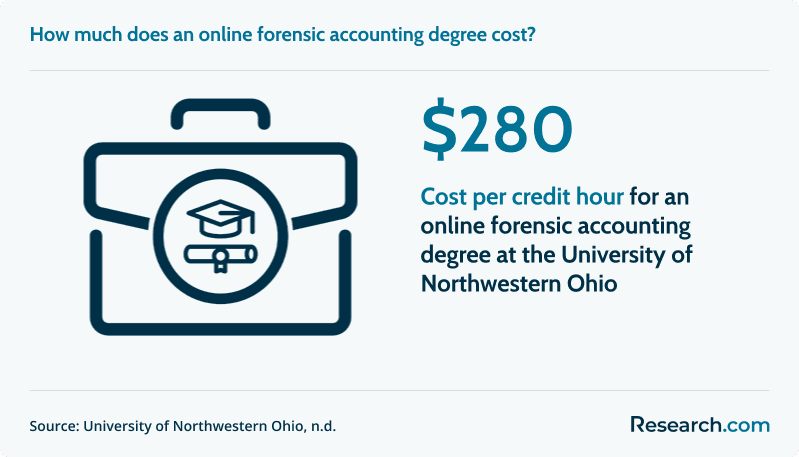
- Estimated Cost: $280 per credit hour
- Required Credits to Graduate: 180 credit hours
- Accreditation: Higher Learning Commission (HLC)
3. Champlain College
Champlain College offers an online certificate program in forensic accounting for students or working accountants who want targeted training rather than a full bachelor’s degree. The certificate connects accounting concepts with forensic investigation and is structured so learners can apply new techniques in current professional settings. Students also study alongside learners in computer forensics, which can broaden their understanding of digital evidence and investigative work.
- Program Length: Seven months
- Tracks/concentrations: Forensic Accounting
- Estimated Cost: $335 per credit hour
- Required Credits to Graduate: 21 credit hours
- Accreditation: New England Commission of Higher Education (NECHE)
4. Franklin University
Franklin University’s online BS in Forensic Accounting is built for students who want a bachelor’s credential directly focused on fraud-related accounting work. The program covers fraud investigation, prevention, control, and detection. Graduates may apply their training to financial investigation, internal auditing, corporate accounting, and other roles where organizations need professionals who understand financial records and fraud risk.
- Program Length: 21 months
- Tracks/concentrations: None specified
- Estimated Cost: $398 per credit
- Required Credits to Graduate: 124 credits
- Accreditation: International Accreditation Council for Business Education (IACBE)
5. Purdue University Global
Purdue University Global offers an online Bachelor of Accounting program that prepares students for broad accounting work, including roles where forensic investigation knowledge may be useful. The curriculum includes Generally Accepted Accounting Principles (GAAP) and coursework in economics, finance, management, law, and information systems. Students also strengthen workplace skills such as communication, collaboration, judgment, and decision-making.
- Program Length: Four years
- Tracks/concentrations: None specified
- Estimated Cost: $371 per credit
- Required Credits to Graduate: 180 credits
- Accreditation: Accreditation Council for Business Schools and Programs (ACBSP)
5. Pennsylvania Western University
Pennsylvania Western University offers a 21-credit forensic accounting minor that can add fraud risk knowledge to a variety of majors. Students learn how to review large data sets, create and interpret tests used in fraud investigations, and communicate findings to different audiences. This option may work well for students who already have a primary major but want accounting-based investigative skills.
- Program Length: Varies
- Tracks/concentrations: Forensic Accounting
- Estimated Cost: $516 per credit (active duty military rate), $626 per credit (resident rate), $688 (non-resident rate)
- Required Credits to Graduate: 21 credits
- Accreditation: Middle States Commission on Higher Education (MSCHE)
7. Eastern Oregon University
Eastern Oregon University’s online accounting program allows students to pursue either a Bachelor of Arts (BA) or Bachelor of Science (BS). The program can be completed in as little as three years and offers a management accounting focus. Graduates may use the accounting foundation to pursue professional credentials and career paths such as certified management accountant, certified public accountant, and forensic accountant roles.
- Program Length: Three to four years
- Tracks/concentrations: Certified Managerial Accounting
- Estimated Cost: $286 per credit hour
- Required Credits to Graduate: 180 credit hours
- Accreditation: International Accreditation Council for Business Education (IACBE)
8. DeSales University
DeSales University offers a Bachelor of Science in Accounting with an optional forensic accounting specialization. The program blends traditional instruction with online activities and learning materials. Students develop skills in financial statement analysis, accounting frameworks, financial decision-making, tax rules, and auditing concepts.
- Program Length: Four years
- Tracks/concentrations: Forensic Accounting
- Estimated Cost: $560 per credit
- Required Credits to Graduate: 120 credits
- Accreditation: Accreditation Council for Business Schools and Programs (ACBSP)
9. Culver-Stockton College
Culver-Stockton College’s undergraduate criminal justice program can support students interested in investigative careers, including forensic accounting-adjacent work. The curriculum covers ethics, criminal behavior, social control, interviewing, interrogation, and crime scene investigation. Students also complete an internship with a relevant agency, which can help connect classroom learning to real investigative environments.
- Program Length: Four years
- Tracks/concentrations: Forensic Accounting
- Estimated Cost: $29,915 tuition and fees per year
- Required Credits to Graduate: 42 hours
- Accreditation: Higher Learning Commission (HLC)
10. Embry-Riddle Aeronautical University Worldwide
Embry-Riddle Aeronautical University Worldwide offers a Bachelor of Science in Homeland Security for students interested in security-focused careers. The curriculum includes global conflict, military science, counterterrorism, and applied security studies. While broader than accounting, the program may appeal to students who want to connect financial investigation interests with homeland security, threat analysis, and organizational risk.
- Program Length: Four years
- Tracks/concentrations: Forensic Accounting
- Estimated Cost: $452 per credit
- Required Credits to Graduate: 123 credits
- Accreditation: Southern Association of Colleges and Schools Commission on Colleges (SACSCOC)
What graduates say about online forensic accounting programs
"The online format made it possible to keep working while I studied. I could complete coursework around my job and use new fraud analysis concepts almost immediately in my accounting role." - Sarah
"I wanted something more focused than a general business degree. Being able to replay lectures, move through assignments at my own pace, and connect with professionals through online forums and guest speakers helped me build both knowledge and contacts." - Michael
"After high school, I was interested in both accounting and criminal justice but did not want to move away right away. Studying online let me explore both areas while living at home and avoiding traditional housing costs." - David
Key findings
- Affordable undergraduate forensic accounting-related programs in this guide range from $280 to $560 per credit.
- Scholarships are the most common type of financial aid reported by online learners.
- At the undergraduate level, forensic accounting is often offered as a concentration, minor, certificate, or track within accounting, business, criminal justice, or related programs.
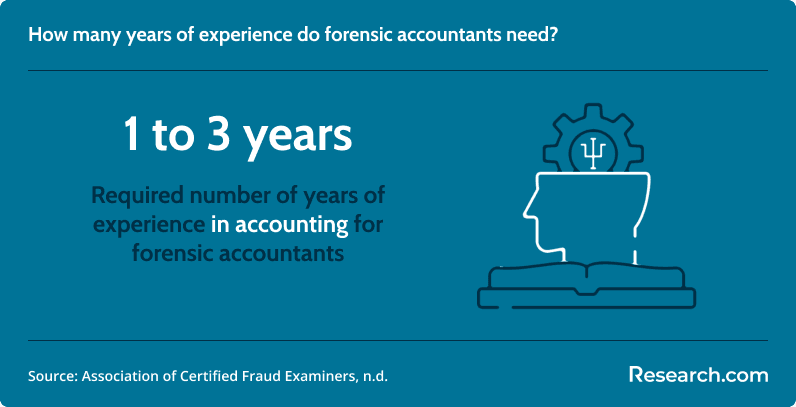
- Many employers expect forensic accounting candidates to bring at least one to three years of relevant accounting, auditing, compliance, or investigative experience.
- There will be about 27,400 openings for accountants and auditors annually until 2032.
How long does it take to complete an online forensic accounting program?
Most online bachelor’s-level forensic accounting programs take three to four years to complete, depending on transfer credits, course load, and program format. Some accelerated options may be completed in as little as two years, while part-time students may need up to five years.
The biggest timeline factors include:
- Transfer credits. Previously completed college coursework may reduce the number of credits you need to finish, especially if the credits apply to general education, business, or accounting requirements.
- Enrollment pace. Full-time students usually finish faster, while part-time students often choose a slower pace to balance work, caregiving, or military responsibilities.
- Program requirements. Internships, capstone projects, prerequisite courses, or certification-aligned coursework can affect the total time commitment.
How does an online forensic accounting program compare to an on-campus program?
Online forensic accounting programs are usually best for students who need flexibility. They allow learners to complete coursework from any location with reliable internet access, which can be especially useful for working adults, parents, military students, and students who do not live near a campus with the right program. Online study can also reduce commuting, relocation, and housing expenses, though students should still review technology fees and other online learning costs.
On-campus programs may be a better fit for students who prefer structured class times, in-person instruction, immediate access to faculty, campus networking, and face-to-face group work. Campus programs may also offer student organizations, accounting labs, in-person career fairs, and local internship relationships that are harder to replicate fully online.
| Format | Best for | Potential trade-offs |
| Online forensic accounting program | Working students, parents, remote learners, students seeking schedule flexibility | Requires self-discipline, strong time management, and comfort with virtual communication |
| On-campus forensic accounting program | Students who want in-person faculty access, campus activities, and a traditional classroom routine | May involve commuting, relocation, housing costs, and less scheduling flexibility |
| Hybrid forensic accounting program | Students who want some online flexibility but still value occasional campus interaction | May still require travel to campus on specific days or for required experiences |
What is the average cost of an online forensic accounting program?
The online undergraduate forensic accounting-related programs listed in this guide cost between $280 and $560 per credit. Among the ranked options, the University of Northwestern Ohio has the lowest listed rate at $280 per credit.
Per-credit tuition is only one part of the total cost. Students should also check mandatory fees, books, digital learning materials, exam fees, technology requirements, proctoring charges, graduation fees, and whether tuition differs for in-state, out-of-state, military, or international students. When possible, review each school’s total cost of attendance or total student budget rather than relying only on tuition marketing pages.
| Cost factor | Why it matters |
| Tuition per credit | Helps estimate the direct instructional cost of the degree or certificate |
| Required credits | A lower per-credit price may still lead to a higher total cost if the program requires more credits |
| Fees and materials | Technology, course materials, textbooks, and proctoring can increase the real price of attendance |
| Transfer credit policy | Generous transfer policies can reduce both cost and time to completion |
| Financial aid eligibility | Federal aid, grants, scholarships, employer benefits, and military benefits can lower out-of-pocket costs |
What are the financial aid options for students enrolling in an online forensic accounting program?
Online forensic accounting students may qualify for several types of financial aid, depending on the school, degree level, enrollment status, citizenship or residency status, and financial need.
- Student loans. Federal and private student loans may help cover tuition and related education costs, but loans must be repaid with interest. Borrow only what you need and compare repayment terms carefully.
- Scholarships. Colleges, accounting organizations, businesses, community groups, and professional associations may offer scholarships for accounting, business, fraud examination, or online students.
- Grants. Grants generally do not need to be repaid and may be awarded based on financial need, academic merit, or student background.
- Military or veteran benefits. Veterans and active-duty service members may qualify for education benefits such as the GI Bill. Some institutions, including Pennsylvania Western University, also list reduced tuition rates for military personnel.
Many online students use savings to pay for part of their education, but 26% also use scholarships to reduce costs. The table below shows common affordability features and financial support options reported by online students and graduates.
For federal aid consideration, students should complete the Free Application for Student Aid (FAFSA) through the Federal Student Aid website. Schools use FAFSA information to determine eligibility for federal, state, and institutional aid programs.
| Type of Financial Aid | Percentage of Online Students and Graduates |
| Scholarships | 26% |
| Tuition discount | 25% |
| Free or no textbooks | 20% |
| Locked-in tuition rate | 17% |
| Free technology equipment (ex. Laptop, iPad) | 13% |
What are the prerequisites for enrolling in an online forensic accounting program?
Admission requirements vary by school, but online undergraduate forensic accounting programs commonly ask applicants to provide evidence of academic readiness and completion of secondary education.
- Educational background. Applicants typically need a high school diploma or GED equivalent.
- GPA requirements. Some programs may require a minimum high school GPA of 2.75 on a 4.0 scale.
- Standardized test scores. Some schools may request ACT or SAT scores, although requirements differ by institution and admission policy.
What courses are typically in an online forensic accounting program?
Online forensic accounting students learn how to work with financial records, spot irregularities, document findings, and understand how accounting evidence may be used in legal or investigative settings. Exact courses vary, but most programs combine accounting, auditing, law, quantitative analysis, fraud examination, and sometimes criminal justice or digital forensics.
- Financial Accounting, which introduces accounting principles and teaches students how to read and interpret financial statements
- Auditing, which explains how auditors evaluate financial records, internal controls, and reporting accuracy
- Financial Statement Analysis, which develops the ability to review statements for risk indicators, unusual patterns, or potential misrepresentation
- Fraud Examination, which focuses on methods for identifying, investigating, and preventing financial fraud
- Investigative Accounting, which teaches students how to gather, organize, and analyze financial evidence
- Law for Forensic Accountants, which covers legal issues connected to financial crimes, investigations, evidence, and litigation support
Some programs also include criminology, data analytics, cybersecurity, computer forensics, ethics, taxation, or business law, depending on whether the degree is housed in an accounting, business, or criminal justice department.
What types of specializations are available in online forensic accounting programs?
Forensic accounting is one of several areas of specialization in accounting. At the bachelor’s level, it is often offered as a concentration, minor, certificate, or track within accounting, business, or criminal justice rather than as a standalone degree. Dedicated forensic accounting degrees are more common at the graduate level.
| Program option | When it makes sense |
| Accounting degree with forensic accounting concentration | Best for students who want a broad accounting foundation plus fraud investigation coursework |
| Criminal justice degree with forensic accounting-related coursework | Best for students more interested in investigations, law enforcement, or security careers |
| Undergraduate certificate in forensic accounting | Best for current students or working professionals who already have accounting knowledge and want a shorter credential |
| Graduate forensic accounting program | Best for students seeking advanced specialization, leadership preparation, or deeper forensic analysis training |
What financial aid opportunities can help make an online forensic accounting degree more affordable?
The most affordable program is not always the one with the lowest listed tuition. A higher-tuition school may become more affordable if it offers stronger scholarships, transfer credit acceptance, employer partnerships, military benefits, or lower textbook and technology costs. Before enrolling, compare your net cost after aid.
- Federal aid through FAFSA: Completing the Free Application for Federal Student Aid (FAFSA) is the starting point for many domestic students seeking grants, loans, and work-study eligibility.
- Institutional scholarships and grants: Review each college’s financial aid page for online learner scholarships, accounting scholarships, merit awards, need-based grants, and priority deadlines.
- Employer tuition reimbursement: If you already work in accounting, finance, compliance, banking, insurance, government, or business operations, ask whether your employer helps pay for job-related education.
- Specialized funding for accounting students: Organizations such as the American Institute of CPAs (AICPA) may offer scholarships and grants for accounting majors.
Students who plan to use federal aid should focus on online accredited colleges that accept financial aid. Confirm aid eligibility directly with the school, especially if you are considering a certificate, minor, nondegree option, or part-time enrollment.
How to choose the best online forensic accounting program?
The best online forensic accounting program is the one that matches your career goal, budget, schedule, transfer credit situation, and credential needs. Flexibility matters, but it should not be the only factor. Accreditation, curriculum depth, faculty background, student support, and career outcomes all affect the long-term value of the program.
- Accreditation. Confirm that the institution is properly accredited and check whether the business or accounting program has accreditation from organizations such as the Accreditation Council for Business Schools and Programs (ACBSP) or the International Accreditation Council for Business Education (IACBE). Accreditation can affect employer recognition, credit transfer, graduate school admission, and financial aid eligibility.
- Faculty. Look for instructors with accounting, auditing, CPA, fraud examination, litigation support, government, or corporate investigation experience. Faculty with field experience can help connect theory to real investigative practice.
- Support services. Online students should have access to academic advising, library resources, tutoring, career counseling, virtual networking, technical support, and job search help.
- Student outcomes. Ask for graduation rates, retention rates, career placement information, internship availability, alumni outcomes, and employer connections when available.
| Question to ask before enrolling | Why it matters |
| Is the school institutionally accredited? | Accreditation can affect aid eligibility, transfer credits, employer recognition, and graduate study options |
| Does the curriculum include fraud examination, auditing, law, and data analysis? | Forensic accounting requires more than general accounting coursework |
| Can I transfer previous credits? | Transfer credits may reduce both completion time and total cost |
| Are internships, projects, or simulations available? | Applied experience can help you compete for entry-level accounting or investigation-related roles |
| Will the program support CPA, CFE, or other credential goals? | Certification requirements can affect course planning and career advancement |
How can integrating a forensic psychology perspective enhance forensic accounting practice?
Forensic accounting focuses on financial evidence, but fraud investigations often involve human behavior, pressure, opportunity, rationalization, concealment, and deception. A forensic psychology perspective can help accountants better understand motives, behavioral patterns, interview dynamics, and the way individuals or groups may respond during investigations. Students who want to add behavioral analysis to their investigative skill set may explore related study options such as forensic psychology master's programs online.
How Does Accreditation Impact the Quality of an Online Forensic Accounting Program?
Accreditation helps verify that a college or program follows recognized academic standards. For students, it can influence financial aid eligibility, credit transfer, graduate school admission, and employer confidence. In forensic accounting, students should also look beyond accreditation and evaluate whether the program includes practical work such as case studies, fraud scenarios, audit exercises, internships, or simulations. If cost is a primary concern, comparing accredited options through resources such as the cheapest online bachelors degree in accounting can help you narrow your choices.
What other accounting career options can complement forensic accounting expertise?
Forensic accounting skills pair well with broader accounting careers because fraud risk appears in many financial environments. Professionals may combine investigative knowledge with internal auditing, compliance, risk management, corporate accounting, tax, or financial analysis. Exploring different accounting career options can help students choose electives, internships, and certifications that support both immediate employment and long-term advancement.
What emerging trends are shaping the future of forensic accounting?
Forensic accounting is becoming more technology-driven. Data analytics, artificial intelligence, blockchain analysis, cybersecurity concerns, and digital forensics are changing how suspicious activity is detected and investigated. Employers increasingly value accountants who can work with large data sets, understand digital transaction trails, communicate findings clearly, and adapt to evolving fraud tactics. Students who want higher-level opportunities should monitor how these skills connect to the highest paying jobs in accounting.
Can an associate degree serve as a launching pad for a forensic accounting career?
An associate degree can be a lower-cost starting point for students who want foundational accounting training before committing to a bachelor’s degree. It may prepare graduates for entry-level bookkeeping, accounting assistant, or office finance roles, while also creating a transfer pathway into a bachelor’s program. Students looking for a budget-conscious first step can compare options for an affordable associates degree in accounting online and then plan how credits may transfer toward forensic accounting coursework.
What role do specialized certifications play in advancing forensic accounting careers?
Certifications can help demonstrate job-ready skills beyond the degree. Forensic accounting employers may value credentials that show competence in fraud examination, accounting, auditing, financial forensics, bookkeeping, or data analysis. Even credentials outside forensic accounting, such as the CPB bookkeeping certification, can support early-career credibility when paired with accounting experience and fraud-focused coursework.
How do geographic factors influence forensic accounting salaries and job prospects?
Location can affect both pay and opportunity. Areas with more corporate headquarters, financial institutions, government agencies, legal services, insurance companies, and accounting firms may offer more openings for accountants with investigative skills. Cost of living, state regulations, employer concentration, and regional demand also shape compensation. Reviewing resources on CPA salary by state can help students understand how geography influences accounting earnings more broadly.
What career paths are available for graduates of forensic accounting programs?
Graduates with an online forensic accounting degree may begin in general accounting, auditing, compliance, bookkeeping, tax, or financial analysis roles before moving into more specialized forensic work. This is common because many forensic accounting positions require one to three years of relevant experience.
Some students continue into graduate study after earning a bachelor’s degree. Online master of accounting programs are more likely to offer advanced forensic accounting coursework and can help students develop specialized expertise for higher-level roles.
Graduates may also pursue the certified fraud examiner (CFE) credential. According to the Global Salary Study from the Association of Certified Fraud Examiners (ACFE), CFEs earn 17% more on average than their uncertified peers.
| Career path | How forensic accounting training helps |
| Forensic accountant | Supports fraud detection, financial investigation, litigation support, and evidence analysis |
| Internal auditor | Helps evaluate controls, identify risk, and review financial processes for irregularities |
| Compliance analyst | Applies accounting and regulatory knowledge to help organizations follow rules and reduce risk |
| Corporate accountant | Uses accounting systems knowledge while recognizing unusual transactions or reporting issues |
| Government investigator or auditor | Applies financial analysis skills to public-sector audits, investigations, and enforcement-related work |
What is the job market for graduates with a forensic accounting degree?
The broader accounting labor market is projected to remain steady. BLS projections from 2024 show that jobs for accountants and auditors will grow 5% by 2034, surpassing the national average, as shown in the chart below. This growth is expected to result in 124,200 openings annually.
Forensic accounting is a specialized part of this larger field. Organizations continue to need professionals who can investigate financial fraud, review complex records, support audits, and help respond to embezzlement or misconduct. Demand may be especially relevant as fraud tactics become more sophisticated and financial activity becomes more digital.
Certification can also affect competitiveness. According to the Global Salary Study from the Association of Certified Fraud Examiners (ACFE), CFEs earn 17% more on average than their uncertified peers.
What additional qualifications can enhance a forensic accounting career?
A degree can provide the academic foundation, but credentials and applied experience often help candidates stand out. The right qualification depends on whether you want to work in fraud investigation, auditing, litigation support, public accounting, compliance, or corporate risk.
- Certified Fraud Examiner (CFE): This credential focuses on fraud prevention, detection, investigation, and deterrence. It is widely recognized in fraud examination and financial investigation roles.
- Certified Public Accountant (CPA): The CPA credential is especially valuable for accountants involved in auditing, financial reporting, public accounting, or expert testimony.
- Certified in Financial Forensics (CFF): Offered by the AICPA, this credential is designed for accountants who work in forensic accounting, litigation support, fraud investigation, and financial analysis.
- Graduate Certificate in Accounting: A graduate certificate in accounting can help professionals deepen knowledge in areas such as tax, auditing, financial reporting, or specialized accounting practice.
Students should choose credentials strategically. A certification is most useful when it aligns with your target role, meets employer expectations, and builds on experience you can demonstrate through projects, internships, or prior accounting work.
What are current forensic accountant salary trends?
Forensic accounting compensation is increasingly tied to specialized skills. Employers may place higher value on professionals who understand data analytics, digital forensics, fraud detection tools, regulatory expectations, and financial investigation methods. Certifications and practical experience can also influence salary growth. Students comparing compensation expectations can review a dedicated forensic accountant salary analysis for more role-specific context.
How can you maximize your success in an online forensic accounting program?
Succeeding online requires more than logging into courses. Forensic accounting students need disciplined study habits, technical accounting practice, communication skills, and opportunities to apply what they learn to real or realistic cases.
- Create a weekly study system. Online flexibility is useful only if you manage deadlines. Set fixed study blocks, track assignments, and break larger accounting projects into smaller steps.
- Participate in discussions and case work. Fraud investigation requires clear reasoning and communication. Use discussion boards, group assignments, and case analyses to practice explaining your conclusions.
- Use virtual office hours and academic support. Accounting concepts build on each other. If you fall behind in financial accounting, auditing, or analytics, contact instructors, tutors, or advisors early.
- Seek applied experience. Look for internships, accounting assistant roles, audit support work, compliance projects, or fraud-related simulations. Practical experience can help bridge the gap between coursework and forensic accounting jobs.
- Follow industry tools and trends. Digital transactions, data analytics, cybersecurity, and evolving fraud schemes are shaping the field. Webinars, professional associations, and accounting publications can help you stay current.
- Add a useful specialization when possible. Data analytics, fraud examination, cybersecurity, auditing, or financial reporting coursework can strengthen your profile. Students comparing broader accounting options can review top online accounting programs to see how different programs structure these skills.
Common mistakes to avoid when choosing an online forensic accounting degree
- Choosing a program without checking accreditation. Accreditation can affect financial aid, transfer credits, graduate school options, and employer recognition.
- Comparing tuition only by sticker price. Review total cost, fees, books, transfer credits, and financial aid before deciding which program is truly affordable.
- Assuming every accounting degree includes forensic training. Some programs offer only general accounting coursework. Look for fraud examination, auditing, law, investigative accounting, and data analysis.
- Ignoring certification planning. If you want to pursue CPA, CFE, CFF, or another credential, ask whether the curriculum supports your eligibility and preparation needs.
- Overlooking experience requirements. Many forensic roles prefer candidates with one to three years of related accounting or investigative experience, so internships and entry-level accounting roles matter.
- Relying only on rankings. Rankings can help you start your search, but your best fit depends on cost, transfer policy, support services, schedule, curriculum, and career goals.
Key Insights
- Forensic accounting is a practical path for students who want to combine accounting, fraud detection, auditing, law, data analysis, and investigation.
- Affordable online forensic accounting-related programs in this guide list costs from $280 to $560 per credit, but the true cost depends on fees, credits required, transfer policies, and aid.
- Most undergraduate options are concentrations, tracks, minors, or certificates attached to accounting, business, criminal justice, or security programs.
- Online programs are best for students who need flexibility, while campus programs may offer stronger in-person networking and structured interaction.
- Career outcomes are strongest when students combine the degree with practical experience, relevant certifications, and technical skills in auditing, fraud examination, and data analytics.
- Before enrolling, verify accreditation, review the curriculum closely, ask about career support, compare total cost after aid, and confirm whether the program supports your long-term credential goals.
References:
- Internal Revenue Service. (2025, December 12). IRS-CI issues fiscal year 2025 annual report showcasing banner investigative results. https://www.irs.gov/newsroom/irs-ci-issues-fiscal-year-2025-annual-report-showcasing-banner-investigative-results
- Payscale. (n.d.). Bachelor of Science (BS / BSc), Forensic Accounting Degree. Payscale. Retrieved March 23, 2024, from https://www.payscale.com/research/US/Degree=Bachelor_of_Science_(BS_%2F_BSc)%2C_Forensic_Accounting/Salary
- U.S. Bureau of Labor Statistics. (2025). Accountants and auditors (Pay section). In Occupational Outlook Handbook. U.S. Department of Labor. Retrieved February 4, 2026, from https://www.bls.gov/ooh/business-and-financial/accountants-and-auditors.htm
- U.S. Bureau of Labor Statistics. (2024). May 2024 Occupational Employment and Wage Statistics. Occupational Employment and Wage Statistics Query System. Retrieved January 2026, from https://data.bls.gov/oes/#/industry/00000
Other Things You Should Know About Online Forensic Accounting Degree Programs
Yes. Many affordable online forensic accounting programs accept federal aid, institutional scholarships, and accounting-specific awards. Applicants usually complete the FAFSA, and some schools require at least a 2.5 GPA, full-time enrollment, or a declared major before funding is released.
In 2027, the average cost for an online forensic accounting degree can range significantly based on the institution. On average, you might expect to pay between $15,000 to $30,000 in total tuition. It is important to research individual programs for precise pricing.


