2027 Fastest Online Medical Assistant Associate Degree Programs

Co-Founder and Chief Data Scientist
Choosing a medical assistant associate degree can feel overwhelming, especially if you want a fast, accredited program that fits your budget and leads to real job opportunities. Many students struggle to find trustworthy online options that balance speed, affordability, and quality. The wrong choice can cost you time, money, and eligibility for certification exams.
This article helps you cut through the confusion by comparing the fastest online medical assistant associate degree programs in detail. You’ll learn how to spot reputable schools, understand costs, plan for externships, and prepare for certification. By the end, you’ll have the clarity and confidence to choose the program that best matches your goals.
What are the benefits of getting the fastest online medical assistant associate degree programs?
- This degree qualifies you for roles such as medical assistant, clinical assistant, administrative medical assistant, and phlebotomy technician in hospitals, clinics, and specialty practices.
- According to the U.S. Bureau of Labor Statistics, medical assistants earn a median annual salary of about $42,000, with higher pay in outpatient care centers and specialty offices.
- Earning your degree online lets you study at your own pace, finish faster—often in 9–12 months—and balance coursework with work or family commitments.
What can I expect from the fastest online medical assistant associate degree programs?
A medical assistant associate degree is a comprehensive, college-level program that trains you to work in both clinical and administrative roles in healthcare settings. Unlike shorter certificate programs, this degree typically takes 9 to 24 months to complete, depending on whether you choose an accelerated online format.
Coursework combines essential topics such as anatomy and physiology, medical terminology, clinical procedures, and healthcare administration. You’ll also complete a supervised externship to gain real-world experience working with patients.
Accredited programs prepare you to sit for certification exams like the Certified Medical Assistant (CMA) or Registered Medical Assistant (RMA), which can significantly boost your job prospects and earning potential. Online programs make it possible to earn your degree flexibly and quickly without sacrificing quality. Overall, this path offers a strong foundation for stable, rewarding employment in the growing healthcare field.
Where can I work with the fastest online medical assistant associate degree programs?
Graduates of a medical assistant associate degree program typically work in a variety of outpatient healthcare settings where routine clinical and administrative support is needed. The most common workplace is a physician’s office, where medical assistants help with patient intake, vitals, scheduling, and electronic health records. They’re also found in specialty practices like cardiology, dermatology, pediatrics, or orthopedics, where they may assist with more focused procedures.
Other common employers include urgent care centers, outpatient clinics, and community health organizations that serve large and diverse patient populations.
Beyond traditional clinics, some medical assistants work in broader healthcare and administrative environments. These may include:
- Hospitals (particularly outpatient departments or same-day surgery units)
- Chiropractic and alternative medicine offices
- Insurance companies (in support or claims roles)
- Medical billing and coding firm
- Clinical research centers (assisting with patient data collection and support)
This versatility makes the degree a flexible entry point into the healthcare industry.
How much can I make with the fastest online medical assistant associate degree programs?
Graduates of a medical assistant associate degree program typically earn a competitive salary that reflects both their education and certification. According to the U.S. Bureau of Labor Statistics, the median annual wage for medical assistants in 2023 was about $42,000.
Entry-level positions often start around $35,000 to $37,000 per year, depending on your location, employer, and whether you have credentials like the CMA or RMA. Medical assistants working in outpatient care centers and specialty practices generally earn more than those in primary care offices.
With experience and additional certifications, salaries can increase over time. The top 10% of medical assistants earn over $55,000 annually, especially in metropolitan areas with higher demand. Those who transition into supervisory, billing, or medical office management roles often see additional pay raises.
An associate degree can also help you qualify for better benefits packages, including healthcare coverage, retirement plans, and paid time off, which adds value to your total compensation.
- Fastest Online Medical Assistant Associate Degree Programs for 2027 List of Programs
- How long does it take to complete the fastest online medical assistant associate degree program? Completion Time
- How does the fastest online medical assistant associate degree program compare to an on-campus program? How does the fastest online medical assistant associate degree program compare to an on-campus program?
- What is the average cost of the fastest online medical assistant associate degree program? Program Cost
- What are the financial aid options for students enrolling in the fastest online medical assistant associate degree program? Financial Aid
- What are the prerequisites for enrolling in the fastest online medical assistant associate degree program? Program Requirements
- What courses are typically in the fastest online medical assistant associate degree program? What courses are typically in the fastest online medical assistant associate degree program?
- What types of specializations are available in the fastest online medical assistant associate degree programs? What types of specializations are available in the fastest online medical assistant associate degree programs?
- How do you choose the best among the fastest online medical assistant associate degree programs? How do you choose the best among the fastest online medical assistant associate degree programs?
- What career paths are available for graduates of the fastest online medical assistant associate degree programs? What career paths are available for graduates of the fastest online medical assistant associate degree programs?
- What is the job market like for graduates with the fastest online medical assistant associate degree program? Job Outlook
- How Do Fast Online Medical Assistant Programs Enhance Student Support and Career Success? How Do Fast Online Medical Assistant Programs Enhance Student Support and Career Success?
- Is the investment in a fast online medical assistant associate degree program worth it? Is the investment in a fast online medical assistant associate degree program worth it?
- How do accreditation and quality assurance shape online medical assistant programs? How do accreditation and quality assurance shape online medical assistant programs?
Fastest Online Medical Assistant Associate Degree Programs for 2027
Choosing a fast online medical assistant associate degree is usually about one practical question: how quickly can you qualify for entry-level healthcare work without choosing a program that limits certification, externship placement, transfer credit, or financial aid options? Speed matters, but it should not be the only factor. The fastest option is not always the best option if it lacks proper accreditation, hands-on clinical training, student support, or clear certification preparation.
This guide is designed for students who want an accelerated path into medical assisting, especially working adults, career changers, parents, and learners who prefer online coursework with local clinical experience. You will find ranked program options, completion timelines, cost comparisons, accreditation notes, career outcomes, common mistakes, and questions to ask before enrolling.
Quick answer: What is the fastest online medical assistant associate degree?
The fastest online medical assistant associate degree programs can be completed in about 40 weeks to 12 months when offered in accelerated or self-paced formats. Ross College lists an accelerated online option that can be completed in 40 weeks, while Penn Foster offers a fast-track pace of 6 months per semester. Most students should still plan for 12 to 18 months because externship scheduling, course load, transfer credits, and personal availability can affect the actual finish date.
If your priority is the shortest possible training, a certificate may be faster than an associate degree. However, an associate degree usually provides broader coursework, more general education, and a stronger foundation for future healthcare education pathways.
How do we rank schools?
Research.com evaluates online medical assistant associate degree programs with a decision-focused approach. Because this choice involves tuition, time, certification eligibility, and career readiness, our rankings emphasize practical factors that affect students before and after enrollment.
The ranking process is based on a transparent Research.com methodology and draws from established education data sources, including the Integrated Postsecondary Education Data System (IPEDS), Peterson's databases and their Distance Learning Licensed Data Set, and the College Scorecard from the National Center for Education Statistics.
When comparing programs, use the ranking as a starting point rather than a final decision. Confirm current tuition, state authorization, externship rules, certification eligibility, and financial aid availability directly with each school before applying.
Fastest online medical assistant associate degree programs at a glance
| Rank | School | Program | Fastest stated timeline | Credits | Cost detail provided | Accreditation listed |
| 1 | Dakota College at Bottineau | Associate of Applied Science in Medical Assistant | 1 year | 60 credits | $139 per credit | Higher Learning Commission (HLC) |
| 2 | Herzing University | Associate of Science in Medical Assisting Services | 20 months, accelerated options with 8-week courses | 60 credits | $515 per credit | Higher Learning Commission (HLC) |
| 3 | Keiser University | Associate of Science in Medical Assisting Science | 12 to 18 months | 60 credit hours | Total program cost is around $26,956 | Southern Association of Colleges and Schools Commission on Colleges (SACSCOC) |
| 4 | Penn Foster | Medical Assistant Associate Degree | 6 months per semester (fast track) | 60 credits | $109 per credit | Distance Education Accrediting Commission (DEAC) |
| 5 | Ross College | Associate of Applied Science in Medical Assisting | 40 weeks (accelerated online) | 60 credits | Total program cost is around $15,990 for their certificate program | Accrediting Bureau of Health Education Schools (ABHES) |
| 6 | Liberty University | Associate of Applied Science in Medical Office Administration | Less than 2 years for a 60-credit associate degree | 60 credit hours | Starts at $390 per credit | Southern Association of Colleges and Schools Commission on Colleges (SACSCOC) |
| 7 | South University | Associate of Science in Medical Assisting | 2 years | 61 credits | $475 per credit | Southern Association of Colleges and Schools Commission on Colleges (SACSCOC) |
| 8 | National American University | Medical Administrative Assistant Associate of Applied Science | 2 years | 90 credits | $342 per credit | Higher Learning Commission (HLC) |
| 9 | Northland Community & Technical College | Medical Assistant Associate of Applied Science | Typically two years for an Associate of Applied Science | Not explicitly stated online for the AAS in Medical Assistant; associate degrees are commonly 60 credits | Information not readily available online for the specific MA program; generally varies by in-state/out-of-state residency | Higher Learning Commission (HLC) |
| 10 | State Fair Community College | Associate of Applied Science in Medical Assisting | 2 years | 61 credit hours | $129 per credit | Higher Learning Commission (HLC) |
1. Dakota College at Bottineau
Dakota College at Bottineau offers an online Associate of Applied Science in Medical Assistant for students who want a compact path into clinical and administrative healthcare support. The curriculum is built for learners preparing for medical office work, patient interaction, basic clinical procedures, and certification-oriented training.
The program can be completed in as little as one year and includes a 160-hour internship. It is especially relevant for students interested in becoming Registered Medical Assistants through American Medical Technologists or National Certified Medical Assistants through the National Center for Competency Testing.
- Program length: 1 year
- Track or concentration: General Medical Assistant AAS degree
- Cost per credit: $139
- Credits required: 60 credits
- Accreditation: Higher Learning Commission (HLC)
2. Herzing University
Herzing University offers an online Associate of Science in Medical Assisting program for students who want a career-centered associate degree with accelerated course scheduling. Many courses are offered in 8-week sessions, which can help motivated students move through the curriculum more efficiently.
The program combines online academic coursework with required in-person clinical labs and an 8-week, 180-hour externship. It is a better fit for students who can manage online study while also meeting hands-on training requirements at approved locations.
- Program length: 20 months, accelerated options with 8-week courses
- Track or concentration: Associate of Science in Medical Assisting Services
- Cost per credit: $515 per credit
- Credits required: 60 credits
- Accreditation: Accredited by the Higher Learning Commission (HLC)
3. Keiser University
Keiser University provides an online Associate of Science in Medical Assisting Science that prepares students for front-office and back-office responsibilities in healthcare settings. The program emphasizes employable skills and preparation for the Registered Medical Assistant credentialing examination.
Students complete 60 credit hours and participate in an externship for practical experience. The program may appeal to learners who want structured faculty support, smaller classes, and an online format with required hands-on components.
- Program length: 12 to 18 months
- Track or concentration: Medical Assisting Science
- Cost detail: Total program cost is around $26,956
- Credits required: 60 credit hours
- Accreditation: Southern Association of Colleges and Schools Commission on Colleges (SACSCOC)
4. Penn Foster
Penn Foster offers a self-paced online Medical Assistant Associate Degree for students who need flexibility and want to move through coursework at an accelerated pace. The program covers clinical and administrative topics such as medical terminology, medical coding, transcription, and outpatient office procedures.
The associate degree includes a real-world externship and is designed to support preparation for credentials such as Registered Medical Assistant or Certified Clinical Medical Assistant. Because the format is self-paced, it may work best for disciplined students who can set weekly goals without a traditional classroom schedule.
- Program length: 6 months per semester (fast track)
- Track or concentration: General Medical Assistant Associate Degree
- Cost per credit: $109 per credit
- Credits required: 60 credits
- Accreditation: Distance Education Accrediting Commission (DEAC)
5. Ross College (Ross Education)
Ross College offers an online Associate of Applied Science in Medical Assisting with an accelerated 40-week option and a standard 55-week option. The curriculum includes medical assisting, pharmacology, healthcare administration, medical law, and ethics.
Students may select areas such as Electronic Medical Records, Patient Experience, Medical Scribe, or General. The online format uses collaboration and discussion to help students build professional communication skills in addition to technical healthcare knowledge.
- Program length: 40 weeks (accelerated online)
- Tracks or concentrations: Electronic Medical Records, Patient Experience, Medical Scribe, or General
- Cost detail: Total program cost is around $15,990 for their certificate program
- Credits required: 60 credits
- Accreditation: Accrediting Bureau of Health Education Schools (ABHES)
6. Liberty University
Liberty University offers a 100% online Associate of Applied Science in Medical Office Administration. This option is more administrative than clinical, so it is best for students who want to work in medical offices rather than focus primarily on direct patient-care procedures.
The curriculum covers medical billing and coding, scheduling, record management, and legal and ethical issues in healthcare. Students may also complete an optional 160-hour externship for practical experience.
- Program length: Less than 2 years for a 60-credit associate degree
- Track or concentration: Associate of Applied Science in Medical Office Administration
- Cost per credit: Starts at $390 per credit
- Credits required: 60 credit hours
- Accreditation: Southern Association of Colleges and Schools Commission on Colleges (SACSCOC)
7. South University
South University offers an online Associate of Science in Medical Assisting that uses a competency-based model. Students are expected to demonstrate mastery of administrative and clinical skills through assessments, performance objectives, and practical training.
The program requires 92 quarter credits and includes a required 160-hour, unpaid, supervised practicum at a local medical practice during the final quarter. It is suited for students who want a structured online program with formal competency checks before graduation.
- Program length: 2 years
- Track or concentration: Associate of Science in Medical Assisting
- Cost per credit: $475
- Credits required: 61 credits
- Accreditation: Southern Association of Colleges and Schools Commission on Colleges (SACSCOC)
8. National American University
National American University offers an online Medical Administrative Assistant Associate of Applied Science for students interested in healthcare office operations. The program is aimed at entry-level administrative roles and may be appropriate for students with or without previous healthcare experience.
Coursework covers medical terminology, recordkeeping, billing, office procedures, and related administrative functions. Students may complete an optional 160-hour virtual practicum.
- Program length: 2 years
- Track or concentration: Medical Administrative Assistant (A.A.S.)
- Cost per credit: $342
- Credits required: 90 credits
- Accreditation: National American University is accredited by the Higher Learning Commission (HLC)
9. Northland Community & Technical College
Northland Community & Technical College offers a Medical Assistant Associate of Applied Science that includes online components for prerequisite coursework. The program prepares students for combined clinical and administrative responsibilities in medical office environments.
The format blends online coursework, clinical procedure labs, and a 160-hour externship. Because some requirements involve hands-on training, students should confirm location expectations, lab schedules, and local externship availability before enrolling.
- Program length: Typically two years for an Associate of Applied Science
- Track or concentration: Medical Assistant (MDA) program with prerequisite courses and sequential clinical courses; no distinct tracks are listed
- Cost detail: Information not readily available online for the specific MA program; generally varies by in-state/out-of-state residency
- Credits required: Not explicitly stated online for the AAS in Medical Assistant; associate degrees are commonly 60 credits
- Accreditation: Northland Community & Technical College is accredited by the Higher Learning Commission (HLC)
10. State Fair Community College (SFCC)
State Fair Community College (SFCC) offers an Associate of Applied Science in Medical Assisting with online classes and one weekly on-ground skills lab. This blended structure gives students online flexibility while preserving regular hands-on practice.
The program prepares students for multi-skilled healthcare support roles in clinics, offices, and other care settings. It is best for students who live close enough to attend required labs and want preparation for certification and entry-level employment.
- Program length: 2 years
- Track or concentration: Associate of Applied Science in Medical Assisting
- Cost per credit: $129
- Credits required: 61 credit hours
- Accreditation: State Fair Community College is accredited by the Higher Learning Commission (HLC)
How long does it take to complete the fastest online medical assistant associate degree program?
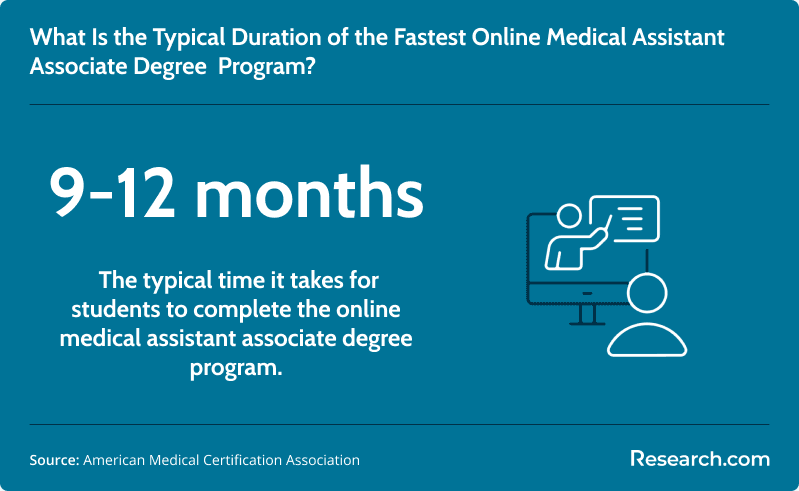
The shortest online medical assistant associate degree timelines are usually found in accelerated or self-paced programs. A fast option can take about 40 weeks, or roughly 9 to 10 months, when the school offers compressed scheduling. Ross College lists an accelerated medical assistant option that can be finished in 40 weeks. Penn Foster allows a fast-track pace of 6 months per semester, which can let students complete four semesters in as little as 12 months depending on pace.
For planning purposes, many students should expect 12 to 18 months. The final timeline depends on how many courses you take at once, whether you transfer credits, how quickly you complete assignments, and how soon you can schedule your externship. If you only need short-term workforce training and do not need an associate degree, some certificate programs may be completed in four to six months.
| Program pace | Typical completion time | Best for | Important trade-off |
| Accelerated associate degree | About 40 weeks to 12 months | Students who can study intensively and complete externship requirements quickly | Heavy weekly workload and less schedule flexibility during clinical requirements |
| Standard online associate degree | 12 to 18 months or up to 2 years | Working adults who need a steadier pace | Slower entry into the workforce |
| Certificate program | Four to six months | Students who want the fastest job-focused training | Does not award an associate degree and may offer less general education |
How does the fastest online medical assistant associate degree program compare to an on-campus program?
An accelerated online medical assistant associate degree can often be completed faster than a traditional campus program because online courses may use compressed terms, self-paced lessons, or year-round scheduling. A fast online degree may take 9 to12 months, while many campus-based associate programs follow an 18 to 24 months academic calendar.
Online programs are usually more flexible for students balancing work, childcare, or transportation limits. They may also be easier to compare by price, especially if you are researching affordable online medical assistant programs. The main limitation is that clinical skills cannot be learned entirely through a screen. Reputable online programs still require labs, externships, practicums, or other hands-on experiences.
Campus programs offer more direct practice with instructors and classmates. This can be helpful for students who want in-person coaching when learning skills such as measuring vital signs, preparing exam rooms, drawing blood, or assisting with injections. The trade-off is less scheduling flexibility and, in many cases, a longer path to completion.
| Factor | Fast online associate degree | On-campus associate degree |
| Speed | Often 9 to12 months in accelerated formats | Often 18 to 24 months in traditional formats |
| Flexibility | Higher for lectures, assignments, and quizzes | Lower because classes and labs meet at set times |
| Hands-on practice | Usually completed through labs, practicums, or externships | More frequent in-person practice built into the schedule |
| Best fit | Independent learners with strong time-management skills | Students who prefer structured routines and face-to-face support |
| Main risk | Underestimating externship and local clinical requirements | Taking longer because of fixed semester scheduling |
What is the average cost of the fastest online medical assistant associate degree program?
The lowest-cost fully online medical assistant associate degree options may cost around $6,000 to $7,000 in total, but pricing varies widely by school, accreditation type, fees, books, supplies, and whether the program uses standard tuition or self-paced pricing.
- Penn Foster: Penn Foster lists a total program cost between $6,100–$6,600 for the complete 60-credit program. Its fast-track option uses a 6 months per semester pace, which may allow completion in about 12 months depending on student progress.
- Herzing University: Herzing University lists its 20‑month associate program at about $33,080, which is substantially higher than lower-cost online options.
Accelerated certificate programs may cost $1,200–$2,600, but they do not lead to an associate degree. They may also offer narrower coursework and may not provide the same academic foundation or certification eligibility as an accredited degree program. Students who want to build beyond medical assisting may compare this pathway with an accelerated online bachelor's degree in public health if their long-term goal includes broader healthcare, prevention, or community health roles.
What should you include when comparing costs?
| Cost item | Why it matters | Question to ask the school |
| Tuition | This is the largest published expense, but it may not include everything. | Is tuition charged per credit, per term, or for the full program? |
| Fees | Technology, clinical, graduation, and assessment fees can change the final cost. | What mandatory fees are not included in advertised tuition? |
| Books and supplies | Medical assisting programs may require textbooks, software, uniforms, or equipment. | What materials are required, and are they included in tuition? |
| Externship expenses | Students may need transportation, immunizations, background checks, or drug screening. | Who pays for externship-related requirements? |
| Certification exam prep | Certification can improve employability, but exam costs may be separate. | Does the program include certification exam preparation or vouchers? |
What are the financial aid options for students enrolling in the fastest online medical assistant associate degree program?
Financial aid for online medical assistant associate degree students may include federal aid, school-based scholarships, payment plans, employer benefits, military education benefits, and workforce funding. Eligibility depends on the institution, program accreditation, enrollment status, and student circumstances.
Federal aid can include Pell Grants, Federal Supplemental Educational Opportunity Grants, and subsidized or unsubsidized Direct Loans. To be considered, students must complete the Free Application for Federal Student Aid and enroll in an eligible accredited program.
Some schools also offer institutional aid, tuition discounts, or monthly payment options. This can be especially important for students comparing degree programs with medical assistant trade school programs, where payment structures may differ from traditional colleges.
Working students should ask employers about tuition reimbursement or career development funding. Military-connected students may be able to use VA education benefits, including the GI Bill, or military spouse career advancement funding.
The median annual wage for medical assistants was $44,200 in May 2024. The chart below provides wage context for the field and can help you compare expected earnings against tuition, fees, and time out of the workforce.
What are the prerequisites for enrolling in the fastest online medical assistant associate degree program?
Admission requirements for accelerated online medical assistant associate degrees are usually accessible. Most programs are designed for entry-level students, so prior healthcare experience is commonly not required. Still, clinical externship sites may impose additional requirements before students can work with patients.
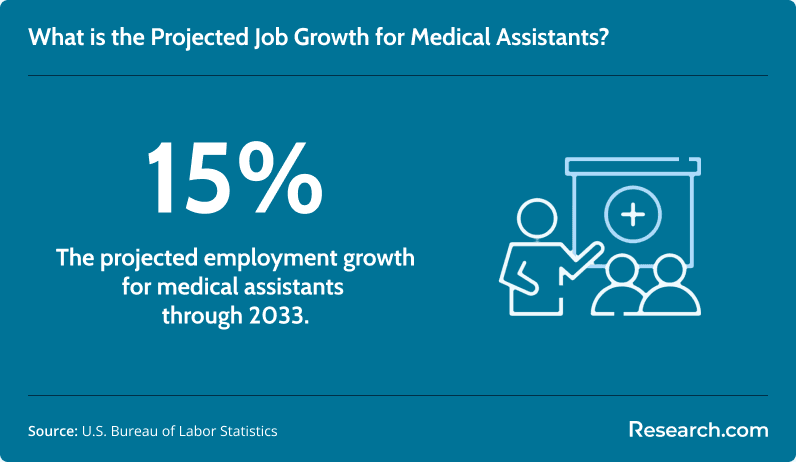
Employment of medical assistants is projected to grow 15% from 2023 to 2033, which is one reason many schools keep entry pathways straightforward for new healthcare students.
- High school diploma or GED: This is the standard baseline requirement for admission.
- Official transcripts: Schools may require proof of graduation or prior college coursework.
- Age requirement: Some programs require students to be at least 18 years old before beginning clinical externship.
- Background check: Clinical sites commonly require background screening before patient contact.
- Drug screening: A drug test may be required before placement in a medical office or clinic.
- Immunization records: Students may need proof of vaccinations such as Hepatitis B and MMR for externship eligibility.
- Placement testing: Some schools may evaluate reading, writing, or math readiness before course placement.
Documents to prepare before applying
| Document or requirement | When you may need it | Why it matters |
| High school transcript or GED record | During admissions | Confirms basic academic eligibility |
| College transcripts | Before transfer credit review | May reduce the number of courses you need to complete |
| Immunization records | Before externship | Required by many healthcare sites for patient safety |
| Background check and drug screening | Before clinical placement | Often required by externship partners |
| Government-issued ID | Admissions, testing, or externship onboarding | Used to verify identity for school and clinical requirements |
What courses are typically in the fastest online medical assistant associate degree program?
Accelerated online medical assistant associate degrees usually combine three types of coursework: general education, administrative healthcare training, and clinical skill preparation. The exact course names differ by school, but most medical assistant programs cover similar topics so students can support both office operations and patient care.
- Medical terminology: Builds fluency in healthcare vocabulary used in charts, conversations, and documentation.
- Anatomy and physiology: Introduces body systems, structures, and functions.
- Pharmacology: Covers medication basics, dosage awareness, and safety concepts.
- Clinical procedures: Trains students in vitals, exam-room support, specimen handling, and basic testing.
- Medical office administration: Covers scheduling, patient records, billing workflows, and electronic health records.
- Medical law and ethics: Explains patient privacy, professional boundaries, legal responsibilities, and ethical decision-making.
- Pathophysiology: Introduces common diseases, conditions, and body-system disruptions.
- Computer applications in healthcare: Develops practical skills with digital records and communication tools.
- Healthcare communication: Focuses on professional communication with patients, providers, and office staff.
- Insurance and billing procedures: Explains claims, reimbursement processes, and payer documentation.
- Externship or practicum: Provides supervised experience in a real healthcare setting.
The chart below shows where medical assistants are commonly employed. Medical assistants held about 783,900 jobs in 2023. Physician offices made up the largest share, accounting for 56% of total employment. This matters when choosing a program because physician offices, clinics, and outpatient sites often expect graduates to be comfortable with both administrative systems and direct patient interaction.
Students who want a related but different clinical support path may also compare medical assisting with the shortest online certificate programs in dental assisting, especially if they are interested in dental office environments.
What types of specializations are available in the fastest online medical assistant associate degree programs?
Most fast medical assistant associate degree programs train students as generalists. That is intentional: medical assistants are often expected to move between front-office tasks and patient-care support. Specializations are usually limited, but some programs offer focused coursework, electives, or concentrations that align with specific healthcare settings.
If your main goal is certification, review how each program supports exam eligibility and preparation. You can also use Research.com's guide on how to become a certified medical assistant to understand credential pathways before selecting a specialization.
| Focus area | What it emphasizes | Best fit for students who want to |
| Administrative medical assisting | Scheduling, billing, insurance processing, patient records, and electronic health records | Work primarily in front-office or medical office support roles |
| Clinical medical assisting | Vitals, specimen collection, injections, exam assistance, and patient preparation | Spend more time in direct patient-care support |
| Phlebotomy | Blood collection, specimen handling, and lab safety basics | Develop a skill that may be useful in clinics, labs, and outpatient settings |
| Medical billing and coding | ICD-10-CM, CPT, claims, reimbursement, documentation, and compliance | Move toward revenue cycle or records-focused healthcare work |
| Pediatric or geriatric assisting | Care considerations for children or older adults | Work in specialty practices serving specific patient populations |
Some students decide that dental care is a better fit than medical office care. In that case, the fastest online dental assistant associate's degree may be worth comparing because it also blends administrative duties with hands-on clinical support.
How do you choose the best among the fastest online medical assistant associate degree programs?
The best fast online medical assistant associate degree is not simply the one with the shortest timeline. A strong program should be accredited, affordable, transparent about externship requirements, aligned with certification goals, and realistic for your schedule.
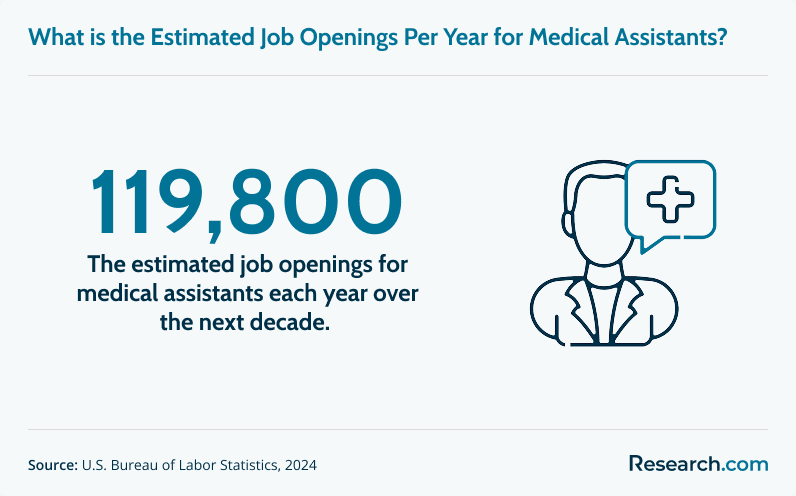
On average, about 119,800 job openings for medical assistants are expected each year over the next decade. Some of those openings are created by workforce growth, while others come from replacement needs as workers retire, change jobs, or continue into related pathways such as medical assistant to LPN programs.
- Verify accreditation first. Look for recognized institutional accreditation and, when relevant, programmatic accreditation through bodies such as the Commission on Accreditation of Allied Health Education Programs or the Accrediting Bureau of Health Education Schools. Accreditation can affect financial aid, transfer credit, employer recognition, and certification eligibility.
- Ask what “accelerated” really means. Some schools use short terms but still take 18–24 months overall. Confirm total credits, course sequence, term length, maximum course load, and whether courses are self-paced.
- Confirm externship placement support. Online does not mean entirely remote. Ask whether the school finds local sites, whether you must secure your own placement, and what happens if there are limited options near you.
- Compare total cost, not just tuition. Include fees, books, supplies, background checks, immunizations, certification exams, and transportation to clinical sites.
- Check certification preparation. Ask which exam the program prepares students for, whether graduates are eligible, and whether exam prep is built into the curriculum.
- Review student outcomes. Ask for graduation rates, certification pass rates, externship completion rates, and job placement information.
- Match the format to your learning style. Self-paced programs require discipline. Cohort-based programs may be slower but often provide more structure.
Questions to ask before enrolling
| Question | Why it matters |
| Is the program eligible for federal financial aid? | This helps confirm whether the school and program meet aid-related requirements. |
| Will this program qualify me for the certification exam I want? | Certification eligibility can vary by credentialing body and program approval. |
| Who arranges the externship? | Students can face delays if they must find their own site without school support. |
| Are labs required in person? | Some online programs still require campus visits or local skills labs. |
| What is the total cost after fees and supplies? | Advertised tuition may not reflect the full out-of-pocket price. |
| Can I transfer credits later? | This matters if you plan to continue into health sciences, nursing, or healthcare administration. |
What career paths are available for graduates of the fastest online medical assistant associate degree programs?
Graduates of fast online medical assistant associate degree programs can pursue entry-level healthcare support roles in physician offices, clinics, outpatient centers, specialty practices, and administrative healthcare settings. The degree is typically designed for immediate employment, but it can also serve as a foundation for additional healthcare education.
Some graduates later move into related clinical fields. For example, students who want to build on patient-care experience may compare this pathway with a fast track online respiratory care therapy associate's degree.
| Career path | Typical responsibilities | Best fit for |
| Medical Assistant | Records patient histories, measures vital signs, assists with exams, schedules appointments, and supports billing tasks | Graduates who want a blended clinical and administrative role |
| Clinical Medical Assistant | Focuses on patient-care support such as room preparation, injections, blood draws, and basic testing | Students who prefer hands-on clinical work |
| Administrative Medical Assistant | Manages front-desk operations, insurance claims, medical records, scheduling, and office workflows | Students who prefer office systems and patient coordination |
| Phlebotomy Technician | Collects blood samples and handles specimens, depending on training and employer requirements | Graduates with phlebotomy coursework or added certification preparation |
| Medical Records Specialist | Maintains patient charts, updates electronic records, and supports privacy compliance | Students interested in documentation, health information, and records accuracy |
| Medical Office Manager | Supervises staff, coordinates office operations, and supports administrative decision-making | Experienced medical assistants who want advancement into leadership |
| Specialty Medical Assistant | Assists providers in settings such as pediatrics, cardiology, dermatology, or orthopedics | Graduates who want to develop expertise in a specific patient population or specialty |
Some students use the associate degree as a stepping stone into healthcare administration, health sciences, or nursing. Credentials such as Certified Medical Assistant or Registered Medical Assistant may also support employability. To understand earnings by location, review Research.com's medical assistant salary guide.
What is the job market like for graduates with the fastest online medical assistant associate degree program?
The employment outlook for medical assistant graduates is favorable, especially for students who complete an accredited program, finish a supervised externship, and earn a recognized certification. Healthcare employers continue to need support staff in outpatient care, physician offices, and specialty practices.
According to the U.S. Bureau of Labor Statistics, employment of medical assistants is projected to grow 14% from 2022 to 2032, much faster than the average for all occupations. A separate discussion of why medical assistants are in high demand points to factors such as outpatient care growth, routine patient needs, and expanding healthcare services.
Graduates from online programs can compete with campus-trained graduates when the program includes credible coursework, clinical experience, and certification preparation. Employers generally focus on whether candidates can perform required tasks, communicate professionally, use electronic health records, and work safely with patients.
The strongest opportunities are commonly found in physician offices, outpatient clinics, and specialty practices. Administrative medical assisting, billing support, and records-related work may also be steady options for graduates who are comfortable with healthcare software and documentation.
Student Perspectives on Fast Online Medical Assistant Associate Degree Programs
- : "The accelerated online format let me keep my full-time job while moving toward healthcare work. I had to stay organized every week, but the flexibility made the degree possible for me. The externship helped connect the online lessons to real patient-care routines. — Jasmine"
- : "Finishing quickly was important, but I learned that speed only works if the program is well structured. Short courses, instructor access, and clear assignments helped me stay on track. My clinical placement gave me the confidence to start working in a pediatric clinic. — Luis"
- : "Online study saved me from relocating, and I could complete coursework around my work schedule. The most valuable part was the real-world practice because it showed me what medical assisting looks like day to day. — Renee"
Is a fast online medical assistant associate degree worth it?
A fast online medical assistant associate degree can be worth it if the program is accredited, affordable for your budget, includes supervised clinical experience, and prepares you for the certification path you want. The main advantage is speed: finishing sooner may help you apply for entry-level healthcare jobs earlier than students in traditional two-year formats.
The investment is less convincing if the program is expensive, does not clearly support certification eligibility, requires externship arrangements you cannot complete, or offers credits that will not transfer if you plan to continue your education. Students who prefer leadership, operations, or nonclinical healthcare work may also compare this pathway with a low cost healthcare administration degree online.
Who should choose this path?
- Students who want a fast route into entry-level healthcare support work.
- Working adults who need online lectures but can complete local clinical requirements.
- Learners who want both administrative and basic clinical training.
- Students who may later pursue healthcare administration, nursing, health sciences, or other allied health pathways.
Who should consider another option?
- Students who want a fully remote career with no patient-care responsibilities.
- Learners who cannot complete an in-person externship, lab, background check, or immunization requirement.
- Students whose main goal is nursing, where a direct nursing pathway may be more efficient.
- Students who need the cheapest possible short-term training and do not need an associate degree.
How do accreditation and quality assurance affect online medical assistant programs?
Accreditation is one of the most important safeguards when choosing an online medical assistant associate degree. It helps verify that the school meets academic and operational standards, that instructors are qualified, and that the curriculum and clinical requirements are designed to prepare students for healthcare work.
Accreditation may also affect financial aid eligibility, employer confidence, transfer credit, and certification exam options. Students should distinguish between institutional accreditation, which applies to the college or university, and programmatic accreditation, which may apply specifically to medical assisting or allied health programs.
If you are also comparing administrative healthcare programs, reviewing accredited medical billing and coding schools online with financial aid can help you understand how accreditation and aid eligibility affect related healthcare education choices.
Common mistakes to avoid when choosing a fast online medical assistant associate degree
| Mistake | Why it can hurt you | Better approach |
| Choosing only by speed | The shortest program may not offer the best certification preparation, externship support, or transfer options. | Balance completion time with accreditation, cost, clinical training, and outcomes. |
| Ignoring accreditation | Accreditation can affect financial aid, employer recognition, and credential eligibility. | Verify accreditation through the school and recognized accrediting agencies before applying. |
| Assuming online means no in-person requirements | Medical assisting requires hands-on skills, and externships are usually in person. | Ask exactly where and when labs, practicums, or externships must be completed. |
| Comparing only tuition | Fees, books, supplies, screenings, immunizations, and exam costs can raise the total price. | Request a full cost breakdown in writing. |
| Overlooking certification alignment | Not every program prepares students for the same credential or eligibility route. | Choose a program that clearly supports your target exam, such as CMA or RMA. |
| Relying only on rankings | A highly ranked program may not fit your location, schedule, budget, or career goal. | Use rankings as a shortlist, then confirm fit with admissions and program advisors. |
Key Insights
- The fastest online medical assistant associate degree options can take about 40 weeks to 12 months, but 12 to 18 months is a more realistic planning range for many students.
- Speed should not outweigh accreditation, externship quality, certification preparation, and total cost.
- Online medical assistant programs are not entirely remote if they include clinical training. Expect labs, practicums, or externships that require hands-on participation.
- Costs vary widely. Some online associate degree options may cost around $6,000 to $7,000, while other programs list much higher total costs.
- The median annual wage for medical assistants was $44,200 in May 2024, so comparing tuition against expected earnings is essential before enrolling.
- Medical assistants held about 783,900 jobs in 2023, and physician offices accounted for 56% of total employment, making outpatient and office-based care especially relevant for graduates.
- About 119,800 job openings for medical assistants are expected each year over the next decade, but job outcomes still depend on location, certification, experience, and employer needs.
- The best program is the one that lets you finish quickly while still meeting your certification, clinical training, financial aid, and long-term education goals.
References:
- American Association of Medical Assistants. (n.d.). 2024 Compensation and benefits report.
- American Association of Medical Assistants. (n.d.). Compensation and benefits.
- American Association of Medical Assistants. (n.d.). Medical assisting educator compensation and benefits report.
- U.S. Bureau of Labor Statistics. (2024). Medical assistants. Occupational Outlook Handbook.
- U.S. Bureau of Labor Statistics. (2024). Occupational employment and wages, May 2023: Medical assistants.
Other Things You Should Know About the Fastest Online Medical Assistant Associate Degree Programs
Most fast online medical assistant associate degree programs require a supervised externship of 160 to 240 hours in a clinic, physician’s office, or similar healthcare setting. Students usually must complete background checks, immunization records, CPR certification, and a drug screen before placement.
To enroll in the fastest online Medical Assistant Associate Degree programs in 2027, students typically need a high school diploma or GED, transcripts, a completed application form, and sometimes prerequisite coursework. Some programs may also require interviews or entrance exams for admission.
The fastest online Medical Assistant Associate Degree programs in 2027 are typically accredited by organizations like the Commission on Accreditation of Allied Health Education Programs (CAAHEP) or the Accrediting Bureau of Health Education Schools (ABHES). Accreditation ensures that programs meet industry standards essential for certification and employment.