2027 Fastest Online Certificate Programs for Dental Assistants

Co-Founder and Chief Data Scientist
Not everyone has time for a four-year degree. If you want to switch careers or start working in healthcare fast, becoming a dental assistant might be the right move. Many online certificate programs take less than a year, some as little as 4 to 6 months. With dental assistant jobs growing at a steady 8%, choosing an online certificate program is a smart and timely move.
To help students find the fastest and most affordable online dental assistant programs, I reviewed data from several schools. I also used my experience in academic advising and career planning. Based on this, I created a list of top programs. Each one includes key details like program length, cost, and what certifications you can prepare for.
What are the benefits of taking an online certificate program for dental assistants?
- An online dental assistant certificate qualifies graduates for entry-level roles such as chairside assistant, sterilization technician, or dental office administrative assistant.
- With this certificate, dental assistants can earn a median annual salary of $47,300, with higher earning potential as they gain experience or earn additional certifications.
- Online programs allow students to complete their training in as little as 4 to 9 months, often through self-paced coursework, without the need to relocate or leave their current job.
What can I expect from an online certificate program for dental assistants?
Online certificate programs for dental assistants are designed to be fast, focused, and practical. Most are built to prepare students for entry-level clinical and administrative work in dental offices. These programs typically require no prior healthcare experience and are ideal for those looking to start working in under a year.
Students can expect a core curriculum that covers topics like dental anatomy, infection control, radiography, chairside assisting, and patient communication. Many programs also include preparation for certification exams, such as the DANB-RHS (Radiation Health and Safety). A required externship is often part of the program, giving students real-world experience in a local dental office.
Program lengths vary, but most online dental assistant certificates can be completed in 4 to 9 months. Tuition depends on the provider, ranging from around $1,200 to $5,000 total. Some schools offer payment plans or include exam fees and materials in the cost.
Where can I work with an online certificate program for dental assistants?
Graduates of online dental assistant certificate programs can work in a variety of healthcare settings. Most commonly, they are employed in private dental offices, where they assist with procedures, prepare exam rooms, manage instruments, and support patient care.
In addition to general dentistry practices, some find roles in specialty clinics such as orthodontics, pediatric dentistry, oral surgery, or endodontics. These roles often involve specific procedures and workflows, giving dental assistants the chance to develop niche skills over time.
While most choose private practice, some dental assistants enter teaching or research roles at universities or dental schools. In these settings, they help with clinical instruction and support faculty-led projects.
Others find opportunities in larger group practices and dental service organizations (DSOs), where positions such as sterilization coordinator, records manager, or radiology assistant are common. These roles often come with defined career paths and professional development support.
How much can I make with a certificate program for dental assistants?
Online certificate holders in dental assisting can expect a reliable start, with a median annual salary of around $47,300. Graduates from an online certificate program can begin with a competitive entry salary, with clear opportunities for growth as they gain experience and certification.
Entry-level positions typically fall around $35,000 per year. More experienced assistants, especially those with additional certifications like DANB or RDA, often earn closer to $56,000 or more annually.
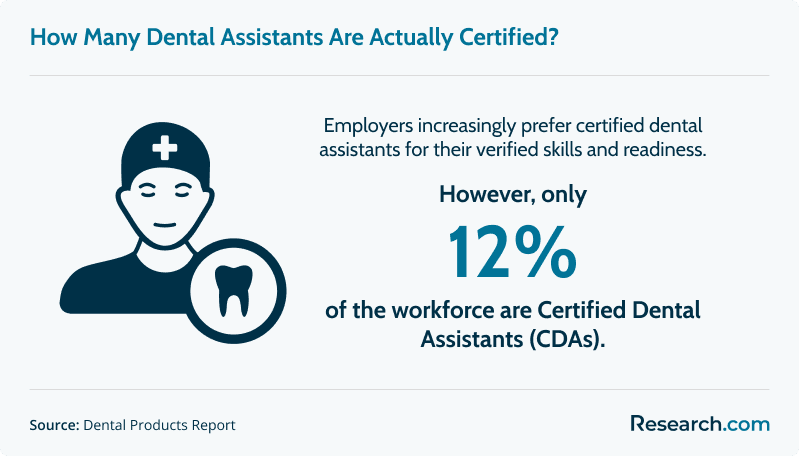
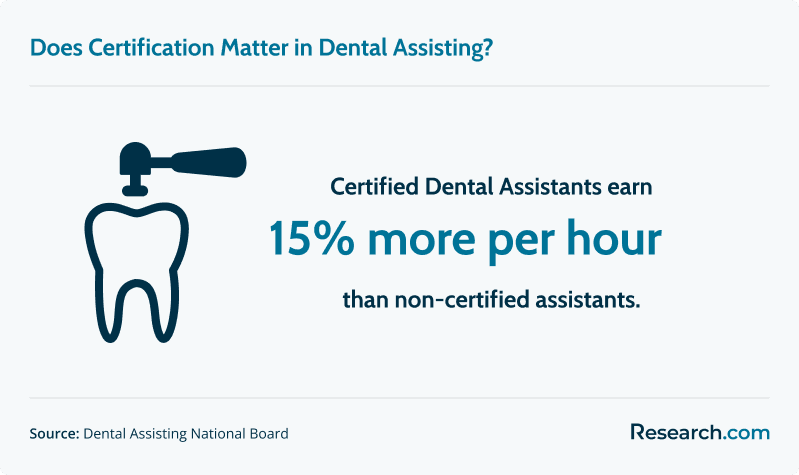
Pay depends heavily on experience, location, and credentials. For example, certified dental assistants (CDAs) often earn $5 to $7 more per hour than non‑certified colleagues. In top-paying states like Minnesota, Massachusetts, or California, average salaries range from $52,000 to $63,000 annually.
- Fastest Online Certificate Programs for Dental Assistants for 2027 Best Programs
- How long does it take to complete an online certificate program for dental assistants? Completion Time
- How does an online certificate program for dental assistants compare to an on-campus program? How does an online certificate program for dental assistants compare to an on-campus program?
- What is the average cost of an online certificate program for dental assistants? Average Cost
- What are the financial aid options for students enrolling in an online certificate program for dental assistants? Financial Aid
- What are the prerequisites for enrolling in an online certificate program for dental assistants? Requirements
- What courses are typically in an online certificate program for dental assistants? What courses are typically in an online certificate program for dental assistants?
- What types of specializations are available in an online certificate program for dental assistants? What types of specializations are available in an online certificate program for dental assistants?
- How do you choose an online certificate program for dental assistants? How do you choose an online certificate program for dental assistants?
- What career paths are available for graduates of an online certificate program for dental assistants? Potential Careers
- What is the job market like for graduates of an online certificate program for dental assistants? Job Market
- What advanced educational opportunities can enhance my dental assistant career? What advanced educational opportunities can enhance my dental assistant career?
- What are the potential challenges of online dental assistant certificate programs? What are the potential challenges of online dental assistant certificate programs?
- How can I assess the return on investment of an online dental assistant certificate program? How can I assess the return on investment of an online dental assistant certificate program?
Fastest Online Certificate Programs for Dental Assistants for 2027
Choosing a fast online dental assistant certificate is not just about finding the shortest program. You also need to know whether the credential is recognized, whether it includes hands-on clinical training, whether it prepares you for certification exams, and whether it fits your state’s dental assisting rules. This guide is designed for students who want to enter the dental field quickly, working adults who need a flexible schedule, and current dental office employees who want a formal credential without committing to a longer degree.
Below, you will find a practical comparison of fast online and hybrid dental assistant certificate programs, followed by guidance on cost, completion time, accreditation, externships, financial aid, career options, and common mistakes to avoid before enrolling.
Quick answer: What is the fastest path to becoming a dental assistant online?
The fastest online dental assistant certificate programs can often be completed in several months, but most legitimate programs still require hands-on practice through labs, externships, or supervised clinical hours. A fully online course may be convenient for learning terminology, infection control, dental software, and administrative procedures, but clinical dental assisting requires in-person skill development. For students who want the strongest employment and certification pathway, a CODA-accredited or state-recognized program with externship support is usually the safer choice.
How we evaluated these dental assistant certificate programs
Our ranking emphasizes speed, affordability, accreditation or institutional recognition, clinical training access, career support, and practical value for students preparing for entry-level dental assisting roles. We prioritize programs that clearly explain costs, credits or instructional structure, hands-on requirements, and the type of student each option serves best.
Key data sources used in our research include:
- Integrated Postsecondary Education Data System, available through IPEDS-related institutional data resources
- Peterson's database, including distance learning program information
- College Scorecard from the U.S. Department of Education
- National Center for Education Statistics, or NCES
For more detail on how Research.com evaluates schools and programs, visit our ranking methodology.
Fast comparison of featured online dental assistant certificate programs
| Rank | School and Program | Cost | Required Credits or Format | Accreditation or Recognition Listed | Best Fit |
| 1 | Eastern Iowa Community College – Dental Assisting Certificate | $9,700 | 46 | CODA, HLC | Students who want online coursework plus clinical training through established local partnerships |
| 2 | Hudson Valley Community College – Dental Assistant Certificate | $8,300 | 27 | CODA, Middle States Commission | Students seeking a one-year pathway with a 225-hour clinical internship |
| 3 | Indiana University – Purdue University Indianapolis – Dental Assisting Certificate | $9,400 | 30 | CODA, HLC | Students who value university-based dental school training and employer connections |
| 4 | Lake Area Technical College – Dental Assistant Certificate | $11,600 (+lab fees) | 44 | North Central Accreditation | Students who want a mostly online format with scheduled in-person lab days |
| 5 | Monroe Community College – Rapid‑Track Dental Assistant Certificate | $5,900 | 24 | Middle States Commission, NY State Education Department | Current dental employees with a dentist sponsor |
| 6 | Ozarks Technical Community College – Dental Assisting Certificate | $6,450 | 32 | CODA, HLC | Students in southwest Missouri who want CODA-accredited online dental assisting training |
| 7 | Sinclair Community College – Dental Assisting Certificate (Hybrid) | $3,800 | 17 | HLC, Ohio Board of Regents | Students who can attend weekly labs while completing didactic work online |
| 8 | Oregon State University via Pearson – Clinical Dental Assistant Certificate | $2,995 | Non-credit modules | Pearson partnership | Students who need a self-paced, non-credit option for exam preparation |
| 9 | University of Georgia – Administrative Dental Assistant Certificate | $1,995 | 15 CEU equivalent | University system accreditation | Students targeting front-office dental administration rather than chairside clinical work |
| 10 | Rutgers University–New Brunswick – Dental Assistant Certificate | $2,500 | Non-credit, modular | Rutgers continuing studies | Students who want dental office software and administrative training |
1. Eastern Iowa Community College – Dental Assisting Certificate
Eastern Iowa Community College offers a Dental Assisting Certificate that blends online academic instruction with required clinical experience at the Davenport VA Dental Clinic. This structure is especially useful for students who want flexibility but do not want to sacrifice supervised patient-care exposure. The program also benefits from local dental and VA partnerships, which can help students build professional contacts before graduation.
- Cost: $9,700
- Required Credits: 46
- Accreditation: CODA, HLC
- What makes it stand out: Strong clinical partnerships and employer connections that may support early hiring opportunities
2. Hudson Valley Community College – Dental Assistant Certificate
The Dental Assistant Certificate at Hudson Valley Community College is an intensive one-year option that includes a 225-hour clinical internship. The program is structured to help students meet New York State licensure requirements while gaining direct experience in dental care environments. About 95% of graduates secure jobs or transfer to bachelor’s programs quickly.
- Cost: $8,300
- Required Credits: 27
- Accreditation: CODA, Middle States Commission
- What makes it stand out: Strong placement outcomes and transfer pathways for students who want additional education later
3. Indiana University – Purdue University Indianapolis – Dental Assisting Certificate
The Dental Assisting Certificate at IUPUI is offered through the School of Dentistry, giving students access to a university-based dental education environment. The school provides a dedicated dental job board for School of Dentistry students, which can help connect graduates with local and national dental employers. The program reports an 85% job placement rate within months of completion.
- Cost: $9,400
- Required Credits: 30
- Accreditation: CODA, HLC
- What makes it stand out: A dental-school setting with professional networking and employer access
4. Lake Area Technical College – Dental Assistant Certificate
Lake Area Technical College offers a Dental Assistant Certificate in a primarily online format with only 12 in-person lab days per semester. This makes it a strong option for students who need distance learning but can travel for scheduled hands-on training. The college reports a 99% job placement rate, and students who want to continue their education may apply credits toward an associate degree with limited additional coursework.
- Cost: $11,600 (+lab fees)
- Required Credits: 44
- Accreditation: North Central Accreditation
- What makes it stand out: High reported placement and a clear continuation route to an AAS degree
5. Monroe Community College – Rapid‑Track Dental Assistant Certificate
Monroe Community College offers a Rapid-Track Dental Assistant Certificate built for people already working under a dentist sponsor. The program includes 500 hours of clinical experience and is designed to help current dental assistants move toward certification efficiently while continuing to gain supervised workplace experience.
- Cost: $5,900
- Required Credits: 24
- Accreditation: Middle States Commission, NY State Education Department
- What makes it stand out: A focused option for working dental assistants who already have a sponsoring dentist
6. Ozarks Technical Community College – Dental Assisting Certificate
Ozarks Technical Community College offers the only CODA-accredited online dental assistant certificate in southwest Missouri. Students receive online learning support, faculty guidance, tutoring access, and job placement assistance. Graduates earn a certificate and college credits that can be applied toward an associate degree.
- Cost: $6,450
- Required Credits: 32
- Accreditation: CODA, HLC
- What makes it stand out: CODA accreditation, hybrid flexibility, and stackable credits for future education
7. Sinclair Community College – Dental Assisting Certificate (Hybrid)
Sinclair Community College offers a 17-credit hybrid Dental Assisting Certificate that can be completed over about 32 weeks. Students complete academic coursework online and attend one to two lab days each week for practice in radiography, sterilization, chairside procedures, and related clinical skills. The program also includes CDA preparation and career support.
- Cost: $3,800
- Required Credits: 17
- Accreditation: HLC, Ohio Board of Regents
- What makes it stand out: Affordable tuition, frequent hands-on labs, and built-in certification exam preparation
8. Oregon State University via Pearson – Clinical Dental Assistant Certificate
The Oregon State University Clinical Dental Assistant Certificate, offered through Pearson, is a self-paced, non-credit option for students who want maximum scheduling flexibility. The curriculum is designed to support preparation for the Radiation Health and Safety (RHS) and Infection Control (ICE) components of the DANB exam. Students may also pursue a 40- to 100-hour externship through local dental clinics.
- Cost: $2,995
- Required Credits: Non-credit modules
- Accreditation: Pearson partnership
- What makes it stand out: Flexible pacing and a clear focus on exam readiness
9. University of Georgia – Administrative Dental Assistant Certificate
The University of Georgia offers a fully online Administrative Dental Assistant Certificate for students who want to work in dental practice operations rather than clinical chairside assisting. The 150-hour curriculum covers appointment management, dental insurance, billing, patient records, office workflow, and HIPAA compliance.
- Cost: $1,995
- Required Credits: 15 CEU equivalent
- Accreditation: University system accreditation
- What makes it stand out: Low cost and a targeted front-office dental administration focus
10. Rutgers University–New Brunswick – Dental Assistant Certificate
The Dental Assistant Certificate from Rutgers University–New Brunswick focuses on practical clinical and administrative tools used in dental offices. Students receive exposure to DENTRIX®, a common dental practice management platform, along with training in appointment scheduling, charting, and digital patient records.
- Cost: $2,500
- Required Credits: Non-credit, modular
- Accreditation: Rutgers continuing studies
- What makes it stand out: Practical dental software training for modern dental office workflows
How long does it take to complete an online certificate program for dental assistants?
Most online dental assistant certificate programs take between four and nine months to complete. Program length depends on course pacing, whether the program is credit-bearing or non-credit, the number of required clinical hours, and how quickly students can schedule externship placements. Many programs include 800 to 1,000 hours of instruction and practice when classroom learning and hands-on preparation are combined.
Students should be cautious when a program advertises speed without explaining clinical expectations. Dental assisting is a hands-on healthcare role, so even online programs often require in-person labs, externship hours, or supervised practice in a dental office. Students who can study full time and complete externship requirements quickly may finish faster, while those balancing work, family, or transportation limitations may need more time.
If you want a broader healthcare pathway after dental assisting, a fast track public health degree online may be a later option for expanding into prevention, community health, or healthcare education roles.
| Program Format | Typical Pace | Best For | Main Trade-Off |
| Self-paced online certificate | Often fastest for academic coursework | Students with strong discipline and predictable schedules | May require students to arrange or verify clinical experience separately |
| Hybrid certificate | Structured around online courses and scheduled labs | Students who need flexibility but also want supervised skill practice | Requires travel to campus or lab sites |
| Credit-bearing community college certificate | Often follows semester schedules | Students seeking financial aid eligibility, transfer credits, or recognized pathways | May take longer than non-credit training |
| Employer-sponsored rapid track | Can move quickly if clinical hours are already available | Current dental office employees | Usually requires a dentist sponsor or existing job placement |
How does an online certificate program for dental assistants compare to an on-campus program?
Online dental assistant programs usually deliver classroom topics through recorded lectures, readings, quizzes, discussion boards, virtual demonstrations, and digital simulations. This format can work well for subjects such as dental terminology, infection control theory, patient records, billing, and dental office procedures. Many students compare options through accredited self-paced online colleges when flexibility is a top priority.
The limitation is that dental assisting requires physical technique. Chairside assisting, instrument transfer, suctioning, dental impressions, radiography positioning, and sterilization routines are easier to master when an instructor can observe and correct your movements in real time. For this reason, the strongest online programs include labs, externships, or documented clinical practice.
On-campus programs usually provide more immediate hands-on repetition. Students practice in lab settings, receive direct feedback, work alongside peers, and build confidence before entering clinical placements. This can be especially helpful for students who are new to healthcare or who learn best through demonstration and correction.
Hybrid programs are often the best middle ground. They keep lectures and written assignments online while requiring scheduled in-person labs for clinical skills. This structure can reduce commuting while still giving students meaningful practice before they work with patients.
| Factor | Online Program | On-Campus Program | Hybrid Program |
| Schedule flexibility | Highest | Lowest | Moderate to high |
| Hands-on practice | Depends on externship or lab design | Usually built into the weekly schedule | Built into scheduled lab sessions |
| Instructor feedback | May be delayed or virtual | Immediate in lab settings | Immediate during required labs |
| Best for | Independent learners and working adults | Students who need structure and direct supervision | Students who want flexibility without losing clinical practice |
| Risk to check | Weak or unclear clinical placement support | Less flexibility for work schedules | Travel requirements for labs |
What is the average cost of an online certificate program for dental assistants?
Many online dental assistant certificate programs cost between $1,200 and $5,000. That amount may cover tuition, online learning access, and basic instructional materials, but students should read the fee schedule carefully before enrolling.
Common additional expenses include around $500–$1,000 for books and supplies, $100–$500 for uniforms or lab kits, and certification exam fees ranging from $125 to $450. Some schools include externship coordination, career services, or exam preparation in tuition, while others charge separately.
Online programs from accredited online schools are often presented as lower-cost alternatives to campus-based training. On-campus certificate programs can reach $5,000-$15,000 in tuition alone. However, price should not be the only deciding factor. A cheaper program may cost more in the long run if it does not meet state requirements, lacks clinical training, or does not prepare you for certification exams.
| Cost Category | What to Ask Before Enrolling |
| Tuition | Is the listed price total program tuition or only the cost per term? |
| Books and supplies | Are textbooks, dental instruments, PPE, or lab kits included? |
| Uniforms and health requirements | Will you need scrubs, immunizations, background checks, or drug screening for externship placement? |
| Certification exam fees | Does tuition include exam vouchers, or will you pay separately? |
| Externship costs | Does the school help arrange a site, or are you responsible for finding one? |
| Travel costs | Are there required lab days, clinical sessions, or campus visits? |
What are the financial aid options for students enrolling in an online certificate program for dental assistants?
Financial aid depends heavily on whether the program is accredited, credit-bearing, and eligible for federal aid. Students should start by completing the Free Application for Federal Student Aid when considering an eligible institution. For 2023-2024, Pell Grants could provide up to $7,395 for qualifying students. Some schools also participate in the Federal Supplemental Educational Opportunity Grant (FSEOG), which may offer $100-$4,000 to students with significant financial need.
Other options may include institutional scholarships, tuition discounts, state grants, payment plans, and workforce training funds. The Pacific Dental Services Foundation, for example, offers scholarships of up to $5,000 to dental assistant students. State programs such as Cal Grant in California may also help reduce out-of-pocket costs for eligible students.
Students comparing allied health pathways may see similar aid structures in programs such as the fastest online respiratory care therapy associate's degree programs, although eligibility rules vary by school, credential type, and enrollment status.
| Aid Type | Best For | Important Limitation |
| Federal grants | Students in eligible accredited, credit-bearing programs | Not all non-credit certificate programs qualify |
| School scholarships | Students with financial need, strong applications, or specific career goals | Funding may be limited or competitive |
| Payment plans | Students who can pay over time without borrowing heavily | May include fees or strict payment deadlines |
| Employer sponsorship | Current dental office employees | May require continued employment or a sponsoring dentist |
| State workforce funds | Career changers and unemployed or underemployed adults | Availability depends on location and program approval |
What are the prerequisites for enrolling in an online certificate program for dental assistants?
Admission requirements for online dental assistant certificate programs are usually accessible, but students should expect both academic and clinical readiness standards. Most programs are designed for entry-level learners, yet externships and patient-care preparation may require documentation before students can begin clinical work.
Students who want a broader credential may compare certificates with an accelerated online dental assistant associate’s degree, which may include similar entry requirements but can provide more general education and advancement flexibility.
Common prerequisites include:
- High school diploma or GED: Most programs require proof of secondary education before enrollment.
- Minimum age of 18: Many schools require students to be at least 18, especially for externships or clinical assignments.
- Basic computer ability: Students should be comfortable using email, learning platforms, video lectures, online testing tools, and digital assignment submission.
- CPR or Basic Life Support (BLS) certification: Some programs require this before clinical placement rather than at admission.
- Externship readiness: Students may need transportation, immunization records, background checks, or availability for in-person clinical hours.
What courses are typically in an online certificate program for dental assistants?
Dental assistant certificate programs are built around the practical tasks performed in a dental office. The best programs combine science, safety, chairside support, patient communication, radiography, and administrative training. Even when coursework is online, the curriculum should connect directly to workplace duties.
| Course Area | What Students Learn | Why It Matters |
| Dental Anatomy & Terminology | Tooth structure, oral tissues, dental surfaces, and professional language | Helps assistants understand procedures and communicate accurately |
| Infection Control and Sterilization | PPE, disinfection, sterilization cycles, exposure prevention, and safe disposal | Protects patients, staff, and the dental practice |
| Radiography | Radiation safety, patient positioning, image capture, and basic image evaluation | Prepares students for x-ray-related responsibilities where allowed |
| Chairside Assisting | Instrument transfer, four-handed dentistry, suctioning, isolation, and patient preparation | Builds the core skill set for clinical dental assisting |
| Dental Materials | Composites, amalgam, sealants, impression materials, and restorative supplies | Helps assistants prepare materials and support procedures efficiently |
| Administrative Procedures | Scheduling, billing, insurance, patient records, coding basics, and dental software | Supports front-office duties and improves employability in smaller practices |
Some programs also include pediatric dentistry, orthodontics, oral surgery assisting, ethics, dental law, and externship seminars. Radiography and chairside assisting are often among the more difficult areas because they require precision, physical coordination, and real-time judgment. The national pass rate for the Radiation Health and Safety (RHS) exam is about 61%, which shows why students should not underestimate x-ray preparation.
Students in an affordable dental assistant associate degree online may receive more time to practice these subjects, but even certificate students can succeed if the program includes strong lab support, feedback, and externship preparation.
What types of specializations are available in an online certificate program for dental assistants?
Specializations can help students align their training with the type of dental setting they want to enter. In certificate programs, these are often offered as electives, modules, or additional career-preparation topics rather than full majors. Some specializations may require extra credentials depending on state rules and employer expectations.
- Pediatric Dentistry: Focuses on assisting with children and adolescents, behavior support, fluoride-related care, and age-appropriate patient communication.
- Orthodontics: Covers braces, aligners, retainers, impressions, and support during orthodontic adjustments.
- Oral Surgery and Periodontics: Prepares students to assist with surgical setup, sterilization, extractions, gum procedures, and post-operative instructions.
- Endodontics: Introduces root canal support, rubber dam placement, endodontic instruments, and internal tooth procedures.
- Prosthodontics: Focuses on restorative devices such as crowns, bridges, dentures, and related dental materials.
- Radiology: Provides deeper preparation in digital imaging, intraoral x-rays, panoramic x-rays, and radiation safety.
- Dental Office Administration: Emphasizes billing, scheduling, insurance processing, dental software, and patient records.
According to Franklin University’s career data, pediatric dental assisting represented about 2.1% of all dental assistant job postings in the U.S. in 2023. That makes it a niche rather than a broad segment of the field, but it may be a good fit for students who specifically want to work with children in pediatric clinics, community health centers, or multi-specialty practices.
How do you choose an online certificate program for dental assistants?
The best online dental assistant certificate is the one that meets your state’s requirements, fits your schedule, includes meaningful clinical practice, and prepares you for the kind of dental assisting role you want. Students often start by comparing cost and speed, but accreditation, externship quality, and certification alignment are more important for long-term value.
When comparing options, look closely at accreditation. There are only 214 CODA‑accredited programs in the U.S., and graduating from a CODA-accredited program may support direct eligibility for national certification or state licensure, depending on your jurisdiction. Students balancing school with employment may also compare programs listed among the best online colleges for working adults, but dental-specific requirements should come first.
You should also confirm whether the curriculum prepares students for recognized exams, such as the Dental Assisting National Board's National Entry Level Dental Assistant exam, and whether the school has local clinic partnerships for externships. A program that leaves students to find their own clinical placement may work for someone already employed in a dental office, but it can be risky for beginners.
Some healthcare professionals eventually explore other advanced clinical fields, including the shortest online graduate certificate program in nurse midwifery, but that is a separate career direction and not a substitute for dental assisting credentials.
| Question to Ask | Why It Matters |
| Is the program CODA-accredited or otherwise recognized for my state? | State rules and certification eligibility can affect whether your credential is useful. |
| Does the program include in-person labs or externship hours? | Clinical dental assisting cannot be learned through theory alone. |
| Who arranges the externship? | School-arranged placements reduce uncertainty for students without dental office contacts. |
| Does tuition include books, exam prep, supplies, and lab fees? | The lowest advertised tuition may not reflect the real total cost. |
| What exams does the program prepare students for? | Exam alignment can affect certification readiness and employer confidence. |
| What job placement support is available? | Resume help, employer connections, and clinic partnerships can make the transition easier. |
What career paths are available for graduates of an online certificate program for dental assistants?
A dental assistant certificate most commonly leads to entry-level chairside assisting, but it can also support administrative, specialized, and advancement-oriented roles. State regulations determine which expanded duties dental assistants may perform, so graduates should verify local rules before assuming a certificate qualifies them for radiography, sealants, or restorative functions.
- Chairside Dental Assistant: Supports dentists during exams and procedures, prepares treatment rooms, sterilizes instruments, assists patients, and helps maintain efficient clinical workflow.
- Expanded Function Dental Assistant (EFDA) or Radiology Assistant: In states that allow expanded functions, assistants may pursue additional credentials to take x-rays, apply sealants, place fillings, or perform other approved duties.
- Dental Office Manager: Experienced assistants with administrative strengths may move into scheduling, billing, insurance coordination, staff support, and practice operations.
- Dental Product Sales: Assistants who understand dental materials and equipment may transition into sales or product education roles with manufacturers or suppliers.
- Dental Lab Technician: Some graduates move toward lab-based work involving crowns, bridges, dentures, impressions, and CAD/CAM-related technologies. Students interested in adjacent clinical support roles may also compare a low-cost sterile processing technician certification online.
Expanded Function Dental Assistants often have higher earning potential because they can perform more advanced duties where state law permits. EFDAs can earn up to $5-7 more per hour than general dental assistants, but these roles usually require additional training and authorization beyond a basic certificate.
| Career Path | Typical Focus | Additional Preparation May Be Needed? |
| General chairside assistant | Clinical support during routine dental care | Sometimes, depending on state rules |
| Radiology-focused assistant | X-ray preparation and imaging support | Yes, in many states |
| Expanded Function Dental Assistant | Advanced clinical duties permitted by state law | Yes |
| Dental administrative assistant | Scheduling, billing, records, and insurance | Software or billing training may help |
| Office manager | Practice operations and staff coordination | Experience and management training may help |
What is the job market like for graduates of an online certificate program for dental assistants?
The dental assistant labor market is favorable for qualified entry-level candidates. The U.S. Bureau of Labor Statistics projects 8% projected growth from 2023 to 2033, with around 54,900 job openings expected yearly. Most opportunities are in private dental practices, although community clinics, specialty offices, and larger healthcare organizations also hire dental assistants.
Graduates with externship experience, radiography preparation, strong infection control knowledge, and dental software skills may be more competitive. Demand can be especially important in suburban and rural areas where staffing shortages may affect patient scheduling and clinic capacity.
Some students use dental assisting as a first healthcare credential and later add administrative or coding skills. If you are considering a shift into healthcare office work, 4-week medical certificate programs online can provide a comparison point, though dental assisting and medical billing lead to different day-to-day work.
Do employers value online dental assistant certificates?
Employers may value an online dental assistant certificate when it comes from a reputable institution, includes clinical practice, and aligns with state requirements or certification standards. What employers usually care about most is not whether lectures were online, but whether the graduate can safely support patient care, follow infection control rules, communicate well, and perform required tasks with confidence.
A certificate with no externship, no lab component, and unclear recognition may be less competitive. On the other hand, a hybrid or online program with supervised clinical training, exam preparation, and employer partnerships can be a credible route into the field. Candidates can also strengthen their profile with complementary administrative skills, such as training from low cost online schools for medical billing and coding courses, especially if they want front-office or billing responsibilities in a dental practice.
What graduates say about online dental assistant certificate programs
- Janelle: "Studying online made it possible for me to keep my part-time job while completing the coursework. Radiography was the hardest unit for me, but being able to replay demonstrations helped me prepare before starting my externship."
- Will: "I was unsure whether an online program could prepare me for a hands-on role. The weekly feedback and virtual practice activities helped, and my clinical hours gave me the confidence to assist during procedures and follow sterilization steps correctly."
- Brea: "The online structure worked well because I had been away from school for years. The lessons on patient charting and dental software were especially useful, and those skills helped me qualify for an administrative support job within two months of finishing."
What advanced educational opportunities can enhance a dental assistant career?
A certificate can be enough for many entry-level dental assisting jobs, but additional education may help with advancement. Dental assistants who want more responsibility may pursue expanded-function credentials, radiography authorization, an associate degree, dental office management training, or healthcare administration coursework.
Students who enjoy the operational side of dental care may eventually consider a management-focused credential such as a health administration degree cheapest online option. This type of education is more relevant for people interested in supervisory, office management, compliance, or broader healthcare operations roles than for those who want to remain primarily chairside.
What are the potential challenges of online dental assistant certificate programs?
Online dental assistant training can be convenient, but it is not the right fit for every student. The biggest challenge is hands-on skill development. If a program relies too heavily on videos and readings without labs or externship support, students may struggle when they enter a real dental office.
Other challenges include limited instructor feedback, difficulty arranging clinical hours, technology problems, unclear state eligibility, and hidden costs for supplies or exams. Students who need strong structure may perform better in a hybrid or campus-based program. Those who want to pair dental training with administrative healthcare skills can also compare options such as accredited medical billing and coding schools online.
| Common Mistake | Better Approach |
| Choosing the shortest program without checking clinical requirements | Confirm lab, externship, and state eligibility details before enrolling. |
| Assuming all online certificates qualify for certification | Ask which exams the program prepares students for and whether graduates meet eligibility rules. |
| Looking only at tuition | Calculate books, supplies, uniforms, lab fees, exam fees, and travel costs. |
| Ignoring accreditation | Check CODA, institutional accreditation, and state recognition where relevant. |
| Assuming salary outcomes are guaranteed | Use job placement data, local employer demand, and state scope-of-practice rules to estimate value realistically. |
| Waiting too long to plan externship hours | Ask the school early how clinical placements are arranged and what documents are required. |
How can you assess the return on investment of an online dental assistant certificate program?
To judge ROI, compare the full cost of the program with the credential’s likely usefulness in your local job market. Do not rely only on advertised tuition or broad salary claims. Instead, look at accreditation, externship quality, certification preparation, employer partnerships, placement data, and whether the program meets your state’s dental assisting requirements.
A strong ROI program is not always the cheapest. It is the one that helps you become employable without unnecessary debt, delays, or duplicate training. Students comparing healthcare credentials more broadly may also review the cheapest health information management degree online to understand how different healthcare education paths balance cost, credential level, and career direction.
| ROI Factor | How to Evaluate It |
| Total program cost | Add tuition, fees, supplies, exams, background checks, travel, and lost work time. |
| Credential recognition | Confirm accreditation, state acceptance, and certification alignment. |
| Clinical experience | Prioritize programs with clear externship or lab requirements. |
| Completion speed | Choose a pace that is fast but still realistic for clinical readiness. |
| Job placement support | Ask about employer partnerships, resume support, job boards, and placement rates. |
| Long-term pathway | Check whether credits transfer into an associate degree or advanced credential. |
Key Insights
- The fastest online dental assistant certificate is not automatically the best choice; the strongest programs combine online theory with supervised labs or externships.
- Accreditation and state recognition matter because dental assisting duties, radiography permissions, and certification eligibility vary by location.
- Most online programs take between four and nine months, but externship scheduling can affect the real completion timeline.
- Costs vary widely. Students should compare total expenses, not just tuition, including supplies, lab fees, uniforms, certification exams, and travel.
- Hybrid programs often provide the best balance for clinical dental assisting because students get online flexibility and in-person skill correction.
- Administrative dental assistant certificates can be useful, but they are not the same as clinical chairside training.
- Graduates can start in chairside roles and later move into expanded functions, radiography, office management, dental sales, or related healthcare administration paths.
- Before enrolling, ask whether the school helps arrange externships, prepares students for certification exams, and has employer relationships in your area.
References
- DentalCareFree. Comparing dental assistant training: Accredited vs. non-accredited. https://dentalcarefree.com/blogs/Comparing-Dental-Assistant-Training--Accredited-vs-Non-Accredited.html
- Dental Products Report. Know the law: Dental assistant regulation and education. https://www.dentalproductsreport.com/view/know-law-dental-assistant-regulation-and-education
- Franklin University. What do pediatric dental assistants do? https://www.franklin.edu/career-guide/dental-assistants/what-do-pediatric-dental-assistants-do
- Manor College. Manor College EFDA pass rate RHS exam. https://manor.edu/manor-college-efda-pass-rate-rhs-exam/
- Dental Assisting National Board. Top 5 dental assistant salary and satisfaction trends in 2024. https://www.danb.org/news-blog/detail/blog/top-5-dental-assistant-salary-and-satisfaction-trends-in-2024
- Vocational Training HQ. Online dental assistant training. https://www.vocationaltraininghq.com/online-dental-assistant-training/
- All Allied Health Schools. Financial aid for allied health students. https://www.allalliedhealthschools.com/financial-aid/
Other Things You Should Know About the Fastest Online Certificate Programs for Dental Assistants for CURRENT_YEAR
Yes. Most accelerated online dental assistant certificate programs include an in-person clinical or externship component of about 40 to 120 hours. The online coursework covers theory, while hands-on training is usually completed at an approved dental office, clinic, or school lab under supervision.
In 2027, online dental assistant certificate programs often cover subjects like dental anatomy, radiography, infection control, and orthodontics. Courses are usually designed to meet American Dental Association standards or similar, equipping students with necessary skills for certification exams.