
2027 How Hard is a Biology Major: What Students Can Expect

Co-Founder and Chief Data Scientist
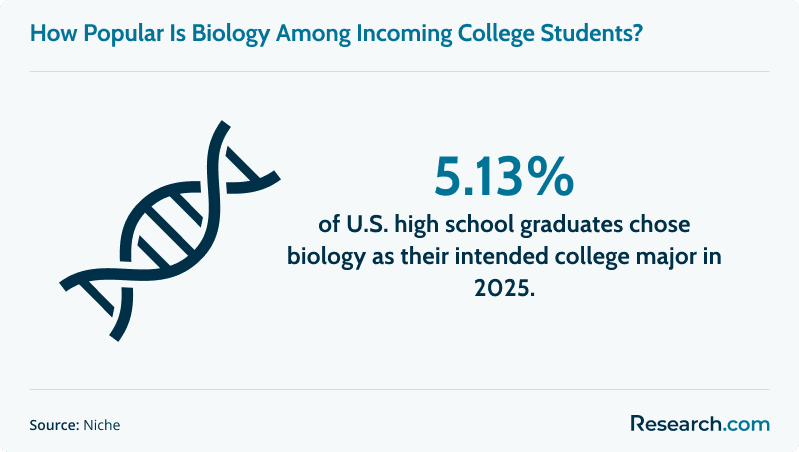
Biology continues to be a popular choice among incoming college students. In 2025, 5.13% of U.S. high school graduates selected biology as their intended major. This reflects steady interest in the field, given its relevance to medicine, biotechnology, and environmental sciences.
However, many students wonder if they can handle the demands of a biology degree. If you want to know how challenging a biology major can be in 2027, this article breaks down what students can expect. It covers core courses, lab work, workload, and what makes biology different from other science majors. By the end, you’ll have a clear picture of what studying biology really involves.
Key Things to Know About Getting a Biology Major in 2027
- Biology graduates often pursue careers as research scientists, biotechnologists, marine biologists, or educators.
- Biology graduates earn a median annual wage of $75,000, with top earners making up to $148,899.
- The U.S. biologist job market is projected to grow by 4.7% between 2022 and 2032.
- How does the difficulty of biology courses compare to other science majors? Degree Comparison
- What are the most challenging courses in a biology degree program? Challenging Courses
- How does the workload change between lower-level and upper-level biology courses? How does the workload change between lower-level and upper-level biology courses?
- What can I expect in a typical biology lab course? Lab Courses
- How can I manage the fast-paced learning environment in biology? Fast-paced Learning
- What are the most popular biology tracks and concentrations in U.S. colleges? Tracks & Concentrations
- What digital tools are used in biology education? Digital Tools
- How long does it typically take to complete a biology degree in the U.S.? Completion Time
- What is the average cost of a biology degree in the U.S.? Average Cost
- Can additional certifications boost job prospects for biology graduates? Can additional certifications boost job prospects for biology graduates?
- What are common career paths for biology graduates? Career Paths
Is Biology a Hard Major? A Practical Guide for Students Comparing Science Degrees
Biology is one of the most popular science majors, but many students underestimate how demanding it can be until they face dense lecture material, long lab reports, genetics problem sets, and high-stakes exams in the same week. The major is not usually as math-heavy as physics or as calculation-intensive as chemistry, yet it requires sustained memorization, scientific reasoning, lab discipline, and the ability to connect details across living systems.
This guide is for students deciding whether to major in biology, parents comparing STEM options, and current biology majors trying to understand what gets harder as the degree progresses. It explains how biology compares with other science fields, which courses tend to be the toughest, what lab work is really like, how long the degree takes, what it costs, and which career paths commonly follow.
Quick Answer: How Hard Is Biology as a College Major?
Biology is a challenging STEM major, but its difficulty is different from chemistry, physics, engineering, or computer science. Students usually struggle less with advanced mathematics and more with the volume of information, frequent exams, detailed terminology, lab procedures, and the need to apply concepts across genetics, anatomy, ecology, molecular biology, and biochemistry. It is a strong fit for students who can study consistently, handle labs carefully, and think scientifically rather than simply memorize facts.
| Question | Short Answer |
| Is biology easier than chemistry or physics? | Often, yes, because it is usually less mathematically abstract; however, it still requires heavy studying and lab work. |
| What makes biology difficult? | The pace, memorization load, lab reports, terminology, cumulative exams, and concept-heavy courses such as genetics and biochemistry. |
| Who is biology best for? | Students interested in living systems, medicine, research, environmental science, biotechnology, health careers, or science education. |
| Who may want another major? | Students who dislike labs, struggle to study consistently, or want a science major with fewer prerequisite sequences and less technical detail. |
How Biology Difficulty Compares With Chemistry, Physics, and Other Majors
Biology is often viewed as more approachable than chemistry or physics, but that does not make it an easy degree. The major tends to emphasize the breadth of living systems: cells, organisms, ecosystems, evolution, genetics, physiology, and molecular processes. Students need to learn many terms and mechanisms, then use that knowledge to interpret experiments, case studies, and biological patterns.
Chemistry and physics typically feel harder for students who are uncomfortable with abstraction, formulas, and multi-step quantitative problems. Biology, by contrast, can feel harder for students who fall behind on reading, delay memorization, or treat lab assignments as secondary work. A student may understand one lecture topic well and still struggle because the next unit introduces a new system, vocabulary set, or experimental method.
Compared with many non-STEM majors and even some flexible science-adjacent pathways, biology usually demands more structured lab time, prerequisite sequencing, and exam preparation. Students exploring STEM but looking for a shorter or more education-focused pathway may compare biology with options such as the fastest online STEM education degree programs. Still, biology remains a rigorous life science degree, especially for students aiming for medical school, graduate research, or biotechnology roles.
Retention data also shows why students should take the major seriously. Nationally, about 48% of students leave STEM majors before completing their degree, and biology contributes heavily to that figure. Common reasons include the pace of introductory courses, the amount of memorization, and pressure from exams that cover large blocks of material.
| Major Area | Typical Difficulty Pattern | What Students Usually Need Most |
| Biology | Large content volume, lab reports, terminology, genetics, systems thinking, and cumulative exams. | Consistent study habits, memorization strategies, lab accuracy, and concept mapping. |
| Chemistry | Quantitative problem-solving, chemical mechanisms, lab precision, and abstract models. | Math fluency, practice problems, spatial reasoning, and careful laboratory technique. |
| Physics | Mathematical modeling, formulas, conceptual abstraction, and multi-step reasoning. | Calculus readiness, problem-solving endurance, and comfort with theoretical concepts. |
| Non-STEM majors | Often more reading, writing, theory, discussion, or project-based work, depending on the field. | Research, communication, analysis, and time management. |
The Hardest Biology Courses Most Students Encounter
In 2027, about 5.13% of U.S. high school graduates selected biology as their intended major, which shows the field’s continued appeal. Popularity, however, does not remove the academic pressure. Many biology programs require students to master dense content, use laboratory equipment correctly, analyze data, and connect biological ideas with chemistry, statistics, and research methods.
The courses below are often among the most demanding because they combine memorization with application. In other words, knowing the terms is not enough; students must use them to solve problems, explain biological mechanisms, or interpret experimental results.
| Course | Why It Is Difficult | How to Prepare |
| Genetics | Students must work through inheritance patterns, gene interactions, probability-based problems, and molecular concepts. It is often described as the “first or second most difficult” course for biology and biology-education majors. | Practice problems early, draw inheritance diagrams, review meiosis carefully, and avoid relying only on memorization. |
| Biochemistry | This course connects chemistry with biological function. Students often struggle with metabolic pathways, enzyme behavior, molecular structures, and lab-based applications. | Review general and organic chemistry, use pathway maps, and test yourself repeatedly rather than rereading notes. |
| Botany | Plant anatomy, physiology, taxonomy, and theory can create a heavy memorization load, especially for students who expected biology to focus mostly on animals or medicine. | Use diagrams, compare plant groups side by side, and study terminology in small daily blocks. |
| Biometry | Many biology students find statistical methods, data interpretation, and accurate analysis difficult because the course requires quantitative reasoning. | Work through data sets, learn statistical vocabulary, and ask for help before falling behind. |
| Molecular Biology | The course requires detailed understanding of DNA, RNA, gene regulation, replication, transcription, translation, and molecular mechanisms. | Build process diagrams, explain each mechanism aloud, and connect molecular steps to larger biological outcomes. |
Students who want a gentler introduction to environmental or applied STEM ideas before committing to a traditional life science sequence may also compare biology with related programs such as the fastest online bachelor's degree in sustainability programs. These programs can still build scientific literacy, but they may place less emphasis on laboratory-heavy biology prerequisites.
How the Biology Workload Changes From Introductory to Advanced Courses
The first year of biology usually feels fast because students are learning the language of the field. Introductory courses often include large lectures, weekly labs, quizzes, short assignments, and detailed lab reports. A study of 100-level biology labs found that students spent about 3.5 hours per week outside class, and 92% reported fewer than six hours.
Upper-level biology courses are different. Instead of simply identifying parts, terms, or processes, students are asked to evaluate journal articles, design experiments, interpret data, write longer scientific papers, and work with more specialized lab techniques. The number of assignments may drop, but each assignment often matters more.
This shift is important for students considering research, medicine, public health, biotechnology, or quantitative life science careers. Advanced biology can become more data-driven, especially in areas such as bioinformatics, epidemiology, computational biology, and genomics. Graduates who want to combine biological training with advanced analytics may eventually compare graduate options such as an online data science doctorate.
| Course Level | What the Work Looks Like | Main Challenge |
| Lower-level biology | Large lectures, introductory labs, quizzes, textbook reading, terminology, and structured reports. | Keeping up with volume and building a strong foundation before exams pile up. |
| Upper-level biology | Primary research articles, independent projects, advanced labs, data analysis, presentations, and longer papers. | Applying concepts, thinking critically, and producing higher-quality scientific work with less step-by-step guidance. |
| Research or capstone work | Experimental design, troubleshooting, literature review, statistical interpretation, and formal scientific communication. | Managing uncertainty, revising methods, and explaining findings clearly. |
What to Expect in a Biology Lab Course
A biology lab is not just a hands-on supplement to lecture. It is where students learn how scientific claims are tested, measured, recorded, and communicated. Depending on the course and program, lab meetings usually run for 1 to 3 hours per week. Some programs also use compressed “non-stop lab weeks,” where students complete many hours of lab work over a shorter period.
Common techniques include pipetting, microscopy, culturing, observation, specimen handling, measurement, and basic data analysis. Outside scheduled lab time, students often prepare for procedures, organize results, complete statistical work, and write reports. The previously cited workload of about 3.5 hours per week outside class gives students a realistic starting point, but advanced courses may require more independent effort.
Biology labs can be frustrating because experiments do not always work as expected. Contaminated samples, unclear microscope images, inconsistent measurements, or calculation mistakes can force students to troubleshoot. That process is part of the training. Students applying to colleges and worried about admissions testing should also know that many colleges that don't require ACT or SAT scores now allow applicants to emphasize coursework, grades, lab readiness, and broader academic strengths.
| Lab Component | What Students Do | Skill Built |
| Pre-lab preparation | Read procedures, understand safety rules, review expected outcomes, and prepare notebook entries. | Planning and scientific readiness. |
| Hands-on procedure | Use tools, handle samples, measure accurately, and follow protocols. | Technical precision and lab safety. |
| Data analysis | Organize observations, calculate results, evaluate patterns, and identify possible errors. | Quantitative reasoning and evidence-based interpretation. |
| Lab report writing | Explain methods, results, limitations, and conclusions in scientific format. | Scientific communication. |
How to Keep Up With Fast-Paced Biology Courses
Biology becomes difficult when students treat it like a subject they can cram. The material builds quickly, and lectures, labs, readings, and exams often overlap. The best strategy is not to study more randomly, but to study more deliberately: prepare before class, test yourself often, reflect after exams, and adjust methods before grades start slipping.
Use Metacognition Instead of Guessing What You Know
Metacognition means checking your own understanding while you study. In biology, this matters because students often feel familiar with a diagram or term but cannot explain it without notes. After each study session, write down what you can explain clearly, what remains confusing, and what you will do differently before the next class or exam.
Senior biology students often perform better because they refine their study system over time. They stop relying on one tactic and instead combine self-testing, concept maps, review schedules, and feedback from past exams.
Replace Passive Reading With Active Recall
Practice testing, self-quizzing, spaced repetition, and drawing processes from memory are usually more useful than rereading chapters or highlighting slides. Biology rewards students who can retrieve information and apply it under exam conditions. If you cannot explain DNA replication, enzyme function, or ecological succession without looking, you are not finished studying.
Prepare Before Lecture
Students in large introductory biology courses often benefit from reviewing worksheets, narrated slides, or assigned materials before class. Pre-class preparation makes lectures easier to follow and gives students more time to ask meaningful questions, connect ideas, and apply concepts during class activities.
Use Feedback After Every Exam
Predicting exam scores, comparing predictions with actual results, and reviewing missed questions can reveal whether confidence matches understanding. Students who overestimate their knowledge often earn lower scores. Students who underestimate their performance may revise their study methods and improve on later assessments.
These habits are not limited to biology. Similar planning and self-evaluation strategies help students in demanding online graduate programs, including a fast-track online master's degree in educational leadership, where independent pacing and workload management are critical.
| Common Study Mistake | Why It Hurts Biology Students | Better Approach |
| Rereading notes without testing recall | Familiarity can feel like mastery even when the student cannot answer exam-style questions. | Use flashcards, blank-page recall, practice questions, and diagrams from memory. |
| Ignoring lab until the report is due | Data, methods, and errors become harder to explain after details fade. | Summarize observations immediately after lab and begin analysis early. |
| Waiting until the week before an exam | Biology exams often cover too many terms, systems, and mechanisms for last-minute studying. | Study in short, repeated sessions throughout the unit. |
| Memorizing without connecting concepts | Upper-level biology requires application, not just definitions. | Ask how each process affects cells, organisms, populations, or ecosystems. |
Popular Biology Tracks and How to Choose One
The general biology track is the most common option because it keeps several doors open. Sixty-four percent (64%) of degree holders reported it as their field of study. This broad route can work well for students who are still deciding between medicine, research, environmental work, teaching, graduate school, or laboratory roles.
General biology graduates may qualify for biological technician jobs, a field that employed over 82,700 workers in 2024 and is projected to grow by 3% through 2034. The median salary for these roles is about $52,000 per year. The track is also flexible because graduates can seek work in hospitals, universities, government laboratories, and private-sector research settings.
More specialized concentrations include biochemical sciences, physiology, microbiology, and molecular biology. These options often make sense for students who already know they want a more research-centered, health-related, biotechnology-oriented, or laboratory-intensive pathway.
| Biology Track | Best For | Decision Point |
| General biology | Students who want flexibility across health, research, education, environmental, and lab careers. | Choose this if you want a broad foundation and are not ready to specialize too early. |
| Biochemical sciences | Students interested in molecular processes, medicine, pharmaceuticals, or lab research. | Choose this if you are comfortable with chemistry-heavy coursework. |
| Physiology | Students focused on human or animal body systems, health careers, or medical preparation. | Choose this if anatomy, function, and organism-level systems interest you most. |
| Microbiology | Students interested in bacteria, viruses, immune response, infectious disease, or laboratory testing. | Choose this if you want a focused life science area with strong lab relevance. |
| Molecular biology | Students drawn to DNA, RNA, gene regulation, biotechnology, and cellular mechanisms. | Choose this if you like detailed molecular explanations and research methods. |
Students who like health science but want a more applied and structured route may also compare biology with nutrition-related programs. Some easiest nutrition degrees focus more directly on wellness, community health, food systems, and applied health education, which may feel less research-heavy than a traditional biology major.
Digital Tools, Virtual Labs, and Technology in Biology Education
Biology education increasingly uses digital tools to help students practice procedures, visualize microscopic processes, and prepare for in-person labs. Virtual lab simulations are especially common in cell biology and molecular biology, where students benefit from seeing processes that are difficult to observe directly.
In a study of first-year biology labs, over 90% of students said platforms like Labster were easy to use and visually engaging. More than 90% also felt their lab reports and test performance improved after using them. These tools do not replace scientific reasoning, but they can help students rehearse steps and understand lab concepts before handling equipment.
Learning Management Systems such as Moodle are also used to organize course materials, track progress, distribute assignments, and support collaboration. In one case study, 67% of biology teachers reported using LMS tools to deliver lessons and monitor student progress.
Virtual reality and 3D simulations are also appearing in biology instruction. A recent study found that students using VR labs maintained or improved scores more consistently and needed less help with equipment like microscopes compared with students learning through video or traditional instruction.
How Long It Takes to Finish a Biology Degree
A bachelor’s degree in biology typically follows a four-year full-time structure, similar to the top bachelor's degree in history online. The difference is that biology students often face tightly sequenced prerequisites, lab requirements, and course availability constraints that can affect graduation timing.
Credit momentum matters. Students who complete 30 or more credits in their first year are far more likely to graduate within four years (72%) than students who complete fewer than 24 credits in that period, where the figure is only 30%. Biology students may also need extra time if they change concentrations, repeat prerequisite courses, add pre-med requirements, complete research projects, or balance work with lab schedules.
| Factor | How It Can Affect Completion Time |
| Credit load | Completing 30 or more credits in the first year is associated with a much higher four-year completion rate. |
| Lab scheduling | Labs may meet at fixed times and can limit scheduling flexibility. |
| Prerequisite chains | Courses such as chemistry, biology, genetics, and biochemistry often must be taken in sequence. |
| Research or internship work | These experiences can strengthen preparation but may add time if not planned into the degree map early. |
| Transfer credits | Students should confirm whether science and lab credits transfer as major requirements, not just electives. |
Average Cost of a Biology Degree in the U.S.
The cost of a biology degree depends heavily on institution type, residency status, housing, supplies, and whether a student attends full time or part time. For biological and biomedical sciences, average tuition and fees at public institutions are approximately $10,089 per year for in-state students and about $31,648 for out-of-state students. At private colleges, tuition averages around $43,000 annually.
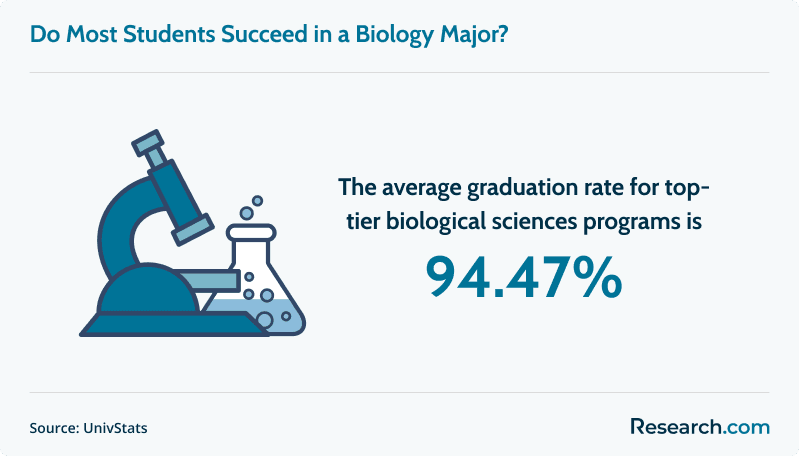
Tuition is only one part of the total price. Biology majors may also pay for housing, food, textbooks, lab manuals, course fees, transportation, and laboratory supplies. When these costs are included, the total cost of attendance at leading biological sciences programs ranges from $39,500 to $81,300 per year.
Students considering biology as a first step toward healthcare, teaching, or advanced clinical roles should think beyond the bachelor’s degree. Some graduates later pursue professional or graduate programs, including options such as a DNP in nursing education online, depending on their long-term goals.
| Cost Category | Reported Amount or Range | What to Check Before Enrolling |
| Public in-state tuition and fees | Approximately $10,089 per year | Confirm residency rules, lab fees, and whether major courses carry extra charges. |
| Public out-of-state tuition and fees | About $31,648 per year | Compare out-of-state costs with private and online options before deciding. |
| Private college tuition | Around $43,000 annually | Review net price after grants and scholarships, not just published tuition. |
| Total cost of attendance at leading biological sciences programs | $39,500 to $81,300 per year | Include housing, food, books, lab supplies, transportation, and personal expenses. |
Can Certifications Improve Job Options for Biology Graduates?
Certifications can help biology graduates signal practical skills, especially when they want to move into healthcare support, biotech operations, laboratory administration, clinical research support, project coordination, or data-related roles. A certification is not a substitute for a biology degree, and it does not guarantee employment, but it can make a resume more targeted.
The best credential depends on the student’s goal. A graduate interested in a hospital setting may need a different add-on than someone interested in biotechnology, regulatory work, or administrative support. Students considering healthcare operations roles may explore options such as the cheapest medical billing and coding certification courses to understand how focused training can support a transition into non-lab healthcare positions.
| Career Goal | Useful Skill Area to Add | Why It May Help |
| Laboratory work | Lab safety, quality control, data recording, and instrument handling. | Shows readiness for technical environments where accuracy matters. |
| Healthcare administration | Medical records, coding, billing, compliance, or office systems. | Can help biology graduates move into health-related support roles outside direct patient care. |
| Biotechnology or research operations | Project coordination, documentation, regulatory basics, or data management. | Supports interdisciplinary roles that combine science knowledge with operational needs. |
| Graduate or professional school preparation | Research methods, statistics, writing, or clinical exposure. | Can strengthen applications when paired with strong coursework and relevant experience. |
Common Career Paths for Biology Graduates
Biology graduates can move in several directions because the major builds a foundation in living systems, scientific reasoning, laboratory methods, and evidence-based analysis. Some paths are available with a bachelor’s degree, while others require graduate school, professional school, licensure, or specialized training.
| Career Path | What the Work Involves | Reported Outlook or Pay Information |
| Biological technicians | Support laboratory research, prepare samples, run experiments, maintain records, and assist scientists. | Projected to grow 3% by 2034, with a median salary of $52,000. |
| Biochemists and biophysicists | Study the chemical and physical principles behind living organisms and biological processes. | Median annual pay is $103,650, and employment is expected to grow 6% through 2034. |
| Medical scientists | Conduct research to improve human health, test treatments, and study disease mechanisms. | Roughly 165,300 positions in 2024 were available, mostly in research and healthcare, with steady demand. |
| Physicians and healthcare roles | Use biology preparation as a foundation for medical, clinical, or related professional training. | About 13.9% of biology graduates work as physicians or related practitioners. |
| Postsecondary teachers and researchers | Teach biology, conduct research, publish findings, and mentor students in colleges or universities. | Often requires graduate study and research experience. Students interested in teaching may consider a fast-track master's in science education online. |
Students should be realistic about the difference between “biology-related” and “biology-required” jobs. Some entry-level roles accept a bachelor’s degree, while research leadership, medical practice, academic careers, and many specialized healthcare roles require further education or credentials.
What Biology Graduates Say About the Major
- : "My first year felt intense because every class seemed to move at once. Fieldwork in ecology helped everything click. Collecting samples outdoors and then analyzing them in the lab made the coursework feel real, and that experience pushed me toward environmental biology. — Martin"
- : "I expected biology to be mostly memorization, but the writing and data analysis surprised me. Genetics and statistics taught me to look for patterns, question evidence, and explain conclusions clearly. Those skills have mattered a lot in graduate school. — Addison"
- : "Organic chemistry was the class I feared most, but finishing it made the rest of the major feel possible. Ecology, neurobiology, and animal behavior kept me engaged because each course showed a different side of life science. — Haley"
Questions to Ask Before Choosing a Biology Major
- Do I enjoy both memorization and problem-solving? Biology requires facts, but exams often ask students to apply those facts to new scenarios.
- Am I willing to spend time in labs? Lab work is central to many programs, and it often includes reports, troubleshooting, and data analysis.
- What career am I aiming for? Medicine, research, teaching, public health, biotechnology, and environmental work may require different course choices.
- Will I need graduate or professional school? Many advanced biology careers require education beyond the bachelor’s degree.
- Can I afford the full cost, not just tuition? Housing, food, lab supplies, textbooks, transportation, and fees can significantly affect the real price.
- Does the program offer research, internships, advising, and strong lab facilities? These experiences can matter as much as the major title.
- How do transfer credits apply? Science credits may not always satisfy major lab or prerequisite requirements.
Common Mistakes Biology Students Should Avoid
| Mistake | Why It Creates Problems | Better Decision |
| Choosing biology only because it sounds like a good pre-med major | Students may lose motivation if they do not actually enjoy biology, labs, or research-style learning. | Compare biology with other pre-health majors and confirm that the coursework fits your strengths. |
| Ignoring chemistry and math requirements | Biology majors often need chemistry, statistics, and sometimes calculus or physics. | Review the full degree plan before enrolling, not just the biology course list. |
| Focusing only on tuition | Lab fees, housing, food, books, and supplies can change the total cost significantly. | Compare total cost of attendance and financial aid packages. |
| Assuming a bachelor’s degree guarantees a high-paying science job | Some biology career paths require graduate school, professional school, certifications, or experience. | Research entry-level roles, salary ranges, and required credentials early. |
| Waiting too long to get research or internship experience | Classroom knowledge alone may not distinguish applicants for competitive jobs or graduate programs. | Ask about labs, faculty research, internships, and campus career support during the first year. |
| Relying only on rankings | A highly ranked school may still be the wrong fit if advising, cost, lab access, or course sequencing do not match your needs. | Use rankings as one factor, then verify affordability, support services, and academic fit. |
References
- American Society for Microbiology. (2022). Utilizing digital tools to support student engagement during instructional assistant-led sessions. Journal of Microbiology & Biology Education, 23(3). https://doi.org/10.1128/jmbe.00143-22
- Bureau of Labor Statistics. (2023, August 29). Field of degree: Biology. Occupational Outlook Handbook. https://www.bls.gov/ooh/field-of-degree/biology/biology-field-of-degree.htm
- College Tuition Compare. (2025). Biological and biomedical sciences program 2025 tuition. https://www.collegetuitioncompare.com/majors/26.0000/biological-and-biomedical-sciences/
- Data USA. (2023). Biology degree. https://datausa.io/profile/cip/biology
- Inside Higher Ed. (2013, November 27). Study tracks attrition rates for STEM majors. https://www.insidehighered.com/news/2013/11/27/study-tracks-attrition-rates-stem-majors
- Niche. (2023, November 9). Data dive: Trends in students’ majors of interest 2021–2025. https://www.niche.com/about/enrollment-insights/trends-majors-2021-2025/
- PubMed Central. (2015). Students perceived and determined knowledge of biology concepts in an upper-level biology course. https://pubmed.ncbi.nlm.nih.gov/26086662/
- ThoughtCo. (2025, May 1). Average college GPA by major and school type. https://www.thoughtco.com/average-college-gpa-4163565
- UnivStats. (n.d.). Biological sciences 9 colleges comparison. https://www.univstats.com/comparison/majors/science/biological-sciences/
Key Insights
- Biology is not usually the most math-heavy science major, but it is demanding because of its pace, memorization load, lab work, and cumulative exams.
- Genetics, biochemistry, botany, biometry, and molecular biology are often difficult because they require both detailed knowledge and applied reasoning.
- The workload changes after introductory courses. Upper-level biology expects more independent analysis, research reading, data interpretation, and scientific writing.
- Labs are a major part of the degree. Students should expect preparation time, technical work, data analysis, and formal reports, not just scheduled lab hours.
- General biology is the most flexible track, with 64% of degree holders reporting it as their field of study, but specialized tracks may be better for students with clear research, healthcare, or biotechnology goals.
- Cost varies widely. Reported annual tuition and fees range from approximately $10,089 for in-state public students to around $43,000 at private colleges, before considering the full cost of attendance.
- A biology degree can lead to lab, research, healthcare, teaching, and graduate-school pathways, but many advanced roles require additional credentials, professional school, or graduate study.
- The students who handle biology best usually study consistently, use active recall, seek feedback, plan around labs, and choose concentrations based on career goals rather than popularity alone.
Other Things You Should Know About Getting a Biology Major
In 2027, a biology major typically requires 15–18 credit hours per semester, balancing lecture courses, laboratory work, and field studies. Core courses generally include subjects like genetics, microbiology, and ecology, which demand significant study time and hands-on practice.
Biology majors in 2027 typically need to complete foundational courses like General Biology, Chemistry, and Mathematics. These courses are essential building blocks, laying the groundwork for advanced study and ensuring students have a broad understanding of the scientific principles crucial for their major.
Many biology departments require a minimum 2.0 GPA in core science courses to enroll in upper-level lab classes, and some capstone or research labs require a 2.5 or higher. Students must also pass prerequisite lecture and lab courses, often with a C or better, before advancing.
Biology majors typically begin engaging in lab research or internships during their second or third year. This timing allows students to build a solid foundation in fundamental biological concepts before applying these skills in practical settings.


