2027 Best Occupational Therapy Majors: Education & Other Requirements

Chief Data Scientist & Ranking Editor
Choosing the wrong academic path in occupational therapy can mean missing out on specialized career opportunities in a fast-growing field projected to expand by 12% through 2032. Waiting too long to make an informed decision could also delay entry into a profession where licensed therapists currently earn a median annual wage of $93,180.
This article highlights the 12 best occupational therapy majors to pursue for 2027, covering education pathways and core requirements. Prepared with expert career planning insights, it will guide readers toward the right academic choice and help avoid setbacks in achieving long-term professional success.
What are the benefits of getting an occupational therapy major?
- Opens doors to careers as an occupational therapist, rehabilitation specialist, or therapy coordinator across hospitals, schools, and private practices.
- Provides access to a strong earning potential, with the median annual salary for occupational therapists reaching $93,180 in 2023.
- Equips graduates with specialized skills that make them eligible for licensure, ensuring long-term career stability in a field with projected 12% growth through 2032.
What can you do with an occupational therapy major?
An occupational therapy major prepares you to help patients regain independence in daily life after injury, illness, or disability. Graduates can pursue roles as licensed occupational therapists, therapy aides, or rehabilitation specialists. With further education, the degree also opens pathways to advanced practice in pediatrics, geriatrics, and mental health support.
According to the U.S. Bureau of Labor Statistics (BLS), employment for occupational therapists is projected to grow 12% from 2022 to 2032—much faster than average. This growth reflects rising demand for skilled professionals who can support aging populations and those with chronic conditions.
Where can you work with an occupational therapy major?
An occupational therapy major allows graduates to work in diverse environments. Occupational therapists are needed in hospitals, rehabilitation centers, outpatient clinics, schools, and nursing homes. Some also find opportunities in home health care and private practice. The field’s flexibility makes it possible to specialize in areas like pediatrics, sports injury recovery, or mental health support.
According to BLS data, nearly 27% of occupational therapists are employed in hospitals, while 25% work in therapy offices and clinics. This wide range of options ensures graduates can choose a setting that matches their professional goals and lifestyle.
How much can you earn with an occupational therapy major?
Earning potential with an occupational therapy major is strong compared to many healthcare roles requiring similar education. The median annual wage for occupational therapists was $93,180 in 2023, according to the BLS. The top 10% in the field earned more than $120,000 per year, showing significant room for growth with experience and specialization.
Earnings vary depending on location and work setting—therapists in nursing care facilities and home health services often earn higher wages than those in schools or outpatient clinics. With continued demand and opportunities for advancement, an occupational therapy degree provides both financial stability and career longevity.
- What are the 12 best occupational therapy majors for 2027? Best Majors
- How long does it take to complete an occupational therapy major? Program Length
- What are the education requirements for occupational therapy? Educational Requirements
- How much does it cost to get an occupational therapy major? Program Cost
- What skills do you gain from an occupational therapy major? Core Skills
- What jobs can you get with an occupational therapy degree? Potential Jobs
- Which states pay occupational therapists the highest salaries? Which states pay occupational therapists the highest salaries?
- What is the job outlook for occupational therapy majors? Job Outlook
- Why is occupational therapy a rewarding career? Why is occupational therapy a rewarding career?
- What are the licensing and certification requirements for occupational therapy? What are the licensing and certification requirements for occupational therapy?
- Should I Consider Complementary Certifications to Enhance My Occupational Therapy Career? Should I Consider Complementary Certifications to Enhance My Occupational Therapy Career?
Best Occupational Therapy Majors in 2027: Which Bachelor’s Degree Should You Choose?
Choosing a major for occupational therapy is not just about picking a health-related degree. Most future occupational therapists need a bachelor’s degree first, then a graduate occupational therapy program, fieldwork, the NBCOT exam, and state licensure. That means your undergraduate major should help you meet prerequisites, build patient-care knowledge, and keep backup career options open if your plans change.
This guide is for students comparing pre-OT majors, transfer students planning prerequisites, and career changers deciding whether occupational therapy is worth the time and cost. You will learn which majors align best with OT school admissions, how long the full pathway takes, what skills and jobs are connected to occupational therapy, how costs can add up, and what questions to ask before choosing a program.
Quick answer: What is the best major for occupational therapy?
The best undergraduate majors for occupational therapy are biology, psychology, health science, exercise science or kinesiology, occupational science, rehabilitation science, public health, neuroscience, sociology, human development and family studies, education, and a liberal arts degree with a pre-OT plan. There is no single required major for OT school, but the strongest choices include prerequisites such as anatomy, physiology, psychology, statistics, and human development while also preparing students for clinical observation and graduate-level coursework.
| Major | Best fit for | Why it works for pre-OT students |
| Biology | Students who want a strong science foundation | Builds preparation in anatomy, physiology, cellular biology, and medical concepts used in rehabilitation. |
| Psychology | Students interested in behavior, mental health, pediatrics, or cognition | Connects well to patient motivation, developmental needs, cognitive challenges, and therapeutic communication. |
| Health Science | Students who want a broad healthcare major | Covers healthcare systems, patient care, public health, ethics, and evidence-based practice. |
| Exercise Science or Kinesiology | Students drawn to movement, biomechanics, and physical rehabilitation | Helps explain mobility, strength, injury recovery, and body mechanics used in OT treatment planning. |
| Occupational Science | Students who want the most OT-specific undergraduate option | Focuses on daily activities, participation, adaptation, wellness, and the meaning of occupation. |
| Rehabilitation Science | Students planning for clinical rehabilitation careers | Introduces recovery, functional independence, adaptive strategies, and therapy-related concepts. |
| Public Health | Students interested in community programs, prevention, and health equity | Develops a population-health perspective useful for schools, community care, and underserved settings. |
| Neuroscience | Students interested in brain injury, stroke recovery, or neurological conditions | Provides a rigorous foundation in the brain, nervous system, cognition, and neurological rehabilitation. |
| Sociology | Students who want to understand social barriers to health | Strengthens cultural awareness, systems thinking, and understanding of how environment affects daily function. |
| Human Development and Family Studies | Students interested in pediatrics, aging, or family-centered care | Explains lifespan development, caregiving, family systems, and age-related needs. |
| Education | Students considering school-based OT | Builds skills in child development, instructional planning, communication, and special education environments. |
| Liberal Arts with Pre-OT Focus | Students who want flexibility while completing prerequisites | Can work well if the student intentionally completes OT prerequisites and gains relevant observation experience. |
1. Biology
Biology is a practical choice for students who want a deep science background before OT school. Courses in anatomy, physiology, genetics, microbiology, and cellular processes help students understand how illness, injury, and disability affect the body. This major can also leave room for healthcare, laboratory, or research alternatives if a student later decides not to pursue occupational therapy.
2. Psychology
Psychology is highly relevant because occupational therapists work with motivation, cognition, emotional adjustment, behavior, and mental health. Students in this major learn how people think, develop, respond to stress, and adapt to challenges. It is especially useful for students considering pediatric OT, mental health OT, neurorehabilitation, or work with clients who have developmental or cognitive conditions.
3. Health Science
Health science is one of the most flexible pre-OT majors because it introduces students to patient care, healthcare delivery, ethics, public health, and rehabilitation-related topics. Many programs also include courses that overlap with OT admissions requirements. Students who are still comparing occupational therapy with other healthcare roles may find health science broad enough to support several paths.
4. Exercise Science or Kinesiology
Exercise science and kinesiology focus on human movement, biomechanics, physical performance, and injury recovery. These subjects fit well with occupational therapy because OTs often help clients regain function after illness, surgery, disability, or injury. This major is a strong match for students interested in rehabilitation, adaptive movement, orthopedics, or outpatient therapy settings.
5. Sociology
Sociology helps students understand how culture, family systems, income, community resources, and institutions shape health outcomes. That perspective matters in occupational therapy because a treatment plan must work in the client’s real environment, not just in a clinic. Sociology can be especially valuable for students interested in community-based OT, health disparities, aging services, or work with diverse populations.
6. Occupational Science
Occupational science is the most directly aligned undergraduate major when it is available. It studies how people participate in meaningful daily activities, how disability or illness interrupts participation, and how environments can support independence. Because the subject matter overlaps closely with OT theory, students may enter graduate school with a clearer understanding of the profession than students from broader majors.
7. Public Health
Public health prepares students to think beyond one-on-one treatment and consider prevention, access, policy, and community wellness. This background is useful for occupational therapists who work in schools, community programs, home health, or population-focused initiatives. It can also help future OTs understand health inequities and advocate for better rehabilitation access.
8. Rehabilitation Science
Rehabilitation science is built around recovery, function, adaptive strategies, and the science of restoring independence. Students often study movement, disability, assistive technology, and therapeutic approaches. For future occupational therapists, this major can create a smooth transition into graduate coursework because the undergraduate focus already centers on functional outcomes.
9. Human Development and Family Studies
Human development and family studies examines how people change from infancy through older adulthood. Students learn about developmental milestones, aging, family dynamics, caregiving, and support systems. This major is especially helpful for students drawn to pediatrics, gerontology, early intervention, or family-centered occupational therapy.
10. Education
Education can be a smart option for students who want to work with children in schools. It develops communication, assessment, instructional planning, child development, and collaboration skills. Students interested in occupational therapy in school settings should still verify that their education major allows enough room for OT prerequisites such as anatomy, physiology, psychology, and statistics.
11. Neuroscience
Neuroscience is a rigorous science pathway for students interested in the brain, nervous system, movement, cognition, and recovery after neurological injury. It can be especially useful for future OTs who want to work with stroke survivors, clients with traumatic brain injury, or people with neurological conditions. Because the coursework can be demanding, students should plan carefully to protect their GPA while completing OT prerequisites.
12. Liberal Arts with Pre-OT Focus
A liberal arts major can work for occupational therapy if the student treats prerequisite planning as non-negotiable. This route offers flexibility and can strengthen writing, ethics, communication, and critical thinking, but it requires careful advising. Students choosing this option should map OT program requirements early and make sure they complete anatomy, physiology, psychology, statistics, and any required observation hours.
How Long Does It Take to Become an Occupational Therapist?
A pre-OT bachelor’s degree usually takes four years. During that time, students complete general education courses, major requirements, OT prerequisites, and often volunteer or observation hours in healthcare, school, or rehabilitation settings. Majors such as biology, psychology, health science, and exercise science are popular because they can fit many OT prerequisites into the undergraduate plan.
Students comparing healthcare careers may also look at shorter clinical pathways. For example, reviewing a guide to pharmacy technician salary and career paths can help students understand how occupational therapy differs from roles that may require less schooling before entry-level employment.
After the bachelor’s degree, aspiring occupational therapists typically enter a Master of Occupational Therapy (MOT) or Doctor of Occupational Therapy (OTD) program. These graduate programs typically last 2–3 years, depending on the degree type and school structure. The master’s remains the minimum requirement for licensure in most states, while the OTD has become an increasingly common option for students who want doctoral-level preparation.
In total, the pathway to licensed occupational therapist status generally takes around 6–7 years. Some universities offer accelerated or combined BS/MS or BS/OTD options that can shorten the timeline to about 5 years. These programs may be competitive, but they can be useful for students who are certain about OT early in college.
| Stage | Typical length | What students complete |
| Bachelor’s degree | 4 years | Major courses, OT prerequisites, general education, observation or volunteer experience |
| MOT or OTD program | 2–3 years | Graduate OT coursework, lab learning, clinical training, fieldwork |
| Combined or accelerated pathway | About 5 years | Integrated undergraduate and graduate study for students admitted to structured programs |
| Total traditional pathway | Around 6–7 years | Bachelor’s degree plus graduate OT education, followed by exam and licensure steps |
The number of accredited programs also shows the range of occupational therapy pathways in the U.S. There are 163 accredited master’s programs (OTM) and 130 doctoral programs (OTD), giving future OTs multiple graduate routes. For assistant-level preparation, there are 214 associate-level (OTA) and just 5 bachelor’s-level OTA programs (OTA-B). This matters because occupational therapy assistant training is shorter, but occupational therapist roles are primarily prepared at the master’s or doctoral level.
The field is also projected to see 12% job growth through 2032, which is one reason many students are willing to commit to the longer graduate pathway.
What Education Requirements Do Occupational Therapists Need?
Occupational therapy is a licensed healthcare profession, so students must complete specific academic, clinical, exam, and state requirements before practicing. A bachelor’s major alone is not enough to become an occupational therapist. The undergraduate degree is the preparation stage; the graduate OT degree, fieldwork, NBCOT exam, and state license are what move a student into professional practice.
- Bachelor’s degree: Most students complete a 4-year degree in a field such as biology, psychology, health science, occupational science, rehabilitation science, or another major that includes OT prerequisites.
- Prerequisite coursework: OT programs commonly expect coursework such as anatomy, physiology, psychology, statistics, and related science or behavioral science classes.
- Graduate OT degree: Students then complete a Master of Occupational Therapy (MOT) or Doctor of Occupational Therapy (OTD), typically lasting 2–3 years.
- Clinical fieldwork: OT programs include supervised hands-on learning in settings such as hospitals, schools, clinics, rehabilitation centers, or community programs.
- NBCOT exam: Graduates must pass the National Board for Certification in Occupational Therapy exam before seeking licensure.
- State licensure: Each state has its own application process, fees, renewal rules, and continuing education expectations.
Students should check requirements for each OT program before choosing a major because prerequisite lists can vary. A degree title that sounds related to occupational therapy does not automatically guarantee that all required courses are included.
If you are weighing long-term education investment across fields, it can help to compare OT with other career guides, including Research.com’s overview of athletic director salary and career paths. The comparison is not about choosing the same career type; it is about learning how education length, credential requirements, and career outcomes differ by profession.
How Much Does an Occupational Therapy Education Cost?
The cost of preparing for occupational therapy depends on where you earn your bachelor’s degree, whether you attend a public or private institution, whether you qualify for in-state tuition, and which graduate OT program you choose. A bachelor’s degree in fields such as biology, psychology, or health science usually ranges from $25,000 to $60,000 per year in tuition at U.S. universities. Public universities are often less expensive for in-state students, while private institutions commonly charge higher tuition.
Graduate occupational therapy education adds another major expense. MOT and OTD programs typically add another $40,000 to $70,000 per year. Students should also plan for textbooks, lab fees, equipment, transportation, background checks, health requirements, and fieldwork-related costs. Because most future OTs complete both undergraduate and graduate education, the total investment can be substantial.
Financial planning should start before enrollment, not after admission. Recent data shows that graduates in health services, allied health, and health sciences fields carry an average student loan debt of $13,020. That number can help students think carefully about borrowing, scholarships, assistantships, employer benefits, and lower-cost prerequisite options.
| Cost factor | Why it matters | Questions to ask |
| Undergraduate tuition | The bachelor’s degree is usually the first major cost before OT graduate school. | Can I complete prerequisites at a lower-cost public institution or through transfer credits? |
| Graduate OT tuition | MOT and OTD programs can significantly increase total debt. | What is the full program cost, not just the first-year tuition? |
| Fieldwork expenses | Clinical placements may require travel, housing, immunizations, background checks, or reduced work hours. | Where are placements located, and can students choose sites near home? |
| Program length | Longer programs may increase tuition and delay full-time earnings. | Is there an accelerated or combined option that fits my goals? |
| Financial aid and scholarships | Grants, assistantships, employer tuition support, and scholarships can reduce borrowing. | What aid is available specifically for OT students? |
Students sometimes compare OT with speech-language pathology because both fields involve graduate education and patient-centered care. If you are asking whether another therapy profession may fit better, Research.com’s guide on why students may choose an SLP degree instead of OT can help frame the trade-offs.

What Skills Do Occupational Therapy Majors Build?
Pre-OT majors develop more than scientific knowledge. Strong occupational therapy preparation combines human biology, behavioral insight, communication, problem-solving, cultural awareness, and evidence-based thinking. The best undergraduate major is one that helps you grow in both clinical reasoning and interpersonal care.
- Clinical science: Students build knowledge of anatomy, physiology, movement, illness, disability, and rehabilitation concepts.
- Patient-centered thinking: Future OTs learn to connect a person’s goals, environment, limitations, and daily routines.
- Communication: Occupational therapy depends on clear conversations with clients, families, caregivers, teachers, physicians, and rehabilitation teams.
- Problem-solving: OTs often adapt tasks, tools, routines, or environments so clients can function more independently.
- Cultural awareness: Effective care requires respect for a client’s background, family context, values, language, and community resources.
- Research literacy: Students learn how to interpret evidence and apply current findings to improve outcomes.
- Professional judgment: Fieldwork and observation experiences help students understand ethics, boundaries, documentation, and team-based care.
These skills can also transfer into adjacent healthcare roles, especially for students who later choose another graduate credential. For example, students comparing advanced healthcare credentials may find it useful to review career options and earnings considerations for a graduate certificate in nursing informatics.
Occupational therapy also overlaps with counseling, family support, developmental care, and behavioral health. If you are exploring helping professions outside OT, Research.com’s guide comparing AMFT vs LMFT salary and degree differences can provide another point of comparison.
What Jobs Can You Get With an Occupational Therapy Degree?
The most direct outcome of an occupational therapy degree is becoming a licensed occupational therapist. However, OT training can also support specialization in pediatrics, geriatrics, neurological rehabilitation, home health, schools, research, education, and program leadership. Students should remember that job eligibility depends on degree level, certification, licensure, and state requirements.
| Role | Typical focus | Common work settings |
| Occupational Therapist | Helps clients regain or improve daily function after injury, illness, disability, or developmental challenges. | Hospitals, outpatient clinics, schools, rehabilitation centers, private practices |
| Pediatric Occupational Therapist | Supports children with developmental delays, sensory needs, motor challenges, autism spectrum disorders, or school participation difficulties. | Schools, pediatric clinics, early intervention programs, hospitals |
| Geriatric Occupational Therapist | Helps older adults maintain independence, manage chronic conditions, reduce fall risks, and adapt daily routines. | Nursing care facilities, home health, rehabilitation centers, hospitals |
| Rehabilitation Specialist | Works on functional recovery after surgery, injury, neurological conditions, or major illness. | Hospitals, outpatient rehab centers, community programs |
| Occupational Therapy Assistant | Supports treatment delivery under the supervision of an occupational therapist, with the required assistant-level training and certification. | Clinics, hospitals, schools, long-term care, home health |
| OT Academic or Researcher | Teaches future practitioners or contributes to studies that improve rehabilitation methods and patient outcomes. | Colleges, universities, research centers, healthcare systems |
Occupational therapists work across several major employment settings. The largest share—29%—work in hospitals, where they support patients recovering from illness, injury, or surgery. Another 28% work in private offices of physical, occupational, and speech therapists, and audiologists, showing the importance of outpatient care. Educational services employ 13% of OTs, home healthcare services employ 8%, and nursing care facilities employ 7%.
Students considering specialized healthcare roles may also compare OT with other advanced credentials. Research.com’s guide on what you can do with a nurse midwifery graduate certificate is useful for understanding how graduate healthcare pathways can lead to different patient populations and scopes of practice.
Which States Pay Occupational Therapists the Highest Salaries?
Occupational therapist pay can vary widely by state, city, employer type, experience, and specialty. According to recent data, California is the top-paying state, with occupational therapists earning an average annual salary of $105,738. Other high-paying states include Alaska ($98,525), Nevada ($95,125), Hawaii ($94,336), and Washington ($89,446).
| State | Average annual salary | Decision note |
| California | $105,738 | Highest listed average, but students should weigh salary against cost of living. |
| Alaska | $98,525 | Strong pay, with location and access considerations depending on community. |
| Nevada | $95,125 | May appeal to OTs seeking high pay outside the highest-cost coastal markets. |
| Hawaii | $94,336 | Salary should be evaluated alongside housing, transportation, and island-specific costs. |
| Washington | $89,446 | Can offer strong healthcare and rehabilitation markets, depending on region. |
Salary alone should not decide where you work. California may offer a six-figure average, but the cost of living can reduce take-home value. Metropolitan areas such as San Jose, CA and San Francisco, CA may offer salaries above the state average, but housing and commuting costs can be high. Students should compare salary, job availability, licensure requirements, cost of living, and preferred patient population before relocating.
The same decision logic applies when comparing credentials in other healthcare careers. For instance, Research.com’s overview of CMA vs RMA shows why credentials, employer expectations, and career goals matter as much as pay figures.
What Is the Job Outlook for Occupational Therapy Majors?
The occupational therapy outlook remains favorable because OTs support independence, rehabilitation, school participation, aging-in-place, and quality of life. The U.S. Bureau of Labor Statistics describes occupational therapy employment as growing faster than the average for all occupations, and the field is projected to see 12% job growth through 2032.
Demand is connected to several durable needs: an aging population, chronic health conditions, disability support, post-surgical recovery, school-based services, and home health care. OTs help clients adapt to physical, developmental, cognitive, or environmental barriers, which makes the profession relevant across hospitals, schools, clinics, nursing care facilities, and homes.
Students comparing OT with broader healthcare programs should also explore what majors are in health science. Health science can be a strong undergraduate foundation for OT, but it can also support alternative healthcare pathways if a student changes direction.
Current trends affecting future occupational therapists
- More care outside hospitals: Home health, outpatient care, and community-based services can increase demand for OTs who understand real-life environments.
- Aging-related needs: Older adults may need help with mobility, self-care, memory challenges, home safety, and chronic condition management.
- School-based support: Educational services remain an important employment area, especially for children with developmental, sensory, or motor needs.
- Evidence-based practice: Employers increasingly expect clinicians to document outcomes and use research-supported interventions.
- Technology and adaptive tools: Assistive devices, telehealth, digital documentation, and home modifications are changing how OTs deliver and coordinate care.
Is Occupational Therapy a Rewarding Career?
Occupational therapy can be rewarding for people who want a healthcare career centered on independence, problem-solving, and long-term patient progress. OTs help clients do the daily activities that matter to them, such as dressing, eating, writing, returning to work, participating in school, managing a home, or using adaptive tools after an injury or diagnosis.
The work also offers variety. An OT may work with a child who struggles with fine motor skills, an adult recovering from a stroke, an injured worker returning to job tasks, or an older adult adapting a home for safety. That range can keep the profession engaging, but it also requires patience, documentation discipline, emotional resilience, and strong communication.
Students should compare OT with other hands-on healthcare roles before committing to graduate school. For example, Research.com’s comparison of medical assistant vs phlebotomist can help clarify how training length, patient interaction, and daily responsibilities differ across healthcare support careers.
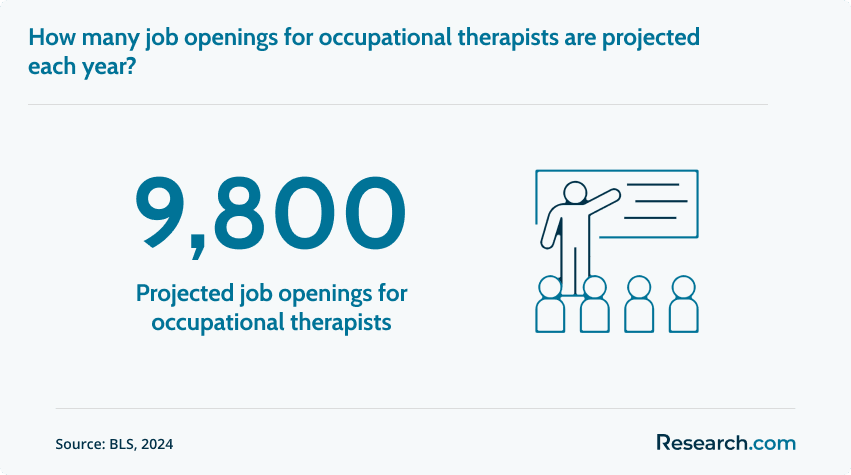
Occupational therapy also offers stability for many graduates. About 9,800 job openings are projected each year, and OTs can work in hospitals, schools, rehabilitation centers, home health, private practices, and long-term care environments. The career may be especially satisfying for students who want both clinical challenge and visible patient impact.
What Are the Licensing and Certification Requirements for Occupational Therapy?
Licensure is required to practice as an occupational therapist. While details vary by state, the standard pathway includes an accredited graduate OT degree, supervised fieldwork, the NBCOT exam, and state licensure. Students should confirm requirements in the state where they plan to work because renewal rules, continuing education expectations, and application procedures are not identical everywhere.
- Complete an accredited graduate OT program: Students must earn an occupational therapy degree that meets professional education standards.
- Finish required fieldwork: Supervised clinical education gives students hands-on experience with clients and care teams.
- Pass the NBCOT exam: The National Board for Certification in Occupational Therapy exam is a key step before licensure.
- Apply for state licensure: Applicants usually submit transcripts, exam results, fees, and any required background information.
- Maintain the license: Practicing OTs must meet renewal and continuing education requirements set by their state board.
Students considering doctoral-level clinical education in other fields may find it useful to compare motivations across professions. Research.com’s guide on why pursue a DNP explains how doctoral education can support advanced practice, leadership, and patient outcomes in nursing.
Should Occupational Therapists Consider Complementary Certifications?
Complementary certifications can be useful when they support a clear career goal, but they should not distract from the core requirements for OT licensure. A future or current OT might consider additional credentials in areas such as administration, billing, specialty practice, assistive technology, or leadership if those skills match their work setting.
For example, therapists who plan to manage a clinic, supervise documentation workflows, or understand reimbursement may benefit from administrative training. Research.com’s guide to medical billing and coding online schools can help readers understand one nonclinical skill area that may support healthcare operations. However, students should prioritize accredited OT education, fieldwork, the NBCOT exam, and state licensure first.
How to Choose the Right Pre-OT Major
The best major depends on your academic strengths, prerequisite plan, target OT programs, and backup options. A student who loves science may thrive in biology or neuroscience. A student drawn to children and families may prefer education or human development. A student who wants the broadest healthcare base may choose health science. What matters most is whether the major helps you complete prerequisites, maintain a competitive GPA, and gain meaningful exposure to occupational therapy.
| If your priority is... | Consider these majors | Be careful about... |
| Strong science preparation | Biology, neuroscience, exercise science, kinesiology | Protecting your GPA in rigorous science-heavy schedules. |
| Behavioral health or mental health OT | Psychology, sociology, human development and family studies | Making room for anatomy, physiology, and other science prerequisites. |
| School-based OT | Education, psychology, human development and family studies | Confirming that the program supports pre-health advising and OT prerequisites. |
| Rehabilitation-focused practice | Rehabilitation science, exercise science, kinesiology, occupational science | Checking whether the major is available at your institution and recognized by OT advisors. |
| Flexibility across healthcare careers | Health science, public health, biology | Avoiding a generic plan with no clinical experience or clear graduate-school strategy. |
Steps to choose wisely
- List OT programs you may apply to. Compare prerequisites before choosing your undergraduate major.
- Map courses semester by semester. Make sure anatomy, physiology, psychology, statistics, and other requirements fit without delaying graduation.
- Ask about observation or volunteer expectations. Some programs value documented exposure to OT settings.
- Check accreditation and licensure alignment. Do not assume a degree title automatically meets professional requirements.
- Compare total cost. Include undergraduate tuition, graduate tuition, fees, fieldwork expenses, and lost work time.
- Protect your GPA. A prestigious major is not helpful if it makes you less competitive for OT school.
- Keep a backup plan. Choose a major that also supports related healthcare, education, research, or community roles.
Common Mistakes Pre-OT Students Should Avoid
- Choosing a major based only on the title: “Health,” “therapy,” or “rehabilitation” in the name does not guarantee that all OT prerequisites are covered.
- Ignoring accreditation: Always verify that graduate OT programs meet professional standards required for licensure.
- Focusing only on tuition: Fees, fieldwork travel, books, housing, and lost wages can change the real cost.
- Assuming online courses always count: Some programs may have rules about online labs, prerequisites, or transfer credits.
- Waiting too long to get experience: Observation, volunteering, or work in rehabilitation and care settings can clarify whether OT is the right fit.
- Overlooking state licensure rules: Requirements can vary, so students should check the state where they want to practice.
- Assuming salary outcomes are guaranteed: Pay depends on location, setting, experience, specialty, and cost of living.
- Using rankings as the only decision tool: Program fit, cost, fieldwork quality, outcomes, and prerequisite alignment matter more than brand name alone.
Questions to Ask Before Choosing an Occupational Therapy Major or Program
- Does this major include the prerequisites required by my target OT programs?
- Will I have access to anatomy and physiology labs if they are required?
- Does the school offer pre-health or pre-OT advising?
- Can I complete observation hours, volunteering, or related work experience nearby?
- What is the total cost of the bachelor’s and graduate pathway?
- Are there accelerated BS/MS or BS/OTD options, and how competitive are they?
- What happens if I decide not to apply to OT school?
- Does the graduate program prepare students for the NBCOT exam and state licensure?
- Where are fieldwork placements located?
- How does the program support students during clinical training?
Graduate Perspectives on Occupational Therapy Majors
- Rebecca: "My OT preparation gave me the science background I needed, but the fieldwork is what made the profession real. Working with clients helped me understand how therapy can turn small daily gains into major independence."
- Jade: "I was surprised by how creative occupational therapy can be. The major taught me to look at tasks, tools, routines, and environments differently so people could participate more fully in everyday life."
- Luna: "The coursework was challenging, but it strengthened my patience and clinical reasoning. I chose OT because I wanted a career where problem-solving directly improves someone’s daily quality of life."
References and further reading:
- Barrows, K. (2024). School administrators: An occupational overview [Fact sheet]. Department for Professional Employees, AFL-CIO.
- National Center for Education Statistics. (2024). A majority of grade 9–12 public schools rate themselves favorably on preparing students for college. U.S. Department of Education.
- Taie, S., & Lewis, L. (2022, December). Characteristics of 2020–21 public and private K–12 school principals in the United States: Results from the National Teacher and Principal Survey (NCES 2022-112). U.S. Department of Education, National Center for Education Statistics.
- U.S. Bureau of Labor Statistics. (n.d.). Adult basic and secondary education and ESL teachers. U.S. Department of Labor. Retrieved [date], from
- Zippia. (n.d.). Occupational therapist jobs. Zippia.
Key Insights
- The best occupational therapy major is the one that completes OT prerequisites, protects your GPA, and builds relevant patient-care knowledge.
- Biology, psychology, health science, exercise science, occupational science, rehabilitation science, and neuroscience are among the strongest pre-OT options, but education, sociology, public health, human development, and liberal arts can also work with careful planning.
- A bachelor’s degree alone does not make you an occupational therapist. Most students need a graduate MOT or OTD program, fieldwork, the NBCOT exam, and state licensure.
- The traditional timeline is around 6–7 years, though some combined or accelerated programs may reduce it to about 5 years.
- Costs can be significant because students usually pay for both undergraduate and graduate education. Compare total program cost, not just tuition.
- Occupational therapy offers broad work settings, including hospitals, private therapy offices, schools, home health, and nursing care facilities.
- Salary varies by location. California, Alaska, Nevada, Hawaii, and Washington are listed among the highest-paying states, but cost of living matters.
- Before choosing a major, ask target OT programs about prerequisites, fieldwork, accreditation, transfer credits, licensure preparation, and student support.
Other Things You Should Know About Occupational Therapy Majors
In 2027, studying occupational therapy typically requires a bachelor's degree in a related field, completion of prerequisite coursework (such as anatomy, psychology, and kinesiology), and acceptance into a master's or doctoral program accredited by the Accreditation Council for Occupational Therapy Education (ACOTE).
In 2027, some of the best occupational therapy majors include programs at Boston University, University of Southern California, and Washington University in St. Louis. These programs stand out for their comprehensive curriculum, clinical training opportunities, and strong employment outcomes for graduates.